

Situating the default-mode network along a principal gradient of macroscale cortical organization
Open accessThe DOI matches its Crossref record; 100 of the 100 references it cites were found in a registry or an index; 26 of the 58 sources its claims cite were checked for support.
Abstract
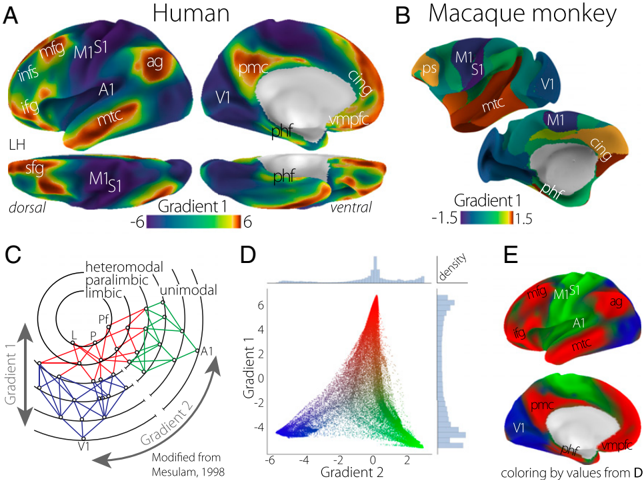
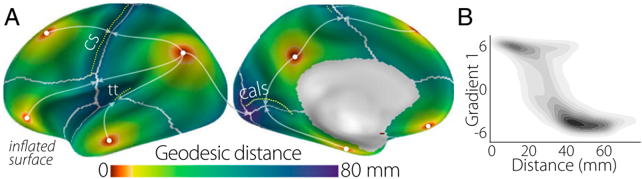
Understanding how the structure of cognition arises from the topographical organization of the cortex is a primary goal in neuroscience. Previous work has described local functional gradients extending from perceptual and motor regions to cortical areas representing more abstract functions, but an overarching framework for the association between structure and function is still lacking. Here, we show that the principal gradient revealed by the decomposition of connectivity data in humans and the macaque monkey is anchored by, at one end, regions serving primary sensory/motor functions and at the other end, transmodal regions that, in humans, are known as the default-mode network (DMN). These DMN regions exhibit the greatest geodesic distance along the cortical surface-and are precisely equidistant-from primary sensory/motor morphological landmarks. The principal gradient also provides an organizing spatial framework for multiple large-scale networks and characterizes a spectrum from unimodal to heteromodal activity in a functional metaanalysis. Together, these observations provide a characterization of the topographical organization of cortex and indicate that the role of the DMN in cognition might arise from its position at one extreme of a hierarchy, allowing it to process transmodal information that is unrelated to immediate sensory input.
Overview
CoChat Summary
TL;DR
The paper identifies a principal connectivity gradient in human and macaque cortex that runs from primary/unimodal sensory-motor regions to transmodal default-mode network (DMN) regions. It argues that the DMN’s position at one extreme, maximally distant from primary areas, helps explain its role in abstract, stimulus-independent cognition.
Key findings
- A principal gradient of functional connectivity, derived from 91,282 cortical/subcortical grayordinates at 2 mm resolution in 820 healthy adults (1 hour resting-state fMRI per participant, HCP S900), is anchored by primary/unimodal visual, somatosensory/motor, and auditory regions at one end and DMN regions at the other.
- Seven peak DMN nodes are maximally distant along the cortical surface from primary sensory/motor landmarks; four are equidistant from the central sulcus, and geodesic distance from DMN peaks relates to the principal gradient with \(R^2 = 0.55\). Beyond 40 mm from DMN peaks, cortex exclusively consists of unimodal regions.
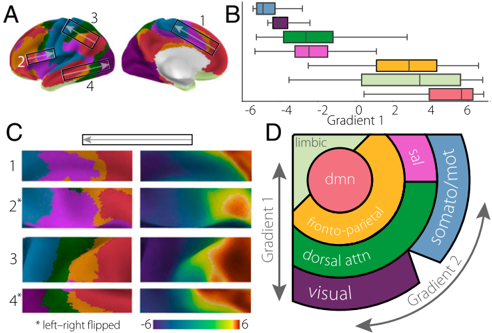
- The principal gradient orders the 7-network Yeo parcellation, with DMN at one extreme and visual/motor networks at the other; the limbic network is an exception, spanning a wide range of values.
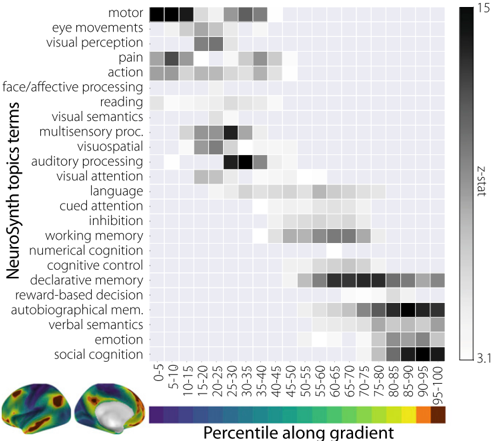
- A NeuroSynth meta-analysis using 24 topic terms shows a functional shift along the gradient: motor, visual perception, multisensory, and auditory terms at the unimodal end; cued attention, inhibition, and working memory in the middle; and social cognition, verbal semantics, and autobiographical memory at the DMN end.
Methods
- Human data were from the Human Connectome Project dense connectome S900 release: 91,282 grayordinates at 2 mm resolution, based on 1 hour of resting-state fMRI from 820 healthy adults, with no further processing beyond HCP minimal preprocessing including 2 mm FWHM smoothing.
- The main analysis used diffusion embedding, a nonlinear dimensionality reduction method, to extract connectivity gradients (“connectopies”) rather than discrete network parcellations; the same embedding was applied to a publicly available macaque tract-tracing database.
- Additional analyses calculated minimum geodesic distance from 7 DMN peak nodes, related gradient values to the 7-network Yeo parcellation, and performed a NeuroSynth meta-analysis with 24 topic terms across 5-percentile bins of the principal gradient.
Limitations
- Stated: the limbic network captures an extensive range of gradient values, which the authors suggest may be due to low signal-to-noise in the original parcellation data and may not accurately reflect its constituent regions’ connectivity.
- Stated: future studies are needed to better characterize transitions between large-scale connectivity patterns and to identify where processing occurs stepwise versus gradientially.
- Evident from the text: the macaque cross-species correspondence is described as “initial evidence” that the axis may be phylogenetically conserved, and the analyses are descriptive/spatial rather than causal tests of the proposed hierarchy.
Model-written summary. Check it against the paper before relying on it.
Integrity signals
Registry
Cites
Statistics
Figures

Verification
Claims the paper makes
14 Valid · 2 Not valid · 11 Not checked · 50 Own results and interpretations
The cited sources support only part of this claim — read each source’s verdict below.
In the paper
“Second, the location of the DMN as equidistant from all sensory/motor systems is aligned with its broad range of functions that require integration between multiple sensory systems, including episodic [51] and semantic memory [52-54], social cognition [55, 56], goal-directed working memory tasks [26, 32, 33, 35] and reward-guided decision making [57, 58].”
What the sources say
- Supportedcites [51] Schacter DL, Addis DR (2007) The cognitive neuroscience of constructive memory: remembering the past and imagining the future. Philos Trans R Soc Lond B Biol Sci 362(1481):773786. 661 662 663 source
Split into 2 atoms — 2 confirmed, 0 partially supported, 0 disputed, 0 misattributed, 0 unverifiable. Expand the claim to see per-atom verdicts.
- Supportedcites [52] Binder JR, Desai RH, Graves WW, Conant LL (2009) Where is the semantic system? a critical review and meta-analysis of 120 functional neuroimaging studies. Cereb Cortex 19(12):27672796. 664 665 source
The citation to this paper is attached to the semantic-memory part of the sentence, not the other listed functions. “Semantic Processing and the ‘Default Network’” says the semantic system closely resembles the default network, while “The Semantic System of the Human Brain” describes its regions as receiving multimodal input and supporting integrative processes. Page numbers are unavailable in our copy. (LLM, conf=0.91)
- Not checked — no full text of the sourcecites [53] Jefferies E (2013) The neural basis of semantic cognition: converging evidence from neuropsychology, neuroimaging and TMS. Cortex 49(3):611-625. 666 source
- Partly supportedcites [54] Constantinescu AO, O'Reilly JX, Behrens TEJ (2016) Organizing conceptual knowledge in humans with a gridlike code. Science 352(6292):1464-8. sourceExperimental — accuracy not yet measured
Split into 2 atoms — 1 confirmed, 1 partially supported, 0 disputed, 0 misattributed, 0 unverifiable. Expand the claim to see per-atom verdicts.
- Not checked — no full text of the sourcecites [55] Amodio DM, Frith CD (2006) Meeting of minds: the medial frontal cortex and social cognition. Nat Rev Neurosci 7(4):268-277. source
- Supportedcites [56] Amft M et al. (2015) Definition and characterization of an extended social-affective default network. Brain Struct Funct 220(2):1031-49. source
Split into 2 atoms — 2 confirmed, 0 partially supported, 0 disputed, 0 misattributed, 0 unverifiable. Expand the claim to see per-atom verdicts.
plainstates an association- Asserted: passes — The authors put it forward as true.
- Checkable: passes — It can be checked against evidence.
- Load-bearing: passes — The paper’s conclusions depend on it.
- Based: passes — The paper gives a reason why it holds.
- Supported
The cited sources support only part of this claim — read each source’s verdict below.
In the paper
“The DMN is at a maximal distance from systems involved in perception and action in both functional connectivity and anatomical space, indicating that the neural activity in these regions is likely to be comparably insulated from direct environmental input [49, 50].”
What the sources say
- Partly supportedcites [49] Kiebel SJ, Daunizeau J, Friston KJ (2008) A hierarchy of time-scales and the brain. PLoS Comput Biol 4(11):e1000209. 659 660 sourceExperimental — accuracy not yet measured
The Introduction and Discussion > Neuroscience Account describe higher cortical levels as farther from sensory input and as representing slower-changing context. But the paper does not identify the DMN as such a level or establish that activity in DMN regions is insulated from direct environmental input; its Conclusion says representations at different levels interact. (LLM, conf=0.78)
- Partly supportedcites [50] Friston K (2013) Life as we know it. J R Soc Interface 10(86):20130475. sourceExperimental — accuracy not yet measured
The Heuristic proof (page unavailable) says a Markov blanket insulates internal states from direct access to external states, and the Proof of principle > The Markov blanket section reports no direct connections between those states in a simulation. The paper does not identify DMN regions as those internal states or establish that DMN activity is insulated from environmental input. (LLM, conf=0.84)
hedged- Asserted: passes — The authors put it forward as true.
- Checkable: passes — It can be checked against evidence.
- Load-bearing: passes — The paper’s conclusions depend on it.
- Based: passes — The paper gives a reason why it holds.
- Partly supported
Every source the paper cites for this claim was checked and supports it.
In the paper
“The principal gradient illustrates a broader topographic organization of large-scale connectivity [38] that accounts for the spatial arrangement of local processing streams throughout the cerebral cortex.”
What the sources say
- Supportedcites [38] Jbabdi S, Sotiropoulos SN, Behrens TE (2013) The topographic connectome. Curr Opin Neurobiol 23(2):207-15. 643 644 source
The Introduction (page unavailable) describes topographic, spatial patterns in large-scale connections between grey-matter regions. The citation is attached to that broader organization of connectivity; the sentence’s interpretation of the principal gradient is the citing authors’ framing. (LLM, conf=0.87)
plainstates a cause- Asserted: passes — The authors put it forward as true.
- Checkable: passes — It can be checked against evidence.
- Load-bearing: passes — The paper’s conclusions depend on it.
- Based: passes — The paper gives a reason why it holds.
- Supported
The sources with a verdict support this claim; the rest weren’t checked yet, have no full text we could read, or their verdicts aren’t rated yet.
In the paper
“Notably, our results are consistent with a recent modification of the rostral-caudal processing gradient described within lateral frontal cortex [59, 60].”
What the sources say
- Supportedcites [59] Goulas A, Uylings HBM, Stiers P (2014) Mapping the hierarchical layout of the structural network of the macaque prefrontal cortex. Cereb Cortex 24(5):1178-94. 684 source
In the ABH Optimization section (page unavailable), the paper reports that the strict anterior–posterior gradient was not observed even when the analysis was limited to lateral prefrontal regions. In the Relation Between Asymmetry-Based Hierarchy and Laminar-Based Hierarchy section (page unavailable), it proposes a laminar-based hierarchy as a more plausible basis for models of that gradient. This supports the citation's identification of a modification; the citing authors' statement that their own results are consistent with it is their interpretation. (LLM, conf=0.86)
- Not checked — no full text of the sourcecites [60] Nee DE, D'Esposito M (2016) The hierarchical organization of the lateral prefrontal cortex. eLife 5. source
plainstates an association- Asserted: passes — The authors put it forward as true.
- Checkable: passes — It can be checked against evidence.
- Load-bearing: unclear — It is unclear whether the paper’s conclusions depend on it.
- Based: passes — The paper gives a reason why it holds.
- Supported
A result the paper reports from its own data — it cites no other source for it, so there is none to check. The quote shows it is in the paper.
In the paper
“Here we show that the principal gradient revealed by the decomposition of connectivity data in humans and the macaque monkey is anchored, at one end, by regions serving primary sensory/motor functions and, at the other, by transmodal regions that, in humans, are known as the default-mode network (DMN).”
- Also stated in: § Situating the default-mode network in a principal gradient of macroscale cortical organization · p. 2 · plain
“We describe an overarching organization of large-scale connectivity that situates the default-mode network at the opposite end of a spectrum from primary sensory and motor regions.”
- Also stated in: § Results · p. 3 · plain
“The principal gradient (Figure 1A), which accounts for the greatest variance in connectivity in the human brain (see Figure S1), is anchored at one end by the primary and unimodal visual, somatosensory/motor, and auditory regions. At the other end are regions including the angular gyrus, rostral anterior cingulate, posteromedial cortex, middle temporal gyrus, and middle and superior frontal gyri -”
boostedstates an association- Asserted: passes — The authors put it forward as true.
- Checkable: passes — It can be checked against evidence.
- Load-bearing: passes — The paper’s conclusions depend on it.
- Based: passes — The paper gives a reason why it holds.
- Also stated in: § Situating the default-mode network in a principal gradient of macroscale cortical organization · p. 2 · plain
33 more claims
Create a free account to see all 77 claims and every source verdict.
- The quote only partly states this claim. 1
- It may state two separate claims as one. 24
- Probably not a substantial claim. 21
Claims other papers make about this one
Each is checked against this paper’s own text: does it say what the citing paper says it does?
The cited source says what the claim attributes to it.
In the citing paper
“Because the DMN integrates information from multiple pathways (Binder and Desai 2011; Margulies et al. 2016), we propose that, as stimulus information travels up the cortical hierarchy of timescales during encoding, from low-level sensory areas up to high-level areas, a form of compression takes place (Hasson et al. 2015).”
From How We Transmit Memories to Other Brains: Constructing Shared Neural Representations Via Communication (2017) · cites this paper as Margulies et al. 2016
Citations
Cites
A Global Geometric Framework for Nonlinear Dimensionality Reduction
Tenenbaum, J. B., Silva, V. D., & Langford, J. C. (2000) · Science · doi:10.1126/science.290.5500.2319 · Cited by 13,585
Jenkinson, M., Bannister, P., Brady, M., & Smith, S. (2002) · NeuroImage · doi:10.1006/nimg.2002.1132 · Cited by 11,888
Jenkinson, M., Beckmann, C. F., Behrens, T. E. J., Woolrich, M. W., & Smith, S. M. (2012) · NeuroImage · doi:10.1016/j.neuroimage.2011.09.015 · Cited by 11,314
A tutorial on spectral clustering
von Luxburg, U. (2007) · Statistics and Computing · doi:10.1007/s11222-007-9033-z · Cited by 10,349
Fischl, B. (2012) · NeuroImage · doi:10.1016/j.neuroimage.2012.01.021 · Cited by 9,526
The organization of the human cerebral cortex estimated by intrinsic functional connectivity
Thomas Yeo, B. T., Krienen, F. M., Sepulcre, J., Sabuncu, M. R., Lashkari, D., Hollinshead, M., Roffman, J. L., Smoller, J. W., Zöllei, L., Polimeni, J. R., et al. (2011) · Journal of Neurophysiology · doi:10.1152/jn.00338.2011 · Cited by 9,182
The organization of the human cerebellum estimated by intrinsic functional connectivity
Buckner, R. L., Krienen, F. M., Castellanos, A., Diaz, J. C., & Yeo, B. T. T. (2011) · Journal of Neurophysiology · doi:10.1152/jn.00339.2011 · Cited by 7,304
Separate visual pathways for perception and action
Goodale, M. A., & Milner, A. D. (1992) · Trends in Neurosciences · doi:10.1016/0166-2236(92)90344-8 · Cited by 6,519
Functional connectivity in the resting brain: a network analysis of the default mode hypothesis
Greicius, M. D., Krasnow, B., Reiss, A. L., & Menon, V. (2003) · Proceedings of the National Academy of Sciences · doi:10.1073/pnas.0135058100 · Cited by 6,358
The WU-Minn Human Connectome Project: An overview
Van Essen, D. C., Smith, S. M., Barch, D. M., Behrens, T. E. J., Yacoub, E., & Ugurbil, K. (2013) · NeuroImage · doi:10.1016/j.neuroimage.2013.05.041 · Cited by 5,651
Research works printed but not linked: 2
- Von Bonin G, Bailey P (1947)
- Langs G, Golland P , Tie Y, Rigolo L, Golby AJ (2010) Functional geometry alignment and localization of brain areas. Adv. Neural Inf. Process. Syst. 1:1225-1233.
Cited by
Items 1,201–1,300 of 2,372
A computational mechanism of cue-stimulus integration for pain in the brain
Kim, J., Gim, S., Yoo, S. B. M., & Woo, C. (2024) · Science Advances · doi:10.1126/sciadv.ado8230 · Cited by 6
“Many previous findings identifying the cortical hierarchy were based on resting-state fMRI data ( 23 , 39 , 72 ), but some studies have shown that hierarchical structure can change under task conditions, such as during movie watching ( 40 ).”
InfluentialOkuno, T., Hata, J., Kawai, C., Okano, H., & Woodward, A. (2024) · Journal of Neuroscience · doi:10.1523/jneurosci.0389-24.2024 · Cited by 5
Vasilkovska, T., Verschuuren, M., Pustina, D., van den Berg, M., Audekerke, J. V., Pintelon, I., Cachope, R., Vos, W. H. D., der Linden, A. V., Adhikari, M. H., et al. (2024) · Clinical and Translational Medicine · doi:10.1002/ctm2.70055 · Cited by 6
“67 68–71 This gradient cortical hierarchy was also found in mice, with similarities observed in both functional and long-range axonal properties.”
BackgroundShevchenko, V., Benn, R. A., Scholz, R., Wei, W., Pallavicini, C., Klatzmann, U., Alberti, F., Satterthwaite, T. D., Wassermann, D., Bazin, P., et al. (2025) · Scientific Reports · doi:10.1038/s41598-024-84152-2 · Cited by 14
“Hong et al. 16 showed that PCA, when applied to thresholded connectivity matrices, yields more reliable gradients compared to the other dimensionality reduction techniques frequently featured in the gradient literature 12,39,40 .”
Self-citationGillig, A., Cremona, S., Zago, L., Mellet, E., de Schotten, M. T., Joliot, M., & Jobard, G. (2025) · Communications Biology · doi:10.1038/s42003-025-07671-2 · Cited by 9
“The meta-analytic decoding procedure 65,66 is illustrated in Fig.”
Kwon, M., Bo, K., Botvinik‐Nezer, R., Kragel, P. A., Oudenhove, L. V., Wager, T. D., Ashar, Y. K., Atlas, L. Y., Barrett, L. F., Becker, B., et al. (2026) · Nature Communications · doi:10.1038/s41467-026-71568-9 · Cited by 10
Hubs and interaction: the brain’s meta-loop
Weiller, C., Reisert, M., LeVan, P., Hosp, J. A., Coenen, V. A., & Rijntjes, M. (2025) · Cerebral Cortex · doi:10.1093/cercor/bhaf035 · Cited by 13
“…based on architecture at cellular, molecular, geometrical, and circuit levels and incorporating onto-and phylogenetic developments (Mesulam 1987; Park and Friston 2013; Margulies et al. 2016; Amunts et al. 2020; Luppi et al. 2022; Pang et al. 2023; Tucker and Luu 2023; Du et al. 2024).”
Zhang, X., Wang, X., Liu, Y., & Bao, J. (2025) · Sleep Medicine · doi:10.1016/j.sleep.2025.106514 · Cited by 9
Fast Möbius transform: An algebraic approach to information decomposition
Jansma, A., Mediano, P. A. M., & Rosas, F. E. (2025) · Physical Review Research · doi:10.1103/32sq-z2jf · Cited by 18
Mapping the microstructure of human cerebral cortex in vivo with diffusion MRI
Sadikov, A., Choi, H. L., Xiao, J., Cai, L. T., & Mukherjee, P. (2025) · Communications Biology · doi:10.1038/s42003-025-08523-9 · Cited by 13
Bridging glucose metabolism and intrinsic functional organization of the human cortex
Wan, B., Riedl, V., Castrillón, G., Kirschner, M., & Valk, S. L. (2026) · Communications Biology · doi:10.1038/s42003-026-09693-w · Cited by 9
“Based on the previous work 13 , we followed recommendations and set α = 0.5, a choice that retains the global relationsbetweendatapointsintheembeddedspaceandhasbeensuggested to be relatively robust to noise in the af fi nity matrix.”
InfluentialCulture, Self, and Agency: An Ecosocial View
Kirmayer, L. J., Gómez-Carrillo, A., Langlois‐Thérien, T., Ramstead, M. J. D., & Gold, I. (2020) · Cambridge University Press eBooks · doi:10.1017/9781108695374.012 · Cited by 7
Discrete spectral eigenmode-resonance network of brain dynamics and connectivity
Robinson, P. A. (2021) · Physical review. E · doi:10.1103/physreve.104.034411 · Cited by 6
Zhao, Y., Wang, M., Hu, K., Wang, Q., Lou, J., Fan, L., & Liu, B. (2022) · Cerebral Cortex · doi:10.1093/cercor/bhac340 · Cited by 6
Ding, K., Chen, Y., Bose, R., Osborn, L. E., Dragomir, A., & Thakor, N. V. (2022) · Scientific Reports · doi:10.1038/s41598-022-24368-2 · Cited by 8
Transcriptomics and magnetic resonance imaging in major psychiatric disorders
Fan, J.-W., Gu, Y.-W., Wang, D.-B., Liu, X., Zhao, S., Li, X., Li, B., Yin, H. J., Wu, W.-J., & Cui, L. (2023) · Frontiers in Psychiatry · doi:10.3389/fpsyt.2023.1185471 · Cited by 7
“The different functional modules are arranged on the axes defined by these functional connectivity gradients according to their macroscopic functional hierarchies (13, 14).”
BackgroundTemporal fingerprints of cortical gyrification in marmosets and humans
Wang, Q., Zhao, S., Liu, T., Han, J., & Liu, C. (2023) · Cerebral Cortex · doi:10.1093/cercor/bhad245 · Cited by 7
Diaschisis in the human brain reveals specificity of cerebrocerebellar connections
Guell, X., & Schmahmann, J. D. (2023) · The Journal of Comparative Neurology · doi:10.1002/cne.25534 · Cited by 6
“…cortex and is thus functionally analogous to the anterior lobe of the cerebellum, from the perspective of functional gradients of organization that progress from primary to multimodal association processing (Guell, Schmahmann, et al., 2018; Margulies et al., 2016; Mesulam, 1998).”
BackgroundReshaping Cortical Connectivity Gradient by Long-Term Cognitive Training During Development
Xu, T., Wu, Y., Zhang, Y., Zuo, X., Chen, F., & Zhou, C. (2022) · Neuroscience Bulletin · doi:10.1007/s12264-023-01108-8 · Cited by 6
“…coordinates using diffusion maps [12], a nonlinear manifold learning approach; such gradients could manifest the functional systems of the brain in a continuous way, in which the principal gradient in adults anchors primary sensory areas at one end and transmodal areas at the other end [2, 8].”
InfluentialFeature similarity gradients detect alterations in the neonatal cortex associated with preterm birth
Galdi, P., Blesa, M., Farrugia, C., Vaher, K., Williams, L. Z. J., Sullivan, G., Stoye, D. Q., Quigley, A. J., Makropoulos, A., Thrippleton, M. J., et al. (2024) · Human Brain Mapping · doi:10.1002/hbm.26660 · Cited by 5
“Studies based on functional connectivity have found a whole-brain gradient with primary sensory and motor regions at one end of the spectrum and multimodal association regions at the opposite end (Huntenburg et al., 2018; Margulies et al., 2016).”
BackgroundWang, Z., Diedrichsen, J., Saltoun, K., Steele, C. J., Anteraper, S. A., Yeo, B. T. T., Schmahmann, J. D., & Bzdok, D. (2024) · Journal of Neurophysiology · doi:10.1152/jn.00164.2024 · Cited by 12
Inter‐ and intra‐subject similarity in network functional connectivity across a full narrative movie
Mochalski, L. N., Friedrich, P., Li, X., Kröll, J., Eickhoff, S. B., & Weis, S. (2024) · Human Brain Mapping · doi:10.1002/hbm.26802 · Cited by 8
“…of brain regions in a network perspective (Igelström & Graziano, 2017), robustly assessing the neural basis of cognitive functions (Binder & Desai, 2011; Etkin et al., 2015; Gross, 2015; Margulies et al., 2016) and therefore laying the ground for further experimental work (Morawetz et al., 2017).”
BackgroundSelf-citationSchumacher, F. K., Steinborn, C., Weiller, C., Schelter, B. O., Reinhard, M., & Kaller, C. P. (2019) · Brain Structure and Function · doi:10.1007/s00429-019-01954-1 · Cited by 5
Plinio, S. D., & Ebisch, S. J. H. (2020) · European Journal of Neuroscience · doi:10.1111/ejn.14883 · Cited by 10
“This multimodality allows relating inter-individual differences in the brain architecture (at both subunit and subsystem levels) to the underlying behavioural and cognitive features (Bolt et al., 2020; Di Plinio & Ebisch, 2018; Eickhoff et al., 2018).”
BackgroundInfluentialRitual and Religion as Social Technologies of Cooperation
Kavanagh, C. M., Jong, J., & Whitehouse, H. (2020) · Cambridge University Press eBooks · doi:10.1017/9781108695374.016 · Cited by 10
Bayesian stroke modeling details sex biases in the white matter substrates of aphasia
Kernbach, J. M., Hartwigsen, G., Lim, J., Bae, H., Yu, K., Schlaug, G., Bonkhoff, A. K., Rost, N. S., & Bzdok, D. (2023) · Communications Biology · doi:10.1038/s42003-023-04733-1 · Cited by 8
“networks, are generally thought to occupy regions juxtaposed and interdigitated with the language network (Braga et al., 2020; Margulies et al., 2016; Thomas Yeo et al., 2011).”
BackgroundPredictability of cortico-cortical connections in the mammalian brain
Molnár, F., Horvát, S., Gomes, A. R. R., Armas, J. M., Molnár, B., Ercsey-Ravasz, M., Knoblauch, K., Kennedy, H., & Toroczkai, Z. (2024) · Network Neuroscience · doi:10.1162/netn_a_00345 · Cited by 8
“Although there is network variability between individuals (G ă m ă nu ţ et al., 2018; Markov et al., 2014), there are common features within and across species (Goulas et al., 2019; Horvát et al., 2016; Margulies et al., 2016; Markov et al., 2013b; Mota et al., 2019).”
BackgroundGuell, X., Schmahmann, J. D., & Gabrieli, J. D. E. (2018) · bioRxiv (Cold Spring Harbor Laboratory) · doi:10.1101/424176 · Cited by 10
“Analysis of resting-state data We calculated functional gradients in the cerebral cortex and in the cerebellum using diffusion map embedding (Coifman et al. 2005), a methodology previously used in cerebral cortical (Margulies et al. 2016) and cerebellar studies (Guell et al. 2018b).”
BackgroundMethodInfluentialLarivière, S., Weng, Y., de Wael, R. V., Frauscher, B., Wang, Z., Bernasconi, A., Bernasconi, N., Schrader, D. V., Zhang, Z., & Bernhardt, B. C. (2019) · bioRxiv (Cold Spring Harbor Laboratory) · doi:10.1101/756494 · Cited by 6
“2011) and connectome topographic profiling (Margulies et al. 2016) showed strongest effects in the default-mode network (pFDR<0.”
BackgroundAsymmetric Functional Gradients in the Human SubcortexPreprint
Guell, X., Schmahmann, J. D., Gabrieli, J. D. E., Ghosh, S., & Geddes, M. R. (2020) · bioRxiv (Cold Spring Harbor Laboratory) · doi:10.1101/2020.09.04.283820 · Cited by 8
“2005) that has unmasked fundamental properties of brain macro-scale organization in studies of cerebral cortex (Margulies et al. 2016) and cerebellum (Guell et al.”
BackgroundMethodInfluentialSelf-citationA network linking scene perception and spatial memory systems in posterior cerebral cortexPreprint
Steel, A., Billings, M. M., Silson, E. H., & Robertson, C. E. (2020) · bioRxiv (Cold Spring Harbor Laboratory) · doi:10.1101/2020.05.25.115147 · Cited by 20
Allostasis as a core feature of hierarchical gradients in the human brainPreprint
Katsumi, Y., Theriault, J. E., Quigley, K. S., et al. (2021) · doi:10.31234/osf.io/wezv8 · Cited by 6
Yang, Y., Zheng, Z., Liu, L., Zheng, H., Zhen, Y., Zheng, Y., Wang, X., & Tang, S. (2022) · bioRxiv (Cold Spring Harbor Laboratory) · doi:10.1101/2022.07.08.499148 · Cited by 6
Personalized Functional Brain Network Topography Predicts Individual Differences in Youth CognitionPreprint
Keller, A. S., Pines, A. R., Sydnor, V. J., Cui, Z., Bertolero, M. A., Barzilay, R., Alexander‐Bloch, A. F., Byington, N., Chen, A. A., Conan, G. M., et al. (2022) · bioRxiv (Cold Spring Harbor Laboratory) · doi:10.1101/2022.10.11.511823 · Cited by 6
Cortical microstructural gradients capture memory network reorganization in temporal lobe epilepsyPreprint
Royer, J., Larivière, S., Rodríguez‐Cruces, R., Cabalo, D. G., Tavakol, S., Auer, H., Park, B., Paquola, C., Smallwood, J., Jefferies, E., et al. (2022) · bioRxiv (Cold Spring Harbor Laboratory) · doi:10.1101/2022.10.31.513891 · Cited by 6
Self-citationSong, H., Shim, W. M., & Rosenberg, M. D. (2022) · bioRxiv (Cold Spring Harbor Laboratory) · doi:10.1101/2022.11.05.515307 · Cited by 6
Structured memory representations develop at multiple time scales in hippocampal-cortical networksPreprint
Tambini, A., Miller, J. A., Ehlert, L., Kiyonaga, A., & D’Esposito, M. (2023) · bioRxiv (Cold Spring Harbor Laboratory) · doi:10.1101/2023.04.06.535935 · Cited by 7
“, 2022) proposes that memory reorganization temporally progresses along the principal connectivity gradient (Huntenburg et al., 2018; Margulies et al., 2016), such that reactivation and reorganization first propagates from the hippocampus to transmodal default mode network (DMN) regions (which are most strongly connec…”
BackgroundBifurcation in space: Functional modularity and distributed cognition in the neocortexPreprint
Wang, X., Jiang, J., Zeraati, R., Battista, A., Vezoli, J., Kennedy, H., & Pereira, U. (2023) · bioRxiv (Cold Spring Harbor Laboratory) · doi:10.1101/2023.06.04.543639 · Cited by 8
Editorial: Lifespan Connectome Gradients for a Road to Mental Health
Zhou, Z.-X., & Zuo, X. (2023) · Journal of the American Academy of Child & Adolescent Psychiatry · doi:10.1016/j.jaac.2023.08.006 · Cited by 9
Wang, X., Krieger‐Redwood, K., Lyu, B., Lowndes, R., Wu, G., Souter, N. E., Wang, X., Kong, R., Shafiei, G., Bernhardt, B. C., et al. (2023) · bioRxiv (Cold Spring Harbor Laboratory) · doi:10.1101/2023.09.06.556465 · Cited by 5
Self-citationMoore, J. W., Wilson, S., Oldehinkel, M., Cordero‐Grande, L., Uus, A. U., Kyriakopoulou, V., Duff, E. P., O’Muircheartaigh, J., Rutherford, M., Andreae, L. C., et al. (2023) · doi:10.7554/elife.90536.1 · Cited by 6
Modelling low-dimensional interacting brain networks reveals organising principle in human cognitionPreprint
Perl, Y. S., Geli, S., Pérez-Ordoyo, E., et al. (2023) · bioRxiv (Cold Spring Harbor Laboratory) · doi:10.1101/2023.11.20.567824 · Cited by 6
The dominance of large-scale phase dynamics in human cortex, from delta to gamma
Alexander, D. M., & Dugué, L. (2026) · eLife · doi:10.7554/elife.100674 · Cited by 15
Current status and future challenges in brain imaging: Insights from leading experts
Hu, X., & Yan, C. (2024) · Medicine Plus · doi:10.1016/j.medp.2024.100049 · Cited by 9
Facca, M., Felice, A. D., & Bertoldo, A. (2024) · NeuroImage · doi:10.1016/j.neuroimage.2024.120902 · Cited by 10
“Secondly, we looked at the global correlation with the first gradient of functional connectivity computed using a diffusion map embedding approach 47,48 .”
Bu, S., Li, X., Pang, H., Zhao, M., Wang, J., Liu, Y., Hong-mei, Y., Jiang, Y., & Fan, G. (2025) · Journal of Neuroscience · doi:10.1523/jneurosci.1492-24.2024 · Cited by 9
Yao, C., Shan, Y., Cui, B., Chen, Z., Bi, S., Wang, T., Yan, S., & Lu, J. (2025) · The Cerebellum · doi:10.1007/s12311-025-01792-4 · Cited by 7
“Considering that the principal gradient is believed to encapsulate the most explained variance and has been extensively applied in previous studies, our primary focused was on the measures within the first gradient component [34, 39].”
Zheng, C., Zhao, W. D., Yang, Z., Guo, S., & Initiative, T. A. D. N. (2025) · Psychological Medicine · doi:10.1017/s0033291725000091 · Cited by 7
“Different gradients represent different axes of variance of brain network features, along which cortical regions are arranged in a spatial continuum (Huntenburg, Bazin, & Margulies, 2018; Margulies et al., 2016).”
InfluentialLin, C., Hsueh, H., Chiang, M., Hsieh, S., & Chao, C. (2025) · Pain · doi:10.1097/j.pain.0000000000003557 · Cited by 6
Kardan, O., Jones, N., Wheelock, M. D., Angstadt, M., Michael, C., Molloy, M. F., Tu, J. C., Cope, L. M., Martz, M. E., McCurry, K. L., et al. (2025) · Developmental Cognitive Neuroscience · doi:10.1016/j.dcn.2025.101543 · Cited by 9
“Another recently proposed connectomic measure for indexing cognitive maturation during adolescence is the degree of principality for primary-to-transmodal regions when decomposing the connectivity matrix (Margulies et al., 2016).”
Dopamine alters functional gradients in Parkinson’s disease
Orlando, I. F., Tan, J. B., Taylor, N. L., Medel, V., Wainstein, G., Lewis, S. J. G., Shine, J. M., & O’Callaghan, C. (2025) · Imaging Neuroscience · doi:10.1162/imag_a_00564 · Cited by 9
“The three gradients were labelled according to established conventions ( Bethlehem et al., 2020; Margulies et al., 2016; Vos de Wael et al., 2020): Gradient 1 (G1), anchored by a sensorimotor- to-association axis (the so-called ‘principal gradient’); Gradient 2 (G2) visual- to-somatomotor; and…”
InfluentialFunctional divergence between the two cerebral hemispheres contributes to human fluid intelligence
Liang, X., Luo, J., Bi, Q., Jiang, Y., Yang, L., Vatansever, D., Jefferies, E., & Gong, G. (2025) · Communications Biology · doi:10.1038/s42003-025-08151-3 · Cited by 11
“Furthermore, we conducted a topic term-based meta-analysis along the between-hemisphere functional distance map within 5-percentile bins for each hemisphere 38,42 .”
InfluentialSelf-citationTopography of cognition: Evolution of parallel distributed association networks in primates
Buckner, R. L. (2025) · Elsevier eBooks · doi:10.1016/b978-0-443-27380-3.00009-9 · Cited by 11
Bottenhorn, K. L., Corbett, J. D., Ahmadi, H., & Herting, M. M. (2025) · Journal of Neuroscience · doi:10.1523/jneurosci.1002-24.2025 · Cited by 12
Reduced cerebello-thalamo-cortical functional connectivity during traumatic memory retrieval in PTSD
Kearney, B. E., Densmore, M., Théberge, J., Jetly, R., McKinnon, M. C., Shaw, S. B., & Lanius, R. A. (2025) · Nature Mental Health · doi:10.1038/s44220-025-00476-6 · Cited by 11
“This diminished differentiation of functional networks furthers the point that large-scale connectivity gradients 81 may be altered in traumatic memory 6 .”
Chen, L., Sun, L., Sun, J., Wang, J., Zhang, D., Xia, M., & Wu, T. (2025) · EBioMedicine · doi:10.1016/j.ebiom.2025.105917 · Cited by 6
“7 This gradient pattern captures the neurodevelopmental trajectories underlying emotional, motor, and cognitive processes.”
InfluentialFragmentation and multithreading of experience in the default-mode network
Yazin, F., Majumdar, G., Bramley, N. R., & Hoffman, P. (2025) · Nature Communications · doi:10.1038/s41467-025-63522-y · Cited by 13
“These also form the anterior nodes of the Default-Mode Network (DMN), which is thought to process internal models of experience 12,13,16,18,36,37 .”
Gao, L., Zhang, T., Zhou, R., Zhang, T., & Guo, X. (2025) · NeuroImage · doi:10.1016/j.neuroimage.2025.121495 · Cited by 6
The role of the default mode network in aesthetic appeal
Vessel, E. A., & Ovadia, H. (2025) · Current Opinion in Behavioral Sciences · doi:10.1016/j.cobeha.2025.101608 · Cited by 9
Evidence for divergent cortical organisation in Parkinson’s disease and Lewy Body Dementia
Zarkali, A., Thomas, G. E. C., Hannaway, N., Dobreva, I., Grant‐Peters, M., Callaghan, M. F., Ryten, M., & Weil, R. S. (2025) · Nature Communications · doi:10.1038/s41467-025-66783-9 · Cited by 5
“We then applied diffusion map embedding, a non-linear dimensionality reductiontechnique 17,88 toidentifygradients(eigenvectors)ofthemainspatialaxes in inter-regional similarity of structural and functional connectivity.”
InfluentialTransBrain: a computational framework for translating brain-wide phenotypes between humans and mice
Huang, S., Zhang, T., Dong, C., Shi, Y., Peng, Y., Liu, X., Li, K., Cheng, L., Wang, Q., He, Y., et al. (2025) · Nature Methods · doi:10.1038/s41592-025-02961-3 · Cited by 11
“The fundamental architecture of brain function, particularly during resting states, has been extensively characterized in both humans and mice through multiple analytical frameworks, including connectivity gradients 36,37 , temporal CAPs 38,39 and functional networks 38,40 .”
Liu, B., Chen, C., Cai, P., Zhang, J., Yang, L., Chen, X., Ma, X., Jiang, X., Zhang, A., Song, L., et al. (2026) · Frontiers in Aging Neuroscience · doi:10.3389/fnagi.2025.1716076 · Cited by 10
Hierarchical maturation of structural brain connectomes from birth to childhood
Zhao, T., Ouyang, M., Shou, X., Zhang, S., Ju, J., Liao, X., Han, M., Sun, L., Wang, X., Xia, Y., et al. (2026) · Nature Communications · doi:10.1038/s41467-026-68704-w · Cited by 10
“Speci fi cally, the sensorimotor cortex relies on simple feedforward/feedback connections for transient local processing, whereasthe transmodalcortex relies on noncanonical parallel connections to support distributed information processing 51,60,62 .”
Geometry of neural dynamics along the cortical attractor landscape reflects changes in attention
Song, H., Chen, R., Botch, T. L., Braver, T. S., Rosenberg, M. D., Zacks, J. M., & Ching, S. (2026) · Nature Communications · doi:10.1038/s41467-026-69041-8 · Cited by 8
“…replicates many studies in human systems neuroscience that have revealed the existence of a low-dimensional manifold of macroscale neural activity 36,48 – 50 that is conserved across evolution 51,52 , stable across contexts 53,54 , and con-fi ned by structural architecture and genetic makeup of…”
InfluentialThe role of white matter myelin in structural-functional network coupling
Nelson, M. C., Lu, W. D., Leppert, I. R., Shafiei, G., Hansen, H. A., Rowley, C. D., Mišić, B., & Tardif, C. L. (2026) · Communications Biology · doi:10.1038/s42003-026-09813-6 · Cited by 8
Complexity organization of resting‐state functional‐ MRI networks
Treviño, G., Lee, J. J., Shimony, J. S., Luckett, P. H., & Leuthardt, E. C. (2024) · Human Brain Mapping · doi:10.1002/hbm.26809 · Cited by 8
“These findings align with a connectivity-based gradient in the brain's architecture proposed by Margulies et al. (2016).”
ResultZhang, Q., Zhang, A., Zhao, Z., Li, Q., Hu, Y., Huang, X., Sweeney, J. A., Kuang, W., 赵尤金, & Gong, Q. (2024) · Journal of Affective Disorders · doi:10.1016/j.jad.2024.11.003 · Cited by 7
Sohn, W., Di, X., Liang, Z., Zhang, Z., & Biswal, B. B. (2024) · Psychoradiology · doi:10.1093/psyrad/kkae021 · Cited by 11
Topographic Axes of Wiring Space Converge to Genetic Topography in Shaping the Human Cortical Layout
Li, D., Wang, Y., Ma, L., Wang, Y., Cheng, L., Liu, Y., Shi, W., Lu, Y., Wang, H., Gao, C., et al. (2025) · Journal of Neuroscience · doi:10.1523/jneurosci.1510-24.2024 · Cited by 6
Self-citationA multimodal characterization of low-dimensional thalamocortical structural connectivity patterns
John, A., Hettwer, M. D., Schaare, H. L., Saberi, A., Bayrak, Ş., Wan, B., Royer, J., Bernhardt, B. C., & Valk, S. L. (2025) · Communications Biology · doi:10.1038/s42003-025-07528-8 · Cited by 9
“Following recommendations based on previous work 38,41,107 , we set α to 0.5 as that will preserve large scale relations between data points in the embedded space and has been suggested to be relatively robust to noise.”
InfluentialZhang, Y., Wang, S., Lin, N., Fan, L., & Zong, C. (2025) · NeuroImage · doi:10.1016/j.neuroimage.2025.121096 · Cited by 12
“Additionally, the four main networks identified through modularity closely resemble the hierarchical structure observed in resting-state data (Margulies et al., 2016), effectively separating primary sensorimotor and transmodal regions, as well as distinct regions within the primary sensorimotor…”
Niu, L., Li, W., Bai, Y., Fang, K., Han, S., Liu, P., Qu, J., & Sun, X. (2025) · Scientific Reports · doi:10.1038/s41598-025-88203-0 · Cited by 7
“Moreover, Cai et al. identified abnormalities in task-induced modulation of connectivity within the VAN and the FPN in children with ADHD. highlighting that cingulo-frontal connectivity represented a common locus of impairment in cognitive control and clinical assessments of inattention symptoms 40 .”
InfluentialRoell, L., Wunderlich, S., Roell, D., Raabe, F. J., Wagner, E. M., Shi, Z., Schmitt, A., Falkai, P., Stoecklein, S., & Keeser, D. (2025) · NeuroImage · doi:10.1016/j.neuroimage.2025.121195 · Cited by 10
Can fMRI functional connectivity index dynamic neural communication and cognition?
Alonso, S., Llera, A., ter Horst, G., & Vidaurre, D. (2025) · Biological Psychology · doi:10.1016/j.biopsycho.2025.109074 · Cited by 7
Large-scale signal propagation modes in the human brain
Song, Y., Kim, P. S., Philip, B. A., & Kim, T. (2025) · NeuroImage · doi:10.1016/j.neuroimage.2025.121357 · Cited by 7
Jang, H., Fotiadis, P., Mashour, G. A., Hudetz, A. G., & Huang, Z. (2025) · Nature Communications · doi:10.1038/s41467-025-66832-3 · Cited by 12
“A promising approach to investigate the causal contribution of thalamic gradients to human consciousness, more speci fi cally conscious sensory perception, is to selectively modulate the activity of speci fi c thalamic subregions.”
The lifespan evolution of individualized neurophysiological traits
Castanheira, J. D. S., Wiesman, A. I., Taylor, M. J., & Baillet, S. (2025) · Cell Reports · doi:10.1016/j.celrep.2025.116657 · Cited by 7
Controlling the human connectome with spatially diffuse input signals
Betzel, R. F., Puxeddu, M. G., Seguin, C., Bazinet, V., Luppi, A. I., Podschun, A. N., Singleton, S. P., Faskowitz, J., Parakkattu, V., Mišić, B., et al. (2026) · Communications Biology · doi:10.1038/s42003-026-09560-8 · Cited by 5
“The annotations also included 10 maps of diffusion map embedding gradients of group-averaged FC ( fcgradient01 to fcgradient10 ) 67 , 5 maps of metabolic measures including cerebral blood fl ow ( cbf and cbfmean ) and volume ( cbv ), oxygen metabolism ( cmro2 ), and glucose metabolism ( cmrglu )…”
Kobbersmed, J. R., Gohil, C., Marquand, A. F., & Vidaurre, D. (2026) · Progress in Neurobiology · doi:10.1016/j.pneurobio.2026.102906 · Cited by 7
Cultural Priming Effects and the Human Brain
Han, S., & Northoff, G. (2020) · Cambridge University Press eBooks · doi:10.1017/9781108695374.011 · Cited by 7
Introduction: Co-constructing Culture, Mind, and Brain
Kirmayer, L. J., Worthman, C. M., & Kitayama, S. (2020) · Cambridge University Press eBooks · doi:10.1017/9781108695374.002 · Cited by 11
Frequency-Resolved Connectome Hubs and Their Test-Retest Reliability in the Resting Human Brain
Wang, L., Chen, X., Xu, Y., Cao, M., Liao, X., & He, Y. (2022) · Neuroscience Bulletin · doi:10.1007/s12264-021-00812-7 · Cited by 5
“These regions show the greatest geodesic distance from primary sensory or motor areas [51] and act as long-range hubs of information integration [6, 22, 52].”
BackgroundLee, D., & Park, H. (2022) · NeuroImage · doi:10.1016/j.neuroimage.2022.119167 · Cited by 7
A perturbative approach to study information communication in brain networks
Mohan, V. M., & Banerjee, A. (2022) · Network Neuroscience · doi:10.1162/netn_a_00260 · Cited by 6
“It is also interesting to note that the DMN, which is located at one extreme of the principal functional gradient (Margulies et al., 2016), neither exerts the greatest influence on the network, nor does it mediate information flow to the greatest degree.”
BackgroundLin, J., You, N. Y., Li, X., Huang, J., Lu, H., Hu, J., Zhang, J., & Lou, X. (2023) · Frontiers in Neuroscience · doi:10.3389/fnins.2023.1084270 · Cited by 5
“The brain function activity, including hearing sensory, strictly follows hierarchical principles for functional requirements, providing the basic framework for information exchange and processing across modalities (Margulies et al., 2016).”
BackgroundEstablishing brain states in neuroimaging data
Dezhina, Z., Smallwood, J., Xu, T., Turkheimer, F., Moran, R., Friston, K. J., Leech, R., & Fagerholm, E. D. (2023) · PLoS Computational Biology · doi:10.1371/journal.pcbi.1011571 · Cited by 7
Self-citationLiu, M., Zhang, J., Wang, Y., Zhou, Y., Xie, F. X., Guo, Q., Shi, F., Zhang, H., Wang, Q., & Shen, D. G. (2023) · iScience · doi:10.1016/j.isci.2023.108244 · Cited by 9
Hirsch, F., & Wohlschlaeger, A. M. (2023) · NeuroImage · doi:10.1016/j.neuroimage.2023.120417 · Cited by 6
“Each cortical parcel is assigned to one of the following seven RSNs (Yeo et al., 2011): Visual (Vis; n = 29), Somatomotor (SomMot; n = 35), Dorsal Attention (DorsAttn; n = 26), Salience/Ventral Attention (SalVentAttn; n = 22), Control (Cont; n = 30), Default ( n = 46), and Limbic ( n = 12).”
BackgroundMethodInfluentialThe molecular genetic landscape of human brain size variation
Seidlitz, J., Mallard, T. T., Vogel, J. W., Lee, Y. A., Warrier, V., Ball, G., Hansson, O., Hernandez, L. M., Mandal, A. S., Wagstyl, K., et al. (2023) · Cell Reports · doi:10.1016/j.celrep.2023.113439 · Cited by 6
Wong, Y.-S., & Yu, J. (2023) · Biological Psychology · doi:10.1016/j.biopsycho.2023.108726 · Cited by 7
Differences in structural connectome organization across sleep quality
Yang, Y., & Park, B. (2023) · Heliyon · doi:10.1016/j.heliyon.2023.e23138 · Cited by 5
“Indeed, the gradients estimated from functional connectivity observed biologically interpretable cortical axes of the sensory-to-transmodal (i.e., frontoparietal and default-mode networks) axis and motor-to-visual axis [17,19].”
BackgroundIndividual variability in functional connectivity of human auditory cortex
Luo, J., Qin, P., Bi, Q., Wu, K., & Gong, G. (2024) · Cerebral Cortex · doi:10.1093/cercor/bhae007 · Cited by 4
Namgung, J. Y., Park, Y., Park, Y., Kim, C. Y., & Park, B. (2024) · NeuroImage · doi:10.1016/j.neuroimage.2024.120590 · Cited by 6
What is abstract about seeing social interactions?
Papeo, L. (2024) · Trends in Cognitive Sciences · doi:10.1016/j.tics.2024.02.004 · Cited by 5
Prefrontal cortex drives the flexibility of whole-brain orchestration of cognition
Kringelbach, M. L., & Deco, G. (2024) · Current Opinion in Behavioral Sciences · doi:10.1016/j.cobeha.2024.101394 · Cited by 13
“In fact, a full understanding of the functioning of a complex system such as the brain can be shown to require the hierarchical integration of the underlying local parts into the whole [11,19,20].”
Fernandino, L., & Conant, L. L. (2023) · Neuropsychologia · doi:10.1016/j.neuropsychologia.2024.108939 · Cited by 9
“Collectively known as the “default mode network” (DMN), these areas have been shown to be the ones that are most distantly connected to primary sensory and motor areas, and they appear to integrate information across all modalities (Fernandino et al., 2016a; Fernandino et al., 2022; Margulies et al., 2016; Sepulcre et…”
BackgroundIntegrative role of attention networks in frequency-dependent modular organization of human brain
Neşe, H., Harı, E., Ay, U., Demıralp, T., & Ademoğlu, A. (2024) · Brain Structure and Function · doi:10.1007/s00429-024-02847-8 · Cited by 7
“Margulies et al. proposed an overarching organization of ICNs in which the default-mode network (DMN) is situated at the top of a representational hierarchy, while the intermediate zone is occupied by attention networks and the bottom range consists of sensory-motor networks (Margulies et al. 2016).”
Structure–function coupling in highly sampled individual brains
Rajesh, A., Seider, N. A., Newbold, D. J., Adeyemo, B., Marek, S. A., Greene, D. J., Snyder, A. Z., Shimony, J. S., Laumann, T. O., Dosenbach, N. U. F., et al. (2024) · Cerebral Cortex · doi:10.1093/cercor/bhae361 · Cited by 6
Structural lesions and transcriptomic specializations shape gradient perturbations in Wilson disease
Hu, S., Li, C., Wang, Y., Wei, T., Wang, X., Dong, T., Yang, Y., Ding, Y., Qiu, B., & Yang, W. (2024) · Brain Communications · doi:10.1093/braincomms/fcae329 · Cited by 5
“17,25 Specifically, the FC matrix was thresholded to retain the top 10% connections of each node, and the cosine similarity between each pair of nodes was computed.”
BackgroundMethodInfluentialPrediction of stroke severity: systematic evaluation of lesion representations
Bonkhoff, A. K., Cohen, A. L., Drew, W., Ferguson, M. A., Hussain, A., Lin, C., Schaper, F. L. W. V. J., Bourached, A., Giese, A., de Oliveira, L. C., et al. (2024) · Annals of Clinical and Translational Neurology · doi:10.1002/acn3.52215 · Cited by 8
Metadata
- Authors
- Margulies, D. S., Ghosh, S. S., Goulas, A., Falkiewicz, M., Huntenburg, J. M., Langs, G., Bezgin, G., Eickhoff, S. B., Castellanos, F. X., Petrides, M., Jefferies, E., & Smallwood, J.
- Affiliations
- Max Planck Institute for Human Cognitive and Brain Sciences (DE)
- Harvard University (US)
- University Medical Center Hamburg-Eppendorf (DE)
- MIT Computer Science and Artificial Intelligence Laboratory (US)
- Montreal Neurological Institute and Hospital (CA)
- Forschungszentrum Jülich (DE)
- Nathan Kline Institute for Psychiatric Research (US)
- University of York (GB)
- ORCID
- Venue
- Proceedings of the National Academy of Sciences
- Publisher
- National Academy of Sciences
- Published
- 2016-10-18
- Volume
- 113
- Issue
- 44
- Pages
- 12574-12579
- ISSN
- 0027-8424 (ISSN-L)
- 1091-6490
- PMC
- PMC5098630
- OpenAlex
- W2536956629
- Cited by
- 2,321
- References
- 96
- Citations by year
- 2026: 365 · 2025: 381 · 2024: 388 · 2023: 292 · 2022: 233 · 2021: 218 · 2020: 215 · 2019: 109 · 2018: 65 · 2017: 50 · 2016: 4
- FWCI
- 48.22
- Type
- journal article
- Language
- en
- Open access
- bronze
- doi.org
- Locations
- Proceedings of the National Academy of Sciences (publishedVersion)
- PubMed Central (publishedVersion)
- PubMed (publishedVersion)
- White Rose Research Online (University of Leeds, The University of Sheffield, University of York) (submittedVersion)
- DSpace@MIT (Massachusetts Institute of Technology) (submittedVersion, cc-by-nc)
- Funders
- EC | European Research Council (283530-SEMBIND, WANDERINGMINDS - 646927)
- John Templeton Foundation (Prospective Psychology Stage 2: A Research Competition)
- Gouvernement du Canada | Canadian Institutes of Health Research (FDN-143212)
- NIH (1R01EB020740-01A1, 1P41EB019936-01A1, 3R01MH092380-04S2, 1U01MH108168-01)
- Topics
- Life Sciences › Neuroscience › Cognitive Neuroscience › Functional Brain Connectivity Studies
- Health Sciences › Medicine › Radiology, Nuclear Medicine and Imaging › Advanced Neuroimaging Techniques and Applications
- Life Sciences › Neuroscience › Cognitive Neuroscience › Neural dynamics and brain function
- Keywords
- default mode network, cortical topography, geodesic distance, cortical connectivity, large-scale brain networks, structure-function relationship, macaque cortex, human cortex
- MeSH terms
- Animals, Brain, Brain Mapping, Humans, Macaca, Magnetic Resonance Imaging, Models, Neurological, Nerve Net, Sensation, Sensorimotor Cortex
About these checks
Registry, retraction, Cites and statistics results are computed, not judged, with one exception: a printed reference that no index lists is read once by a model before it counts as a citation error. Claims are extracted by a model and kept only when their quote appears verbatim in the text; each cited source is then checked, with a model’s help, for whether it says what the claim relies on. Those verdicts can be wrong — read the claim’s quote and the cited source before relying on one.
The claim verdicts this report counts are experimental: their accuracy is not yet measured.
A language model drew the claims from the paper on 2026-09-30, under version 3 of the claim definition (model deepseek-v4.1-flash, prompt extract-v3).
A second model labelled each claim on 2026-09-30 (model jev-1.13-20260917, definition revision gold-guideline-v0.2).
Cited sources are checked with a language model’s help (gpt-6-sol).
Statistics and arithmetic are recomputed, not judged.
Confidence bands are shown only for fields calibrated on our annotated test set. None is calibrated yet, so no band is shown.
What counts as a claim ›How we measure confidence ›How we check this ›
Are you an author, or do you see a problem with this page? Request a review
Data sources
Bibliographic data: Semantic Scholar, OpenAlex, Crossref.
Contains information from the Semantic Scholar Academic Graph Datasets, made available under the ODC Attribution License (ODC-BY 1.0).
Semantic Scholar’s data is described in: Kinney, R., et al. (2023). The Semantic Scholar Open Data Platform. arXiv:2301.10140.
