

Situating the default-mode network along a principal gradient of macroscale cortical organization
Open accessThe DOI matches its Crossref record; 100 of the 100 references it cites were found in a registry or an index; 26 of the 58 sources its claims cite were checked for support.
Abstract
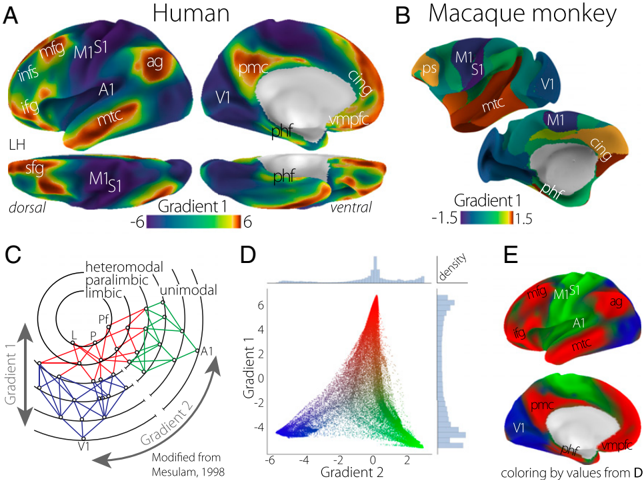
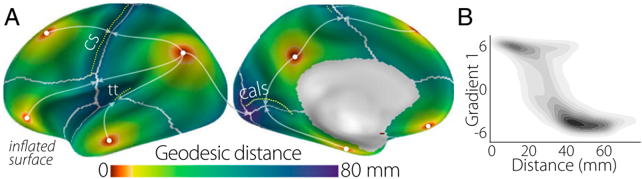
Understanding how the structure of cognition arises from the topographical organization of the cortex is a primary goal in neuroscience. Previous work has described local functional gradients extending from perceptual and motor regions to cortical areas representing more abstract functions, but an overarching framework for the association between structure and function is still lacking. Here, we show that the principal gradient revealed by the decomposition of connectivity data in humans and the macaque monkey is anchored by, at one end, regions serving primary sensory/motor functions and at the other end, transmodal regions that, in humans, are known as the default-mode network (DMN). These DMN regions exhibit the greatest geodesic distance along the cortical surface-and are precisely equidistant-from primary sensory/motor morphological landmarks. The principal gradient also provides an organizing spatial framework for multiple large-scale networks and characterizes a spectrum from unimodal to heteromodal activity in a functional metaanalysis. Together, these observations provide a characterization of the topographical organization of cortex and indicate that the role of the DMN in cognition might arise from its position at one extreme of a hierarchy, allowing it to process transmodal information that is unrelated to immediate sensory input.
Overview
CoChat Summary
TL;DR
The paper identifies a principal connectivity gradient in human and macaque cortex that runs from primary/unimodal sensory-motor regions to transmodal default-mode network (DMN) regions. It argues that the DMN’s position at one extreme, maximally distant from primary areas, helps explain its role in abstract, stimulus-independent cognition.
Key findings
- A principal gradient of functional connectivity, derived from 91,282 cortical/subcortical grayordinates at 2 mm resolution in 820 healthy adults (1 hour resting-state fMRI per participant, HCP S900), is anchored by primary/unimodal visual, somatosensory/motor, and auditory regions at one end and DMN regions at the other.
- Seven peak DMN nodes are maximally distant along the cortical surface from primary sensory/motor landmarks; four are equidistant from the central sulcus, and geodesic distance from DMN peaks relates to the principal gradient with \(R^2 = 0.55\). Beyond 40 mm from DMN peaks, cortex exclusively consists of unimodal regions.
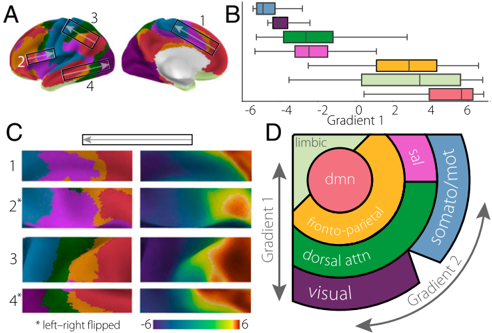
- The principal gradient orders the 7-network Yeo parcellation, with DMN at one extreme and visual/motor networks at the other; the limbic network is an exception, spanning a wide range of values.
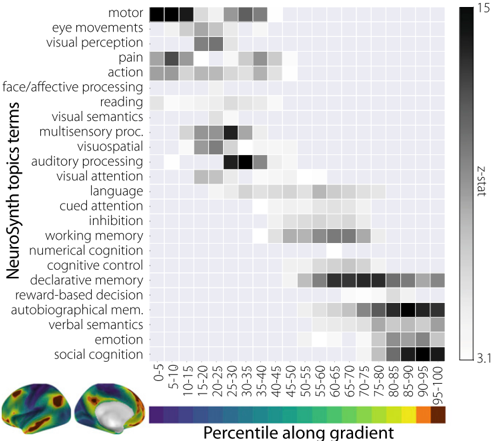
- A NeuroSynth meta-analysis using 24 topic terms shows a functional shift along the gradient: motor, visual perception, multisensory, and auditory terms at the unimodal end; cued attention, inhibition, and working memory in the middle; and social cognition, verbal semantics, and autobiographical memory at the DMN end.
Methods
- Human data were from the Human Connectome Project dense connectome S900 release: 91,282 grayordinates at 2 mm resolution, based on 1 hour of resting-state fMRI from 820 healthy adults, with no further processing beyond HCP minimal preprocessing including 2 mm FWHM smoothing.
- The main analysis used diffusion embedding, a nonlinear dimensionality reduction method, to extract connectivity gradients (“connectopies”) rather than discrete network parcellations; the same embedding was applied to a publicly available macaque tract-tracing database.
- Additional analyses calculated minimum geodesic distance from 7 DMN peak nodes, related gradient values to the 7-network Yeo parcellation, and performed a NeuroSynth meta-analysis with 24 topic terms across 5-percentile bins of the principal gradient.
Limitations
- Stated: the limbic network captures an extensive range of gradient values, which the authors suggest may be due to low signal-to-noise in the original parcellation data and may not accurately reflect its constituent regions’ connectivity.
- Stated: future studies are needed to better characterize transitions between large-scale connectivity patterns and to identify where processing occurs stepwise versus gradientially.
- Evident from the text: the macaque cross-species correspondence is described as “initial evidence” that the axis may be phylogenetically conserved, and the analyses are descriptive/spatial rather than causal tests of the proposed hierarchy.
Model-written summary. Check it against the paper before relying on it.
Integrity signals
Registry
Cites
Statistics
Figures

Verification
Claims the paper makes
14 Valid · 2 Not valid · 11 Not checked · 50 Own results and interpretations
The cited sources support only part of this claim — read each source’s verdict below.
In the paper
“Second, the location of the DMN as equidistant from all sensory/motor systems is aligned with its broad range of functions that require integration between multiple sensory systems, including episodic [51] and semantic memory [52-54], social cognition [55, 56], goal-directed working memory tasks [26, 32, 33, 35] and reward-guided decision making [57, 58].”
What the sources say
- Supportedcites [51] Schacter DL, Addis DR (2007) The cognitive neuroscience of constructive memory: remembering the past and imagining the future. Philos Trans R Soc Lond B Biol Sci 362(1481):773786. 661 662 663 source
Split into 2 atoms — 2 confirmed, 0 partially supported, 0 disputed, 0 misattributed, 0 unverifiable. Expand the claim to see per-atom verdicts.
- Supportedcites [52] Binder JR, Desai RH, Graves WW, Conant LL (2009) Where is the semantic system? a critical review and meta-analysis of 120 functional neuroimaging studies. Cereb Cortex 19(12):27672796. 664 665 source
The citation to this paper is attached to the semantic-memory part of the sentence, not the other listed functions. “Semantic Processing and the ‘Default Network’” says the semantic system closely resembles the default network, while “The Semantic System of the Human Brain” describes its regions as receiving multimodal input and supporting integrative processes. Page numbers are unavailable in our copy. (LLM, conf=0.91)
- Not checked — no full text of the sourcecites [53] Jefferies E (2013) The neural basis of semantic cognition: converging evidence from neuropsychology, neuroimaging and TMS. Cortex 49(3):611-625. 666 source
- Partly supportedcites [54] Constantinescu AO, O'Reilly JX, Behrens TEJ (2016) Organizing conceptual knowledge in humans with a gridlike code. Science 352(6292):1464-8. sourceExperimental — accuracy not yet measured
Split into 2 atoms — 1 confirmed, 1 partially supported, 0 disputed, 0 misattributed, 0 unverifiable. Expand the claim to see per-atom verdicts.
- Not checked — no full text of the sourcecites [55] Amodio DM, Frith CD (2006) Meeting of minds: the medial frontal cortex and social cognition. Nat Rev Neurosci 7(4):268-277. source
- Supportedcites [56] Amft M et al. (2015) Definition and characterization of an extended social-affective default network. Brain Struct Funct 220(2):1031-49. source
Split into 2 atoms — 2 confirmed, 0 partially supported, 0 disputed, 0 misattributed, 0 unverifiable. Expand the claim to see per-atom verdicts.
plainstates an association- Asserted: passes — The authors put it forward as true.
- Checkable: passes — It can be checked against evidence.
- Load-bearing: passes — The paper’s conclusions depend on it.
- Based: passes — The paper gives a reason why it holds.
- Supported
The cited sources support only part of this claim — read each source’s verdict below.
In the paper
“The DMN is at a maximal distance from systems involved in perception and action in both functional connectivity and anatomical space, indicating that the neural activity in these regions is likely to be comparably insulated from direct environmental input [49, 50].”
What the sources say
- Partly supportedcites [49] Kiebel SJ, Daunizeau J, Friston KJ (2008) A hierarchy of time-scales and the brain. PLoS Comput Biol 4(11):e1000209. 659 660 sourceExperimental — accuracy not yet measured
The Introduction and Discussion > Neuroscience Account describe higher cortical levels as farther from sensory input and as representing slower-changing context. But the paper does not identify the DMN as such a level or establish that activity in DMN regions is insulated from direct environmental input; its Conclusion says representations at different levels interact. (LLM, conf=0.78)
- Partly supportedcites [50] Friston K (2013) Life as we know it. J R Soc Interface 10(86):20130475. sourceExperimental — accuracy not yet measured
The Heuristic proof (page unavailable) says a Markov blanket insulates internal states from direct access to external states, and the Proof of principle > The Markov blanket section reports no direct connections between those states in a simulation. The paper does not identify DMN regions as those internal states or establish that DMN activity is insulated from environmental input. (LLM, conf=0.84)
hedged- Asserted: passes — The authors put it forward as true.
- Checkable: passes — It can be checked against evidence.
- Load-bearing: passes — The paper’s conclusions depend on it.
- Based: passes — The paper gives a reason why it holds.
- Partly supported
Every source the paper cites for this claim was checked and supports it.
In the paper
“The principal gradient illustrates a broader topographic organization of large-scale connectivity [38] that accounts for the spatial arrangement of local processing streams throughout the cerebral cortex.”
What the sources say
- Supportedcites [38] Jbabdi S, Sotiropoulos SN, Behrens TE (2013) The topographic connectome. Curr Opin Neurobiol 23(2):207-15. 643 644 source
The Introduction (page unavailable) describes topographic, spatial patterns in large-scale connections between grey-matter regions. The citation is attached to that broader organization of connectivity; the sentence’s interpretation of the principal gradient is the citing authors’ framing. (LLM, conf=0.87)
plainstates a cause- Asserted: passes — The authors put it forward as true.
- Checkable: passes — It can be checked against evidence.
- Load-bearing: passes — The paper’s conclusions depend on it.
- Based: passes — The paper gives a reason why it holds.
- Supported
The sources with a verdict support this claim; the rest weren’t checked yet, have no full text we could read, or their verdicts aren’t rated yet.
In the paper
“Notably, our results are consistent with a recent modification of the rostral-caudal processing gradient described within lateral frontal cortex [59, 60].”
What the sources say
- Supportedcites [59] Goulas A, Uylings HBM, Stiers P (2014) Mapping the hierarchical layout of the structural network of the macaque prefrontal cortex. Cereb Cortex 24(5):1178-94. 684 source
In the ABH Optimization section (page unavailable), the paper reports that the strict anterior–posterior gradient was not observed even when the analysis was limited to lateral prefrontal regions. In the Relation Between Asymmetry-Based Hierarchy and Laminar-Based Hierarchy section (page unavailable), it proposes a laminar-based hierarchy as a more plausible basis for models of that gradient. This supports the citation's identification of a modification; the citing authors' statement that their own results are consistent with it is their interpretation. (LLM, conf=0.86)
- Not checked — no full text of the sourcecites [60] Nee DE, D'Esposito M (2016) The hierarchical organization of the lateral prefrontal cortex. eLife 5. source
plainstates an association- Asserted: passes — The authors put it forward as true.
- Checkable: passes — It can be checked against evidence.
- Load-bearing: unclear — It is unclear whether the paper’s conclusions depend on it.
- Based: passes — The paper gives a reason why it holds.
- Supported
A result the paper reports from its own data — it cites no other source for it, so there is none to check. The quote shows it is in the paper.
In the paper
“Here we show that the principal gradient revealed by the decomposition of connectivity data in humans and the macaque monkey is anchored, at one end, by regions serving primary sensory/motor functions and, at the other, by transmodal regions that, in humans, are known as the default-mode network (DMN).”
- Also stated in: § Situating the default-mode network in a principal gradient of macroscale cortical organization · p. 2 · plain
“We describe an overarching organization of large-scale connectivity that situates the default-mode network at the opposite end of a spectrum from primary sensory and motor regions.”
- Also stated in: § Results · p. 3 · plain
“The principal gradient (Figure 1A), which accounts for the greatest variance in connectivity in the human brain (see Figure S1), is anchored at one end by the primary and unimodal visual, somatosensory/motor, and auditory regions. At the other end are regions including the angular gyrus, rostral anterior cingulate, posteromedial cortex, middle temporal gyrus, and middle and superior frontal gyri -”
boostedstates an association- Asserted: passes — The authors put it forward as true.
- Checkable: passes — It can be checked against evidence.
- Load-bearing: passes — The paper’s conclusions depend on it.
- Based: passes — The paper gives a reason why it holds.
- Also stated in: § Situating the default-mode network in a principal gradient of macroscale cortical organization · p. 2 · plain
33 more claims
Create a free account to see all 77 claims and every source verdict.
- The quote only partly states this claim. 1
- It may state two separate claims as one. 24
- Probably not a substantial claim. 21
Claims other papers make about this one
Each is checked against this paper’s own text: does it say what the citing paper says it does?
The cited source says what the claim attributes to it.
In the citing paper
“Because the DMN integrates information from multiple pathways (Binder and Desai 2011; Margulies et al. 2016), we propose that, as stimulus information travels up the cortical hierarchy of timescales during encoding, from low-level sensory areas up to high-level areas, a form of compression takes place (Hasson et al. 2015).”
From How We Transmit Memories to Other Brains: Constructing Shared Neural Representations Via Communication (2017) · cites this paper as Margulies et al. 2016
Citations
Cites
A Global Geometric Framework for Nonlinear Dimensionality Reduction
Tenenbaum, J. B., Silva, V. D., & Langford, J. C. (2000) · Science · doi:10.1126/science.290.5500.2319 · Cited by 13,585
Jenkinson, M., Bannister, P., Brady, M., & Smith, S. (2002) · NeuroImage · doi:10.1006/nimg.2002.1132 · Cited by 11,888
Jenkinson, M., Beckmann, C. F., Behrens, T. E. J., Woolrich, M. W., & Smith, S. M. (2012) · NeuroImage · doi:10.1016/j.neuroimage.2011.09.015 · Cited by 11,314
A tutorial on spectral clustering
von Luxburg, U. (2007) · Statistics and Computing · doi:10.1007/s11222-007-9033-z · Cited by 10,349
Fischl, B. (2012) · NeuroImage · doi:10.1016/j.neuroimage.2012.01.021 · Cited by 9,526
The organization of the human cerebral cortex estimated by intrinsic functional connectivity
Thomas Yeo, B. T., Krienen, F. M., Sepulcre, J., Sabuncu, M. R., Lashkari, D., Hollinshead, M., Roffman, J. L., Smoller, J. W., Zöllei, L., Polimeni, J. R., et al. (2011) · Journal of Neurophysiology · doi:10.1152/jn.00338.2011 · Cited by 9,182
The organization of the human cerebellum estimated by intrinsic functional connectivity
Buckner, R. L., Krienen, F. M., Castellanos, A., Diaz, J. C., & Yeo, B. T. T. (2011) · Journal of Neurophysiology · doi:10.1152/jn.00339.2011 · Cited by 7,304
Separate visual pathways for perception and action
Goodale, M. A., & Milner, A. D. (1992) · Trends in Neurosciences · doi:10.1016/0166-2236(92)90344-8 · Cited by 6,519
Functional connectivity in the resting brain: a network analysis of the default mode hypothesis
Greicius, M. D., Krasnow, B., Reiss, A. L., & Menon, V. (2003) · Proceedings of the National Academy of Sciences · doi:10.1073/pnas.0135058100 · Cited by 6,358
The WU-Minn Human Connectome Project: An overview
Van Essen, D. C., Smith, S. M., Barch, D. M., Behrens, T. E. J., Yacoub, E., & Ugurbil, K. (2013) · NeuroImage · doi:10.1016/j.neuroimage.2013.05.041 · Cited by 5,651
Research works printed but not linked: 2
- Von Bonin G, Bailey P (1947)
- Langs G, Golland P , Tie Y, Rigolo L, Golby AJ (2010) Functional geometry alignment and localization of brain areas. Adv. Neural Inf. Process. Syst. 1:1225-1233.
Cited by
Items 1,101–1,200 of 2,372
Human Fronto-Striatal Connectivity is Organized into Discrete Functional SubnetworksPreprint
Gordon, E. M., Laumann, T. O., Marek, S. A., Newbold, D. J., Hampton, J. M., Seider, N. A., Montez, D. F., Nielsen, A. M., Van, A. N., Zheng, A., et al. (2021) · bioRxiv (Cold Spring Harbor Laboratory) · doi:10.1101/2021.04.12.439415 · Cited by 8
Kuhnke, P., Chapman, C. A., Cheung, V. K. M., Turker, S., Graessner, A., Martin, S., Williams, K. A., & Hartwigsen, G. (2021) · bioRxiv (Cold Spring Harbor Laboratory) · doi:10.1101/2021.12.21.473704 · Cited by 8
What might interoceptive inference reveal about consciousness?Preprint
Nikolova, N. E., Waade, P. T., Friston, K. J., et al. (2021) · doi:10.31234/osf.io/9vxdg · Cited by 8
Intrinsic Activity Develops Along a Sensorimotor-Association Cortical Axis in YouthPreprint
Sydnor, V. J., Larsen, B., Seidlitz, J., Adebimpe, A., Alexander‐Bloch, A. F., Bassett, D. S., Bertolero, M. A., Cieslak, M., Covitz, S. C., Yong Fan, A., et al. (2022) · bioRxiv (Cold Spring Harbor Laboratory) · doi:10.1101/2022.08.15.503994 · Cited by 8
Luo, A. C., Sydnor, V. J., Pines, A. R., Larsen, B., Alexander‐Bloch, A. F., Cieslak, M., Covitz, S. C., Chen, A. A., Esper, N. B., Feczko, E., et al. (2023) · bioRxiv (Cold Spring Harbor Laboratory) · doi:10.1101/2023.07.20.549090 · Cited by 8
Structurally informed resting-state effective connectivity recapitulates cortical hierarchyPreprint
Greaves, M. D., Novelli, L., & Razi, A. (2024) · bioRxiv (Cold Spring Harbor Laboratory) · doi:10.1101/2024.04.03.587831 · Cited by 11
“…the model’s biological plausibility and relevance, we explore inter-network differences in the coupling between structural and effective connectivity and show that these differences align with an established cortical hierarchy as quantified by the principal gradient of functional connectivity (11).”
InfluentialAtypical cortical hierarchy in Aβ-positive older adults and its reflection in spontaneous speech
He, R., Al‐Tamimi, J., Sánchez‐Benavides, G., Montaña-Valverde, G., Gispert, J. D., Grau‐Rivera, O., Suárez‐Calvet, M., Minguillón, C., Fauria, K., Navarro, A., et al. (2024) · Brain Research · doi:10.1016/j.brainres.2024.148806 · Cited by 8
“Recent studies have specifically measured the cortical hierarchy using functional connectome gradients, defined as large-scale components of FC obtained with dimension reduction techniques (Huntenburg et al., 2018; Margulies et al., 2016).”
BackgroundMethodSynaptic signaling modeled by functional connectivity predicts metabolic demands of the human brain
Klug, S., Murgaš, M., Godbersen, G. M., Hacker, M., Lanzenberger, R. R., & Hahn, A. (2024) · NeuroImage · doi:10.1016/j.neuroimage.2024.120658 · Cited by 10
Sisterhood predicts similar neural processing of a film
Bacha‐Trams, M., Yorulmaz, G. E., Glerean, E., Ryyppö, E., Tapani, K., Virmavirta, E., Saaristo, J., Jääskeläinen, I. P., & Sams, M. E. (2024) · NeuroImage · doi:10.1016/j.neuroimage.2024.120712 · Cited by 7
“…finding is not only in line with we know from other connectivity studies, with the default network being the core network between other subnetworks (Margulies et al., 2016), but further supports our findings in the ISC analysis: as the DNM has an essential role in multiple social interaction…”
ResultGell, M., Langner, R., Küppers, V., Cieslik, E. C., Satterthwaite, T. D., Eickhoff, S. B., & Müller, V. I. (2024) · Imaging Neuroscience · doi:10.1162/imag_a_00295 · Cited by 8
“This technique was recently used to determine spatial variation in both node-to-node (Margulies et al., 2016) and seed-to-voxel (J. Zhang et al., 2019) connectivity, as well as structural characteristics such as microstructure (Paquola et al., 2019) across the cortex.”
MethodSelf-citationLi, B., Xu, X., Wu, Y., Miao, X.-Q., Feng, Y., Chen, Y., Salvi, R., Xǔ, J., & Qi, J. (2024) · Brain Communications · doi:10.1093/braincomms/fcae317 · Cited by 7
“22 This functional connectivity gradient aligns with previous micro-structural cortical gradients, suggesting a close relationship between macroscopic connectome gradients and local micro-structural gradients, indicating that cortical functional connectivity has spatial and hierarchical structures.”
BackgroundYao, G., Luo, J., Li, J., Feng, K., Liu, P., & Xu, Y. J. (2024) · Psychological Medicine · doi:10.1017/s0033291724001739 · Cited by 14
“Subsequently, the diffusion map embedding techniques were used for determining the connectome gradient (Margulies et al., 2016).”
Perinatal development of structural thalamocortical connectivity
Oldham, S., Sina Mansour, L., & Ball, G. (2025) · Imaging Neuroscience · doi:10.1162/imag_a_00418 · Cited by 13
Sleep-stage dependent patterning of slowly propagating brain activity
Liu, X., Picchioni, D., Yang, Y., Mandelkow, H., de Zwart, J. A., Duyn, J. H., & Liu, X. (2025) · npj Biological Timing and Sleep · doi:10.1038/s44323-024-00017-x · Cited by 7
“…voxels were grouped into 70 position bins (regions) of equal size (with an equal number of gray-matter voxels) along a principal gradient (PG) direction 4 , which was derived in a previous study by using a low-dimensional embedding method on a mean connectivity matrix from 820 subjects 35 .”
Low-dimensional controllability of brain networks
Messaoud, R. B., Du, V. L., Bousfiha, C., Corsi, M., Gonzalez-Astudillo, J., Kaufmann, B. C., Venot, T., Couvy‐Duchesne, B., Migliaccio, R., Rosso, C., et al. (2025) · PLoS Computational Biology · doi:10.1371/journal.pcbi.1012691 · Cited by 10
“…systems as controlling drivers and that of associative systems as controlled targets, match previous results obtained with network communication models of brain cognition 72 and align with theories postulating that the brain topography is organized along spatial and functional gradients 73,74 .”
Distinguishing Neural Correlates of Prediction Errors on Perceptual Content and Detection of Content
Dijkstra, N., Warrington, O., Kok, P., & Fleming, S. M. (2025) · Journal of Cognitive Neuroscience · doi:10.1162/jocn_a_02290 · Cited by 14
Stimulus Selection Influences Prediction of Individual Phenotypes in Naturalistic Conditions
Li, X., Eickhoff, S. B., & Weis, S. (2025) · Human Brain Mapping · doi:10.1002/hbm.70164 · Cited by 6
“Moreover, the hierarchy in inter-subject variability of brain activity we observed in this present study aligns well with the sensory- to-association gradient axis, which has been thought to constitute a fundamental principle of cortical functional organisation (Margulies et al. 2016).”
Self-citationReshaped functional connectivity gradients in acute ischemic stroke
Koba, C., Falcó-Roget, J., & Crimi, A. (2025) · NeuroImage Clinical · doi:10.1016/j.nicl.2025.103755 · Cited by 11
Shen, C., Liu, C., Chen, N., & Qiu, A. (2025) · NeuroImage · doi:10.1016/j.neuroimage.2025.121183 · Cited by 13
“The principal gradient of cortical FC characterizes the variability in how each brain region functionally connects to the rest of the brain (Margulies et al., 2016; Mesulam, 1998; Sydnor et al., 2021).”
InfluentialThe Default Mode Network and inner time consciousness
Northoff, G., Buccellato, A., & Ventura, B. (2025) · Current Opinion in Behavioral Sciences · doi:10.1016/j.cobeha.2025.101524 · Cited by 12
“[29], a principal gradient extends from unimodal sensory and motor regions to transmodal, integrative areas — such as the DMN.”
Complex functions of human lateral frontopolar cortex
Chau, B. K. H., Law, C.-K., To, J. Y. L., Shum, D., & Mars, R. B. (2025) · Brain · doi:10.1093/brain/awaf289 · Cited by 10
BROAD‐NESS Uncovers Dual‐Stream Mechanisms Underlying Predictive Coding in Auditory Memory Networks
Bonetti, L., Fernández‐Rubio, G., Andersen, M. H., Malvaso, C., Carlomagno, F., Testa, C. M., Vuust, P., Kringelbach, M. L., & Rosso, M. (2025) · Advanced Science · doi:10.1002/advs.202507878 · Cited by 12
Parallel systems for social and spatial cognition reaching the cortical apex
Deen, B., & Freiwald, W. A. (2025) · Proceedings of the National Academy of Sciences · doi:10.1073/pnas.2520067122 · Cited by 54
“The DMN is anatomically positioned at the apex of an organizing gradient in cortex separating unimodal sensorimotor areas from transmodal association cortex ( 6 , 7 ).”
InfluentialRodriguez, R. X., Noble, S., Camp, C., & Scheinost, D. (2025) · Nature Neuroscience · doi:10.1038/s41593-025-02099-7 · Cited by 18
“Previous works, including those that performed functional gradient mapping, have shown overlap between manifolds (or gradients) generated from task data and those from resting-state data 6,54,55 .”
Dexmedetomidine produces more sleep-like brain activity compared with propofol in human participants
Krause, B. M., Dappen, E. R., Mueller, R. N., Kawasaki, H., Sanders, R., Nourski, K. V., & Banks, M. I. (2025) · British Journal of Anaesthesia · doi:10.1016/j.bja.2025.09.050 · Cited by 18
“6,43,51 When functional connectivity matrices are sorted, a ‘blocked ’ structure is visually apparent: groups of recording sites share stronger connectivity with some groups but not others (Fig.”
RetractedCortical hierarchy underlying homeostatic sleep pressure alleviation
Zou, Q., Zou, G., Wang, S., Wang, Y., Xu, J., Long, Y., Zhou, S., Wu, X., Yang, G., Qin, L., et al. (2025) · Nature Communications · doi:10.1038/s41467-025-64989-5 · Cited by 12
“The principal functional gradient used in this study was generated in a prior study 43 .”
InfluentialCortical traveling waves in time and space: Physics, physiology, and psychology
Cruddas, J., Pang, J. C. S., & Fornito, A. (2026) · Neuron · doi:10.1016/j.neuron.2025.12.019 · Cited by 60
Xu, X., Yang, H., Cong, J., Xu, H., Kai, J., Zhao, S., Li, Y., Shou, H., Wang, K., Sydnor, V. J., et al. (2026) · Nature Communications · doi:10.1038/s41467-026-73072-6 · Cited by 13
Li, M., Xu, X., Cao, Z., Chen, R., Zhao, R., Zhao, Z., Dang, X., Oishi, K., & Wu, D. (2023) · NeuroImage · doi:10.1016/j.neuroimage.2023.120071 · Cited by 9
Dong, J., Xu, S., Zhang, W., Yun, P., Jiang, W., & Yan, H. J. (2023) · Thinking Skills and Creativity · doi:10.1016/j.tsc.2023.101378 · Cited by 11
Genetic Influence on Gyral Peaks
Huang, Y., Zhang, T., Zhang, S., Zhang, W., Yang, L., Zhu, D., Liu, T., Jiang, X., Han, J., & Guo, L. (2023) · NeuroImage · doi:10.1016/j.neuroimage.2023.120344 · Cited by 8
Chen, J., Jiang, S., Lu, B. L., Liao, J., Yang, Z., Li, H., Pei, H., Li, J., Iturria‐Medina, Y., Yao, D., et al. (2023) · Human Brain Mapping · doi:10.1002/hbm.26551 · Cited by 5
“(Guell, Schmahmann, et al., 2018; Margulies et al., 2016), the FC matrix ( N 1 (cid”
BackgroundPopulation imaging cerebellar growth for personalized neuroscience
Zhou, Z.-X., & Zuo, X. (2024) · Nature Communications · doi:10.1038/s41467-024-46545-9 · Cited by 8
Amelink, J. S., Postema, M. C., Kong, X., Schijven, D., Carrión-Castillo, A., Soheili‐Nezhad, S., Sha, Z., Molz, B., Joliot, M., Fisher, S. E., et al. (2024) · Communications Biology · doi:10.1038/s42003-024-06890-3 · Cited by 13
“Therearenoexisting datasetsofthissizethathavecollectedfunctionalimagingdataduring languagetaskperformance,butrestingstatefunctionalconnectivityis predictiveoftask-relatedfunctionalactivation 30 – 32 and also reveals meaningful organization of the human cortex 33,34 .”
The morphospace of the brain-cognition organisation
Pacella, V., Nozais, V., Talozzi, L., Abdallah, M., Wassermann, D., Forkel, S. J., & de Schotten, M. T. (2024) · Nature Communications · doi:10.1038/s41467-024-52186-9 · Cited by 14
“According to the gradient theory, resting-state brain activation can be summarised based on the main trend of activation from unimodal to higher-cognition regions 22 .”
InfluentialSex differences in autism spectrum disorder using class imbalance adjusted functional connectivity
Namgung, J. Y., Mun, J., Park, Y., Kim, J., & Park, B. (2024) · NeuroImage · doi:10.1016/j.neuroimage.2024.120956 · Cited by 11
“We adopted the gradient technique, which is useful for assessing the connectome organization of the brain (Margulies et al., 2016).”
Mapping patterns of thought onto brain activity during movie-watching
Wallace, R. S., Mckeown, B., Goodall-Halliwell, I., Chitiz, L., Forest, P., Karapanagiotidis, T., Mulholland, B., Turnbull, A. G., Vanderwal, T., Hardikar, S., et al. (2025) · eLife · doi:10.7554/elife.97731.4 · Cited by 33
Self-citationEpilogue: Interdisciplinarity in the Study of Culture, Mind, and Brain
Kirmayer, L. J., Worthman, C. M., & Kitayama, S. (2020) · Cambridge University Press eBooks · doi:10.1017/9781108695374.028 · Cited by 9
Shine, J. M., Li, M., Koyejo, S., Fulcher, B., & Lizier, J. T. (2021) · Brain Informatics · doi:10.1186/s40708-021-00147-z · Cited by 9
“A potential means for mapping psychological functions to neural architecture involves the analysis of neuroimaging data from a systems-level perspective [3–5].”
BackgroundCortical development coupling between surface area and sulcal depth on macaque brains
Li, X., Zhang, S., Jiang, X., Zhang, S., Han, J., Guo, L., & Zhang, T. (2022) · Brain Structure and Function · doi:10.1007/s00429-021-02444-z · Cited by 9
Neural Systems Underlying the Implementation of Working Memory Removal Operations
DeRosa, J., Kim, H., Lewis‐Peacock, J. A., & Banich, M. T. (2023) · Journal of Neuroscience · doi:10.1523/jneurosci.0283-23.2023 · Cited by 9
Revealing complex functional topology brain network correspondences between humans and marmosets
Li, Q., Calhoun, V. D., & Iraji, A. (2024) · Neuroscience Letters · doi:10.1016/j.neulet.2024.137624 · Cited by 7
“Recent methodological advancements have facilitated the mapping of intricate brain properties as gradients onto low-dimensional representations [12].”
BackgroundYang, S., Zhou, Y., Peng, C., Meng, Y., Chen, H., Zhang, S., Kong, X., Kong, R., Yeo, B. T. T., Liao, W., et al. (2024) · Communications Biology · doi:10.1038/s42003-024-05819-0 · Cited by 10
Compressed cerebellar functional connectome hierarchy in spinocerebellar ataxia type 3
Liu, X., Guo, J., Jiang, Z., Liu, X., Chen, H., Zhang, Y., Wang, J., Liu, C., Gao, Q. C., & Chen, H. (2024) · Human Brain Mapping · doi:10.1002/hbm.26624 · Cited by 8
“To capture the similarity of connectivity patterns across voxels, we thresholded the matrix, retaining only the top 10% of connections in each row, and then computed the cosine similarity matrix (Dong et al., 2020; Margulies et al., 2016).”
BackgroundMethodInfluentialTripathi, V., Devaney, K. J., Lazar, S. W., & Somers, D. C. (2024) · Mindfulness · doi:10.1007/s12671-024-02316-7 · Cited by 8
“The DMN couples both with the language and control networks (Gordon et al., 2020) and can be associated with hierarchical predictions of prolonged timescales (Heilbron et al., 2022; Margulies et al., 2016).”
Analyzing asymmetry in brain hierarchies with a linear state-space model of resting-state fMRI data
Benozzo, D., Baggio, G., Baron, G., Chiuso, A., Zampieri, S., & Bertoldo, A. (2024) · Network Neuroscience · doi:10.1162/netn_a_00381 · Cited by 9
“These include studies on structural data (Markov et al., 2013; Seguin et al., 2019; Tanner et al., 2022), investigations into functional gradients (Margulies et al., 2016), and dynamic models (Deco, Vidaurre, & Kringelbach, 2021; Demirta ş et al., 2019; Parkes et al., 2022).”
BackgroundKashyap, A., & Keilholz, S. D. (2020) · Network Neuroscience · doi:10.1162/netn_a_00129 · Cited by 9
“Over the past decade, our understanding of spontaneous whole-brain activity and coordination between brain regions has largely been obtained through noninvasive resting-state functional magnetic resonance imaging (rs-fMRI) studies (Biswal, Yetkin, Haughton, & Hyde, 1995; Margulies et al., 2016; Smith et al., 2009; Zal…”
MethodProbabilistic flow in brain-wide activity
Mitra, A., Snyder, A. Z., & Raichle, M. E. (2020) · NeuroImage · doi:10.1016/j.neuroimage.2020.117321 · Cited by 6
Neurodiversity as a Conceptual Lens and Topic of Cross-Cultural Study
Cascio, M. A. (2020) · Cambridge University Press eBooks · doi:10.1017/9781108695374.027 · Cited by 10
Connectivity gradients on tractography data: Pipeline and example applications
Freches, G. B., Haak, K. V., Beckmann, C. F., & Mars, R. B. (2021) · Human Brain Mapping · doi:10.1002/hbm.25623 · Cited by 7
“regions corresponding to hubs of the default-mode network sitting at one extreme and primary sensory regions such as primary visual area V1 being at the other (Margulies et al., 2016; Xu et al., 2020).”
BackgroundValuing Others: Evidence from Economics, Developmental Psychology, and Neurobiology
Billeke, P. B., Soto‐Icaza, P., Aspé-Sánchez, M., Villarroel, V., & Rodríguez‐Sickert, C. (2017) · Springer eBooks · doi:10.1007/978-3-319-68421-5_2 · Cited by 7
Folloni, D., Verhagen, L., Mars, R. B., Fouragnan, E. F., Constans, C., Aubry, J., Rushworth, M. F. S., & Sallet, J. (2018) · bioRxiv (Cold Spring Harbor Laboratory) · doi:10.1101/342303 · Cited by 15
Bagging Improves Reproducibility of Functional Parcellation of the Human BrainPreprint
Nikolaidis, A., Heinsfeld, A. S., Xu, T., Bellec, P., Vogelstein, J. T., & Milham, M. P. (2018) · bioRxiv (Cold Spring Harbor Laboratory) · doi:10.1101/343392 · Cited by 6
“Such network and region-level parcellations have enabled a greater understanding of fundamental attributes of the brain’s multi-level network structure (Bellec et al., 2015; Buckner, Krienen, Castellanos, Diaz, & Yeo, 2011; Margulies et al., 2016; Meunier, Lambiotte, Fornito, Ersche, & Bullmore, 2009; Yeo et al., 201…”
Value shapes the structure of schematic representations in the medial prefrontal cortexPreprint
Paulus, P. C., Charest, I., & Benoit, R. G. (2020) · bioRxiv (Cold Spring Harbor Laboratory) · doi:10.1101/2020.08.21.260950 · Cited by 9
Ball, G., Seidlitz, J., O’Muircheartaigh, J., et al. (2020) · bioRxiv (Cold Spring Harbor Laboratory) · doi:10.1101/2020.01.28.922849 · Cited by 7
The Interplay Between Information Flux and Temporal Dynamics in Infraslow FrequenciesPreprint
Golesorkhi, M., Tumati, S., Gómez‐Pilar, J., Stamatakis, E. A., & Northoff, G. (2020) · Research Square · doi:10.1101/2020.06.11.106476 · Cited by 13
Molecular signatures of cognition and affectPreprint
Hansen, J. Y., Markello, R. D., Vogel, J. W., Seidlitz, J., Bzdok, D., & Mišić, B. (2020) · bioRxiv (Cold Spring Harbor Laboratory) · doi:10.1101/2020.07.16.203026 · Cited by 7
“Given that the score pattern resembles the differentiation between unimodal and transmodal cortex [43, 56], we sought to relate the score pattern to the principal functional gradient reported by Margulies and colleagues [52].”
ResultLi, Q., Tavakol, S., Royer, J., Larivière, S., de Wael, R. V., Park, B., Paquola, C., Zeng, D., Caldairou, B., Bassett, D. S., et al. (2020) · bioRxiv (Cold Spring Harbor Laboratory) · doi:10.1101/2020.06.22.165290 · Cited by 7
Self-citationFunctional idiosyncrasy has a shared topography with group-level connectivity alterations in autismPreprint
Benkarim, O. M., Paquola, C., Park, B., Hong, S., Royer, J., de Wael, R. V., Larivière, S., Valk, S. L., Bzdok, D., Mottron, L., et al. (2020) · bioRxiv (Cold Spring Harbor Laboratory) · doi:10.1101/2020.12.18.423291 · Cited by 7
“Such manifolds provide coordinate systems based on intrinsic network organization and are, thus, decoupled from the underlying anatomy (Hong et al., 2020b; Huntenburg et al., 2018; Margulies et al., 2016).”
BackgroundXia, M., Liu, J., Mechelli, A., Sun, X., Ma, Q., Wang, X., Wei, D., Chen, Y., Liu, B., Huang, C., et al. (2020) · bioRxiv (Cold Spring Harbor Laboratory) · doi:10.1101/2020.10.24.352153 · Cited by 7
Anatomical and Functional Gradients Shape Dynamic Functional Connectivity in the Human BrainPreprint
Kong, X., Kong, R., Orbán, C., Wang, P., Zhang, S., Anderson, K. M., Holmes, A. J., Murray, J. D., Deco, G., van den Heuvel, M. P., et al. (2021) · bioRxiv (Cold Spring Harbor Laboratory) · doi:10.1101/2021.03.15.435361 · Cited by 7
Vision-to-value transformations in artificial neural networks and human brainPreprint
Pham, T. Q., Yoshimoto, T., Niwa, H., Takahashi, H. K., Uchiyama, R., Matsui, T., Anderson, A. K., Sadato, N., & Chikazoe, J. (2021) · bioRxiv (Cold Spring Harbor Laboratory) · doi:10.1101/2021.03.18.435929 · Cited by 10
A spatiotemporal complexity architecture of human brain activityPreprint
Krohn, S., von Schwanenflug, N., Waschke, L., Romanello, A., Gell, M., Garrett, D. D., & Finke, C. (2021) · bioRxiv (Cold Spring Harbor Laboratory) · doi:10.1101/2021.06.04.446948 · Cited by 6
Chiou, R. Y.-C., Jefferies, E., Duncan, J., et al. (2021) · bioRxiv (Cold Spring Harbor Laboratory) · doi:10.1101/2021.11.26.470178 · Cited by 7
Self-citationMulti-task representations in human cortex transform along a sensory-to-motor hierarchyPreprint
Ito, T., & Murray, J. D. (2021) · bioRxiv (Cold Spring Harbor Laboratory) · doi:10.1101/2021.11.29.470432 · Cited by 7
Assortative mixing in micro-architecturally annotated brain connectomesPreprint
Bazinet, V., Hansen, J. Y., de Wael, R. V., et al. (2022) · bioRxiv (Cold Spring Harbor Laboratory) · doi:10.1101/2022.05.31.494070 · Cited by 7
“This is consistent with previous reports that these three properties are re-lated to the principal gradient of functional connectivity [18, 47, 48], which can be thought of as the dominant pattern of “assortativity” in functional connectomes [55].”
ResultTripathi, V., & Somers, D. C. (2023) · bioRxiv (Cold Spring Harbor Laboratory) · doi:10.1101/2023.02.19.529136 · Cited by 9
“The Default Mode Network (DMN) plays an integral part in the intrinsic processing related to autobiographical information, long-term memory processes and social cognition (Buckner et al., 2008; Buckner and DiNicola, 2019; Andrews-Hanna, 2012; Spreng et al., 2014; Spreng and Grady, 2010, Buckner and Margulies, 2019; Ma…”
BackgroundAtypical connectome topography and signal flow in temporal lobe epilepsyPreprint
Xie, K., Royer, J., Larivière, S., Rodríguez‐Cruces, R., Frässle, S., Cabalo, D. G., Ngo, A., DeKraker, J., Auer, H., Tavakol, S., et al. (2023) · bioRxiv (Cold Spring Harbor Laboratory) · doi:10.1101/2023.05.23.541934 · Cited by 7
A Synergistic Workspace for Human Consciousness Revealed by Integrated Information DecompositionPreprint
Luppi, A. I., Mediano, P. A. M., Rosas, F. E., Allanson, J. E., Pickard, J. D., Carhart-Harris, R. L., Williams, G. B., Craig, M. M., Finoia, P., Owen, A. M., et al. (2023) · eLife · doi:10.7554/elife.88173.1 · Cited by 7
Vohryzek, J., Cabral, J., Timmermann, C., Atasoy, S., Roseman, L., Nutt, D. J., Carhart-Harris, R. L., Deco, G., & Kringelbach, M. L. (2023) · bioRxiv (Cold Spring Harbor Laboratory) · doi:10.1101/2023.08.20.554019 · Cited by 4
“A recent development in system neuroscience has been 220 that of cortical gradients [3].”
BackgroundInfluentialMultimodal gradient mapping of rodent hippocampus
Gunnarsdóttir, B., Zerbi, V., & Kelly, C. A. M. (2022) · NeuroImage · doi:10.1016/j.neuroimage.2022.119082 · Cited by 13
Huang, Z. (2023) · Entropy · doi:10.3390/e25071074 · Cited by 13
“Recent advances in neuroimaging offer a new approach that can be applied to investigate the neural dimensions of consciousness by representing the brain’s functional geometry in terms of its cortical gradients [56,109].”
BackgroundHeritability of functional gradients in the human subcortico-cortical connectivity
Wu, X., Zhang, Y., Xue, M., Li, J., Li, X., Cui, Z., Gao, J., & Yang, G. (2024) · Communications Biology · doi:10.1038/s42003-024-06551-5 · Cited by 10
“Previousstudiesintheadultcerebralcortexhaveillustratedthepre-senceandtopologicalfeaturesofagradientoffunctionalbrainconnectivity fromtheprimarysensorycortextoassociativecorticalareas 3,4 .”
Functional connectome gradient predicts clinical symptoms of chronic insomnia disorder
Wu, J., Yang, J., Yuan, Z., Zhang, J., Zhang, Z., Qin, T., Li, X., Deng, H., & Gong, L. (2024) · Progress in Neuro-Psychopharmacology and Biological Psychiatry · doi:10.1016/j.pnpbp.2024.111120 · Cited by 6
Subramani, V., Lioi, G., Jerbi, K., & Farrugia, N. (2025) · Imaging Neuroscience · doi:10.1162/imag_a_00448 · Cited by 9
Lin, Z., Jiao, F., Huang, L., Zhuang, J., & Liu, Y. (2025) · Computers in Human Behavior · doi:10.1016/j.chb.2025.108582 · Cited by 8
Advances in neuroimaging in disorders of consciousness
Sala, A., Gosseries, O., Laureys, S., & Annen, J. (2025) · Handbook of clinical neurology · doi:10.1016/b978-0-443-13408-1.00008-7 · Cited by 9
Han, Y. N., Wang, X., Cheng, S., Yan, P., Chen, Y., Kang, N., Zhou, Z., Guo, X., Lu, Y., Wang, Q., et al. (2025) · Psychological Medicine · doi:10.1017/s0033291725000479 · Cited by 7
“The MS network exhibits complex topology (Seidlitz, Vasa, et al., 2018), and gradient-based approaches provide a valuable perspective for linking low-dimensional representations of cortical organization to human cognition (Margulies et al., 2016).”
Zheng, Y., Wang, P., Yao, C., Wang, J., Wang, J., & Xue, S. (2025) · Human Brain Mapping · doi:10.1002/hbm.70249 · Cited by 7
“For example, a large-scale resting-state dynamic causal modeling (DCM) study found that patients with MDD exhibit a directional imbalance characterized by enhanced excitatory connections and weakened inhibitory connections within the default mode network (DMN) and between the DMN and the salience network (SN) (Li et a…”
InfluentialPoerio, G. L., & Karapanagiotidis, T. (2025) · Current Opinion in Behavioral Sciences · doi:10.1016/j.cobeha.2025.101546 · Cited by 10
Kemmerer, D. L. (2025) · Journal of Cognitive Neuroscience · doi:10.1162/jocn.a.66 · Cited by 5
The effect of spherical projection on spin tests for brain maps
Bazinet, V., Liu, Z.-Q., & Mišić, B. (2025) · Imaging Neuroscience · doi:10.1162/imag.a.118 · Cited by 11
Profiling brain morphology for autism spectrum disorder with two cross-culture large-scale consortia
Fan, X.-R., He, Y., Wang, Y.-S., Li, L., Adamson, C. L., Adler, S., Alexander‐Bloch, A. F., Anagnostou, E. A., Anderson, K. M., Gonzalez, A. A., et al. (2025) · Communications Biology · doi:10.1038/s42003-025-08573-z · Cited by 12
“Drawing on the spatial distributions 55 of 7 large-scale functional networks 56 , we constructed a schematic (Fig.”
Ye, S., Dave, A., Salami, A., & Ziaei, M. (2025) · Neurobiology of Aging · doi:10.1016/j.neurobiolaging.2025.09.004 · Cited by 7
Gao, L., Wang, H., Chen, Y., Chen, Z., Deng, L., Liu, D., Ding, X., Le, Z., Liu, Y., Du, Y., et al. (2025) · Neuron · doi:10.1016/j.neuron.2025.10.019 · Cited by 14
Mapping interactions between adversity and neuroplasticity across development
Michael, C., Larsen, B., Satterthwaite, T. D., & Hyde, L. W. (2025) · Trends in Cognitive Sciences · doi:10.1016/j.tics.2025.11.001 · Cited by 10
Pontine Functional Connectivity Gradients
Rousseau, P.-N., Bazin, P., & Steele, C. J. (2025) · The Cerebellum · doi:10.1007/s12311-025-01943-7 · Cited by 7
“…cerebellar cortex, the pontine-derived gradient aligns closely with the primary gradients observed within each of these separately (Guell et al. 2018; Margulies et al. 2016) but with important regional differences pointing to a level of reorganization of cere - brocortical information in the pons.”
InfluentialSensory encoding and memory retrieval are coordinated with propagating waves in the human brain
Yang, Y., Leopold, D. A., Duyn, J. H., & Liu, X. (2026) · Nature Communications · doi:10.1038/s41467-026-69068-x · Cited by 16
“S3; Supplementary Movie 1), which approximates the cortical hierarchy gradient 36 .”
The integrative biology of marmoset monkey vocal learning
Ghazanfar, A. A., Biazzi, R. B., & Zhang, Y. S. (2026) · Philosophical Transactions of the Royal Society B Biological Sciences · doi:10.1098/rstb.2025.0097 · Cited by 7
An opposing molecular gradient axis underlies primate cortical organization
Huang, Z. R., Yang, Q., Li, S., Zhu, X., Wang, H., Lin, J., Zhan, Y., Wu, Y. H., Wang, Z.-H., Majka, P., et al. (2026) · Science · doi:10.1126/science.aea2673 · Cited by 17
Chiou, R. Y.-C., Cox, C. R., & Ralph, M. A. L. (2022) · Cerebral Cortex · doi:10.1093/cercor/bhac135 · Cited by 8
“The bipartite structure has been discussed under the framework of a macroscale “gradient” spanning the entirety of cerebrum (Margulies et al. 2016; Huntenburg et al. 2017).”
Cortical hierarchy disorganization in major depressive disorder and its association with suicidality
Lin, S., Zhang, X., Yingli, Z., Shengli, C., Xiaoshan, L., Xu, Z., Gangqiang, H., & Qiu, Y. (2023) · Frontiers in Psychiatry · doi:10.3389/fpsyt.2023.1140915 · Cited by 12
“Gradient mapping provides us a simplified representation in terms of main dimensions to characterize the macroscale cortical hierarchy (16, 31).”
BackgroundMethodDysfunction of human brain network hierarchy in Parkinson's disease patients with freezing of gait
Ruan, X., Huang, X., Li, Y., Kuang, Z., Li, M., & Wei, X. (2023) · Parkinsonism & Related Disorders · doi:10.1016/j.parkreldis.2023.105446 · Cited by 6
Shang, Y., Su, Q., Ma, R., Chen, M., Zhao, Z., Yao, C., Han, L., Yao, Z., & Hu, B. (2023) · Journal of Magnetic Resonance Imaging · doi:10.1002/jmri.28985 · Cited by 7
“…cortical organization exists a global hierarchical structure from primary sensory/motor regions to transmodal regions, 5 which constitutes a core axis and is re fl ected across various brain features in a multimodal and multiscale manner, such as connectivity, 5 and synaptic excitation/inhibition.”
BackgroundMethodInfluentialWang, X., Li, X., Hua, L., Shao, J., Yan, R., Yao, Z., & Lü, Q. (2024) · Psychological Medicine · doi:10.1017/s0033291724000801 · Cited by 8
“Specifically, unimodal regions, including primary sensory and motor cortices, specialize in processing information from single sensory modalities or functions (Braga, Sharp, Leeson, Wise, & Leech, 2013; Margulies et al., 2016).”
BackgroundZhang, Y., Lin, L., Zhou, D., Song, Y., Stein, A., Zhou, S., Xu, H., Zhao, W., Cong, F., Sun, J., et al. (2024) · Network Neuroscience · doi:10.1162/netn_a_00396 · Cited by 8
Connectome gradient dysfunction contributes to white matter hyperintensity‐related cognitive decline
Yang, D., Tan, Y. J., Zhou, Z., Ke, Z., Huang, L., Mo, Y., Tang, L., Mao, C., Hu, Z., Cheng, Y., et al. (2024) · CNS Neuroscience & Therapeutics · doi:10.1111/cns.14843 · Cited by 5
“6,7 Recent advancements in noninvasive techniques have allowed research - ers to explore the hierarchical architecture of the brain's functional connectome in vivo.”
BackgroundMethodInfluentialThye, M. D., Hoffman, P., & Mirman, D. (2024) · Journal of Cognitive Neuroscience · doi:10.1162/jocn_a_02228 · Cited by 10
“This network may play a broader role in cognition, however, given that functional connectivity networks of the brain (Yeo et al., 2011) can be organized along a principal gradient, with the DMN existing at one extreme and sensory and motor networks at the other (Margulies et al., 2016).”
BackgroundUnique Functional Neuroimaging Signatures of Genetic Versus Clinical High Risk for Psychosis
Schleifer, C. H., Chang, S. E., Amir, C., O’Hora, K., Fung, H., Kang, J. W. D., Kushan, L., Daly, E., Fabio, F. D., Frascarelli, M., et al. (2024) · Biological Psychiatry · doi:10.1016/j.biopsych.2024.08.010 · Cited by 8
Oh, S., Kim, S., Lee, J., Park, B., Won, J. H., & Park, H. (2024) · NeuroImage Clinical · doi:10.1016/j.nicl.2024.103660 · Cited by 9
“The three gradients were largely consistent with those reported in previous studies (Huntenburg et al., 2018; Margulies et al., 2016; Nenning et al., 2023).”
BackgroundMethodResultInfluential
Metadata
- Authors
- Margulies, D. S., Ghosh, S. S., Goulas, A., Falkiewicz, M., Huntenburg, J. M., Langs, G., Bezgin, G., Eickhoff, S. B., Castellanos, F. X., Petrides, M., Jefferies, E., & Smallwood, J.
- Affiliations
- Max Planck Institute for Human Cognitive and Brain Sciences (DE)
- Harvard University (US)
- University Medical Center Hamburg-Eppendorf (DE)
- MIT Computer Science and Artificial Intelligence Laboratory (US)
- Montreal Neurological Institute and Hospital (CA)
- Forschungszentrum Jülich (DE)
- Nathan Kline Institute for Psychiatric Research (US)
- University of York (GB)
- ORCID
- Venue
- Proceedings of the National Academy of Sciences
- Publisher
- National Academy of Sciences
- Published
- 2016-10-18
- Volume
- 113
- Issue
- 44
- Pages
- 12574-12579
- ISSN
- 0027-8424 (ISSN-L)
- 1091-6490
- PMC
- PMC5098630
- OpenAlex
- W2536956629
- Cited by
- 2,321
- References
- 96
- Citations by year
- 2026: 365 · 2025: 381 · 2024: 388 · 2023: 292 · 2022: 233 · 2021: 218 · 2020: 215 · 2019: 109 · 2018: 65 · 2017: 50 · 2016: 4
- FWCI
- 48.22
- Type
- journal article
- Language
- en
- Open access
- bronze
- doi.org
- Locations
- Proceedings of the National Academy of Sciences (publishedVersion)
- PubMed Central (publishedVersion)
- PubMed (publishedVersion)
- White Rose Research Online (University of Leeds, The University of Sheffield, University of York) (submittedVersion)
- DSpace@MIT (Massachusetts Institute of Technology) (submittedVersion, cc-by-nc)
- Funders
- EC | European Research Council (283530-SEMBIND, WANDERINGMINDS - 646927)
- John Templeton Foundation (Prospective Psychology Stage 2: A Research Competition)
- Gouvernement du Canada | Canadian Institutes of Health Research (FDN-143212)
- NIH (1R01EB020740-01A1, 1P41EB019936-01A1, 3R01MH092380-04S2, 1U01MH108168-01)
- Topics
- Life Sciences › Neuroscience › Cognitive Neuroscience › Functional Brain Connectivity Studies
- Health Sciences › Medicine › Radiology, Nuclear Medicine and Imaging › Advanced Neuroimaging Techniques and Applications
- Life Sciences › Neuroscience › Cognitive Neuroscience › Neural dynamics and brain function
- Keywords
- default mode network, cortical topography, geodesic distance, cortical connectivity, large-scale brain networks, structure-function relationship, macaque cortex, human cortex
- MeSH terms
- Animals, Brain, Brain Mapping, Humans, Macaca, Magnetic Resonance Imaging, Models, Neurological, Nerve Net, Sensation, Sensorimotor Cortex
About these checks
Registry, retraction, Cites and statistics results are computed, not judged, with one exception: a printed reference that no index lists is read once by a model before it counts as a citation error. Claims are extracted by a model and kept only when their quote appears verbatim in the text; each cited source is then checked, with a model’s help, for whether it says what the claim relies on. Those verdicts can be wrong — read the claim’s quote and the cited source before relying on one.
The claim verdicts this report counts are experimental: their accuracy is not yet measured.
A language model drew the claims from the paper on 2026-09-30, under version 3 of the claim definition (model deepseek-v4.1-flash, prompt extract-v3).
A second model labelled each claim on 2026-09-30 (model jev-1.13-20260917, definition revision gold-guideline-v0.2).
Cited sources are checked with a language model’s help (gpt-6-sol).
Statistics and arithmetic are recomputed, not judged.
Confidence bands are shown only for fields calibrated on our annotated test set. None is calibrated yet, so no band is shown.
What counts as a claim ›How we measure confidence ›How we check this ›
Are you an author, or do you see a problem with this page? Request a review
Data sources
Bibliographic data: Semantic Scholar, OpenAlex, Crossref.
Contains information from the Semantic Scholar Academic Graph Datasets, made available under the ODC Attribution License (ODC-BY 1.0).
Semantic Scholar’s data is described in: Kinney, R., et al. (2023). The Semantic Scholar Open Data Platform. arXiv:2301.10140.
