

The DOI matches its Crossref record; 32 of the 32 references it cites were found in a registry or an index.
Psychological targeting as an effective approach to digital mass persuasion
Open accessAbstract
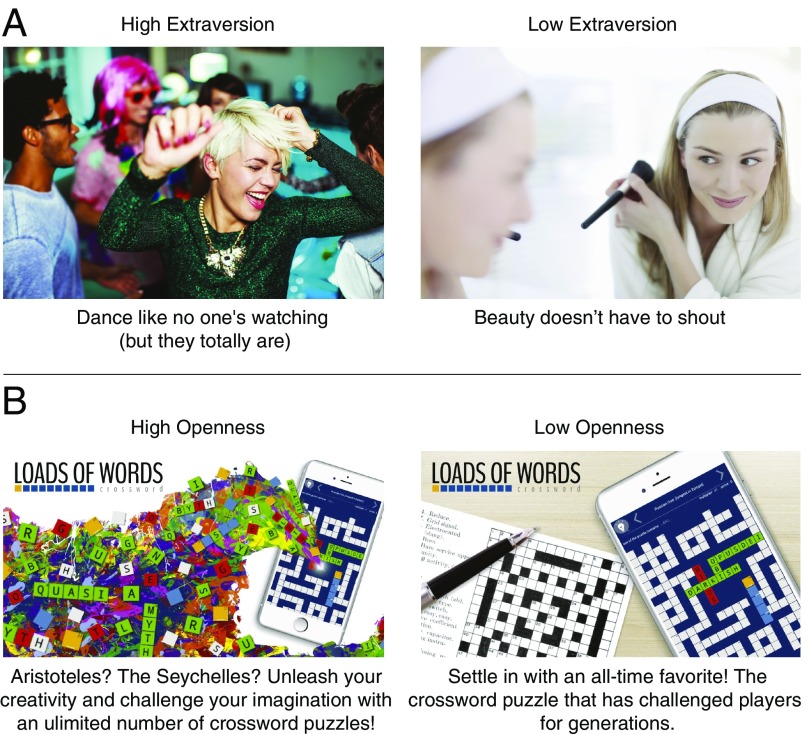
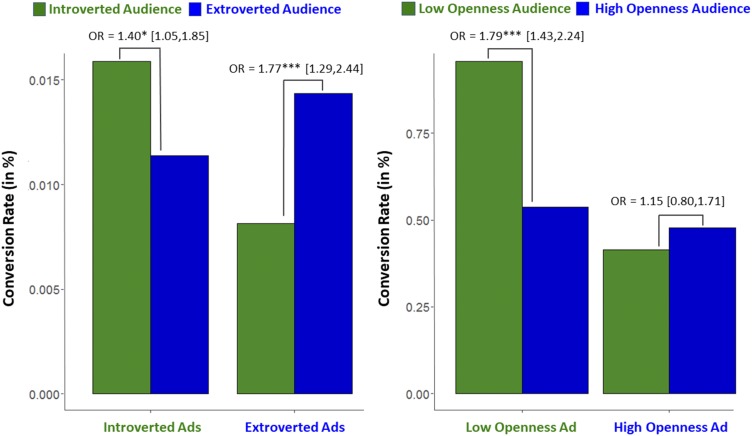
People are exposed to persuasive communication across many different contexts: Governments, companies, and political parties use persuasive appeals to encourage people to eat healthier, purchase a particular product, or vote for a specific candidate. Laboratory studies show that such persuasive appeals are more effective in influencing behavior when they are tailored to individuals' unique psychological characteristics. However, the investigation of large-scale psychological persuasion in the real world has been hindered by the questionnaire-based nature of psychological assessment. Recent research, however, shows that people's psychological characteristics can be accurately predicted from their digital footprints, such as their Facebook Likes or Tweets. Capitalizing on this form of psychological assessment from digital footprints, we test the effects of psychological persuasion on people's actual behavior in an ecologically valid setting. In three field experiments that reached over 3.5 million individuals with psychologically tailored advertising, we find that matching the content of persuasive appeals to individuals' psychological characteristics significantly altered their behavior as measured by clicks and purchases. Persuasive appeals that were matched to people's extraversion or openness-to-experience level resulted in up to 40% more clicks and up to 50% more purchases than their mismatching or unpersonalized counterparts. Our findings suggest that the application of psychological targeting makes it possible to influence the behavior of large groups of people by tailoring persuasive appeals to the psychological needs of the target audiences. We discuss both the potential benefits of this method for helping individuals make better decisions and the potential pitfalls related to manipulation and privacy.
Overview
The claims and statistics of this paper haven’t been checked yet.
Run the check — free, no account needed. It reads the open-access text and checks the sources it cites.
Integrity signals
Registry
Cites
Statistics
Figures
Verification
Claims the paper makes
The claims and statistics of this paper haven’t been checked yet.
Run the check — free, no account needed. It reads the open-access text and checks the sources it cites.
Claims other papers make about this one
Each is checked against this paper’s own text: does it say what the citing paper says it does?
The source backs part of the claim, not all of it — or backs it for a different population, condition or comparison.
In the citing paper
“Matz et al. (2017) reflect on their (Kosinski and Stillwell) decade-long research program on infering personality traits from social media users and its potential for mass manipulation, as evidenced in the adoption of similar techniques in the manipulation of elections.28”
From Social Data: Biases, Methodological Pitfalls, and Ethical Boundaries (2019) · cites this paper as Matz et al., 2017
Experimental — accuracy not yet measuredThe cited source says what the claim attributes to it.
In the citing paper
“Personality matching has been shown to increase the effectiveness of real-life persuasive communication59.”
From A psychometric framework for evaluating and shaping personality traits in large language models (2025) · cites this paper as [59]
In the citing paper
“companies report an increase in sales if salespersons demonstrate high extraversion and openness [38]”
From Interacting with a Chatbot-Based Advising System: Understanding the Effect of Chatbot Personality and User Gender on Behavior (2022) · cites this paper as [38]
In the citing paper
“and matching a message to an audience's personality improves its effectiveness [36 ].”
From Two social lives: how differences between online and offline interaction influence social outcomes (2020) · cites this paper as [36]
Self-check
Percentages, sums and reported differences re-computed from the paper’s own numbers.
The self-check needs the paper’s full text.
Citations
Cites
Self-Reports in Organizational Research: Problems and Prospects
Podsakoff, P. M., & Organ, D. W. (1986) · Journal of Management · doi:10.1177/014920638601200408 · Cited by 17,102
An Introduction to the Five‐Factor Model and Its Applications
McCrae, R. R., & John, O. P. (1992) · Journal of Personality · doi:10.1111/j.1467-6494.1992.tb00970.x · Cited by 6,835
Interaction terms in logit and probit models
Ai, C., & Norton, E. C. (2003) · Economics Letters · doi:10.1016/s0165-1765(03)00032-6 · Cited by 4,599
Lazer, D., Pentland, A., Adamic, L., Aral, S., Barabási, A.-L., Brewer, D., Christakis, N., Contractor, N., Fowler, J., Gutmann, M., et al. (2009) · Science · doi:10.1126/science.1167742 · Cited by 3,365
The Role of Emotions in Marketing
Bagozzi, R. P., Gopinath, M., & Nyer, P. U. (1999) · Journal of the Academy of Marketing Science · doi:10.1177/0092070399272005 · Cited by 3,349
The international personality item pool and the future of public-domain personality measures
Goldberg, L. R., Johnson, J. A., Eber, H. W., Hogan, R., Ashton, M. C., Cloninger, C. R., & Gough, H. G. (2006) · Journal of Research in Personality · doi:10.1016/j.jrp.2005.08.007 · Cited by 3,185
Private traits and attributes are predictable from digital records of human behavior
Kosinski, M., Stillwell, D., & Graepel, T. (2013) · Proceedings of the National Academy of Sciences · doi:10.1073/pnas.1218772110 · Cited by 2,829
Self-citationWhat Do Laboratory Experiments Measuring Social Preferences Reveal About the Real World?
Levitt, S. D., & List, J. A. (2007) · Journal of Economic Perspectives · doi:10.1257/jep.21.2.153 · Cited by 2,668
Does tailoring matter? Meta-analytic review of tailored print health behavior change interventions
Noar, S. M., Benac, C. N., & Harris, M. S. (2007) · Psychological Bulletin · doi:10.1037/0033-2909.133.4.673 · Cited by 2,136
Personality, Gender, and Age in the Language of Social Media: The Open-Vocabulary Approach
Schwartz, H. A., Eichstaedt, J. C., Kern, M. L., Dziurzynski, L., Ramones, S. M., Agrawal, M., Shah, A., Kosinski, M., Stillwell, D., Seligman, M. E. P., et al. (2013) · PLoS ONE · doi:10.1371/journal.pone.0073791 · Cited by 1,700
Self-citationComputer-based personality judgments are more accurate than those made by humans
Youyou, W., Kosinski, M., & Stillwell, D. (2015) · Proceedings of the National Academy of Sciences · doi:10.1073/pnas.1418680112 · Cited by 1,086
Self-citationKosiński, M., Matz, S., Gosling, S. D., Popov, V., & Stillwell, D. J. (2015) · American Psychologist · doi:10.1037/a0039210 · Cited by 1,031
Self-citationRegulatory Fit and Persuasion: Transfer From "Feeling Right."
Cesario, J., Grant, H., & Higgins, E. T. (2004) · Journal of Personality and Social Psychology · doi:10.1037/0022-3514.86.3.388 · Cited by 1,014
Enhancement and denial in socially desirable responding.
Paulhus, D. L., & Reid, D. B. (1991) · Journal of Personality and Social Psychology · doi:10.1037/0022-3514.60.2.307 · Cited by 824
Automatic personality assessment through social media language.
Park, G., Schwartz, H. A., Eichstaedt, J. C., Kern, M. L., Kosinski, M., Stillwell, D. J., Ungar, L. H., & Seligman, M. E. P. (2015) · Journal of Personality and Social Psychology · doi:10.1037/pspp0000020 · Cited by 802
Self-citationPersonality in 100,000 Words: A large-scale analysis of personality and word use among bloggers
Yarkoni, T. (2010) · Journal of Research in Personality · doi:10.1016/j.jrp.2010.04.001 · Cited by 637
Predicting Personality from Twitter
Golbeck, J., Robles, C., Edmondson, M., & Turner, K. (2011) · International Conference on Social Computing · doi:10.1109/passat/socialcom.2011.33 · Cited by 613
FEELTRACE: an instrument for recording perceived emotion in real time
Cowie, R., Douglas‐Cowie, E., Savvidou, S. M., & McMahon, E. R. (2000) · Research Portal (Queen's University Belfast) · Cited by 539
Hirsh, J. B., Kang, S. K., & Bodenhausen, G. V. (2012) · Psychological Science · doi:10.1177/0956797611436349 · Cited by 506
Emotion-Induced Engagement in Internet Video Advertisements
Teixeira, T. S., Wedel, M., & Pieters, R. G. M. (2011) · Journal of Marketing Research · doi:10.1509/jmr.10.0207 · Cited by 471
MoodScope: building a mood sensor from smartphone usage patterns
LiKamWa, R., Liu, Y., Lane, N. D., & Zhong, L. (2013) · Proceeding of the 11th annual international conference on Mobile systems, applications, and services · doi:10.1145/2462456.2464449 · Cited by 444
Regulatory Fit and Persuasion: Basic Principles and Remaining Questions
Cesario, J., Higgins, E. T., & Scholer, A. A. (2007) · Social and Personality Psychology Compass · doi:10.1111/j.1751-9004.2007.00055.x · Cited by 371
Personality in cyberspace: Personal web sites as media for personality expressions and impressions.
Marcus, B., Machilek, F., & Schütz, A. (2006) · Journal of Personality and Social Psychology · doi:10.1037/0022-3514.90.6.1014 · Cited by 302
Wheeler, S. C., Petty, R. E., & Bizer, G. Y. (2005) · Journal of Consumer Research · doi:10.1086/426613 · Cited by 291
Hauser, J. R., Urban, G. L., Liberali, G., & Braun, M. I. (2009) · Marketing Science · doi:10.1287/mksc.1080.0459 · Cited by 291
Mann, T. L., Sherman, D. K., & Updegraff, J. A. (2004) · Health Psychology · doi:10.1037/0278-6133.23.3.330 · Cited by 242
Pathological gambling and the five-factor model of personality
Bagby, R. M., Vachon, D. D., Bulmash, E. L., Toneatto, T., Quilty, L. C., & Costa, P. T. (2007) · Personality and Individual Differences · doi:10.1016/j.paid.2007.02.011 · Cited by 187
What Do Laboratory Experiments Tell Us About the Real World
Levitt, S. D., & List, J. A. (2006) · Cited by 176
Moon, Y. (2002) · Journal of Consumer Psychology · doi:10.1016/s1057-7408(16)30083-3 · Cited by 141
Segalin, C., Perina, A., Cristani, M., & Vinciarelli, A. (2016) · IEEE Transactions on Affective Computing · doi:10.1109/taffc.2016.2516994 · Cited by 139
Dynamics of Communicator and Audience Power: The Persuasiveness of Competence versus Warmth
Dubois, D., Rucker, D. D., & Galinsky, A. D. (2016) · Journal of Consumer Research · doi:10.1093/jcr/ucw006 · Cited by 131
Moon, Y. (2002) · Journal of Consumer Psychology · doi:10.1207/15327660260382351 · Cited by 47
Cited by
Sorted by citations
Human trust in artificial intelligence: Review of empirical research
Glikson, E., & Woolley, A. W. (2020) · Academy of Management Annals · doi:10.5465/annals.2018.0057 · Cited by 2,921
The Ethics of AI Ethics -- An Evaluation of Guidelines
Hagendorff, T. (2019) · arXiv · doi:10.48550/arxiv.1903.03425 · Cited by 1,907
“Furthermore, countless companies strive for the opposite of human autonomy, employing more and more subtle techniques for manipulating user behavior via micro targeting, nudging, UX-design and so on (Fogg 2003; Matz et al. 2017).”
MethodThe Ethics of AI Ethics: An Evaluation of Guidelines
Hagendorff, T. (2020) · Minds and Machines · doi:10.1007/s11023-020-09517-8 · Cited by 1,911
“Furthermore, countless companies strive for the opposite of human autonomy, employing more and more subtle techniques for manipulating user behavior via micro targeting, nudging, UX-design and so on (Fogg 2003; Matz et al. 2017).”
MethodTask-Dependent Algorithm Aversion
Castelo, N., Bos, M. W., & Lehmann, D. R. (2019) · Springer eBooks · doi:10.1007/978-3-031-88067-4_21 · Cited by 1,723
Feuerriegel, S., Hartmann, J., Janiesch, C., & Zschech, P. (2024) · Business & Information Systems Engineering · doi:10.1007/s12599-023-00834-7 · Cited by 2,267
“…that generative AI can automate the creation of personalized marketing content, for instance, different sales slogans for introverts vs. extroverts (Matz et al. 2017) or other personality traits as personalized marketing content is more effective than a one-content-fits-all approach (Matz et al.…”
Metadata
- Authors
- Matz, S. C., Kosinski, M., Nave, G., & Stillwell, D. J.
- Affiliations
- Columbia University (US)
- Graduate School of Business, Stanford University, Stanford, CA 94305;
- University of Pennsylvania (US)
- University of Cambridge (GB)
- Corresponding author
- Matz, S. C.
- Venue
- Proceedings of the National Academy of Sciences
- Publisher
- National Academy of Sciences
- Published
- 2017-11-13
- Volume
- 114
- Issue
- 48
- Pages
- 12714-12719
- ISSN
- 0027-8424 (ISSN-L)
- 1091-6490
- PMC
- PMC5715760
- OpenAlex
- W2768262152
- Cited by
- 892
- References
- 32
- Citations by year
- 2026: 86 · 2025: 127 · 2024: 113 · 2023: 105 · 2022: 125 · 2021: 110 · 2020: 115 · 2019: 72 · 2018: 39
- FWCI
- 48.48
- Type
- journal article
- Language
- en
- Open access
- hybrid
- doi.org
- Licence
- Locations
- Proceedings of the National Academy of Sciences (publishedVersion, cc-by-nc-nd)
- PubMed Central (publishedVersion, cc-by-nc-nd)
- PubMed (publishedVersion)
- Apollo (University of Cambridge) (submittedVersion, cc-by-nc-nd)
- Apollo
- Columbia Academic Commons (Columbia University)
- Topics
- Social Sciences › Decision Sciences › General Decision Sciences › Decision-Making and Behavioral Economics
- Social Sciences › Psychology › Social Psychology › Psychology of Social Influence
- Social Sciences › Business, Management and Accounting › Marketing › Digital Marketing and Social Media
- Keywords
- personalized advertising, persuasive appeals, digital footprint, personality prediction, extraversion, openness to experience, behavioral influence, online purchase, click behavior, manipulation, privacy
- MeSH terms
- Direct-to-Consumer Advertising, Extraversion, Psychological, Humans, Individuality, Introversion, Psychological, Mass Behavior, Persuasive Communication, Psychometrics, Behavior Control, Social Media
About these checks
Registry, retraction, Cites and statistics results are computed, not judged, with one exception: a printed reference that no index lists is read once by a model before it counts as a citation error. Claims are extracted by a model and kept only when their quote appears verbatim in the text; each cited source is then checked, with a model’s help, for whether it says what the claim relies on. Those verdicts can be wrong — read the claim’s quote and the cited source before relying on one.
Statistics and arithmetic are recomputed, not judged.
Confidence bands are shown only for fields calibrated on our annotated test set. None is calibrated yet, so no band is shown.
What counts as a claim ›How we measure confidence ›How we check this ›
Are you an author, or do you see a problem with this page? Request a review
