

Constraining the climate and ocean pH of the early Earth with a geological carbon cycle model
Open accessThe DOI matches its Crossref record; 146 of the 146 references it cites were found in a registry or an index.
Abstract
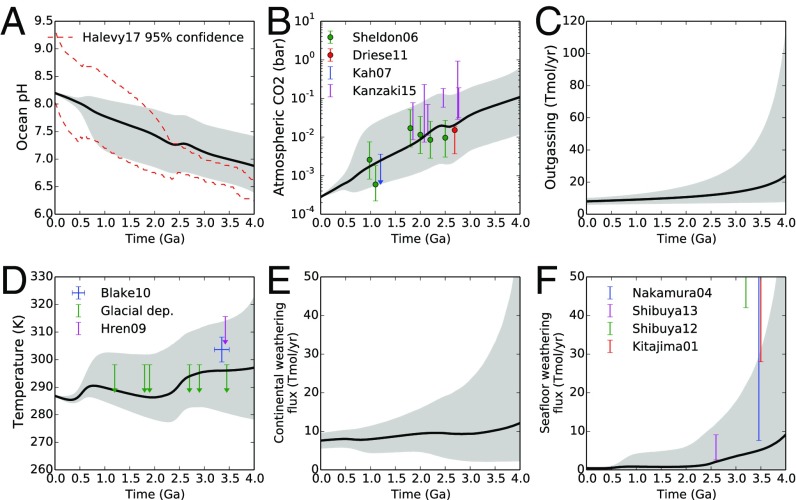
Significance: The climate and ocean pH of the early Earth are important for understanding the origin and early evolution of life. However, estimates of early climate range from below freezing to over 70 °C, and ocean pH estimates span from strongly acidic to alkaline. To better constrain environmental conditions, we applied a self-consistent geological carbon cycle model to the last 4 billion years. The model predicts a temperate (0–50 °C) climate and circumneutral ocean pH throughout the Precambrian due to stabilizing feedbacks from continental and seafloor weathering. These environmental conditions under which life emerged and diversified were akin to the modern Earth. Similar stabilizing feedbacks on climate and ocean pH may operate on earthlike exoplanets, implying life elsewhere could emerge in comparable environments.
Overview
The claims and statistics of this paper haven’t been checked yet.
Free: it reads the open-access text and checks the first 5 claims that cite a source we can check. Create a free account to check every claim.
Integrity signals
Registry
Cites
Statistics
Figures
Verification
Claims the paper makes
The claims and statistics of this paper haven’t been checked yet.
Free: it reads the open-access text and checks the first 5 claims that cite a source we can check. Create a free account to check every claim.
Claims other papers make about this one
Each is checked against this paper’s own text: does it say what the citing paper says it does?
The source backs part of the claim, not all of it — or backs it for a different population, condition or comparison.
In the citing paper
“In the Archean, with greater seafloor production than today, seafloor weathering could have been comparable to continental weathering (34, 35, 182), and negative feedback (Eq. 2) likely maintained average Archean surface temperatures between 0° and 40°C with seawater pH 6.4 to 7.4 (34).”
From The Archean atmosphere (2020) · cites this paper as [34]
Experimental — accuracy not yet measuredThe source backs part of the claim, not all of it — or backs it for a different population, condition or comparison.
In the citing paper
“The corresponding pCO2 would have been 0.006 to 0.6 bar 4 Ga ago, assuming that ~104-ppmv CH4 also contributed to the greenhouse effect.”
From The Archean atmosphere (2020) · cites this paper as [34]
Experimental — accuracy not yet measuredThe source backs part of the claim, not all of it — or backs it for a different population, condition or comparison.
In the citing paper
“CO2 alone could have solved the FYS problem with 0.004- to 0.03-bar CO2 at 2.5 Ga ago and 0.024- to 1-bar CO2 at 4 Ga ago, where the spread comes from uncertain carbonate-silicate model parameters.”
From The Archean atmosphere (2020) · cites this paper as [34]
Experimental — accuracy not yet measuredThe source backs part of the claim, not all of it — or backs it for a different population, condition or comparison.
In the citing paper
“In general, how CO2 outgassing changed with time dominates the uncertainty (34).”
From The Archean atmosphere (2020) · cites this paper as [34]
Experimental — accuracy not yet measured
5 more claims about this paper
Create a free account to see every claim other papers make about this one.
Self-check
Percentages, sums and reported differences re-computed from the paper’s own numbers.
The self-check needs the paper’s full text.
Citations
Cites
An early Cenozoic perspective on greenhouse warming and carbon-cycle dynamics
Zachos, J. C., Dickens, G. R., & Zeebe, R. E. (2008) · Nature · doi:10.1038/nature06588 · Cited by 3,550 · cited 2×
“e existence of glacial deposits anywhere on Earth bounds global average temperatures to <25°C. The glaciation of Antarctica occurred approximately 35 Ma when global temperatures crossed below 20°C (48), and so an upper limit of 25°C is a more conservative estimate allowing for variations due to paleogeography. Of c…”
BackgroundInfluentialClark, P. U., Dyke, A. S., Shakun, J. D., Carlson, A. E., Clark, J., Wohlfarth, B., Mitrovica, J. X., Hostetler, S. W., & McCabe, A. M. (2009) · Science · doi:10.1126/science.1172873 · Cited by 3,277 · cited 2×
“coupled atmosphere-ocean GCMs with complete ocean circulation. Paleocene-Eocene Thermal Maximum (PETM) temperatures were sourced from Jones, et al. (22), Last Glacial Maximum (LGM) from Clark, et al. (23), and Cretaceous proxies from a composite dataset described in Krissansen-Totton and Catling (1). See KrissansenTot…”
BackgroundMethodInfluentialA negative feedback mechanism for the long‐term stabilization of Earth's surface temperature
Walker, J. C. G., Hays, P. B., & Kasting, J. F. (1981) · Journal of Geophysical Research: Oceans · doi:10.1029/jc086ic10p09776 · Cited by 2,310 · cited 1×
“The conventional view of the carbon cycle is that carbon outgassing into the atmosphere– ocean system is balanced by continental silicate weathering and subsequent marine carbonate formation (30, 31).”
BackgroundThermal Equilibrium of the Atmosphere with a Given Distribution of Relative Humidity
Manabe, S., & Wetherald, R. T. (1967) · Journal of the Atmospheric Sciences · doi:10.1175/1520-0469(1967)024<0241:teotaw>2.0.co;2 · Cited by 1,735 · cited 1×
“n). 13 We assume an Earth-mass planet with a surface albedo of 0.32, which includes the radiative effects of water clouds (60). We apply a Manabe/Wetherald relative humidity model for the troposphere (71) and specify a surface relative humidity of 0.8. Our relative humidity parameterization is described in more detail…”
MethodInfluentialGEOCARB II; a revised model of atmospheric CO 2 over Phanerozoic time
Berner, R. A. (1994) · American Journal of Science · doi:10.2475/ajs.294.1.56 · Cited by 1,683
HABITABLE ZONES AROUND MAIN-SEQUENCE STARS: NEW ESTIMATES
Kopparapu, R. K., Ramirez, R., Kasting, J. F., Eymet, V., Robinson, T. D., Mahadevan, S., Terrien, R. C., Domagal-Goldman, S., Meadows, V., & Deshpande, R. (2013) · The Astrophysical Journal · doi:10.1088/0004-637x/765/2/131 · Cited by 1,615 · cited 1×
“We used a 1D radiative convective model (46) to create a grid of mean surface temperatures as a function of solar luminosity and pCO2.”
MethodMantle Convection in the Earth and Planets
Schubert, G., Turcotte, D. L., & Olson, P. (2001) · Cambridge University Press eBooks · doi:10.1017/cbo9780511612879 · Cited by 1,374
GEOCARB III: A revised model of atmospheric CO2 over Phanerozoic time
Berner, R. A. (2001) · American Journal of Science · doi:10.2475/ajs.301.2.182 · Cited by 1,323
Research works printed but not linked: 1
- 2. Knauth LP Lowe DR 2003 High Archean climatic temperature inferred from oxygen isotope geochemistry of cherts in the 3.5 Ga Swaziland Supergroup, South Africa Geol Soc Am Bull 115 566 580 · doi:10.1130/0016-7606(2003)115
Cited by
Items 101–200 of 368
Crustal carbonate build-up as a driver for Earth’s oxygenation
Alcott, L., Walton, C. R., Planavsky, N. J., Shorttle, O., & Mills, B. J. W. (2024) · Nature Geoscience · doi:10.1038/s41561-024-01417-1 · Cited by 28
“Several different reconstructions are proposed for the exposure of subaerial landmass throughout Earth’s history 23–25 , so we adopt the Monte-Carlo parameter range used by Krissansen-Totten et al. 26 and add possible high-landmass options for the Archean.”
InfluentialHigh Organic Burial Efficiency Is Required to Explain Mass Balance in Earth's Early Carbon Cycle
Kipp, M. A., Krissansen‐Totton, J., & Catling, D. C. (2021) · Global Biogeochemical Cycles · doi:10.1029/2020gb006707 · Cited by 28
“…planet, particularly since biogeochemical modulation of greenhouse gas (i.e., CO2 and CH4) concentrations has played an important role in regulating Earth's climate since at least the Archean (Kharecha et al., 2005; Krissansen-Totton et al., 2018a), and perhaps Hadean (Kadoya et al., 2020a).”
BackgroundSelf-citationThe Sedimentary Origin of Black and White Banded Cherts of the Buck Reef, Barberton, South Africa
Ledevin, M., Arndt, N., Chauvel, C., Jaillard, É., & Simionovici, A. (2019) · Geosciences · doi:10.3390/geosciences9100424 · Cited by 26
“, [104]) or very similar to today’s [105].”
BackgroundBrunk, C. F., & Marshall, C. R. (2021) · Life · doi:10.3390/life11070690 · Cited by 23
Jin, M., Feng, D., Huang, K., Peckmann, J., Li, N., Huang, H., Liang, Q., & Chen, D. (2021) · Chemical Geology · doi:10.1016/j.chemgeo.2021.120101 · Cited by 25
Stability of Nitrogen in Planetary Atmospheres in Contact with Liquid Water
Hu, R., & Diaz, H. D. (2019) · The Astrophysical Journal · doi:10.3847/1538-4357/ab4cea · Cited by 25
“Such a pH value is much higher than the pH of the Earth’s ocean currently or in the Archean (Halevy & Bachan 2017; Krissansen-Totton et al. 2018).”
BackgroundGuo, M., & Korenaga, J. (2021) · Proceedings of the National Academy of Sciences · doi:10.1073/pnas.2116083118 · Cited by 25
Wavelength Requirements for Life Detection via Reflected Light Spectroscopy of Rocky Exoplanets
Krissansen‐Totton, J., Ulses, A. G., Frissell, M., Gilbert-Janizek, S., Young, A., Lustig‐Yaeger, J., Robinson, T. D., Olson, S. L., Alei, E., Arney, G., et al. (2026) · Astrobiology · doi:10.1177/15311074261477497 · Cited by 23
“Atmospheric CO 2 was kept at 1% to broadly represent the Proterozoic average (Krissansen-Totton et al., 2018a).”
Self-citationDandouras, I., Blanc, M., Fossati, L., Gerasimov, M. V., Guenther, E. W., Kislyakova, K. G., Lammer, H., Lin, Y., Marty, B. M., Mazelle, C. X., et al. (2020) · Space Science Reviews · doi:10.1007/s11214-020-00736-0 · Cited by 23
Fate of organic compounds during transformation of ferrihydrite in iron formations
Jelavić, S., Mitchell, A. C., & Sand, K. K. S. (2020) · Geochemical Perspectives Letters · doi:10.7185/geochemlet.2030 · Cited by 23
“Our pH is for ~1.5 unit lower than the current estimates for Precambrian seawater (Halevy and Bachan, 2017; Krissansen-Totton et al., 2018).”
BackgroundInfluentialPlausibility of the Formose Reaction in Alkaline Hydrothermal Vent Environments
Omran, A. P. (2020) · Origins of Life and Evolution of Biospheres · doi:10.1007/s11084-020-09599-5 · Cited by 22
Experimentally investigating the origin of DNA/RNA on early Earth
Krishnamurthy, R. (2018) · Nature Communications · doi:10.1038/s41467-018-07212-y · Cited by 22
Hydrothermal vents and organic ligands sustained the Precambrian copper budget
Stüeken, E. E. (2020) · Geochemical Perspectives Letters · doi:10.7185/geochemlet.2037 · Cited by 22
“The pH of the seawater endmember was varied from 6.5 in the Archean to 7.5 in the Proterozoic and 8.1 in the Phanerozoic (Halevy and Bachan, 2017; Isson and Planavsky, 2018; Krissansen-Totton et al., 2018).”
BackgroundInfluentialSchad, M., Byrne, J. M., ThomasArrigo, L. K., Kretzschmar, R., Konhauser, K. O., & Kappler, A. A. (2022) · Geochimica et Cosmochimica Acta · doi:10.1016/j.gca.2022.05.016 · Cited by 26
Checlair, J., Abbot, D. S., Webber, R. J., Feng, Y. K., Bean, J. L., Schwieterman, E. W., Stark, C. C., Robinson, T. D., Kempton, E. M.-R., Alcabes, O. D. N., et al. (2019) · arXiv (Cornell University) · doi:10.48550/arxiv.1903.05211 · Cited by 21
“For our optimistic parameters, we choose means and standard deviations such that values typical of Earth-like planets in the habitable zone with a functioning silicate-weathering feedback are sampled (Krissansen-Totton et al., 2018; Olson et al., 2018; Rogers, 2015).”
Self-citationFinenko, A. A., Bézard, B., Gordon, I. E., Chistikov, D. N., Lokshtanov, S. E., Petrov, S. V., & Vigasin, A. A. (2022) · The Astrophysical Journal Supplement Series · doi:10.3847/1538-4365/ac36d3 · Cited by 22
Oxygen-induced chemocline precipitation between Archean Fe-rich and Fe-poor carbonate seas
Riding, R., Liang, L., & Fralick, P. W. (2022) · Precambrian Research · doi:10.1016/j.precamres.2022.106902 · Cited by 21
Chapter 4: A Geological and Chemical Context for the Origins of Life on Early Earth
Rodriguez, L. E., Altair, T., Hermis, N. Y., Jia, T. Z., Roche, T. P., Steller, L. H., & Weber, J. M. (2024) · Astrobiology · doi:10.1089/ast.2021.0139 · Cited by 24
“Hadean oceanic waters were likely temperate (0– 50 (cid:2) C; Hren et al., 2009; Krissansen-Totton et al., 2018) and, due to the relatively high partial pressure of atmospheric CO 2 , mildly acidic ( i.e., Sleep et al., 2001).”
InfluentialPrecambrian Earth: Co-evolution of life and geodynamics
Westall, F., & Xiao, S. (2024) · Precambrian Research · doi:10.1016/j.precamres.2024.107589 · Cited by 23
Rapid rise of early ocean pH under elevated weathering rates
Guo, M., & Korenaga, J. (2025) · Nature Geoscience · doi:10.1038/s41561-025-01649-9 · Cited by 24
“The atmosphere and oceans are treated as a single reservoir due to CO 2 solubility equilibrium 4,5 .”
InfluentialAdsorption of nucleotides on clay surfaces: Effects of mineral composition, pH and solution salts
Mignon, P., Corbin, G., Crom, S. L., Marry, V., Hao, J., & Daniel, I. (2020) · Applied Clay Science · doi:10.1016/j.clay.2020.105544 · Cited by 21
Carbon isotope stratigraphy: Principles and applications
Gröcke, D. R. (2020) · Stratigraphy & timescales · doi:10.1016/bs.sats.2020.08.002 · Cited by 22
Diurnal Fe(II)/Fe(III) cycling and enhanced O2 production in a simulated Archean marine oxygen oasis
Herrmann, A. J., Sorwat, J., Byrne, J. M., Frankenberg‐Dinkel, N., & Gehringer, M. M. (2021) · Nature Communications · doi:10.1038/s41467-021-22258-1 · Cited by 19
Vance, J., Currie, K., Zeldis, J., Dillingham, P. W., & Law, C. S. (2022) · Biogeosciences · doi:10.5194/bg-19-241-2022 · Cited by 19
A global network model of abiotic phosphorus cycling on Earth through time
Jusino-Maldonado, M., Rianço-Silva, R., Mondal, J. A., Pasek, M. A., Laneuville, M., & Cleaves, H. J. (2022) · Scientific Reports · doi:10.1038/s41598-022-12994-9 · Cited by 19
Eolianite Grain Size Distributions as a Proxy for Large Changes in Planetary Atmospheric Density
Goosmann, E. A., Catling, D. C., Som, S. M., Altermann, W., & Buick, R. (2018) · Journal of Geophysical Research: Planets · doi:10.1029/2018je005723 · Cited by 18
“temperate Archean temperatures are possible with higher levels of CO2 and CH4 within current atmospheric constraints (Krissansen-Totton et al., 2018), higher nitrogen partial pressures of 2–3 bar in the Archean could have enhanced greenhouse warming through pressure broadening of greenhouse gas absorption lines, keepi…”
BackgroundSelf-citationSimulated early Earth geochemistry fuels a hydrogen-dependent primordial metabolism
Helmbrecht, V., Reichelt, R., Grohmann, D., & Orsi, W. D. (2025) · Nature Ecology & Evolution · doi:10.1038/s41559-025-02676-w · Cited by 19
“43,44).”
Can prebiotic systems survive in the wild? An interference chemistry approach
Walton, C. R., Rimmer, P. B., & Shorttle, O. (2022) · Frontiers in Earth Science · doi:10.3389/feart.2022.1011717 · Cited by 20
“Finally, atmospheric pCO2 of early Earth is poorly constrained, rendering Dissolved Inorganic Carbon (DIC) estimates uncertain for all environments (Krissansen-Totton et al., 2018; Kadoya et al., 2020).”
BackgroundCation exchange to montmorillonite induces selective adsorption of amino acids
Millman, E., Chatterjee, A., Parker, K. M., & Catalano, J. G. (2024) · Geochimica et Cosmochimica Acta · doi:10.1016/j.gca.2024.02.020 · Cited by 21
Nims, C., & Johnson, J. E. (2022) · Geobiology · doi:10.1111/gbi.12523 · Cited by 19
Birski, Ł., Słaby, E., Wirth, R., Koch‐Müller, M., Simon, K., Wudarska, A., Götze, J., Lepland, A., Hofmann, A., & Kuras, A. (2019) · Contributions to Mineralogy and Petrology · doi:10.1007/s00410-019-1560-z · Cited by 20
Simulated diagenesis of the iron-silica precipitates in banded iron formations
Hinz, I. L., Rossi, L., Ma, C., & Johnson, J. E. (2023) · American Mineralogist · doi:10.2138/am-2022-8758 · Cited by 18
“…was higher than the hypothesized pH of the Archean ocean, which was constrained to pH ~6.5–7.0 by two independent marine and atmospheric geochemical models (Halevy and Bachan 2017; Krissansen-Totton et al. 2018) and considerations of authi-genic clay formation (Isson and Planavsky 2018).”
BackgroundInfluentialFarhat, M. A., Auclair-Desrotour, P., Boué, G., Deitrick, R., & Laskar, J. (2024) · Astronomy and Astrophysics · doi:10.1051/0004-6361/202348625 · Cited by 19
“, de Wit and Furnes, 2016), geological carbon cycle models (e.g., Sleep and Zahnle, 2001; Krissansen-Totton et al., 2018), numerical results of 3D GCMs (e.”
BackgroundLaskar, J., Farhat, M., Lantink, M. L., Auclair-Desrotour, P., Boué, G., & Sinnesael, M. (2024) · Sedimentologika · doi:10.57035/journals/sdk.2024.e21.1271 · Cited by 14
“…are in contrast with geochemical analysis using phosphates (e.g., Blake et al, 2010), geological carbon cycle models (e.g., Sleep and Zahnle, 2001; Krissansen-Totton et al, 2018), numerical results of 3D GCMs (e.g., Charnay et al, 2020), and the fact that solar luminosity was 10-25% lower during…”
ResultChemical Antiquity in Metabolism
Mrnjavac, N., Schwander, L., Brabender, M., & Martin, W. F. (2024) · Accounts of Chemical Research · doi:10.1021/acs.accounts.4c00226 · Cited by 17
In search of the RNA world on Mars
Mojarro, A., Jin, L., Szostak, J. W., Head, J. W., III, & Zuber, M. T. (2021) · Geobiology · doi:10.1111/gbi.12433 · Cited by 19
“Modeling of continental weathering of early Earth basalts additionally suggests that waters with high alkalinity would have stabilized pH between 6.6 and 7 under a ∼1 bar CO2 atmosphere (Halevy and Bachan, 2017; Krissansen-Totton et al., 2018).”
BackgroundInfluentialUnexpected Thiocyanate Adsorption onto Ferrihydrite Under Prebiotic Chemistry Conditions
Zaia, D. A. M., de Carvalho, P. C. G., Samulewski, R. B., Pereira, R. D. C., & Zaia, C. T. B. V. (2020) · Origins of Life and Evolution of Biospheres · doi:10.1007/s11084-020-09594-w · Cited by 17
Cyanobacterial UV Pigments Evolved to Optimize Photon Dissipation Rather than Photoprotection
Simeonov, A., & Michaelian, K. (2025) · Biophysica · doi:10.3390/biophysica5020023 · Cited by 19
Phenotypic reconstruction of the last universal common ancestor reveals a complex cellPreprint
Baidouri, F. E., Venditti, C., Suzuki, S., Meade, A., & Humphries, S. (2020) · bioRxiv (Cold Spring Harbor Laboratory) · doi:10.1101/2020.08.20.260398 · Cited by 20
Constraints on hydrogen levels in the Archean atmosphere based on detrital magnetite
Kadoya, S., & Catling, D. C. (2019) · Geochimica et Cosmochimica Acta · doi:10.1016/j.gca.2019.07.041 · Cited by 16
“1 shows cumulative dissolution of pCO2 following Krissansen-Totton et al. (2018). Fig.”
BackgroundResultInfluentialSelf-citationRelative Abundances of CO 2 , CO, and CH 4 in Atmospheres of Earth-like Lifeless Planets
Watanabe, Y., & Ozaki, K. (2024) · The Astrophysical Journal · doi:10.3847/1538-4357/ad10a2 · Cited by 17
Maguire, O. R., Smokers, I. B. A., Oosterom, B. G., Zheliezniak, A., & Huck, W. T. S. (2024) · Journal of the American Chemical Society · doi:10.1021/jacs.4c01156 · Cited by 18
Graham, R. J. (2021) · Astrobiology · doi:10.1089/ast.2020.2411 · Cited by 19
“…relevant proxy data produce a corresponding history, with pH increasing from an initial slightly acidic-to-neutral range of 6.5–7 in the Archean to a slightly basic range of 7.5–9 during the Phanerozoic (Halevy and Bachan, 2017; Krissansen-Totton et al. , 2018; Krissansen-Totton and Catling, 2020).”
InfluentialWatanabe, Y., Tajika, E., & Ozaki, K. (2023) · Geobiology · doi:10.1111/gbi.12554 · Cited by 17
Plate Tectonics: The Stabilizer of Earth’s Habitability
Wang, Z., Zhang, J., Zong, K., Kusky, T., & Wang, Y. (2023) · Journal of Earth Science · doi:10.1007/s12583-023-1864-9 · Cited by 17
“…indeed been episodic ocean acidification, poisoning, and temperature change events, some associated with mass ex‐ tinctions (Green et al., 2022; Cui et al., 2021; Krissansen-Totton et al., 2018; Ernst and Youbi, 2017; Hönisch et al., 2012; Zeebe, 2012; Sobolev et al., 2011; Knoll et al., 2007).”
BackgroundEvolution of iron and oxygen biogeochemical cycles during the Precambrian
Watanabe, Y., Tajika, E., & Ozaki, K. (2023) · Geobiology · doi:10.1111/gbi.12571 · Cited by 16
“The evolution of solar luminosity was based on a parameterization used in previous studies (Figure 3a) (Krissansen-Totton et al., 2018).”
BackgroundMethodInfluentialThe role of Fe(II)-silicate gel in the generation of Archean and Paleoproterozoic chert
Tostevin, R., & Sevgen, S. (2024) · Geology · doi:10.1130/g52202.1 · Cited by 16
Rossetto, D., Valer, L., Martín, N. Y., Guella, G., Hongo, Y., & Mansy, S. S. (2022) · ACS Earth and Space Chemistry · doi:10.1021/acsearthspacechem.2c00042 · Cited by 16
Mesoarchaean acidic volcanic lakes: A critical ecological niche in early land colonisation
Agangi, A., Hofmann, A., Ossa, F. O., Paprika, D., & Bekker, A. (2021) · Earth and Planetary Science Letters · doi:10.1016/j.epsl.2020.116725 · Cited by 14
Flores, E., Martinez, E., Rodriguez, L. E., Weber, J. M., Khodayari, A., VanderVelde, D. G., & Barge, L. M. (2021) · ACS Earth and Space Chemistry · doi:10.1021/acsearthspacechem.1c00006 · Cited by 14
Intermediate stages in the origin of metabolism at a phosphorylating hydrothermal vent
Mrnjavac, N., Hoffmann, N. K., Schlikker, M. L., Burmeister, M., Schwander, L., García, C. G., Brabender, M., Steel, M., Huson, D. H., Metzger, S. U., et al. (2026) · Science Advances · doi:10.1126/sciadv.aef3128 · Cited by 14
Evolution of continental crust and sedimentary rock chemistry through time
Kamber, B. S., & Ossa, F. O. (2023) · Elsevier eBooks · doi:10.1016/b978-0-323-99762-1.00007-3 · Cited by 12
Exploring Neoproterozoic climate and biogeochemical evolution in the SCION model
Mills, B. J. W., Hir, G. L., Merdith, A., Gurung, K., Bowyer, F. T., Krause, A. J., Sánchez‐Baracaldo, P., Hunter, S. J., & Zhang, Y. (2025) · Global and Planetary Change · doi:10.1016/j.gloplacha.2025.104791 · Cited by 14
pH-Dependent peptide bond formation by the selective coupling of α-amino acids in water
Wu, L.-F., Liu, Z., & Sutherland, J. D. (2021) · Chemical Communications · doi:10.1039/d0cc06042a · Cited by 12
Tsikos, H., Siahi, M., Rafuza, S., Mhlanga, X., Oonk, P. B. H., Papadopoulos, V., Boyce, A. J., Mason, P. R. D., Harris, C., Gröcke, D. R., et al. (2022) · Gondwana Research · doi:10.1016/j.gr.2022.05.007 · Cited by 14
Global tectonics and oxygenation events drove the Earth-scale phosphorus cycle
Ma, C., Tang, Y., & Ying, J. (2022) · Earth-Science Reviews · doi:10.1016/j.earscirev.2022.104166 · Cited by 12
Ranjan, S., Abdelazim, K., Lozano, G. G., Mandal, S., Zhou, C. Y., Kufner, C. L., Todd, Z. R., Sahai, N., & Sasselov, D. D. (2023) · AGU Advances · doi:10.1029/2023av000926 · Cited by 15
“Yet, the temperature of the prebiotic Earth remains uncertain, with global-mean temperature estimates spanning 273–323 K (Krissansen-Totton et al., 2018).”
BackgroundMethodResultInfluentialWatanabe, Y., & Tajika, E. (2021) · Earth Planets and Space · doi:10.1186/s40623-021-01527-9 · Cited by 14
“In particular, the fundamental role of seafloor weathering for climate regulation has recently gained attention in understanding the stability of the climate on Earth and Earth-like exoplanets (e.g., Krissansen-Totton and Catling 2017; Krissansen-Totton et al. 2018; Hao et al. 2020b; Hayworth and Foley 2020).”
BackgroundMethodWhite and green rust chimneys accumulate RNA in a ferruginous chemical garden
Helmbrecht, V., Weingart, M., Klein, F., Braun, D., & Orsi, W. D. (2023) · Geobiology · doi:10.1111/gbi.12572 · Cited by 14
“However assuming a circumneutral pH ( ~ 6.6) of the ocean around 4.0 Ga, it has been proposed that carbonates and brucite could have existed as well (Krissansen-Totton et al., 2018).”
BackgroundInfluentialAuthigenic precipitation of ferric oxyhydroxides and greenalite in Archean oceans
Ghosh, R. (2020) · Chemical Geology · doi:10.1016/j.chemgeo.2020.119777 · Cited by 13
Three Billion Year Secular Evolution of the Triple Oxygen Isotope Composition of Marine ChertPreprint
Hayles, J. A., Yeung, L. Y., Homann, M., Banerjee, A., Jiang, H., Shen, B., & Lee, C. A. (2019) · EarthArXiv (California Digital Library) · doi:10.31223/osf.io/n2p5q · Cited by 12
Exoplanet Geology: What Can We Learn from Current and Future Observations?
Foley, B. J. (2024) · Reviews in Mineralogy and Geochemistry · doi:10.2138/rmg.2024.90.15 · Cited by 11
Ocean mixing timescale through time and implications for the origin of iron formations
Liu, C. X., Capirala, A., Olson, S. L., Jansen, M. F., & Dauphas, N. (2024) · Geochemical Perspectives Letters · doi:10.7185/geochemlet.2433 · Cited by 13
“S-4) where 𝑟𝑟 = 0.8 is the Archean to present-day ratio of the fraction of CO 2 drawdown associated with continental weathering (Krissansen-Totton et al ., 2018), 𝑟𝑟 mantle = 2.3 is the Archean to present-day ratio of mantle heat flux ( Patočka et al. , 2020), and 𝜙𝜙 Nd,r (0) = 1.5 × 10 g/yr…”
BackgroundInfluentialLi, Y., SUTHERLAND, B. R., Gingras, M. K., Owttrim, G. W., & Konhauser, K. O. (2021) · Journal of Sedimentary Research · doi:10.2110/jsr.2020.114 · Cited by 12
“Although pH 10 is higher than the maximum pH value of 8.6 that was predicted in the Archean oceans (Krissansen-Totton et al. 2018), higher pH values could have occurred episodically when high-pH and silica-rich hydrothermal fluids were introduced to shallow marine environments (Sekine et al. 2015).”
BackgroundInfluentialZaia, D. A. M., & Zaia, C. T. B. V. (2020) · Symmetry · doi:10.3390/sym12122046 · Cited by 11
“00 [125,126], and in hydrothermal vents the pH could reach 2.”
BackgroundWater Versus Land on Temperate Rocky Planets
Guimond, C. M., Spohn, T., Berdyugina, S. V., Byrne, P. K., Coltice, N., Glaser, D. M., Lingam, M., Lineweaver, C. H., & Cawood, P. A. (2026) · Space Science Reviews · doi:10.1007/s11214-025-01264-5 · Cited by 10
“…the kinetics of seafloor weathering remain ambiguous; several studies have argued that seafloor weathering could still be an efficient carbon sink under high-enough geothermal heat flux (e.g., Coogan and Gillis 2013, 2018; Coogan and Dosso 2015; Krissansen-Totton et al. 2018; Nakayama et al. 2019).”
Biospheric Evolution Is Coarsely Deterministic
Schwartzman, D. (2020) · Journal of Big History · doi:10.22339/jbh.v4i2.4230 · Cited by 10
“Re: Krissansen-Totton et al. (2018) They model the long-term carbon cycle, concluding that current best knowledge of this cycle precludes a hot Archean.”
BackgroundOxygen isotope insights into the Archean ocean and atmosphere
Olson, H. C., Drabon, N., & Johnston, D. T. (2022) · Earth and Planetary Science Letters · doi:10.1016/j.epsl.2022.117603 · Cited by 11
Waltham, D. A. (2019) · Earth-Science Reviews · doi:10.1016/j.earscirev.2019.02.008 · Cited by 10
Lin, P.-C., & Catling, D. C. (2024) · American Journal of Science · doi:10.2475/001c.118215 · Cited by 9
Self-citationElevated Phosphorus Concentrations in Shallow Oceans as a Trigger for the 1.57‐Ga Oxygenation Event
Xie, B.-Z., Zhang, Z.-H., Li, C., Dodd, M. S., Shi, X.-Y., Shi, Q., Li, C., Sun, L.-F., Xu, L., Wang, X.-Q., et al. (2024) · Geophysical Research Letters · doi:10.1029/2024gl111586 · Cited by 10
Prospects for biological evolution on Hycean worlds
Mitchell, E. G., & Madhusudhan, N. (2025) · Monthly Notices of the Royal Astronomical Society · doi:10.1093/mnras/staf094 · Cited by 10
Redox chemistry of early Earth and the origin of life
Moldogazieva, N. T., Terentiev, A. A., Mokhosoev, I. M., & Astakhov, D. V. (2026) · Communications Chemistry · doi:10.1038/s42004-026-01969-w · Cited by 12
“The decrease in atmospheric pCO 2 caused a lowering of the global mean surface temperature (GMST), which ranged from 0 to 50 °C whereas dissolved cations changed seawater pH towards near neutral and alkaline values between ca. 4.3 and 4.0 Ga 268 .”
InfluentialTakabayashi, M., Hirakawa, Y., Kakegawa, T., & Furukawa, Y. (2023) · GEOCHEMICAL JOURNAL · doi:10.2343/geochemj.gj23012 · Cited by 9
The fats of the matter: Lipids in prebiotic chemistry and in origin of life studies
Santos, T. C. B., & Futerman, A. H. (2023) · Progress in Lipid Research · doi:10.1016/j.plipres.2023.101253 · Cited by 11
The Inner Solar System’s Habitability Through Time
Genio, A. D. D. (2005) · University of Arizona Press eBooks · doi:10.2458/azu_uapress_9780816540068-ch016 · Cited by 9
Cui, M., & Gomes, M. L. (2021) · Geochimica et Cosmochimica Acta · doi:10.1016/j.gca.2021.07.009 · Cited by 9
Mineral evolution facilitated Earth’s oxidation
Shang, H. (2023) · Communications Earth & Environment · doi:10.1038/s43247-023-00824-3 · Cited by 10
The Effect of Seafloor Weathering on Planetary Habitability
Chambers, J. (2020) · The Astrophysical Journal · doi:10.3847/1538-4357/ab94a4 · Cited by 9
Zengli, G., Du, J., Zhang, L., Bader, T., Tao, R., Zhang, Z., Bucher, K., Gong, T., & Yu, J. (2025) · Geochimica et Cosmochimica Acta · doi:10.1016/j.gca.2025.08.010 · Cited by 8
Pomar, L., Hallock, P. M., Mateu‐Vicens, G., & Baceta, J. I. (2022) · Journal of Marine Science and Engineering · doi:10.3390/jmse10111648 · Cited by 8
“(C): pH evolution from [20]; [a]: nominal model, in which the median Archean surface temperature is slightly higher than modern surface temperatures.”
BackgroundCarbon Cycle Instability for High-CO2 Exoplanets: Implications for Habitability
Graham, R. J., & Pierrehumbert, R. T. (2024) · The Astrophysical Journal · doi:10.3847/1538-4357/ad45fb · Cited by 8
“…p CO 2 -sensitive CO 2 sequestration flux analogous to the continental weathering feedback (e.g. Francois & Walker 1992; Brady & Gislason 1997; Coogan & Gillis 2013; Coogan & Dosso 2015; Krissansen-Totton & Catling 2017; Krissansen-Totton et al. 2018; Coogan & Gillis 2018; Hayworth & Foley 2020).”
BackgroundThomas, T. B., & Catling, D. C. (2024) · Nature Communications · doi:10.1038/s41467-024-51412-8 · Cited by 9
“Krissansen-Totton and Catling 21 developed an empirically justi fi ed parameterization of sea fl oor weathering in a geologic carbon cycle model, and Krissansen-Totton et al. 22 used this model to show that sea fl oor weathering may have been comparable in strength to continental weathering at some points in Earth ’ s hi…”
InfluentialSelf-citationDreher, C., Schad, M., Duda, J., Fischer, S., Shuster, J., Li, Y., Konhauser, K. O., & Kappler, A. A. (2025) · Geochimica et Cosmochimica Acta · doi:10.1016/j.gca.2025.07.023 · Cited by 8
Gebauer, S., Grenfell, J. L., Lehmann, R., & Rauer, H. (2018) · ACS Earth and Space Chemistry · doi:10.1021/acsearthspacechem.8b00088 · Cited by 9
A New Depositional Framework for Massive Iron Formations After the Great Oxidation Event
Eyster, A. E., Brengman, L. A., Nichols, C. I. O., Levitt, Z., Wilcots, J., & Bergmann, K. (2021) · Geochemistry Geophysics Geosystems · doi:10.1029/2020gc009113 · Cited by 9
Carbon Cycling and Habitability of Massive Earth-like Exoplanets
Kruijver, A., Höning, D., & van Westrenen, W. (2021) · The Planetary Science Journal · doi:10.3847/psj/ac24aa · Cited by 10
Diverse Carbonates in Exoplanet Oceans Promote the Carbon Cycle
Hakim, K., Tian, M., Bower, D. J., & Heng, K. (2023) · The Astrophysical Journal Letters · doi:10.3847/2041-8213/aca90c · Cited by 8
“These ocean pH ranges are consistent with the inferences for Earth’s history, transitioning from an acidic ocean during the Archean at high PCO2 to an alkaline ocean at present-day PCO2 (Halevy & Bachan 2017; Krissansen-Totton et al. 2018).”
BackgroundMello, F. D. S., & Friaça, A. C. S. (2023) · International Journal of Astrobiology · doi:10.1017/s1473550423000083 · Cited by 8
Past and present dynamics of the iron biogeochemical cycle
Dauphas, N., Heard, A. W., Rêgo, E. S., Rouxel, O. J., Marin‐Carbonne, J., Pasquier, V., Bekker, A., & Rowley, D. B. (2024) · Elsevier eBooks · doi:10.1016/b978-0-323-99762-1.00059-0 · Cited by 10
Horne, J. E., & Goldblatt, C. (2024) · Geochemistry Geophysics Geosystems · doi:10.1029/2023gc011252 · Cited by 9
Heat‐Flow‐Driven Nonequilibria for Prebiotic Chemistry
Mast, C. B. (2024) · ChemSystemsChem · doi:10.1002/syst.202400039 · Cited by 10
Zhang, Y., Chen, X., Wang, M., Zhu, Y., Shi, W., Li, C., Zhang, Z., Taniguchi, H., & Ao, P. (2025) · Cell Stress · doi:10.15698/cst2025.07.306 · Cited by 9
Zhou, A. Q., Templeton, A. S., & Johnson, J. E. (2024) · Geobiology · doi:10.1111/gbi.12587 · Cited by 7
“…to previous studies, our SAS medium was modified to contain lower concentrations of bicarbonate (10 mM), magnesium (20 mM), and ammonium (1 mM) to mimic conditions constrained by recent models of Neoarchean ocean chemistry (Halevy & Bachan, 2017; Jones et al., 2015; Krissansen-Totton et al., 2018).”
BackgroundMethodLi, Y., SUTHERLAND, B. R., Ilin, A. M., Schad, M., Robbins, L. J., Kappler, A. A., Yusta, I., Sánchez‐España, J., Owttrim, G. W., Dreher, C., et al. (2024) · South African Journal of Geology · doi:10.25131/sajg.127.0010 · Cited by 8
Park, J. G., & Schaller, M. F. (2024) · Gondwana Research · doi:10.1016/j.gr.2024.12.003 · Cited by 7
Affholder, A., Mazevet, S., Sauterey, B., Apai, D., & Ferrière, R. (2025) · The Astronomical Journal · doi:10.3847/1538-3881/ada384 · Cited by 7
“…simulation is in the ML regime, we calculate the value of the CO 2 outgassing rate from planetary age following the parameterization used in Krissansen-Totton et al. (2018): The values of power law parameters m and n out are set at 1.1 and 0.7 respectively following Krissansen-Totton et al. (2018).”
InfluentialMechanistic links between intense volcanism and the transient oxygenation of the Archean atmosphere
Watanabe, Y., Ozaki, K., Harada, M., Matsumoto, H., & Tajika, E. (2025) · Communications Earth & Environment · doi:10.1038/s43247-025-02090-x · Cited by 7
Habitable zones with an earth climate history model
Levenson, B. P. (2021) · Planetary and Space Science · doi:10.1016/j.pss.2021.105318 · Cited by 8
Simple Stochastic Modeling of Snowball Probability Throughout Earth History
Baum, M., & Fu, M. (2022) · Geochemistry Geophysics Geosystems · doi:10.1029/2022gc010611 · Cited by 7
“To compensate for the increase in absorbed solar radiation, the mean CO2 concentration has very likely decreased over time (Halevy & Bachan, 2017; Krissansen-Totton et al., 2018).”
Background
Metadata
- Authors
- Krissansen-Totton, J., Arney, G. N., & Catling, D. C.
- Affiliations
- Department of Earth and Space Sciences, University of Washington, Seattle, WA 98195;
- Goddard Space Flight Center (US)
- NASA Astrobiology Institute (US)
- Venue
- Proceedings of the National Academy of Sciences
- Publisher
- National Academy of Sciences
- Published
- 2018-04-02
- Volume
- 115
- Issue
- 16
- Pages
- 4105-4110
- ISSN
- 0027-8424 (ISSN-L)
- 1091-6490
- PMC
- PMC5910859
- OpenAlex
- W2796394497
- Cited by
- 348
- References
- 140
- Citations by year
- 2026: 35 · 2025: 51 · 2024: 38 · 2023: 37 · 2022: 44 · 2021: 62 · 2020: 43 · 2019: 27 · 2018: 9
- FWCI
- 25.94
- Type
- journal article
- Language
- en
- Open access
- hybrid
- doi.org
- Licence
- Locations
- Proceedings of the National Academy of Sciences (publishedVersion, cc-by-nc-nd)
- Europe PMC (PubMed Central) (publishedVersion, cc-by-nc-nd)
- PubMed Central (publishedVersion, cc-by-nc-nd)
- PubMed (publishedVersion)
- arXiv (Cornell University) (submittedVersion)
- arXiv (Cornell University)
- Funders
- National Aeronautics and Space Administration (NNX15AL23G, NNX15AR63H, NNA13AA93A)
- Simons Foundation (511570)
- Topics
- Physical Sciences › Earth and Planetary Sciences › Paleontology › Paleontology and Stratigraphy of Fossils
- Physical Sciences › Environmental Science › Global and Planetary Change › Earth Systems and Cosmic Evolution
- Physical Sciences › Physics and Astronomy › Astronomy and Astrophysics › Origins and Evolution of Life
- Keywords
- early Earth climate, seawater pH, Precambrian, continental weathering, seafloor weathering, origin of life, early evolution of life, exoplanet habitability
About these checks
Registry, retraction, Cites and statistics results are computed, not judged, with one exception: a printed reference that no index lists is read once by a model before it counts as a citation error. Claims are extracted by a model and kept only when their quote appears verbatim in the text; each cited source is then checked, with a model’s help, for whether it says what the claim relies on. Those verdicts can be wrong — read the claim’s quote and the cited source before relying on one.
Statistics and arithmetic are recomputed, not judged.
Confidence bands are shown only for fields calibrated on our annotated test set. None is calibrated yet, so no band is shown.
What counts as a claim ›How we measure confidence ›How we check this ›
Are you an author, or do you see a problem with this page? Request a review
Data sources
Bibliographic data: Semantic Scholar, OpenAlex, Crossref.
Contains information from the Semantic Scholar Academic Graph Datasets, made available under the ODC Attribution License (ODC-BY 1.0).
Semantic Scholar’s data is described in: Kinney, R., et al. (2023). The Semantic Scholar Open Data Platform. arXiv:2301.10140.
