

Constraining the climate and ocean pH of the early Earth with a geological carbon cycle model
Open accessThe DOI matches its Crossref record; 146 of the 146 references it cites were found in a registry or an index.
Abstract
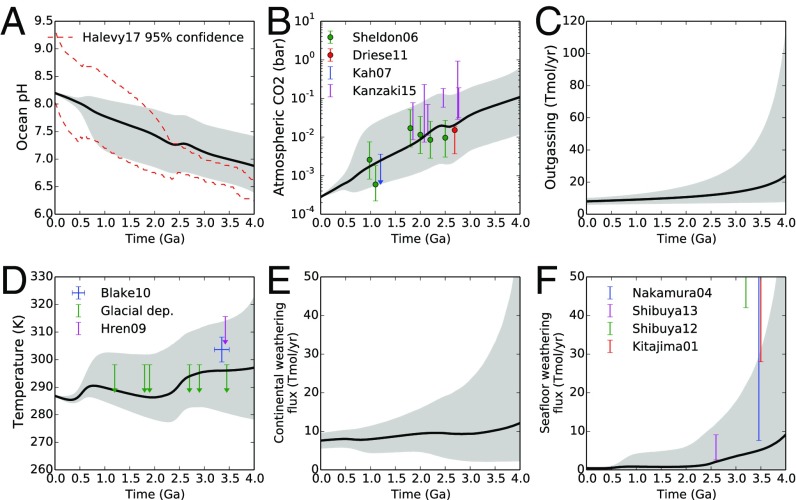
Significance: The climate and ocean pH of the early Earth are important for understanding the origin and early evolution of life. However, estimates of early climate range from below freezing to over 70 °C, and ocean pH estimates span from strongly acidic to alkaline. To better constrain environmental conditions, we applied a self-consistent geological carbon cycle model to the last 4 billion years. The model predicts a temperate (0–50 °C) climate and circumneutral ocean pH throughout the Precambrian due to stabilizing feedbacks from continental and seafloor weathering. These environmental conditions under which life emerged and diversified were akin to the modern Earth. Similar stabilizing feedbacks on climate and ocean pH may operate on earthlike exoplanets, implying life elsewhere could emerge in comparable environments.
Overview
The claims and statistics of this paper haven’t been checked yet.
Free: it reads the open-access text and checks the first 5 claims that cite a source we can check. Create a free account to check every claim.
Integrity signals
Registry
Cites
Statistics
Figures
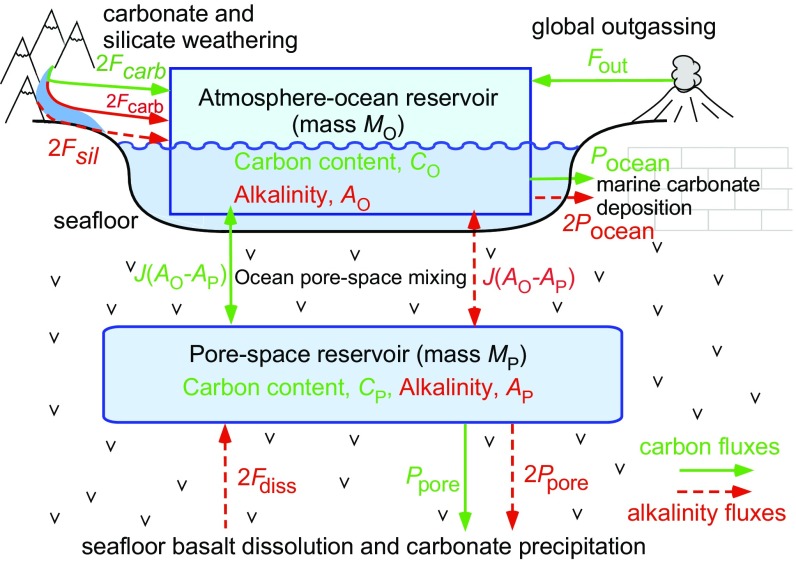
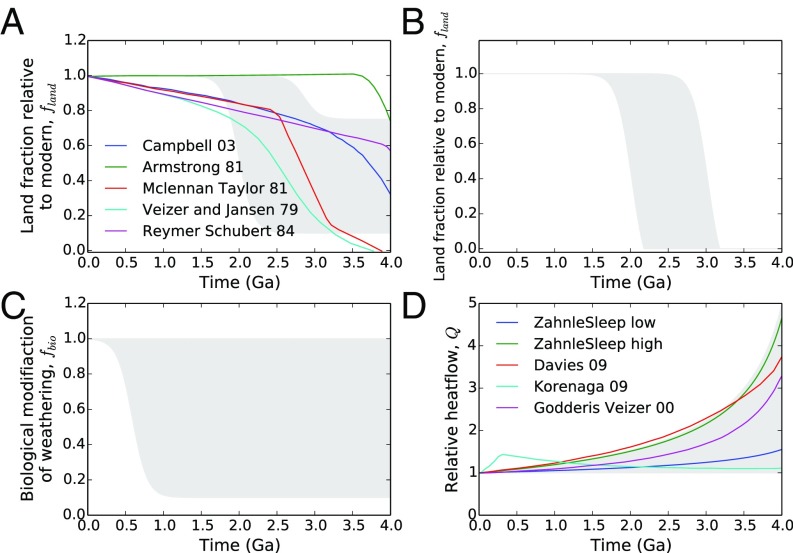
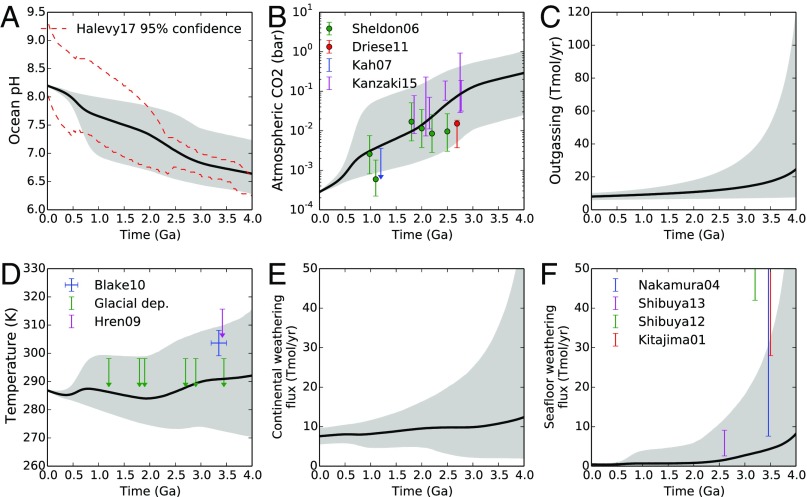
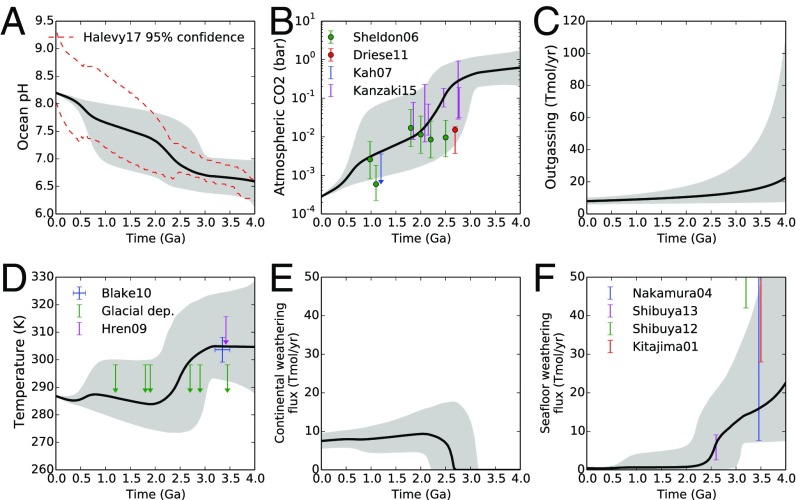
Verification
Claims the paper makes
The claims and statistics of this paper haven’t been checked yet.
Free: it reads the open-access text and checks the first 5 claims that cite a source we can check. Create a free account to check every claim.
Claims other papers make about this one
Each is checked against this paper’s own text: does it say what the citing paper says it does?
The source backs part of the claim, not all of it — or backs it for a different population, condition or comparison.
In the citing paper
“In the Archean, with greater seafloor production than today, seafloor weathering could have been comparable to continental weathering (34, 35, 182), and negative feedback (Eq. 2) likely maintained average Archean surface temperatures between 0° and 40°C with seawater pH 6.4 to 7.4 (34).”
From The Archean atmosphere (2020) · cites this paper as [34]
Experimental — accuracy not yet measuredThe source backs part of the claim, not all of it — or backs it for a different population, condition or comparison.
In the citing paper
“The corresponding pCO2 would have been 0.006 to 0.6 bar 4 Ga ago, assuming that ~104-ppmv CH4 also contributed to the greenhouse effect.”
From The Archean atmosphere (2020) · cites this paper as [34]
Experimental — accuracy not yet measuredThe source backs part of the claim, not all of it — or backs it for a different population, condition or comparison.
In the citing paper
“CO2 alone could have solved the FYS problem with 0.004- to 0.03-bar CO2 at 2.5 Ga ago and 0.024- to 1-bar CO2 at 4 Ga ago, where the spread comes from uncertain carbonate-silicate model parameters.”
From The Archean atmosphere (2020) · cites this paper as [34]
Experimental — accuracy not yet measuredThe source backs part of the claim, not all of it — or backs it for a different population, condition or comparison.
In the citing paper
“In general, how CO2 outgassing changed with time dominates the uncertainty (34).”
From The Archean atmosphere (2020) · cites this paper as [34]
Experimental — accuracy not yet measured
5 more claims about this paper
Create a free account to see every claim other papers make about this one.
Self-check
Percentages, sums and reported differences re-computed from the paper’s own numbers.
The self-check needs the paper’s full text.
Citations
Cites
An early Cenozoic perspective on greenhouse warming and carbon-cycle dynamics
Zachos, J. C., Dickens, G. R., & Zeebe, R. E. (2008) · Nature · doi:10.1038/nature06588 · Cited by 3,550 · cited 2×
“e existence of glacial deposits anywhere on Earth bounds global average temperatures to <25°C. The glaciation of Antarctica occurred approximately 35 Ma when global temperatures crossed below 20°C (48), and so an upper limit of 25°C is a more conservative estimate allowing for variations due to paleogeography. Of c…”
BackgroundInfluentialClark, P. U., Dyke, A. S., Shakun, J. D., Carlson, A. E., Clark, J., Wohlfarth, B., Mitrovica, J. X., Hostetler, S. W., & McCabe, A. M. (2009) · Science · doi:10.1126/science.1172873 · Cited by 3,277 · cited 2×
“coupled atmosphere-ocean GCMs with complete ocean circulation. Paleocene-Eocene Thermal Maximum (PETM) temperatures were sourced from Jones, et al. (22), Last Glacial Maximum (LGM) from Clark, et al. (23), and Cretaceous proxies from a composite dataset described in Krissansen-Totton and Catling (1). See KrissansenTot…”
BackgroundMethodInfluentialA negative feedback mechanism for the long‐term stabilization of Earth's surface temperature
Walker, J. C. G., Hays, P. B., & Kasting, J. F. (1981) · Journal of Geophysical Research: Oceans · doi:10.1029/jc086ic10p09776 · Cited by 2,310 · cited 1×
“The conventional view of the carbon cycle is that carbon outgassing into the atmosphere– ocean system is balanced by continental silicate weathering and subsequent marine carbonate formation (30, 31).”
BackgroundThermal Equilibrium of the Atmosphere with a Given Distribution of Relative Humidity
Manabe, S., & Wetherald, R. T. (1967) · Journal of the Atmospheric Sciences · doi:10.1175/1520-0469(1967)024<0241:teotaw>2.0.co;2 · Cited by 1,735 · cited 1×
“n). 13 We assume an Earth-mass planet with a surface albedo of 0.32, which includes the radiative effects of water clouds (60). We apply a Manabe/Wetherald relative humidity model for the troposphere (71) and specify a surface relative humidity of 0.8. Our relative humidity parameterization is described in more detail…”
MethodInfluentialGEOCARB II; a revised model of atmospheric CO 2 over Phanerozoic time
Berner, R. A. (1994) · American Journal of Science · doi:10.2475/ajs.294.1.56 · Cited by 1,683
HABITABLE ZONES AROUND MAIN-SEQUENCE STARS: NEW ESTIMATES
Kopparapu, R. K., Ramirez, R., Kasting, J. F., Eymet, V., Robinson, T. D., Mahadevan, S., Terrien, R. C., Domagal-Goldman, S., Meadows, V., & Deshpande, R. (2013) · The Astrophysical Journal · doi:10.1088/0004-637x/765/2/131 · Cited by 1,615 · cited 1×
“We used a 1D radiative convective model (46) to create a grid of mean surface temperatures as a function of solar luminosity and pCO2.”
MethodMantle Convection in the Earth and Planets
Schubert, G., Turcotte, D. L., & Olson, P. (2001) · Cambridge University Press eBooks · doi:10.1017/cbo9780511612879 · Cited by 1,374
GEOCARB III: A revised model of atmospheric CO2 over Phanerozoic time
Berner, R. A. (2001) · American Journal of Science · doi:10.2475/ajs.301.2.182 · Cited by 1,323
Research works printed but not linked: 1
- 2. Knauth LP Lowe DR 2003 High Archean climatic temperature inferred from oxygen isotope geochemistry of cherts in the 3.5 Ga Swaziland Supergroup, South Africa Geol Soc Am Bull 115 566 580 · doi:10.1130/0016-7606(2003)115
Cited by
Items 301–368 of 368
TRAJECTORY-BASED SIMULATION OF FAR-INFRARED CIA PROFILES OF CH4−N2 FOR MODELING TITAN'S ATMOSPHERE
Finenko, A. A., Vigasin, A. A., Petrov, S., Lokshtanov, S. E., Chistikov, D. N., Kalugina, Y. N., Bézard, B., Conway, E. K., & Gordon, I. E. (2021) · International Symposium on Molecular Spectroscopy (ISMS) · doi:10.15278/isms.2021.te13
(2021) · Biogeosciences · doi:10.5194/bg-2021-244-rc3
(2021) · Biogeosciences · doi:10.5194/bg-2021-244-rc2
Humphreys, M. P. (2021) · Biogeosciences · doi:10.5194/bg-2021-244-ac1
The Geological Platform for the Origin of Life on Earth
Stüeken, E. E., & Gardiner, N. J. (2021) · Advances in astrobiology and biogeophysics · doi:10.1007/978-3-030-81039-9_3 · Cited by 1
Vance, J. (2021) · Biogeosciences · doi:10.5194/bg-2021-78-ac1
Vance, J. (2021) · Biogeosciences · doi:10.5194/bg-2021-78-ac2
(2021) · Biogeosciences · doi:10.5194/bg-2021-78-rc2
(2021) · Геология и геофизика · doi:10.15372/gig202120 · Cited by 1
Abiotic Influences on the Early Evolution of Life
Mukherjee, I., & Corkrey, R. (2020) · Encyclopedia of the UN sustainable development goals · doi:10.1007/978-3-319-95981-8_130
Nabhan, S. (2020) · Encyclopedia of Astrobiology · doi:10.1007/978-3-642-27833-4_5235-3
Thioester Synthesis by Geoelectrochemical CO2 Fixation on Ni SulfidesPreprint
Kitadai, N., Nakamura, R., Yamamoto, M., Okada, S., Takahagi, W., Nakano, Y., Takahashi, Y., Takai, K., & Oono, Y. (2020) · ChemRxiv · doi:10.26434/chemrxiv.12016779.v1
(2021) · Biogeosciences · doi:10.5194/bg-2021-244-rc1
Microbial influences on manganese deposit formation at Yunotaki Fall, Japan
Shiraishi, F., Chihara, R., Tanimoto, R., Tanaka, K., & Takahashi, Y. (2022) · Island Arc · doi:10.1111/iar.12448
Geochemical and Evolutionary Prerequisites for the Cambrian Skeletal Revolution
Наймарк, Е. Б. (2022) · Biology Bulletin · doi:10.1134/s1062359022070111
“However, it should be noted that the pH of ocean water increased monotonically from the acidic (pH 6.5) state in the Early Proterozoic to the modern alkaline (pH 8.2) state (Krissansen-Totton et al., 2018).”
BackgroundInfluentialCheng, M., 张, 子., 金, 承., 魏, 巍., 王, 海., Thomas, J. A., & 李, 超. (2023) · SCIENTIA SINICA Terrae · doi:10.1360/n072022-0145
Nabhan, S. (2023) · Encyclopedia of Astrobiology · doi:10.1007/978-3-662-65093-6_5235
La résistance dans les infections bactériennes : apport de l'entrepôt de données de santé de l'AP-HP
Abbara, S. (2022) · theses.fr (ABES) · doi:10.70675/95a68873zc241z4037z981az6deb4348d913
Searching for traces of life in a Mars analogue rock : The Kitty’s Gap Chert
Clodoré, L. (2023) · theses.fr (ABES) · doi:10.70675/d5e6642dz41c6z4e3bzb7f5z6bc58cf11c86
An Ensemble Approach to the Origin of Life
Alicea, B., Ahmad, B., & Gordon, R. (2024) · Wiley eBooks · doi:10.1002/9781119901228.ch8 · Cited by 1
Environmental Changes Impacting on, and Caused by, the Evolution of Photosynthetic Organisms
Raven, J. A. (2024) · Cambridge University Press eBooks · doi:10.1017/9781139049979.002
3rd Drake: Fraction of Stable Planets for 7 Gy (Duration of the Stellar Population)
Mieli, E., Valli, A. M. F., & Maccone, C. (2024) · Springer eBooks · doi:10.1007/978-3-031-67324-5_5
Biological control on iron phyllosilicate authigenesis and Archean ocean chemistryPreprint
Sen, A., Baldermann, A., Pal, D. C., Grengg, C., Samanta, P., Bose, S., Sengupta, P., Agrawal, S., & Mukhopadhyay, S. (2025) · Research Square · doi:10.21203/rs.3.rs-6098202/v1
Urbano, E. E. M. C., Gomes, M. E. P., Meireles, C., Brandão, P. R. G., Hippertt, J., Scholz, R., & LANA, C. D. C. (2025) · Sedimentary Geology · doi:10.1016/j.sedgeo.2025.106885
Balancing Earth's Deep Carbon Cycle
Kitamura, S., Kadoya, S., Hernlund, J. W., & Nakagawa, T. (2026) · Journal of Geophysical Research Solid Earth · doi:10.1029/2025jb033024
The Role of Tectonic Luck in Long-Term Habitability of Abiotic Earth-like PlanetsPreprint
Coy, B. P., Kite, E. S., & Graham, R. J. (2025) · EarthArXiv (California Digital Library) · doi:10.31223/x5f45q
Temperature and Chemical Composition of Precambrian Oceans
Marin‐Carbonne, J., & Thomazo, C. (2025) · Wiley eBooks · doi:10.1002/9781394417865.ch5
The Role of Hydrothermal Processes in the Evolution of Early Earth and Aquaplanets
Shibuya, T., Tan, S., Kikuchi, S., Ueda, H., Takai, K., & Sekine, Y. (2025) · Geophysical monograph · doi:10.1002/9781394229185.ch15
Evolving weathering processes during the Archean Eon
Hao, J., Knoll, A. H., Cui, X., Song, Y., Jing, Z., & Huang, F. (2025) · Elsevier eBooks · doi:10.1016/b978-0-323-95547-8.00025-2
Robbins, L. J., Mänd, K., Li, Z., & Konhauser, K. O. (2025) · Elsevier eBooks · doi:10.1016/b978-0-323-95547-8.00027-6
Comellas, J. M., Essunfeld, A., Morris, R. A., Gasda, P. J., Lanza, N., Sharma, S. K., Huynh, A. K., Das, D., Bedford, C. C., Dehouck, E., et al. (2025) · Icarus · doi:10.1016/j.icarus.2025.116902
Li, S., Guy, B. M., & Nie, J. (2025) · Geochimica et Cosmochimica Acta · doi:10.1016/j.gca.2025.12.020 · Cited by 1
Linking lithium isotopic composition of seawater to atmospheric oxygenation
Xu, Z., Frings, P. J., Liu, C., & Li, G. (2025) · Geochimica et Cosmochimica Acta · doi:10.1016/j.gca.2025.12.013 · Cited by 1
Morgan, A. (2022) · Lancaster EPrints (Lancaster University) · doi:10.17635/lancaster/thesis/1546
Watanabe, Y., & Tajika, E. (2021) · Figshare · doi:10.6084/m9.figshare.16829416
Springsklee, C. (2023) · doi:10.5282/edoc.32199 · Cited by 1
Evaluation of extraterrestrial life origin based on extreme environments evidence
Fernández Martín, M., & de Biociències, U. A. D. B. F. (2021) · Dipòsit Digital de Documents de la UAB (Universitat Autònoma de Barcelona)
Mantle differentiation, mixing, and interior-exterior exchange
Nakagawa, T., Jain, C., Lourenço, D. L., Ballmer, M., & Tackley, P. J. (2025) · Elsevier eBooks · doi:10.1016/b978-0-323-95547-8.00010-0
Chen, D., & Catling, D. C. (2026) · Geochimica et Cosmochimica Acta · doi:10.1016/j.gca.2026.01.020
Self-citationXu, L., Shi, X., von Strandmann, P. A. E. P., Zhou, X., Wang, X., Xiao, Y., Lei, J. F., Zhou, Q., Zhou, L., Sun, L., et al. (2026) · Geophysical Research Letters · doi:10.1029/2025gl119617
“Notably, geological reconstructions of seawater pH show no significant pH variation during this period (Halevy & Bachan, 2017; Krissansen‐Totton et al., 2018), suggesting that the negative δ 7 Li excursions may not primarily be controlled by pH.”
Climates of Terrestrial Exoplanets and Biosignatures
Bhatnagar, S., Bolmont, É., Boeren, N. J., Hansen, J., Konrad, B. S., Schlarmann, L., Alei, E., Azevedo, M., Braam, M., Chaverot, G., et al. (2026) · Lirias · doi:10.48550/arxiv.2601.20620 · Cited by 1
Steve, K. L., Moyen, J., Boyet, M., Marin‐Carbonne, J., Olivier, N., Garçon, M., & Stevens, G. (2026) · Advances in Geochemistry and Cosmochemistry · doi:10.33063/agc.v2i1.773
“The Archean seawater and resultant silica-rich hydrothermal fluid are generally believed to have been acidic (Halevy and Bachan, 2018; Krissansen-Totton et al., 2018; Rouchon and Orberger, 2008), and lighter REEs are known to preferentially re-precipitate from such acidic fluids compared to heavier…”
Bachelet, I. (2026) · bioRxiv (Cold Spring Harbor Laboratory) · doi:10.64898/2026.03.05.709948
“While the cooling itself would have expanded the thermal range habitable by RNA, it accelerated silicate weathering of the evolving crust, releasing cations into the ocean and drawing down atmospheric CO ₂ - directly driving a rapid pH rise 19,20 .”
Basu, H., Prakash, K., Sivasubramaniam, R., Goyal, N., Sunilkumar, T. S., & Sinha, D. K. (2026) · Journal of Asian Earth Sciences · doi:10.1016/j.jseaes.2026.107057
Precambrian paleoclimate: fragments of a mosaic (review)
Maslov, A. V., & Melnichuk, O. Y. (2026) · Geologicheskii vestnik · doi:10.31084/2619-0087/2026-1-4
Yan, X., Zhu, C., Song, W., (15334741), Y. W., Gao, L., Wang, W., Yin, H. Y., Fan, H., & Wen, H. (2026) · Geochimica et Cosmochimica Acta · doi:10.1016/j.gca.2026.03.030 · Cited by 1
鉄に富む温泉環境における微生物生態の地球化学的変動要因:メタゲノム解析と機械学習アプローチ
Li, H. F., & Li-Hau, F. (2025) · Institutional Repositories DataBase (IRDB)
Outgassing control on the Phanerozoic atmospheric CO2 dynamics
Fakhraee, M. (2026) · Chemical Geology · doi:10.1016/j.chemgeo.2026.123410
Thanwerdas, J. (2021) · theses.fr (ABES) · doi:10.70675/ea48fa39z83abz4302z8760zcb00119a44c8 · Cited by 2
Constraining the early evolution of Earth’s photosynthetic pathways : an isotopic approach
Patry, L. A. (2022) · theses.fr (ABES) · doi:10.70675/c979ae58zc800z4ff3z8fe6z3812b16dbeef
Legrain, É. (2023) · theses.fr (ABES) · doi:10.70675/e0683d6dz1959z4d5az8d18zd55d6181f940 · Cited by 1
Endo, Y., Watanabe, Y., & Ozaki, K. (2026) · The Astrophysical Journal · doi:10.3847/1538-4357/ae6266
“If oceans were more acidic—due to elevated atmospheric p CO 2 , as predicted for the early Earth ( e.g., E. Tajika & T. Matsui 1992; I. Halevy & A. Bachan 2017; J. Krissansen-Totton et al. 2018a; M. Guo & J. Korenaga 2025 ) —”
The role of plate tectonic-like behaviour in the long-term climate evolution of Earth
Nakagawa, T. (2026) · Earth and Planetary Science Letters · doi:10.1016/j.epsl.2026.120193
The chemistry of habitable oceans in the Solar system
Hao, J., Zhu, Y., Knoll, A. H., Tosca, N. J., He, C., Lau, M. C. Y., Liao, L., Crockford, P. W., Stüeken, E. E., Huo, A., et al. (2026) · Nature Communications · doi:10.1038/s41467-026-74955-4
“However, progressive silicate weathering would have gradually increased ocean alkalinity and pH over time 78,79 , perhaps buffering at a value around 6.5-7 in the Archean (Fig.”
InfluentialSelf-citationLangbert, C., Apai, D., & Malhotra, R. (2026) · The Astrophysical Journal Letters · doi:10.3847/2041-8213/ae8a43
“On Earth, ocean carbonate chemistry regulates the partitioning of carbon between the atmosphere and ocean, while continental and seafloor weathering provide long-term sinks for atmospheric CO 2 ( J. C. G. Walker et al. 1981; R. E. Zeebe 2012; J. Krissansen-Totton et al. 2018 ) .”
Present, T. M., Adams, E. W., Bergmann, K., Harthy, A. A., Al-Rawahi, Z., & Grotzinger, J. P. (2026) · Journal of Sedimentary Research · doi:10.2110/jsr.2025.098
Guo, M., Meng, Z., Liu, S., & Redfern, S. A. T. (2026) · Life · doi:10.3390/life16091436
“Compared with earlier ocean-pH reconstructions [30,93], Guo and Korenaga [37] present a coupled global carbon-cycle and marine-chemistry framework explicitly initialized with the high post-magma-ocean pCO 2 conditions implied by degassing models.”
Influential鉄に富む温泉環境における微生物生態の地球化学的変動要因:メタゲノム解析と機械学習アプローチ
Li-Hau, F. (2025) · Institutional Repositories DataBase (IRDB)
Krause, A. J., Zhao, M., Merdith, A., & Mills, B. (2026) · EarthArXiv (California Digital Library) · doi:10.31223/x5cb9p
Zinc isotopic evidence for an Archean initiation of deep carbon cycling
Du, Y.-F., Ma, Z., Wang, S., Sun, J., Mitchell, R. H., & Tappe, S. (2026) · Proceedings of the National Academy of Sciences · doi:10.1073/pnas.2616574123
Material cycling across Earth’s spheres and triggers of Cambrian explosion: a tectonic perspective
Yao, J., Han, Y., Zhang, D., Liu, Q., Chen, L., Cui, P., & Zhao, G. (2026) · Continent and Life Evolution · doi:10.55092/cle20260011
“This carbon-cycle mode created a surficial environment characterized by “continuously increasing oxygenation, sufficient nutrients, and relatively stable climate” (Krissansen-Totton et al. 2018).”
Kinetics of CO 2 reduction across Fe(Ni)S precipitates: the role of pH gradients
Decker, Y. D., Cantillon, V., Doneux, T., & Hudson, R. (2026) · Physical Chemistry Chemical Physics · doi:10.1039/d6cp00794e
Boron isotopes in Archean-Proterozoic marine deposits trace continental emergence
Abbo, A., Marschall, H., & Gerdes, A. (2026) · Geochemical Perspectives Letters · doi:10.7185/geochemlet.2635
Intimate Link Between Prebiotic Chemistry and Meteorites: Mechanisms of Organic Molecule Formation
Tunney, L. D., Harrison, P. H. M., & Slater, G. F. (2026) · Astrobiology · doi:10.1177/15311074261493342
Data cleaning and standardization in GeobiologyData and their scientific implications
Xiang, S. H. U., Jian-kang, L. A. I., Yao-kai, T. I. A. N., Yan, F. E. N. G., Lai, W. E. I., Yong, D. U., En-hao, J. I. A., Wu, Y., Xiao-kang, L. I. U., Dao-liang, C. H. U., et al. (2026) · Gushengwu xuebao · doi:10.3724/aps.2026027
Evolutionary histories of microbial calcification-associated genes across the tree of life
Liu, P., Wang, Y., Roberts, A., Meng, F., Zhang, R., Zhang, C., Zhu, K., Cao, Z., Pan, Y., & Li, J. (2026) · mSystems · doi:10.1128/msystems.00911-26
“This process could facilitate carbonate precipitation on cell surfaces, potentially buffering against acidic early ocean conditions (49, 50).”
Influential
Metadata
- Authors
- Krissansen-Totton, J., Arney, G. N., & Catling, D. C.
- Affiliations
- Department of Earth and Space Sciences, University of Washington, Seattle, WA 98195;
- Goddard Space Flight Center (US)
- NASA Astrobiology Institute (US)
- Venue
- Proceedings of the National Academy of Sciences
- Publisher
- National Academy of Sciences
- Published
- 2018-04-02
- Volume
- 115
- Issue
- 16
- Pages
- 4105-4110
- ISSN
- 0027-8424 (ISSN-L)
- 1091-6490
- PMC
- PMC5910859
- OpenAlex
- W2796394497
- Cited by
- 348
- References
- 140
- Citations by year
- 2026: 35 · 2025: 51 · 2024: 38 · 2023: 37 · 2022: 44 · 2021: 62 · 2020: 43 · 2019: 27 · 2018: 9
- FWCI
- 25.94
- Type
- journal article
- Language
- en
- Open access
- hybrid
- doi.org
- Licence
- Locations
- Proceedings of the National Academy of Sciences (publishedVersion, cc-by-nc-nd)
- Europe PMC (PubMed Central) (publishedVersion, cc-by-nc-nd)
- PubMed Central (publishedVersion, cc-by-nc-nd)
- PubMed (publishedVersion)
- arXiv (Cornell University) (submittedVersion)
- arXiv (Cornell University)
- Funders
- National Aeronautics and Space Administration (NNX15AL23G, NNX15AR63H, NNA13AA93A)
- Simons Foundation (511570)
- Topics
- Physical Sciences › Earth and Planetary Sciences › Paleontology › Paleontology and Stratigraphy of Fossils
- Physical Sciences › Environmental Science › Global and Planetary Change › Earth Systems and Cosmic Evolution
- Physical Sciences › Physics and Astronomy › Astronomy and Astrophysics › Origins and Evolution of Life
- Keywords
- early Earth climate, seawater pH, Precambrian, continental weathering, seafloor weathering, origin of life, early evolution of life, exoplanet habitability
About these checks
Registry, retraction, Cites and statistics results are computed, not judged, with one exception: a printed reference that no index lists is read once by a model before it counts as a citation error. Claims are extracted by a model and kept only when their quote appears verbatim in the text; each cited source is then checked, with a model’s help, for whether it says what the claim relies on. Those verdicts can be wrong — read the claim’s quote and the cited source before relying on one.
Statistics and arithmetic are recomputed, not judged.
Confidence bands are shown only for fields calibrated on our annotated test set. None is calibrated yet, so no band is shown.
What counts as a claim ›How we measure confidence ›How we check this ›
Are you an author, or do you see a problem with this page? Request a review
Data sources
Bibliographic data: Semantic Scholar, OpenAlex, Crossref.
Contains information from the Semantic Scholar Academic Graph Datasets, made available under the ODC Attribution License (ODC-BY 1.0).
Semantic Scholar’s data is described in: Kinney, R., et al. (2023). The Semantic Scholar Open Data Platform. arXiv:2301.10140.
