

Cascading trend of Early Paleozoic marine radiations paused by Late Ordovician extinctions
Open accessThe DOI matches its Crossref record; 83 of the 84 references it cites were found in a registry or an index, and 1 are not checked yet.
Abstract
The greatest relative changes in marine biodiversity accumulation occurred during the Early Paleozoic. The precision of temporal constraints on these changes is crude, hampering our understanding of their timing, duration, and links to causal mechanisms. We match fossil occurrence data to their lithostratigraphical ranges in the Paleobiology Database and correlate this inferred taxon range to a constructed set of biostratigraphically defined high-resolution time slices. In addition, we apply capture–recapture modeling approaches to calculate a biodiversity curve that also considers taphonomy and sampling biases with four times better resolution of previous estimates. Our method reveals a stepwise biodiversity increase with distinct Cambrian and Ordovician radiation events that are clearly separated by a 50-million-year-long period of slow biodiversity accumulation. The Ordovician Radiation is confined to a 15-million-year phase after which the Late Ordovician extinctions lowered generic richness and further delayed a biodiversity rebound by at least 35 million years. Based on a first-differences approach on potential abiotic drivers controlling richness, we find an overall correlation with oxygen levels, with temperature also exhibiting a coordinated trend once equatorial sea surface temperatures fell to present-day levels during the Middle Ordovician Darriwilian Age. Contrary to the traditional view of the Late Ordovician extinctions, our study suggests a protracted crisis interval linked to intense volcanism during the middle Late Ordovician Katian Age. As richness levels did not return to prior levels during the Silurian—a time of continental amalgamation—we further argue that plate tectonics exerted an overarching control on biodiversity accumulation.
Overview
The claims and statistics of this paper haven’t been checked yet.
Free: it reads the open-access text and checks the first 5 claims that cite a source we can check. Create a free account to check every claim.
Integrity signals
Registry
Cites
Statistics
Figures
Verification
Claims the paper makes
The claims and statistics of this paper haven’t been checked yet.
Free: it reads the open-access text and checks the first 5 claims that cite a source we can check. Create a free account to check every claim.
Claims other papers make about this one
Each is checked against this paper’s own text: does it say what the citing paper says it does?
The source backs part of the claim, not all of it — or backs it for a different population, condition or comparison.
In the citing paper
“Both the curves (Fig. 2B) of Rasmussen et al. (2019) and Kr ¨ oger et al. (2019) indicated a strong increase of diversity in Cambrian Series 2 (Cambrian Stage 3), already observed by Na and Kiessling (2015), and thus illustrating the presence of taxa in the PBDB, resulting mainly from the numerous descriptions of fossils in the major Lagerst ¨ atten.”
From No (Cambrian) explosion and no (Ordovician) event: A single long-term radiation in the early Palaeozoic (2023) · cites this paper as Rasmussen et al., 2019
Experimental — accuracy not yet measuredThe cited source says what the claim attributes to it.
In the citing paper
“It is interesting to note that the timing of the Cambrian 'Explo sion ' differs slightly in both datasets, but that the definition of the GOBE is totally different: while the GBDB (Fan et al., 2020) indicates a GOBE in the late Cambrian and Early Ordovician, the PBDB related publications by Rasmussen et al. (2019) and Kr ¨ oger et al. (2019) define a rather short GOBE in the Middle Ordovician (”
From No (Cambrian) explosion and no (Ordovician) event: A single long-term radiation in the early Palaeozoic (2023) · cites this paper as Rasmussen et al., 2019
The cited source says what the claim attributes to it.
In the citing paper
“Rasmussen et al. (2019) narrowed the concept of the 'GOBE ' even more, considering a particular diversity increase in the PBDB dataset, taking place during an earlier part of the Darriwilian, as the 'event. '”
From No (Cambrian) explosion and no (Ordovician) event: A single long-term radiation in the early Palaeozoic (2023) · cites this paper as Rasmussen et al. (2019)
Self-check
Percentages, sums and reported differences re-computed from the paper’s own numbers.
The self-check needs the paper’s full text.
Citations
Cites
Chao, A., Gotelli, N. J., Hsieh, T. C., Sander, E. L., Ma, K. H., Colwell, R. K., & Ellison, A. M. (2014) · Ecological Monographs · doi:10.1890/13-0133.1 · Cited by 4,256 · cited 5×
“We compared the results of the CR-modeling (DCR) approach with results from shareholders quorum subsampling, DSQS (2, 3), and from estimates of the Shannon entropy Hill number, DHill (17, 21).”
MethodResultInfluentialPARTITIONING DIVERSITY INTO INDEPENDENT ALPHA AND BETA COMPONENTS
Jost, L. (2007) · Ecology · doi:10.1890/06-1736.1 · Cited by 2,265
Approaching a state shift in Earth’s biosphere
Barnosky, A. D., Hadly, E. A., Bascompte, J., Berlow, E. L., Brown, J. H., Fortelius, M., Getz, W. M., Harte, J., Hastings, A., Marquet, P. A., et al. (2012) · Nature · doi:10.1038/nature11018 · Cited by 1,966 · cited 1×
“C transitions in the state of the Earth that forced global ecosystems to adjust to changes in the physical environment fundamentally impacted Phanerozoic biodiversity levels (1).”
BackgroundA Chronology of Paleozoic Sea-Level Changes
Haq, B. U., & Schutter, S. R. (2008) · Science · doi:10.1126/science.1161648 · Cited by 1,623 · cited 2×
“Likely the increase in oxygen concentrations benefitted metazoan life and continued to sustain increased biodiversity accumulation as sea levels rose (32), expanding the habitable ecospace on the drowned epicontinental platforms.”
BackgroundMethod(2016) · Elsevier eBooks · doi:10.1016/c2009-0-64442-1 · Cited by 1,476
Phanerozoic polar wander, palaeogeography and dynamics
Torsvik, T. H., Van der Voo, R., Preeden, U., Mac Niocaill, C., Steinberger, B., Doubrovine, P. V., van Hinsbergen, D. J. J., Domeier, M., Gaina, C., Tohver, E., et al. (2012) · Earth-Science Reviews · doi:10.1016/j.earscirev.2012.06.007 · Cited by 1,445 · cited 1×
“Decreasing provincialism and habitat destruction caused by amalgamating continents (70) further hindered a fast rebound of biodiversity accumulation during the earliest Silurian (56).”
BackgroundPhanerozoic Trends in the Global Diversity of Marine Invertebrates
Alroy, J., Aberhan, M., Bottjer, D. J., Foote, M., Fürsich, F. T., Harries, P. J., Hendy, A. J. W., Holland, S. M., Ivany, L. C., Kiessling, W., et al. (2008) · Science · doi:10.1126/science.1156963 · Cited by 778 · cited 17×
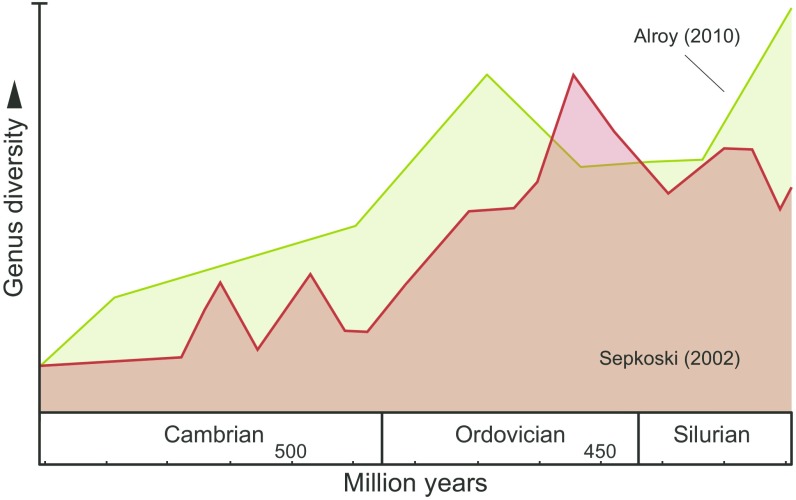
“(2, 3) used genus-level occurrences to address sampling and preservation bias in a temporal binning framework of equal duration (Fig.”
BackgroundResultInfluentialA General Methodology for the Analysis of Capture-Recapture Experiments in Open Populations
Schwarz, C. J., & Arnason, A. N. (1996) · Biometrics · doi:10.2307/2533048 · Cited by 747
Falcon, N. L., & Harland, W. B. (1983) · The Geographical Journal · doi:10.2307/634028 · Cited by 689
Did Cooling Oceans Trigger Ordovician Biodiversification? Evidence from Conodont Thermometry
Trotter, J. A., Williams, I. S., Barnes, C. R., Lécuyer, C., & Nicoll, R. S. (2008) · Science · doi:10.1126/science.1155814 · Cited by 669 · cited 5×
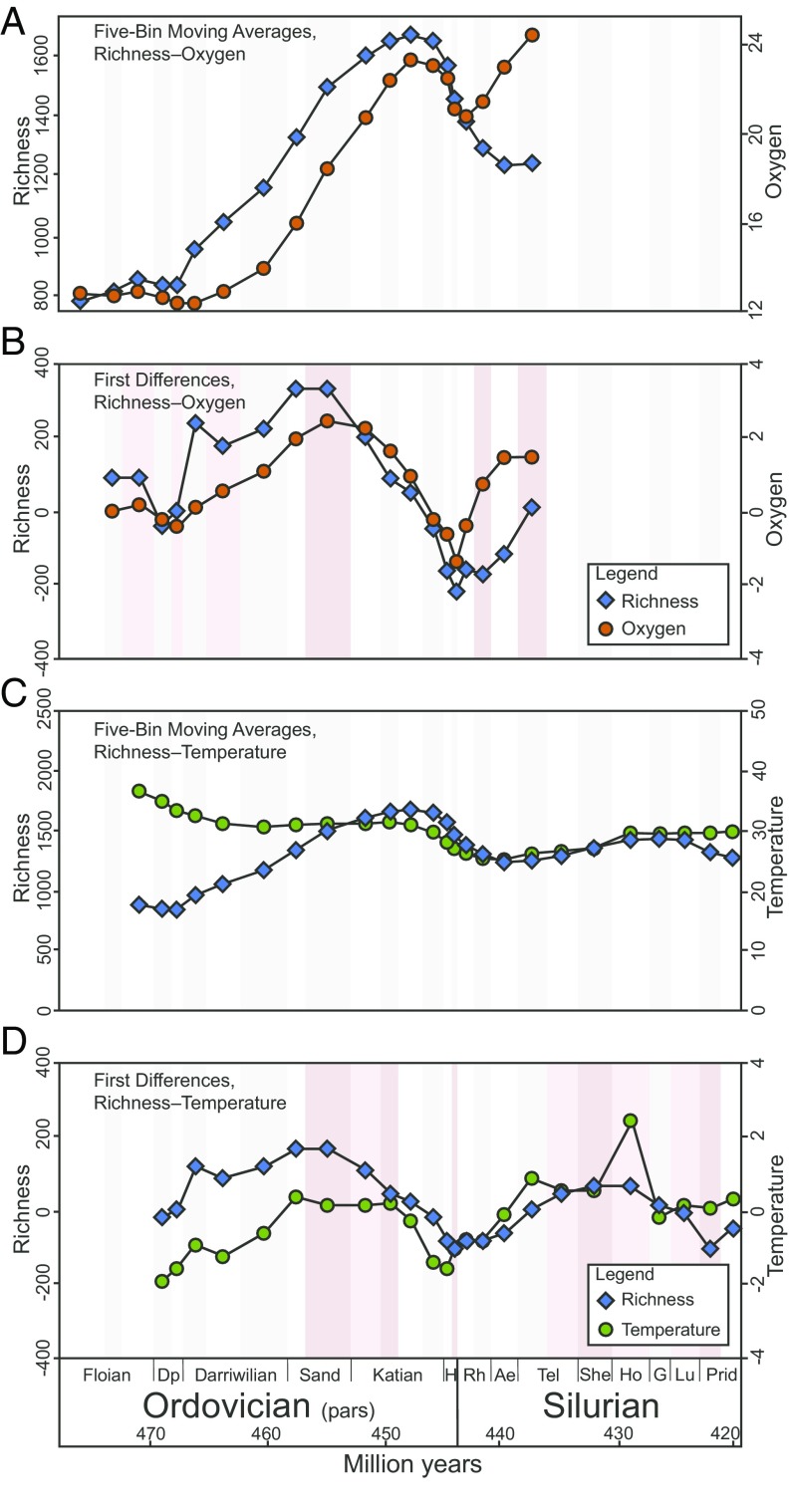
“(C and D) Coordinated change between richness and tropical sea surface temperature estimates (33, 63).”
BackgroundInfluentialBenton, M. J. (2009) · Science · doi:10.1126/science.1157719 · Cited by 663 · cited 1×
“While controls on biodiversity change have been long discussed (71), better temporal precision on the chain of eco-evolutionary events and dating of the richness fluctuations themselves may resolve this debate.”
BackgroundBrenchley, P. J., Marshall, J. D., Carden, G. A. F., Robertson, D. B. R., Long, D. G. F., Meidla, T., Hints, L., & Anderson, T. F. (1994) · Geology · doi:10.1130/0091-7613(1994)022<0295:baiefa>2.3.co;2 · Cited by 610
Bergström, S. M., Chen, X., Gutiérrez‐Marco, J. C., & Dronov, A. (2009) · Lethaia · doi:10.1111/j.1502-3931.2008.00136.x · Cited by 606 · cited 1×
“(13) for the Lower–Middle Ordovician, and Ferretti et al.”
Background(2002) · Medical Entomology and Zoology · Cited by 555
On the causes of mass extinctions
Bond, D. P. G., & Grasby, S. E. (2017) · Palaeogeography, Palaeoclimatology, Palaeoecology · doi:10.1016/j.palaeo.2016.11.005 · Cited by 538
PHANEROZOIC BIODIVERSITY MASS EXTINCTIONS
Bambach, R. K. (2006) · Annual Review of Earth and Planetary Sciences · doi:10.1146/annurev.earth.33.092203.122654 · Cited by 529 · cited 1×
“Previous studies have shown that the ecological disruption succeeding the end Ordovician extinction events was of lower order than, for instance, after the end-Permian and end-Cretaceous mass extinctions (51, 52).”
The Shifting Balance of Diversity Among Major Marine Animal Groups
Alroy, J. (2010) · Science · doi:10.1126/science.1189910 · Cited by 467 · cited 20×
“(2, 3) used genus-level occurrences to address sampling and preservation bias in a temporal binning framework of equal duration (Fig.”
BackgroundMethodResultInfluentialStrontium Isotope Stratigraphy
McArthur, J. M., Howarth, R. J., & Shields, G. A. (2012) · The Geologic Time Scale · doi:10.1016/b978-0-444-59425-9.00007-x · Cited by 436
Osleger, D., & Hallam, A. (1993) · PALAIOS · doi:10.2307/3515270 · Cited by 405
Rohde, R. A., & Muller, R. A. (2005) · Nature · doi:10.1038/nature03339 · Cited by 399 · cited 16×
“aNatural History Museum of Denmark, University of Copenhagen, DK-1350 Copenhagen, Denmark; bFinnish Museum of Natural History, University of Helsinki, 00014 Helsinki, Finland; and cSchool of Earth Sciences, University of Bristol, Bristol BS8 1RL, United Kingdom Edited by Lauren Sallan, University of Pennsylvania, Phil…”
BackgroundInfluentialSepkoski, J. J. (1979) · Paleobiology · doi:10.1017/s0094837300006539 · Cited by 387 · cited 2×
“The two stepwise pulses of biodiversity increase observed in our curve echoes the classic ideas of the kinetic model of taxonomic richness suggesting that an equilibrium was reached twice during the Early Paleozoic (10).”
BackgroundPeng, S., Babcock, L. E., & Cooper, R. A. (2012) · The Geologic Time Scale · doi:10.1016/b978-0-444-59425-9.00019-6 · Cited by 386
Earliest land plants created modern levels of atmospheric oxygen
Lenton, T. M., Dahl, T. W., Daines, S. J., Mills, B. J. W., Ozaki, K., Saltzman, M. R., & Porada, P. (2016) · Proceedings of the National Academy of Sciences · doi:10.1073/pnas.1604787113 · Cited by 343 · cited 2×
“Cooling climate, as expressed in temperature estimates (33, 34) and rising oxygen levels (35, 36) may have been key factors for the diversification during this time (see further discussion on abiotic drivers below).”
BackgroundEnd Ordovician extinctions: A coincidence of causes
Harper, D. A. T., Hammarlund, E. U., & Rasmussen, C. M. Ø. (2014) · Gondwana Research · doi:10.1016/j.gr.2012.12.021 · Cited by 326
Self-citationBiodiversity: Past, Present, and Future
Sepkoski, J. J. (1997) · Journal of Paleontology · doi:10.1017/s0022336000040026 · Cited by 313 · cited 4×
“As Silurian richness levels did not surpass the Late Ordovician levels, our estimate is consistent with the “Paleozoic Plateau” suggested by Sepkoski (6, 48).”
BackgroundResultInfluentialPlate-tectonic Regulation of Faunal Diversity and Sea Level: a Model
VALENTINE, J. W., & MOORES, E. M. (1970) · Nature · doi:10.1038/228657a0 · Cited by 304 · cited 2×
“Such plate tectonic cycles have been demonstrated on the Phanerozoic scale to yield higher global biodiversity (59, 60), and this has also been invoked as causal mechanisms behind the GOBE (61, 62).”
BackgroundGeologic constraints on the macroevolutionary history of marine animals
Peters, S. E. (2005) · Proceedings of the National Academy of Sciences · doi:10.1073/pnas.0502616102 · Cited by 291 · cited 1×
“A number of studies have found a first-order correlation of richness to outcrop area and number of formations (25, 26).”
BackgroundCooper, R. A., Sadler, P. M., Hammer, O., & Gradstein, F. M. (2012) · The Geologic Time Scale · doi:10.1016/b978-0-444-59425-9.00020-2 · Cited by 268
The Ordovician biodiversification: setting an agenda for marine life
Harper, D. A. T. (2006) · Palaeogeography, Palaeoclimatology, Palaeoecology · doi:10.1016/j.palaeo.2005.07.010 · Cited by 261
Calibrating the Ordovician Radiation of marine life: implications for Phanerozoic diversity trends
Miller, A. I., & Foote, M. (1996) · Paleobiology · doi:10.1017/s0094837300016237 · Cited by 240 · cited 5×
“Crampton JS, Cooper RA, Sadler PM, Foote M (2016) Greenhouse-icehouse transition in the Late Ordovician marks a step change in extinction regime in the marine plankton.”
MethodInfluentialCramer, B. D., Brett, C. E., Melchin, M. J., Männik, P., Kleffner, M. A., Mclaughlin, P. I., Loydell, D. K., Munnecke, A., Jeppsson, L., Corradini, C., et al. (2011) · Lethaia · doi:10.1111/j.1502-3931.2010.00234.x · Cited by 226
Late Ordovician global warming—The Boda event
Fortey, R. A., & Cocks, L. R. M. (2005) · Geology · doi:10.1130/g21180.1 · Cited by 226
Onset of main Phanerozoic marine radiation sparked by emerging Mid Ordovician icehouse
Rasmussen, C. M. Ø., Ullmann, C. V., Jakobsen, K. G., Lindskog, A., Hansen, J., Hansen, T., Eriksson, M. E., Dronov, A., Frei, R., Korte, C., et al. (2016) · Scientific Reports · doi:10.1038/srep18884 · Cited by 222 · cited 6×
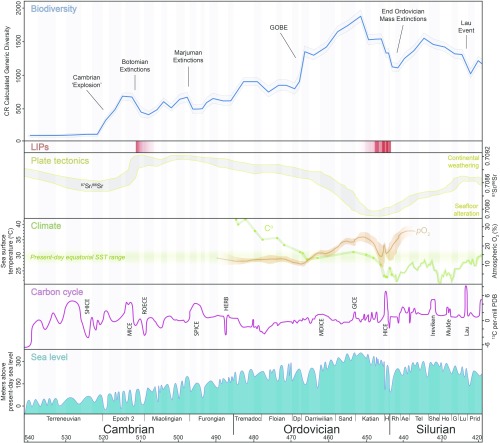
“However, as the MDICE is characterized by a slow increase toward heavier values, this contrasts with the repeated, abrupt positive pulses seen associated with the extinction intervals (Fig.”
BackgroundInfluentialSelf-citationDeterminants of extinction in the fossil record
Peters, S. E., & Foote, M. (2002) · Nature · doi:10.1038/416420a · Cited by 220
Plate tectonic regulation of global marine animal diversity
Zaffos, A., Finnegan, S., & Peters, S. E. (2017) · Proceedings of the National Academy of Sciences · doi:10.1073/pnas.1702297114 · Cited by 214
A global synthesis of the latest Ordovician Hirnantian brachiopod faunas
Jia-yu, R., & Harper, D. A. T. (1988) · Transactions of the Royal Society of Edinburgh: Earth Sciences · doi:10.1017/s026359330001436x · Cited by 195
Calibrating the Ordovician Radiation of marine life: implications for Phanerozoic diversity trends.
Miller, A. I., & Foote, M. (1996) · PubMed · doi:10.1666/0094-8373-22.2.304 · Cited by 194
A Cenozoic-style scenario for the end-Ordovician glaciation
Ghienne, J.-F., Desrochers, A., Vandenbroucke, T. R. A., Achab, A., Asselin, E., Dabard, M.-P., Farley, C., Loi, A., Paris, F., Wickson, S., et al. (2014) · Nature Communications · doi:10.1038/ncomms5485 · Cited by 193
Decoupling of taxonomic and ecologic severity of Phanerozoic marine mass extinctions
Droser, M. L., Bottjer, D. J., Sheehan, P. M., & McGhee, G. R. (2000) · Geology · doi:10.1130/0091-7613(2000)028<0675:dotaes>2.3.co;2 · Cited by 189 · cited 1×
“Previous studies have shown that the ecological disruption succeeding the end Ordovician extinction events was of lower order than, for instance, after the end-Permian and end-Cretaceous mass extinctions (51, 52).”
Jones, D. S., Martini, A. M., Fike, D. A., & Kaiho, K. (2017) · Geology · doi:10.1130/g38940.1 · Cited by 179
Oxygenation as a driver of the Great Ordovician Biodiversification Event
Edwards, C. T., Saltzman, M. R., Royer, D. L., & Fike, D. A. (2017) · Nature Geoscience · doi:10.1038/s41561-017-0006-3 · Cited by 177 · cited 11×
“The Middle Ordovician Darriwilian Age may represent one such example of a fundamental change in the state of the Earth as global temperatures dropped while oxygenation levels increased in the marine and atmospheric realms.”
BackgroundInfluentialThe onset of the ‘Ordovician Plankton Revolution’ in the late Cambrian
Servais, T., Perrier, V., Danelian, T., Klug, C., Martin, R., Munnecke, A., Nowak, H., Nützel, A., Vandenbroucke, T. R. A., Williams, M., et al. (2016) · Palaeogeography, Palaeoclimatology, Palaeoecology · doi:10.1016/j.palaeo.2015.11.003 · Cited by 174 · cited 11×
“The temporal resolution applied herein reveals a first-order stepwise rise in richness through the Cambro–Ordovician periods with the Cambrian Explosion and the GOBE being two separate diversification events.”
BackgroundInfluentialSelf-citationYoung, S. A., Saltzman, M. R., Foland, K. A., Linder, J. S., & Kump, L. R. (2009) · Geology · doi:10.1130/g30152a.1 · Cited by 167
10. Ordovician Sea Level Changes: A Baltoscandian Perspective
Nielsen, A. T. (2004) · Columbia University Press eBooks · doi:10.7312/webb12678-011 · Cited by 164
Quantitative analysis of Phanerozoic sedimentation
Ronov, A. B., Khain, V. E., Balukhovsky, A. N., & Seslavinsky, K. B. (1980) · Sedimentary Geology · doi:10.1016/0037-0738(80)90067-6 · Cited by 158 · cited 2×
“With the Ordovician probably representing the greatest transgressed rock-volume preserved of the Phanerozoic (29) and the early Katian part of the Late Ordovician possibly representing a Phanerozoic sea level maximum (30, 31), we expected higher biodiversity accumulation at this time.”
BackgroundTrotter, J., Williams, I. S., Barnes, C. R., Männik, P., & Simpson, A. J. (2015) · Palaeogeography Palaeoclimatology Palaeoecology · doi:10.1016/j.palaeo.2015.11.011 · Cited by 150
CARBONATES IN SKELETON-POOR SEAS: NEW INSIGHTS FROM CAMBRIAN AND ORDOVICIAN STRATA OF LAURENTIA
PRUSS, S. B., FINNEGAN, S., FISCHER, W. W., & KNOLL, A. H. (2010) · PALAIOS · doi:10.2110/palo.2009.p09-101r · Cited by 139 · cited 1×
“There is undoubtedly an increase of abundance (as in number of specimens) from the Early Ordovician onward (24), but that does not necessarily reflect an increase in richness.”
BackgroundDid intense volcanism trigger the first Late Ordovician icehouse?
Buggisch, W., Joachimski, M. M., Lehnert, O., Bergström, S. M., Repetski, J. E., & Webers, G. F. (2010) · Geology · doi:10.1130/g30577.1 · Cited by 137
Glass, L. M., & Phillips, D. (2006) · Geology · doi:10.1130/g22122.1 · Cited by 126
Chapter 11 Biodiversity, biogeography and phylogeography of Ordovician rhynchonelliform brachiopods
Harper, D. A. T., Rasmussen, C. M. Ø., Liljeroth, M., Blodgett, R. B., Candela, Y., Jin, J., Percival, I. G., Rong, J.-Y., Villas, E., & Zhan, R.-B. (2013) · Geological Society, London, Memoirs · doi:10.1144/m38.11 · Cited by 123
Self-citationPolar front shift and atmospheric CO 2 during the glacial maximum of the Early Paleozoic Icehouse
Vandenbroucke, T. R. A., Armstrong, H. A., Williams, M., Paris, F., Zalasiewicz, J. A., Sabbe, K., Nõlvak, J., Challands, T. J., Verniers, J., & Servais, T. (2010) · Proceedings of the National Academy of Sciences · doi:10.1073/pnas.1003220107 · Cited by 122 · cited 1×
“Traditionally, this event has been linked to icehouse conditions during the Hirnantian Age, but more and more evidence for pre-Hirnantian glaciations has emerged within the past decade (34, 64, 65, 68), suggesting a less steep temperature gradient toward the end of the Ordovician than previously thought (33).”
BackgroundA new look at Ecologic Evolutionary Units (EEUs)
Sheehan, P. M. (1996) · Palaeogeography Palaeoclimatology Palaeoecology · doi:10.1016/s0031-0182(96)00086-7 · Cited by 121 · cited 9×
“With our approach, the results of Sepkoski’s analyses are revived.”
BackgroundResultInfluentialAssociation of orogenic activity with the Ordovician radiation of marine life
Miller, A. I., & Mao, S. (1995) · Geology · doi:10.1130/0091-7613(1995)023<0305:aooawt>2.3.co;2 · Cited by 119 · cited 11×
“The temporal resolution applied herein reveals a first-order stepwise rise in richness through the Cambro–Ordovician periods with the Cambrian Explosion and the GOBE being two separate diversification events.”
BackgroundInfluentialMercury spikes suggest volcanic driver of the Ordovician-Silurian mass extinction
Gong, Q., Wang, X., Zhao, L., Grasby, S. E., Chen, Z.-Q., Zhang, L., Li, Y., Cao, L., & Li, Z. (2017) · Scientific Reports · doi:10.1038/s41598-017-05524-5 · Cited by 108
Crampton, J. S., Cooper, R. A., Sadler, P. M., & Foote, M. (2016) · Proceedings of the National Academy of Sciences · doi:10.1073/pnas.1519092113 · Cited by 105
Plate tectonic influences on Neoproterozoic–early Paleozoic climate and animal evolution
McKenzie, N. R., Hughes, N. C., Gill, B. C., & Myrow, P. M. (2014) · Geology · doi:10.1130/g34962.1 · Cited by 102
The Ordovician Radiation: A Follow-up to the Cambrian Explosion?
Droser, M. L. (2003) · Integrative and Comparative Biology · doi:10.1093/icb/43.1.178 · Cited by 99
Jourdan, F., Hodges, K., Sell, B., Schaltegger, U., Wingate, M. T. D., Evins, L. Z., Söderlund, U., Haines, P. W., Phillips, D., & Blenkinsop, T. (2014) · Geology · doi:10.1130/g35434.1 · Cited by 97
Diversity partitioning during the Cambrian radiation
Na, L., & Kiessling, W. (2015) · Proceedings of the National Academy of Sciences · doi:10.1073/pnas.1424985112 · Cited by 95 · cited 1×
“This follows the global stage-level data on invertebrate fossils (4), but our estimate shows a more significant rise in generic richness that is further sustained for ∼50 My despite the intervention of significant mass extinction events.”
BackgroundBiotic immigration events, speciation, and the accumulation of biodiversity in the fossil record
Stigall, A. L., Bauer, J. E., Lam, A. R., & Wright, D. F. (2016) · Global and Planetary Change · doi:10.1016/j.gloplacha.2016.12.008 · Cited by 92
Paleozoic large igneous provinces of Northern Eurasia: Correlation with mass extinction events
Kravchinsky, V. A. (2012) · Global and Planetary Change · doi:10.1016/j.gloplacha.2012.01.007 · Cited by 87
Nichols, J. D., & Pollock, K. H. (1983) · Paleobiology · doi:10.1017/s0094837300007533 · Cited by 80 · cited 2×
“Nichols JD, Pollock KH (1983) Estimating taxonomic diversity, extinction rates, and speciation rates from fossil data using capture–recapture models.”
MethodDabard, M., Loi, A., Paris, F., Ghienne, J., Pistis, M., & Vidal, M. (2015) · Palaeogeography Palaeoclimatology Palaeoecology · doi:10.1016/j.palaeo.2015.06.038 · Cited by 79 · cited 1×
“Traditionally, this event has been linked to icehouse conditions during the Hirnantian Age, but more and more evidence for pre-Hirnantian glaciations has emerged within the past decade (34, 64, 65, 68), suggesting a less steep temperature gradient toward the end of the Ordovician than previously thought (33).”
BackgroundDid the amalgamation of continents drive the end Ordovician mass extinctions?
Rasmussen, C. M. Ø., & Harper, D. A. T. (2011) · Palaeogeography, Palaeoclimatology, Palaeoecology · doi:10.1016/j.palaeo.2011.07.029 · Cited by 70
Self-citationLam, A. R., Stigall, A. L., & Matzke, N. J. (2017) · Palaeogeography Palaeoclimatology Palaeoecology · doi:10.1016/j.palaeo.2017.10.006 · Cited by 68 · cited 1×
“These events were characterized by faunal dispersal and immigration, notably toward Laurentia, but also with enhanced migration at much higher latitudes where invading taxa regionally increased richness (44, 45).”
BackgroundBrachiopod Synecology in a Time of Crisis (Late Ordovician-Early Silurian)
Sheehan, P. M. (1975) · Paleobiology · doi:10.1017/s0094837300002396 · Cited by 63 · cited 1×
“This is concurrent with a comparably low-level ecological reorganization during the early Silurian Llandovery Epoch (41, 49, 50).”
BackgroundFinnegan, S., Rasmussen, C. M. Ø., & Harper, D. A. T. (2016) · Proceedings of the Royal Society B: Biological Sciences · doi:10.1098/rspb.2016.0007 · Cited by 53
Self-citationMacrostratigraphy and macroevolution in marine environments: testing the common-cause hypothesis
Peters, S. E., & Heim, N. A. (2011) · Geological Society, London, Special Publications · doi:10.1144/sp358.7 · Cited by 52
Rasmussen, C. M. Ø., & Harper, D. A. T. (2011) · Geological Journal · doi:10.1002/gj.1310 · Cited by 51
Self-citationRapid recovery from the Late Ordovician mass extinction
Krug, A. Z., & Patzkowsky, M. E. (2004) · Proceedings of the National Academy of Sciences · doi:10.1073/pnas.0405199102 · Cited by 49 · cited 5×
“Pruss SB, Finnegan S, Fischer WW, Knoll AH (2010) Carbonates in skeleton-poor seas: New insights from Cambrian and Ordovician strata of Laurentia.”
BackgroundInfluentialTurner, B. R., Armstrong, H. A., & Holt, P. J. (2011) · Sedimentary Geology · doi:10.1016/j.sedgeo.2011.01.009 · Cited by 49 · cited 1×
“Traditionally, this event has been linked to icehouse conditions during the Hirnantian Age, but more and more evidence for pre-Hirnantian glaciations has emerged within the past decade (34, 64, 65, 68), suggesting a less steep temperature gradient toward the end of the Ordovician than previously thought (33).”
BackgroundRasmussen, C. M. Ø., Nielsen, A. T., & Harper, D. A. T. (2009) · Geological Magazine · doi:10.1017/s0016756809990148 · Cited by 41
Self-citationRasmussen, C. M. Ø., Ebbestad, J. O. R., & Harper, D. A. T. (2010) · GFF · doi:10.1080/11035897.2010.506008 · Cited by 34
Self-citationKatian ( U pper O rdovician) conodonts from W ales
Ferretti, A., Bergström, S. M., & Barnes, C. R. (2013) · Palaeontology · doi:10.1111/pala.12089 · Cited by 34
Colmenar, J., & Rasmussen, C. M. Ø. (2018) · Lethaia · doi:10.1111/let.12238 · Cited by 31
Self-citationVrublevskii, V. V., Izokh, A. E., Polyakov, G. V., Федорович, Г. И., Yudin, D. S., & Крупчатников, В. И. (2009) · Doklady Earth Sciences · doi:10.1134/s1028334x09050304 · Cited by 27
A global review of the Virgianidae (Ashgillian-Llandovery, Brachiopoda, Pentameroidea)
Jiayu, R., & Boucot, A. J. (1998) · Journal of Paleontology · doi:10.1017/s0022336000024203 · Cited by 25
Kröger, B., & Lintulaakso, K. (2017) · Palaeontologia Electronica · doi:10.26879/729 · Cited by 21 · cited 5×
“B.K. is grateful to Lee Hsiang Liow (Oslo) for encouragement to conduct CR analysis and to Kari Lintulaakso (Helsinki) for support with the RNames database.”
MethodResultInfluentialSelf-citationDid incumbency play a role in maintaining boundaries between Late Ordovician brachiopod realms?
Sheehan, P. M. (2008) · Lethaia · doi:10.1111/j.1502-3931.2008.00116.x · Cited by 13
BIOTIC IMMIGRATION EVENTS, SPECIATION, AND THE ACCUMULATION OF BIODIVERSITY IN THE FOSSIL RECORD
Stigall, A. L., Lam, A. R., Wright, D. F., & Bauer, J. E. (2016) · Abstracts with programs - Geological Society of America · doi:10.1130/abs/2016am-279835 · Cited by 9 · cited 11×
“We find the highest biodiversity levels of the entire Early Paleozoic to be reached during the Sandbian–early Katian interval, but hereafter a three-phased fall in richness levels starts that ended during the earliest Silurian Rhuddanian Age (time slice Rhud2).”
BackgroundInfluentialOXYGENATION AS A DRIVER OF THE GREAT ORDOVICIAN BIODIVERSIFICATION EVENT
Edwards, C. T., Saltzman, M. R., & Royer, D. L. (2016) · Abstracts with programs - Geological Society of America · doi:10.1130/abs/2016am-281182 · Cited by 9
A re-calibrated revised sea-level curve for the Ordovician of Baltoscandia
Nielsen, A. T. (2011) · Research at the University of Copenhagen (University of Copenhagen) · Cited by 9
bjoekroe (2019) · Zenodo (CERN European Organization for Nuclear Research) · doi:10.5281/zenodo.2586976
How were vendobiont bodies patterned?
(2001) · doi:10.1666/0094-8373(2001)027
Research works printed but not linked: 3
- Liow LH Nichols JD 2010 Estimating rates and probabilities of origination and extinction using taxonomic occurrence data: Capture–mark–recapture (CMR) approaches The Paleontological Society Short Course, October 30th, 2010 The Paleontological Society Bethesda 81 94
- Peters SE Foote M 2001 Biodiversity in the Phanerozoic: A reinterpretation Paleobiology 27 583 601 · doi:10.1666/0094-8373(2001)027
- Holland SM 1997 Using time/environment analysis to recognize faunal events in the Upper Ordovician of the Cincinnati Arch Paleontological Event Horizons: Ecological and Evolutionary Implications Brett CE Baird GC Columbia Univ Press New York 309 334
Cited by
An Atlas of Phanerozoic Paleogeographic Maps: The Seas Come In and the Seas Go Out
Scotese, C. R. (2021) · Annual Review of Earth and Planetary Sciences · doi:10.1146/annurev-earth-081320-064052 · Cited by 688
A high resolution summary of Cambrian to early Triassic marine invertebrate biodiversity
Fan, J.-X., Shen, S.-Z., Erwin, D. H., Sadler, P. M., MacLeod, N., Cheng, Q.-M., Hou, X.-D., Yang, J., Wang, X.-D., Wang, Y., et al. (2020) · Science · doi:10.1126/science.aax4953 · Cited by 583
Ordovician palaeogeography and climate change
Cocks, L. R. M., & Torsvik, T. H. (2021) · Gondwana Research · doi:10.1016/j.gr.2020.09.008 · Cited by 220
“Although Rasmussen et al. (2016) concluded that the GOBE of Webby et al. (2004) was triggered by an emerging mid-Ordovician icehouse, there are no known mid-Ordovician glacial deposits from anywhere to firmly support any icecaps anywhere: for example, those glacial pavements previously reported from Morocco by Hamoumi…”
BackgroundStigall, A. L., Edwards, C. T., Freeman, R. L., & Rasmussen, C. M. Ø. (2019) · Palaeogeography, Palaeoclimatology, Palaeoecology · doi:10.1016/j.palaeo.2019.05.034 · Cited by 160
Self-citationDeng, Y., Fan, J., Zhang, S., Fang, X., Chen, Z., Shi, Y., Wang, H., Wang, X., Yang, J., Hou, X., et al. (2021) · Earth-Science Reviews · doi:10.1016/j.earscirev.2021.103743 · Cited by 134
Metadata
- Authors
- Rasmussen, C. M. Ø., Kröger, B., Nielsen, M. L., & Colmenar, J.
- Affiliations
- University of Copenhagen (DK)
- University of Helsinki (FI)
- Corresponding author
- Rasmussen, Christian M. Ø.
- Venue
- Proceedings of the National Academy of Sciences
- Publisher
- National Academy of Sciences
- Published
- 2019-03-25
- Volume
- 116
- Issue
- 15
- Pages
- 7207-7213
- ISSN
- 0027-8424 (ISSN-L)
- 1091-6490
- PMC
- PMC6462056
- OpenAlex
- W2924932526
- Cited by
- 226
- References
- 84
- Citations by year
- 2026: 27 · 2025: 41 · 2024: 25 · 2023: 39 · 2022: 31 · 2021: 25 · 2020: 26 · 2019: 12
- FWCI
- 17.85
- Type
- journal article
- Language
- en
- Open access
- hybrid
- doi.org
- Licence
- Locations
- Proceedings of the National Academy of Sciences (publishedVersion, cc-by-nc-nd)
- Europe PMC (PubMed Central) (publishedVersion, cc-by-nc-nd)
- PubMed Central (publishedVersion, cc-by-nc-nd)
- PubMed (publishedVersion)
- Research at the University of Copenhagen (University of Copenhagen) (publishedVersion, cc-by-nc-nd)
- Bristol Research (University of Bristol) (publishedVersion, cc-by-nc-nd)
- Työväentutkimus Vuosikirja (submittedVersion)
- Funders
- Villum Fonden (VKR023452)
- Geocenter Danmark (2015-5, 3-2017)
- Topics
- Physical Sciences › Earth and Planetary Sciences › Paleontology › Paleontology and Stratigraphy of Fossils
- Physical Sciences › Earth and Planetary Sciences › Paleontology › Evolution and Paleontology Studies
- Physical Sciences › Earth and Planetary Sciences › Paleontology › Paleontology and Evolutionary Biology
- Keywords
- Cambrian explosion, Ordovician radiation, Paleobiology Database, sea surface temperature, volcanic activity, plate tectonics, Silurian
- MeSH terms
- Paleontology, Databases, Factual, Biodiversity, Extinction, Biological
About these checks
Registry, retraction, Cites and statistics results are computed, not judged, with one exception: a printed reference that no index lists is read once by a model before it counts as a citation error. Claims are extracted by a model and kept only when their quote appears verbatim in the text; each cited source is then checked, with a model’s help, for whether it says what the claim relies on. Those verdicts can be wrong — read the claim’s quote and the cited source before relying on one.
Statistics and arithmetic are recomputed, not judged.
Confidence bands are shown only for fields calibrated on our annotated test set. None is calibrated yet, so no band is shown.
What counts as a claim ›How we measure confidence ›How we check this ›
Are you an author, or do you see a problem with this page? Request a review
Data sources
Bibliographic data: Semantic Scholar, OpenAlex, Crossref.
Contains information from the Semantic Scholar Academic Graph Datasets, made available under the ODC Attribution License (ODC-BY 1.0).
Semantic Scholar’s data is described in: Kinney, R., et al. (2023). The Semantic Scholar Open Data Platform. arXiv:2301.10140.
