

Regulation of nuclear epigenome by mitochondrial DNA heteroplasmy
Open accessThe DOI matches its Crossref record; 31 of the 31 references it cites were found in a registry or an index.
Abstract
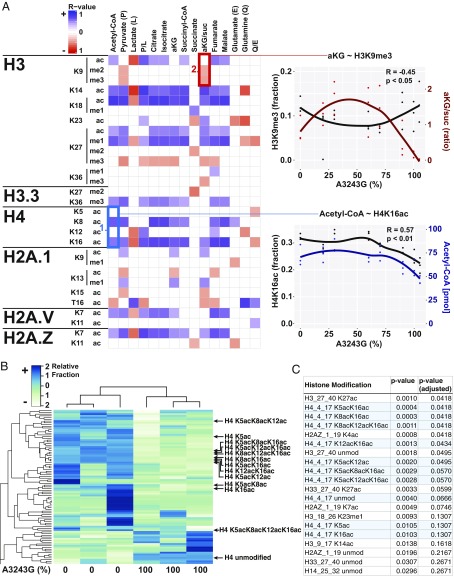
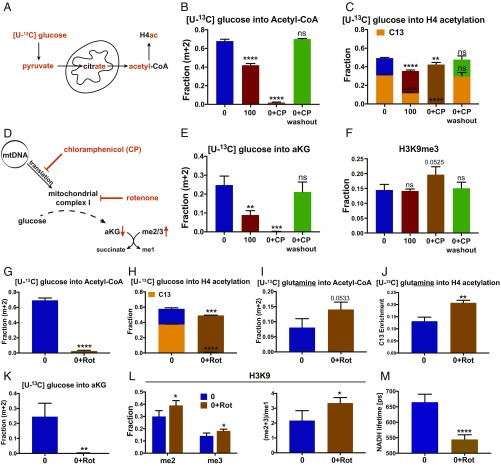
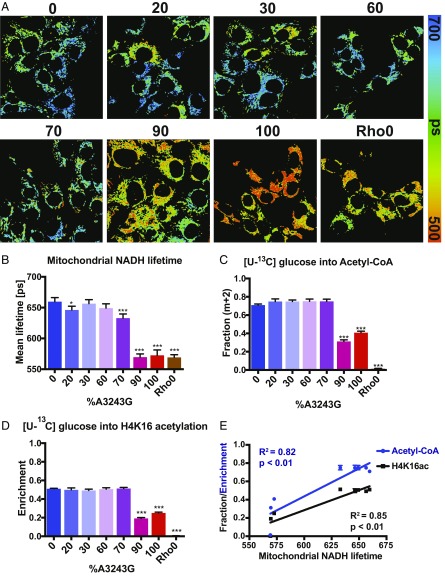
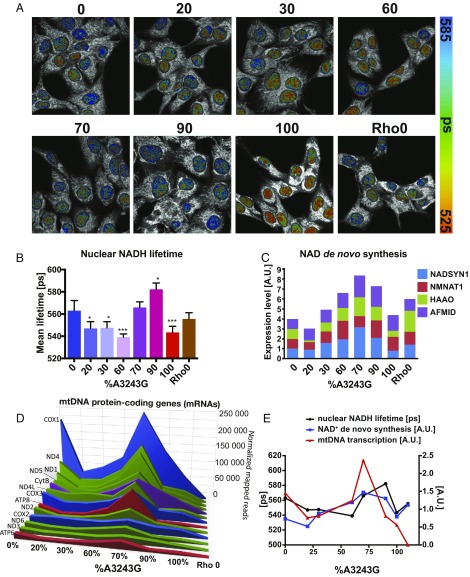
Diseases associated with mitochondrial DNA (mtDNA) mutations are highly variable in phenotype, in large part because of differences in the percentage of normal and mutant mtDNAs (heteroplasmy) present within the cell. For example, increasing heteroplasmy levels of the mtDNA tRNA Leu(UUR) nucleotide (nt) 3243A > G mutation result successively in diabetes, neuromuscular degenerative disease, and perinatal lethality. These phenotypes are associated with differences in mitochondrial function and nuclear DNA (nDNA) gene expression, which are recapitulated in cybrid cell lines with different percentages of m.3243G mutant mtDNAs. Using metabolic tracing, histone mass spectrometry, and NADH fluorescence lifetime imaging microscopy in these cells, we now show that increasing levels of this single mtDNA mutation cause profound changes in the nuclear epigenome. At high heteroplasmy, mitochondrially derived acetyl-CoA levels decrease causing decreased histone H4 acetylation, with glutamine-derived acetyl-CoA compensating when glucose-derived acetyl-CoA is limiting. In contrast, α-ketoglutarate levels increase at midlevel heteroplasmy and are inversely correlated with histone H3 methylation. Inhibition of mitochondrial protein synthesis induces acetylation and methylation changes, and restoration of mitochondrial function reverses these effects. mtDNA heteroplasmy also affects mitochondrial NAD + /NADH ratio, which correlates with nuclear histone acetylation, whereas nuclear NAD + /NADH ratio correlates with changes in nDNA and mtDNA transcription. Thus, mutations in the mtDNA cause distinct metabolic and epigenomic changes at different heteroplasmy levels, potentially explaining transcriptional and phenotypic variability of mitochondrial disease.
Overview
The claims and statistics of this paper haven’t been checked yet.
Free: it reads the open-access text and checks the first 5 claims that cite a source we can check. Create a free account to check every claim.
Integrity signals
Registry
Cites
Statistics
Figures
Verification
Claims the paper makes
The claims and statistics of this paper haven’t been checked yet.
Free: it reads the open-access text and checks the first 5 claims that cite a source we can check. Create a free account to check every claim.
Claims other papers make about this one
Each is checked against this paper’s own text: does it say what the citing paper says it does?
The cited source says what the claim attributes to it.
In the citing paper
“Finally, inhibiting the electron transport chain (Fig. 3G) would alter the mitochondrial metabolites, which serve as the substrates for the epigenome modification enzymes (Kopinski et al., 2019).”
From Comprehensive Multi-omics Analysis Reveals Mitochondrial Stress as a Central Biological Hub for Spaceflight Impact (2020) · cites this paper as Kopinski et al., 2019
Self-check
Percentages, sums and reported differences re-computed from the paper’s own numbers.
The self-check needs the paper’s full text.
Citations
Cites
Wallace, D. C. (2012) · Nature Reviews Cancer · doi:10.1038/nrc3365 · Cited by 2,404 · cited 1×
“This could occur by the conversion of glutamine to glutamate and then αKG, with αKG being converted to acetyl-CoA by either entering the TCA cycle to generate citrate or by reductive carboxylation (15).”
BackgroundSelf-citationATP-citrate lyase links cellular metabolism to histone acetylation
Wellen, K. E., Hatzivassiliou, G., Sachdeva, U. M., Bui, T. V., Cross, J. R., & Thompson, C. B. (2009) · Science · doi:10.1126/science.1164097 · Cited by 2,298 · cited 1×
“We incubated 0% and 100% mutant cells with uniformly (13)C -labeled glucose and traced the label through pyruvate, mitochondrial generation and exportation to the cytosol of citrate, conversion of cytosolic citrate into acetyl-CoA and oxaloacetate by ATPcitrate lyase (13), and use of the mitochondrially derived acetyl…”
MethodSelf-citationImpaired Mitochondrial Activity in the Insulin-Resistant Offspring of Patients with Type 2 Diabetes
Petersen, K. F., Dufour, S., Befroy, D., Garcia, R., & Shulman, G. I. (2004) · New England Journal of Medicine · doi:10.1056/nejmoa031314 · Cited by 2,193 · cited 1×
“This correlates with the chronic mitochondrial energy deficiency observed in type 2 diabetes (17, 18) and autism (19).”
BackgroundHistone demethylation by a family of JmjC domain-containing proteins
Tsukada, Y.-I., Fang, J., Erdjument-Bromage, H., Warren, M. E., Borchers, C. H., Tempst, P., & Zhang, Y. (2006) · Nature · doi:10.1038/nature04433 · Cited by 2,163 · cited 1×
“Because αKG is the required substrate for the JmjC histone demethylases (14), histone demethylation should be impaired by a protein synthesis defect resulting in increased histone methylation (Fig.”
BackgroundMitochondrial dysfunction in the elderly: possible role in insulin resistance
Petersen, K. F., Befroy, D., Dufour, S., Dziura, J., Ariyan, C., Rothman, D. L., DiPietro, L., Cline, G. W., & Shulman, G. I. (2003) · Science · doi:10.1126/science.1082889 · Cited by 2,107
NAD + in aging, metabolism, and neurodegeneration
Verdin, E. (2015) · Science · doi:10.1126/science.aac4854 · Cited by 1,319
Intracellular α-ketoglutarate maintains the pluripotency of embryonic stem cells
Carey, B. W., Finley, L. W. S., Cross, J. R., Allis, C. D., & Thompson, C. B. (2015) · Nature · doi:10.1038/nature13981 · Cited by 1,007 · cited 1×
“The inverse αKG-histone methylation association is expected, as Jumonji C (JmjC) histone demethylases known to be active on H3K9 require αKG to demethylate histones and are inhibited by succinate (11).”
BackgroundPrevalence of nuclear and mitochondrial DNA mutations related to adult mitochondrial disease
Gorman, G. S., Schaefer, A. M., Ng, Y., Gomez, N., Blakely, E. L., Alston, C. L., Feeney, C., Horvath, R., Yu‐Wai‐Man, P., Chinnery, P. F., et al. (2015) · Annals of Neurology · doi:10.1002/ana.24362 · Cited by 936 · cited 1×
“The overall prevalence of mtDNA mutations is about 1 in 5,000 (2, 3).”
BackgroundTrounce, I. A., Kim, Y. L., Jun, A. S., & Wallace, D. C. (1996) · Methods in Enzymology · doi:10.1016/s0076-6879(96)64044-0 · Cited by 746 · cited 2×
“Transmitochondrial cybrid cell lines were maintained in DMEM (4.5 g/L [25 mM] glucose + 110 mg/L sodium pyruvate [Gibco #10569]) supplemented with 50 μg/mL uridine, nonessential amino acids (1:100, Gibco #11140), and 10% FBS, grown at 37 °C in 5% CO2 (21).”
Self-citationMitochondrial Energetics and Therapeutics
Wallace, D. C., Fan, W., & Procaccio, V. (2010) · Annual Review of Pathology: Mechanisms of Disease · doi:10.1146/annurev.pathol.4.110807.092314 · Cited by 730
Self-citation
Cited by
Items 101–158 of 158
Mitochondrial genome-wide analysis of nuclear DNA methylation quantitative trait loci
Laaksonen, J., Mishra, P. P., Seppälä, I., Raitoharju, E., Marttila, S., Mononen, N., Lyytikäinen, L., Kleber, M. E., Delgado, G. E., Lepistö, M., et al. (2021) · Human Molecular Genetics · doi:10.1093/hmg/ddab339 · Cited by 9
“In addition, experimental findings have directly coupled mtDNA variation with TCA metabolites and histone methylation (24).”
Crosstalk Between Mitochondrial DNA and Immune Response: Focus on Autism Spectrum Disorder
Qu, W., Yan, G., Du, Y., Zhou, X., Huang, C., Li, B., Zhou, J., & Li, Q. (2024) · Molecular Neurobiology · doi:10.1007/s12035-024-04637-z · Cited by 8
“Extensive mtDNA hetero-plasmy caused by gene mutations impacts signal transduction, altering genetic phenotype, cellular metabolisms, and oxidative stress states [92].”
Atilano, S. R., Abedi, S., Ianopol, N., Singh, M. K., Norman, J. L., Malik, D., Falatoonzadeh, P., Chwa, M., Nesburn, A. B., Kuppermann, B. D., et al. (2022) · Cells · doi:10.3390/cells11172655 · Cited by 10
Shastry, A., Wilkinson, M., Miller, D. M., Kuriakose, M., Veeneman, J., Smith, M. R., Hindmarch, C. C. T., & Dunham‐Snary, K. J. (2025) · Redox Biology · doi:10.1016/j.redox.2025.103541 · Cited by 9
“Point mutations and SNPs in mtDNA are implicated in the pathogenesis of mitochondrial diseases, including diabetic and cardiovascular disease phenotypes [49,53,54,112,113].”
He, Y., Gao, Z., Li, X., Zhou, M., & Guan, M. (2024) · iScience · doi:10.1016/j.isci.2024.108883 · Cited by 8
“2,22 However, the mechanism underlying deficient mt-tRNA posttranscription modification regulates the OXPHOS biogenesis, mitochondrial quality controls, and apoptosis is far less understood.”
BackgroundPankammoon, P., Salinas, M. B. S., Thitaram, C., & Sathanawongs, A. (2025) · International Journal of Molecular Sciences · doi:10.3390/ijms26073310 · Cited by 10
“Notably, restoring mitochondrial function can reverse these epigenetic alterations, potentially through nuclear compensatory evolution [92,105].”
InfluentialMcCastlain, K., Welsh, C. E., Ni, Y., Ding, L., Franco, M., Autry, R. J., Sejdiu, B. I., Chang, T.-C., Chen, W., Wu, H., et al. (2025) · Science Advances · doi:10.1126/sciadv.adt3873 · Cited by 9
“Mitochondrial Toolbox” – A Review of Online Resources to Explore Mitochondrial Genomics
Cappa, R., de Campos, C. P., Maxwell, A. P., & McKnight, A. J. (2020) · Frontiers in Genetics · doi:10.3389/fgene.2020.00439 · Cited by 8
John, J. C. S. (2021) · Annual Review of Animal Biosciences · doi:10.1146/annurev-animal-080520-083353 · Cited by 7
Wang, Y., Wang, X., Long, Q., Liu, Y., Yin, T., Sirota, I., Ren, F., Gu, Z., & Luo, J. (2021) · FEBS Journal · doi:10.1111/febs.16121 · Cited by 7
Yagi, K., Okazaki, S., Ohbatake, A., Nakaya, M., Liu, J., Arite, E., Miyamoto, Y., Ito, N., Nakano, K., Yamaaki, N., et al. (2023) · Molecular Genetics and Metabolism · doi:10.1016/j.ymgme.2023.107691 · Cited by 7
Towards understanding the evolutionary dynamics of mtDNA
Towarnicki, S. G., & Ballard, J. W. O. (2020) · Mitochondrial DNA Part A · doi:10.1080/24701394.2020.1830076 · Cited by 8
Paepe, B. D. (2019) · Epigenomics · doi:10.2217/epi-2019-0310 · Cited by 6
“3243A>G heteroplasmy affects the magnitude of changes to the nuclear epigenome, and subsequent alteration to nuclear gene expression [11].”
BackgroundHypoxia-ischemia and sexual dimorphism: modeling mitochondrial dysfunction using brain organoids
Gaston-Breton, R., Disdier, C., Hagberg, H., & Mabondzo, A. M. (2025) · Cell & Bioscience · doi:10.1186/s13578-025-01402-0 · Cited by 8
“According to recent studies, epigenetic histone methylation is regulated by mtDNA heteroplasmy [23].”
Fetterman, J. L., Chinnery, P. F., McClellan, R., Wallace, D. C., Suomalainen, A., Ojala, T. H., Lewis, S. C., & Ballinger, S. W. (2025) · Circulation · doi:10.1161/cir.0000000000001393 · Cited by 8
Self-citationMitochondrial DNA Depletion in Granulosa Cell Derived Nuclear Transfer Tissues
Bebbere, D., Ulbrich, S. E., Giller, K., Zakhartchenko, V., Reichenbach, H.-D., Reichenbach, M., Verma, P. J., Wolf, E., Ledda, S., & Hiendleder, S. (2021) · Frontiers in Cell and Developmental Biology · doi:10.3389/fcell.2021.664099 · Cited by 5
Ramya, G., Rai, N., Othayoth, R., & Kamma, S. (2024) · Egyptian Journal of Medical Human Genetics · doi:10.1186/s43042-024-00599-y · Cited by 4
Exploring the oncogenic impact of heteroplasmic de novo MT-ND5 truncating mutations
Wu, Y., Ye, J., & Gu, Z. (2025) · Mitochondrial Communications · doi:10.1016/j.mitoco.2025.03.001 · Cited by 4
“24 Their critical role in cellular differentiation 25 and epigenetic regulation 26,27 highlights the profound impact of mitochondrial dysfunction on cellular processes.”
Decoding Mitochondrial–Nuclear (epi)genome Interactions: The Emerging Role of ncRNAs
Nguyen, J., Le, Q., Win, P. W., Hill, K. A., Singh, S. M., & Castellani, C. A. (2023) · Epigenomics · doi:10.2217/epi-2023-0322 · Cited by 3
Mitochondrial DNA variant spectrum and the association with chronic tic disorders
Jiang, P., Zhu, T., Liu, J., Tao, X., Xue, Z., Tao, Y., Chen, H., Zeng, X., Zhu, W., Shu, Q., et al. (2022) · European Journal of Neurology · doi:10.1111/ene.15484 · Cited by 3
“Different heteroplasmy levels in variants can cause different nuclear epigenetic changes [47].”
BackgroundLiu, H., Cai, B., Gong, R., Yang, Y., Wang, J., Zhou, D., Yu, M., & Li, Y. (2023) · Frontiers in Genetics · doi:10.3389/fgene.2023.1130411 · Cited by 4
“CoA decreased at high heteroplasmy (Kopinski et al., 2019).”
Reply to Comment on: Sideroblastic anemia associated with multisystem mitochondrial disorders
Tesarova, M., & Zeman, J. (2019) · Pediatric Blood & Cancer · doi:10.1002/pbc.28007 · Cited by 4
Wang, M., Zheng, Y., Lai, M. M., Saake, E., Liu, X., Guo, X., Taylor, K. D., Huan, T., Joehanes, R., Nannini, D. R., et al. (2025) · Aging Cell · doi:10.1111/acel.70279 · Cited by 4
“…several studies have explored the potential regulatory role of mtDNA homoplas-mic (Bellizzi et al. 2012; Vivian et al. 2017; Lee et al. 2017) and heteroplasmic variants (Kopinski et al. 2019) on the nuclear epigenome, the relationship between these two hallmarks of aging remains to be elucidated.”
Andreas, E., Penn, A., Okada, T., & John, J. C. S. (2024) · Biomolecules · doi:10.3390/biom14111477 · Cited by 3
“Added to this, metabolites associated with the TCA cycle are modulated, which, in turn, could affect the epigenetic status of the respective tissue through DNA methylation [74] and histone [75] modifications.”
Mitochondrial DNA Copy Number and Heteroplasmy in Monozygotic Twins Discordant for Schizophrenia
Win, P. W., Singh, S. M., & Castellani, C. A. (2023) · Twin Research and Human Genetics · doi:10.1017/thg.2023.34 · Cited by 3
“To this end, mtDNA-CN establishes the quantity of mitochondrial DNA, while heteroplasmy (HP), which captures the quality, refers to the ratio of mutated to normal mtDNA, and represents a crucial threshold, which may lead to pathological outcomes (Kopinski et al., 2019; Stefano & Kream, 2016).”
BackgroundFeng, L., Zou, L., Wen, X., Zhang, L., Zhao, Y., Ren, W., Wang, T., Chen, J., Wang, X., & Tian, Z. (2025) · Journal of sport and health science/Journal of Sport and Health Science · doi:10.1016/j.jshs.2025.101118 · Cited by 3
“43,44 Therefore, the synthesis of ACh is rapidly curtailed when acetyl-CoA export is decreased.”
Stabilizing selection and mitochondrial heteroplasmy in the Canada lynx (Lynx canadensis)
Forbes, K. J., Barrera, M. A., Nielsen-Roine, K., Hersh, E. W., Janes, J. K., Harrower, W. L., & Gorrell, J. C. (2024) · Genome · doi:10.1139/gen-2023-0094 · Cited by 2
Pérez, M. J., Colombo, R. B., Real, S., Branham, M. T., Laurito, S. R., Moraes, C. T., & Mayorga, L. (2025) · EMBO Molecular Medicine · doi:10.1038/s44321-025-00285-5 · Cited by 3
“Consequently, different degrees of mitochondrial stress modify nuclear transcriptomics (Picard et al, 2014), histone marks (Kopinski et al, 2019), and DNA methylation (Mayorga et al, 2019) in a speci fi c manner.”
Frye, R. E. (2023) · Journal of the American Academy of Child & Adolescent Psychiatry · doi:10.1016/j.jaac.2023.12.002 · Cited by 2
Nguyen, J., Win, P. W., Nagano, T. S., Shin, E. H., Newcomb, C., Arking, D. E., & Castellani, C. A. (2024) · bioRxiv (Cold Spring Harbor Laboratory) · doi:10.1101/2024.01.29.577835 · Cited by 2
Mitochondrial DNA homeostasis: A novel therapeutic target for neurodegenerative diseases
Fu, T., Chen, X., Zhang, S., Fu, Y., Huang, L., & Xiong, W. (2025) · Neural Regeneration Research · doi:10.4103/nrr.nrr-d-25-00495 · Cited by 3
“In HD, the high proportion of m.3243A > G may impair mitochondrial metabolic function and affect mitochondrial respiratory function (Picard et al., 2014; Kopinski et al., 2019).”
Spectrum and Impact of Mitochondrial DNA Mutations in Ovarian Cancer
Low, S. S. P., Greaves, L. C., Silk, R., Semple, C. A. M., & Gourley, C. (2025) · International Journal of Molecular Sciences · doi:10.3390/ijms262211180 · Cited by 1
“At mid-levels of heteroplasmy, raised alpha-ketoglutarate levels was inversely correlated with histone H3 methylation [61].”
Win, P. W., Nguyen, J., Shin, E. H., Nagano, T. S., Selimi, B., Hong, K. E., Meybodi, A. M., Yates, B. P., Burke, E. V., Carter, D. E., et al. (2025) · Epigenomics · doi:10.1080/17501911.2025.2603883 · Cited by 3
“Metabolites belonging to the TCA cycle, OXPHOS, and folate/ one-carbon cycle, such as methylthioadenosine (MTA), alpha-ketoglutarate, serine, choline, NADH, and betaine are also associated with DNA methylation [31,44,117,122–124].”
John, J. C. S., & Rodgers, R. J. (2026) · Human Reproduction · doi:10.1093/humrep/deaf247 · Cited by 2
“Furthermore, in somatic cell models, where a nucleus is fused to an enucleated cell carrying heteroplasmic mtDNA, the significant changes to the nucleus’s epigenome are proportional to heteroplasmic load (Kopinski et al. , 2019).”
Varga, L., Borecká, S., Škopková, M., Rambani, V., Sklenar, M., Cipkova, K., Kickova, T., Ugorová, D., Kabátová, Z., Stanik, J., et al. (2026) · Ear and Hearing · doi:10.1097/aud.0000000000001780 · Cited by 1
“Kopinski et al. (2019) found that mtDNA mutations cause distinct metabolic and epigenomic changes depending on heteroplasmy level, explaining phenotypic variability.”
14-3-3ζ constrains insulin secretion by regulating mitochondrial function in pancreatic β-cellsPreprint
Mugabo, Y., Zhao, C., Tan, J., Ghosh, A., Campbell, S., Fadzeyeva, E., Paré, F., Pan, S., Galipeau, M., Ast, J., et al. (2021) · bioRxiv (Cold Spring Harbor Laboratory) · doi:10.1101/2021.10.17.464702 · Cited by 1
“16 mitochondria and nuclei through shuttling of metabolites (63), or in the case of the present study, 14-3-3z”
BackgroundSelf-citationDobson, N. L., Kleeberger, S. R., Burkholder, A., Walters, D. M., Gladwell, W., Gerrish, K., & Vellers, H. L. (2023) · International Journal of Molecular Sciences · doi:10.3390/ijms241914507 · Cited by 1
“[26] showed that heteroplasmy leads to diminished acetyl coA generation and concomitant alterations in histone acetylation (i.”
BackgroundUeda, M. (2024) · Translational Pediatrics · doi:10.21037/tp-24-131 · Cited by 2
Mechanistic insights into overeating
Morris, A. W. J. (2019) · Nature Reviews Endocrinology · doi:10.1038/s41574-019-0235-1
Novel mtDNA Imparts the Connective Tissue Disorder of a Tourette PedigreePreprint
Schaefer, P. M., Alves, L. S., Lvova, M., Huang, J. Y., Rathi, K. S., Janssen, K. A., Butic, A., Yardeni, T., Morrow, R. M., Lott, M. T., et al. (2022) · bioRxiv (Cold Spring Harbor Laboratory) · doi:10.1101/2022.02.25.481696
Self-citationFaculty Opinions recommendation of Mitonuclear genomics and aging.
Osiewacz, H. D. (2020) · Faculty Opinions – Post-Publication Peer Review of the Biomedical Literature · doi:10.3410/f.737293312.793571684
Mitochondrion at the crossroads between nutrients and the epigenome
Bordoni, L., & Sergi, D. (2022) · Elsevier eBooks · doi:10.1016/b978-0-323-90256-4.00015-1
Mitochondrial DNA m.3243A>G mutation in ethambutol-induced optic neuropathy: A case report
Lu, J., Feng, Y., Peng, X., & Li, H. (2023) · Indian Journal of Ophthalmology - Case Reports · doi:10.4103/ijo.ijo_294_23
Farooq, S., Naqvi, S. F.-U.-H., Muhammad, S., Piotrowska-Nowaka, A., Bukhari, S. A. R. S., Javed, A., Irfan, M. I., & Khan, I. A. (2024) · Research Square · doi:10.21203/rs.3.rs-3759931/v1
Exploring the Role of Mitochondrial DNA Mutations in Cancer Development and Diagnosis
Caldiran, F. Y., & Aydemir, M. N. (2024) · Interdisciplinary cancer research · doi:10.1007/16833_2024_270 · Cited by 2
Identification of determinants for variability in mitochondrial biochemical complex activities
de Courtade, S. M. B., Eikenes, M., Sheng, Y., Nyman, T. A., Bliksrud, Y. T., Scheffler, K., & Eide, L. (2025) · Biochimica et Biophysica Acta (BBA) - Bioenergetics · doi:10.1016/j.bbabio.2025.149553
Varga, L., Borecká, S., Škopková, M., Rambani, V., Sklenar, M., Cipkova, K., Kickova, T., Ugorová, D., Kabátová, Z., Staník, J., et al. (2025) · medRxiv · doi:10.1101/2025.03.13.25321027
Relationship troubles at the mitochondrial level and what it might mean for human disease
James, R. (2025) · Open Biology · doi:10.1098/rsob.240331 · Cited by 1
“The tricarboxylic acid cycle (TCA) at the heart of mitochondria generates the metabolic intermediates for modifying several epigenetic marks, especially histone acetylation and methylation, and DNA methylation [82,83].”
Coevolution Between the Mitochondrial and Nuclear Genomes
Mishmar, D. (2025) · Elsevier eBooks · doi:10.1016/b978-0-443-15750-9.00131-2
Pérez-Amado, C., Bazan-Cordoba, A., Gómez-Romero, L., Ramírez-Bello, J., Bautista-Piña, V., Tenorio-Torres, A., Ruvalcaba-Limón, E., Villegas-Carlos, F., Mendiola-Soto, D. K., Hidalgo-Miranda, A., et al. (2025) · International Journal of Molecular Sciences · doi:10.3390/ijms26178456 · Cited by 1
On the diverse and common evolutionary constraints acting on mitochondria across the eukaryotic tree
Nagarajan‐Radha, V., Aanen, D. K., Mishmar, D., & Beekman, M. (2026) · Philosophical Transactions of the Royal Society B Biological Sciences · doi:10.1098/rstb.2025.0073
Smith, J. T., Hooten, N. N., Mode, N. A., Zonderman, A. B., Ezike, N., & Evans, M. K. (2026) · International Journal of Radiation Biology · doi:10.1080/09553002.2026.2699714
“Studies in cytoplasmic hybrid (cybrid) cell lines, which compared two or more cell lines that share nuclear DNA sequence but differ by mtDNA sequence, show that mtDNA also affects the silencing and expression of nuclear DNA (Fetterman and Ballinger 2019; Kopinski et al. 2019; Atilano et al. 2022).”
Bhongade, B. A., Ali, A. A., El‐Tanani, M., Satyam, S. M., Talath, S., Wali, A. F., Rabbani, S. A., Ibraheem, W., Hoffmann, K., Арманович, А. А., et al. (2026) · Current Issues in Molecular Biology · doi:10.3390/cimb48070723
“Heteroplasmy is complicated by its dynamic nature: the percentage of mutant mtDNA varies in response to selective pressures, such as anticancer therapies [69].”
Liu, M., Guo, Q., Zhang, S., Yu, D., & Ding, Y. (2026) · Human Mutation · doi:10.1155/humu/6788682
“The human mitochondrion is a semiautonomous organelle and contains its own genome (mitochondrial DNA [mtDNA]), encoding 13 subunits for Complexes I~V, as well as two rRNAs and 22 tRNAs necessary for mitochondrial protein translation [9].”
Chen, X., Wang, W., Shen, F., & Zhao, Z. (2026) · Frontiers in Cell and Developmental Biology · doi:10.3389/fcell.2026.1840428
Su, Y., Gong, Z., Mu, J., Huang, L., Yang, P., Zhang, C., Zhao, L., Yang, L., Deng, J., & Liao, X. (2026) · Advanced Science · doi:10.1002/advs.77713
The Genetic and Epigenetic Mechanisms of mtDNA in Regulation of Inflammation and Metabolism
Zhang, Y., 郑言江, Duan, H., & Li, Y. (2026) · The FASEB Journal · doi:10.1096/fj.202600927r
Kopinski, P. K., Magi, I. J., & Dalvin, L. A. (2026) · Elsevier eBooks · doi:10.1016/b978-0-443-19001-8.00026-x
Self-citation
Metadata
- Authors
- Kopinski, P. K., Janssen, K. A., Schaefer, P. M., Trefely, S., Perry, C. E., Potluri, P., Tintos-Hernandez, J. A., Singh, L. N., Karch, K. R., Campbell, S. L., Doan, M. T., Jiang, H., Nissim, I., Nakamaru-Ogiso, E., Wellen, K. E., Snyder, N. W., Garcia, B. A., & Wallace, D. C.
- Affiliations
- Children's Hospital of Philadelphia (US)
- University of Pennsylvania (US)
- Drexel University (US)
- Center for Mitochondrial and Epigenomic Medicine, Children’s Hospital of Philadelphia, Philadelphia, PA 19104;
- Department of Biochemistry and Biophysics, Perelman School of Medicine, University of Pennsylvania, Philadelphia, PA 19104;
- Corresponding author
- Wallace, Douglas C.
- ORCID
- Venue
- Proceedings of the National Academy of Sciences
- Publisher
- National Academy of Sciences
- Published
- 2019-06-28
- Volume
- 116
- Issue
- 32
- Pages
- 16028-16035
- ISSN
- 0027-8424 (ISSN-L)
- 1091-6490
- PMC
- PMC6689928
- OpenAlex
- W2955398568
- Cited by
- 159
- References
- 31
- Citations by year
- 2026: 10 · 2025: 24 · 2024: 22 · 2023: 18 · 2022: 23 · 2021: 28 · 2020: 26 · 2019: 8
- FWCI
- 7.03
- Type
- journal article
- Language
- en
- Open access
- hybrid
- doi.org
- Licence
- Locations
- Proceedings of the National Academy of Sciences (publishedVersion, cc-by-nc-nd)
- Europe PMC (PubMed Central) (publishedVersion, cc-by-nc-nd)
- PubMed Central (publishedVersion, cc-by-nc-nd)
- PubMed (publishedVersion)
- Funders
- Howard Hughes Medical Institute (Predoctoral Grant)
- HHS | NIH | National Institute of Neurological Disorders and Stroke (NS021328)
- HHS | NIH | National Institute of Mental Health (MH108592)
- HHS | NIH | National Institute of General Medical Sciences (OD010944)
- DOD | United States Army | MEDCOM | Academy of Health Sciences (W81XWH-16-1-0401)
- Topics
- Life Sciences › Biochemistry, Genetics and Molecular Biology › Molecular Biology › Mitochondrial Function and Pathology
- Life Sciences › Biochemistry, Genetics and Molecular Biology › Molecular Biology › Epigenetics and DNA Methylation
- Life Sciences › Biochemistry, Genetics and Molecular Biology › Molecular Biology › Genomics and Chromatin Dynamics
- Keywords
- mitochondrial heteroplasmy, m.3243A>G mutation, mitochondrial disease, histone H4 acetylation, histone H3 methylation, acetyl-CoA metabolism, alpha-ketoglutarate, NAD+/NADH ratio, mitochondrial translation, cybrid cells, mtDNA transcription, metabolic tracing
- MeSH terms
- Epigenome, Acetyl Coenzyme A, Cell Line, Cell Nucleus, DNA, Mitochondrial, Histones, Humans, Mitochondria, NAD, Transcription, Genetic, Metabolome
About these checks
Registry, retraction, Cites and statistics results are computed, not judged, with one exception: a printed reference that no index lists is read once by a model before it counts as a citation error. Claims are extracted by a model and kept only when their quote appears verbatim in the text; each cited source is then checked, with a model’s help, for whether it says what the claim relies on. Those verdicts can be wrong — read the claim’s quote and the cited source before relying on one.
Statistics and arithmetic are recomputed, not judged.
Confidence bands are shown only for fields calibrated on our annotated test set. None is calibrated yet, so no band is shown.
What counts as a claim ›How we measure confidence ›How we check this ›
Are you an author, or do you see a problem with this page? Request a review
Data sources
Bibliographic data: Semantic Scholar, OpenAlex, Crossref.
Contains information from the Semantic Scholar Academic Graph Datasets, made available under the ODC Attribution License (ODC-BY 1.0).
Semantic Scholar’s data is described in: Kinney, R., et al. (2023). The Semantic Scholar Open Data Platform. arXiv:2301.10140.
