

The DOI matches its Crossref record; 49 of the 49 references it cites were found in a registry or an index.
Mechanistic transmission modeling of COVID-19 on the Diamond Princess cruise ship demonstrates the importance of aerosol transmission
Open accessPublished version of a preprint
Abstract
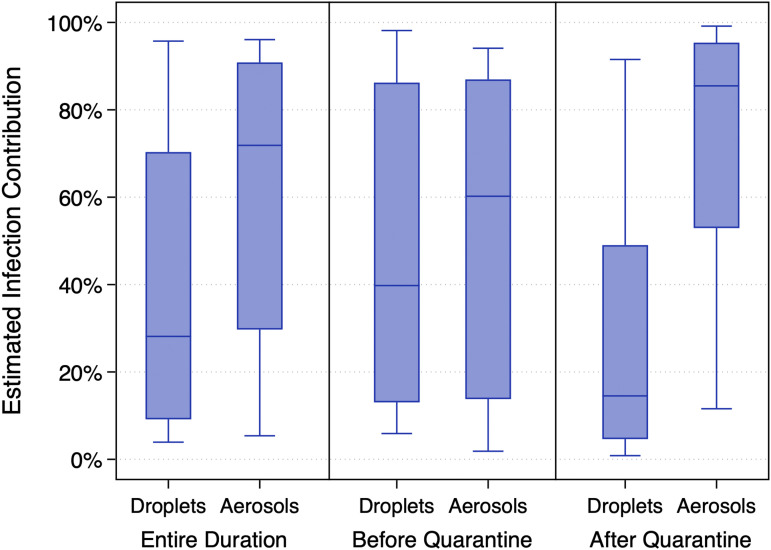
Significance: We find that airborne transmission likely accounted for >50% of disease transmission on the Diamond Princess cruise ship, which includes inhalation of aerosols during close contact as well as longer range. These findings underscore the importance of implementing public health measures that target the control of inhalation of aerosols in addition to ongoing measures targeting control of large-droplet and fomite transmission, not only aboard cruise ships but in other indoor environments as well. Guidance from health organizations should include a greater emphasis on controls for reducing spread by airborne transmission. Last, although our work is based on a cruise ship outbreak of COVID-19, the model approach can be applied to other indoor environments and other infectious diseases.
Overview
The claims and statistics of this paper haven’t been checked yet.
Run the check — free, no account needed. It reads the open-access text and checks the sources it cites.
Integrity signals
Registry
Cites
Statistics
Figures
Verification
Claims the paper makes
The claims and statistics of this paper haven’t been checked yet.
Run the check — free, no account needed. It reads the open-access text and checks the sources it cites.
Claims other papers make about this one
Each is checked against this paper’s own text: does it say what the citing paper says it does?
In the citing paper
“Laboratory, field, modelling, and case studies have shown that airborne transmission through the inhalation of a virus-laden aerosol is important, if not dominant, for COVID-19.119, 120, 121, 122, 123, 124, 125, 126, 127, 128, 129, 130, 131, 132”
From The Lancet Commission on lessons for the future from the COVID-19 pandemic (2022) · cites this paper as [127]
In the citing paper
“showing that building-level strategies are key to reducing the spread of airborne infectious diseases.40, 127, 401, 402, 403”
From The Lancet Commission on lessons for the future from the COVID-19 pandemic (2022) · cites this paper as [127]
Self-check
Percentages, sums and reported differences re-computed from the paper’s own numbers.
The self-check needs the paper’s full text.
Citations
Cites
Aerodynamic Analysis of SARS-CoV-2 in Two Wuhan Hospitals
Liu, Y., Ning, Z., Chen, Y., Guo, M., Liu, Y., Gali, N. K., Sun, L., Duan, Y., Cai, J., Westerdahl, D., et al. (2020) · Nature · doi:10.1038/s41586-020-2271-3 · Cited by 1,872
Airborne transmission of SARS-CoV-2: The world should face the reality
Morawska, L., & Cao, J. (2020) · Environment International · doi:10.1016/j.envint.2020.105730 · Cited by 1,728
How can airborne transmission of COVID-19 indoors be minimised?
Morawska, L., Tang, J. W., Bahnfleth, W., Bluyssen, P. M., Boerstra, A., Buonanno, G., Cao, J., Dancer, S., Floto, A., Franchimon, F., et al. (2020) · Environment International · doi:10.1016/j.envint.2020.105832 · Cited by 1,343
Pathogenesis and transmission of SARS-CoV-2 in golden hamsters
Sia, S. F., Yan, L.-M., Chin, A. W. H., Fung, K., Choy, K.-T., Wong, A. Y. L., Kaewpreedee, P., Perera, R. A. P. M., Poon, L. L. M., Nicholls, J. M., et al. (2020) · Nature · doi:10.1038/s41586-020-2342-5 · Cited by 1,342
It is time to address airborne transmission of coronavirus disease 2019 (COVID-19)
Morawska, L., & Milton, D. K. (2020) · Clinical Infectious Diseases · doi:10.1093/cid/ciaa939 · Cited by 1,189
Stadnytskyi, V., Bax, C. E., Bax, A., & Anfinrud, P. (2020) · Proceedings of the National Academy of Sciences · doi:10.1073/pnas.2006874117 · Cited by 1,104
Bourouiba, L. (2020) · JAMA · doi:10.1001/jama.2020.4756 · Cited by 1,066
Aerosol and surface contamination of SARS-CoV-2 observed in quarantine and isolation care
Santarpia, J. L., Rivera, D. N., Herrera, V. L., Morwitzer, M. J., Creager, H. M., Santarpia, G. W., Crown, K. K., Brett‐Major, D. M., Schnaubelt, E. R., Broadhurst, M. J., et al. (2020) · Scientific Reports · doi:10.1038/s41598-020-69286-3 · Cited by 956
Detection of air and surface contamination by SARS-CoV-2 in hospital rooms of infected patients
Chia, P. Y., Coleman, K. K., Tan, Y. K., Ong, S. W. X., Gum, M., Lau, S. K., Lim, X. F., Lim, A. S., Sutjipto, S., Lee, P. H., et al. (2020) · Nature Communications · doi:10.1038/s41467-020-16670-2 · Cited by 932
Reducing transmission of SARS-CoV-2
Prather, K. A., Wang, C. C., & Schooley, R. T. (2020) · Science · doi:10.1126/science.abc6197 · Cited by 850
Recognition of aerosol transmission of infectious agents: a commentary
Tellier, R., Li, Y., Cowling, B. J., & Tang, J. W.-T. (2019) · BMC Infectious Diseases · doi:10.1186/s12879-019-3707-y · Cited by 745
Miller, S. L., Nazaroff, W. W., Jimenez, J. L., Boerstra, A., Buonanno, G., Dancer, S. J., Kurnitski, J., Marr, L. C., Morawska, L., & Noakes, C. (2021) · Indoor Air · doi:10.1111/ina.12751 · Cited by 734
The coronavirus pandemic and aerosols: Does COVID-19 transmit via expiratory particles?
Asadi, S., Bouvier, N. M., Wexler, A. S., & Ristenpart, W. D. (2020) · Aerosol Science and Technology · doi:10.1080/02786826.2020.1749229 · Cited by 701
Probable airborne transmission of SARS-CoV-2 in a poorly ventilated restaurant
Li, Y., Qian, H., Hang, J., Chen, X., Cheng, P., Ling, H., Wang, S., Liang, P., Li, J., Xiao, S., et al. (2021) · Building and Environment · doi:10.1016/j.buildenv.2021.107788 · Cited by 686
Viable SARS-CoV-2 in the air of a hospital room with COVID-19 patients
Lednicky, J. A., Lauzardo, M., Fan, Z. H., Jutla, A., Tilly, T. B., Gangwar, M., Usmani, M., Shankar, S. N., Mohamed, K., Eiguren-Fernandez, A., et al. (2020) · International Journal of Infectious Diseases · doi:10.1016/j.ijid.2020.09.025 · Cited by 683
Airborne or Droplet Precautions for Health Workers Treating Coronavirus Disease 2019?
Bahl, P., Doolan, C. J., de Silva, C. M., Chughtai, A. A., Bourouiba, L., & MacIntyre, C. R. (2020) · The Journal of Infectious Diseases · doi:10.1093/infdis/jiaa189 · Cited by 513
Community Outbreak Investigation of SARS-CoV-2 Transmission Among Bus Riders in Eastern China
Shen, Y., Li, C., Dong, H., Wang, Z., Martínez, L., Sun, Z., Handel, A., Chen, Z., Chen, E., Ebell, M. H., et al. (2020) · JAMA Internal Medicine · doi:10.1001/jamainternmed.2020.5225 · Cited by 429
Public Health Responses to COVID-19 Outbreaks on Cruise Ships — Worldwide, February–March 2020
Moriarty, L. F., Pluciński, M. M., Marston, B. J., Kurbatova, E. V., Knust, B., Murray, E. L., Pesik, N., Rose, D. A., Fitter, D. L., Kobayashi, M., et al. (2020) · MMWR Morbidity and Mortality Weekly Report · doi:10.15585/mmwr.mm6912e3 · Cited by 403
Sze-To, G. N., & Chao, C. Y. H. (2009) · Indoor Air · doi:10.1111/j.1600-0668.2009.00621.x · Cited by 400
Short-range airborne route dominates exposure of respiratory infection during close contact
Chen, W., Zhang, N., Wei, J., Yen, H.-L., & Li, Y. (2020) · Building and Environment · doi:10.1016/j.buildenv.2020.106859 · Cited by 371
Is the coronavirus airborne? Experts can’t agree
Lewis, D. (2020) · Nature · doi:10.1038/d41586-020-00974-w · Cited by 304
Aerosol transmission of rhinovirus colds
Dick, E. C., Jennings, L. C., Mink, K. A., Wartgow, C. D., & Inborn, S. L. (1987) · Journal of Infectious Diseases · doi:10.1093/infdis/156.3.442 · Cited by 280 · cited 1×
“In the absence of empirical studies using controlled exposures to elucidate transmission pathways (29), mathematical modeling approaches can offer insights into the likely importance of the different modes of disease transmission among human populations (30 – 34), provided that sufficiently…”
Nicas, M., & Best, D. (2008) · Journal of Occupational and Environmental Hygiene · doi:10.1080/15459620802003896 · Cited by 262
Microbial Exchange via Fomites and Implications for Human Health
Stephens, B., Azimi, P., Thoemmes, M. S., Heidarinejad, M., Allen, J. G., & Gilbert, J. A. (2019) · Current Pollution Reports · doi:10.1007/s40726-019-00123-6 · Cited by 202
Self-citationRelative Contributions of Four Exposure Pathways to Influenza Infection Risk
Nicas, M., & Jones, R. M. (2009) · Risk Analysis · doi:10.1111/j.1539-6924.2009.01253.x · Cited by 192
Viable SARS-CoV-2 in the air of a hospital room with COVID-19 patientsPreprint
Lednicky, J. A., Lauzardo, M., Fan, Z. H., et al. (2020) · medRxiv · doi:10.1101/2020.08.03.20167395 · Cited by 189
Evidence for probable aerosol transmission of SARS-CoV-2 in a poorly ventilated restaurantPreprint
Li, Y., Qian, H., Hang, J., et al. (2020) · medRxiv · doi:10.1101/2020.04.16.20067728 · Cited by 189
Long-distance airborne dispersal of SARS-CoV-2 in COVID-19 wards
Nissen, K., Krambrich, J., Akaberi, D., Hoffman, T., Ling, J., Lundkvist, Å., Svensson, L., & Salaneck, E. (2020) · Scientific Reports · doi:10.1038/s41598-020-76442-2 · Cited by 184
Norovirus Transmission on Cruise Ship
Isakbaeva, E. T., Widdowson, M., Beard, R. S., Bulens, S. N., Mullins, J. A., Monroe, S. S., Bresee, J., Sassano, P., Cramer, E. H., & Glass, R. I. (2005) · Emerging infectious diseases · doi:10.3201/eid1101.040434 · Cited by 174
Lei, H., Li, Y., Xiao, S., Lin, C., Norris, S. L., Wei, D., Hu, Z., & Ji, S. (2017) · Indoor Air · doi:10.1111/ina.12445 · Cited by 169
Kraay, A. N. M., Hayashi, M. A. L., Hernández-Cerón, N., Spicknall, I. H., Eisenberg, M. C., Meza, R., & Eisenberg, J. N. S. (2018) · BMC Infectious Diseases · doi:10.1186/s12879-018-3425-x · Cited by 147
Hartman, A. L., Nambulli, S., McMillen, C. M., White, A. G., Tilston‐Lunel, N. L., Albe, J. R., Cottle, E. L., Dunn, M., Frye, L. J., Gilliland, T. H., et al. (2020) · PLoS Pathogens · doi:10.1371/journal.ppat.1008903 · Cited by 140
An Integrated Model of Infection Risk in a Health‐Care Environment
Nicas, M., & Sun, G. (2006) · Risk Analysis · doi:10.1111/j.1539-6924.2006.00802.x · Cited by 122
Jones, R. M. (2020) · Journal of Occupational and Environmental Hygiene · doi:10.1080/15459624.2020.1784427 · Cited by 117
Advanced turbulence models for predicting particle transport in enclosed environments
Wang, M., Lin, C., & Chen, Q. (2011) · Building and Environment · doi:10.1016/j.buildenv.2011.05.018 · Cited by 116
Lednicky, J. A., Shankar, S. N., Elbadry, M. A., Gibson, J. C., Alam, M. M., Stephenson, C. J., Eiguren-Fernandez, A., Morris, J. G., Mavian, C. N., Salemi, M., et al. (2020) · Aerosol and Air Quality Research · doi:10.4209/aaqr.2020.05.0202 · Cited by 111
Role of fomites in SARS transmission during the largest hospital outbreak in Hong Kong
Xiao, S., Li, Y., Wong, T.-W., & Hui, D. S. C. (2017) · PLoS ONE · doi:10.1371/journal.pone.0181558 · Cited by 108
Airborne Spread of SARS-CoV-2 and a Potential Role for Air Disinfection
Nardell, E. A., & Nathavitharana, R. R. (2020) · JAMA · doi:10.1001/jama.2020.7603 · Cited by 108
COVID-19—Lessons Learned and Questions Remaining
Fang, F. C., Benson, C. A., del Río, C., Edwards, K. M., Fowler, V. G., Fredricks, D. N., Limaye, A. P., Murray, B. E., Naggie, S., Pappas, P. G., et al. (2020) · Clinical Infectious Diseases · doi:10.1093/cid/ciaa1654 · Cited by 78
Chen, C., Liu, W., Lin, C., & Chen, Q. (2015) · Aerosol Science and Technology · doi:10.1080/02786826.2015.1079587 · Cited by 57
Vivancos, R., Keenan, A., Sopwith, W., Smith, K., Quigley, C., Mutton, K. J., Dardamissis, E., Nichols, G. L., Harris, J. P., Gallimore, C., et al. (2010) · Journal of Infection · doi:10.1016/j.jinf.2010.03.018 · Cited by 46
Short-range airborne route dominates exposure of respiratory infection during close contactPreprint
Chen, W., Zhang, N., Wei, J., et al. (2020) · medRxiv · doi:10.1101/2020.03.16.20037291 · Cited by 42
Jones, R. M., Masago, Y., Bartrand, T. A., Haas, C. N., Nicas, M., & Rose, J. B. (2008) · Risk Analysis · doi:10.1111/j.1539-6924.2008.01161.x · Cited by 37
Putting a balance on the aerosolization debate around SARS-CoV-2
Dancer, S. J., Tang, J. W.-T., Marr, L. C., Miller, S. L., Morawska, L., & Jimenez, J. L. (2020) · Journal of Hospital Infection · doi:10.1016/j.jhin.2020.05.014 · Cited by 36
Influenza Infection Risk and Predominate Exposure Route: Uncertainty Analysis
Jones, R. M., & Adida, E. (2011) · Risk Analysis · doi:10.1111/j.1539-6924.2011.01600.x · Cited by 23
Benchmarking of a Markov Multizone Model of Contaminant Transport
Jones, R. M., & Nicas, M. (2014) · The Annals of Occupational Hygiene · doi:10.1093/annhyg/meu055 · Cited by 20
Re-thinking the Potential for Airborne Transmission of SARS-CoV-2Preprint
Allen, J. G., & Marr, L. C. (2020) · Preprints.org · doi:10.20944/preprints202005.0126.v1 · Cited by 15
Self-citationNational Academies of Sciences, E. (2020) · National Academies Press eBooks · doi:10.17226/25774 · Cited by 11
Experimental Evaluation of a Markov Multizone Model of Particulate Contaminant Transport
Jones, R. M., & Nicas, M. (2014) · The Annals of Occupational Hygiene · doi:10.1093/annhyg/meu056 · Cited by 10
Cited by
Sorted by citations
Airborne transmission of respiratory viruses
Wang, C. C., Prather, K. A., Sznitman, J., Jimenez, J. L., Lakdawala, S. S., Tüfekçi, Z., & Marr, L. C. (2021) · Science · doi:10.1126/science.abd9149 · Cited by 1,631
Transmissibility and transmission of respiratory viruses
Leung, N. H. L. (2021) · Nature Reviews Microbiology · doi:10.1038/s41579-021-00535-6 · Cited by 890
The Lancet Commission on lessons for the future from the COVID-19 pandemic
Sachs, J. D., Karim, S. S. A., Aknin, L., Allen, J., Brosbøl, K., Colombo, F., Barron, G. C., Espinosa, M. F., Gaspar, V., Gaviria, A., et al. (2022) · The Lancet · doi:10.1016/s0140-6736(22)01585-9 · Cited by 842
Self-citationAssociation of social distancing and face mask use with risk of COVID-19
Kwon, S., Joshi, A. D., Lo, C., Drew, D. A., Nguyen, L. H., Guo, C., Ma, W., Mehta, R. S., Shebl, F. M., Warner, E. T., et al. (2021) · Nature Communications · doi:10.1038/s41467-021-24115-7 · Cited by 219
The dynamics of SARS-CoV-2 infectivity with changes in aerosol microenvironment
Oswin, H. P., Haddrell, A. E., Otero-Fernandez, M., Mann, J. F. S., Cogan, T. A., Hilditch, T. G., Tian, J., Hardy, D., Hill, D. J., Finn, A. H. R., et al. (2022) · Proceedings of the National Academy of Sciences · doi:10.1073/pnas.2200109119 · Cited by 186
Metadata
- Authors
- Azimi, P., Keshavarz, Z., Cedeno Laurent, J. G., Stephens, B., & Allen, J. G.
- Affiliations
- Harvard University (US)
- Environmental Health Department, Harvard T.H. Chan School of Public Health, Boston, MA 02115;
- Illinois Institute of Technology (US)
- Corresponding author
- Azimi, Parham
- Allen, Joseph G.
- Venue
- Proceedings of the National Academy of Sciences
- Publisher
- National Academy of Sciences
- Published
- 2021-02-03
- Volume
- 118
- Issue
- 8
- ISSN
- 0027-8424 (ISSN-L)
- 1091-6490
- PMC
- PMC7923347
- OpenAlex
- W3126546596
- Cited by
- 245
- References
- 46
- Citations by year
- 2026: 12 · 2025: 31 · 2024: 32 · 2023: 38 · 2022: 72 · 2021: 52
- FWCI
- 31.49
- Type
- journal article
- Language
- en
- Open access
- hybrid
- doi.org
- Licence
- Locations
- Proceedings of the National Academy of Sciences (publishedVersion, cc-by)
- medRxiv (acceptedVersion, cc-by-nc-nd)
- PubMed Central (publishedVersion, cc-by)
- PubMed (publishedVersion)
- Topics
- Health Sciences › Medicine › Pulmonary and Respiratory Medicine › Infection Control and Ventilation
- Physical Sciences › Mathematics › Modeling and Simulation › COVID-19 epidemiological studies
- Physical Sciences › Environmental Science › Global and Planetary Change › COVID-19 impact on air quality
- Keywords
- COVID-19 pandemic, airborne transmission, respiratory droplets, fomite transmission, long-range transmission, cruise ships, transmission modelling, ventilation, air recirculation
- MeSH terms
- COVID-19, SARS-CoV-2, Aerosols, Disease Outbreaks, Humans, Models, Theoretical, Quarantine, Ships
About these checks
Registry, retraction, Cites and statistics results are computed, not judged, with one exception: a printed reference that no index lists is read once by a model before it counts as a citation error. Claims are extracted by a model and kept only when their quote appears verbatim in the text; each cited source is then checked, with a model’s help, for whether it says what the claim relies on. Those verdicts can be wrong — read the claim’s quote and the cited source before relying on one.
Statistics and arithmetic are recomputed, not judged.
Confidence bands are shown only for fields calibrated on our annotated test set. None is calibrated yet, so no band is shown.
What counts as a claim ›How we measure confidence ›How we check this ›
Are you an author, or do you see a problem with this page? Request a review
