

The DOI matches its Crossref record; 39 of the 39 references it cites were found in a registry or an index.
Protein sequence design by conformational landscape optimization
Open accessAbstract
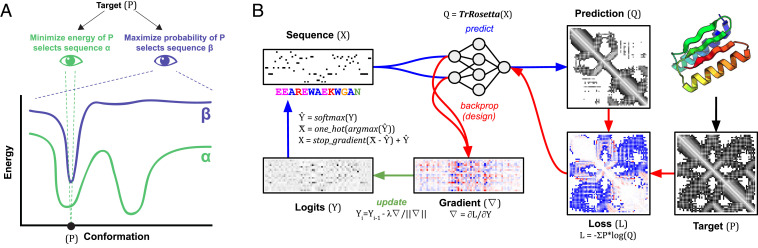
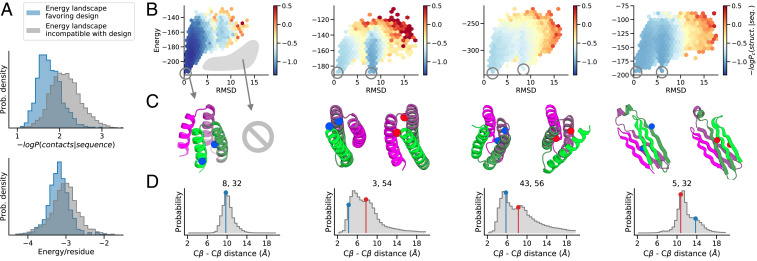
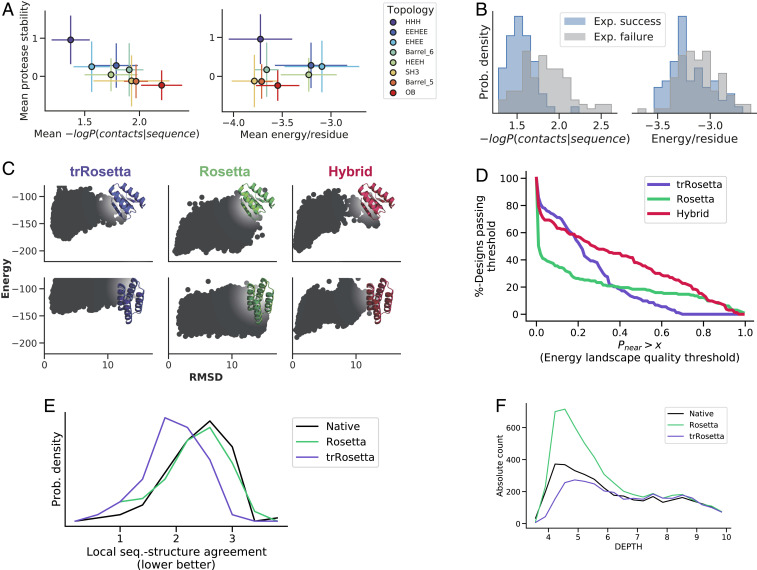
Significance: Almost all proteins fold to their lowest free energy state, which is determined by their amino acid sequence. Computational protein design has primarily focused on finding sequences that have very low energy in the target designed structure. However, what is most relevant during folding is not the absolute energy of the folded state but the energy difference between the folded state and the lowest-lying alternative states. We describe a deep learning approach that captures aspects of the folding landscape, in particular the presence of structures in alternative energy minima, and show that it can enhance current protein design methods.
Overview
The claims and statistics of this paper haven’t been checked yet.
Free: it reads the open-access text and checks the first 5 claims that cite a source we can check. Create a free account to check every claim.
Integrity signals
Registry
Cites
Statistics
Figures
Verification
Claims the paper makes
The claims and statistics of this paper haven’t been checked yet.
Free: it reads the open-access text and checks the first 5 claims that cite a source we can check. Create a free account to check every claim.
Claims other papers make about this one
Each is checked against this paper’s own text: does it say what the citing paper says it does?
The cited source says what the claim attributes to it.
In the citing paper
“trRosetta can also be used to design sequences that fold into a target backbone structure by carrying out sequence optimization using a structure recapitulation loss function that rewards similarity of the predicted structure to the target structure (13).”
From Scaffolding protein functional sites using deep learning (2022) · cites this paper as [13]
The check wasn’t confident either way, so it gives no verdict — never disputed.
In the citing paper
“We determined a 2.5 Å resolution crystal of L056 (see Methods, Figure 3e). The global fold was similar to predictions, with a Cα RMSD of 2.9 Å from the backbone structure predicted by trRosetta and 2.3 Å RMSD from a WT T4 Lysozyme structure59,60.”
From Large language models generate functional protein sequences across diverse families (2023) · cites this paper as [59]
Experimental — accuracy not yet measuredIn the citing paper
“RF and AF have different architectures and were trained independently, and hence AF predictions can be regarded as a partially orthogonal in silico test of whether RF-designed sequences fold into the intended structures, analogous to traditional ab initio folding (13, 24).”
From Scaffolding protein functional sites using deep learning (2022) · cites this paper as [13]
Self-check
Percentages, sums and reported differences re-computed from the paper’s own numbers.
The self-check needs the paper’s full text.
Citations
Cites
A Simplex Method for Function Minimization
Nelder, J. A., & Mead, R. (1965) · The Computer Journal · doi:10.1093/comjnl/7.4.308 · Cited by 28,905
Amino acid substitution matrices from protein blocks.
Henikoff, S., & Henikoff, J. G. (1992) · Proceedings of the National Academy of Sciences · doi:10.1073/pnas.89.22.10915 · Cited by 6,218
TM-align: a protein structure alignment algorithm based on the TM-score
Zhang, Y. (2005) · Nucleic Acids Research · doi:10.1093/nar/gki524 · Cited by 3,774
Categorical Reparameterization with Gumbel-Softmax
Jang, E., Gu, S., & Poole, B. (2016) · arXiv · doi:10.48550/arxiv.1611.01144 · Cited by 3,616 · cited 1×
“3 with respect to the auxiliary variable Y (24):”
BackgroundHow fast-folding proteins fold
Lindorff-Larsen, K., Piana, S., Dror, R. O., & Shaw, D. E. (2011) · Science · doi:10.1126/science.1208351 · Cited by 1,980 · cited 1×
“…folding energy landscape characterization using molecular dynamics methods even for small proteins is a resource-intensive computational task (18, 19), and even Rosetta ab initio folding simulations are extremely computationally intensive, requiring thousands of CPU hours to generate enough…”
BackgroundAtomic-level characterization of the structural dynamics of proteins
Shaw, D. E., Maragakis, P., Lindorff-Larsen, K., Piana, S., Dror, R. O., Eastwood, M. P., Bank, J. A., Jumper, J. M., Salmon, J. K., Shan, Y., et al. (2010) · Science · doi:10.1126/science.1187409 · Cited by 1,923
Protein Structure Prediction Using Rosetta
Rohl, C. A., Strauss, C. E. M., Misura, K. M. S., & Baker, D. (2004) · Methods in Enzymology · doi:10.1016/s0076-6879(04)83004-0 · Cited by 1,725 · cited 1×
“Energy landscapes of designs were mapped out using Rosetta de novo structure prediction (ab initio folding) (27).”
MethodSelf-citationDesign of a Novel Globular Protein Fold with Atomic-Level Accuracy
Kuhlman, B., Dantas, G., Ireton, G. C., Varani, G., Stoddard, B. L., & Baker, D. (2003) · Science · doi:10.1126/science.1089427 · Cited by 1,670
Self-citationThe Rosetta All-Atom Energy Function for Macromolecular Modeling and Design
Alford, R. F., Leaver-Fay, A., Jeliazkov, J. R., O’Meara, M. J., DiMaio, F. P., Park, H., Shapovalov, M. V., Renfrew, P. D., Mulligan, V. K., Kappel, K., et al. (2017) · Journal of Chemical Theory and Computation · doi:10.1021/acs.jctc.7b00125 · Cited by 1,532
Self-citationImproved protein structure prediction using predicted interresidue orientations
Yang, J., Anishchenko, I., Park, H., Peng, Z., Ovchinnikov, S., & Baker, D. (2020) · Proceedings of the National Academy of Sciences · doi:10.1073/pnas.1914677117 · Cited by 1,421 · cited 2×
“Combining these predictions with Rosetta energy minimization yielded excellent predictions of structures in benchmark cases, as well as recent blind Continous Automated Model EvalutiOn (CAMEO) structure modeling evaluations (13).”
BackgroundMethodSelf-citation
Cited by
Large language models generate functional protein sequences across diverse families
Madani, A., Krause, B., Greene, E. R., Subramanian, S., Mohr, B. P., Holton, J. M., Olmos, J. L., Xiong, C., Sun, Z. Z., Socher, R., et al. (2023) · Nature Biotechnology · doi:10.1038/s41587-022-01618-2 · Cited by 1,078
De novo protein design by deep network hallucination
Anishchenko, I., Chidyausiku, T. M., Ovchinnikov, S., Pellock, S. J., & Baker, D. (2020) · doi:10.1101/2020.07.22.211482 · Cited by 629
“On the sampling side, the Monte Carlo approach can be made more efficient by direct gradient-based minimization by tracing the gradients back to the inputs 25 .”
MethodSelf-citationAlphaFold2 and its applications in the fields of biology and medicine
Yang, Z., Zeng, X., Zhao, Y., & Chen, R. (2023) · Signal Transduction and Targeted Therapy · doi:10.1038/s41392-023-01381-z · Cited by 577
“111,112 The integrity of the structures predicted is validated and con fi rmed by standard ab initio folding, protein structure analysis methods, and rigorous all-atom molecular dynamics simulations.”
MethodScaffolding protein functional sites using deep learning
Wang, J., Lisanza, S., Juergens, D., Tischer, D., Watson, J. L., Castro, K. M., Ragotte, R., Saragovi, A., Milles, L. F., Baek, M., et al. (2022) · Science · doi:10.1126/science.abn2100 · Cited by 487
“…fold to the hallucinated structures (12). trRosetta can also be used to design sequences that fold into a target backbone structure by carrying out sequence optimization using a structure recapitulation loss function that rewards similarity of the predicted structure to the target structure (13).”
BackgroundMethodSelf-citationDe novo design of luciferases using deep learning
Yeh, A. H.-W., Norn, C., Kipnis, Y., Tischer, D., Pellock, S. J., Evans, D., Ma, P., Lee, G. R., Zhang, J. Z., Anishchenko, I., et al. (2023) · Nature · doi:10.1038/s41586-023-05696-3 · Cited by 441
“…of ideal NTF2-like structures, we developed a deep-learning-based ‘family-wide hallu-cination’ approach that integrates unconstrained de novo design 17,18 and Rosetta sequence-design approaches 19 to enable the generation of an essentially unlimited number of proteins that have a desired fold (Fig.”
MethodSelf-citation
Metadata
- Authors
- Norn, C., Wicky, B. I. M., Juergens, D., Liu, S., Kim, D., Tischer, D., Koepnick, B., Anishchenko, I., Players, F., Baker, D., Ovchinnikov, S., Coral, A., Bubar, A. J., Boykov, A., Valle Pérez, A. U., MacMillan, A., Lubow, A., Mussini, A., Cai, A., Ardill, A. J., Seal, A., Kalantarian, A., Failer, B., Lackersteen, B., Chagot, B., Haight, B. R., Taştan, B., Uitham, B., Roy, B. G., de Melo Cruz, B. R., Echols, B., Lorenz, B. E., Blair, B., Kestemont, B., Eastlake, C. D., Bragdon, C. J., Vardeman, C., Salerno, C., Comisky, C., Hayman, C. L., Landers, C. R., Zimov, C., Coleman, C. D., Painter, C. R., Ince, C., Lynagh, C., Malaniia, D., Wheeler, D. C., Robertson, D., Simon, V., Chisari, E., Kai, E. L. J., Rezae, F., Lengyel, F., Tabotta, F., Padelletti, F., Boström, F., Gross, G. O., McIlvaine, G., Beecher, G., Hansen, G. T., de Jong, G., Feldmann, H., Borman, J. L., Quinn, J., Norrgard, J., Truong, J., Diderich, J. A., Canfield, J. M., Photakis, J., Slone, J. D., Madzio, J., Mitchell, J., Stomieroski, J. C., Mitch, J. H., Altenbeck, J. R., Schinkler, J., Weinberg, J. B., Burbach, J. D., Sequeira da Costa, J. C., Bada Juarez, J. F., Gunnarsson, J. P., Harper, K. D., Joo, K., Clayton, K. T., DeFord, K. E., Scully, K. F., Gildea, K. M., Abbey, K. J., Kohli, K. L., Stenner, K., Takács, K., Poussaint, L. L., Manalo, L. C., Withers, L. C., Carlson, L., Wei, L., Fisher, L. R., Carpenter, L., Ji-hwan, M., Ricci, M., Belcastro, M. A., Leniec, M., Hohmann, M., Thompson, M., Thayer, M. A., Gaebel, M., Cassidy, M. D., Fagiola, M., Lewis, M., Pfützenreuter, M., Simon, M., Elmassry, M. M., Benevides, N., Kerr, N. K., Verma, N., Shannon, O., Yin, O., Wolfteich, P., Gummersall, P., Tłuścik, P., Gajar, P., Triggiani, P. J., Guha, R., Mathew Innes, R. B., Buchanan, R., Gamble, R., Leduc, R., Spearing, R., dos Santos Gomes, R. L. C., Estep, R. D., DeWitt, R., Moore, R., Shnider, S. G., Zaccanelli, S. J., Kuznetsov, S., Burillo-Sanz, S., Mooney, S., Vasiliy, S., Butkovich, S. S., Hudson, S. B., Pote, S. L., Denne, S. P., Schwegmann, S. A., Ratna, S., Kleinfelter, S. C., Bausewein, T., George, T. J., de Almeida, T. S., Yeginer, U., Barmettler, W., Pulley, W. R., Wright, W. S., Willyanto, Lansford, W., Hochart, X., Gaiji, Y. A. S., Lagodich, Y., & Christian, V.
- Affiliations
- University of Washington (US)
- Harvard University (US)
- Howard Hughes Medical Institute (US)
- Corresponding author
- Baker, David
- Ovchinnikov, Sergey
- ORCID
- Norn, Christoffer
- Wicky, Basile I. M.
- Juergens, David
- Liu, Sirui
- Kim, David
- Tischer, Doug
- Koepnick, Brian
- Anishchenko, Ivan
- Baker, David
- Ovchinnikov, Sergey
- Seal, Aniruddha
- Chagot, Benjamin
- Roy, Brandon G.
- Kestemont, Bruno
- Coleman, Charles David
- Chisari, Emanuele
- Truong, Jason
- Diderich, Jasper A.
- Slone, Jesse David
- Madzio, Joanna
- Joo, Keehyoung
- Wei, Linda
- Elmassry, Moamen M.
- Guha, Rajarshi
- Kuznetsov, Sergey
- Butkovich, Slava S.
- Pote, Spencer Len
- George, Thomas J.
- Venue
- Proceedings of the National Academy of Sciences
- Publisher
- National Academy of Sciences
- Published
- 2021-03-12
- Volume
- 118
- Issue
- 11
- ISSN
- 0027-8424 (ISSN-L)
- 1091-6490
- PMC
- PMC7980421
- OpenAlex
- W3134186384
- Cited by
- 144
- References
- 34
- Citations by year
- 2026: 19 · 2025: 15 · 2024: 26 · 2023: 33 · 2022: 30 · 2021: 21
- FWCI
- 8.62
- Type
- journal article
- Language
- en
- Open access
- hybrid
- doi.org
- Licence
- Locations
- Proceedings of the National Academy of Sciences (publishedVersion, cc-by-nc-nd)
- PubMed Central (publishedVersion, cc-by-nc-nd)
- PubMed (publishedVersion)
- Funders
- Novo Nordisk Foundation (NNF17OC0030446)
- European Molecular Biology Organization (ALTF 139-2018)
- HHS | NIH | NIH Office of the Director (DP5OD026389)
- Howard Hughes Medical Institute (N/A)
- Audacious Project at the Institute for Protein Design (N/A)
- HHS | NIH | National Institute of Allergy and Infectious Diseases (HHSN272201700059C)
- Schmidt Futures program (N/A)
- Topics
- Life Sciences › Biochemistry, Genetics and Molecular Biology › Molecular Biology › Protein Structure and Dynamics
- Life Sciences › Biochemistry, Genetics and Molecular Biology › Molecular Biology › RNA and protein synthesis mechanisms
- Physical Sciences › Chemistry › Organic Chemistry › Chemical Synthesis and Analysis
- Keywords
- protein design, backpropagation, de novo protein design, energy landscape, folding stability
- MeSH terms
- Models, Molecular, Protein Conformation, Proteins, Thermodynamics, Neural Networks, Computer, Protein Folding
About these checks
Registry, retraction, Cites and statistics results are computed, not judged, with one exception: a printed reference that no index lists is read once by a model before it counts as a citation error. Claims are extracted by a model and kept only when their quote appears verbatim in the text; each cited source is then checked, with a model’s help, for whether it says what the claim relies on. Those verdicts can be wrong — read the claim’s quote and the cited source before relying on one.
Statistics and arithmetic are recomputed, not judged.
Confidence bands are shown only for fields calibrated on our annotated test set. None is calibrated yet, so no band is shown.
What counts as a claim ›How we measure confidence ›How we check this ›
Are you an author, or do you see a problem with this page? Request a review
How to cite
Cite CoChat for the checks on this page, and the paper for its own findings.
- This page
- CoChat. (2026). Citation check: Protein sequence design by conformational landscape optimization. https://app.cochat.ai/papers/10.1073/pnas.2017228118
- The paper
- Norn, C., Wicky, B. I. M., Juergens, D., Liu, S., Kim, D., Tischer, D., Koepnick, B., Anishchenko, I., Players, F., Baker, D., Ovchinnikov, S., Coral, A., Bubar, A. J., Boykov, A., Valle Pérez, A. U., MacMillan, A., Lubow, A., Mussini, A., Cai, A., . . . Christian, V. (2021). Protein sequence design by conformational landscape optimization. Proceedings of the National Academy of Sciences. https://doi.org/10.1073/pnas.2017228118
Data sources
Bibliographic data: Semantic Scholar, OpenAlex, Crossref.
Contains information from the Semantic Scholar Academic Graph Datasets, made available under the ODC Attribution License (ODC-BY 1.0).
Semantic Scholar’s data is described in: Kinney, R., et al. (2023). The Semantic Scholar Open Data Platform. arXiv:2301.10140.
