

Timing matters when correcting fake news
Open accessThe DOI matches its Crossref record; 21 of the 21 references it cites were found in a registry or an index.
Abstract
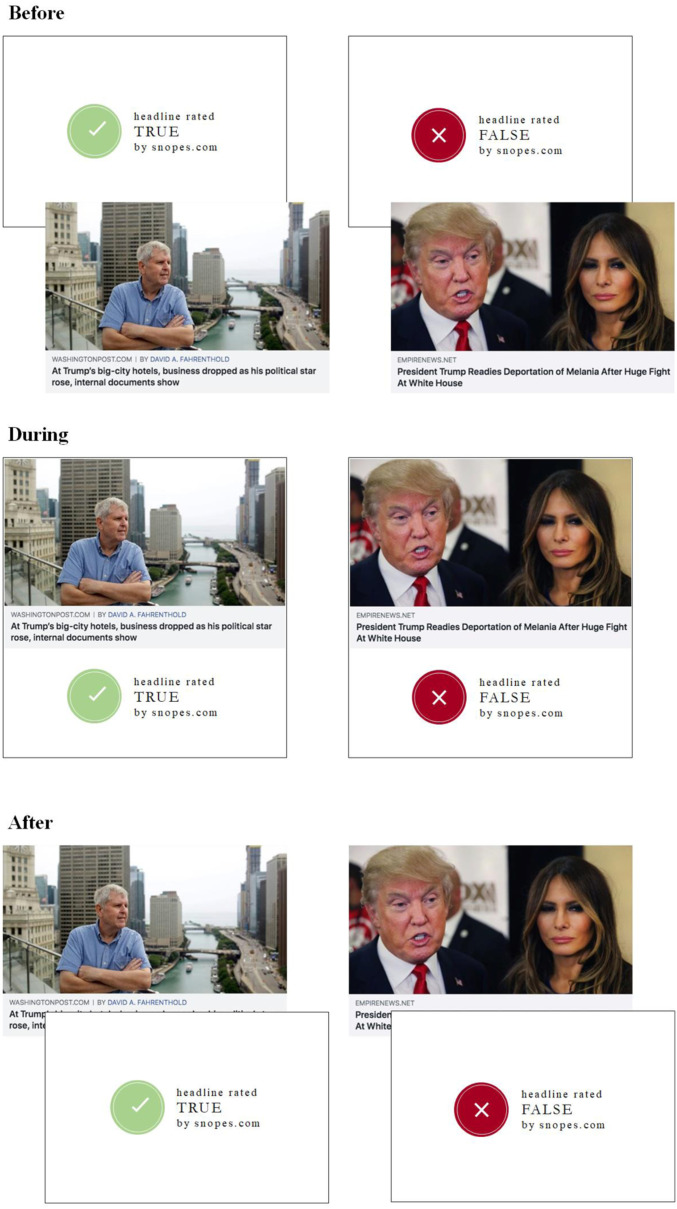
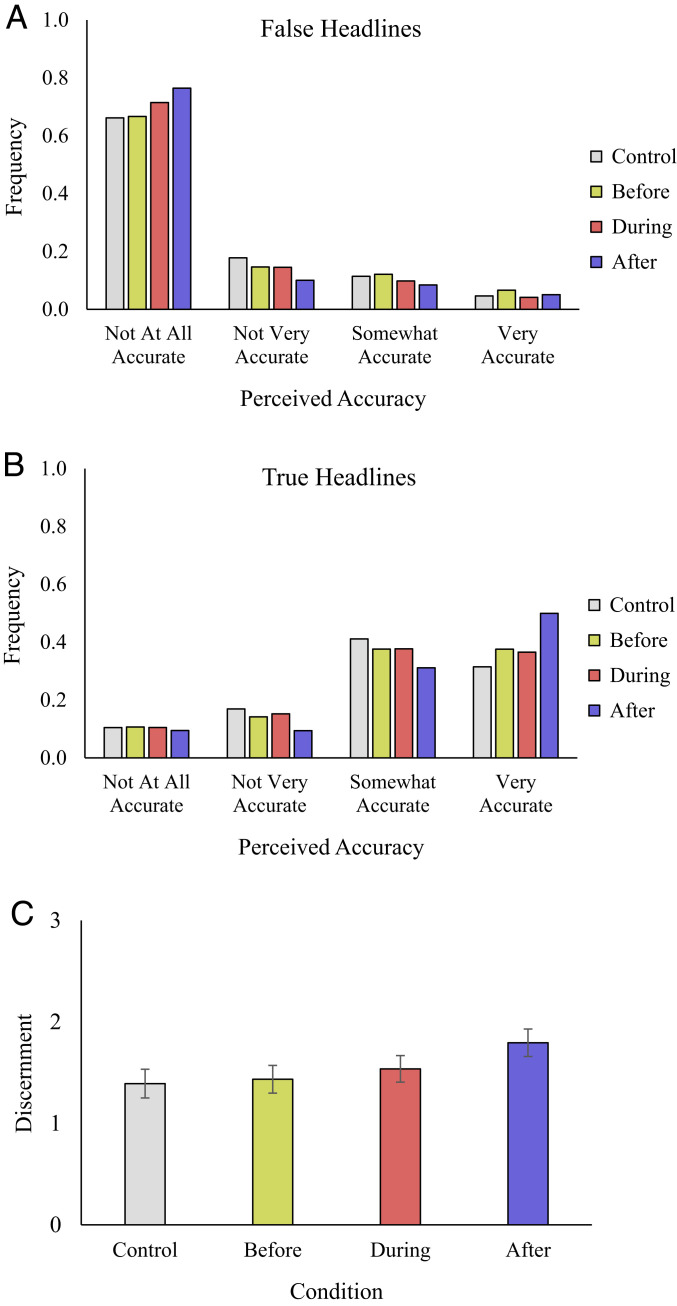
Countering misinformation can reduce belief in the moment, but corrective messages quickly fade from memory. We tested whether the longer-term impact of fact-checks depends on when people receive them. In two experiments (total N = 2,683), participants read true and false headlines taken from social media. In the treatment conditions, “true” and “false” tags appeared before, during, or after participants read each headline. Participants in a control condition received no information about veracity. One week later, participants in all conditions rated the same headlines’ accuracy. Providing fact-checks after headlines ( debunking ) improved subsequent truth discernment more than providing the same information during ( labeling ) or before ( prebunking ) exposure. This finding informs the cognitive science of belief revision and has practical implications for social media platform designers.
Overview
The claims and statistics of this paper haven’t been checked yet.
Free: it reads the open-access text and checks the first 5 claims that cite a source we can check. Create a free account to check every claim.
Integrity signals
Registry
Cites
Statistics
Figures
Verification
Claims the paper makes
The claims and statistics of this paper haven’t been checked yet.
Free: it reads the open-access text and checks the first 5 claims that cite a source we can check. Create a free account to check every claim.
Claims other papers make about this one
Each is checked against this paper’s own text: does it say what the citing paper says it does?
The check wasn’t confident either way, so it gives no verdict — never disputed.
In the citing paper
“A prominent troll farm example is the Russia-based Internet Research Agency (IRA), which disseminated inflammatory content online to influence the outcome of the 2016 U.S. presidential election.33”
From Fake news, disinformation and misinformation in social media: a review (2023) · cites this paper as [33]
Experimental — accuracy not yet measured
Self-check
Percentages, sums and reported differences re-computed from the paper’s own numbers.
The self-check needs the paper’s full text.
Citations
Cites
Hattie, J., & Timperley, H. (2007) · Review of Educational Research · doi:10.3102/003465430298487 · Cited by 12,905
Prior exposure increases perceived accuracy of fake news
Pennycook, G., Cannon, T. D., & Rand, D. G. (2018) · Journal of Experimental Psychology General · doi:10.1037/xge0000465 · Cited by 1,268 · cited 1×
“Ideally, people would not see misinformation in the first place, since even a single exposure to a fake headline makes it seem truer (20).”
BackgroundSelf-citationCook, J., Lewandowsky, S., & Ecker, U. K. H. (2017) · PLOS ONE · doi:10.1371/journal.pone.0175799 · Cited by 971 · cited 1×
“As examples, reading about “fake experts” protects people from climate science myths (5), and playing a game involving common disinformation tactics (e.”
BackgroundThe Elusive Backfire Effect: Mass Attitudes’ Steadfast Factual Adherence
Wood, T., & Porter, E. (2019) · Political Behavior · doi:10.1007/s11109-018-9443-y · Cited by 904
Debunking: A Meta-Analysis of the Psychological Efficacy of Messages Countering Misinformation
Chan, M.-P. S., Jones, C. R., Hall Jamieson, K., & Albarracín, D. (2017) · Psychological Science · doi:10.1177/0956797617714579 · Cited by 898
Pennycook, G., Bear, A., Collins, E. T., & Rand, D. G. (2020) · Management Science · doi:10.1287/mnsc.2019.3478 · Cited by 714
Self-citationExposure to untrustworthy websites in the 2016 US election
Guess, A. M., Nyhan, B., & Reifler, J. (2020) · Nature Human Behaviour · doi:10.1038/s41562-020-0833-x · Cited by 587
A Meta-Analysis of Research on Inoculation Theory
Banas, J. A., & Rains, S. A. (2010) · Communication Monographs · doi:10.1080/03637751003758193 · Cited by 510 · cited 1×
“Inoculating people to weakened arguments makes them less vulnerable to persuasion (4).”
BackgroundThe effect of type and timing of feedback on learning from multiple-choice tests.
Butler, A. C., Karpicke, J. D., & Roediger, H. L. (2007) · Journal of Experimental Psychology: Applied · doi:10.1037/1076-898x.13.4.273 · Cited by 321 · cited 1×
“However, delivering debunks farther in time from exposure may be beneficial, as delayed feedback can be more effective than immediate feedback (19).”
BackgroundThe role of familiarity in correcting inaccurate information.
Swire, B., Ecker, U. K. H., & Lewandowsky, S. (2017) · Journal of Experimental Psychology: Learning, Memory, and Cognition · doi:10.1037/xlm0000422 · Cited by 297
Reminders and Repetition of Misinformation: Helping or Hindering Its Retraction?
Ecker, U. K. H., Hogan, J. L., & Lewandowsky, S. (2017) · Journal of Applied Research in Memory and Cognition · doi:10.1016/j.jarmac.2017.01.014 · Cited by 280
Errors committed with high confidence are hypercorrected.
Butterfield, B., & Metcalfe, J. (2001) · Journal of Experimental Psychology: Learning, Memory, and Cognition · doi:10.1037/0278-7393.27.6.1491 · Cited by 223 · cited 1×
“Corrective feedback facilitates learning (12), especially when errors are made with high confidence (13).”
BackgroundRoozenbeek, J., van der Linden, S., & Nygren, T. (2020) · Harvard Kennedy School Misinformation Review · doi:10.37016//mr-2020-008 · Cited by 201 · cited 1×
“, faking an official Twitter account) helps people detect fake news (6).”
BackgroundThe effectiveness of short‐format refutational fact‐checks
Ecker, U. K. H., O'Reilly, Z., Reid, J. S., & Chang, E. P. (2020) · British Journal of Psychology · doi:10.1111/bjop.12383 · Cited by 177 · cited 1×
“Detailed corrections increase the likelihood of knowledge revision (3), but social media platforms prioritize user experience and typically attach simple tags (e.”
BackgroundKnowledge revision through the lenses of the three-pronged approach
Kendeou, P., Butterfuss, R., Kim, J., & Boekel, M. V. (2018) · Memory & Cognition · doi:10.3758/s13421-018-0848-y · Cited by 141
Surprising feedback improves later memory
Fazio, L. K., & Marsh, E. J. (2009) · Psychonomic Bulletin & Review · doi:10.3758/pbr.16.1.88 · Cited by 124 · cited 2×
“Debunking may improve discernment even more when “false” tags are infrequent, as they would be more surprising and thus more memorable (15).”
BackgroundExploring the neural substrates of misinformation processing
Gordon, A., Brooks, J. C. W., Quadflieg, S., Ecker, U. K. H., & Lewandowsky, S. (2017) · Neuropsychologia · doi:10.1016/j.neuropsychologia.2017.10.003 · Cited by 89
Knowledge acquisition is governed by striatal prediction errors
Pine, A., Sadeh, N., Ben-Yakov, A., Dudai, Y., & Mendelsohn, A. (2018) · Nature Communications · doi:10.1038/s41467-018-03992-5 · Cited by 79
Wahlheim, C. N., Alexander, T. R., & Peske, C. D. (2020) · Psychological Science · doi:10.1177/0956797620952797 · Cited by 71 · cited 1×
“, do not “backfire”) (9)—it is actually best to restate a myth when retracting it (10, 11).”
BackgroundFailure to accept retractions: A contribution to the continued influence effect
O’Rear, A. E., & Radvansky, G. A. (2019) · Memory & Cognition · doi:10.3758/s13421-019-00967-9 · Cited by 66 · cited 1×
“If misinformation persists because people refuse to “update” beliefs initially (16), prebunking should outperform debunking; readers know from the outset that news is false, so no updating is needed.”
BackgroundKeeping track of ‘alternative facts’: The neural correlates of processing misinformation corrections
Gordon, A., Quadflieg, S., Brooks, J. C. W., Ecker, U. K. H., & Lewandowsky, S. (2019) · NeuroImage · doi:10.1016/j.neuroimage.2019.03.014 · Cited by 57 · cited 1×
“We found the opposite pattern, which instead supports the concurrent storage hypothesis that people retain both misinformation and its correction (17); but over time,”
Result
Research works printed but not linked: 1
- 10.1037/h0101809 · doi:10.1037/h0101809 · Paper page
Cited by
The psychological drivers of misinformation belief and its resistance to correction
Ecker, U. K. H., Lewandowsky, S., Cook, J., Schmid, P., Fazio, L. K., Brashier, N., Kendeou, P., Vraga, E. K., & Amazeen, M. A. (2022) · Nature Reviews Psychology · doi:10.1038/s44159-021-00006-y · Cited by 1,372
Self-citationPennycook, G., & Rand, D. G. (2021) · Trends in Cognitive Sciences · doi:10.1016/j.tics.2021.02.007 · Cited by 1,360
“Indeed, political knowledge is positively associated truth discernment for political news content [23,41], as is media literacy [42] and general information literacy [43].”
BackgroundSelf-citationFake news, disinformation and misinformation in social media: a review
Aïmeur, E., Amri, S., & Brassard, G. (2023) · Social Network Analysis and Mining · doi:10.1007/s13278-023-01028-5 · Cited by 772
“…org/ Uploa dedFi les/ Scree nshot 031120_ false. jpg, last access date: 26-12-2022 2015; Metzger et al. 2020; Sherman et al. 2020; Nekmat 2020; Brashier et al. 2021; Chung and Kim 2021; Lanius et al. 2021); as well as social media-driven studies , which investigate the effect of signals…”
BackgroundPsychological Inoculation against Misinformation: Current Evidence and Future Directions
Traberg, C. S., Roozenbeek, J., & van der Linden, S. (2022) · The ANNALS of the American Academy of Political and Social Science · doi:10.1177/00027162221087936 · Cited by 224
Quantifying the effects of fake news on behavior: Evidence from a study of COVID-19 misinformation.
Greene, C. M., & Murphy, G. (2021) · Journal of Experimental Psychology: Applied · doi:10.1037/xap0000371 · Cited by 150
Metadata
- Authors
- Brashier, N. M., Pennycook, G., Berinsky, A. J., & Rand, D. G.
- Affiliations
- Harvard University (US)
- University of Regina (CA)
- Massachusetts Institute of Technology (US)
- Corresponding author
- Brashier, Nadia M.
- Venue
- Proceedings of the National Academy of Sciences
- Publisher
- National Academy of Sciences
- Published
- 2021-01-25
- Volume
- 118
- Issue
- 5
- ISSN
- 0027-8424 (ISSN-L)
- 1091-6490
- PMC
- PMC7865139
- OpenAlex
- W3122113325
- Cited by
- 216
- References
- 21
- Citations by year
- 2026: 27 · 2025: 39 · 2024: 46 · 2023: 49 · 2022: 37 · 2021: 16
- FWCI
- 51.24
- Type
- journal article
- Language
- en
- Open access
- hybrid
- doi.org
- Licence
- Locations
- Proceedings of the National Academy of Sciences (publishedVersion, cc-by)
- PubMed Central (publishedVersion, cc-by)
- PubMed (publishedVersion)
- DSpace@MIT (Massachusetts Institute of Technology) (submittedVersion, cc-by-nc)
- Funders
- National Science Foundation (1808571)
- Ethics and Governance of Artificial Intelligence of the Miami Foundation (N/A)
- Gouvernement du Canada | Social Sciences and Humanities Research Council of Canada (N/A)
- William and Flora Hewlett Foundation (N/A)
- Reset Project of Luminate (N/A)
- Google (N/A)
- Topics
- Social Sciences › Sociology and Political Science › Misinformation and Its Impacts
- Social Sciences › Arts and Humanities › Philosophy › Epistemology, Ethics, and Metaphysics
- Social Sciences › Library and Information Sciences › Academic Publishing and Open Access
- Keywords
- fact-checking, fake news, misinformation, debunking, prebunking, labeling, truth discernment, belief revision, memory retention, social media
- MeSH terms
- Humans, Newspapers as Topic, Time Factors
About these checks
Registry, retraction, Cites and statistics results are computed, not judged, with one exception: a printed reference that no index lists is read once by a model before it counts as a citation error. Claims are extracted by a model and kept only when their quote appears verbatim in the text; each cited source is then checked, with a model’s help, for whether it says what the claim relies on. Those verdicts can be wrong — read the claim’s quote and the cited source before relying on one.
Statistics and arithmetic are recomputed, not judged.
Confidence bands are shown only for fields calibrated on our annotated test set. None is calibrated yet, so no band is shown.
What counts as a claim ›How we measure confidence ›How we check this ›
Are you an author, or do you see a problem with this page? Request a review
Data sources
Bibliographic data: Semantic Scholar, OpenAlex, Crossref.
Contains information from the Semantic Scholar Academic Graph Datasets, made available under the ODC Attribution License (ODC-BY 1.0).
Semantic Scholar’s data is described in: Kinney, R., et al. (2023). The Semantic Scholar Open Data Platform. arXiv:2301.10140.
