

Timing matters when correcting fake news
Open accessThe DOI matches its Crossref record; 21 of the 21 references it cites were found in a registry or an index.
Abstract
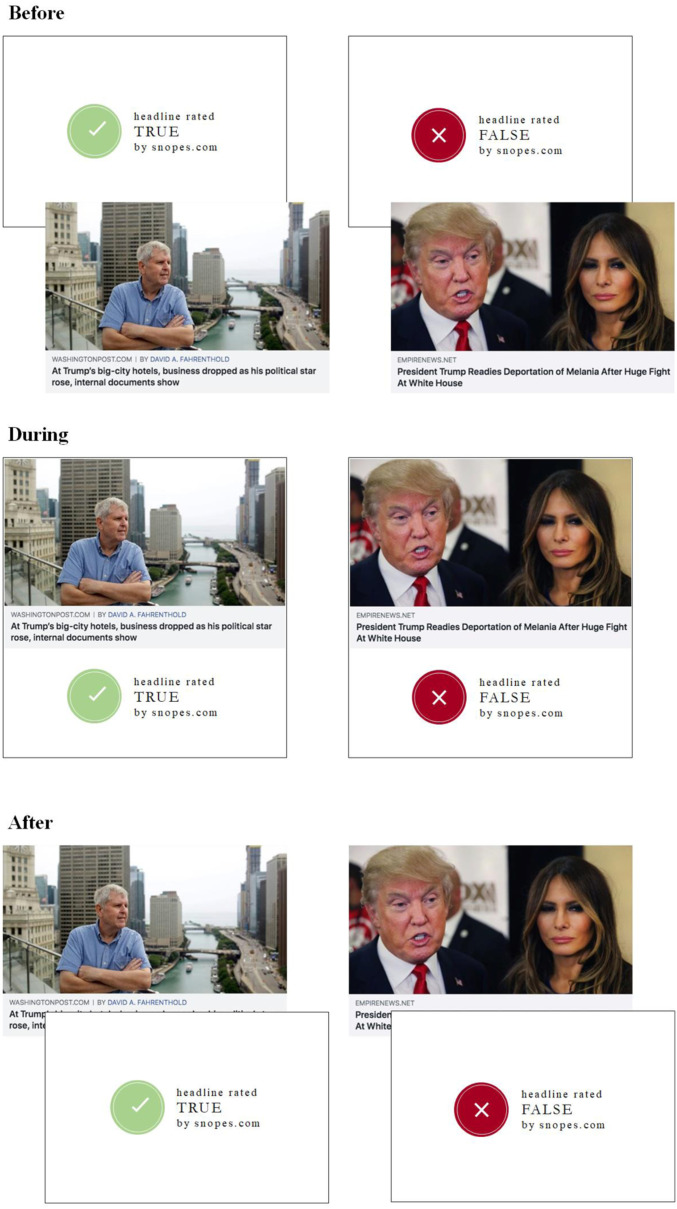
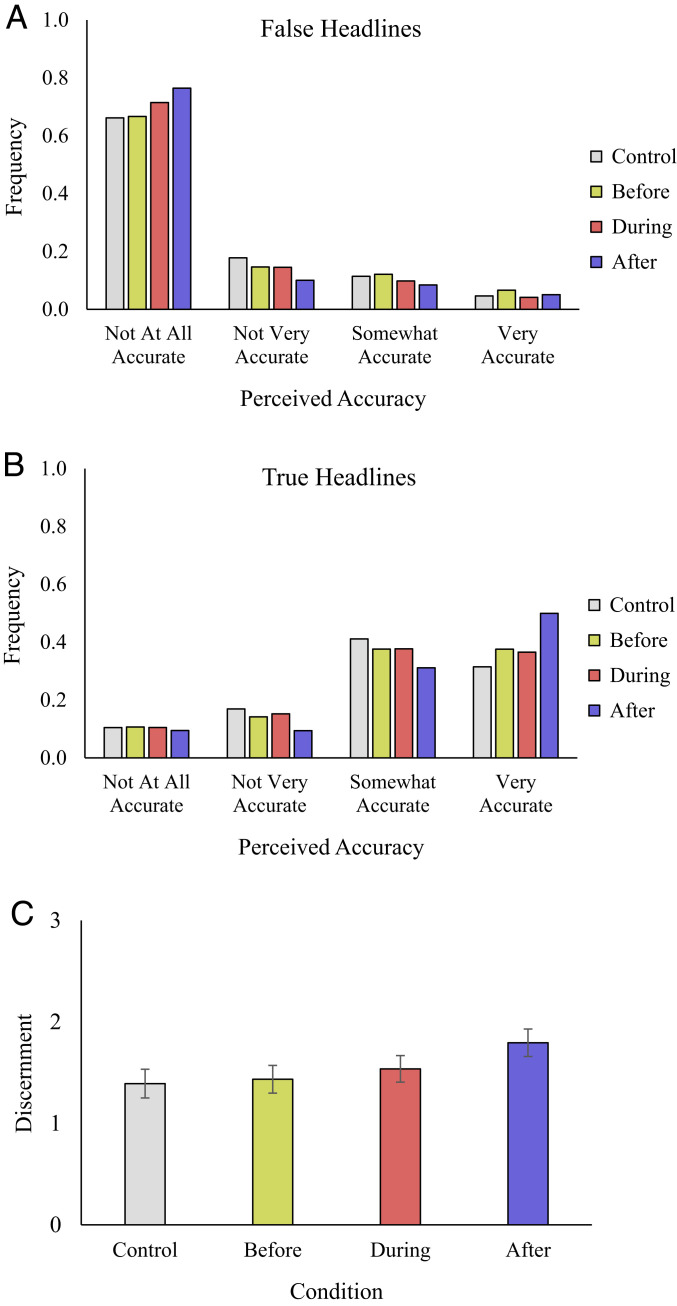
Countering misinformation can reduce belief in the moment, but corrective messages quickly fade from memory. We tested whether the longer-term impact of fact-checks depends on when people receive them. In two experiments (total N = 2,683), participants read true and false headlines taken from social media. In the treatment conditions, “true” and “false” tags appeared before, during, or after participants read each headline. Participants in a control condition received no information about veracity. One week later, participants in all conditions rated the same headlines’ accuracy. Providing fact-checks after headlines ( debunking ) improved subsequent truth discernment more than providing the same information during ( labeling ) or before ( prebunking ) exposure. This finding informs the cognitive science of belief revision and has practical implications for social media platform designers.
Overview
The claims and statistics of this paper haven’t been checked yet.
Free: it reads the open-access text and checks the first 5 claims that cite a source we can check. Create a free account to check every claim.
Integrity signals
Registry
Cites
Statistics
Figures
Verification
Claims the paper makes
The claims and statistics of this paper haven’t been checked yet.
Free: it reads the open-access text and checks the first 5 claims that cite a source we can check. Create a free account to check every claim.
Claims other papers make about this one
Each is checked against this paper’s own text: does it say what the citing paper says it does?
The check wasn’t confident either way, so it gives no verdict — never disputed.
In the citing paper
“A prominent troll farm example is the Russia-based Internet Research Agency (IRA), which disseminated inflammatory content online to influence the outcome of the 2016 U.S. presidential election.33”
From Fake news, disinformation and misinformation in social media: a review (2023) · cites this paper as [33]
Experimental — accuracy not yet measured
Self-check
Percentages, sums and reported differences re-computed from the paper’s own numbers.
The self-check needs the paper’s full text.
Citations
Cites
Hattie, J., & Timperley, H. (2007) · Review of Educational Research · doi:10.3102/003465430298487 · Cited by 12,905
Prior exposure increases perceived accuracy of fake news
Pennycook, G., Cannon, T. D., & Rand, D. G. (2018) · Journal of Experimental Psychology General · doi:10.1037/xge0000465 · Cited by 1,268 · cited 1×
“Ideally, people would not see misinformation in the first place, since even a single exposure to a fake headline makes it seem truer (20).”
BackgroundSelf-citationCook, J., Lewandowsky, S., & Ecker, U. K. H. (2017) · PLOS ONE · doi:10.1371/journal.pone.0175799 · Cited by 971 · cited 1×
“As examples, reading about “fake experts” protects people from climate science myths (5), and playing a game involving common disinformation tactics (e.”
BackgroundThe Elusive Backfire Effect: Mass Attitudes’ Steadfast Factual Adherence
Wood, T., & Porter, E. (2019) · Political Behavior · doi:10.1007/s11109-018-9443-y · Cited by 904
Debunking: A Meta-Analysis of the Psychological Efficacy of Messages Countering Misinformation
Chan, M.-P. S., Jones, C. R., Hall Jamieson, K., & Albarracín, D. (2017) · Psychological Science · doi:10.1177/0956797617714579 · Cited by 898
Pennycook, G., Bear, A., Collins, E. T., & Rand, D. G. (2020) · Management Science · doi:10.1287/mnsc.2019.3478 · Cited by 714
Self-citationExposure to untrustworthy websites in the 2016 US election
Guess, A. M., Nyhan, B., & Reifler, J. (2020) · Nature Human Behaviour · doi:10.1038/s41562-020-0833-x · Cited by 587
A Meta-Analysis of Research on Inoculation Theory
Banas, J. A., & Rains, S. A. (2010) · Communication Monographs · doi:10.1080/03637751003758193 · Cited by 510 · cited 1×
“Inoculating people to weakened arguments makes them less vulnerable to persuasion (4).”
BackgroundThe effect of type and timing of feedback on learning from multiple-choice tests.
Butler, A. C., Karpicke, J. D., & Roediger, H. L. (2007) · Journal of Experimental Psychology: Applied · doi:10.1037/1076-898x.13.4.273 · Cited by 321 · cited 1×
“However, delivering debunks farther in time from exposure may be beneficial, as delayed feedback can be more effective than immediate feedback (19).”
BackgroundThe role of familiarity in correcting inaccurate information.
Swire, B., Ecker, U. K. H., & Lewandowsky, S. (2017) · Journal of Experimental Psychology: Learning, Memory, and Cognition · doi:10.1037/xlm0000422 · Cited by 297
Research works printed but not linked: 1
- 10.1037/h0101809 · doi:10.1037/h0101809 · Paper page
Cited by
The psychological drivers of misinformation belief and its resistance to correction
Ecker, U. K. H., Lewandowsky, S., Cook, J., Schmid, P., Fazio, L. K., Brashier, N., Kendeou, P., Vraga, E. K., & Amazeen, M. A. (2022) · Nature Reviews Psychology · doi:10.1038/s44159-021-00006-y · Cited by 1,372
Self-citationPennycook, G., & Rand, D. G. (2021) · Trends in Cognitive Sciences · doi:10.1016/j.tics.2021.02.007 · Cited by 1,360
“Indeed, political knowledge is positively associated truth discernment for political news content [23,41], as is media literacy [42] and general information literacy [43].”
BackgroundSelf-citationFake news, disinformation and misinformation in social media: a review
Aïmeur, E., Amri, S., & Brassard, G. (2023) · Social Network Analysis and Mining · doi:10.1007/s13278-023-01028-5 · Cited by 772
“…org/ Uploa dedFi les/ Scree nshot 031120_ false. jpg, last access date: 26-12-2022 2015; Metzger et al. 2020; Sherman et al. 2020; Nekmat 2020; Brashier et al. 2021; Chung and Kim 2021; Lanius et al. 2021); as well as social media-driven studies , which investigate the effect of signals…”
BackgroundPsychological Inoculation against Misinformation: Current Evidence and Future Directions
Traberg, C. S., Roozenbeek, J., & van der Linden, S. (2022) · The ANNALS of the American Academy of Political and Social Science · doi:10.1177/00027162221087936 · Cited by 224
Quantifying the effects of fake news on behavior: Evidence from a study of COVID-19 misinformation.
Greene, C. M., & Murphy, G. (2021) · Journal of Experimental Psychology: Applied · doi:10.1037/xap0000371 · Cited by 150
Modirrousta-Galian, A., & Higham, P. A. (2023) · Journal of Experimental Psychology: General · doi:10.1037/xge0001395 · Cited by 131
Countering Misinformation: Evidence, Knowledge Gaps, and Implications of Current Interventions
Roozenbeek, J., Culloty, E., & Suiter, J. (2023) · European Psychologist · doi:10.1027/1016-9040/a000492 · Cited by 189
Martel, C., & Rand, D. G. (2023) · Current Opinion in Psychology · doi:10.1016/j.copsyc.2023.101710 · Cited by 122
Self-citationA comparison of prebunking and debunking interventions for implied versus explicit misinformation
Tay, L. Q., Hurlstone, M. J., Kurz, T., & Ecker, U. K. H. (2022) · British Journal of Psychology · doi:10.1111/bjop.12551 · Cited by 109
Sultan, M., Tump, A. N., Ehmann, N., Lorenz-Spreen, P., Hertwig, R., Gollwitzer, A., & Kurvers, R. H. J. M. (2024) · Proceedings of the National Academy of Sciences · doi:10.1073/pnas.2409329121 · Cited by 181
A framework for understanding reasoning errors: From fake news to climate change and beyond
Pennycook, G. (2022) · Advances in experimental social psychology · doi:10.1016/bs.aesp.2022.11.003 · Cited by 132
Self-citationFact-checking information from large language models can decrease headline discernment
DeVerna, M., Yan, H. Y., Yang, K.-C., & Menczer, F. (2024) · Proceedings of the National Academy of Sciences · doi:10.1073/pnas.2322823121 · Cited by 146
Chan, M. (2022) · New Media & Society · doi:10.1177/14614448221127675 · Cited by 89
“…government legislation to regulate misleading content (Rodrigues and Xu, 2020), message-based interventions before, during and after of fake news exposure (Brashier et al., 2021), and media literacy education with curricula focusing on the critical evaluation of news (Luhtala and Whiting, 2018).”
Ali, A., & Qazi, I. A. (2023) · Journal of Development Economics · doi:10.1016/j.jdeveco.2023.103108 · Cited by 97
Blair, R., Gottlieb, J., Nyhan, B. J., Paler, L., Argote, P., & Stainfield, C. J. (2023) · Current Opinion in Psychology · doi:10.1016/j.copsyc.2023.101732 · Cited by 100
The Landscape of User-centered Misinformation Interventions - A Systematic Literature Review
Hartwig, K., Doell, F., & Reuter, C. (2024) · ACM Computing Surveys · doi:10.1145/3674724 · Cited by 54
Effective correction of misinformation
Prike, T., & Ecker, U. K. H. (2023) · Current Opinion in Psychology · doi:10.1016/j.copsyc.2023.101712 · Cited by 86
Inoculating against the spread of Islamophobic and radical-Islamist disinformation
Lewandowsky, S., & Yesilada, M. (2021) · Cognitive Research: Principles and Implications · doi:10.1186/s41235-021-00323-z · Cited by 62
Fact-checker warning labels are effective even for those who distrust fact-checkers
Martel, C., & Rand, D. G. (2024) · Nature Human Behaviour · doi:10.1038/s41562-024-01973-x · Cited by 108
“An emerging body of research suggests that these kinds of fact-checker warning labels do effectively reduce belief in, and sharing of, false claims on average 7–12 (for a review, see ref.”
Self-citationHow to Combat Health Misinformation: A Psychological Approach
Roozenbeek, J., & van der Linden, S. (2022) · American Journal of Health Promotion · doi:10.1177/08901171211070958 · Cited by 60
Lu, Z., Li, P., Wang, W., & Yin, M. (2022) · Proceedings of the ACM on Human-Computer Interaction · doi:10.1145/3555562 · Cited by 54
“differentiating true and false information in the long term, especially when warning labels are provided as feedback after people have first processed the information independently [11].”
BackgroundBowes, S. M., & Tasimi, A. (2022) · Journal of Research in Personality · doi:10.1016/j.jrp.2022.104220 · Cited by 68
Changing the incentive structure of social media platforms to halt the spread of misinformation
Globig, L. K., Holtz, N., & Sharot, T. (2023) · eLife · doi:10.7554/elife.85767 · Cited by 66
“This may contrast with incentives which are either provided by the platform itself and/ or not clearly quantified such as verification marks (Edgerly and Vraga, 2019) or flagging false news (Brashier et al., 2021; Chan et al., 2017; Grady et al., 2021; Lees et al., 2022).”
BackgroundCountering misinformation through psychological inoculation
van der Linden, S. (2023) · Advances in experimental social psychology · doi:10.1016/bs.aesp.2023.11.001 · Cited by 70
Labeling AI-generated media online
Wittenberg, C., Epstein, Z., Péloquin-Skulski, G., Berinsky, A. J., & Rand, D. G. (2025) · PNAS Nexus · doi:10.1093/pnasnexus/pgaf170 · Cited by 45
“…has also shown previous success in related settings; labeling content that fact-checkers have flagged as false generally reduces viewers’ belief in (33 – 38) and likelihood of sharing (36, 39 – 41) this content, even in cases where people are pre-disposed to discount labels as biased ((42); for a…”
Self-citationLateral reading and monetary incentives to spot disinformation about science
Panizza, F., Ronzani, P., Martini, C., Mattavelli, S., Morisseau, T., & Motterlini, M. (2022) · Scientific Reports · doi:10.1038/s41598-022-09168-y · Cited by 46
Psychological interventions countering misinformation in social media: A scoping review
Gwiaździński, P., Gundersen, A. B., Piksa, M., Krysińska, I., Kunst, J. R., Noworyta, K., Olejniuk, A., Morzy, M., Rygula, R., Wójtowicz, T., et al. (2023) · Frontiers in Psychiatry · doi:10.3389/fpsyt.2022.974782 · Cited by 37
“The most straightforward intervention is manipulating the user interface by adding warnings (14), tags (15), credibility scores (16), or fact-checks (17).”
BackgroundWhat's so bad about misinformation?
de Ridder, J. (2021) · Inquiry · doi:10.1080/0020174x.2021.2002187 · Cited by 60
Spotting false news and doubting true news: a systematic review and meta-analysis of news judgements
Pfänder, J., & Altay, S. (2025) · Nature Human Behaviour · doi:10.1038/s41562-024-02086-1 · Cited by 41
Digital Technology, Politics, and Policy-Making
Gilardi, F. (2022) · Cambridge University Press eBooks · doi:10.1017/9781108887304 · Cited by 57
Kemp, P. L., Alexander, T. R., & Wahlheim, C. N. (2022) · Cognitive Research Principles and Implications · doi:10.1186/s41235-022-00434-1 · Cited by 53
“, 2017), longer retention intervals (Brashier et al., 2021; Walter & Tukachinsky, 2020), and when attention is divided (Ecker et al.”
BackgroundAccost, Accede, or Amplify: Attitudes towards COVID-19 Misinformation on WhatsApp in India
Varanasi, R. A., Pal, J., & Vashistha, A. (2022) · CHI Conference on Human Factors in Computing Systems · doi:10.1145/3491102.3517588 · Cited by 51
“In particular, HCI scholars have studied misinformation with diverse stakeholders (e.g., journalists) [18, 47, 99, 109, 112, 113] on various media (e.g., news, tweets) [9, 30, 31, 50, 54, 59, 60] through a range of disciplinary perspectives [27, 46, 67, 79, 82].”
Examining the impact of provenance-enabled media on trust and accuracy perceptions
Feng, K. J. K., Ritchie, N., Blumenthal, P., Parsons, A., & Zhang, A. X. (2023) · Proceedings of the ACM on Human-Computer Interaction · doi:10.1145/3610061 · Cited by 39
“accuracy of a claim, or simply Correction, as how much closer one’s perception of accuracy for a claim moves towards the ground truth of that claim after an intervention [12, 87].”
BackgroundFactual Corrections Eliminate False Beliefs About COVID-19 Vaccines
Porter, E., Velez, Y., & Wood, T. J. (2022) · Public Opinion Quarterly · doi:10.1093/poq/nfac034 · Cited by 40
Fazio, L. K., Rand, D. G., Lewandowsky, S., Susmann, M. W., Berinsky, A. J., Guess, A. M., Kendeou, P., Lyons, B. A., Miller, J. M., Newman, E. J., et al. (2024) · PsyArXiv (OSF Preprints) · doi:10.31234/osf.io/uyjha · Cited by 70
Self-citationFighting misinformation among the most vulnerable users
Brashier, N. M. (2024) · Current Opinion in Psychology · doi:10.1016/j.copsyc.2024.101813 · Cited by 47
Self-citationBruns, H., Dessart, F. J., Krawczyk, M. W., Lewandowsky, S., Pantazi, M., Pennycook, G., Schmid, P., & Smillie, L. (2024) · Scientific Reports · doi:10.1038/s41598-024-71599-6 · Cited by 53
“However, our findings align with previous findings attesting higher effectiveness to debunks compared with prebunks 27,28 , while contradicting findings of prebunks being more effective 29 .”
ResultSelf-citation“Fact-checking” fact checkers: A data-driven approach
Lee, S., Xiong, A., Seo, H., & Lee, D. (2023) · Harvard Kennedy School Misinformation Review · doi:10.37016/mr-2020-126 · Cited by 70
“For instance, research conducted by Brashier et al. (2021) and Walter & Murphy (2018) suggests that debunking, which involves fact-checking after the exposure of misinformation, tends to be more effective than forewarning or prebunking.”
MethodBerger, L., Kerkhof, A., Mindl, F., & Münster, J. (2025) · Journal of Public Economics · doi:10.1016/j.jpubeco.2025.105345 · Cited by 48
Survey of machine learning techniques for Arabic fake news detection
Touahri, I., & Mazroui, A. (2024) · Artificial Intelligence Review · doi:10.1007/s10462-024-10778-3 · Cited by 39
“To improve information reliability, systems to detect fake news in real time should be built (Brashier et al. 2021).”
Fighting Infodemics: Labels as Antidotes to Mis- and Disinformation?!
Mende, M., Ubal, V. O., Cozac, M., Vallen, B., & Berry, C. (2023) · Journal of Public Policy & Marketing · doi:10.1177/07439156231184816 · Cited by 39
“In contrast, Brashier et al. (2021) report that providing “ true ” or “ false ” tags on social media headlines after exposure has a stronger impact on accuracy perceptions relative to labels that occur before or during exposure.”
BackgroundResultBattling the coronavirus ‘infodemic’ among social media users in Kenya and Nigeria
Offer‐Westort, M., Rosenzweig, L. R., & Athey, S. C. (2024) · Nature Human Behaviour · doi:10.1038/s41562-023-01810-7 · Cited by 40
Policy responses to false and misleading digital content: A snapshot of Children’s Media Literacy
Hill, J. (2022) · OECD education working papers · doi:10.1787/1104143e-en · Cited by 34
Zhang, S., Zhang, Y., Li, J., Ni, Z., & Liu, Z. (2024) · Computers in Human Behavior · doi:10.1016/j.chb.2024.108136 · Cited by 33
Social media influence, trust, and conflict: An interview based study of leadership perceptions
Johnson, N., Turnbull, B., & Reisslein, M. (2021) · Technology in Society · doi:10.1016/j.techsoc.2021.101836 · Cited by 38
Effects of inductive learning and gamification on news veracity discernment.
Modirrousta-Galian, A., Higham, P. A., & Seabrooke, T. (2023) · Journal of Experimental Psychology Applied · doi:10.1037/xap0000458 · Cited by 44
Zhong, B. (2023) · International Journal of Information Management · doi:10.1016/j.ijinfomgt.2023.102626 · Cited by 37
Misinformation interventions decay rapidly without an immediate posttest
Capewell, G., Maertens, R., Remshard, M., van der Linden, S., Compton, J., Lewandowsky, S., & Roozenbeek, J. (2024) · Journal of Applied Social Psychology · doi:10.1111/jasp.13049 · Cited by 38
“And although some longitudinal studies are available (Basol et al., 2021; Brashier et al., 2021; Maertens et al., 2021; Swire et al., 2017), 2 most of these studies have involved participants going through an intervention, then immediately taking a posttest, and then taking another posttest some…”
BackgroundFactual corrections: Concerns and current evidence
Porter, E. V., & Wood, T. (2023) · Current Opinion in Psychology · doi:10.1016/j.copsyc.2023.101715 · Cited by 39
Countering AI-generated misinformation with pre-emptive source discreditation and debunking
Spearing, E. R., Gile, C. I., Fogwill, A. L., Prike, T., Swire‐Thompson, B., Lewandowsky, S., & Ecker, U. K. H. (2025) · Royal Society Open Science · doi:10.1098/rsos.242148 · Cited by 42
Casara, B. G. S., Filippi, S., Suitner, C., Dollani, E., & Maass, A. (2022) · British Journal of Social Psychology · doi:10.1111/bjso.12555 · Cited by 51
“Another intervention could be to directly tackle conspiracy theories, by both inoculating scepticism against conspiratorial narratives, and debunking conspiratorial information (Brashier et al., 2021; Jolley & Douglas, 2017; Salvador Casara et al., 2019).”
BackgroundParasocial diffusion: K-pop fandoms help drive COVID-19 public health messaging on social media
Chang, H.-C. H., Pham, B., & Ferrara, E. (2023) · Online Social Networks and Media · doi:10.1016/j.osnem.2023.100267 · Cited by 38
“Practically, external factors such as the timing of the information and trustworthiness of the source can impact one’s belief in misinformation [9], along with the channels where misinformation arises from [10].”
BackgroundJohansson, P., Enoch, F., Hale, S. A., Vidgen, B., Bereskin, C., Margetts, H. Z., & Bright, J. (2023) · SSRN Electronic Journal · doi:10.2139/ssrn.4648332 · Cited by 40
Debriefing works: Successful retraction of misinformation following a fake news study
Greene, C. M., & Murphy, G. (2023) · PLoS ONE · doi:10.1371/journal.pone.0280295 · Cited by 25
Brenes-Peralta, C., Sánchez, R. P., & Siles, I. (2021) · Journalism Studies · doi:10.1080/1461670x.2021.1994446 · Cited by 31
Vaccination against misinformation: The inoculation technique reduces the continued influence effect
Buczel, K. A., Szyszka, P. D., Siwiak, A., Szpitalak, M., & Polczyk, R. (2022) · PLoS ONE · doi:10.1371/journal.pone.0267463 · Cited by 29
“Although both types of interventions seemed to be effective in reducing CIE, contrary to the researchers’ expectations, it turned out that retrospective inoculation was more effective than prospective one (also: [4, 80]; see, however: [74, 81]).”
Scales, D. A., Gorman, J. M., DiCaprio, P., Hurth, L., Radhakrishnan, M., Windham, S., Akunne, A., Florman, J., Leininger, L. J., & Starks, T. J. (2022) · Computers in Human Behavior · doi:10.1016/j.chb.2022.107609 · Cited by 29
“The more incorrect information is repeated and the longer it is allowed to persist without challenge, the more likely it is to influence actual health behaviors, a phenomenon termed the “ illusory truth effect ” (Brashier et al., 2021; Walter & Tukachinsky, 2020).”
BackgroundKemp, P. L., Loaiza, V. M., & Wahlheim, C. N. (2022) · Scientific Reports · doi:10.1038/s41598-022-25649-6 · Cited by 25
Shao, X., Li, A., Chen, C., Loftus, E. F., & Zhu, B. (2023) · Nature Communications · doi:10.1038/s41467-023-38046-y · Cited by 28
Guay, B., Berinsky, A. J., Pennycook, G., & Rand, D. G. (2026) · The Journal of Politics · doi:10.1086/741130 · Cited by 26
Self-citationPark, S., Park, J. Y., Chin, H., Kang, J., & Cha, M. (2021) · International World Wide Web Conference (WWW) · doi:10.1145/3442381.3450121 · Cited by 28
“These systems help people recognize fake news and pay more attention to questionable features on news headlines [6].”
BackgroundDobber, T., Kruikemeier, S., Votta, F., Helberger, N., & Goodman, E. (2023) · Journal of Information Technology & Politics · doi:10.1080/19331681.2023.2224316 · Cited by 30
“Some studies suggest debunking is more effective than prebunking or labeling (e.g., Brashier, Pennycook, Berinsky, & Rand, 2021), other suggest that prebunking is more effective than debunking (e.g., Jolley & Douglas, 2017).”
Combatting Climate Disinformation: Comparing the Effectiveness of Correction Placement and Type
Christner, C., Merz, P., Barkela, B., Jungkunst, H. F., & von Sikorski, C. (2024) · Environmental Communication · doi:10.1080/17524032.2024.2316757 · Cited by 22
“The most common correction types are fact-focused corrections , which directly address inaccuracies in the disinformation and provide recipients with accurate information that rebut the disinformation (e.g. Brashier et al., 2021; Ecker et al., 2022).”
Influential“That’s just like, your opinion, man”: the illusory truth effect on opinions
Riesthuis, P., & Woods, J. (2023) · Psychological Research · doi:10.1007/s00426-023-01845-5 · Cited by 24
“Interestingly, social media platforms have already introduced fact checks to combat the spread of misinformation and research indicates that such fact checks can indeed reduce the belief in misinformation (Brashier et al., 2021; Clayton et al., 2020).”
BackgroundThe preference for belief, issue polarization, and echo chambers
Baumgaertner, B. O., & Justwan, F. (2022) · Synthese · doi:10.1007/s11229-022-03880-y · Cited by 28
“Admittedly, however, it is not well understood how real cognitive systems handle corrective information—memory and timing complicate matters (Brashier et al., 2021), and we also know that the discrediting of evidence often has little effect (Ross & Anderson, 1982).”
BackgroundA framework for promoting online prosocial behavior via digital interventions
Grüning, D. J., Kamin, J., Panizza, F., Katsaros, M., & Lorenz-Spreen, P. (2024) · Communications Psychology · doi:10.1038/s44271-023-00052-7 · Cited by 32
“Moreover, presenting the label immediately after the content rather than immediately before or at the same time seems to increase its effectiveness, possibly because reading the content itself enhances the effect of the label 36,37 .”
BackgroundLeft–right political orientations are not systematically related to conspiracism
Enders, A. M., Klofstad, C., Littrell, S., Miller, J. M., Theocharis, Y., Uscinski, J. E., & Zilinsky, J. (2024) · Political Psychology · doi:10.1111/pops.13017 · Cited by 21
“If individuals sharing a particular ideological orientation are more likely than others to engage in conspiracism, then efforts aimed at preventing (Traberg et al., 2022) or debunking (Brashier et al., 2021) conspiracy theory beliefs should be targeted among those groups.”
Paris, B. S., Reynolds, R. B., & Marcello, G. (2022) · Information and Learning Sciences · doi:10.1108/ils-09-2021-0083 · Cited by 19
Zhao, A., & Naaman, M. (2023) · Journal of Online Trust and Safety · doi:10.54501/jots.v2i1.118 · Cited by 24
A Unified Framework for Understanding and Intervening on False News SharingPreprint
Gollwitzer, A., Tump, A. N., Martel, C., Deffner, D., Sultan, M., Kurvers, R. H. J. M., & Hertwig, R. (2024) · PsyArXiv (OSF Preprints) · doi:10.31234/osf.io/pxn29 · Cited by 19
Search & Verify: Misinformation and source evaluations in Internet search results
Dennis, A. R., Moravec, P. L., & Kim, A. (2023) · Decision Support Systems · doi:10.1016/j.dss.2023.113976 · Cited by 16
Ahmed, W., Önkal, D., Das, R., Krishnan, S., Olan, F., Hardey, M., & Fenton, A. (2023) · IEEE Transactions on Engineering Management · doi:10.1109/tem.2023.3273191 · Cited by 23
“Extant work shows that providing fact-checks after headlines is more effective than before exposure in subsequent discernment of true headlines [109] and those simple reminders, such as judging the accuracy of a headline, affect information sharing [53].”
BackgroundExploring the Design of Technology-Mediated Nudges for Online Misinformation
Konstantinou, L., Panos, D., & Karapanos, E. (2024) · International Journal of Human-Computer Interaction · doi:10.1080/10447318.2023.2301265 · Cited by 20
“The study revealed that debunking false headlines improved subsequent truth discernment by 25.3%, while labeling and prebunking led an improvement to a significantly less extent (Brashier et al., 2021).”
InfluentialImpact of misinformation in the evolution of collective cooperation on networks
Meng, Y., Broom, M., & Li, A. (2023) · Journal of The Royal Society Interface · doi:10.1098/rsif.2023.0295 · Cited by 25
How do we raise media bias awareness effectively? Effects of visualizations to communicate bias
Spinde, T., Jeggle, C., Haupt, M., Gaissmaier, W., & Giese, H. (2022) · PLoS ONE · doi:10.1371/journal.pone.0266204 · Cited by 25
“However, whereas some research concerning the effects of visualizations of media bias in news articles to detect bias are promising (here: flagging fake news as debunked [35]) others did not find such effects, potentially also due to the technical issues in accurately annotating single articles [19].”
BackgroundIncorporating Psychological Science Into Policy Making: The Case of Misinformation
Kozyreva, A., Smillie, L., & Lewandowsky, S. (2023) · European Psychologist · doi:10.1027/1016-9040/a000493 · Cited by 20
Collaboratively adding context to social media posts reduces the sharing of false news.Preprint
Renault, T., Amariles, D. R., & Troussel, A. (2024) · SSRN Electronic Journal · doi:10.2139/ssrn.4800565 · Cited by 36
“The choice of the words used (for example “disputed” versus “false”), the timing of the intervention (before, alongside or after the news) (Brashier et al., 2021), or even just the size of the color of the text could affect the perceived veracity of those news.”
BackgroundIncreasing Demand for Fact-Checking
GRAHAM, M. H., & Porter, E. V. (2024) · Political Communication · doi:10.1080/10584609.2024.2395859 · Cited by 22
Belief in Science‐Related Conspiracy Theories
Littrell, S., Diekman, A. B., Seelig, M. I., Premaratne, K., Wuchty, S., Verdear, D., Klofstad, C., & Uscinski, J. E. (2025) · Journal of Social Issues · doi:10.1111/josi.70004 · Cited by 17
Kim, A., Moravec, P. L., & Dennis, A. R. (2019) · International Journal of Information Management · doi:10.1016/j.ijinfomgt.2023.102666 · Cited by 19
A practical guide to doing behavioural research on fake news and misinformationPreprint
Pennycook, G., Binnendyk, J., Newton, C., & Rand, D. G. (2020) · PsyArXiv (OSF Preprints) · doi:10.31234/osf.io/g69ha · Cited by 18
“This research has looked at factors such as fact-checking (Brashier et al., 2021; Clayton et al., 2019; Pennycook, Bear, et al., 2020), emphasizing news sources/publishers (Dias et al., 2020), digital media literacy tips (Guess, Lerner, et al., 2020), inoculation and other educational approaches…”
MethodSelf-citationReinero, D. A., Harris, E., Rathje, S., Duke, A., & Bavel, J. J. V. (2023) · PsyArXiv (OSF Preprints) · doi:10.31234/osf.io/z4df3 · Cited by 20
A focus shift in the evaluation of misinformation interventions
Tay, L. Q., Lewandowsky, S., Hurlstone, M. J., Kurz, T., & Ecker, U. K. H. (2023) · Harvard Kennedy School Misinformation Review · doi:10.37016/mr-2020-124 · Cited by 15
The Battlefront of Combating Misinformation and Coping with Media Bias
Fung, Y. R., Huang, K.-H., Nakov, P., & Ji, H. (2022) · ACM SIGKDD Conference on Knowledge Discovery and Data Mining (KDD) · doi:10.1145/3534678.3542615 · Cited by 13
“Hence, we cover frameworks for explaining why a given piece of news is actually fake news through the leverage of reader comments, as well as appropriate strategies for placing the corrective explanations based on user studies (Shu et al., 2019; Brashier et al., 2021).”
Method(2021) · doi:10.31234/osf.io/ar96c · Cited by 12
Self-citationCountering State-Controlled Media Propaganda Through Labeling: Evidence from Facebook
Moravec, P. L., Collis, A., & Wolczynski, N. (2023) · Information Systems Research · doi:10.1287/isre.2022.0305 · Cited by 20
Carey, J. M., Fogarty, B. J., Gehrke, M., Nyhan, B. J., & Reifler, J. (2025) · Science Advances · doi:10.1126/sciadv.adv3758 · Cited by 16
A brief forewarning intervention overcomes negative effects of salient changes in COVID-19 guidance
Gretton, J. D., Meyers, E. A., Walker, A. C., Fugelsang, J. A., & Koehler, D. J. (2021) · Judgment and Decision Making · doi:10.1017/s1930297500008548 · Cited by 16
Seelam, A., Choudhury, A. P., Liu, C., Goay, M., Bali, K., & Vashistha, A. (2024) · Proceedings of the ACM on Human-Computer Interaction · doi:10.1145/3637333 · Cited by 18
“In addition, Brashier et al. [29] demonstrated that timing matters when correcting fake news.”
BackgroundDahlke, R., & Hancock, J. T. (2022) · OSF Preprints (OSF Preprints) · doi:10.31219/osf.io/325tn · Cited by 14
Does Length Matter? The Impact of Fact-Check Length in Reducing COVID-19 Vaccine Misinformation
Tandoc, E. C., Lee, J. C. B., Lee, S., & Quek, P. J. (2022) · Mass Communication & Society · doi:10.1080/15205436.2022.2155195 · Cited by 12
“Brashier et al. (2021) found that providing fact-checks after one sees the fake news significantly outper-formed providing fact-checks during and before the news exposure, thus reiterating the benefits of fact-checking.”
BackgroundBuczel, K. A., Siwiak, A., Szpitalak, M., & Polczyk, R. (2024) · Memory & Cognition · doi:10.3758/s13421-024-01520-z · Cited by 18
“Brashier et al. (2021) presented participants with true and false headlines taken from social media, tagging them as “true” or “false” before, during, and after presentation of the headlines.”
InfluentialThe polarizing content warning: how the media can reduce affective polarization
Kubin, E., & von Sikorski, C. (2024) · Human Communication Research · doi:10.1093/hcr/hqae006 · Cited by 18
Spampatti, T., Brosch, T., Trutnevyte, E., & Hahnel, U. J. J. (2024) · Journal of Experimental Social Psychology · doi:10.1016/j.jesp.2024.104656 · Cited by 11
Zhang, S., Hou, J., Zhang, Y., Yao, Z., & Zhang, Z. (2024) · Science Communication · doi:10.1177/10755470241261323 · Cited by 10
“In addition, response time is a critical feature of debunking channels, as faster social media response time results in more effective intervention (Brashier et al., 2021).”
Can We Detect Bias in Political Fact-Checking? Evidence from a Spanish Case Study
Fernández-Roldán, A., Elías, C., Santiago-Caballero, C., & Teira, D. (2023) · Journalism Practice · doi:10.1080/17512786.2023.2262444 · Cited by 17
“Moreover, research suggests that the timing also matters (Brashier et al. 2021) and so do format (Ecker et al. 2020; Amazeen et al. 2018; Young et al. 2018) and tone (Young et al., ibid ).”
Moazen, B., Ismail, N., Agbaria, N., Mazzilli, S., Petri, D., Amaya, A., D’Arcy, J., Plugge, E., Tavoschi, L., & Stöver, H. (2024) · Frontiers in Public Health · doi:10.3389/fpubh.2024.1323195 · Cited by 11
Reasoning versus prior beliefs: The case of COVID ‐19 fake news
Čavojová, V., Lorko, M., & Šrol, J. (2024) · Applied Cognitive Psychology · doi:10.1002/acp.4194 · Cited by 11
Does wording matter? Examining the effect of phrasing on memory for negated political fact checks.
Pillai, R. M., Brown‐Schmidt, S., & Fazio, L. K. (2023) · Journal of Applied Research in Memory and Cognition · doi:10.1037/mac0000022 · Cited by 12
Preempting polarization: An experiment on opinion formation
Kashner, D., & Stalinski, M. (2024) · Journal of Public Economics · doi:10.1016/j.jpubeco.2024.105122 · Cited by 10
Metadata
- Authors
- Brashier, N. M., Pennycook, G., Berinsky, A. J., & Rand, D. G.
- Affiliations
- Harvard University (US)
- University of Regina (CA)
- Massachusetts Institute of Technology (US)
- Corresponding author
- Brashier, Nadia M.
- Venue
- Proceedings of the National Academy of Sciences
- Publisher
- National Academy of Sciences
- Published
- 2021-01-25
- Volume
- 118
- Issue
- 5
- ISSN
- 0027-8424 (ISSN-L)
- 1091-6490
- PMC
- PMC7865139
- OpenAlex
- W3122113325
- Cited by
- 216
- References
- 21
- Citations by year
- 2026: 27 · 2025: 39 · 2024: 46 · 2023: 49 · 2022: 37 · 2021: 16
- FWCI
- 51.24
- Type
- journal article
- Language
- en
- Open access
- hybrid
- doi.org
- Licence
- Locations
- Proceedings of the National Academy of Sciences (publishedVersion, cc-by)
- PubMed Central (publishedVersion, cc-by)
- PubMed (publishedVersion)
- DSpace@MIT (Massachusetts Institute of Technology) (submittedVersion, cc-by-nc)
- Funders
- National Science Foundation (1808571)
- Ethics and Governance of Artificial Intelligence of the Miami Foundation (N/A)
- Gouvernement du Canada | Social Sciences and Humanities Research Council of Canada (N/A)
- William and Flora Hewlett Foundation (N/A)
- Reset Project of Luminate (N/A)
- Google (N/A)
- Topics
- Social Sciences › Sociology and Political Science › Misinformation and Its Impacts
- Social Sciences › Arts and Humanities › Philosophy › Epistemology, Ethics, and Metaphysics
- Social Sciences › Library and Information Sciences › Academic Publishing and Open Access
- Keywords
- fact-checking, fake news, misinformation, debunking, prebunking, labeling, truth discernment, belief revision, memory retention, social media
- MeSH terms
- Humans, Newspapers as Topic, Time Factors
About these checks
Registry, retraction, Cites and statistics results are computed, not judged, with one exception: a printed reference that no index lists is read once by a model before it counts as a citation error. Claims are extracted by a model and kept only when their quote appears verbatim in the text; each cited source is then checked, with a model’s help, for whether it says what the claim relies on. Those verdicts can be wrong — read the claim’s quote and the cited source before relying on one.
Statistics and arithmetic are recomputed, not judged.
Confidence bands are shown only for fields calibrated on our annotated test set. None is calibrated yet, so no band is shown.
What counts as a claim ›How we measure confidence ›How we check this ›
Are you an author, or do you see a problem with this page? Request a review
Data sources
Bibliographic data: Semantic Scholar, OpenAlex, Crossref.
Contains information from the Semantic Scholar Academic Graph Datasets, made available under the ODC Attribution License (ODC-BY 1.0).
Semantic Scholar’s data is described in: Kinney, R., et al. (2023). The Semantic Scholar Open Data Platform. arXiv:2301.10140.
