

Impacts of biodiversity and biodiversity loss on zoonotic diseases
Open accessThe DOI matches its Crossref record; 67 of the 68 references it cites were found in a registry or an index; 56 of the 77 sources its claims cite were checked for support.
Abstract
Zoonotic diseases are infectious diseases of humans caused by pathogens that are shared between humans and other vertebrate animals. Previously, pristine natural areas with high biodiversity were seen as likely sources of new zoonotic pathogens, suggesting that biodiversity could have negative impacts on human health. At the same time, biodiversity has been recognized as potentially benefiting human health by reducing the transmission of some pathogens that have already established themselves in human populations. These apparently opposing effects of biodiversity in human health may now be reconcilable. Recent research demonstrates that some taxa are much more likely to be zoonotic hosts than others are, and that these animals often proliferate in human-dominated landscapes, increasing the likelihood of spillover. In less-disturbed areas, however, these zoonotic reservoir hosts are less abundant and nonreservoirs predominate. Thus, biodiversity loss appears to increase the risk of human exposure to both new and established zoonotic pathogens. This new synthesis of the effects of biodiversity on zoonotic diseases presents an opportunity to articulate the next generation of research questions that can inform management and policy. Future studies should focus on collecting and analyzing data on the diversity, abundance, and capacity to transmit of the taxa that actually share zoonotic pathogens with us. To predict and prevent future epidemics, researchers should also focus on how these metrics change in response to human impacts on the environment, and how human behaviors can mitigate these effects. Restoration of biodiversity is an important frontier in the management of zoonotic disease risk.
Overview
CoChat Summary
TL;DR
Recent evidence reconciles conflicting views of biodiversity and zoonotic disease: biodiversity loss, rather than high biodiversity itself, appears to increase human exposure to both new and established zoonotic pathogens. The authors argue that research and management should focus on the diversity, abundance, and transmission capacity of zoonotic host taxa, especially those that proliferate in human-dominated landscapes.
Key findings
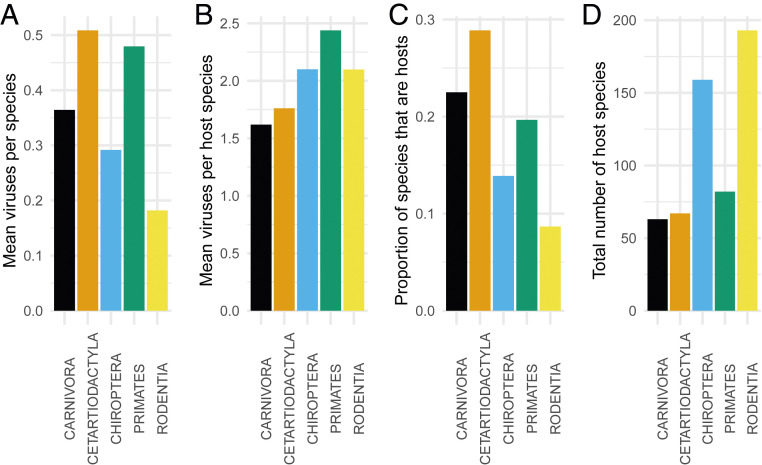
- The “total host diversity” model is no longer adequate; certain mammal taxa are consistently important zoonotic sources—rodents, bats, primates, cetartiodactyls, and carnivores. In one analysis of 142 zoonotic viruses, Rodentia was the source for two-thirds of viruses originating from mammals, with bats hosting the second greatest number.
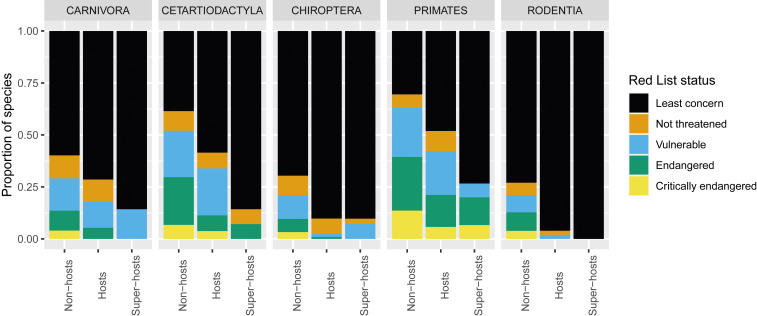
- Human impacts shift communities toward zoonotic hosts. Gibb et al. compiled 6,801 ecological assemblages and 376 host species and found that wild zoonotic hosts were more abundant and more diverse in human-impacted habitats, while nonhosts declined; Johnson et al. found 11% of 5,335 wild terrestrial mammal species were hosts of zoonotic viruses, and hosts were more likely to be of lower conservation concern.
- Reservoir analyses point to similar taxa and traits. Plourde et al. found reservoirs for human disease systems were most commonly Rodentia (36%), Carnivora (25%), and Artiodactyla (21%), while bats were reservoirs for only 8 of 261 disease systems (3%); reservoirs also had faster life histories.
- The dilution effect can reconcile biodiversity loss with increased risk: a larger meta-analysis found the dilution effect was as strong for zoonoses as for other diseases, and domesticated species from across mammalian Orders hosted on average 100 times as many viruses per species as their wild counterparts in one analysis.
Methods
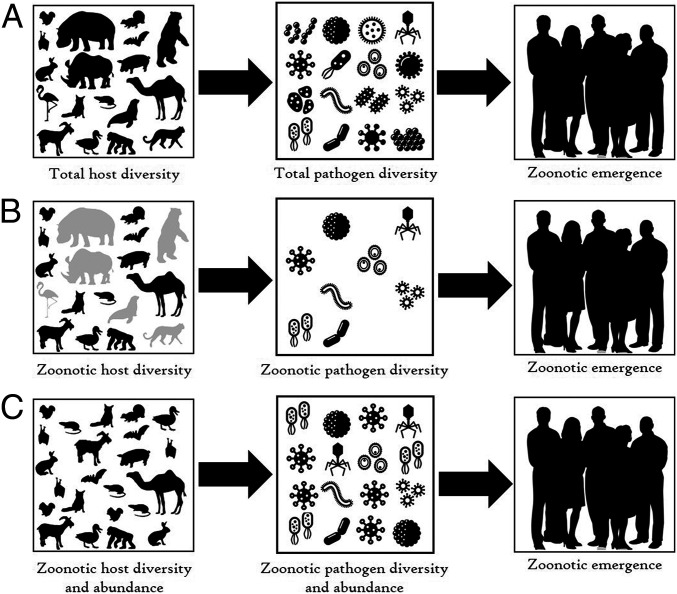
- Design: conceptual synthesis/review evaluating recent evidence on how biodiversity affects zoonotic pathogen emergence and transmission, organized around three models: total host diversity, zoonotic host diversity, and zoonotic host diversity and abundance.
- Data: no new primary data; the paper draws on cited databases and analyses, including 142 zoonotic viruses, 5,335 wild terrestrial mammal species, 6,801 ecological assemblages and 376 host species, and 330 zoonotic/nonzoonotic disease systems.
- Analysis: narrative synthesis reconciling spillover/emergence with ongoing transmission, including the dilution effect, host life-history traits, immune investment, and taxonomic patterns.
Limitations
- The paper states that most spillover studies have not included quantitative measures of transmission and instead rely on qualitative host–pathogen associations; primary versus secondary spillover is difficult to distinguish, and the primary source of a zoonotic pathogen is rarely identified definitively.
- The paper states that evidence linking hosts and pathogens varies in quality, that taxonomic conclusions differ between studies, and that more data are needed on host abundance effects and on disentangling innate host traits from human behaviors.
- Evident from the text: as a review/synthesis, it presents no new empirical test, and its conclusions depend on the cited studies and their available databases, with caveats noted in the SI Appendix.
Model-written summary. Check it against the paper before relying on it.
Integrity signals
Registry
Cites
Statistics
Figures
Verification
Claims the paper makes
39 Valid · 6 Not valid · 16 Not checked · 21 Own results and interpretations
Every source the paper cites for this claim was checked and supports it.
In the paper
“They found a hotspot for probable zoonotic spillover in central and western Africa, for example, because there is broad geographic overlap between humans and primate species to which humans are particularly closely related.”
§ Impacts of biodiversity and biodiversity loss on zoonotic diseases > Biodiversity as a Source of Zoonotic Pathogens
What the sources say
- Supportedcites [18] A. B. Pedersen, T. J. Davies, Cross-species pathogen transmission and disease emergence in primates. EcoHealth 6, 496– 508 (2009). 20232229 PMC7087625 source
The Results section (Hotspot Maps for Cross-Species Pathogen Transmission) identifies central and western Africa as high-risk areas for pathogen shifts from wild primates to humans. Figure 4b attributes the west-central African hotspot to overlapping ranges of many of humans’ closest primate relatives. (LLM, conf=0.92)
plainstates a cause- Asserted: passes — The authors put it forward as true.
- Checkable: passes — It can be checked against evidence.
- Load-bearing: unclear — It is unclear whether the paper’s conclusions depend on it.
- Based: passes — The paper gives a reason why it holds.
- Supported
The cited sources support only part of this claim — read each source’s verdict below.
In the paper
“Cross-species transmission results from a complex interplay between the characteristics of the pathogen (2, 10–12): the original host’s infection, behavior, and ecology; how the pathogen is shed into and survives in the environment; how humans are exposed to the pathogen; and how susceptible those humans are to infection (4, 12–16).”
§ Impacts of biodiversity and biodiversity loss on zoonotic diseases > Biodiversity as a Source of Zoonotic Pathogens
What the sources say
- Partly supportedcites [2] J. L. Geoghegan, A. M. Senior, F. Di Giallonardo, E. C. Holmes, Virological factors that increase the transmissibility of emerging human viruses. Proc. Natl. Acad. Sci. U.S.A. 113, 4170– 4175 (2016). 27001840 PMC4839412 sourceExperimental — accuracy not yet measured
The Significance and Discussion sections identify viral traits associated with human-to-human transmission and acknowledge ecological factors and barriers to host adaptation. They do not establish the claimed interplay involving the original host’s behavior, environmental shedding and survival, human exposure, and human susceptibility; the paper’s main analysis concerns onward transmission after spillover. (LLM, conf=0.85)
- Partly supportedcites [10] A. D. Washburne., Taxonomic patterns in the zoonotic potential of mammalian viruses. PeerJ 6, e5979 (2018). 30519509 PMC6272030 sourceExperimental — accuracy not yet measured
The Introduction and the Discussion’s life-history section describe spillover as involving viral traits, reservoir–human contact, exposure, shedding, environmental persistence, and barriers to infection. The paper does not clearly address the original host’s behavior and ecology or human susceptibility as distinct factors in the full list attributed to it; its evidence is also framed around mammalian viruses rather than pathogens generally. (LLM, conf=0.82)
- Partly supportedcites [11] K. J. Olival., Host and viral traits predict zoonotic spillover from mammals. Nature 546, 646– 650 (2017). 28636590 PMC5570460 sourceExperimental — accuracy not yet measured
The Abstract and Extended Data conceptual model describe zoonotic spillover in terms of viral traits, host ecology and behavior, opportunities for human contact, and clinical signs that can increase shedding (pages not provided). Our copy does not address pathogen survival in the environment or variation in human susceptibility to infection, so it supports only part of the attributed list. (LLM, conf=0.83)
- Partly supportedcites [12] J. L. Geoghegan, E. C. Holmes, Predicting virus emergence amid evolutionary noise. Open Biol. 7, 170189 (2017). 29070612 PMC5666085 sourceExperimental — accuracy not yet measured
The sections on the nature of virus emergence and the human–animal interface link cross-species transmission to viral traits, host adaptation, ecology, human exposure and susceptible hosts. The copy does not address the claim’s specific factors of pathogen shedding or survival in the environment, so it does not support the full list. (LLM, conf=0.84)
- Partly supportedcites [4] N. D. Wolfe, C. P. Dunavan, J. Diamond, Origins of major human infectious diseases. Nature 447, 279– 283 (2007). 17507975 PMC7095142 sourceExperimental — accuracy not yet measured
The Evolutionary stages section explains cross-species infection in terms of pathogen traits, the number and infection rate of animal hosts, opportunities for human exposure, and barriers to infection in the new host. It does not specifically address how pathogens are shed or survive in the environment, so that part of the attributed claim is unsupported by our copy. (LLM, conf=0.85)
plainstates a cause- Asserted: passes — The authors put it forward as true.
- Checkable: passes — It can be checked against evidence.
- Load-bearing: unclear — It is unclear whether the paper’s conclusions depend on it.
- Based: passes — The paper gives a reason why it holds.
- Partly supported
The cited sources support only part of this claim — read each source’s verdict below.
In the paper
“Their results suggest that zoonotic host status in mammals may be positively correlated with resilience to human impacts, such as land conversion, direct exploitation (e.g., hunting, trade), pollution, and the spread of invasive species.”
§ Impacts of biodiversity and biodiversity loss on zoonotic diseases > How Human Impacts Influence Zoonotic Hosts
What the sources say
- Partly supportedcites [21] C. K. Johnson., Global shifts in mammalian population trends reveal key predictors of virus spillover risk. Proc. Biol. Sci. 287, 20192736 (2020). 32259475 PMC7209068 sourceExperimental — accuracy not yet measured
The Conclusion and future directions links greater zoonotic virus richness to abundant mammals adapted to human-dominated landscapes, supporting the land-conversion aspect. But Results and discussion describes exploitation and habitat loss as causes of population declines in zoonotic hosts, not evidence that those hosts are resilient to those impacts. Our copy does not link zoonotic host status to resilience to pollution or the spread of invasive species. (LLM, conf=0.88)
hedgedstates an association- Asserted: passes — The authors put it forward as true.
- Checkable: passes — It can be checked against evidence.
- Load-bearing: passes — The paper’s conclusions depend on it.
- Based: passes — The paper gives a reason why it holds.
- Partly supported
Every source the paper cites for this claim was checked and supports it.
In the paper
“Species that host zoonotic pathogens were more likely to be of lower conservation concern (e.g., they were more abundant) than species that do not (Fig. 3).”
§ Impacts of biodiversity and biodiversity loss on zoonotic diseases > How Human Impacts Influence Zoonotic Hosts
What the sources say
- Supportedcites [21] C. K. Johnson., Global shifts in mammalian population trends reveal key predictors of virus spillover risk. Proc. Biol. Sci. 287, 20192736 (2020). 32259475 PMC7209068 source
The Results and discussion section (‘Zoonotic virus richness scales with wild mammalian abundance’; page not provided) reports significantly more zoonotic viruses in widespread, abundant species and fewer in species of increasingly threatened conservation status. This supports the citing sentence’s broad comparison, although the paper measures reported virus richness rather than presenting a separate host-versus-non-host comparison. (LLM, conf=0.86)
hedgedstates an association- Asserted: passes — The authors put it forward as true.
- Checkable: passes — It can be checked against evidence.
- Load-bearing: passes — The paper’s conclusions depend on it.
- Based: passes — The paper gives a reason why it holds.
- Supported
Every source the paper cites for this claim was checked and supports it.
In the paper
“These so-called zoonotic diseases, which result from cross-species transmission of pathogens between humans and other vertebrate animals, appear to be emerging more frequently (5).”
§ Impacts of biodiversity and biodiversity loss on zoonotic diseases > A Confusing Role for Biodiversity in Pathogen Transmission?
What the sources say
- Supportedcites [5] K. E. Jones., Global trends in emerging infectious diseases. Nature 451, 990– 993 (2008). 18288193 PMC5960580 source
In “Global trends in emerging infectious diseases” (page not specified), the authors report that emerging infectious disease events are predominantly zoonotic and that wildlife-origin zoonotic events increased significantly over time. This supports the citing sentence’s qualified statement that zoonotic diseases appear to be emerging more frequently. (LLM, conf=0.92)
hedged- Asserted: passes — The authors put it forward as true.
- Checkable: passes — It can be checked against evidence.
- Load-bearing: unclear — It is unclear whether the paper’s conclusions depend on it.
- Based: passes — The paper gives a reason why it holds.
- Supported
42 more claims · 18 with their cited sources checked
Create a free account to see all 82 claims and every source verdict.
- It may state two separate claims as one. 25
- Probably not a substantial claim. 14
Citations
Cites
Global trends in emerging infectious diseases
Jones, K. E., Patel, N. G., Levy, M. A., Storeygard, A., Balk, D., Gittleman, J. L., & Daszak, P. (2008) · Nature · doi:10.1038/nature06536 · Cited by 8,338
Life-History Tactics: A Review of the Ideas
Stearns, S. C. (1976) · The Quarterly Review of Biology · doi:10.1086/409052 · Cited by 3,557
Impacts of biodiversity on the emergence and transmission of infectious diseases
Keesing, F., Belden, L. K., Daszak, P., Dobson, A., Harvell, C. D., Holt, R. D., Hudson, P., Jolles, A., Jones, K. E., Mitchell, C. E., et al. (2010) · Nature · doi:10.1038/nature09575 · Cited by 2,043 · cited 4×
“5, 8, 29, 38, and 39).”
InfluentialSelf-citationOrigins of major human infectious diseases
Wolfe, N. D., Dunavan, C. P., & Diamond, J. (2007) · Nature · doi:10.1038/nature05775 · Cited by 1,867
Host Range and Emerging and Reemerging Pathogens
Woolhouse, M. E. J., & Gowtage-Sequeria, S. (2005) · Emerging Infectious Diseases · doi:10.3201/eid1112.050997 · Cited by 1,586
Effects of species diversity on disease risk
Keesing, F., Holt, R. D., & Ostfeld, R. S. (2006) · Ecology Letters · doi:10.1111/j.1461-0248.2006.00885.x · Cited by 1,556
Self-citationBats: Important Reservoir Hosts of Emerging Viruses
Calisher, C. H., Childs, J. E., Field, H. E., Holmes, K. V., & Schountz, T. (2006) · Clinical Microbiology Reviews · doi:10.1128/cmr.00017-06 · Cited by 1,514 · cited 1×
“At about the same time, Dobson (25) and Calisher et al. (26) highlighted the importance of bats, a taxon that has been the focus of many subsequent studies (11, 27).”
Pathways to zoonotic spillover
Plowright, R. K., Parrish, C. R., McCallum, H., Hudson, P. J., Ko, A. I., Graham, A. L., & Lloyd-Smith, J. O. (2017) · Nature Reviews Microbiology · doi:10.1038/nrmicro.2017.45 · Cited by 1,244
Host and viral traits predict zoonotic spillover from mammals
Olival, K. J., Hosseini, P. R., Zambrana-Torrelio, C., Ross, N., Bogich, T. L., & Daszak, P. (2017) · Nature · doi:10.1038/nature22975 · Cited by 1,130
Global hotspots and correlates of emerging zoonotic diseases
Allen, T., Murray, K. A., Zambrana-Torrelio, C., Morse, S. S., Rondinini, C., Di Marco, M., Breit, N., Olival, K. J., & Daszak, P. (2017) · Nature Communications · doi:10.1038/s41467-017-00923-8 · Cited by 1,124
Cited by
Dilution effects in disease ecology
Keesing, F., & Ostfeld, R. S. (2021) · Ecology Letters · doi:10.1111/ele.13875 · Cited by 191
Self-citationInterconnecting global threats: climate change, biodiversity loss, and infectious diseases
Pfenning-Butterworth, A., Buckley, L. B., Drake, J. M., Farner, J. E., Farrell, M. J., Gehman, A.-L. M., Mordecai, E. A., Stephens, P. R., Gittleman, J. L., & Davies, T. J. (2024) · The Lancet Planetary Health · doi:10.1016/s2542-5196(24)00021-4 · Cited by 185
“72,73 The amplifying and diluting effects of biodiversity on disease prevalence are complex, and probably capture multiple mechanisms, sometimes simultaneously.”
Gupta, J., Bai, X., Liverman, D. M., Rockström, J., Qin, D., Stewart-Koster, B., Rocha, J. C., Jacobson, L., Abrams, J. F., Andersen, L. S., et al. (2024) · The Lancet Planetary Health · doi:10.1016/s2542-5196(24)00042-1 · Cited by 197
Giglio, S., Kuchler, T., Stroebel, J., & Zeng, X. (2023) · National Bureau of Economic Research · doi:10.3386/w31137 · Cited by 176
The Impact of Human Activities on Zoonotic Infection Transmissions
Esposito, M. M., Turku, S., Lehrfield, L., & Shoman, A. (2023) · Animals · doi:10.3390/ani13101646 · Cited by 174
Ortiz, D. I., Piche-Ovares, M., Romero-Vega, L. M., Wagman, J., & Troyo, A. (2021) · Insects · doi:10.3390/insects13010020 · Cited by 162
Biological invasions facilitate zoonotic disease emergences
Zhang, L., Rohr, J. R., Cui, R., Xin, Y., Han, L., Yang, X., Gu, S., Du, Y., Liang, J. Y., Wang, X., et al. (2022) · Nature Communications · doi:10.1038/s41467-022-29378-2 · Cited by 170
Climate change and infectious disease: a review of evidence and research trends
de Vuurst, P. V., & Escobar, L. E. (2023) · Infectious Diseases of Poverty · doi:10.1186/s40249-023-01102-2 · Cited by 164
Mutilation of the tree of life via mass extinction of animal genera
Ceballos, G., & Ehrlich, P. R. (2023) · Proceedings of the National Academy of Sciences · doi:10.1073/pnas.2306987120 · Cited by 163
“That is the case of emerging zoonotic diseases such as ebola, Marburg virus, han-tavirus disease, Mers, Sars, and Covid (55, 56).”
BackgroundVora, N. M., Hannah, L., Walzer, C., Vale, M. M., Lieberman, S., Emerson, A., Jennings, J., Alders, R., Bonds, M. H., Evans, J., et al. (2023) · Emerging infectious diseases · doi:10.3201/eid2903.221079 · Cited by 127
“Forest clearing and degradation also causes loss of biodiversity, which disrupts and decreases natural species assemblages and favors animals that can survive near humans, which often are animals associated with zoonotic pathogens, such as bats and rodents (10).”
BackgroundThe significance of biofilms to human, animal, plant and ecosystem health
Sentenac, H., Loyau, A., Leflaive, J., & Schmeller, D. S. (2021) · Functional Ecology · doi:10.1111/1365-2435.13947 · Cited by 112
Fremout, T., Thomas, E., Taedoumg, H., Briers, S., Gutiérrez‐Miranda, C. E., Alcázar-Caicedo, C., Lindau, A., Kpoumie, H. M., Vinceti, B., Kettle, C. J., et al. (2021) · Journal of Applied Ecology · doi:10.1111/1365-2664.14079 · Cited by 114
Population fluctuations and synanthropy explain transmission risk in rodent-borne zoonoses
Ecke, F., Han, B. A., Hörnfeldt, B., Khalil, H., Magnusson, M., Singh, N. J., & Ostfeld, R. S. (2022) · Nature Communications · doi:10.1038/s41467-022-35273-7 · Cited by 105
Self-citationBuelow, E., Ploy, M.-C., & Dagot, C. (2021) · Current Opinion in Microbiology · doi:10.1016/j.mib.2021.10.005 · Cited by 91
Gräf, T., Delatorre, E. O., Ferreira, C. D. N., Rossi, A., Santos, H. G. G., Pizzato, B. R., do Nascimento, V. A., de Souza, V. C., de Lima, G. B., Dezordi, F. Z., et al. (2024) · The Lancet Infectious Diseases · doi:10.1016/s1473-3099(24)00687-x · Cited by 81
Land-use change and rodent-borne diseases: hazards on the shared socioeconomic pathways
García‐Peña, G. E., Rubio, A. V., Mendoza, H., Fernández, M., Milholland, M. T., Aguirre, A. A., Suzán, G., & Zambrana‐Torrelio, C. (2021) · Philosophical Transactions of the Royal Society B Biological Sciences · doi:10.1098/rstb.2020.0362 · Cited by 71
The Internet of Animals: what it is, what it could be
Kays, R., & Wikelski, M. C. (2023) · Trends in Ecology & Evolution · doi:10.1016/j.tree.2023.04.007 · Cited by 67
Dharmarajan, G., Li, R., Chanda, E., Dean, K. R., Dirzo, R., Jakobsen, K. S., Khan, I., Leirs, H., Shi, Z., WOLFE, N. D., et al. (2022) · Zoonoses · doi:10.15212/zoonoses-2021-0028 · Cited by 68
“Importantly, as described above, generalist species that are more likely to invade anthropogenic habitats may also be more competent hosts for pathogens [86], particularly zoonotic pathogens [36,72,87].”
BackgroundChen, F., Jiang, F., Ma, J., Alghamdi, M. A., Zhu, Y., & Yong, J. W. H. (2024) · Ecotoxicology and Environmental Safety · doi:10.1016/j.ecoenv.2024.116848 · Cited by 71
“By safeguarding biodiversity and ecosystem integrity, we can enhance natural disease regulation mechanisms that suppress the outbreak and spread of infectious diseases (Keesing and Ostfeld, 2021).”
BackgroundKocher, A., Cornuault, J., Gantier, J.-C., Manzi, S., Chavy, A., Girod, R., Dusfour, I., Forget, P., Ginouvès, M., Prévot, G., et al. (2022) · Molecular Ecology · doi:10.1111/mec.16341 · Cited by 45
Peros, C. S., Dasgupta, R., Kumar, P., & Johnson, B. A. (2021) · Environmental Science & Policy · doi:10.1016/j.envsci.2021.05.025 · Cited by 63
Marie, V., & Gordon, M. L. (2023) · Viruses · doi:10.3390/v15081638 · Cited by 61
“(1) In both the amplification and dilution models, total host diversity assumes a spectrum of circulating microbes that have the ability to jump the species barrier; (2) the zoonotic host species diversity model (animals circled in red) assumes that potential host species are more likely to harbour zoonotic pathogens…”
BackgroundResultInfluentialBrazilian Biodiversity as a Source of Power and Sustainable Development: A Neglected Opportunity
Ellwanger, J. H., Nobre, C. A., & Chies, J. A. B. (2022) · Sustainability · doi:10.3390/su15010482 · Cited by 67
Bevan, J., Blyth, R., Russell, B., Holtgrewe, L., Cheung, A. H. C., Austin, I., Shah, V., Butler, M., Fraser, S. D., Pabellan, V., et al. (2022) · Medical Teacher · doi:10.1080/0142159x.2022.2152190 · Cited by 52
“Global biodiversity loss, through soil degradation, urbanisation and deforestation, will threaten food security (FAO 2019), increase the incidence of zoonotic disease (Keesing and Ostfeld 2021) and may even alter the human microbiome (Cardinale 2012; Mills et al. 2019; Roe 2019).”
BackgroundEmerging patterns in rodent-borne zoonotic diseases
Keesing, F., & Ostfeld, R. S. (2024) · Science · doi:10.1126/science.adq7993 · Cited by 55
Self-citationDong, L., & Huang, Z. (2023) · Journal of Cleaner Production · doi:10.1016/j.jclepro.2023.139667 · Cited by 51
Real‐time genomics for One Health
Urban, L., Perlas, A., Francino, O., Martí‐Carreras, J., Muga, B., Mwangi, J., Boykin, L. M., Stanton, J. L., Black, A., Waipara, N. W., et al. (2023) · Molecular Systems Biology · doi:10.15252/msb.202311686 · Cited by 43
“Although we do not fully understand the connection between the emergence of zoonotic diseases, wild habitat destruction, and biodiversity loss (Keesing & Ostfeld, 2021), projected environmental changes will undoubtedly place an additional burden on planetary and human health.”
BackgroundEnveloped viruses show increased propensity to cross-species transmission and zoonosis
Valero, A., & Sanjuán, R. (2022) · Proceedings of the National Academy of Sciences · doi:10.1073/pnas.2215600119 · Cited by 38
“A number of risk factors have been identified, such as biodiversity loss (6), species invasions (7), wildlife trade (8), viral host plasticity (9, 10), life history traits of reservoir hosts (11), and host proximity to humans in terms of phylogenetic distance (12) and interaction frequency (13).”
BackgroundHepatozoon (Eucoccidiorida: Hepatozoidae) in wild mammals of the Americas: a systematic review
Thomas, R. S., Santodomingo, A., Saboyá‐Acosta, L. P., Quintero‐Galvis, J. F., Moreno, L., Uribe, J. E., & Muñoz‐Leal, S. (2024) · Parasites & Vectors · doi:10.1186/s13071-024-06154-3 · Cited by 47
“Therefore, studying infectious diseases in wildlife is crucial for the conservation of animal biodiversity and human health, particularly in the context of global climate change [3, 168].”
BackgroundMetagenomic profiling of rhizosphere microbiota: Unraveling the plant-soil dynamics
Wani, A. K., Rahayu, F., Alkahtani, A. M., Alreshidi, M. A., Yadav, K. K., Parnidi, Fauziah, L., Murianingrum, M., Akhtar, N., Mufidah, E., et al. (2024) · Physiological and Molecular Plant Pathology · doi:10.1016/j.pmpp.2024.102381 · Cited by 44
Biofabrication's Contribution to the Evolution of Cultured Meat
Albrecht, F. B., Ahlfeld, T., Klatt, A., Heine, S., Gelinsky, M., & Kluger, P. J. (2024) · Advanced Healthcare Materials · doi:10.1002/adhm.202304058 · Cited by 41
Heni, A. C., Fackelmann, G., Eibner, G. J., Kreinert, S., Schmid, J., Schwensow, N., Wiegand, J., Wilhelm, K., & Sommer, S. (2023) · Animal Microbiome · doi:10.1186/s42523-023-00237-9 · Cited by 36
“As anthropogenic selection pressures will affect these pathogen reservoirs and disease vectors best adapted to living in close proximity to human settlements, studies on generalists’ role in emerging infectious diseases from wildlife and their adaptability to global environmental changes are key in order to understand…”
BackgroundEllwanger, J. H., Byrne, L. B., & Chies, J. A. B. (2022) · Urban Ecosystems · doi:10.1007/s11252-022-01260-5 · Cited by 48
“For instance, further studies are needed about how abiotic conditions, biodiversity, and landscape patterns affect vector populations and pathogen spread in urban systems, including dilution effect (Keesing and Ostfeld 2021; Johnson et al. 2015b; Combs et al. 2022).”
BackgroundInfluentialTowards a ‘people and nature’ paradigm for biodiversity and infectious disease
Gibb, R., Redding, D. W., Friant, S., & Jones, K. E. (2025) · Philosophical Transactions of the Royal Society B Biological Sciences · doi:10.1098/rstb.2023.0259 · Cited by 40
“…and vector-borne infectious diseases (i.e. infections transmitted to humans from animals and/or by arthropod vectors) are unusual in being both an urgent concern for global public health and a relatively direct, visible and measurable link between human health and local ecosystem processes [5].”
Global One Health index for zoonoses: A performance assessment in 160 countries and territories
Sun, Z., Wan, E., Agbana, Y. L., Zhao, H.-Q., Yin, J.-X., Jiang, T.-G., Li, Q., Fei, S.-W., Wu, L. B., Li, X.-C., et al. (2024) · iScience · doi:10.1016/j.isci.2024.109297 · Cited by 44
“54 Thus, it is important to preserve the environment, reduce pollution, and protect biodiversity to prevent and control zoonotic diseases.”
Barathan, M. (2024) · Pathogens and Disease · doi:10.1093/femspd/ftae006 · Cited by 49
“Wildlife species often serve as nat-ur al r eservoirs for v arious pathogens, facilitating spillov er e v ents (Keesing and Ostfeld 2021 ).”
BackgroundHuman disturbance increases coronavirus prevalence in bats
Warmuth, V. M., Metzler, D., & Zamora‐Gutierrez, V. (2023) · Science Advances · doi:10.1126/sciadv.add0688 · Cited by 40
“Human landmodification often interacts with climate and/or biodiversity in its effect on pathogen transmission and zoonotic disease emergence (22, 24, 25).”
BackgroundSchistosoma transmission: scaling-up competence from hosts to ecosystems
Douchet, P., Gourbal, B., Loker, E. S., & Rey, O. (2023) · Trends in Parasitology · doi:10.1016/j.pt.2023.04.001 · Cited by 35
Shilereyo, M. T., Magige, F. J., Ranke, P. S., Ogutu, J. O., & Røskaft, E. (2022) · Parasitology Research · doi:10.1007/s00436-022-07439-1 · Cited by 41
“2003; Keesing and Ostfeld 2021b).”
Weber, N., Nagy, M., Markotter, W., Schaer, J., Puechmaille, S. J., Sutton, J., Dávalos, L. M., Dusabe, M., Ejotre, I., Fenton, M. B., et al. (2023) · Biology Letters · doi:10.1098/rsbl.2023.0358 · Cited by 35
“Indeed, conservation efforts that target habitat preservation are linked to spillover prevention [12,211 – 213].”
BackgroundKaczmarek, N., Mahjoubi, I., Benlasri, M., Nothof, M., Schäfer, R. B., Frör, O., & Berger, E. (2023) · Ecological Indicators · doi:10.1016/j.ecolind.2023.110050 · Cited by 47
Latinne, A., & Morand, S. (2022) · Viruses · doi:10.3390/v14051100 · Cited by 33
“Several additional key drivers that promote cross-species transmission and emergence of zoonotic pathogens have been identified in Asia and include rapidly urbanizing populations, widespread wildlife trade and wildlife consumption, intensive livestock production, deforestation, habitat fragmentation, land-use change,…”
BackgroundReceptor-binding proteins from animal viruses are broadly compatible with human cell entry factors
Dufloo, J., Andreu-Moreno, I., Moreno‐García, J., Valero, A., & Sanjuán, R. (2025) · Nature Microbiology · doi:10.1038/s41564-024-01879-4 · Cited by 33
Genotoxic and antigenotoxic medicinal plant extracts and their main phytochemicals: “A review”
Al‐Naqeb, G., Kalmpourtzidou, Α., Giampieri, F., Giuseppe, R. D., & Cena, H. (2024) · Frontiers in Pharmacology · doi:10.3389/fphar.2024.1448731 · Cited by 37
Kuthyar, S., & Reese, A. T. (2021) · mSystems · doi:10.1128/msystems.00567-21 · Cited by 28
Impacts of agriculture intensification on biodiversity loss, climate change and ecosystem services
Pereira, P. A. D. S., Inácio, M., Barceló, ., & Zhao, W. (2025) · Current Opinion in Environmental Science & Health · doi:10.1016/j.coesh.2025.100637 · Cited by 37
Bat species assemblage predicts coronavirus prevalence
Meyer, M., Schmid, D. W., Baldwin, H., Wilhelm, K., Nkrumah, E. E., Badu, E. K., Oppong, S. K., Schwensow, N., Stow, A., Vallo, P., et al. (2024) · Nature Communications · doi:10.1038/s41467-024-46979-1 · Cited by 29
“Our observation aligns with the commonly observed but not fully understood phenomenon that species, which are more resilient to human disturbance, are often competent hosts 16,73 , particularly for pathogens with zoonotic potential 4,74 .”
Spatial and temporal overlap of domestic cats (Felis catus) and native urban wildlife
Herrera, D. J., Cove, M. V., McShea, W. J., Decker, S. T., Flockhart, D. T. T., Moore, S. M., & Gallo, T. (2022) · Frontiers in Ecology and Evolution · doi:10.3389/fevo.2022.1048585 · Cited by 29
“The risk of zoonotic disease transmission is further amplified by biodiversity loss (Jones et al., 2008; Johnson et al., 2020; Keesing and Ostfeld, 2021), such as that attributed to free-roaming cats (Loss et al.”
BackgroundForest Diversity Reduces the Prevalence of Pathogens Transmitted by the Tick Ixodes ricinus
Bourdin, A., Bord, S., Durand, J., Galon, C., Moutailler, S., Scherer‐Lorenzen, M., & Jactel, H. (2022) · Frontiers in Ecology and Evolution · doi:10.3389/fevo.2022.891908 · Cited by 29
Advancing Global Climate and Biodiversity Goals Through Regenerative Tourism
Duarte, C. M., Cousins, R., Ficociello, M. A., Williams, I. D., & Khowala, A. (2024) · Sustainability · doi:10.3390/su16209133 · Cited by 49
Biodiversity is central for restoration
Edwards, D. P., & Cerullo, G. R. (2024) · Current Biology · doi:10.1016/j.cub.2024.02.032 · Cited by 35
Schwensow, N., Heni, A. C., Schmid, J., Montero, B. K., Brändel, S. D., Halczok, T. K., Mayer, G., Fackelmann, G., Wilhelm, K., Schmid, D. W., et al. (2022) · Journal of Animal Ecology · doi:10.1111/1365-2656.13802 · Cited by 25
Mammal assemblage composition predicts global patterns in emerging infectious disease risk
Wang, Y., Matson, K. D., Santini, L., Visconti, P., Hilbers, J. P., Huijbregts, M. A. J., Xu, Y., Prins, H. H. T., Allen, T., Huang, Z. Y. X., et al. (2021) · Global Change Biology · doi:10.1111/gcb.15784 · Cited by 22
“However, rare studies integrated host abundance in mapping zoonotic disease risk (Keesing & Ostfeld, 2021).”
BackgroundPei, S., Yu, P., Raghwani, J., Wang, Y., Liu, Z., Li, Y., Cheng, Y., Lin, Q., Song, C., Dharmarajan, G., et al. (2024) · Nature Ecology & Evolution · doi:10.1038/s41559-024-02570-x · Cited by 26
“However, the conversion of landscapes has reshaped natural animal populations and their community structures 5–8 .”
Exploring scenarios for the food system–zoonotic risk interface
Shepon, A., Wu, T., Kremen, C., Dayan, T., Perfecto, I., Fanzo, J., Eshel, G., & Golden, C. D. W. (2023) · The Lancet Planetary Health · doi:10.1016/s2542-5196(23)00007-4 · Cited by 43
Kavulikirwa, O. K. (2024) · One Health · doi:10.1016/j.onehlt.2024.100849 · Cited by 29
“3, elevates the risk of zoonotic disease transmission, as displaced populations often live in overcrowded conditions with limited access to clean water, sanitation, and healthcare services [41 – 44].”
BackgroundJohnson, P. T. J., Merrill, T. E. S., Dean, A. D., & Fenton, A. (2024) · Nature Communications · doi:10.1038/s41467-024-46091-4 · Cited by 29
Prist, P. R., de Andreazzi, C. S., Vidal, M. M., Zambrana‐Torrelio, C., Daszak, P., Carvalho, R. L., & Tambosi, L. R. (2023) · Journal of Applied Ecology · doi:10.1111/1365-2664.14442 · Cited by 36
Wang, B., Zhou, Y., Wang, Q., Xu, S., Wang, F., Yue, M., Zeng, Z., & Li, W. (2023) · Cells · doi:10.3390/cells12101438 · Cited by 25
“) that are shared between vertebrate animals and humans seriously threaten the health of animals and humans by causing many foodborne illnesses, ranging from mild to serious, and even death [1,3,4].”
BackgroundSmith, T. B., Vacca, R., Mantegazza, L., & Capua, I. (2023) · Globalization and Health · doi:10.1186/s12992-023-00943-8 · Cited by 29
Sánchez, A., Contreras, A., Corrales, J. C., & de la Fe, C. (2022) · Gaceta Sanitaria · doi:10.1016/j.gaceta.2022.01.012 · Cited by 38
Luo, L., Zhang, J., Wang, H., Chen, M., Jiang, Q., Yang, W., Wang, F., Zhang, J., Swain, R. B., Meadows, M. E., et al. (2024) · The Innovation Geoscience · doi:10.59717/j.xinn-geo.2024.100087 · Cited by 31
Looking beyond land-use and land-cover change: Zoonoses emerge in the agricultural matrix
Perfecto, I., Chaves, L. F., Fitch, G. M., Hajian‐Forooshani, Z., Iuliano, B. G., Li, K., Medina, N., Morris, J. R., Jiménez, B. O., Rivera‐Salinas, I. S., et al. (2023) · One Earth · doi:10.1016/j.oneear.2023.08.010 · Cited by 29
Pathogen Filtration: An Untapped Ecosystem Service
Klohmann, C., & Padilla‐Gamiño, J. L. (2022) · Frontiers in Marine Science · doi:10.3389/fmars.2022.921451 · Cited by 24
Conteddu, K., English, H. M., Byrne, A. W., Amin, B., Griffin, L. L., Kaur, P., Morera‐Pujol, V., Murphy, K. J., Salter‐Townshend, M., Smith, A. F., et al. (2024) · Veterinary Research · doi:10.1186/s13567-024-01314-w · Cited by 28
“Only a small number of studies have looked at the effect of human disturbances on the spread of bTB in wildlife host species, and this knowledge gap needs to be tackled as we are aware that human perturbations may exacerbate zoonotic outbreaks and spread [46–48].”
BackgroundOrthopoxvirus Seroprevalence and Infection Susceptibility in France, Bolivia, Laos, and Mali
Lucıanı, L., Lapidus, N., Amroun, A., Falchi, A., Souksakhone, C., Mayxay, M., Dubot‐Pérès, A., Villarroel, P. M. S., Diarra, I., Koita, O., et al. (2022) · Emerging infectious diseases · doi:10.3201/eid2812.221136 · Cited by 23
Özçelik, F., Dündar, M. S., Yildirim, A. B., HENEHAN, G. T. M., Vicente, O., Sánchez-Alcázar, J. A., Gökçe, N., Yildirim, D. T., Bingol, N. N., Plaseska‐Karanfilska, D., et al. (2024) · Functional & Integrative Genomics · doi:10.1007/s10142-024-01417-9 · Cited by 26
“…environmental changes, such as agricultural intensification and biodiversity loss, and the emergence of zoonotic diseases, which are significantly influenced by factors like host genetic diversity and human population densities (Jones et al. 2013 ; Keesing and Ostfeld 2021; Pillai et al. 2022).”
Amman, B. R., Schuh, A. J., Akurut, G. G., Kamugisha, K., Namanya, D., Sealy, T. K., Graziano, J. C., Enyel, E. M., Wright, E. A., Balinandi, S. K., et al. (2023) · Emerging infectious diseases · doi:10.3201/eid2911.230362 · Cited by 18
“This loss in biodiversity correlates with in - creased human exposure to zoonotic pathogens ( 41 – 43 ).”
BackgroundAn immediate way to lower pandemic risk: (not) seizing the low-hanging fruit (bat)
Osofsky, S. A., Lieberman, S., Walzer, C., Lee, H. L., & Neme, L. A. (2023) · The Lancet Planetary Health · doi:10.1016/s2542-5196(23)00077-3 · Cited by 20
Ticks and tick-borne diseases in the northern hemisphere affecting humans
Boulanger, N., Iijima, H., Doi, K., Watari, Y., Kwak, M. L., Nakao, R., & Wikel, S. K. (2025) · Frontiers in Microbiology · doi:10.3389/fmicb.2025.1632832 · Cited by 23
A review of bovine tuberculosis transmission risk in European wildlife communities
Justus, W., Valle, S., Barton, O., Gresham, A., & Shannon, G. (2024) · Mammal Review · doi:10.1111/mam.12347 · Cited by 22
Diversity regained: Precautionary approaches to COVID-19 as a phenomenon of the total environment
Franco, M. P. V., Molnár, O., Dorninger, C., Laciny, A., Treven, M., Weger, J. O., Albuquerque, E. D. M. E., Gatti, R. C., Hernández, L. A. V., Jakab, M., et al. (2022) · The Science of The Total Environment · doi:10.1016/j.scitotenv.2022.154029 · Cited by 21
“…Gatti et al., 2021), such as couplings between the pandemic and climate change (Beyer et al., 2021; Le Quéré et al., 2020), biodiversity loss (Keesing and Ostfeld, 2021), economic processes (Pak et al., 2020; Spash, 2020), political power struggles (Dressler, 2021), social inequality…”
Alkorta, I., & Garbisu, C. (2024) · Reviews on Environmental Health · doi:10.1515/reveh-2024-0013 · Cited by 18
de Andreazzi, C. S., Martínez-Vaquero, L. A., Winck, G. R., Cardoso, T. D. S., Teixeira, B. R., Xavier, S. C. D. C., Gentile, R., Jansen, A. M., & D’Andrea, P. S. (2023) · Ecography · doi:10.1111/ecog.06579 · Cited by 17
Esposito, A. M., Esposito, M. M., & Ptashnik, A. (2022) · Microorganisms · doi:10.3390/microorganisms10091815 · Cited by 18
“Zoonotic simply means that a pathogen was residing in an animal reservoir but then jumped to a human host through close contact or interactions (Figure 1) [3].”
BackgroundHost functional traits as the nexus for multilevel infection patterns
Huang, Z. Y. X., Halliday, F. W., & Becker, D. J. (2023) · Trends in Ecology & Evolution · doi:10.1016/j.tree.2023.08.011 · Cited by 16
Advancing the central role of non-model biorepositories in predictive modeling of emerging pathogens
Colella, J. P., Cobos, M. E., Salinas, I., & Cook, J. A. (2023) · PLoS Pathogens · doi:10.1371/journal.ppat.1011410 · Cited by 15
“, [9]) remain unknown for most nonmodel wild hosts.”
BackgroundEmerging risk identification in the food chain – A systematic procedure and data analytical options
Farkas, Z., Országh, E., Engelhardt, T., Zentai, A., Süth, M., Csorba, S., & Jóźwiak, Á. B. (2023) · Innovative Food Science & Emerging Technologies · doi:10.1016/j.ifset.2023.103366 · Cited by 14
O’Connor, J., Eberle, C., Cotti, D., Hagenlocher, M., Hassel, J., Janzen, S., Narvaez, L., Newsom, A., Ortiz-Vargas, A., Schütze, S., et al. (2021) · UNU Collections (United Nations University) · doi:10.53324/nyhz4182 · Cited by 33
Drivers and Consequences of Viral Zoonoses: Public Health and Economic Perspectives
Banik, A., & Basu, S. (2025) · Zoonotic Diseases · doi:10.3390/zoonoticdis5040032 · Cited by 29
de Grefte, J., & de Bruin, B. (2025) · Current Opinion in Environmental Sustainability · doi:10.1016/j.cosust.2025.101522 · Cited by 17
Liu, J., Ren, Y., Glauben, T., & Sun, Z. (2026) · Environmental Impact Assessment Review · doi:10.1016/j.eiar.2026.108424 · Cited by 16
Denny, S., Englander, G., & Hunnicutt, P. (2024) · Proceedings of the National Academy of Sciences · doi:10.1073/pnas.2401814121 · Cited by 20
Early-stage loss of ecological integrity drives the risk of zoonotic disease emergence
Marcolin, L., Tonelli, A., & Marco, M. D. (2024) · Journal of The Royal Society Interface · doi:10.1098/rsif.2023.0733 · Cited by 18
“More diverse host communities instead may inhibit the spread of pathogens according to the dilution effect hypothesis [41].”
BackgroundBirds and human health: Pathways for a positive relationship and improved integration
Gray, A., Doyle, S., Doyle, C., Young, J. C., & McMahon, B. J. (2023) · Ibis · doi:10.1111/ibi.13290 · Cited by 23
It’s about time: small mammal communities and Lyme disease emergence
Millien, V., Leo, S. S. T., Turney, S., & Gonzalez, A. (2023) · Scientific Reports · doi:10.1038/s41598-023-41901-z · Cited by 19
Jato‐Espino, D., Mayor-Vitoria, F., Moscardó, V., Capra-Ribeiro, F., & Pino, L. E. B. D. (2023) · Frontiers in Public Health · doi:10.3389/fpubh.2023.1215574 · Cited by 21
“The impact of air pollution (I19 and I20) is indirect as it stems from its contribution to biodiversity decline (166), which in turn has been argued to increase human exposure to zoonotic pathogens (167).”
BackgroundHiscock, P. D., & Sterelny, K. (2023) · Journal of Anthropological Archaeology · doi:10.1016/j.jaa.2023.101499 · Cited by 54
The DAMA Protocol, an Introduction: Finding Pathogens before They Find Us
Hoberg, E. P. (2022) · MANTER Journal of Parasite Biodiversity · doi:10.32873/unl.dc.manter21 · Cited by 14
Invaders as Diluents of the Cercarial Dermatitis Etiological Agent
Stanicka, A., Migdalski, Ł., Szopieray, K., Cichy, A., Jermacz, Ł., Lombardo, P., & Żbikowska, E. (2021) · Pathogens · doi:10.3390/pathogens10060740 · Cited by 15
“Many research studies [21,38,52,53,55,59,60] support our finding that potential consumers of free-living cercariae are species with different feeding modes—scrapers, filterers (which may ingest the cercariae only as a byproduct of their grazing on the substrate or water filtering) and active sensu stricto predators.”
BackgroundForest Fragmentation and Warmer Climate Increase Tick-Borne Disease Infection
Iijima, H., Watari, Y., Doi, K., Yasuo, K., & Okabe, K. (2025) · EcoHealth · doi:10.1007/s10393-025-01702-4 · Cited by 14
“Anthropogenic disturbances and losses in forests have led to forest fragmentation, increasing the occurrence of pathogen spillover events and also creating more opportunities for humans to encounter pathogen-carrying organisms (Gottdenker et al. 2012; Rulli et al. 2017; Keesing and Ostfeld 2021).”
Perspectives on climate change and infectious disease outbreaks: is the evidence there?
Charnley, G. E. C., & Kelman, I. (2024) · npj Climate Action · doi:10.1038/s44168-024-00115-3 · Cited by 23
“Furthermore, the biodiversity loss expected due to climate and global changes may reduce some zoonotic infectious diseases, although not all animals have the same zoonotic potential 31 .”
Sánchez-Soto, M. F., Gaona, O., Vigueras-Galván, A. L., Suzán, G., Falcón, L. I., & Vázquez-Domínguez, E. (2024) · PLOS Neglected Tropical Diseases · doi:10.1371/journal.pntd.0012286 · Cited by 12
Zoonotic pathogens in wild Asian primates: a systematic review highlighting research gaps
Patouillat, L., Hambuckers, A., Subrata, S. A., Garigliany, M., & Brotcorne, F. (2024) · Frontiers in Veterinary Science · doi:10.3389/fvets.2024.1386180 · Cited by 18
Haq, Z., Nazir, J., Manzoor, T., Saleem, A., Hamadani, H., Khan, A. A., Saleem, S., Jha, P., & Ahmad, S. M. (2024) · PeerJ · doi:10.7717/peerj.17394 · Cited by 18
“This approach not only provides information about animal exposure or the presence of pathogens but also indicates that the pathogen is circulating in the environment and has the potential to infect humans upon contact, as noted by Keesing & Ostfeld (2021) .”
BackgroundBacterial zoonoses impacts to conservation of wildlife populations: a global synthesis
Hirst, K., & Halsey, S. J. (2023) · Frontiers in Conservation Science · doi:10.3389/fcosc.2023.1218153 · Cited by 12
Novaes, R. L. M., CLÁUDIO, V. C., Wilson, D. E., et al. (2023) · Biological Journal of the Linnean Society · doi:10.1093/biolinnean/blad123 · Cited by 11
López, W., Altamiranda‐Saavedra, M., Kehl, S., Ferro, I., Bellomo, C., Martínez, V. P., Simoy, M. I., & Gil, J. F. (2023) · BMC Public Health · doi:10.1186/s12889-023-16071-2 · Cited by 13
“It has been previously reported that the loss of diversity in ecosystems can increase the risk of Hantavirus transmission due to the loss of the dilution effect [48].”
BackgroundScarpa, A., Pianezza, R., Gellert, H. R., Haider, A., Kim, B. Y., Lai, E. C., Kofler, R., & Signor, S. A. (2025) · Nature Communications · doi:10.1038/s41467-024-55779-6 · Cited by 15
González, P., Salazar, J. R., Salinas, T. P., Ávila, M., Colella, J. P., Dunnum, J. L., Glass, G. E., Gonzalez, G., Juarez, E., Lindblade, K. A., et al. (2023) · Viruses · doi:10.3390/v15061390 · Cited by 18
“Agricultural development also reduces biodiversity, which can unintentionally lead to higher prevalence of a disease in remaining host species [34].”
Background
Metadata
- Authors
- Keesing, F., & Ostfeld, R. S.
- Affiliations
- Bard College (US)
- Cary Institute of Ecosystem Studies (US)
- Corresponding author
- Keesing, Felicia
- Venue
- Proceedings of the National Academy of Sciences
- Publisher
- National Academy of Sciences
- Published
- 2021-04-05
- Volume
- 118
- Issue
- 17
- ISSN
- 0027-8424 (ISSN-L)
- 1091-6490
- PMC
- PMC8092607
- OpenAlex
- W3145578579
- Cited by
- 367
- References
- 68
- Citations by year
- 2026: 51 · 2025: 77 · 2024: 86 · 2023: 71 · 2022: 61 · 2021: 21
- FWCI
- 52.95
- Type
- journal article
- Language
- en
- Open access
- hybrid
- doi.org
- Licence
- Locations
- Proceedings of the National Academy of Sciences (publishedVersion, cc-by)
- PubMed Central (publishedVersion, cc-by)
- PubMed (publishedVersion)
- Funders
- National Science Foundation (1948419)
- Topics
- Health Sciences › Medicine › Public Health, Environmental and Occupational Health › Zoonotic diseases and public health
- Health Sciences › Medicine › Infectious Diseases › Viral Infections and Outbreaks Research
- Physical Sciences › Environmental Science › Global and Planetary Change › Land Use and Ecosystem Services
- Keywords
- zoonoses, biodiversity, biodiversity loss, pathogen spillover, human health, disease risk, anthropogenic landscapes, ecological restoration, epidemic prevention, human-wildlife interface
- MeSH terms
- Animals, Conservation of Natural Resources, Disease Vectors, Humans, Zoonoses, Biodiversity
About these checks
Registry, retraction, Cites and statistics results are computed, not judged, with one exception: a printed reference that no index lists is read once by a model before it counts as a citation error. Claims are extracted by a model and kept only when their quote appears verbatim in the text; each cited source is then checked, with a model’s help, for whether it says what the claim relies on. Those verdicts can be wrong — read the claim’s quote and the cited source before relying on one.
The claim verdicts this report counts are experimental: their accuracy is not yet measured.
A language model drew the claims from the paper on 2026-10-02, under version 3 of the claim definition (model deepseek-v4.1-flash, prompt extract-v3).
A second model labelled each claim on 2026-10-02 (model jev-1.13-20260917, definition revision gold-guideline-v0.2).
Cited sources are checked with a language model’s help (gpt-6-sol).
Statistics and arithmetic are recomputed, not judged.
Confidence bands are shown only for fields calibrated on our annotated test set. None is calibrated yet, so no band is shown.
What counts as a claim ›How we measure confidence ›How we check this ›
Are you an author, or do you see a problem with this page? Request a review
Data sources
Bibliographic data: Semantic Scholar, OpenAlex, Crossref.
Contains information from the Semantic Scholar Academic Graph Datasets, made available under the ODC Attribution License (ODC-BY 1.0).
Semantic Scholar’s data is described in: Kinney, R., et al. (2023). The Semantic Scholar Open Data Platform. arXiv:2301.10140.
