

Rapid interrogation of cancer cell of origin through CRISPR editing
Open accessThe DOI matches its Crossref record; 46 of the 46 references it cites were found in a registry or an index.
Abstract
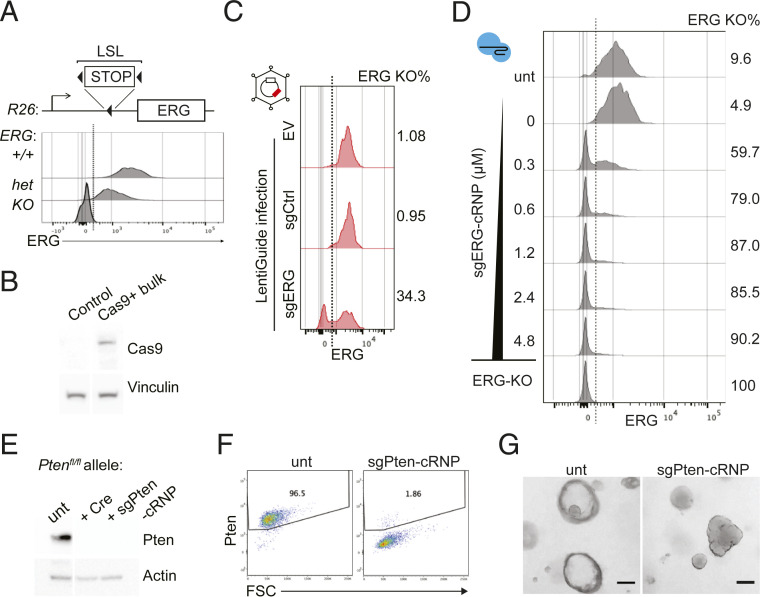
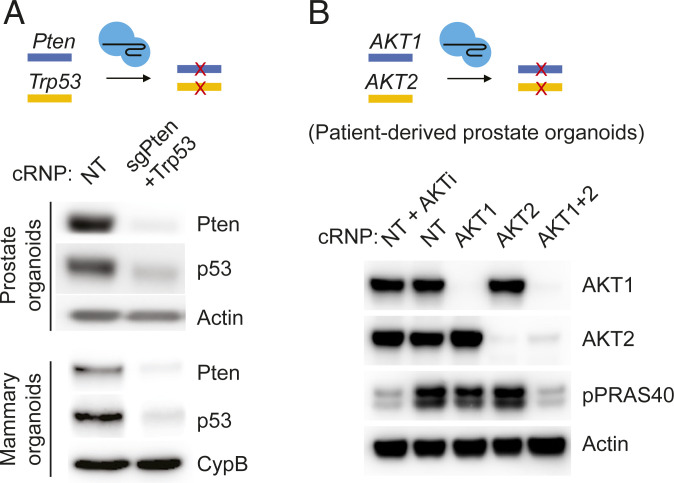
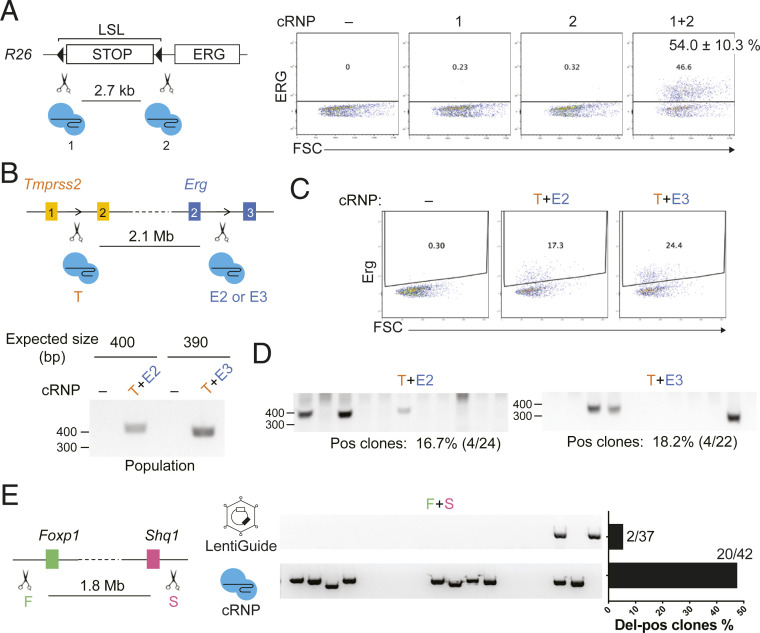
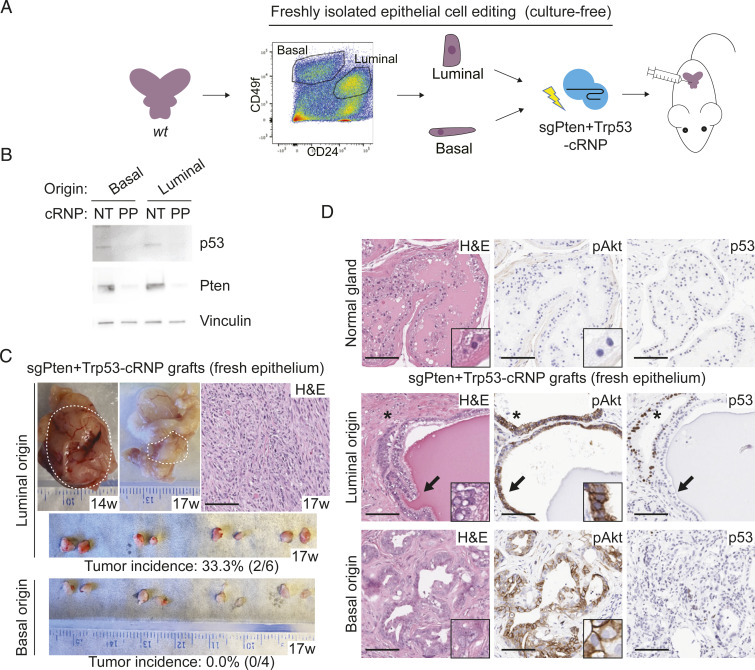
Significance Modeling cancer formation requires introduction of relevant oncogenic perturbations into normal cells in a tissue/cell-type–specific manner. Genetically engineered mouse models are powerful but require significant time and cost to generate and maintain. The ability to edit primary epithelial cells ex vivo followed by orthotopic transplantation provides an alternative strategy for cancer modeling but requires efficient gene editing, typically in a multiplex fashion. Here we successfully engineer multigenic perturbations or chromosomal rearrangements in primary prostate organoids through single-step Cas9–sgRNA ribonucleoprotein electroporation. This approach can also address cell-of-origin questions by directly editing and transplanting freshly isolated subpopulations without the intermediate step of organoid culture, providing a rapid complement to traditional lineage tracing approaches.
Overview
The claims and statistics of this paper haven’t been checked yet.
Free: it reads the open-access text and checks the first 5 claims that cite a source we can check. Create a free account to check every claim.
Integrity signals
Registry
Cites
Statistics
Figures
Verification
Claims the paper makes
The claims and statistics of this paper haven’t been checked yet.
Free: it reads the open-access text and checks the first 5 claims that cite a source we can check. Create a free account to check every claim.
Claims other papers make about this one
Each is checked against this paper’s own text: does it say what the citing paper says it does?
In the citing paper
“Pten−/−;sgERG organoids previously generated by electroporation of Cas9-sgRNA ribonucleoprotein complexes against ERG (Feng et al., 2021) were transduced with an empty vector control, or an allelic series of WT and mutant ERG variants and selected with 2 μg/mL puromycin for 1 week.”
From Allosteric interactions prime androgen receptor dimerization and activation (2022) · cites this paper as Feng et al., 2021
Self-check
Percentages, sums and reported differences re-computed from the paper’s own numbers.
The self-check needs the paper’s full text.
Citations
Cites
In situ click chemistry generation of cyclooxygenase-2 inhibitors
Bhardwaj, A., Kaur, J., Wuest, M., & Wuest, F. (2017) · Nature Communications · doi:10.1038/s41467-016-0009-6 · Cited by 7,448
Improved vectors and genome-wide libraries for CRISPR screening
Sanjana, N. E., Shalem, O., & Zhang, F. (2014) · Nature Methods · doi:10.1038/nmeth.3047 · Cited by 5,239 · cited 5×
“NT-1 (human) (39): ACGGAGGCTAAGCGTCGCAA”
MethodInfluentialRecurrent Fusion of TMPRSS2 and ETS Transcription Factor Genes in Prostate Cancer
Tomlins, S. A., Rhodes, D. R., Perner, S., Dhanasekaran, S. M., Mehra, R., Sun, X.-W., Varambally, S., Cao, X., Tchinda, J., Kuefer, R., et al. (2005) · Science · doi:10.1126/science.1117679 · Cited by 3,846 · cited 1×
“1-Mb intrachromosomal deletion that results in aberrant expression of the ETS family transcription factor ERG in human prostate cancer (23).”
BackgroundIntegrative Genomic Profiling of Human Prostate Cancer
Taylor, B. S., Schultz, N., Hieronymus, H., Gopalan, A., Xiao, Y., Carver, B. S., Arora, V. K., Kaushik, P., Cerami, E., Reva, B., et al. (2010) · Cancer Cell · doi:10.1016/j.ccr.2010.05.026 · Cited by 3,701 · cited 2×
“Recurrent multigenic chromosomal deletions are among the most common alterations in cancer genomes, particularly in epithelial tumors such as prostate cancer (18, 19).”
BackgroundSelf-citationIntegrative Clinical Genomics of Advanced Prostate Cancer
Robinson, D., Van Allen, E. M., Wu, Y.-M., Schultz, N., Lonigro, R. J., Mosquera, J.-M., Montgomery, B., Taplin, M.-E., Pritchard, C. C., Attard, G., et al. (2015) · Cell · doi:10.1016/j.cell.2015.05.001 · Cited by 3,645
Self-citationThe Molecular Taxonomy of Primary Prostate Cancer
Abeshouse, A., Ahn, J., Akbani, R., Ally, A., Amin, S., Andry, C. D., Annala, M., Aprikian, A., Armenia, J., Arora, A., et al. (2015) · Cell · doi:10.1016/j.cell.2015.10.025 · Cited by 3,110 · cited 1×
“0Mb tumor suppressor locus at human 3p13-14, found in ∼15% of localized prostate cancers (18, 25).”
BackgroundSelf-citationEasy quantitative assessment of genome editing by sequence trace decomposition
Brinkman, E. K., Chen, T., Amendola, M., & van Steensel, B. (2014) · Nucleic Acids Research · doi:10.1093/nar/gku936 · Cited by 2,390
CRISPR-Cas9 Knockin Mice for Genome Editing and Cancer Modeling
Platt, R. J., Chen, S., Zhou, Y., Yim, M. J., Swiech, L., Kempton, H. R., Dahlman, J. E., Parnas, O., Eisenhaure, T. M., Jovanovic, M., et al. (2014) · Cell · doi:10.1016/j.cell.2014.09.014 · Cited by 2,001
Crucial role of p53-dependent cellular senescence in suppression of Pten-deficient tumorigenesis
Chen, Z., Trotman, L. C., Shaffer, D., Lin, H.-K., Dotan, Z. A., Niki, M., Koutcher, J. A., Scher, H. I., Ludwig, T., Gerald, W., et al. (2005) · Nature · doi:10.1038/nature03918 · Cited by 1,993 · cited 1×
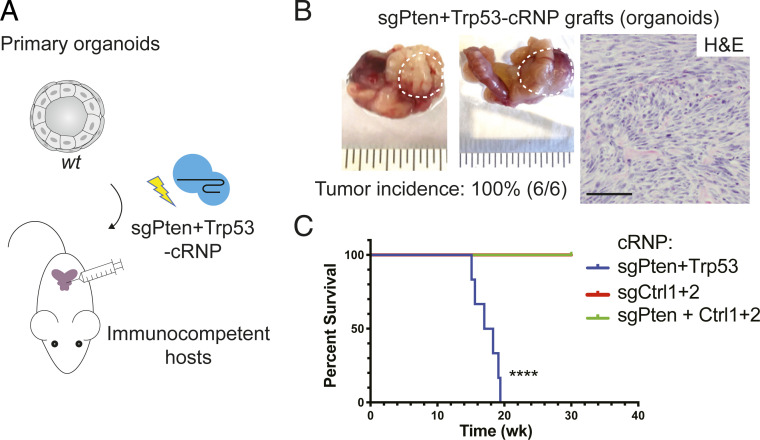
“Remarkably, 100% (six of six) B6 recipient mice developed locally invasive adenocarcinomas with median survival of ∼17 wk, comparable to that observed in Pb-Cre;Pten;Trp53 GEM models (16).”
BackgroundDynamic Imaging of Genomic Loci in Living Human Cells by an Optimized CRISPR/Cas System
Chen, B., Gilbert, L. A., Cimini, B. A., Schnitzbauer, J., Zhang, W., Li, G.-W., Park, J., Blackburn, E. H., Weissman, J. S., Qi, L. S., et al. (2013) · Cell · doi:10.1016/j.cell.2013.12.001 · Cited by 1,963 · cited 1×
“To create a lentiGuide-mCherry backbone, the sgRNA scaffold of LRG (Addgene plasmid #65656) (36) was first replaced with an enhanced scaffold (37) between BsmBI/EcoRI sites.”
Method
Cited by
The neuroendocrine transition in prostate cancer is dynamic and dependent on ASCL1
Romero, R., Chu, T., González-Robles, T. J., Smith, P., Xie, Y., Kaur, H., Yoder, S., Zhao, H., Mao, C., Kang, W., et al. (2024) · Nature Cancer · doi:10.1038/s43018-024-00838-6 · Cited by 112
“Previously, we described a strategy to assess genetic drivers of prostate adenocarcinoma (PRAD), as well as cells of origin using mouse prostate organoids coupled with orthotopic transplantation 21 (OT).”
InfluentialSelf-citationUnderstanding Drug Sensitivity and Tackling Resistance in Cancer
Tyner, J. W., Haderk, F., Kumaraswamy, A., Baughn, L. B., Van Ness, B., Liu, S., Marathe, H., Alumkal, J. J., Bivona, T. G., Chan, K. S., et al. (2022) · Cancer Research · doi:10.1158/0008-5472.can-21-3695 · Cited by 78
“Lineage tracing methods have given deeper insights on tumor evolution, and work to date suggest selection of specific subpopulation with late-hybrid EMT states may occur during pancreatic cancer progression (108, 109).”
BackgroundSelf-citationAllosteric interactions prime androgen receptor dimerization and activation
Wasmuth, E. V., Broeck, A. V., LaClair, J. R., Hoover, E. A., Lawrence, K. E., Paknejad, N., Pappas, K., Matthies, D., Wang, B., Feng, W., et al. (2022) · Molecular Cell · doi:10.1016/j.molcel.2022.03.035 · Cited by 50
“Pten−/−;sgERG organoids previously generated by electroporation of Cas9-sgRNA ribonucleoprotein complexes against ERG (Feng et al., 2021) were transduced with an empty vector control, or an allelic series of WT and mutant ERG variants and selected with 2 μg/mL puromycin for 1 week.”
MethodSelf-citationTreatment of acute myeloid leukemia models by targeting a cell surface RNA-binding protein
George, B. M., Eleftheriou, M., Yankova, E., Perr, J., Chai, P., Nestola, G., Almahayni, K., Evans, S., Damaskou, A., Hemberger, H., et al. (2025) · Nature Biotechnology · doi:10.1038/s41587-025-02648-2 · Cited by 47
“Normal prostate tissue was derived from Rosa26 -LSL-Cas9 knockin mice on B6J (strain 26175, Jackson Laboratory), and Pten −/− ; Trp53 −/− prostate tumors were derived from a mouse model of prostate cancer of the same genetic background similar to Feng et al. 57 .”
Advancements in CRISPR/Cas systems for disease treatment
Xu, Y., Le, H., Wu, Q., Wang, N., & Gong, C. (2025) · Acta Pharmaceutica Sinica B · doi:10.1016/j.apsb.2025.05.007 · Cited by 35
“Furthermore, researchers have established a prostate cancer model by transplanting genetically modified prostate epithelial cells into mice’s prostate glands, a method that proves more efficient and cost-effective than conventional genetically engineered mouse models 95 .”
Genome editing via non-viral delivery platforms: current progress in personalized cancer therapy
Lan, T., Que, H., Luo, M., Zhao, X., & Wei, X. (2022) · Molecular Cancer · doi:10.1186/s12943-022-01550-8 · Cited by 34
“By inducing the key carcinogenic mutation in the cancer cell of origin, the personalized cancer models can be quickly established [163, 164].”
BackgroundMao, N., Lee, Y. S., Salsabeel, N., Zhang, Z., Li, D., Kaur, H., Chen, X., Chang, Q., Mehta, S., Barnes, J., et al. (2025) · Science Advances · doi:10.1126/sciadv.adq3802 · Cited by 24
Self-citationERG-driven prostate cancer initiation is cell-context dependent and requires KMT2A and DOT1L
Feng, W., Ladewig, E., Lange, M., Salsabeel, N., Zhao, H., Lee, Y. S., Gopalan, A., Luo, H., Kang, W., Fan, N., et al. (2025) · Nature Genetics · doi:10.1038/s41588-025-02289-w · Cited by 27
“…method to interrogate cell of origin by collecting primary mouse prostate tissue, sorting into luminal and basal subpopulations, genetically manipulating each subpopulation ex vivo, then immediately (same day) reintroducing these cells orthotopically to score subsequent tumor formation 43 .”
Self-citationOrganoids: An Emerging Precision Medicine Model for Prostate Cancer Research
Waseem, M., & Wang, B. (2024) · International Journal of Molecular Sciences · doi:10.3390/ijms25021093 · Cited by 23
“Ultimately, these iPSC-derived organoids represent a promising model system mimicking patient phenotypes/characteristics in vitro, thereby leading to future discovery of new therapeutic targets in different types of cancers, including PCa [53–55].”
BackgroundInfluentialPappas, K., Ferrari, M., Smith, P., Nandakumar, S., Khan, Z., Young, S. B., LaClair, J. R., Russo, M. V., Huang-Hobbs, E., Schultz, N. D., et al. (2025) · Proceedings of the National Academy of Sciences · doi:10.1073/pnas.2426743122 · Cited by 25
“To address this challenge, we took advantage of recent developments in prostate organoid technology that allow rapid and efficient generation of complex genotypes that reflect those seen in patients ( 29 , 30 ).”
Self-citationPletcher, A., & Shibata, M. (2022) · Development · doi:10.1242/dev.200394 · Cited by 21
Vanoli, F., Herviou, L., Tsuda, Y., Sung, P., Xie, Z., Fishinevich, E., Min, S. S., Mallen, W., de Wardin, H. D. T., Zhang, Y., et al. (2023) · Oncogenesis · doi:10.1038/s41389-023-00454-6 · Cited by 8
“NHEJ represents a fast and reliable method to induce deletions up to ~2 Mb [22], even if laborious sib-selection may be necessary to isolate clones harboring the deletion.”
MethodSelf-citationXu, D., Wang, L., Wieczorek, K., Zhang, Y., Wang, Z., Wang, J., Xu, B., Singh, P. K., Wang, Y., Zhang, X., et al. (2022) · Cancers · doi:10.3390/cancers14102511 · Cited by 9
“Rapid and efficient ex vivo gene editing in organoids has accelerated the pace of generating clinically relevant experimental models [14].”
BackgroundEndocrine cancer organoids in basic and translational medical research
Chen, D., Chen, Z., Yang, H., Zhang, L., Hu, C., Yang, Z., Li, P., Su, X., Liu, X., Wei, W., et al. (2025) · Science China Life Sciences · doi:10.1007/s11427-024-2888-8 · Cited by 7
“Genome editing technology has the potential to be applied in establishing PDOs for studying the molecular mechanisms of cancers (Driehuis and Clevers, 2017; Feng et al., 2021; Tiroille et al., 2023).”
Hamada, T., Yokoyama, S., Akahane, T., Matsuo, K., & Tanimoto, A. (2022) · International Journal of Molecular Sciences · doi:10.3390/ijms24010500 · Cited by 4
How CRISPR Is Revolutionizing the Generation of New Models for Cancer Research
Rivera, F. J. S., & Dow, L. E. (2023) · Cold Spring Harbor Perspectives in Medicine · doi:10.1101/cshperspect.a041384 · Cited by 6
Extracellular matrix regulates lineage plasticity in prostate cancer through YAP/TEADPreprint
Han, T., Sun, Z., Lange, M., Cho, Y. Z., McGillivray, P. D., Büttner, M., Kastan, N. R., Nandakumar, S., Zhao, H., Salataj, E., et al. (2025) · bioRxiv (Cold Spring Harbor Laboratory) · doi:10.64898/2025.12.30.697072 · Cited by 7
Self-citationLadewig, E., Nazir, A., Park, T., Fan, V. B., Cao, Z., Hawk, J., Kelly, L., Tjian, R., Leslie, C. S., & Sawyers, C. L. (2026) · Cell Reports · doi:10.1016/j.celrep.2026.116950 · Cited by 3
Self-citationEx Vivo Organoid Model of Adenovirus-Cre Mediated Gene Deletions in Mouse Urothelial Cells
Xu, D., Wang, L., Wieczorek, K., Wang, Y., Zhang, X., Goodrich, D. W., & Li, Q. (2022) · Journal of Visualized Experiments · doi:10.3791/63855 · Cited by 4
Pandell, N., Househam, J., Tartagni, M., Thankamony, A. P., Gabel, F., Rota, R., Flittner, E., Gürel, B., Figueiredo, I., Seed, G., et al. (2025) · bioRxiv (Cold Spring Harbor Laboratory) · doi:10.1101/2025.11.16.688689 · Cited by 1
Vanoli, F., & Antonescu, C. R. (2023) · Genes Chromosomes and Cancer · doi:10.1002/gcc.23141
“5%).(77) Using the same approach, the authors generated another 2.”
Sun, Z., Zhao, J., Khan, Z., Ismail, W. M., Han, T., Nandakumar, S., Young, S., Lange, M., Cheng, P., Koche, R. P., et al. (2026) · bioRxiv (Cold Spring Harbor Laboratory) · doi:10.64898/2026.05.05.723058
Self-citationProstate Cancer Development, Progression, and Therapy
Jin, X., Xiao, Z., Ding, Z., Li, W., Zeng, R., Shuai, Y., Ci, W., Xia, D., Zhang, X., & Huang, H. (2026) · MedComm – Oncology · doi:10.1002/mog2.70082
IL-1β/IL-6 signaling circuit in the tumor microenvironment drives prostate cancer developmentPreprint
Lee, Y. S., Zhao, J. L., Chryplewicz, A., Land, M., Sharma, R., Chan, J., Smith, P., Kottapalli, S., Fong, L. E., Chen, Z., et al. (2026) · bioRxiv (Cold Spring Harbor Laboratory) · doi:10.64898/2026.07.30.741572
Self-citation
Metadata
- Authors
- Feng, W., Cao, Z., Lim, P. X., Zhao, H., Luo, H., Mao, N., Lee, Y. S., Rivera, A. A., Choi, D., Wu, C., Han, T., Romero, R., de Stanchina, E., Carver, B. S., Wang, Q., Jasin, M., & Sawyers, C. L.
- Affiliations
- Memorial Sloan Kettering Cancer Center (US)
- Human Oncology and Pathogenesis Program, Memorial Sloan Kettering Cancer Center, New York, NY 10065;
- Antitumor Assessment Core Facility, Memorial Sloan Kettering Cancer Center, New York, NY 10065;
- Shanghai Medical College of Fudan University (CN)
- Corresponding author
- Sawyers, Charles L.
- ORCID
- Venue
- Proceedings of the National Academy of Sciences
- Publisher
- National Academy of Sciences
- Published
- 2021-08-05
- Volume
- 118
- Issue
- 32
- ISSN
- 0027-8424 (ISSN-L)
- 1091-6490
- PMC
- PMC8364185
- OpenAlex
- W3192622360
- Cited by
- 25
- References
- 46
- Citations by year
- 2026: 4 · 2025: 9 · 2024: 2 · 2023: 3 · 2022: 7
- FWCI
- 0.94
- Type
- journal article
- Language
- en
- Open access
- hybrid
- doi.org
- Licence
- Locations
- Proceedings of the National Academy of Sciences (publishedVersion, cc-by-nc-nd)
- PubMed Central (publishedVersion, cc-by-nc-nd)
- PubMed (publishedVersion)
- Funders
- HHS | NIH | National Cancer Institute (CA193837, CA092629, CA224079, CA155169, CA008748)
- Starr Cancer Consortium (I12-0007)
- U.S. Department of Defense (W81XWH)
- Topics
- Life Sciences › Biochemistry, Genetics and Molecular Biology › Molecular Biology › CRISPR and Genetic Engineering
- Life Sciences › Biochemistry, Genetics and Molecular Biology › Molecular Biology › Chromatin Remodeling and Cancer
- Life Sciences › Biochemistry, Genetics and Molecular Biology › Cancer Research › Prostate Cancer Treatment and Research
- Keywords
- cell of origin, prostate cancer, CRISPR/Cas9, chromosomal rearrangements, organoids, orthotopic transplantation, cancer modeling, ex vivo gene editing
- MeSH terms
- Transcriptional Regulator ERG, Gene Editing, CRISPR-Associated Protein 9, RNA, Guide, CRISPR-Cas Systems, Animals, Chromosome Deletion, Epithelial Cells, Humans, Male, Mice, Inbred C57BL, Mice, Transgenic, Organoids, Prostate, Prostatic Neoplasms, Ribonucleoproteins, Genes, Tumor Suppressor, Xenograft Model Antitumor Assays, Adaptor Proteins, Signal Transducing, Mice, Clustered Regularly Interspaced Short Palindromic Repeats
About these checks
Registry, retraction, Cites and statistics results are computed, not judged, with one exception: a printed reference that no index lists is read once by a model before it counts as a citation error. Claims are extracted by a model and kept only when their quote appears verbatim in the text; each cited source is then checked, with a model’s help, for whether it says what the claim relies on. Those verdicts can be wrong — read the claim’s quote and the cited source before relying on one.
Statistics and arithmetic are recomputed, not judged.
Confidence bands are shown only for fields calibrated on our annotated test set. None is calibrated yet, so no band is shown.
What counts as a claim ›How we measure confidence ›How we check this ›
Are you an author, or do you see a problem with this page? Request a review
Data sources
Bibliographic data: Semantic Scholar, OpenAlex, Crossref.
Contains information from the Semantic Scholar Academic Graph Datasets, made available under the ODC Attribution License (ODC-BY 1.0).
Semantic Scholar’s data is described in: Kinney, R., et al. (2023). The Semantic Scholar Open Data Platform. arXiv:2301.10140.
