

The DOI matches its Crossref record; 5 of the 5 references it cites were found in a registry or an index.
Building multi-system nexuses in low-carbon transitions: Conflicts and asymmetric adjustments in Norwegian ferry electrification
Abstract
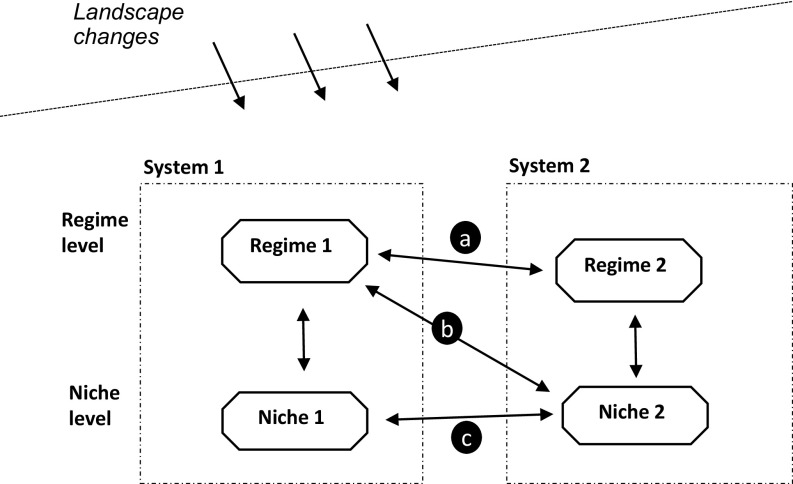
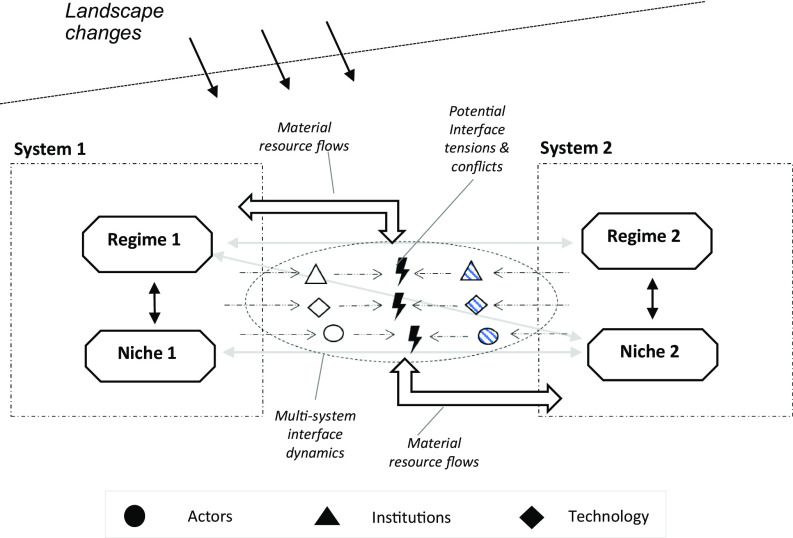
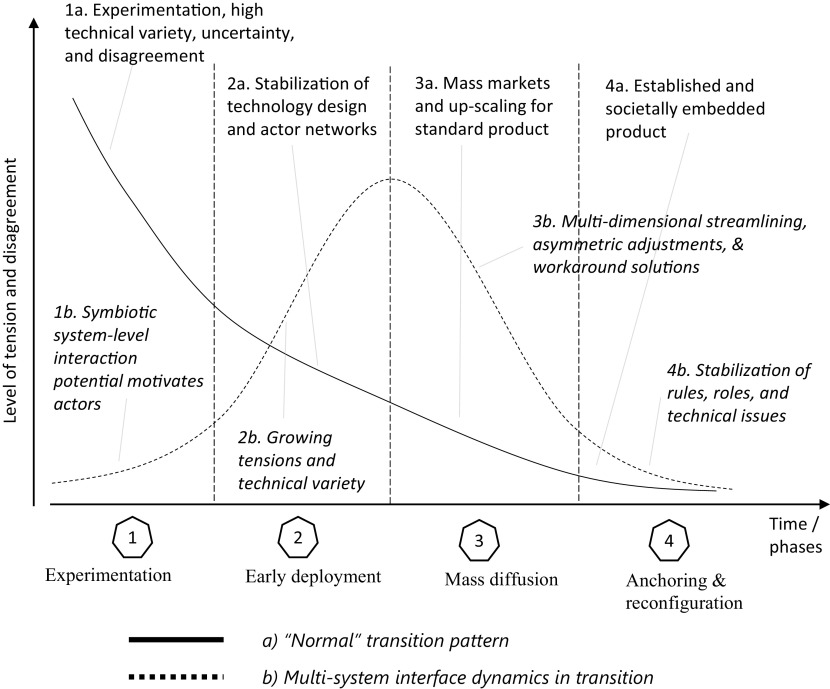
While nexus research in sustainability science has investigated the consequences of connected systems, it has paid less attention to the processes of building nexuses which is becoming increasingly important in low-carbon transitions because these often require the creation of new connections between multiple consumption–production systems. Building on multi-system research in the sustainability transitions literature, this paper introduces a conceptual system interface perspective on nexus-building which considers four dimensions (technology, actors, institutions, and resources) that are useful for analyzing nexus-building dynamics. We apply our framework to the case of electrification of ferries in Norway which requires the building of a new interface between the electricity system and the maritime transport system. The case study shows that the system interface was initially characterized by conflicts and tensions in all dimensions, which actors then attempted to resolve through cross-system intermediation and adjustment activities. These activities were asymmetrical because of differences in external pressures, urgency, unequal power relationships, and different degrees of interest in cross-system nexus building. Because important tensions remained unresolved, ferry actors started implementing sub-optimal workaround solutions in the diffusion phase.
Overview
The claims and statistics of this paper haven’t been checked yet.
Run the check — free, no account needed. It reads the open-access text and checks the sources it cites.
Integrity signals
Registry
Cites
Statistics
Figures
Verification
Claims the paper makes
The claims and statistics of this paper haven’t been checked yet.
Run the check — free, no account needed. It reads the open-access text and checks the sources it cites.
Claims other papers make about this one
Each is checked against this paper’s own text: does it say what the citing paper says it does?
In the citing paper
“Such interactions can be synergic for transitions [42], but are also giving rise to tensions [43].”
From The Importance of Being Consistent: Circularity Policy Aims in the European Wastewater Sector (2025) · cites this paper as [43]
In the citing paper
“The novel functional couplings between previously unrelated sectors [38 , 40 , 42] lead to institutional tensions that can slow down transitions [43].”
From The Importance of Being Consistent: Circularity Policy Aims in the European Wastewater Sector (2025) · cites this paper as [43]
Self-check
Percentages, sums and reported differences re-computed from the paper’s own numbers.
The self-check needs the paper’s full text.
Citations
Cites
Geels, F. W. (2002) · Research Policy · doi:10.1016/s0048-7333(02)00062-8 · Cited by 7,275 · cited 4×
“Drawing on the multilevel perspective (17, 18), which conceptualizes transitions as multidimensional struggles between radical niche innovations and existing regimes in a focal production–consumption system in the context of slow - changing “landscape” developments, this research stream typically…”
BackgroundInfluentialSelf-citationTypology of sociotechnical transition pathways
Geels, F. W., & Schot, J. (2007) · Research Policy · doi:10.1016/j.respol.2007.01.003 · Cited by 5,245 · cited 1×
“These cross - system interactions may initially be challenging because actors are embedded in system - specific organizational fields (26, 27), which means they are initially more oriented towards other actors in “their” system than towards actors from other systems.”
Self-citationCarbon lock-in: types, causes, and policy implications
Seto, K. C., Davis, S. J., Mitchell, R. B., Stokes, E. C., Unruh, G., & Ürge-Vorsatz, D. (2016) · Annual Review of Environment and Resources · doi:10.1146/annurev-environ-110615-085934 · Cited by 1,346
The Role of Critical Minerals in Clean Energy Transitions
International Energy Agency (2021) · doi:10.1787/f262b91c-en · Cited by 779
Anatomy of a buzzword: The emergence of ‘the water-energy-food nexus’ in UK natural resource debates
Cairns, R., & Krzywoszynska, A. (2016) · Environmental Science & Policy · doi:10.1016/j.envsci.2016.07.007 · Cited by 317
Research works printed but not linked: 46
- 10.1016/j.enpol.2020.111913 · DOI
- 10.3390/en10070956 · DOI
- 10.1016/j.envsci.2016.12.018 · DOI
- 10.1038/s41893-018-0135-8 · DOI · Paper page
- 10.1146/annurev-environ-012420-043621 · DOI
- 10.1007/s11625-013-0224-6 · DOI
- 10.1016/j.eist.2015.07.005 · DOI · Paper page
- 10.1016/j.eist.2019.01.004 · DOI · Paper page
- 10.1016/j.eist.2019.10.003 · DOI
- 10.1016/j.jclepro.2007.08.014 · DOI · Paper page
- 10.1080/09537320701403441 · DOI
- 10.1016/j.eist.2013.03.002 · DOI
- F. W. Geels, Technological Transitions and System Innovations. A Co-Evolutionary and Socio-Technical Analysis (Edward Elgar, 2005), p. 328. · DOI
- 10.1080/09537320802292651 · DOI
- 10.1016/j.respol.2011.12.012 · DOI · Paper page
- 10.1016/0167-6245(88)90024-8 · DOI
- M. L. Tushman, J. P. Murmann, Dominant designs, technology cycles and organizational outcomes. Res. Organ. Behav. 20, 231–266 (1998).
- 10.1017/CBO9780511808678 · DOI · Paper page
- 10.1016/j.techfore.2015.07.004 · DOI
- 10.4135/9781848608030.n7 · DOI · Paper page
- 10.1016/j.respol.2013.10.010 · DOI
- 10.1016/j.futures.2009.11.009 · DOI
- 10.1016/j.eist.2018.08.002 · DOI
- 10.5465/amr.2006.19379629 · DOI
- A. D. Andersen, Towards a new approach to natural resources and development: The role of learning, innovation and linkage dynamics. Int. J. Technol. Learn. Innov. Dev. 5, 291–324 (2012).
- 10.1016/j.eist.2022.01.002 · DOI
- J. Summerton, Changing Large Technical Systems (Westview Press, Boulder, San Francisco and Oxford, 1994).
- 10.2307/258557 · DOI · Paper page
- S. G. Sjøtun, A ferry making waves: A demonstration project ‘doing’ institutional work in a greening maritime industry. Norw. J. Geograp. 73, 16–28 (2018).
- 10.1088/1748-9326/acf67a · DOI
- A. Fenstad, “Has to find collective charging solution for medium-sized vessels (Skal finne felles ladeløsning for mellomstore fartøy)” in Teknisk Ukeblad, J. M. Moberg, Ed. (Teknisk Ukeblad Media AS, Oslo, Norway, 2021).
- T. Stensvold, “Battery swapping with robot cuts emissions in hurtigbåter (Batteribytte med robot gjør hurtigbåter utslippsfrie)” in Teknisk Ukeblad, J. M. Moberg, Ed. (Teknisk Ukeblad Media AS, Oslo, Norway, 2021).
- A. Fenstad, “Wants to replace ferry chargers with self-driving battery packs (Vil bytte ut fergeladere med selvkjørende batteripakker)” in Teknisk Ukeblad, J. M. Moberg, Ed. (Teknisk Ukeblad Media AS, Oslo, Norway, 2020).
- T. Stensvold, “Battery ferries: Charging systems often fail (Batteriferger: Ladesystemer svikter ofte)” in Teknisk Ukeblad, J. M. Moberg, Ed. (Teknisk Ukeblad Media AS, Oslo, Norway, 2020).
- O. P. Pedersen, “Butchers revenue model–Does not solve the problems (Slakter inntektsrammeforslag–løser ikke strømproblemene)” in EUROPOWER (NHST Media Group, Oslo, Norway, 2022).
- J.-A. Tomasgard, “The solution of the future? Shared energy stations for boat and car (Framtidens løsning? Felles energistasjon for båt og bil)” in Teknisk Ukeblad (Teknisk Ukeblad Media AS, Oslo, Norway, 2021).
- 10.1016/j.trd.2018.11.012 · DOI
- 10.1016/j.eist.2020.09.004 · DOI
- 10.1016/j.erss.2023.103178 · DOI
- H. Gong, A. D. Andersen, The role of natural resources in accelerating net-zero transitions: Insights from EV lithium-ion battery technological innovation system in China, in TIK Working Papers on Innovation Studies (Center for Technology, Innovation, and Culture, University of Oslo, Oslo, Norwary, 2022) p. 1–38.
- 10.1016/j.respol.2022.104559 · DOI · Paper page
- 10.1177/0007650320935015 · DOI
- 10.1177/10860266231162057 · DOI
- 10.1111/j.1467-9558.2010.01385.x · DOI · Paper page
- 10.1177/0018726715605555 · DOI
- 10.1093/ooenergy/oiad007 · DOI
Cited by
Sorted by citations
The Importance of Being Consistent: Circularity Policy Aims in the European Wastewater Sector
Mäkitie, T., Damman, S., Hansen, T., Haugland, B. T., & Lund, H. B. (2025) · Circular Economy and Sustainability · doi:10.1007/s43615-025-00665-6 · Cited by 8
Metadata
- Authors
- Andersen, A. D., Geels, F. W., Steen, M., & Bugge, M. M.
- Venue
- Proceedings of the National Academy of Sciences
- Publisher
- National Academy of Sciences
- Published
- 2023-11-13
- Volume
- 120
- Issue
- 47
- ISSN
- 0027-8424
- 1091-6490
- PMC
- PMC10666111
- Cited by
- 62
- References
- 5
- Language
- en
About these checks
Registry, retraction, Cites and statistics results are computed, not judged, with one exception: a printed reference that no index lists is read once by a model before it counts as a citation error. Claims are extracted by a model and kept only when their quote appears verbatim in the text; each cited source is then checked, with a model’s help, for whether it says what the claim relies on. Those verdicts can be wrong — read the claim’s quote and the cited source before relying on one.
Statistics and arithmetic are recomputed, not judged.
Confidence bands are shown only for fields calibrated on our annotated test set. None is calibrated yet, so no band is shown.
What counts as a claim ›How we measure confidence ›How we check this ›
Are you an author, or do you see a problem with this page? Request a review
How to cite
Cite CoChat for the checks on this page, and the paper for its own findings.
- This page
- CoChat. (2026). Citation check: Building multi-system nexuses in low-carbon transitions: Conflicts and asymmetric adjustments in Norwegian ferry electrification. https://app.cochat.ai/papers/10.1073/pnas.2207746120
- The paper
- Andersen, A. D., Geels, F. W., Steen, M., & Bugge, M. M. (2023). Building multi-system nexuses in low-carbon transitions: Conflicts and asymmetric adjustments in Norwegian ferry electrification. Proceedings of the National Academy of Sciences. https://doi.org/10.1073/pnas.2207746120
