

Structures of NPAS4-ARNT and NPAS4-ARNT2 heterodimers reveal new dimerization modalities in the bHLH-PAS transcription factor family
Open accessThe DOI matches its Crossref record; 53 of the 54 references it cites were found in a registry or an index.
Abstract
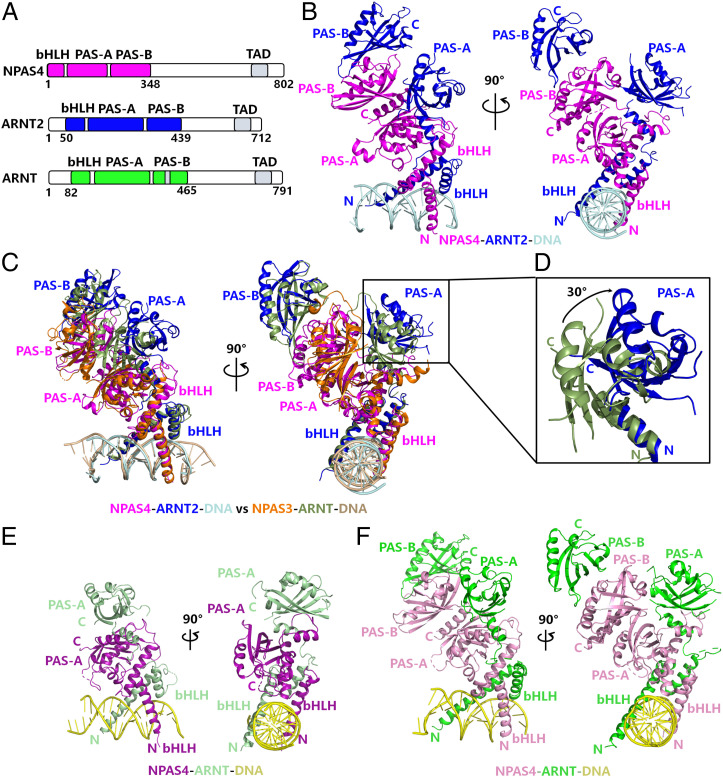
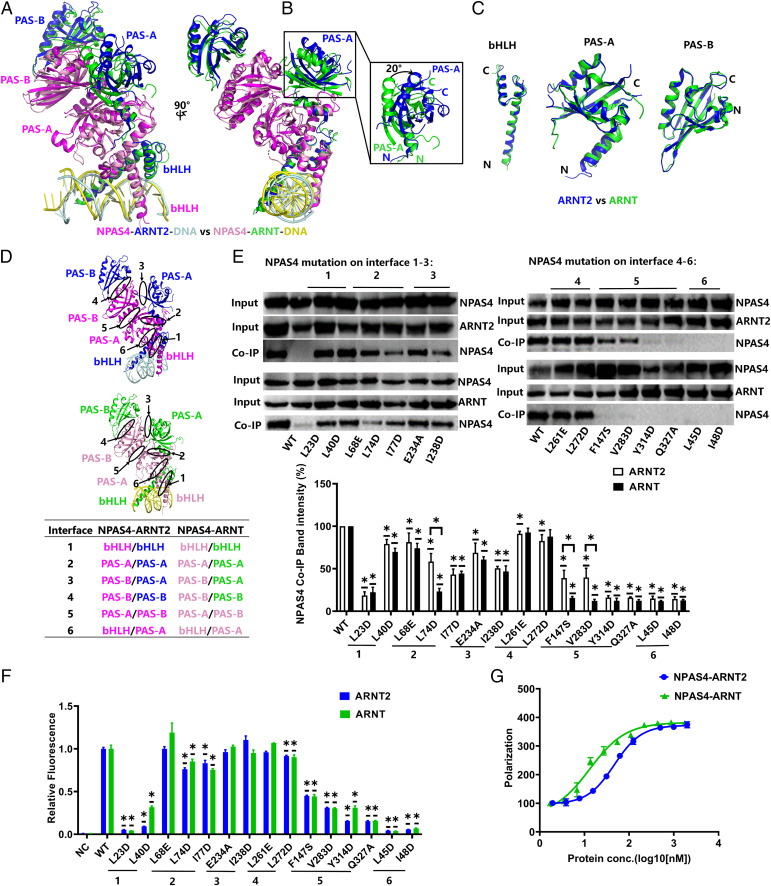
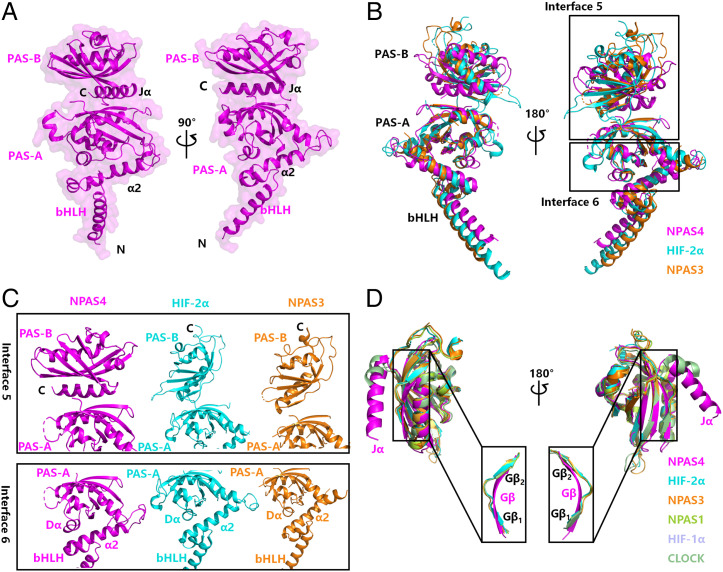
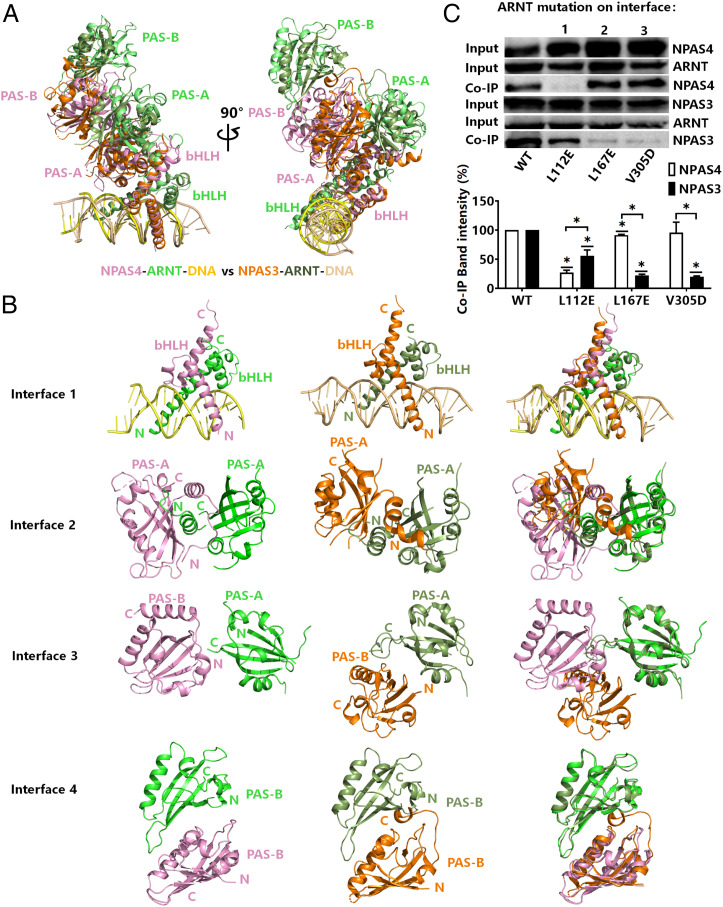
Neuronal PER-ARNT-SIM (PAS) domain protein 4 (NPAS4) is a protective transcriptional regulator whose dysfunction has been linked to a variety of neuropsychiatric and metabolic diseases. As a member of the basic helix–loop–helix PER-ARNT-SIM (bHLH-PAS) transcription factor family, NPAS4 is distinguished by an ability to form functional heterodimers with aryl hydrocarbon receptor nuclear translocator (ARNT) and ARNT2, both of which are also bHLH-PAS family members. Here, we describe the quaternary architectures of NPAS4-ARNT and NPAS4-ARNT2 heterodimers in complexes involving DNA response elements. Our crystallographic studies reveal a uniquely interconnected domain conformation for the NPAS4 protein itself, as well as its differentially configured heterodimeric arrangements with both ARNT and ARNT2. Notably, the PAS-A domains of ARNT and ARNT2 exhibit variable conformations within these two heterodimers. The ARNT PAS-A domain also forms a set of interfaces with the PAS-A and PAS-B domains of NPAS4, different from those previously noted in ARNT heterodimers formed with other class I bHLH-PAS family proteins. Our structural observations together with biochemical and cell-based interrogations of these NPAS4 heterodimers provide molecular glimpses of the NPAS4 protein architecture and extend the known repertoire of heterodimerization patterns within the bHLH-PAS family. The PAS-B domains of NPAS4, ARNT, and ARNT2 all contain ligand-accessible pockets with appropriate volumes required for small-molecule binding. Given NPAS4’s linkage to human diseases, the direct visualization of these PAS domains and the further understanding of their relative positioning and interconnections within the NPAS4-ARNT and NPAS4-ARNT2 heterodimers may provide a road map for therapeutic discovery targeting these complexes.
Overview
The claims and statistics of this paper haven’t been checked yet.
Free: it reads the open-access text and checks the first 5 claims that cite a source we can check. Create a free account to check every claim.
Integrity signals
Registry
Cites
Statistics
Figures
Verification
Claims the paper makes
The claims and statistics of this paper haven’t been checked yet.
Free: it reads the open-access text and checks the first 5 claims that cite a source we can check. Create a free account to check every claim.
Self-check
Percentages, sums and reported differences re-computed from the paper’s own numbers.
The self-check needs the paper’s full text.
Citations
Cites
1 retracted
RETRACTED: Genomic Decoding of Neuronal Depolarization by Stimulus-Specific NPAS4 Heterodimers
Brigidi, G. S., Hayes, M. G. B., Santos, N. P. D., Hartzell, A. L., Texari, L., Lin, P.-A., Bartlett, A., Ecker, J. R., Benner, C. W., Heinz, S., et al. (2019) · Cell · doi:10.1016/j.cell.2019.09.004 · Cited by 74
RetractedFeatures and development of Coot
Emsley, P., Lohkamp, B., Scott, W. G., & Cowtan, K. (2010) · Acta Crystallographica Section D Biological Crystallography · doi:10.1107/s0907444910007493 · Cited by 29,915
Phaser crystallographic software
McCoy, A. J., Grosse-Kunstleve, R. W., Adams, P. D., Winn, M. D., Storoni, L. C., & Read, R. J. (2007) · Journal of Applied Crystallography · doi:10.1107/s0021889807021206 · Cited by 20,612
Liebschner, D., Afonine, P. V., Baker, M. L., Bunkóczi, G., Chen, V. B., Croll, T. I., Hintze, B., Hung, L.-W., Jain, S., McCoy, A. J., et al. (2019) · Acta Crystallographica Section D Structural Biology · doi:10.1107/s2059798319011471 · Cited by 7,953 · cited 6×
“heterodimeric complex consisting of the bHLH and PAS-A domains of both ARNT (82-345) and NPAS4 (1-205).”
InfluentialVaradi, M., Anyango, S., Deshpande, M., Nair, S., Natassia, C., Yordanova, G., Yuan, D., Stroe, O., Wood, G., Laydon, A., et al. (2022) · Nucleic Acids Research · doi:10.1093/nar/gkab1061 · Cited by 7,850
Minor, W., Cymborowski, M., Otwinowski, Z., & Chruszcz, M. (2006) · Acta Crystallographica Section D Biological Crystallography · doi:10.1107/s0907444906019949 · Cited by 2,099 · cited 6×
“heterodimeric complex consisting of the bHLH and PAS-A domains of both ARNT (82-345) and NPAS4 (1-205).”
InfluentialActivity-dependent regulation of inhibitory synapse development by Npas4
Lin, Y., Bloodgood, B. L., Hauser, J. L., Lapan, A. D., Koon, A. C., Kim, T.-K., Hu, L. S., Malik, A. N., & Greenberg, M. E. (2008) · Nature · doi:10.1038/nature07319 · Cited by 639 · cited 5×
“heterodimeric complex consisting of the bHLH and PAS-A domains of both ARNT (82-345) and NPAS4 (1-205).”
InfluentialSpiegel, I., Mardinly, A. R., Gabel, H. W., Bazinet, J. E., Couch, C. H., Tzeng, C. P., Harmin, D. A., & Greenberg, M. E. (2014) · Cell · doi:10.1016/j.cell.2014.03.058 · Cited by 416 · cited 5×
“heterodimeric complex consisting of the bHLH and PAS-A domains of both ARNT (82-345) and NPAS4 (1-205).”
InfluentialMammalian Per-Arnt-Sim Proteins in Environmental Adaptation
McIntosh, B. E., Hogenesch, J. B., & Bradfield, C. A. (2010) · Annual Review of Physiology · doi:10.1146/annurev-physiol-021909-135922 · Cited by 352 · cited 4×
“Therefore, we coexpressed and purified the NPAS4 (1-348)–ARNT2”
InfluentialCrystal Structure of the Heterodimeric CLOCK:BMAL1 Transcriptional Activator Complex
Huang, N., Chelliah, Y., Shan, Y., Taylor, C. A., Yoo, S.-H., Partch, C., Green, C. B., Zhang, H., & Takahashi, J. S. (2012) · Science · doi:10.1126/science.1222804 · Cited by 349 · cited 7×
“tor CLOCK-BMAL1 (brain and muscle ARNT-like protein 1, also called ARNTL) (30, 33).”
Influential
Research works printed but not linked: 3
- X. Sun., Structures of NPAS4-ARNT and NPAS4-ARNT2 heterodimers reveal new dimerization modalities in the bHLH-PAS transcription factor family. PDB. https://www.rcsb.org/structure/unreleased/7XI3. Deposited 11 April 2022. PMC9674253 36343253
- X. Sun., Structures of NPAS4-ARNT and NPAS4-ARNT2 heterodimers reveal new dimerization modalities in the bHLH-PAS transcription factor family. PDB. https://www.rcsb.org/structure/unreleased/7XI4. Deposited 12 April 2022. PMC9674253 36343253
- X. Sun., Structures of NPAS4-ARNT and NPAS4-ARNT2 heterodimers reveal new dimerization modalities in the bHLH-PAS transcription factor family. PDB. https://www.rcsb.org/structure/unreleased/7XHV. Deposited 10 April 2022. PMC9674253 36343253
Cited by
The aryl hydrocarbon receptor: structure, signaling, physiology and pathology
Coumoul, X., Barouki, R., Esser, C., Haarmann‐Stemmann, T., Lawrence, B. P., Lehmann, J., Moura‐Alves, P., Murray, I. A., Opitz, C. A., Perdew, G. H., et al. (2026) · Signal Transduction and Targeted Therapy · doi:10.1038/s41392-025-02500-8 · Cited by 124
“128 This study also identi fi ed a long AHR PAS-B C-terminal loop unique to the AHR-ARNT heterodimer, which intercalates between the two PAS-B domains and forms numerous intra-and interdomain contacts (in red in Fig.”
Structural basis for the ligand-dependent activation of heterodimeric AHR-ARNT complex
Diao, X., Shang, Q., Guo, M., Huang, Y., Zhang, M., Chen, X., Liang, Y., Sun, X., Zhou, F., Zhuang, J., et al. (2025) · Nature communications · doi:10.1038/s41467-025-56574-7 · Cited by 72
Self-citationPharmacological targeting of BMAL1 modulates circadian and immune pathways
Pu, H., Bailey, L. C., Bauer, L. G., Voronkov, M., Baxter, M. D., Huber, K., Khorasanizadeh, S., Ray, D. W., & Rastinejad, F. (2025) · Nature Chemical Biology · doi:10.1038/s41589-025-01863-x · Cited by 51
Self-citationThe AhR Signaling Mechanism: A Structural Point of View
Bonati, L., Motta, S., & Callea, L. (2023) · Journal of Molecular Biology · doi:10.1016/j.jmb.2023.168296 · Cited by 37
The protein architecture and allosteric landscape of HNF4α
Rastinejad, F. (2023) · Frontiers in Endocrinology · doi:10.3389/fendo.2023.1219092 · Cited by 27
Self-citationDecoding Allosteric Control in Hypoxia-Inducible Factors
Zhuang, J., Shang, Q., Rastinejad, F., & Wu, D. (2023) · Journal of Molecular Biology · doi:10.1016/j.jmb.2023.168352 · Cited by 26
Self-citationAllosteric communications between domains of nuclear receptors
Rastinejad, F. (2024) · Steroids · doi:10.1016/j.steroids.2024.109551 · Cited by 22
Self-citationBrito, D. V. C., Kupke, J., Sokolov, R. A., Cambridge, S. B., Both, M., Bengtson, C. P., Rozov, A. V., & Oliveira, A. M. M. (2024) · Molecular Psychiatry · doi:10.1038/s41380-024-02454-3 · Cited by 22
The aryl hydrocarbon receptor: a new frontier in male reproductive system
Bustani, G. S., Alghetaa, H., Mohammed, A. K., Nagarkatti, M., & Nagarkatti, P. S. (2025) · Reproductive Biology and Endocrinology · doi:10.1186/s12958-025-01401-3 · Cited by 24
“The ARNT is made up of a bHLH domain necessary for DNA binding, two essential PAS domains (PAS-A and PAS-B) for dimerization, and one trans-activation domain that enables its dimerization with AhR and binding to XREs [59].”
Daffern, N., & Radhakrishnan, I. (2023) · Journal of Molecular Biology · doi:10.1016/j.jmb.2023.168370 · Cited by 21
Tumova, S., Doležel, D., & Jindra, M. (2023) · Journal of Molecular Biology · doi:10.1016/j.jmb.2023.168332 · Cited by 18
Differential usage of DNA modifications in neurons, astrocytes, and microglia
Tooley, K. B., Chucair‐Elliott, A. J., Ocañas, S. R., Machalinski, A. H., Pham, K. D., Hoolehan, W., Kulpa, A. M., Stanford, D. R., & Freeman, W. M. (2023) · Epigenetics & Chromatin · doi:10.1186/s13072-023-00522-6 · Cited by 15
“Similarly, neuronal hyper-hydroxymeth-ylation of HIF1b likely induces excitatory-inhibitory balance functions within neurons [62, 63].”
BackgroundChen, S., Liu, Y., Wang, Z., Qi, C., Yu, Y., Xu, L., Hou, T., & Sheng, R. (2024) · European Journal of Medicinal Chemistry · doi:10.1016/j.ejmech.2024.116227 · Cited by 11
Li, W., Chen, Y.-C., Lin, Y., Zou, Y.-Q., Hu, G.-S., Yang, J.-J., Nie, X. Y., Li, M.-Y., Wang, Y., He, Y., et al. (2025) · Cell Reports · doi:10.1016/j.celrep.2025.115487 · Cited by 13
Emerging approaches for antagonizing the aryl hydrocarbon receptor
Dvořák, Z., Mani, S., & Vondráček, J. (2025) · Trends in Pharmacological Sciences · doi:10.1016/j.tips.2025.05.003 · Cited by 12
Dimerization Rules of Mammalian PAS Proteins
Rojas, B. L., Vazquez-Rivera, E., Partch, C. L., & Bradfield, C. A. (2023) · Journal of Molecular Biology · doi:10.1016/j.jmb.2023.168406 · Cited by 8
Zhang, W., Xue, Z., Cao, Q., Zong, Y., Li, X., Ma, Y. C., Jia, C., Liu, C., Ding, N., & Wang, R. (2024) · The Science of The Total Environment · doi:10.1016/j.scitotenv.2024.174136 · Cited by 6
Discovery of a highly potent NPAS3 heterodimer inhibitor by covalently modifying ARNT
Li, P., Tian, Y., Shang, Q., Tang, C., Zeng, H. L., Li, Y., Cao, L., Xue, S., Bian, J., Luo, C., et al. (2023) · Bioorganic Chemistry · doi:10.1016/j.bioorg.2023.106676 · Cited by 4
Self-citationAdvances in understanding aryl hydrocarbon receptor structure, function, and modulation
Shang, Q., Khorasanizadeh, S., Diao, X., Rastinejad, F., & Wu, D. (2026) · Trends in Biochemical Sciences · doi:10.1016/j.tibs.2026.02.018 · Cited by 6
Self-citationReichlmeir, M., Canet-Pons, J., Koepf, G., Nurieva, W., Duecker, R. P., Döring, C., Abell, K., Key, J., Stokes, M. P., Zielen, S., et al. (2023) · Cells · doi:10.3390/cells12192399 · Cited by 5
Zhang, M., Guo, Y., Diao, X., Guo, M., Teng, H., Sun, X., Zhuang, J., Song, C. M., Xie, X., & Wu, D. (2025) · Marine Life Science & Technology · doi:10.1007/s42995-025-00306-9 · Cited by 4
“After 24 h of culture, the cells were harvested, and immuno-precipitation was performed as described in our previous study (Sun et al. 2022).”
Self-citationWisdom of Crowds for Supporting the Safety Evaluation of Nanomaterials
Saarimäki, L. A., Fratello, M., del Giudice, G., Lieto, E. D., Afantitis, A., Alenius, H. T., Chiavazzo, E., Gulumian, M., Karisola, P., Lynch, I., et al. (2025) · Environmental Science & Technology · doi:10.1021/acs.est.5c00841 · Cited by 4
Multimodal bHLH-PAS DNA binding controls specificity and drives obesity
Bersten, D. C., McDougal, D. P., Sullivan, A. E., Gerassimou, A. G., Breen, J., Fitzsimmons, R. L., Muscat, G. E. O., Pederson, S., Bruning, J. B., Fan, C., et al. (2026) · Nucleic Acids Research · doi:10.1093/nar/gkaf1352 · Cited by 3
“While others [ 37 , 75 , 76 ] have indicated that the PAS domains, either P AS-A or P AS-B [ 76 ], make DNA or histone contacts, the biological importance of these interactions remains unclear.”
He, Z., Ma, H., Zhang, Y., Chen, L., Pang, Y., Ding, X., Wang, Y., Liu, Y., Li, L., & Li, J. (2025) · Experimental Neurology · doi:10.1016/j.expneurol.2025.115290 · Cited by 3
Molecular Clocks in Translational Roadmap for Circadian‐Based Therapeutics in Lung Diseases
Panda, K., Khasa, R., Chinnapaiyan, S., Aggarwal, S., Rahman, I., & Unwalla, H. J. (2026) · The FASEB Journal · doi:10.1096/fj.202504876r · Cited by 3
“Emerging structural and pharmacological evidence suggests that PAS domains contain ligandable pockets suitable for small-molecule targeting, contradicting the long-held belief that core clock proteins are difficult to drug [111].”
Khorasanizadeh, S., & Gardner, K. H. (2024) · Journal of Molecular Biology · doi:10.1016/j.jmb.2024.168457 · Cited by 1
Punia, R., & Goel, G. (2025) · Journal of Chemical Information and Modeling · doi:10.1021/acs.jcim.5c01556
Aryl hydrocarbon receptor nuclear translocator 2: a forgotten per-ARNT-Sim transcription factor
Jahan, I., Matos, Y. A. S., Jayaraman, A., & Joshi, A. (2026) · Toxicological Sciences · doi:10.1093/toxsci/kfag078
Juvenile hormone receptor relies on conserved domain interfaces for dimerization-dependent activity
Bittova, L., Tumova, S., Yatsenko, M., Mokhamatam, R. B., Tůma, R., & Jindra, M. (2026) · Proceedings of the National Academy of Sciences · doi:10.1073/pnas.2605755123
“Crystallography studies on other bHLH - PAS complexes, such as CLOCK:BMAL1 (29) and the heterodimers of ARNT with hypoxia - inducible factor HIF - 2 α (30), AHR (14, 31, 32) and other bHLH - PAS partners (13, 33) have indicated that the PAS -”
Omidi, M., Shadboorestan, A., & Mohammadi‐Bardbori, A. (2026) · Drug Discovery Today · doi:10.1016/j.drudis.2026.104779
Metadata
- Authors
- Sun, X., Jing, L., Li, F., Zhang, M., Diao, X., Zhuang, J., Rastinejad, F., & Wu, D.
- Affiliations
- Shandong University (CN)
- University of Oxford (GB)
- Corresponding author
- Wu, Dalei
- Venue
- Proceedings of the National Academy of Sciences
- Publisher
- National Academy of Sciences
- Published
- 2022-11-07
- Volume
- 119
- Issue
- 46
- Pages
- e2208804119-e2208804119
- ISSN
- 0027-8424 (ISSN-L)
- 1091-6490
- PMC
- PMC9674253
- OpenAlex
- W4308430006
- Cited by
- 32
- References
- 54
- Citations by year
- 2026: 6 · 2025: 11 · 2024: 5 · 2023: 9 · 2022: 1
- FWCI
- 2.12
- Type
- journal article
- Language
- en
- Open access
- hybrid
- doi.org
- Licence
- Locations
- Proceedings of the National Academy of Sciences (publishedVersion, cc-by-nc-nd)
- PubMed Central (publishedVersion, cc-by-nc-nd)
- PubMed (publishedVersion)
- Funders
- 山东省科学技术厅 | Natural Science Fund for Distinguished Young Scholars of Shandong Province (ZR2021JQ30)
- National Natural Science Foundation of China (22177063)
- Shandong University (2020QNQT009)
- Natural Science Foundation of Jiangsu Province (BK20170399)
- Taishan Scholar Project of Shandong Province (tsqn201909004)
- Topics
- Life Sciences › Biochemistry, Genetics and Molecular Biology › Molecular Biology › Protein Structure and Dynamics
- Life Sciences › Biochemistry, Genetics and Molecular Biology › Molecular Biology › Genomics and Chromatin Dynamics
- Life Sciences › Biochemistry, Genetics and Molecular Biology › Structural Biology › Enzyme Structure and Function
- Keywords
- Npas4, ARNT, ARNT2, bHLH-PAS transcription factors, heterodimerization, protein dimerization, PAS-B domain, DNA response elements, binding pocket, transcriptional regulation, neuropsychiatric disorders
- MeSH terms
- DNA, Gene Expression Regulation, Humans, Response Elements, Aryl Hydrocarbon Receptor Nuclear Translocator, Basic Helix-Loop-Helix Transcription Factors, Basic Helix-Loop-Helix Proteins, Protein Multimerization
About these checks
Registry, retraction, Cites and statistics results are computed, not judged, with one exception: a printed reference that no index lists is read once by a model before it counts as a citation error. Claims are extracted by a model and kept only when their quote appears verbatim in the text; each cited source is then checked, with a model’s help, for whether it says what the claim relies on. Those verdicts can be wrong — read the claim’s quote and the cited source before relying on one.
Statistics and arithmetic are recomputed, not judged.
Confidence bands are shown only for fields calibrated on our annotated test set. None is calibrated yet, so no band is shown.
What counts as a claim ›How we measure confidence ›How we check this ›
Are you an author, or do you see a problem with this page? Request a review
Data sources
Bibliographic data: Semantic Scholar, OpenAlex, Crossref.
Contains information from the Semantic Scholar Academic Graph Datasets, made available under the ODC Attribution License (ODC-BY 1.0).
Semantic Scholar’s data is described in: Kinney, R., et al. (2023). The Semantic Scholar Open Data Platform. arXiv:2301.10140.
