

AI can help people feel heard, but an AI label diminishes this impact
Open accessThe DOI matches its Crossref record; 48 of the 49 references it cites were found in a registry or an index.
Abstract
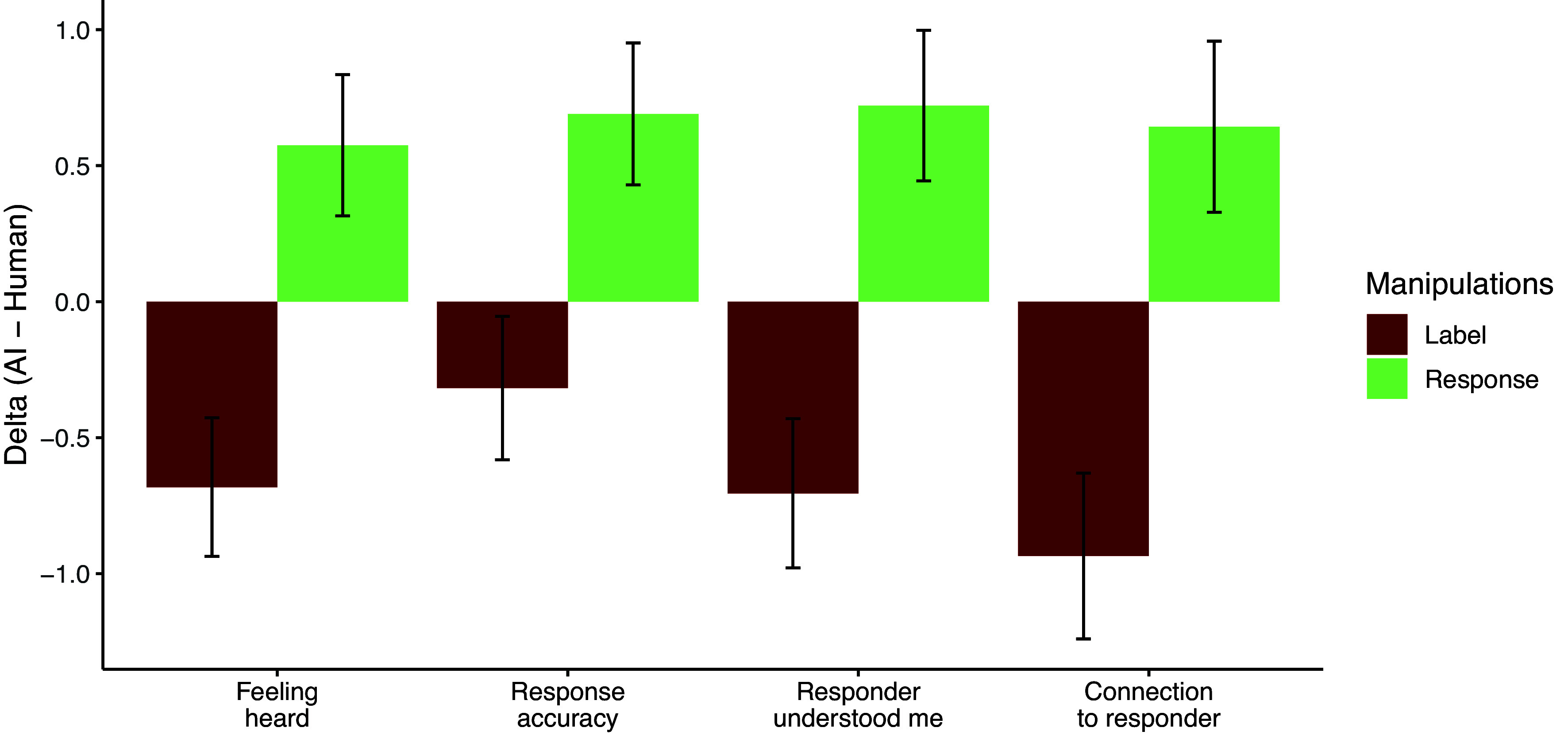
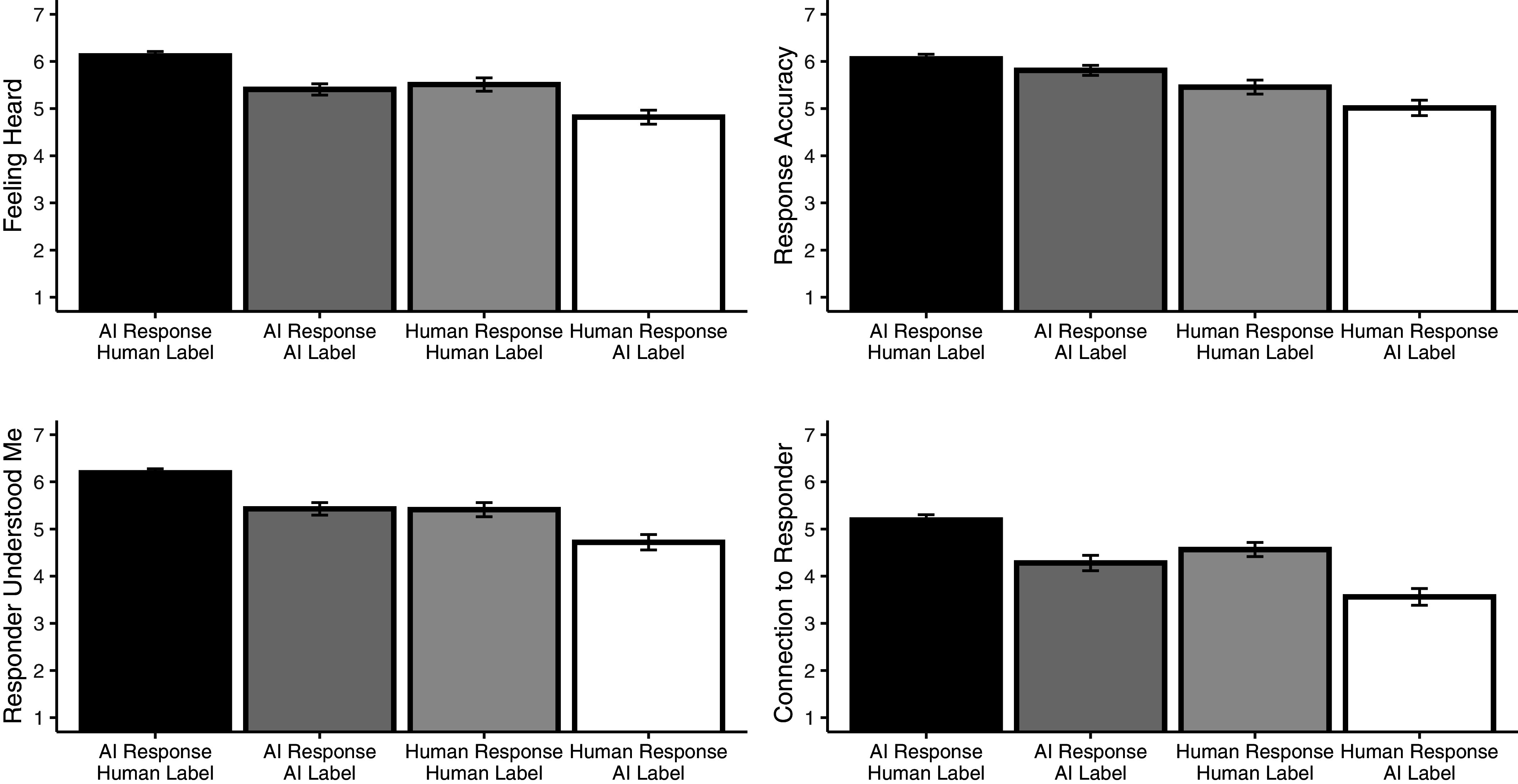
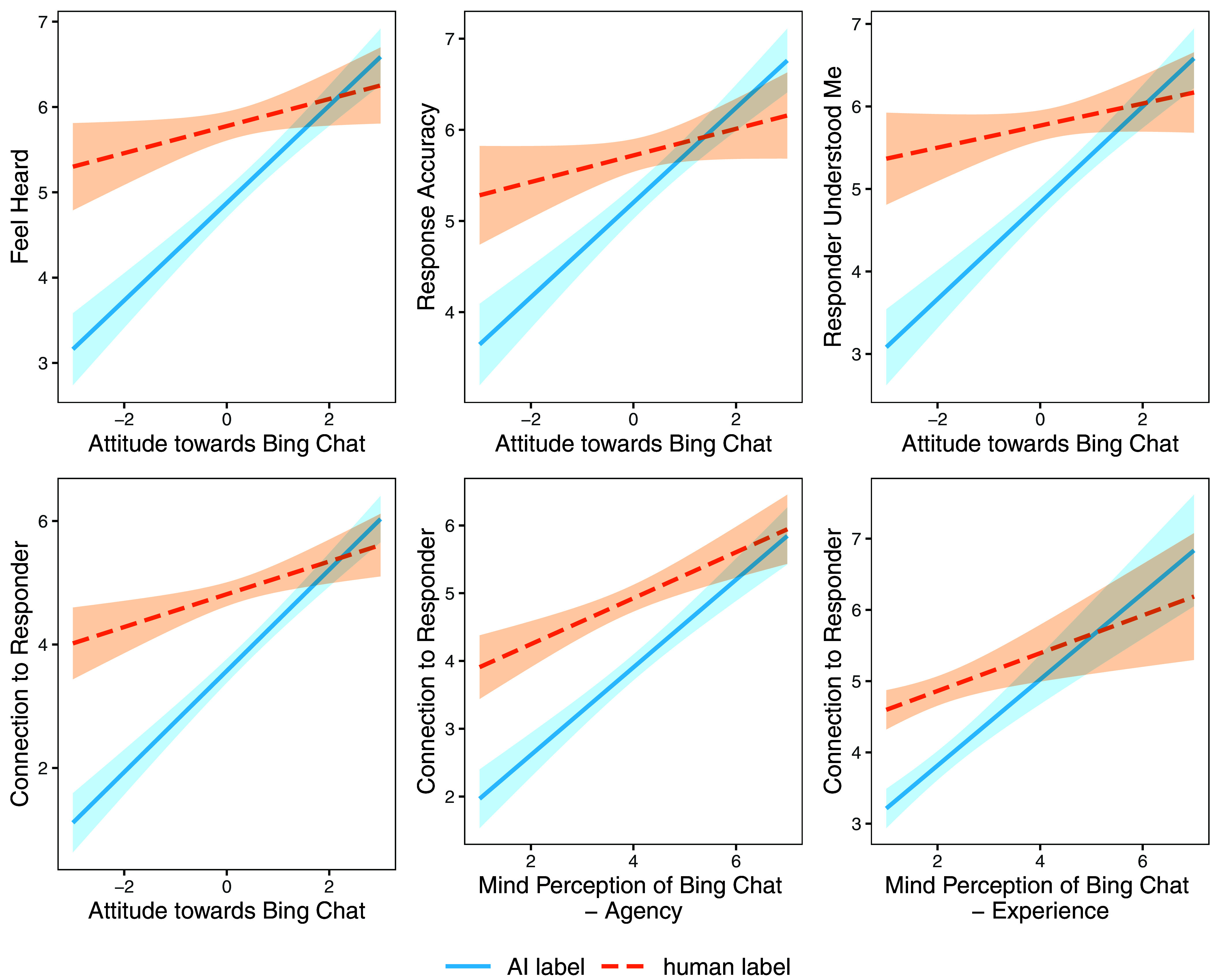
People want to “feel heard” to perceive that they are understood, validated, and valued. Can AI serve the deeply human function of making others feel heard? Our research addresses two fundamental issues: Can AI generate responses that make human recipients feel heard, and how do human recipients react when they believe the response comes from AI? We conducted an experiment and a follow-up study to disentangle the effects of actual source of a message and the presumed source. We found that AI-generated messages made recipients feel more heard than human-generated messages and that AI was better at detecting emotions. However, recipients felt less heard when they realized that a message came from AI (vs. human). Finally, in a follow-up study where the responses were rated by third-party raters, we found that compared with humans, AI demonstrated superior discipline in offering emotional support, a crucial element in making individuals feel heard, while avoiding excessive practical suggestions, which may be less effective in achieving this goal. Our research underscores the potential and limitations of AI in meeting human psychological needs. These findings suggest that while AI demonstrates enhanced capabilities to provide emotional support, the devaluation of AI responses poses a key challenge for effectively leveraging AI’s capabilities.
Overview
The claims and statistics of this paper haven’t been checked yet.
Free: it reads the open-access text and checks the first 5 claims that cite a source we can check. Create a free account to check every claim.
Integrity signals
Registry
Cites
Statistics
Figures
Verification
Claims the paper makes
The claims and statistics of this paper haven’t been checked yet.
Free: it reads the open-access text and checks the first 5 claims that cite a source we can check. Create a free account to check every claim.
Claims other papers make about this one
Each is checked against this paper’s own text: does it say what the citing paper says it does?
The cited source says what the claim attributes to it.
In the citing paper
“Four publications further explored intimate human-AI relationships under several aspects: One study showed that people feel heard by GenAI output [92], one investigated stigmatization of the use of erotic chatbots [93], one paper addressed men's accounts of intentionally sexually harassing a chatbot [94], and one paper addressed jealousy towards chatbots [95].”
From The Impact of Artificial Intelligence on Human Sexuality: A Five-Year Literature Review 2020–2024 (2024) · cites this paper as [92]
The cited source says what the claim attributes to it.
In the citing paper
“These models are increasingly achieving or surpassing human performance benchmarks in various domains, including medical diagnostic dialogue28, persuasive communication29, theory of mind30, making people feel heard31, responding to relationship issues32 and helping people reframe negative situations to reduce negative emotions33.”
From “It happened to be the perfect thing”: experiences of generative AI chatbots for mental health (2024) · cites this paper as [31]
The cited source says what the claim attributes to it.
In the citing paper
“People can feel heard by AI-generated responses, though knowing a response is AI-generated can reduce this effect [75].”
From Caring Without Feeling: Affective Dynamics as the Control Layer of Human-AI Agent Collaboration (2026) · cites this paper as [75]
The cited source says what the claim attributes to it.
In the citing paper
“This capacity may strengthen user engagement [20], therapeutic alliance [21], and the sense of being understood [22].”
From Generative AI Mental Health Chatbots as Therapeutic Tools: Systematic Review and Meta-Analysis of Their Role in Reducing Mental Health Issues (2025) · cites this paper as [22]
In the citing paper
“For instance, while AI can generate responses that make people feel heard by offering emotional support, people feel more heard when they believe a response comes from a human (48).”
From The impact of generative artificial intelligence on socioeconomic inequalities and policy making (2024) · cites this paper as [48]
Self-check
Percentages, sums and reported differences re-computed from the paper’s own numbers.
The self-check needs the paper’s full text.
Citations
Cites
Ayers, J. W., Poliak, A., Dredze, M., Leas, E. C., Zhu, Z., Kelley, J. B., Faix, D. J., Goodman, A. M., Longhurst, C. A., Hogarth, M., et al. (2023) · JAMA Internal Medicine · doi:10.1001/jamainternmed.2023.1838 · Cited by 2,613 · cited 3×
“More intriguingly, recent studies suggest that such mod els can generate responses that exhibit even higher levels of empathy than those from human experts (15–19); for example, responses by LLM to patients were rated by outsiders as more empathetic than responses by physicians (20).”
Ekman, P. (1992) · Psychological Review · doi:10.1037//0033-295x.99.3.550 · Cited by 2,372
Gray, H. M., Gray, K., & Wegner, D. M. (2007) · Science · doi:10.1126/science.1134475 · Cited by 2,342
Doctor-patient communication: a review.
Ha, J. F., & Longnecker, N. E. (2010) · PubMed · Cited by 2,014
Sparks of Artificial General Intelligence: Early experiments with GPT-4
Bubeck, S., Chandrasekaran, V., Eldan, R., Gehrke, J., Horvitz, E., Kamar, E., Lee, P., Lee, Y. T., Li, Y., Lundberg, S., et al. (2023) · arXiv · doi:10.48550/arxiv.2303.12712 · Cited by 1,526 · cited 1×
“Current large lan guage models (LLM), such as GPT - 4, can not only complete tasks in mathematics and coding but also understand people’s mental states (14).”
Task-Dependent Algorithm Aversion
Castelo, N., Bos, M. W., & Lehmann, D. R. (2019) · Journal of Marketing Research · doi:10.1177/0022243719851788 · Cited by 1,500 · cited 2×
“On the other hand, research on algorithm aversion (26) shows that people generally favor humans over algorithms, especially in areas traditionally viewed as uniquely human—those involving emotions (27, 28).”
Task-Dependent Algorithm Aversion
Castelo, N., Bos, M. W., Bos, M. W., Lehmann, D. R., & Lehmann, D. R. (2019) · Springer eBooks · doi:10.1007/978-3-031-88067-4_21 · Cited by 1,441
Doctor Patient Communication: A Review
Begum, T. (2015) · Journal of Bangladesh College of Physicians and Surgeons · doi:10.3329/jbcps.v32i2.26036 · Cited by 1,035
Changes in Dispositional Empathy in American College Students Over Time: A Meta-Analysis
Konrath, S. H., O'Brien, E. H., & Hsing, C. (2011) · Personality and Social Psychology Review · doi:10.1177/1088868310377395 · Cited by 962 · cited 1×
“Given the resource constraints and deepening societal divisions in society (12), as well as declining levels of dispositional empathy (13), it may be increasingly difficult for people to feel heard.”
Feeling robots and human zombies: Mind perception and the uncanny valley
Gray, K., & Wegner, D. M. (2012) · Cognition · doi:10.1016/j.cognition.2012.06.007 · Cited by 941 · cited 1×
“People may also hold negative attitudes toward AI, perceiving it as unnat ural or even threatening (29, 30), thereby diminishing the likeli hood of feeling heard by AI.”
Research works printed but not linked: 1
- Y. Yin, N. Jia, C. J. Wakslak, Data from “AI can help people feel heard, but an AI label diminishes this impact.” OSF. https://osf.io/8wnmr. Deposited 24 February 2024. PMC10998586 38551835
Cited by
The impact of generative artificial intelligence on socioeconomic inequalities and policy making
Capraro, V., Lentsch, A., Acemoglu, D., Akgun, S., Akhmedova, A., Bilancini, E., Bonnefon, J.-F., Brañas-Garza, P., Butera, L., Douglas, K. M., et al. (2024) · PNAS Nexus · doi:10.1093/pnasnexus/pgae191 · Cited by 371
Durably reducing conspiracy beliefs through dialogues with AI
Costello, T. H., Pennycook, G., & Rand, D. G. (2024) · Science · doi:10.1126/science.adq1814 · Cited by 354
“It happened to be the perfect thing”: experiences of generative AI chatbots for mental health
Siddals, S., Torous, J., & Coxon, A. (2024) · npj Mental Health Research · doi:10.1038/s44184-024-00097-4 · Cited by 241
Human-AI agency in the age of generative AI
Krakowski, S. (2025) · Information and Organization · doi:10.1016/j.infoandorg.2025.100560 · Cited by 162
Third-party evaluators perceive AI as more compassionate than expert humans
Ovsyannikova, D., de Mello, V. O., & Inzlicht, M. (2025) · Communications Psychology · doi:10.1038/s44271-024-00182-6 · Cited by 124
Comparing the value of perceived human versus AI-generated empathy
Rubin, M., Li, J. Z., Zimmerman, F., Ong, D. C., Goldenberg, A., & Perry, A. (2025) · Nature Human Behaviour · doi:10.1038/s41562-025-02247-w · Cited by 122
“In sum, realizing that an emotional response was AI-generated can reduce its social–emotional benefits 8,41 .”
InfluentialConsidering the role of human empathy in AI-driven therapy
Rubin, M., Arnon, H., Huppert, J. D., & Perry, A. (2024) · JMIR Mental Health · doi:10.2196/56529 · Cited by 111
“While conversational AI systems can, at times, give the feeling of “being heard,” their responses have still been reported to have less value than those written by humans [13].”
BackgroundFact-checking information from large language models can decrease headline discernment
DeVerna, M., Yan, H. Y., Yang, K.-C., & Menczer, F. (2024) · Proceedings of the National Academy of Sciences · doi:10.1073/pnas.2322823121 · Cited by 146
Large Language Models Produce Responses Perceived to be Empathic
Lee, Y. K., Suh, J., Zhan, H., Li, J. J., & Ong, D. C. (2024) · International Conference on Affective Computing and Intelligent Interaction and workshops · doi:10.1109/acii63134.2024.00012 · Cited by 150
Using Attachment Theory to Conceptualize and Measure the Experiences in Human-AI Relationships
Yang, F., & Oshio, A. (2025) · Current Psychology · doi:10.1007/s12144-025-07917-6 · Cited by 63
“For example, in addition to answering questions to help solve practical problems, generative AI can provide social support by offering companionship and mak - ing people feel heard (Chaturvedi et al., 2023; Yin et al., 2024).”
Xu, Y., Zhou, G., Cai, R., & Gürsoy, D. (2024) · International Journal of Hospitality Management · doi:10.1016/j.ijhm.2024.103829 · Cited by 95
Will users fall in love with ChatGPT? A perspective from the triangular theory of love
Chen, Q., Jing, Y., Gong, Y., & Tan, J. (2025) · Journal of Business Research · doi:10.1016/j.jbusres.2024.114982 · Cited by 66
The Impact of Artificial Intelligence on Human Sexuality: A Five-Year Literature Review 2020–2024
Döring, N., Le, T. D., Vowels, L. M., Vowels, M. J., & Marcantonio, T. L. (2024) · Current Sexual Health Reports · doi:10.1007/s11930-024-00397-y · Cited by 65
“• Four publications further explored intimate human-AI relationships under several aspects: One study showed that people feel heard by GenAI output [92], one investigated stigmatization of the use of erotic chatbots [93], one paper addressed men’s accounts of intentionally sexually harassing a…”
Zhang, Q., Zhang, R., Xiong, Y., Sui, Y., Tong, C., & Lin, F.-H. (2025) · Journal of Medical Internet Research · doi:10.2196/78238 · Cited by 56
“This capacity may strengthen user engagement [20], therapeutic alliance [21], and the sense of being understood [22].”
Trusting emotional support from generative artificial intelligence: a conceptual review
Volpato, R., DeBruine, L. M., & Stumpf, S. (2025) · Computers in Human Behavior Artificial Humans · doi:10.1016/j.chbah.2025.100195 · Cited by 74
“Liu and Yin (Liu & Yin, 2024) suggest that empathy in AI does not need to replicate human feelings, but can be modelled on how animals and humans signal emotions to each other, using patterns of safety, adaptation, and learned emotional responses.”
Fears about artificial intelligence across 20 countries and six domains of application.
Dong, M., Conway, J. R., Bonnefon, J., Shariff, A., & Rahwan, I. (2026) · American Psychologist · doi:10.1037/amp0001454 · Cited by 60
Yonatan‐Leus, R., & Brukner, H. (2024) · Counselling and Psychotherapy Research · doi:10.1002/capr.12832 · Cited by 53
Lim, S., & Kim, M. (2025) · International Journal of Hospitality Management · doi:10.1016/j.ijhm.2025.104259 · Cited by 50
Mentalizing Without a Mind: Psychotherapeutic Potential of Generative AI
Yirmiya, K., & Fonagy, P. (2025) · Journal of Medical Internet Research · doi:10.2196/79156 · Cited by 49
“For example, AI-generated responses are often perceived as offering greater emotional support but less practical advice compared with human replies, which frequently include personal experiences and explicit solutions, responses negatively correlated with “being with” and “feeling heard” [45].”
Lai, L., Pan, Y., Xu, R., & Jiang, Y. (2025) · Frontiers in Public Health · doi:10.3389/fpubh.2025.1580826 · Cited by 34
The impact of generative artificial intelligence on socioeconomic inequalities and policy makingPreprint
Capraro, V., Lentsch, A., Acemoğlu, D., Akgün, S., Akhmedova, A., Bilancini, E., Bonnefon, J., Brañas‐Garza, P., Butera, L., Douglas, K. M., et al. (2023) · PsyArXiv (OSF Preprints) · doi:10.31234/osf.io/6fd2y · Cited by 48
Artificial Intelligence (AI) and Workplace Communication: Promises, Perils, and Recommended Policy
Quaquebeke, N. V., & Gerpott, F. H. (2024) · Journal of Leadership & Organizational Studies · doi:10.1177/15480518241289644 · Cited by 50
“As such, the current research shows that once aware of AI involvement, humans display negative emotions toward content fully or partially generated with AI support (e.g., Yin et al., 2024).”
Large language models can predict the results of social science experiments
Ashokkumar, A., Hewitt, L., Ghezae, I., & Willer, R. (2026) · Nature · doi:10.1038/s41586-026-10742-x · Cited by 94
“LLMs—machine learning models trained on vast language corpora— have been shown to mimic human behaviours and abilities, such as social interaction, moral judgement and persuasion 11–17 .”
Relational Norms for Human-AI CooperationPreprint
Earp, B. D., Mann, S. P., Aboy, M., Awad, E., Betzler, M., Botes, M., Calcott, R., Caraccio, M., Chater, N., Coeckelbergh, M., et al. (2025) · arXiv (Cornell University) · doi:10.48550/arxiv.2502.12102 · Cited by 57
How does anthropomorphism promote consumer responses to social chatbots: mind perception perspective
Li, B., Yao, R., & Nan, Y. (2025) · Internet Research · doi:10.1108/intr-04-2024-0583 · Cited by 36
Cao, Z., Li, M., & Pavlou, P. A. (2024) · Decision Sciences · doi:10.1111/deci.12655 · Cited by 41
AI-mediated social support: the prospect of human–AI collaboration
Meng, J., Zhang, R., Qin, J., Lee, Y.-J., & Lee, Y. (2025) · Journal of Computer-Mediated Communication · doi:10.1093/jcmc/zmaf013 · Cited by 53
Durably reducing conspiracy beliefs through dialogues with AI
Costello, T. H., Pennycook, G., & Rand, D. G. (2024) · doi:10.31234/osf.io/xcwdn · Cited by 28
Generative AI framework for sensory and consumer research
Motoki, K., Low, J. Y. Q., & Velasco, C. (2025) · Food Quality and Preference · doi:10.1016/j.foodqual.2025.105600 · Cited by 32
Kleinert, T., Waldschütz, M., Blau, J., Heinrichs, M., & Schiller, B. (2026) · Communications Psychology · doi:10.1038/s44271-025-00391-7 · Cited by 37
“Consistent with recent fi ndings showing that labelling content as AI-generated reduces its positive perception 7 , participants reported less interpersonal closeness when they were informed they wouldinteractwithanAI.”
InfluentialPeer perceptions of clinicians using generative AI in medical decision-making
Yang, H., Dai, T., Mathioudakis, N. N., Knight, A. M., Nakayasu, Y., & Wolf, R. M. (2025) · npj Digital Medicine · doi:10.1038/s41746-025-01901-x · Cited by 40
AI Surrogates and illusions of generalizability in cognitive science
Crockett, M. J., & Messeri, L. R. (2025) · Trends in Cognitive Sciences · doi:10.1016/j.tics.2025.09.012 · Cited by 36
Transforming mental health research and care through artificial intelligence
Opel, N., & Breakspear, M. J. (2026) · Science · doi:10.1126/science.adz9193 · Cited by 37
How effective is AI augmentation in human–AI collaboration? Evidence from a field experiment
Liao, C., Wen, X., Li, S., & Du, P. (2024) · Information Technology and People · doi:10.1108/itp-11-2022-0859 · Cited by 45
Huang, G. I., Zhang, C., Torres, W. C. Z., Xiong, X., & Li, H. (2025) · Tourism Management · doi:10.1016/j.tourman.2025.105315 · Cited by 26
People choose to receive human empathy despite rating AI empathy higher
Wenger, J. D., Cameron, C. D., & Inzlicht, M. (2026) · Communications Psychology · doi:10.1038/s44271-025-00387-3 · Cited by 18
Kim, H., & Wang, Y. (2025) · International Journal of Advertising · doi:10.1080/02650487.2025.2558479 · Cited by 23
“Other research shows that users may still perceive AI interactions as less genuine simply because they are aware that they are communicating with a machine (Yin, Jia, and Wakslak 2024).”
Ruben, M. A., Blanch‐Hartigan, D., & Hall, J. A. (2025) · Journal of General Internal Medicine · doi:10.1007/s11606-025-10068-w · Cited by 31
“24 In that study, recipients of chatbot responses felt more heard than recipients of human-generated responses when they did not know who authored the response.”
When large language models are reliable for judging empathic communication
Kumar, A., Poungpeth, N., Yang, D., Farrell, E. L., Lambert, B. L., & Groh, M. (2026) · Nature Machine Intelligence · doi:10.1038/s42256-025-01169-6 · Cited by 43
“The Perceived Empathy conversational dataset contains two-turn conversations collected in stages [5].”
InfluentialMarcinkevage, C. H., & Kumar, A. (2025) · Computers · doi:10.3390/computers14030101 · Cited by 24
Haensch, A. (2025) · arXiv (Cornell University) · doi:10.48550/arxiv.2504.12337 · Cited by 23
“These models are increasingly reaching or even surpassing human performance benchmarks in persuasive communication (Salvi et al., 2024), user engagement and responsiveness (Yin et al., 2024), and cognitive reframing to alleviate distress (Li et al., 2024).”
Averse to what: Consumer aversion to algorithmic labels, but not their outputs?
Mariadassou, S., Klesse, A.-K., & Boegershausen, J. (2024) · Current Opinion in Psychology · doi:10.1016/j.copsyc.2024.101839 · Cited by 37
What makes children perceive or not perceive minds in generative AI?
Xu, Y., Thomas, T., Yu, C., & Pan, Z. (2025) · Computers in Human Behavior Artificial Humans · doi:10.1016/j.chbah.2025.100135 · Cited by 26
Weinstein, N., Itzchakov, G., & Maniaci, M. R. (2025) · Computers in Human Behavior Artificial Humans · doi:10.1016/j.chbah.2025.100149 · Cited by 27
Boissin, E., Costello, T. H., Spinoza-Martín, D., Rand, D. G., & Pennycook, G. (2025) · PNAS Nexus · doi:10.1093/pnasnexus/pgaf325 · Cited by 18
“…enhance trust and persuasive impact (10), with some studies finding that AI agents are perceived as neutral, more impartial or more competent (5, 11), while others report a general preference for human communicators — often seen as more convincing, emotionally at-tuned, or socially aware (12, 13).”
Wang, M., Yang, Y., & Zhong, P. (2025) · Technology in Society · doi:10.1016/j.techsoc.2025.102855 · Cited by 21
Cicco, R. D., Francioni, B., Dini, M., Curina, I., Filieri, R., & Cioppi, M. (2025) · Journal of Travel Research · doi:10.1177/00472875251364222 · Cited by 21
“Research even suggests that AI-generated messages can make users feel more understood than those created by humans, provided they are unaware that the message was produced by an AI (Yin et al., 2024).”
Zohar, E., Bloom, P., & Inzlicht, M. (2026) · Communications Psychology · doi:10.1038/s44271-026-00402-1 · Cited by 25
Bout, N., Moukhliss, G., Belhadaoui, H., Afifi, N., & Abık, M. (2025) · Discover Internet of Things · doi:10.1007/s43926-025-00174-w · Cited by 23
“Recent findings also highlight that perceived empathy from AI may paradoxically reduce trust when users are aware of the system’s artificial nature [17], where several studies have also examined emotional AI acceptability in healthcare [18– 21] and surgical robotics in complex operations [22],…”
InfluentialUnderstanding Reader Perception Shifts upon Disclosure of AI Authorship
Nakano, H., Takezawa, J., Matulic, F., Yang, C.-L., & Yatani, K. (2026) · ACM International Conference on Intelligent User Interfaces (IUI) · doi:10.1145/3742413.3789076 · Cited by 26
Gonzalez, K., Kanitz, R., & Briker, R. (2024) · The Journal of Applied Behavioral Science · doi:10.1177/00218863241279916 · Cited by 18
“…AI becoming pro-li fi c at completing some tasks requiring skills thought to be unique to humans — such as persuasion, empathy, or complex problem-solving (Ayers et al., 2023; Ge et al., 2024; Yin et al., 2024a) — the question arises: what is the distinctive contribution of human change managers?”
InfluentialAI disclosure, moral shame, and the punishment of honesty
Bao, A., & Zeng, Y. (2025) · Accountability in Research · doi:10.1080/08989621.2025.2542197 · Cited by 26
“Yin et al. also found that in human-AI interactions, when humans know that an AI is listening to their words, they feel emotionally unheard (Yin, Jia, and Wakslak 2024).”
Refoua, E., Elyoseph, Z., Wacker, R., Dziobek, I., Tsafrir, I., & Meinlschmidt, G. (2025) · Computers in Human Behavior Reports · doi:10.1016/j.chbr.2025.100702 · Cited by 19
Wang, Z., Song, R., Shen, C., Yin, S., Song, Z., Battu, B., Shi, L., Jia, D., Rahwan, T., & Hu, S. (2026) · National Science Review · doi:10.1093/nsr/nwag223 · Cited by 17
“However, at its core, the machine penalty reflects a form of algorithm aversion, whereby humans are reluctant to view machines as genuine social partners [12 ,13 ].”
Public trust in artificial intelligence users
Dang, J., & Liu, L. (2025) · Current Opinion in Psychology · doi:10.1016/j.copsyc.2025.102148 · Cited by 23
Dai, X., Leng, L. L., Liu, Y., Huang, Y., & Wong, D. F. K. (2025) · BMC Psychiatry · doi:10.1186/s12888-025-07671-w · Cited by 18
“This aligns with prior work showing that AI-generated responses in emotionally complex scenarios can make recipients feel more understood than responses from untrained humans when AI’s identity is concealed [52].”
Therapy chatbots and emotional complexity: do therapy chatbots really empathise?
Gabriels, K., & Goffin, K. (2026) · Current Opinion in Psychology · doi:10.1016/j.copsyc.2025.102263 · Cited by 19
Resistance to AI-designed customized travel: the role of perceived personalization
Niu, J. W., Wang, K., Wang, L., Ruan, W.-Q., & Xiao, H. (2025) · Tourism Review · doi:10.1108/tr-09-2024-0824 · Cited by 15
Sun, X., Ma, R., Wei, S., Cesar, P. S., Bosch, J. A., & Ali, A. E. (2025) · International Journal of Human-Computer Studies · doi:10.1016/j.ijhcs.2025.103714 · Cited by 17
“Research on labeling further shows that disclosing AI involvement often reduces trust even when content is identical [64, 111, 147].”
InfluentialThe Impact of Generative Artificial Intelligence on Socioeconomic Inequalities and Policy MakingPreprint
Capraro, V., Lentsch, A., Acemoğlu, D., Akgün, S., Akhmedova, A., Bilancini, E., Bonnefon, J., Brañas‐Garza, P., Butera, L., Douglas, K. M., et al. (2024) · SSRN Electronic Journal · doi:10.2139/ssrn.4666103 · Cited by 18
Chen, Y., Zhang, Y., Fan, H., & Guo, Y. (2025) · Journal of Retailing and Consumer Services · doi:10.1016/j.jretconser.2025.104683 · Cited by 15
How artificial intelligence shapes job anxiety: the mediating role of AI stress
Fang, L. B., Tang, L., & Yang, H. (2026) · Internet Research · doi:10.1108/intr-09-2024-1462 · Cited by 18
Speaker effects in language comprehension: An integrative model of language and speaker processing
Wu, H., & Cai, Z. G. (2026) · Psychonomic Bulletin & Review · doi:10.3758/s13423-026-02896-6 · Cited by 15
“In one such attempt, Yin et al. (2024) explored whether AI-generated language could make people “feel heard” and whether the “AI label” could influence this feeling.”
Does Humanness Matter? An Ethical Evaluation of Sharing Care Work with Social Robots
Mihailov, E., & Wangmo, T. (2025) · Science and Engineering Ethics · doi:10.1007/s11948-025-00547-y · Cited by 15
“Though it is controversial what emo - tions should be expressed in human-robot interactions (Fosch Villaronga, 2019 ), AI agents can communicate with humans in ways that makes them feel heard (Yin et al., 2024 ).”
Zhong, W., & Luo, J. (2025) · International Journal of Human-Computer Interaction · doi:10.1080/10447318.2025.2537794 · Cited by 14
“Beyond transactional, task-oriented uses, GenAI chatbots are emerging as affective social actors, providing emotional support, companionship, and social connection (Elyoseph et al., 2024; Ooi et al., 2025; Salah et al., 2024; Yin et al., 2024).”
Technosolutionism and the empathetic medical chatbot
Sharon, T. (2025) · AI & Society · doi:10.1007/s00146-025-02441-4 · Cited by 17
“One recent study (Yin et al. 2024) aimed to compare the effects of AI-generated vs. human-generated messages on the extent to which people “felt heard”, i.e., their sense of being understood, validated and valued.”
Suh, J., Le, L., Shayegani, E., Ramos, G., Amores, J., Ong, D. C., Czerwinski, M. P., & Hernandez, J. (2026) · IEEE Transactions on Affective Computing · doi:10.1109/taffc.2026.3656531 · Cited by 18
“Indeed, recently developed Large Language Models (LLMs) can now produce empathic [7],[8],[9],[10],[11],[12],[13].”
Liu, H., Fang, X., Cui, Q., & Chiu, T. K. F. (2026) · Review of Education · doi:10.1002/rev3.70141 · Cited by 14
Meiling, H., Jin, M., & Li, N. (2024) · RePEc: Research Papers in Economics · doi:10.48550/arxiv.2412.03963 · Cited by 12
Li, J. Z., Herderich, A., & Goldenberg, A. (2024) · doi:10.31234/osf.io/fzvd8 · Cited by 10
Increasing happiness through conversations with artificial intelligence
Heffner, J., Qin, C., Chadwick, M., Knutsen, C., Summerfield, C., Kurth-Nelson, Z., & Rutledge, R. B. (2025) · arXiv · doi:10.48550/arxiv.2504.02091 · Cited by 10
“Recent studies suggest that these models can generate empathetic responses 22,23 , providing emotional support and using mirroring language to make people feel heard.”
D-Twins: Your Digital Twin Designed for Real-Time Boredom Intervention
Lo, I.-C., & Rau, P. P. (2025) · CHI Conference on Human Factors in Computing Systems · doi:10.1145/3706598.3714163 · Cited by 13
“The expected emotional feedback can vary depending on the application scenario and individual expectations [23, 66].”
Blease, C. (2025) · JMIR Mental Health · doi:10.2196/78663 · Cited by 11
“For example, a study found that AI-generated messages made recipients feel more understood than human-written ones, and AI was better at detecting emotions [42].”
When privacy concerns drive AI adoption: a psychological perspective
Guo, T. T., Wu, Q., & Cai, F. (2025) · Journal of Research in Interactive Marketing · doi:10.1108/jrim-02-2024-0122 · Cited by 18
Machine talk: When flattery sounds better from a bot
Chai, D., Li, J., & Huang, J. (2025) · Journal of Retailing and Consumer Services · doi:10.1016/j.jretconser.2025.104465 · Cited by 12
Zhou, J., Corbett, F., Byun, J., Porat, T., & Zalk, N. V. (2026) · Communications Psychology · doi:10.1038/s44271-026-00466-z · Cited by 9
Mourning the loss of AI companions
Freitas, J. D., Castelo, N., Uğuralp, A. K., & Uğuralp, Z. (2026) · Nature Human Behaviour · doi:10.1038/s41562-026-02569-3 · Cited by 15
“Empathy Code”: The Dangers of Automating Empathy in Business
Thomas, N., & Docherty, N. (2025) · Business & Society · doi:10.1177/00076503241310142 · Cited by 10
“Research supports this concern: studies show that when people realize empathetic messages are AI-generated, their sense of being understood diminishes, often replaced by feelings of reduced authenticity and insincerity (Yin et al., 2024).”
Kitchens, M. B., & Meier, B. P. (2025) · The Journal of Social Psychology · doi:10.1080/00224545.2025.2503006 · Cited by 12
Lv, D., Sun, R., Zhu, Q., & Qin, S. (2025) · BMC Psychology · doi:10.1186/s40359-025-02894-8 · Cited by 13
“Users often acquire “empathy” illusions, thinking that GenAI can comprehend their emotional support requirements, because of GenAI’s high emotional expression capabilities [14], hence evaluating user responses to GenAI service failures requires this attentions.”
Zhang, W., Xie, C., Jiang, L., Li, Y., Hu, Z., & Hao, N. (2025) · Social Cognitive and Affective Neuroscience · doi:10.1093/scan/nsaf071 · Cited by 10
Jin, X., & Li, J. (2025) · International Journal of Consumer Studies · doi:10.1111/ijcs.70133 · Cited by 13
Jin, H., & Wang, S. (2025) · Journal of Philosophy of Education · doi:10.1093/jopedu/qhaf087 · Cited by 10
Hằng, N. P. T., Nguyen, N. T. T., & Huynh, T. B. (2026) · Discover Artificial Intelligence · doi:10.1007/s44163-026-01043-3 · Cited by 14
EmpathyAgent: Can Embodied Agents Conduct Empathetic Actions?Preprint
Chen, X., Ge, J., Dai, H., Zhou, Q., Feng, Q., Hu, J., Wang, Y., Liu, J., & Zhang, S. (2025) · arXiv (Cornell University) · doi:10.48550/arxiv.2503.16545 · Cited by 10
“Recent studies show that agents can make people “feel heard,” suggesting they have the potential to offer emotional and empathetic support to humans (Yin et al., 2024).”
Li, Y., Chang, Y., & Li, Y. (2025) · International Journal of Information Management · doi:10.1016/j.ijinfomgt.2025.102937 · Cited by 16
Cao, B., Wen, C., & Zhang, R. (2025) · Journal of Broadcasting & Electronic Media · doi:10.1080/08838151.2025.2519730 · Cited by 12
“…increasingly deployed across various platforms, including websites and messaging apps, and across different domains, such as businesses, education, healthcare, and mental health support, where they can provide valuable resources and assistance (Li & Zhang, 2024; Meng & Dai, 2021; Yin et al., 2024).”
Lu, X., Guo, W. R., Wang, Y., & Zhang, H. (2025) · International Journal of Human-Computer Interaction · doi:10.1080/10447318.2025.2520997 · Cited by 11
“Consistent with Yin et al. AI-dominant informational content is perceived as more attentive by recipients compared to human-dominant content; however, the presence of an AI label diminishes this effect (Yin et al., 2024).”
When Neutrality Conceals Bias: Perceived Discrimination in Algorithmic Decisions
Li, Y., & Lu, R. (2025) · European Journal of Social Psychology · doi:10.1002/ejsp.70020 · Cited by 8
Arnold, C., Xu, L. Z., Saffarizadeh, K., & Madiraju, P. (2025) · Behaviour and Information Technology · doi:10.1080/0144929x.2025.2590099 · Cited by 9
“Degree captures the extent of this divergence, which can vary based on cues like disclosure (i.e. whether the use of GenAI is made transparent, see Tong et al. 2021; Yin, Jia, and Wakslak 2024).”
Yu, F., Zhao, Y., Xu, L., & Peng, K. (2025) · Frontiers of digital education. · doi:10.1007/s44366-025-0043-1 · Cited by 13
“Clinical psychologists are exploring whether and how AI can function as a qualified intelligent counselor (Aktan et al., 2022; Yin et al., 2024).”
Loss of control: AI-based decision-making induces negative company evaluation
Xie, Z., Niu, W., Lin, C., Fu, S., Liao, K.-T., & Zhang, W. (2025) · Chinese Management Studies · doi:10.1108/cms-12-2024-0979 · Cited by 10
Can large language models exhibit cognitive and affective empathy as humans?
Yu, T., Pan, S., Fan, C., Luo, S., Jin, Y., & Zhao, B. (2025) · Computers in Human Behavior Artificial Humans · doi:10.1016/j.chbah.2025.100233 · Cited by 13
Rao, X., Wu, H., & Cai, Z. G. (2025) · Applied Psycholinguistics · doi:10.1017/s0142716425100404 · Cited by 9
“Yin et al. (2024) showed that, after expressing their feelings, participants reported being heard more often if they received responses generated by LLMs than by humans (with response source unknown to participants); however, when the source of response was known, participants reported being heard…”
Why Most Resist AI CompanionsPreprint
Uğuralp, Z., Uğuralp, A. K., Puntoni, S., & Freitas, J. D. (2025) · SSRN Electronic Journal · doi:10.2139/ssrn.5097445 · Cited by 16
Croce, N. (2025) · Perspectives on Public Management and Governance · doi:10.1093/ppmgov/gvaf005 · Cited by 8
Algorithmic Witnessing: A Narrative Review and the AI CARE Framework for Trauma Testimony
Hadar‐Shoval, D., Haber, Y., Refoua, E., Elyoseph, Z., Yirmiya, K., & Yinon, D. (2026) · Trauma Violence & Abuse · doi:10.1177/15248380261425937 · Cited by 8
Becker, M., Jong, D. D., Briker, R., Mennens, K., Heller, J., Mahr, D., & Grewal, D. (2026) · The Leadership Quarterly · doi:10.1016/j.leaqua.2026.101952 · Cited by 7
Jin, M., Yang, Z., Freling, T. H., & Janakiraman, N. (2025) · Journal of Public Policy & Marketing · doi:10.1177/07439156251320314 · Cited by 8
“Further research by Yin, Jia, and Wakslak (2024) reveals that AI-generated messages were perceived as making recipients feel more heard than human-generated messages, and that AI demonstrated superior accuracy in detecting emotions.”
Dong, X., Wang, B., Chu, W., Filieri, R., & Liao, J. (2025) · Psychology and Marketing · doi:10.1002/mar.70003 · Cited by 8
Metadata
- Authors
- Yin, Y., Jia, N., & Wakslak, C. J.
- Affiliations
- University of Southern California (US)
- Corresponding author
- Yin, Yidan
- Wakslak, Cheryl J.
- Venue
- Proceedings of the National Academy of Sciences
- Publisher
- National Academy of Sciences
- Published
- 2024-03-29
- Volume
- 121
- Issue
- 14
- Pages
- e2319112121-e2319112121
- ISSN
- 0027-8424 (ISSN-L)
- 1091-6490
- PMC
- PMC10998586
- OpenAlex
- W4393306715
- Cited by
- 247
- References
- 44
- Citations by year
- 2026: 116 · 2025: 105 · 2024: 24
- FWCI
- 116.23
- Type
- journal article
- Language
- en
- Open access
- hybrid
- doi.org
- Licence
- Locations
- Proceedings of the National Academy of Sciences (publishedVersion, cc-by-nc-nd)
- PubMed Central (publishedVersion, cc-by-nc-nd)
- PubMed (publishedVersion)
- OSF Preprints (OSF Preprints) (submittedVersion)
- Topics
- Social Sciences › Psychology › Social Psychology › Social Robot Interaction and HRI
- Social Sciences › Business, Management and Accounting › Marketing › AI in Service Interactions
- Physical Sciences › Computer Science › Artificial Intelligence › Emotion and Mood Recognition
- Keywords
- AI-generated responses, feeling heard, emotional support, AI labeling, emotion recognition, human-AI interaction, psychological needs
- MeSH terms
- Emotions, Follow-Up Studies, Humans, Motivation
About these checks
Registry, retraction, Cites and statistics results are computed, not judged, with one exception: a printed reference that no index lists is read once by a model before it counts as a citation error. Claims are extracted by a model and kept only when their quote appears verbatim in the text; each cited source is then checked, with a model’s help, for whether it says what the claim relies on. Those verdicts can be wrong — read the claim’s quote and the cited source before relying on one.
Statistics and arithmetic are recomputed, not judged.
Confidence bands are shown only for fields calibrated on our annotated test set. None is calibrated yet, so no band is shown.
What counts as a claim ›How we measure confidence ›How we check this ›
Are you an author, or do you see a problem with this page? Request a review
Data sources
Bibliographic data: Semantic Scholar, OpenAlex, Crossref.
Contains information from the Semantic Scholar Academic Graph Datasets, made available under the ODC Attribution License (ODC-BY 1.0).
Semantic Scholar’s data is described in: Kinney, R., et al. (2023). The Semantic Scholar Open Data Platform. arXiv:2301.10140.
