

AI can help people feel heard, but an AI label diminishes this impact
Open accessThe DOI matches its Crossref record; 48 of the 49 references it cites were found in a registry or an index.
Abstract
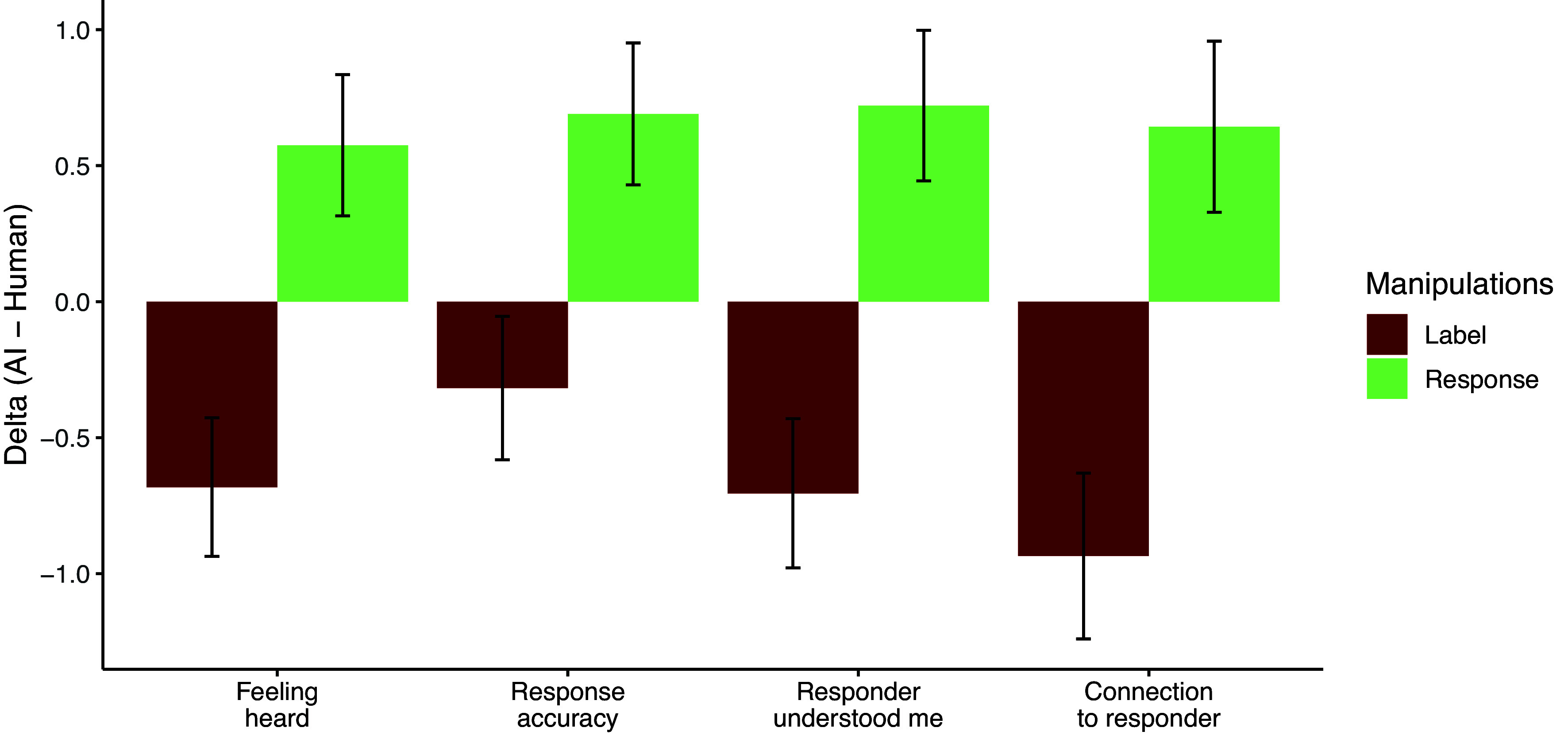
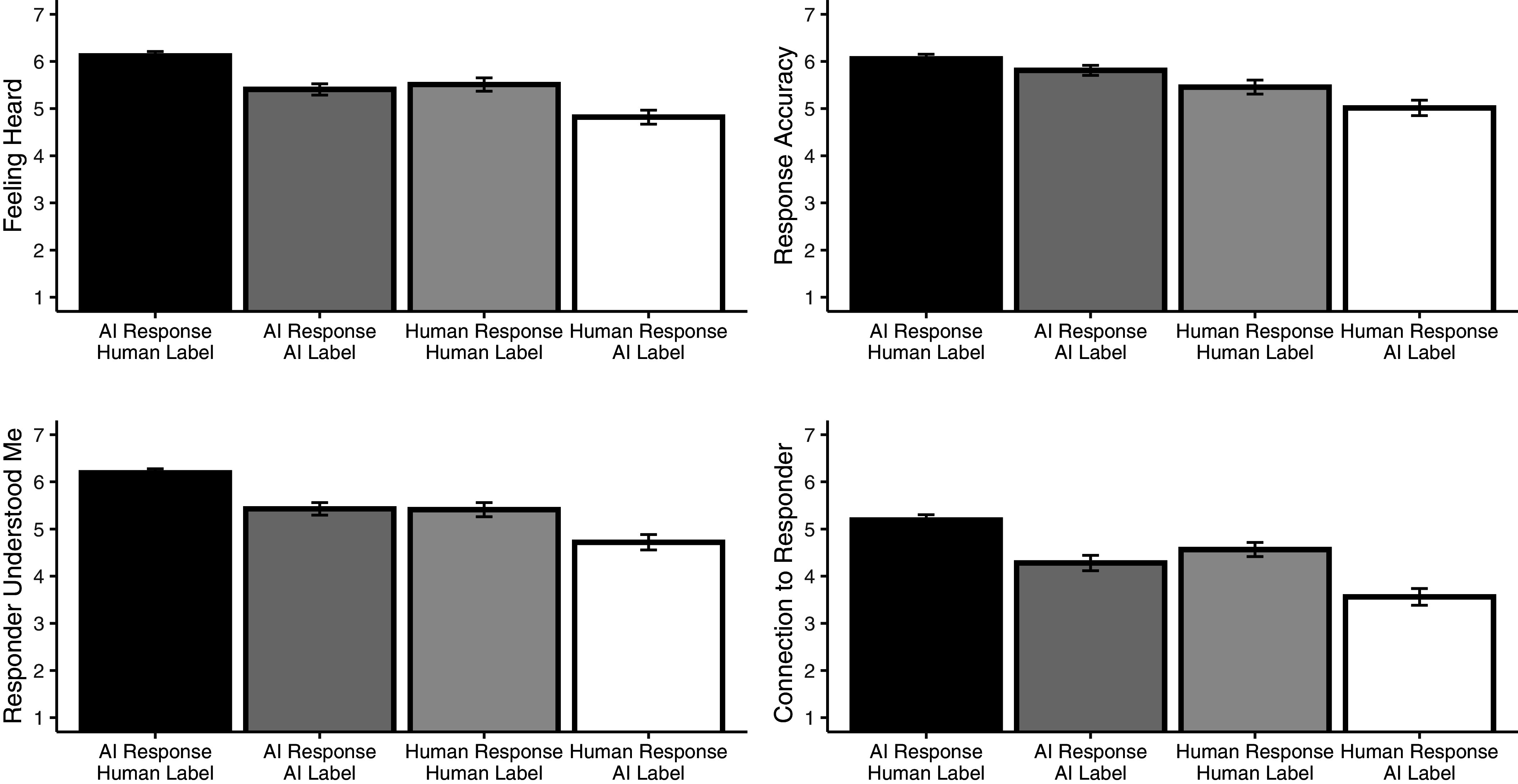
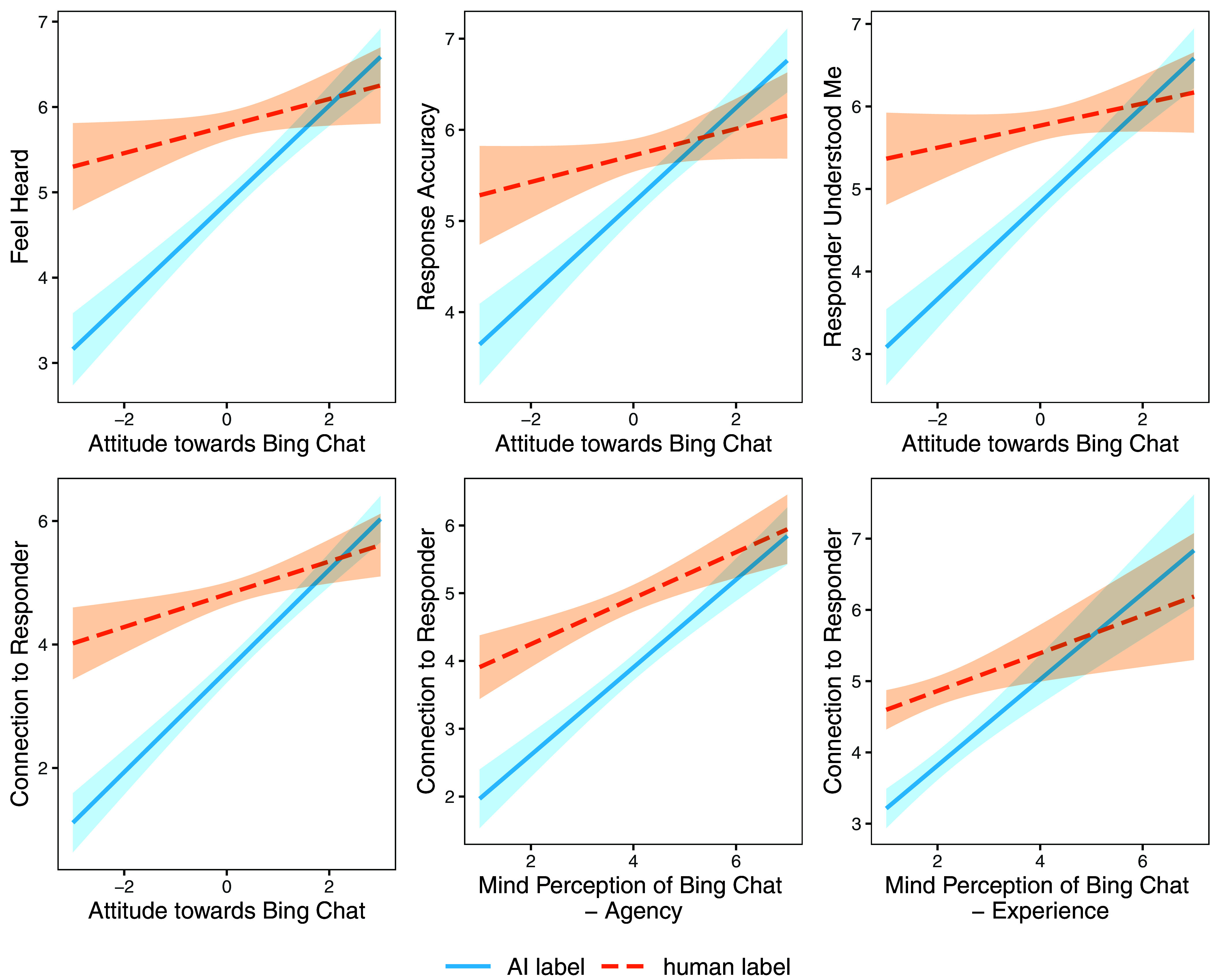
People want to “feel heard” to perceive that they are understood, validated, and valued. Can AI serve the deeply human function of making others feel heard? Our research addresses two fundamental issues: Can AI generate responses that make human recipients feel heard, and how do human recipients react when they believe the response comes from AI? We conducted an experiment and a follow-up study to disentangle the effects of actual source of a message and the presumed source. We found that AI-generated messages made recipients feel more heard than human-generated messages and that AI was better at detecting emotions. However, recipients felt less heard when they realized that a message came from AI (vs. human). Finally, in a follow-up study where the responses were rated by third-party raters, we found that compared with humans, AI demonstrated superior discipline in offering emotional support, a crucial element in making individuals feel heard, while avoiding excessive practical suggestions, which may be less effective in achieving this goal. Our research underscores the potential and limitations of AI in meeting human psychological needs. These findings suggest that while AI demonstrates enhanced capabilities to provide emotional support, the devaluation of AI responses poses a key challenge for effectively leveraging AI’s capabilities.
Overview
The claims and statistics of this paper haven’t been checked yet.
Free: it reads the open-access text and checks the first 5 claims that cite a source we can check. Create a free account to check every claim.
Integrity signals
Registry
Cites
Statistics
Figures
Verification
Claims the paper makes
The claims and statistics of this paper haven’t been checked yet.
Free: it reads the open-access text and checks the first 5 claims that cite a source we can check. Create a free account to check every claim.
Claims other papers make about this one
Each is checked against this paper’s own text: does it say what the citing paper says it does?
The cited source says what the claim attributes to it.
In the citing paper
“Four publications further explored intimate human-AI relationships under several aspects: One study showed that people feel heard by GenAI output [92], one investigated stigmatization of the use of erotic chatbots [93], one paper addressed men's accounts of intentionally sexually harassing a chatbot [94], and one paper addressed jealousy towards chatbots [95].”
From The Impact of Artificial Intelligence on Human Sexuality: A Five-Year Literature Review 2020–2024 (2024) · cites this paper as [92]
The cited source says what the claim attributes to it.
In the citing paper
“These models are increasingly achieving or surpassing human performance benchmarks in various domains, including medical diagnostic dialogue28, persuasive communication29, theory of mind30, making people feel heard31, responding to relationship issues32 and helping people reframe negative situations to reduce negative emotions33.”
From “It happened to be the perfect thing”: experiences of generative AI chatbots for mental health (2024) · cites this paper as [31]
The cited source says what the claim attributes to it.
In the citing paper
“People can feel heard by AI-generated responses, though knowing a response is AI-generated can reduce this effect [75].”
From Caring Without Feeling: Affective Dynamics as the Control Layer of Human-AI Agent Collaboration (2026) · cites this paper as [75]
The cited source says what the claim attributes to it.
In the citing paper
“This capacity may strengthen user engagement [20], therapeutic alliance [21], and the sense of being understood [22].”
From Generative AI Mental Health Chatbots as Therapeutic Tools: Systematic Review and Meta-Analysis of Their Role in Reducing Mental Health Issues (2025) · cites this paper as [22]
In the citing paper
“For instance, while AI can generate responses that make people feel heard by offering emotional support, people feel more heard when they believe a response comes from a human (48).”
From The impact of generative artificial intelligence on socioeconomic inequalities and policy making (2024) · cites this paper as [48]
Self-check
Percentages, sums and reported differences re-computed from the paper’s own numbers.
The self-check needs the paper’s full text.
Citations
Cites
Ayers, J. W., Poliak, A., Dredze, M., Leas, E. C., Zhu, Z., Kelley, J. B., Faix, D. J., Goodman, A. M., Longhurst, C. A., Hogarth, M., et al. (2023) · JAMA Internal Medicine · doi:10.1001/jamainternmed.2023.1838 · Cited by 2,613 · cited 3×
“More intriguingly, recent studies suggest that such mod els can generate responses that exhibit even higher levels of empathy than those from human experts (15–19); for example, responses by LLM to patients were rated by outsiders as more empathetic than responses by physicians (20).”
Ekman, P. (1992) · Psychological Review · doi:10.1037//0033-295x.99.3.550 · Cited by 2,372
Gray, H. M., Gray, K., & Wegner, D. M. (2007) · Science · doi:10.1126/science.1134475 · Cited by 2,342
Doctor-patient communication: a review.
Ha, J. F., & Longnecker, N. E. (2010) · PubMed · Cited by 2,014
Sparks of Artificial General Intelligence: Early experiments with GPT-4
Bubeck, S., Chandrasekaran, V., Eldan, R., Gehrke, J., Horvitz, E., Kamar, E., Lee, P., Lee, Y. T., Li, Y., Lundberg, S., et al. (2023) · arXiv · doi:10.48550/arxiv.2303.12712 · Cited by 1,526 · cited 1×
“Current large lan guage models (LLM), such as GPT - 4, can not only complete tasks in mathematics and coding but also understand people’s mental states (14).”
Task-Dependent Algorithm Aversion
Castelo, N., Bos, M. W., & Lehmann, D. R. (2019) · Journal of Marketing Research · doi:10.1177/0022243719851788 · Cited by 1,500 · cited 2×
“On the other hand, research on algorithm aversion (26) shows that people generally favor humans over algorithms, especially in areas traditionally viewed as uniquely human—those involving emotions (27, 28).”
Task-Dependent Algorithm Aversion
Castelo, N., Bos, M. W., Bos, M. W., Lehmann, D. R., & Lehmann, D. R. (2019) · Springer eBooks · doi:10.1007/978-3-031-88067-4_21 · Cited by 1,441
Doctor Patient Communication: A Review
Begum, T. (2015) · Journal of Bangladesh College of Physicians and Surgeons · doi:10.3329/jbcps.v32i2.26036 · Cited by 1,035
Changes in Dispositional Empathy in American College Students Over Time: A Meta-Analysis
Konrath, S. H., O'Brien, E. H., & Hsing, C. (2011) · Personality and Social Psychology Review · doi:10.1177/1088868310377395 · Cited by 962 · cited 1×
“Given the resource constraints and deepening societal divisions in society (12), as well as declining levels of dispositional empathy (13), it may be increasingly difficult for people to feel heard.”
Feeling robots and human zombies: Mind perception and the uncanny valley
Gray, K., & Wegner, D. M. (2012) · Cognition · doi:10.1016/j.cognition.2012.06.007 · Cited by 941 · cited 1×
“People may also hold negative attitudes toward AI, perceiving it as unnat ural or even threatening (29, 30), thereby diminishing the likeli hood of feeling heard by AI.”
Research works printed but not linked: 1
- Y. Yin, N. Jia, C. J. Wakslak, Data from “AI can help people feel heard, but an AI label diminishes this impact.” OSF. https://osf.io/8wnmr. Deposited 24 February 2024. PMC10998586 38551835
Cited by
Items 101–200 of 298
Using Large Language Models in Behavioral Science Interventions: Promise & Risk
Hecht, C. A., Ong, D. C., Clapper, M., Jones, M., Demszky, D., Yang, D., Eichstaedt, J. C., Bryan, C. J., & Yeager, D. S. (2025) · Behavioral Science & Policy · doi:10.1177/23794607251344698 · Cited by 12
“44,45 Mitigating the Risks of LLM-Powered Behavioral Science Interventions Next, we address ways that LLM developers and intervention designers can mitigate risks that arise regardless of who is interacting with an LLM and then address ways they can mitigate risks related to interactions with…”
Gain or loss? Unveiling the power of framing in chatbot identity disclosure
Li, T., Zhang, C., Zheng, W. T., & Qiao, J. (2025) · International Journal of Contemporary Hospitality Management · doi:10.1108/ijchm-09-2024-1415 · Cited by 6
Chen, H., Liu, S., Wang, Y., Dong, N., Kim, W. G., & Li, J. (. (2025) · British Food Journal · doi:10.1108/bfj-08-2025-1101 · Cited by 6
Keeler, J. B., & Murphy, B. A. (2026) · Community Work & Family · doi:10.1080/13668803.2026.2623500 · Cited by 10
Dimensions of AI de-anthropomorphization based on impression integration theory
Li, J., Huang, J., & Ni, B. (2026) · Technology in Society · doi:10.1016/j.techsoc.2026.103352 · Cited by 6
Hu, M., Ho, J. Q. H., Ng, C., Wong, S. S., & Hartanto, A. (2026) · Computers in Human Behavior Reports · doi:10.1016/j.chbr.2026.101149 · Cited by 7
Gong, X., & Zhang, Y. (2025) · International Journal of Human-Computer Interaction · doi:10.1080/10447318.2025.2586085 · Cited by 8
“Although studies confirm that interface type affects usage intention (Gutuleac et al., 2024; Yin et al., 2024), the specific pathways driving these effects are poorly understood.”
Zhang, Y., Fang, J., Liao, M., Han, L., Wen, C., & Addo, P. C. (2025) · Journal of Business Research · doi:10.1016/j.jbusres.2025.115315 · Cited by 8
Integrating generative AI with neurophysiological methods in psychiatric practice
Feng, Y., Zhou, Y., Xu, J., Lu, X., Gu, R., & Qiao, Z. (2025) · Asian Journal of Psychiatry · doi:10.1016/j.ajp.2025.104499 · Cited by 5
Künstliche Intelligenz in der Sozialen Arbeit: Grundlagen für Theorie und Praxis
:null (2025) · Beltz Juventa eBooks · doi:10.3262/978-3-7799-8562-4 · Cited by 5
Papiernik, P., Dzula, S., Zimanyi, M., Millgate, E., Bouazzaoui, M., Buttimer, J., Warren, G., Cooper, E., Catarino, A., Mehew, S., et al. (2025) · JMIR Human Factors · doi:10.2196/76377 · Cited by 8
“Recent advances in generative AI have transformed human-technology interaction by enabling dialogue systems that emulate fluent human conversation, making users feel heard and understood [57].”
Shifting from social media to AI Chatbots: Saying goodbye to digital mental harms?
Fattouh, D. (2025) · Strategic Business Research · doi:10.1016/j.sbr.2025.100011 · Cited by 7
A Framework for Automation in Psychotherapy
Imel, Z. E., Creed, T. A., Kious, B. M., Althoff, T., Atzil–Slonim, D., & Srikumar, V. (2025) · Current Directions in Psychological Science · doi:10.1177/09637214251386047 · Cited by 7
“With respect to the therapeutic relationship, LLM agents can be perceived as more empathic than humans, but this advantage can be diminished when the human knows responses were not generated by a human (Rubin et al., 2025; Yin et al. 2024).”
Toward a human–AI task tensor: a taxonomy for organizing work in the age of generative AI
Doshi, A. R., & Moore, A. P. (2026) · Edward Elgar Publishing eBooks · doi:10.4337/9781035345885.00014 · Cited by 8
“Alternatively, because generative AI’s output is open-ended—language, in the case of LLMs—AI can engage in open exchange, such as acting as a companion or advisor that a human might turn to for help, comfort, or companionship (Yin et al., 2024).”
Zhou, Q., Hu, L., Yan, J., Cai, Y., & Zhang, Y. (2025) · Computers in Human Behavior Reports · doi:10.1016/j.chbr.2025.100904 · Cited by 8
Fang, L., & Qiu, H. (2025) · Chinese Journal of Communication · doi:10.1080/17544750.2025.2599116 · Cited by 5
Can a Mystical Experience be Emulated by AI-Generated Rationality?
Yin, M. (2025) · International Journal of Human-Computer Interaction · doi:10.1080/10447318.2025.2607552 · Cited by 5
“Modern LLMs often produce expansive, comforting, or philosophical replies even to closed questions (Ayers et al., 2023; Chi & Hoang Vu, 2023; Y. Yin et al., 2024), blurring the line between information exchange and spiritual dialogue.”
Zhang, R., Yuxin, L. I. U., Qasim, M., & Wang, X. (2026) · Personnel Review · doi:10.1108/pr-05-2025-0478 · Cited by 8
Wang, H., Song, X., Jiang, L., Xu, X. V., & Long, L. (2026) · Human Resource Management · doi:10.1002/hrm.70053 · Cited by 5
Loneliness increases consumers’ preference for virtual human companionship
Liao, J., Wang, X., & Dong, X. (2026) · Journal of Business Research · doi:10.1016/j.jbusres.2026.116001 · Cited by 7
Rapp, A., Lodovico, C. D., & Di, L. (2026) · International Journal of Human-Computer Interaction · doi:10.1080/10447318.2026.2632156 · Cited by 7
“…(Li & Zhang, 2024): recent research indicates that LLMs’ empathic responses do not produce improvements in loneliness reduction when users are aware that the source is artificial (Hu et al., 2025; Zhou et al., 2026), and may diminish the sense of being genuinely understood (Yin et al., 2024).”
Lu, Y., Wang, J., Zhang, C., Qin, X., & Wang, A. (2025) · Humanities and Social Sciences Communications · doi:10.1057/s41599-025-05915-4 · Cited by 5
“It is noteworthy that an individual ’ s physiological responses — such as emotion, attention, and cognition — can be in fl uenced by external cues like anthropomorphic features (Yin et al., 2024, Han et al., 2023).”
Yu, Q., Wu, M., & Lan, X. (2026) · CHI Conference on Human Factors in Computing Systems · doi:10.1145/3772318.3790550 · Cited by 6
Generative AI usage among investor types: The role of personality and perceptions
Luo, J., Cao, Q., Zhang, S., & Gu, D. (2025) · Finance research letters · doi:10.1016/j.frl.2025.107604 · Cited by 7
Wu, J., & Cheng, L. (2025) · Humanities and Social Sciences Communications · doi:10.1057/s41599-025-05690-2 · Cited by 4
“Third, regarding language interaction, research shows that AI-generated messages more readily make recipients feel heard, and in some ways AI is more adept at detecting emotions than humans (Yin et al. 2024).”
How Generative AI Impacts Content Engagement: Evidence from an Online Learning PlatformPreprint
Narang, U., Ahlbom, C.-P., & Banerjee, S. (2025) · SSRN Electronic Journal · doi:10.2139/ssrn.4558719 · Cited by 4
A funny companion: Distinct neural responses to AI- versus human-attributed humorPreprint
Rao, X., Wu, H., & Cai, Z. G. (2025) · arXiv (Cornell University) · doi:10.48550/arxiv.2509.10847 · Cited by 4
“This bias extends to how people perceive being understood: while participants reported being heard more often by AI than by humans when the source was unknown, this effect reversed when the source was known, with human responses being preferred (Yin et al., 2024).”
What LLMpathy Can Tell Us about Received Empathy
Hadjiandreou, E., Lau, T., & Ong, D. C. (2026) · Cambridge University Press eBooks · doi:10.1017/9781009639057.013 · Cited by 5
Pareek, S., & Jain, G. (2025) · Journal of Technology in Behavioral Science · doi:10.1007/s41347-025-00544-9 · Cited by 3
“While such responses may still have some benefits, they will probably not be experienced by the listener in the same way (Chung & Kang, 2023; Rubin et al., 2024; Yin et al., 2024).”
Gruber, E. N., Zlatec, L. G., & Biočina, S. M. (2025) · Psychiatria Danubina · doi:10.24869/psyd.2025.141 · Cited by 4
Nendauni, L. (2025) · Journal of Learning Development in Higher Education · doi:10.47408/jldhe.vi38.1654 · Cited by 5
Can AI be a good counselor? Comparing the effectiveness of AI and human career counseling
Yang, W., Xie, Y., & Wu, X. (2026) · Technology in Society · doi:10.1016/j.techsoc.2026.103301 · Cited by 3
Chen, X. K., & Na, J. (2025) · Social Science Computer Review · doi:10.1177/08944393251338403 · Cited by 3
“Recent studies (e.g., Yin et al., 2024) further support the potential of synthetic data for improving emotion detection and supporting nuanced analyses.”
To Apologize or Not to Apologize? Trust Repair After Automated Vehicles’ Mistakes
Cai, Y., Chu, Y., Xu, Z., & Liu, P. (2025) · Transportation Research Record Journal of the Transportation Research Board · doi:10.1177/03611981251355535 · Cited by 7
“Trust repair is believed to provide emotional support, yet people tend to devalue emotional support from non-human agents if they know its origin ( 31 ).”
Exploring Human and AI Emotional Support Through Reframing of Negative SituationsPreprint
Herderich, A., Li, J. Z., Nair, P., Perry, A., & Goldenberg, A. (2025) · PsyArXiv (OSF Preprints) · doi:10.31234/osf.io/fzvd8_v4 · Cited by 5
Shadow AI thrives under punitive social evaluationPreprint
Dong, M., Yakura, H., Sherif, O., Bonnefon, J., & Rahwan, I. (2025) · PsyArXiv (OSF Preprints) · doi:10.31234/osf.io/tfv79_v1 · Cited by 3
Generative Confidants: How do People Experience Trust in Emotional Support from Generative AI?Preprint
Volpato, R., Stumpf, S., & DeBruine, L. (2026) · arXiv (Cornell University) · doi:10.48550/arxiv.2601.16656 · Cited by 4
“Substantial past research has investigated whether human observers can distinguish machine responses from those of an actual human (Hatch et al., 2025; Kuhail et al., 2025; Vowels, 2024; Yin et al., 2024).”
Human attribution of empathic behaviour to AI systemsPreprint
Festor, J., Snels, I., & Kleinberg, B. (2026) · arXiv (Cornell University) · doi:10.48550/arxiv.2602.17293 · Cited by 3
“However, previous work found clear evidence for a negativity bias against AI content (Osborne & Bailey, 2025; Reis et al., 2024; Rubin et al., 2025; Yin et al., 2024): when the participants were told that an AI authored text, they tended to perceive it to be of lower quality than when they believed…”
InfluentialStressFlow: Designing Physically Visualized Stress Management System for Office Workers
Weng, S., Gohumpu, J., Zhao, C., Bao, Y., Zhang, B., & Xue, M. (2024) · Lecture notes in computer science · doi:10.1007/978-3-031-74353-5_36 · Cited by 3
Shank, D. B. (2025) · Springer eBooks · doi:10.1007/978-3-031-86061-4_11 · Cited by 2
Buss, M., Metzger, M. J., & Kearney, E. (2025) · Journal of Applied Social Psychology · doi:10.1111/jasp.70028 · Cited by 3
Lu, Y., Chang, Q., & Wang, N. (2025) · Enterprise Information Systems · doi:10.1080/17517575.2025.2579989 · Cited by 3
“For instance, intelligent assistants can bolster employees’ innovation confidence through timely feedback and encouragement (M. Yin et al., 2024).”
Liu, Y., Song, C., Huang, D., Liu, X., Li, Z., & Hu, B. (2025) · International Journal of Human-Computer Interaction · doi:10.1080/10447318.2025.2598675 · Cited by 2
“This may be explained by the AI attribution effect (Yin et al., 2024), whereby users discount emotional messages upon recognizing AI generation, triggering skepticism.”
Emotional Intelligence: A Human-Centred AI Perspective
Gámez, M. E. (2026) · Springer eBooks · doi:10.1007/978-981-97-8440-0_109-1 · Cited by 5
Ji, X., & Zhang, X. (2026) · Journal of the Association for Information Science and Technology · doi:10.1002/asi.70049 · Cited by 4
“Although research has found that AI-generated labels reduce user trust (Yin et al., 2024), whether this source disclosure effect systematically alters the strength of different persuasion mechanisms has not been thoroughly explored.”
InfluentialSilacci, A., Cherubini, M., Boldi, A., Rapp, A., & Caon, M. (2026) · CHI Conference on Human Factors in Computing Systems · doi:10.1145/3772318.3790303 · Cited by 4
Self-Congruity as a Pathway to AI-User Relationships: A Serial Mechanism for AI Engagement Formation
Fang, L. B., Cheng, T., & Yang, H. (2026) · International Journal of Human-Computer Interaction · doi:10.1080/10447318.2026.2649391 · Cited by 2
Advancing human–AI teams: evolving from instrumental tools to trusted partners
Murthy, S. V., Goh, Y., Lee, Y., & Kim, S.-H. (2026) · AI & Society · doi:10.1007/s00146-026-02977-z · Cited by 3
“…and support (Brave et al. 2005), a significant paradox emerges: although AI-generated messages can make people feel more heard than human communication and detect emotions effectively, knowledge that an AI created the message significantly reduces feelings of being valued (Yin et al. 2024).”
Feedback and Feedback Culture in Medical Education: Evolution, Evidence, and Emerging Horizons
Peterec, K., Kazmir, S., Chartash, D., & Phatak, U. P. (2026) · International Medical Education · doi:10.3390/ime5030071 · Cited by 2
“Interestingly, one study demonstrated that recipients devalue messages once they become aware that the message is from AI as opposed to a human [47].”
Santtila, P. O., Sun, Y., Kask, K., Järvilehto, L., & Xiu, J. (2025) · Acta Psychologica · doi:10.1016/j.actpsy.2025.105270 · Cited by 2
Machine Learning and Bias: Creating Inclusive AI Systems for All
Kayyali, M. (2025) · IGI Global eBooks · doi:10.4018/979-8-3373-2685-6.ch006 · Cited by 2
What does it mean to be person-centred in the UK’s National Health Service?
Titheridge, B. (2025) · European Journal of Psychotherapy & Counselling · doi:10.1080/13642537.2025.2539099 · Cited by 2
“This, the authors say, is ‘a key challenge for effectively leveraging AI’s capabilities’ (Yin et al., 2024, p. 1).”
Linnemann, G. A., & Reimann, L. (2024) · Preprints.org · doi:10.20944/preprints202406.1586.v1 · Cited by 3
Chen, J., Brandimarte, L., & Susarla, A. (2024) · SSRN Electronic Journal · doi:10.2139/ssrn.4898166 · Cited by 2
AI Behavioral SciencePreprint
Jackson, M. O., Mei, Q., Wang, S., Xie, Y., Yuan, W., Benzell, S. G., Brynjolfsson, E., Evans, J. A., Jabarian, B., Kleinberg, J. M., et al. (2025) · SSRN Electronic Journal · doi:10.2139/ssrn.5395006 · Cited by 12
Linguistic traces of stochastic empathy in language models
Kleinberg, B., Zegers, J., Festor, J., Vida, S., Präsent, J., Loconte, R., & Peereboom, S. (2024) · arXiv · doi:10.48550/arxiv.2410.01675 · Cited by 1
“Recent work where human participants were receiving emotional support from an LLM (Bing Chat) suggest that humans indeed report feeling heard as long as they were led to believe the response stemmed from another human [16] (see also [17]).”
The Ethics of Empathetic AI in Medicine
Selinger, E. M., & Carroll, T. (2025) · IEEE Transactions on Technology and Society · doi:10.1109/tts.2025.3563812 · Cited by 1
“For starters, it is important to note that a recent study suggests that while the content of an empathic message matters, so does the messenger’s identity [23].”
Gerpott, F. H., & Schyns, B. (2025) · Research for People in Organizations · doi:10.5964/rpio.16597 · Cited by 1
Dong, X., & Huifeng, Z. (2025) · International Journal of Human-Computer Interaction · doi:10.1080/10447318.2025.2555705 · Cited by 1
“In line with this perspective, scholars hold that the presence of an AI label may trigger algorithmic distrust, thereby causing negative effect (Yin et al., 2024).”
Empathic AI Will Undermine Human Kindness
Shastry, M., Fernandes, S., & Gray, K. J. (2026) · Cambridge University Press eBooks · doi:10.1017/9781009639057.012 · Cited by 2
Generative AI in Marketing Innovation:Applications and Research Outlook
Shen, Q., Hu, D., & Xie, H. (2025) · 中国科学基金 · doi:10.3724/bnsfc-2025-0013 · Cited by 3
Lee, C.-H., Chiu, H.-C., Lai, T. C., & Yuan, C. W. (2025) · International Journal of Human-Computer Studies · doi:10.1016/j.ijhcs.2025.103697 · Cited by 1
Liu, Q., Liu, S., Si, G., & Cui, K. (2025) · Industrial Management & Data Systems · doi:10.1108/imds-05-2025-0643 · Cited by 2
The future of productivity: digital surrogacy
Aeon, B. (2025) · AI & Society · doi:10.1007/s00146-025-02791-z · Cited by 1
Addiction and Organization Studies
Ronzani, M., Gatzweiler, M. K., Amis, J., & Spicer, A. (2026) · Organization Studies · doi:10.1177/01708406261418204 · Cited by 1
Xia, H., Yang, Y., & Duan, J. (2026) · Technology in Society · doi:10.1016/j.techsoc.2026.103263 · Cited by 2
Love on Demand: Motivations and Consequences for Human–SCAI Attachment
Quanling, E. (2026) · Advances in computational intelligence and robotics book series · doi:10.4018/979-8-3373-6623-4.ch002 · Cited by 1
The Impact of AI-Generated Corporate Messaging as a Credibility Signal in Algorithmic Communication
Gabelaia, I., & Gedmine, M. (2026) · International Journal of Management Knowledge and Learning · doi:10.53615/2232-5697.15.271-284 · Cited by 1
“Meanwhile, psychological aspects such as “AI anxiety” influence both audience reactions and employees’ attitudes toward AI use, compelling organizations to strategically evaluate the application of these technologies in different communication contexts (Yin et al., 2024).”
Artificial Empathy: Evaluating AI Emotional Support Systems in Organizations
Ahmad, F., & Phillips, N. (2026) · Springer eBooks · doi:10.1007/978-3-032-12670-2_13 · Cited by 2
Scaffolding human and AI instruction: Neural alignment and learning gains in online education
Peng, Y., Nastase, S. A., Huang, Y., Li, Y., Guo, Z., & Li, P. (2026) · Neuron · doi:10.1016/j.neuron.2026.04.005 · Cited by 4
Hwang, L. J., Li, H., & Feng, B. (2026) · International Journal of Human-Computer Interaction · doi:10.1080/10447318.2026.2669042 · Cited by 3
Li, R. K., Li, L., Zheng, Y., Li, C., & Zeng, X. (2026) · International Journal of Human-Computer Interaction · doi:10.1080/10447318.2026.2665410 · Cited by 1
Artificial Intelligence and Being Human: Critical Thinking, Creativity, and Empathy
Hoffman, L., & Hoffman, L. C. E. (2026) · The Journal of Humanistic Counseling · doi:10.1002/johc.70047 · Cited by 1
Zhu, R., Markowitz, D. M., & Heide, B. L. V. D. (2026) · Annals of the International Communication Association · doi:10.1093/anncom/wlag029 · Cited by 1
Sounds like AI? Consumer suspicion of AI authorship in mixed-source online reviews
Mao, M., Guo, T., Zhang, F., & Chen, S. (2026) · Internet Research · doi:10.1108/intr-07-2025-1039 · Cited by 1
GenAI as counsellor: how employee evaluations drive engagement and organizational attractiveness
Cao, T. T., Zhang, Y., & Tuân, N. P. (2026) · Journal of Enterprise Information Management · doi:10.1108/jeim-02-2026-0238 · Cited by 2
Hennemann, S., Fähnrich, J. M., Tietze, C., Witthöft, M., & Jungmann, S. M. (2026) · Digital Health · doi:10.1177/20552076261450336 · Cited by 1
“53 For example, Gratch et al. 54 found reduced impression management when users were made to believe they were interacting with a fully automated avatar rather than when told they interacted with a human-operated avatar, even when this was the same for both conditions.”
Lee, E. H., Yin, Y., & Wakslak, C. J. (2026) · Cambridge University Press eBooks · doi:10.1017/9781009639057.014
Self-citationWhat’s So Special about Human Empathy? Examining AI Empathy and Its Trade-offs
Wenger, J. D., Cameron, C. D., Orlandi, M., & Inzlicht, M. (2026) · Cambridge University Press eBooks · doi:10.1017/9781009639057.015 · Cited by 1
Tool or Companion? Reframing Conversational AI to Prevent Psychological Harm
Novelli, A. M., Shergill, S. S., & Teixeira, A. S. (2026) · JMIR Mental Health · doi:10.2196/99354 · Cited by 1
“Evaluations have been conducted by experts [46], third parties [47], and directly by recipients of the empathic responses [48].”
What shapes user engagement with bot-like accounts on social Media? Evidence from Twitter
Liu, X., Song, N., Li, J., Shi, J., & Pei, L. (2026) · Telematics and Informatics Reports · doi:10.1016/j.teler.2026.100370 · Cited by 1
Genzer, S., & Perry, A. (2026) · Nature Reviews Psychology · doi:10.1038/s44159-026-00624-4 · Cited by 1
How to tell a Story – Storytelling mittels KI zur Gestaltung von Lehr-Lern-Szenarien
Sailer-Frank, S., Feil, S., & Annen, S. (2025) · Verlag Julius Klinkhardt eBooks · doi:10.35468/jfad-13-2025-04 · Cited by 1
When Transparency is Costly: GenAI Disclosure Suppresses Empathy in Medical Crowdfunding
Xu, L. Z., & Ow, T. T. (2026) · Journal of Organizational Computing and Electronic Commerce · doi:10.1080/10919392.2026.2715190 · Cited by 1
“Empirical studies (Altay and Gilardi 2024; Teigen et al. 2024; Yin, Jia, and Wakslak 2024) provide evidence to buttress this assertion, showing that when users are informed of AI’s involvement through disclosure and labeling, they evaluate content more critically and are less susceptible to…”
AI Is Not IntelligentPreprint
Opara, E. (2025) · SSRN Electronic Journal · doi:10.20944/preprints202501.1953.v1 · Cited by 2
Caffier, J., Stavrova, O., & Kleinberg, B. (2026) · arXiv (Cornell University) · doi:10.48550/arxiv.2604.03202 · Cited by 2
“…LLM-generated appeals persists when recipients are aware of "AI authorship" represents an important route for future studies, as such disclosure obligations are increasingly being discussed politically and have been recently shown to reverse the LLM advantage (Laux et al., 2024; Yin et al., 2024).”
Maheux, A. J., & Maes, C. (2026) · Perspectives on Psychological Science · doi:10.1177/17456916261460771 · Cited by 3
“For adolescents who may feel hesitant seeking human help because of social stigma or fear of judgment, GenAI can provide a space for emotional expression free of judgment (Opel et al., 2023; Yin et al., 2024).”
Interview with the AI: a quantitative analysis of AI companions’ relationship formation features
Dede, E., Sungur, H., Lemmens, J. S., & Peter, J. (2026) · AI & Society · doi:10.1007/s00146-026-03368-0 · Cited by 1
Caring Without Feeling: Affective Dynamics as the Control Layer of Human-AI Agent Collaboration
Xu, J., Wu, X., Zhang, Z., Xu, Y., Yang, Y., Zhu, J., Xiao, L., Wu, W., & He, L. (2026) · arXiv · doi:10.48550/arxiv.2606.18259
“People can feel heard by AI-generated responses, though knowing a response is AI-generated can reduce this effect [75].”
AI IS NOT INTELLIGENTPreprint
C., M. O. E. (2025) · doi:10.22541/au.173809708.82643278/v1
Refoua, E., Elyoseph, Z., Wacker, R., Dziobek, I., Tsafrir, I., & Meinlschmidt, G. (2025) · SSRN Electronic Journal · doi:10.2139/ssrn.5074696 · Cited by 1
Shank, D. B. (2025) · Springer eBooks · doi:10.1007/978-3-031-86061-4_12
Aad, S. S., & Hardey, M. (2025) · Emerald Group Publishing Limited eBooks · doi:10.1108/978-1-83549-946-720251015
Zhang, Y., Chen, K., Xiong, Y., Hua, M., Fan, Y., & Zhong, S. (2025) · Lecture notes in computer science · doi:10.1007/978-3-031-92823-9_17
Huang, H., Meng, J., & He, X. (2025) · SSRN Electronic Journal · doi:10.2139/ssrn.5341517
Huang, H., & Meng, J. (2025) · SSRN Electronic Journal · doi:10.2139/ssrn.5341505
Abstracts from the 2025 Annual Meeting of the Society for Affective Science: Positive Emotions
(2025) · Affective Science · doi:10.1007/s42761-025-00336-7
“Prior work has found that AI empathy is consistently rated as more empathetic than human empathy, yet people are averse to the fact that the responses are written by AI (Yin et al., 2024).”
InfluentialJournal für Allgemeine Didaktik JfAD Jg.13/2025 Allgemeine Didaktik und Künstliche Intelligenu (KI)
(2025) · Verlag Julius Klinkhardt eBooks · doi:10.35468/jfad-13-2025
Fang, C., Guo, F., & Belpaeme, T. (2025) · IEEE RO-MAN · doi:10.1109/ro-man63969.2025.11217721
“However, Yin et al. [10] reported that participants felt more heard and experienced greater perceived understanding when they believed the responses came from a human rather than from an AI system.”
Metadata
- Authors
- Yin, Y., Jia, N., & Wakslak, C. J.
- Affiliations
- University of Southern California (US)
- Corresponding author
- Yin, Yidan
- Wakslak, Cheryl J.
- Venue
- Proceedings of the National Academy of Sciences
- Publisher
- National Academy of Sciences
- Published
- 2024-03-29
- Volume
- 121
- Issue
- 14
- Pages
- e2319112121-e2319112121
- ISSN
- 0027-8424 (ISSN-L)
- 1091-6490
- PMC
- PMC10998586
- OpenAlex
- W4393306715
- Cited by
- 247
- References
- 44
- Citations by year
- 2026: 116 · 2025: 105 · 2024: 24
- FWCI
- 116.23
- Type
- journal article
- Language
- en
- Open access
- hybrid
- doi.org
- Licence
- Locations
- Proceedings of the National Academy of Sciences (publishedVersion, cc-by-nc-nd)
- PubMed Central (publishedVersion, cc-by-nc-nd)
- PubMed (publishedVersion)
- OSF Preprints (OSF Preprints) (submittedVersion)
- Topics
- Social Sciences › Psychology › Social Psychology › Social Robot Interaction and HRI
- Social Sciences › Business, Management and Accounting › Marketing › AI in Service Interactions
- Physical Sciences › Computer Science › Artificial Intelligence › Emotion and Mood Recognition
- Keywords
- AI-generated responses, feeling heard, emotional support, AI labeling, emotion recognition, human-AI interaction, psychological needs
- MeSH terms
- Emotions, Follow-Up Studies, Humans, Motivation
About these checks
Registry, retraction, Cites and statistics results are computed, not judged, with one exception: a printed reference that no index lists is read once by a model before it counts as a citation error. Claims are extracted by a model and kept only when their quote appears verbatim in the text; each cited source is then checked, with a model’s help, for whether it says what the claim relies on. Those verdicts can be wrong — read the claim’s quote and the cited source before relying on one.
Statistics and arithmetic are recomputed, not judged.
Confidence bands are shown only for fields calibrated on our annotated test set. None is calibrated yet, so no band is shown.
What counts as a claim ›How we measure confidence ›How we check this ›
Are you an author, or do you see a problem with this page? Request a review
Data sources
Bibliographic data: Semantic Scholar, OpenAlex, Crossref.
Contains information from the Semantic Scholar Academic Graph Datasets, made available under the ODC Attribution License (ODC-BY 1.0).
Semantic Scholar’s data is described in: Kinney, R., et al. (2023). The Semantic Scholar Open Data Platform. arXiv:2301.10140.
