

AI can help people feel heard, but an AI label diminishes this impact
Open accessThe DOI matches its Crossref record; 48 of the 49 references it cites were found in a registry or an index.
Abstract
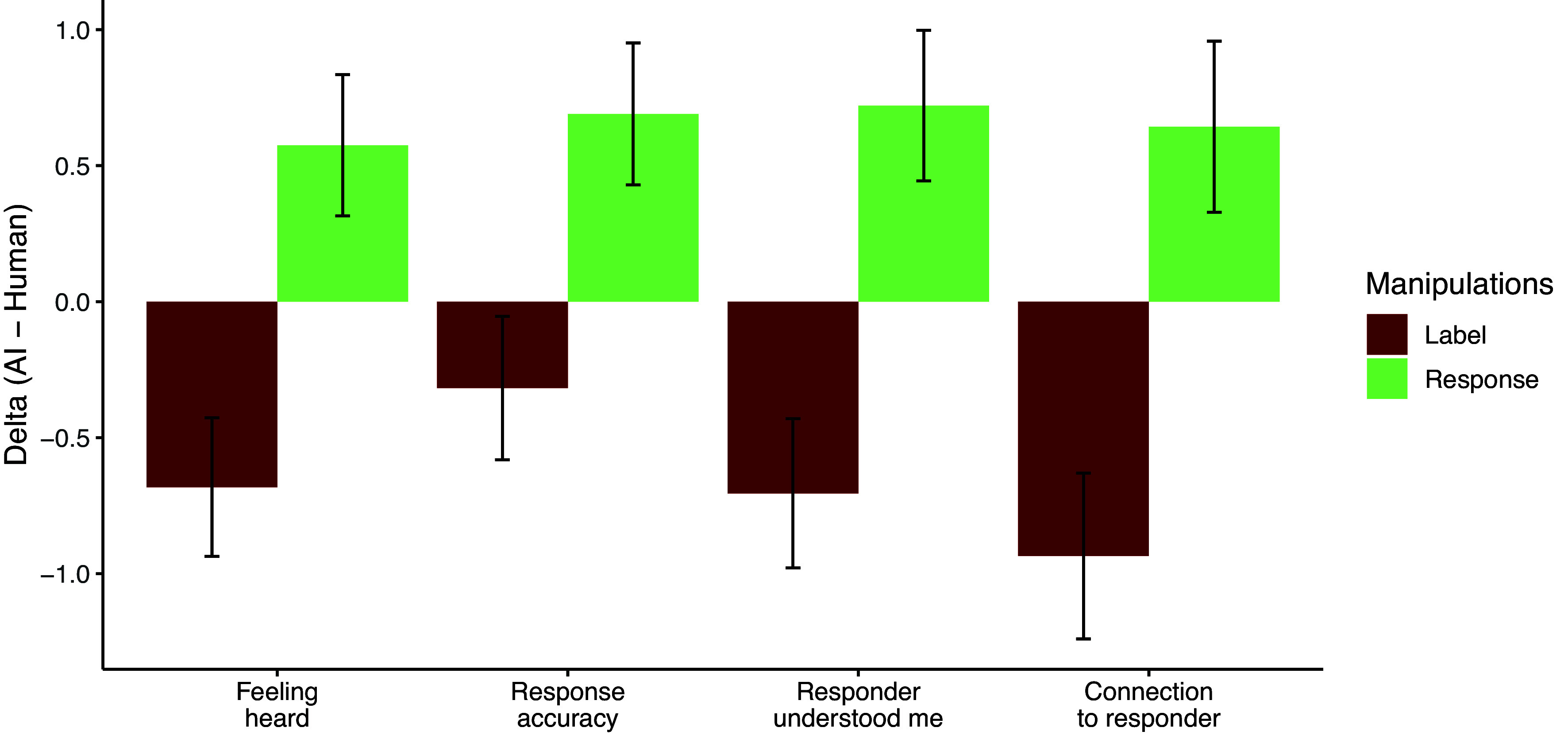
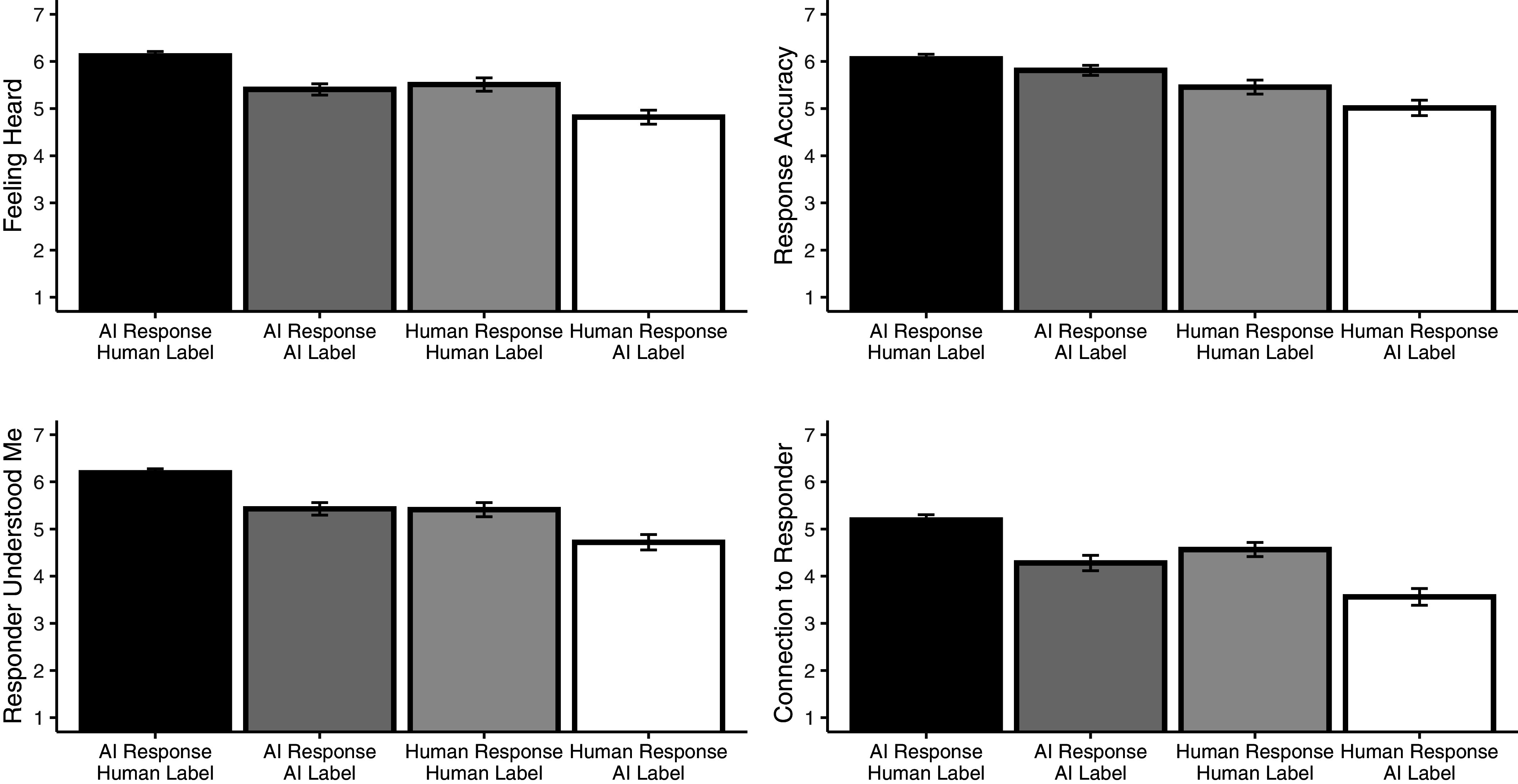
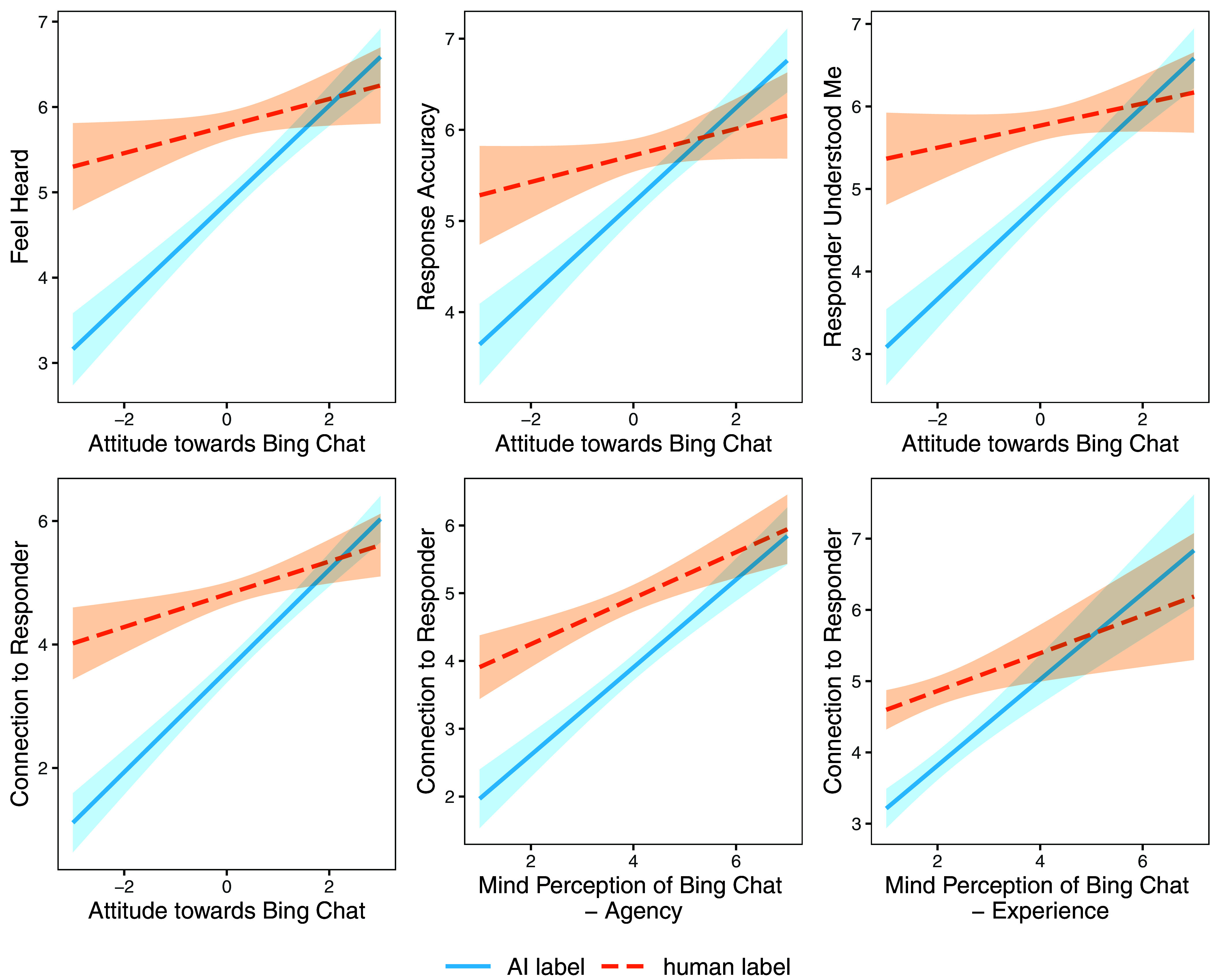
People want to “feel heard” to perceive that they are understood, validated, and valued. Can AI serve the deeply human function of making others feel heard? Our research addresses two fundamental issues: Can AI generate responses that make human recipients feel heard, and how do human recipients react when they believe the response comes from AI? We conducted an experiment and a follow-up study to disentangle the effects of actual source of a message and the presumed source. We found that AI-generated messages made recipients feel more heard than human-generated messages and that AI was better at detecting emotions. However, recipients felt less heard when they realized that a message came from AI (vs. human). Finally, in a follow-up study where the responses were rated by third-party raters, we found that compared with humans, AI demonstrated superior discipline in offering emotional support, a crucial element in making individuals feel heard, while avoiding excessive practical suggestions, which may be less effective in achieving this goal. Our research underscores the potential and limitations of AI in meeting human psychological needs. These findings suggest that while AI demonstrates enhanced capabilities to provide emotional support, the devaluation of AI responses poses a key challenge for effectively leveraging AI’s capabilities.
Overview
The claims and statistics of this paper haven’t been checked yet.
Free: it reads the open-access text and checks the first 5 claims that cite a source we can check. Create a free account to check every claim.
Integrity signals
Registry
Cites
Statistics
Figures
Verification
Claims the paper makes
The claims and statistics of this paper haven’t been checked yet.
Free: it reads the open-access text and checks the first 5 claims that cite a source we can check. Create a free account to check every claim.
Claims other papers make about this one
Each is checked against this paper’s own text: does it say what the citing paper says it does?
The cited source says what the claim attributes to it.
In the citing paper
“Four publications further explored intimate human-AI relationships under several aspects: One study showed that people feel heard by GenAI output [92], one investigated stigmatization of the use of erotic chatbots [93], one paper addressed men's accounts of intentionally sexually harassing a chatbot [94], and one paper addressed jealousy towards chatbots [95].”
From The Impact of Artificial Intelligence on Human Sexuality: A Five-Year Literature Review 2020–2024 (2024) · cites this paper as [92]
The cited source says what the claim attributes to it.
In the citing paper
“These models are increasingly achieving or surpassing human performance benchmarks in various domains, including medical diagnostic dialogue28, persuasive communication29, theory of mind30, making people feel heard31, responding to relationship issues32 and helping people reframe negative situations to reduce negative emotions33.”
From “It happened to be the perfect thing”: experiences of generative AI chatbots for mental health (2024) · cites this paper as [31]
The cited source says what the claim attributes to it.
In the citing paper
“People can feel heard by AI-generated responses, though knowing a response is AI-generated can reduce this effect [75].”
From Caring Without Feeling: Affective Dynamics as the Control Layer of Human-AI Agent Collaboration (2026) · cites this paper as [75]
The cited source says what the claim attributes to it.
In the citing paper
“This capacity may strengthen user engagement [20], therapeutic alliance [21], and the sense of being understood [22].”
From Generative AI Mental Health Chatbots as Therapeutic Tools: Systematic Review and Meta-Analysis of Their Role in Reducing Mental Health Issues (2025) · cites this paper as [22]
In the citing paper
“For instance, while AI can generate responses that make people feel heard by offering emotional support, people feel more heard when they believe a response comes from a human (48).”
From The impact of generative artificial intelligence on socioeconomic inequalities and policy making (2024) · cites this paper as [48]
Self-check
Percentages, sums and reported differences re-computed from the paper’s own numbers.
The self-check needs the paper’s full text.
Citations
Cites
Ayers, J. W., Poliak, A., Dredze, M., Leas, E. C., Zhu, Z., Kelley, J. B., Faix, D. J., Goodman, A. M., Longhurst, C. A., Hogarth, M., et al. (2023) · JAMA Internal Medicine · doi:10.1001/jamainternmed.2023.1838 · Cited by 2,613 · cited 3×
“More intriguingly, recent studies suggest that such mod els can generate responses that exhibit even higher levels of empathy than those from human experts (15–19); for example, responses by LLM to patients were rated by outsiders as more empathetic than responses by physicians (20).”
Ekman, P. (1992) · Psychological Review · doi:10.1037//0033-295x.99.3.550 · Cited by 2,372
Gray, H. M., Gray, K., & Wegner, D. M. (2007) · Science · doi:10.1126/science.1134475 · Cited by 2,342
Doctor-patient communication: a review.
Ha, J. F., & Longnecker, N. E. (2010) · PubMed · Cited by 2,014
Sparks of Artificial General Intelligence: Early experiments with GPT-4
Bubeck, S., Chandrasekaran, V., Eldan, R., Gehrke, J., Horvitz, E., Kamar, E., Lee, P., Lee, Y. T., Li, Y., Lundberg, S., et al. (2023) · arXiv · doi:10.48550/arxiv.2303.12712 · Cited by 1,526 · cited 1×
“Current large lan guage models (LLM), such as GPT - 4, can not only complete tasks in mathematics and coding but also understand people’s mental states (14).”
Task-Dependent Algorithm Aversion
Castelo, N., Bos, M. W., & Lehmann, D. R. (2019) · Journal of Marketing Research · doi:10.1177/0022243719851788 · Cited by 1,500 · cited 2×
“On the other hand, research on algorithm aversion (26) shows that people generally favor humans over algorithms, especially in areas traditionally viewed as uniquely human—those involving emotions (27, 28).”
Task-Dependent Algorithm Aversion
Castelo, N., Bos, M. W., Bos, M. W., Lehmann, D. R., & Lehmann, D. R. (2019) · Springer eBooks · doi:10.1007/978-3-031-88067-4_21 · Cited by 1,441
Doctor Patient Communication: A Review
Begum, T. (2015) · Journal of Bangladesh College of Physicians and Surgeons · doi:10.3329/jbcps.v32i2.26036 · Cited by 1,035
Changes in Dispositional Empathy in American College Students Over Time: A Meta-Analysis
Konrath, S. H., O'Brien, E. H., & Hsing, C. (2011) · Personality and Social Psychology Review · doi:10.1177/1088868310377395 · Cited by 962 · cited 1×
“Given the resource constraints and deepening societal divisions in society (12), as well as declining levels of dispositional empathy (13), it may be increasingly difficult for people to feel heard.”
Feeling robots and human zombies: Mind perception and the uncanny valley
Gray, K., & Wegner, D. M. (2012) · Cognition · doi:10.1016/j.cognition.2012.06.007 · Cited by 941 · cited 1×
“People may also hold negative attitudes toward AI, perceiving it as unnat ural or even threatening (29, 30), thereby diminishing the likeli hood of feeling heard by AI.”
Research works printed but not linked: 1
- Y. Yin, N. Jia, C. J. Wakslak, Data from “AI can help people feel heard, but an AI label diminishes this impact.” OSF. https://osf.io/8wnmr. Deposited 24 February 2024. PMC10998586 38551835
Cited by
Items 201–298 of 298
Huber, R. J. (2025) · Computers in Human Behavior · doi:10.1016/j.chb.2025.108870
GPT’s emotion venting and punishment: the evolution from chaos to order
Wang, G., Li, J., Wang, W., Wang, Y., & Niu, X. (2025) · Humanities and Social Sciences Communications · doi:10.1057/s41599-025-06197-6
“Existing studies on GPT ’ s emotion abilities focus on GPT ’ s ability of emotion recognition (Yin et al., 2024; Zhao et al., 2022; Valor et al., 2022; Roberts et al., 2015; Mart ı ́ nez-Miranda, and Aldea, 2005; Khare et al., 2023; Lian et al., 2024).”
InfluentialGhobrial, M. (2025) · Maryland Shared Open Access Repository (USMAI Consortium) · doi:10.13016/m2scs7-gj8w
Generative AI in STEM Teaching: Opportunities and Tradeoffs
Price, J., & Grover, S. (2025) · IUScholarWorks (Indiana University) · Cited by 14
Tekoälyn hyödyntäminen mielenterveyden seurannassa ja hoidon apuna
Nielikäinen, O. (2025) · UTUPub (University of Turku)
How to tell a Story – Storytelling mittels KI zur Gestaltung von Lehr-Lern-Szenarien
Sailer-Frank, S., Feil, S., & Annen, S. (2025) · Pedocs (German Institute for International Educational Research) · doi:10.25656/01:34254
Jubany i Vila, J. (2025) · Tesis Doctorals en Xarxa (Consorci de Serveis Universitaris de Catalunya)
Ayaz, F. O., & Yasin, G. (2025) · IGI Global eBooks · doi:10.4018/979-8-3373-4267-2.ch014
Human-AI Collaboration in High-Stakes Decision-Making: Work in Progress
Zhou, J., Aloufi, R., TalyaPorat, N., & Zalk, N. V. (2025) · doi:10.14236/ewic/bcshci2025.52 · Cited by 1
Future echoes? A prologue & a tale
Bonnelame, N., Lee, A., Malik, N., & Turnbull, B. (2025) · Research in Drama Education The Journal of Applied Theatre and Performance · doi:10.1080/13569783.2025.2506698
Journal für Allgemeine Didaktik (JfAD), Jg. 13/2025
(2025) · Directory of Open access Books (OAPEN Foundation)
Carli, R., Bhattacharya, S., Tchappi, I., Främling, K., & Najjar, A. (2026) · Springer eBooks · doi:10.1007/978-981-96-5290-7_24
Between the Digital Heart and Human Touch
Xu, S. (2026) · Advances in computational intelligence and robotics book series · doi:10.4018/979-8-3373-6623-4.ch005
Beyond Human vs. Machine: An Interactionist Model of AI Evaluation
Chang, M. J., Ko, J., & Chang, B.-H. (2026) · International Journal of Human-Computer Interaction · doi:10.1080/10447318.2026.2645768
Turning skepticism into engagement: understanding high-skilled users' acceptance of AI translation
Chen, A., Wang, Y., Lu, Y., & Liu, Y. (2026) · Industrial Management & Data Systems · doi:10.1108/imds-03-2025-0263
Yang, Y., Li, J., Liang, W., Peng, Y., Zou, Y., Yan, Z., Lyu, X., & Wang, Y. (2026) · International Journal of Human-Computer Interaction · doi:10.1080/10447318.2026.2647127
Perceived Robot Threat Enhances Preference for Hierarchy
Xu, L., Zhao, Y., Zhou, X., Bai, F., & Yu, F. (2026) · European Journal of Social Psychology · doi:10.1002/ejsp.70079
Who Is More Willing to Form a Romantic Intimate Relationship with GAI?
Wang, C., Zhang, J., & Zhou, C. (2026) · CHI Conference Extended Abstracts on Human Factors in Computing Systems (CHI EA) · doi:10.1145/3772363.3798510
“On the positive side, GAI demonstrates considerable promise in emotional and mental health support[25] [3][45][17], medical con-sultationandhealthcare[39][2][43],andeldercarecompanionship[42][1].”
Cui, N., Luo, S., Zhang, Y., & Huang, C. (2026) · CHI Conference Extended Abstracts on Human Factors in Computing Systems (CHI EA) · doi:10.1145/3772363.3798796
“Nevertheless, pure AI lacks cultural flexibility and warmth, making it difficult for users to perceive the interaction as authentic [27].”
Schaap, G., van de Sande, Y., & Schraffenberger, H. (2026) · CHI Conference Extended Abstracts on Human Factors in Computing Systems (CHI EA) · doi:10.1145/3772363.3799056
Toward Natural and Companionable Virtual Agents via Cross-Temporal Emotional Modeling
Zheng, Y., Qin, F., Li, X., Huang, H., Wang, H., Wang, X., Lu, Y., & Zhang, Y. (2026) · CHI Conference on Human Factors in Computing Systems · doi:10.1145/3772318.3790917 · Cited by 1
“Supportive, non-judgmental styles foster disclosure [10, 30, 63, 69], while anthropomorphic cues shape rapport [48, 57, 60, 61].”
Feeling powerful and less emotional: how sense of power reduces aversion to AI services
Ren, S., & Hu, Y. (2026) · Frontiers in Psychology · doi:10.3389/fpsyg.2026.1760538
“This research makes several important contributions to the literature on AI attitude (Dang and Li, 2025; Qin et al., 2025; Yin et al., 2024) and power psychology (Chen et al., 2001; Fiske, 1993; Kipnis, 1972).”
InfluentialBridging Human–Robot Social Distance: The Effects of Affiliative and Reciprocal Disclosure Responses
Lei, X., & Yikai, W. (2026) · International Journal of Human-Computer Interaction · doi:10.1080/10447318.2026.2660886
Recalled AI Experiences Shift Evaluations of AI but Not of Humans or ExpertsPreprint
Dan, K., & Hoshino, T. (2026) · Research Square · doi:10.21203/rs.3.rs-9267872/v1
Wu, X., Wang, H., Yan, Z., Xiaohan, T., Xu, P., Siok, W. T., Li, P., Gao, J., Lyu, B., & Qin, L. (2026) · Computers in Human Behavior · doi:10.1016/j.chb.2026.109051 · Cited by 1
Emotional Intelligence: A Human-Centred AI Perspective
Gámez, M. E. (2026) · Springer eBooks · doi:10.1007/978-981-95-3658-0_109
Realisierung von Transformationen
Fallgatter, M. J. (2026) · Springer eBooks · doi:10.1007/978-3-658-51661-1_5
Emerging Technologies and the Future of Singlehood
Hanson, K. R., & Lapointe, V. A. (2026) · Oxford University Press eBooks · doi:10.1093/9780197826461.003.0024
Investigating the physiological basis of susceptibility to human and AI-generated fake news
Wu, L. (. (2024) · Centrum Wiskunde & Informatica (CWI), the national research institute for mathematics and computer science in the Netherlands
Qi, Z., Yan, Y., & Ren, P. (2026) · Frontiers in Psychology · doi:10.3389/fpsyg.2026.1804847
“This finding not only confirms that mind perception theory can be applied to non-human agents (Chen et al., 2024), but also uncovers the cognitive mechanisms underlying anthropomorphic mentalization in human-AI interactions (Yin et al., 2024).”
People Like Us: Heightened Preference for Ingroup Providers in Mental Healthcare
Wang, P. X., Shi, Z., Chen, J., & Wang, Q. (2026) · Journal of Marketing · doi:10.1177/00222429261463517
“That Breaks My Heart”: Expressions of Artificial Empathy by AI Chatbots
Oliver, C. (2026) · Institutional Repositories DataBase (IRDB) · doi:10.69341/0002026978
Rosmayanti, V., Sabillah, B. M., & Syata, W. M. (2026) · Advances in computational intelligence and robotics book series · doi:10.4018/979-8-3373-4893-3.ch006
Wan, C., & Hwang, A. H. (2026) · arXiv (Cornell University) · doi:10.48550/arxiv.2606.26672
“Additionally, AI is increasingly perceived as capable of providing emotional support (Meng et al., 2025; Yin et al., 2024).”
Katz, J. E. (2026) · Frontiers in Communication · doi:10.3389/fcomm.2026.1895848 · Cited by 1
Self-Disclosure to AI and Stress: A Cross-Lagged Panel Study with Social Anxiety as a Moderator
Xu, Y., & Chen, S. (2026) · International Journal of Human-Computer Interaction · doi:10.1080/10447318.2026.2697354
Putri, A. S., Khairani, N. A., Sabrina, N., & Wijaya, M. I. (2026) · International Symposium on AI-Driven Engineering Systems (ISADES) · doi:10.1109/isades69945.2026.11608060
Lei, X., & Liu, F. (2026) · International Journal of Social Robotics · doi:10.1007/s12369-026-01421-y
Attachment towards generative AI influences self‐ AI agreement in personality reports
Yang, F., & Oshio, A. (2026) · Asian Journal Of Social Psychology · doi:10.1111/ajsp.70102
Ciego, E., Taneja, S., Wong, W., & Kapoor, A. (2026) · arXiv (Cornell University) · doi:10.48550/arxiv.2607.28203
“These questions belonged to four survey sections: To address RQ1, students were not told apriori that the videos were AI-generated to avoid biasing their evaluations [24, 32].”
Li, Q., & Peng, X. (2026) · International Journal of Human-Computer Interaction · doi:10.1080/10447318.2026.2706922
The self-positivity bias of large language models
Peng, Z. (2026) · Scientific Reports · doi:10.1038/s41598-026-63768-6 · Cited by 1
Zhang, M., Fan, Z., Du, J., & Wang, J. (2026) · International Journal of Human-Computer Interaction · doi:10.1080/10447318.2026.2708474
How AI Feedback Shapes Workplace Social Support Perception: A Randomized Controlled Trial in JapanPreprint
Watanabe, Y., Nakayama, M., Takemura, K., & Uchida, Y. (2026) · Research Square · doi:10.21203/rs.3.rs-9606142/v1
Effects of AI disclosure in service recovery communication: The role of framing strategies
Gong, Y., Liu-Lastres, B., & Pan, B. (2026) · International Journal of Hospitality Management · doi:10.1016/j.ijhm.2026.104867
Li, D., Yu, S., Chen, R., Xu, P., Shi, T., & Zhang, L. (2026) · Humanities and Social Sciences Communications · doi:10.1057/s41599-026-08628-4
Austin, A., Hohe, E., Kennedy, R., Litman, L., Minozzi, W., & Moses, L. M. (2026) · Public Opinion Quarterly · doi:10.1093/poq/nfag063 · Cited by 1
Hao, Y., Sheng, Y., He, J., He, S., & Fu, Z. (2026) · International Journal of Human-Computer Interaction · doi:10.1080/10447318.2026.2712099 · Cited by 1
The impact of generative AI on news believability: A mind perception perspective
Liu, Y., Zeng, J., Liu, S., & 卢, 晗. (2026) · Information & Management · doi:10.1016/j.im.2026.104418
Smolinski, R. (2026) · Current Opinion in Psychology · doi:10.1016/j.copsyc.2026.102414
Erdem, G., Kafesçioğlu, N., & Başer, G. (2026) · Journal of Marital and Family Therapy · doi:10.1111/jmft.70168
“In some cases, recipients have reported that AI‐generated responses were more supportive than those from non‐professional human responses (e.g., Elyoseph et al. 2023; Yin et al. 2024).”
Reframing disability in the online writing centre
Violini, C. (2026) · AUSpace (Athabasca University)
Bloom, P. A. (2026) · Cambridge University Press eBooks · doi:10.1017/9781009639057.010
AI and Empathy at a Crossroads: A Primer for an Interdisciplinary Field
Cameron, C. D., & Perry, A. (2026) · Cambridge University Press eBooks · doi:10.1017/9781009639057.001
Perry, A., & Cameron, C. D. (2026) · Cambridge University Press eBooks · doi:10.1017/9781009639057.002
Humans and AIs May Fulfill Different Empathic Needs
Perry, A., & Zaki, J. (2026) · Cambridge University Press eBooks · doi:10.1017/9781009639057.011
Beyond Text: Embodiment and Robots
Perry, A., & Cameron, C. D. (2026) · Cambridge University Press eBooks · doi:10.1017/9781009639057.016
Perry, A., & Cameron, C. D. (2026) · Cambridge University Press eBooks · doi:10.1017/9781009639057.009
Anticipating Children’s Beliefs about Artificial Empathy
Reinecke, M. G. (2026) · Cambridge University Press eBooks · doi:10.1017/9781009639057.022
Petersen, G. B., Santoso, M., Fauville, G., Hancock, J. T., & Bailenson, J. N. (2026) · Computers & Education X Reality · doi:10.1016/j.cexr.2026.100181
A structured framework for human–AI resemblance: Evidence, inference and perception
Wang, P., Law, E. L., Zou, L., Jiang, Y., Hertwig, R., PAAS, F. G. W. C., & Laureys, S. (2026) · Physics of Life Reviews · doi:10.1016/j.plrev.2026.09.003
Exploring the Impact of Human-Machine Identity Labels on Patients’ Emotional Experiences in Dialogue
Qiao, Y., Gao, Y., Zhang, Y., & Zou, S. (2026) · Communications in computer and information science · doi:10.1007/978-981-92-3991-7_13
Wu, X., Li, Y., Wang, R., & Hai, M. (2026) · European Journal of Social Psychology · doi:10.1002/ejsp.70112
Service type conditions stance attribution effects on switching after generative AI failures
Lv, D., Sun, R., Jiang, X., & Zhu, Q. (2026) · Scientific Reports · doi:10.1038/s41598-026-71320-9
Li, M., Bitterly, T. B., Nason, S. W., & Cheung, C. S. (2026) · Current Opinion in Psychology · doi:10.1016/j.copsyc.2026.102456
Mindel, J. R., Xie, S., Chan, Y. K., Swartz, H. A., Kraut, R. E., Zhu, H., Fang, A., & Wu, T. (2026) · ACM Conference on Human-AI Complementarity and Alignment · doi:10.1145/3834580.3838750
Hou, Y., Yang, J., Wong, R. Y., & Howell, N. (2026) · Proceedings of the ACM on Human-Computer Interaction · doi:10.1145/3816945
“Furthermore, even though some AIs are capable of making people feel heard, the ”AI” label diminishes their impact [128].”
Zhu, Z., Song, T., Lim, J., Yang, C.-L., & Lee, Y. (2026) · Proceedings of the ACM on Human-Computer Interaction · doi:10.1145/3816998
“However, since chatbots providing social support are consistently found to help reduce users’ distress at the moment [71, 113], AI chatbots may be better positioned as a complement or booster to human social support, rather than a replacement [82].”
Bian, Q., Xin, L., & Ma, B. (2026) · Public Administration · doi:10.1111/padm.70097
AYNACI, C. (2026) · İstanbul Ticaret Üniversitesi Sosyal Bilimler Dergisi · doi:10.46928/iticusbe.1957632
A Design Framework for Calibrated Emotional Anthropomorphism in Conversational AI
Leucas, D. (2026) · International Conference on Affective Computing and Intelligent Interaction Workshops and Demos (ACIIW) · doi:10.1109/aciiw71585.2026.11712082
“…identify the "calibration threshold" where the agent provides sufficient empathy to be helpful without inducing the "transparency-efficacy paradox" — the point where the user's awareness of the machine's nature begins to diminish the therapeutic or supportive benefit of the interaction [8], [9].”
Thakkar, S., Bhatt, P., & Parekh, H. (2026) · Counselling and Psychotherapy Research · doi:10.1002/capr.70237
Łapot, M., Hober, K., Krupnik, D., Skowron, W., Skowron, M., Bzdak, W., Szwemińska, P., Górak, J., & Neumann, W. (2026) · International Journal of Innovative Technologies in Social Science · doi:10.31435/ijitss.3(51).2026.6235
Generative AI as a social partner for young adults: Dual pathways to resilience and AI dependence
Shin, Y., Jeong, D., Kang, H. C., & Lee, S. W. (2026) · International Journal of Information Management · doi:10.1016/j.ijinfomgt.2026.103141
Shen, X., Chen, S., & Lee, S. M. (2026) · International Journal of Human-Computer Interaction · doi:10.1080/10447318.2026.2740881
Is There a Human Premium in Negotiations? A Relational-Economic Tradeoff in Human vs. AI Bargaining
Mislin, A. A., Druckman, D., & Serre, L. (2026) · Group Decision and Negotiation · doi:10.1007/s10726-026-10027-8
“However, even when AI agents produce highly empathetic or supportive lan - guage, people respond more positively and attribute greater mindfulness when they believe the counterpart is human rather than AI (Rubin et al. 2025; Yin et al. 2024; Warren-Smith et al. 2025).”
Chen, Y., Yue, D. I. N. G., Wang, L., & Kou, Y. (2026) · International Journal of Human-Computer Interaction · doi:10.1080/10447318.2026.2738514
Helpfulness of AI-generated review summaries: A cognitive-affective perspective
Wang, F., Yang, L., Liu, Z., Wang, F., & Wang, S. (2026) · Decision Support Systems · doi:10.1016/j.dss.2026.114782 · Cited by 1
Rijhwani, V., Edwards, C. C., Edwards, A., Lin, X., & Abendschein, B. (2026) · SAGE Open · doi:10.1177/21582440261496513
Zhong, W., Luo, J., Yu, S., Lyu, Y., & Guo, J. (2026) · Computers & Education · doi:10.1016/j.compedu.2026.105768
Logic or Emotion? The Impact of Persuasion Strategies on Human-AI Trust
Li, T., & Yue, Q. I. (2026) · International Journal of Human-Computer Interaction · doi:10.1080/10447318.2026.2740322
Sun, D., Wong, I. A., & Li, S. (2026) · Tourism Management Perspectives · doi:10.1016/j.tmp.2026.101542
How AI Agents Reshape Service Work Under Incentive Misalignment: Evidence from an Insurance Company
Dongsheng, L. I., Andy Tao, L. I., & Sun, S. (n.d.) · AIS Electronic Library (AISeL)
When AI Enters Art Market: Substitution, Disclosure, and Strategic Responses
Liu, X., Du, T., Xue, L., & Song, P. (n.d.) · AIS Electronic Library (AISeL)
Wang, Y., Deng, B., Ng, E., & Chau, M. (n.d.) · Journal of the Association for Information Systems
AI Labeling as a General Caution: How it Shapes Credibility and Engagement
Min, C., & Li, Z. (2026) · Mass Communication & Society · doi:10.1080/15205436.2026.2748853
Yin, M., Wang, W., & Xu, W. (2026) · SAGE Open · doi:10.1177/21582440261501638
Rewriting the Self: User Perceptions of AI-Mediated Cognitive ReframingPreprint
Yang, Y., Yessenbayev, O., Meter, A. V., Choudhury, T., & Adler, D. A. (2026) · arXiv (Cornell University) · doi:10.48550/arxiv.2610.34647
From observation to generation: A complex-systems perspective on generative Human–AI social systems
Ma, Y., Peng, M., Hu, S., Zhu, B., Wang, Y., Chen, Y., Liu, S., & Cheong, K. H. (2026) · Chaos Solitons & Fractals · doi:10.1016/j.chaos.2026.119312
Ge, W., Li, Y., Wen, Q., Zhu, Q., Hu, Y., & Wang, B. (2026) · Computers in Human Behavior Reports · doi:10.1016/j.chbr.2026.101412
People offload empathy when they think AI can give it instead
Shastry, M., & Gray, K. J. (2026) · Computers in Human Behavior · doi:10.1016/j.chb.2026.109240
Voice can help and hurt AI empathy: How context shapes the effects of vocal delivery.
Wenger, J. D., Cameron, C. D., Mogavi, R. H., & Inzlicht, M. (2026) · Technology Mind and Behavior · doi:10.1037/tmb0000235
Raise, Don’t Replace: Two Kinds of Connection in AI Character Products
Zhu, J., & Guo, Y. (2026) · Electronic workshops in computing · doi:10.14236/ewic/britchi26.70
Wang, B. (2026) · Health Communication · doi:10.1080/10410236.2026.2757767
Empathic Decision-Making : Motivated empathy and helping behavior
Tagesson, A. (2026) · Lund University Publications (Lund University)
Lee, G. K. S., Bikowski, L., Meliani, A., & Bennouna, A. (2026) · Digital Enterprise Studies · doi:10.68217/dx7zvr09
Rodriguez, M., Trinh, E. N., Lieberman, A., & Schroeder, J. (2026) · Current Opinion in Psychology · doi:10.1016/j.copsyc.2026.102499
Relating to AI: A relationship-orientation view of its impact on humans
Zhang, R. Z., Kyung, E. J., & Longoni, C. (2026) · Current Opinion in Psychology · doi:10.1016/j.copsyc.2026.102498
Metadata
- Authors
- Yin, Y., Jia, N., & Wakslak, C. J.
- Affiliations
- University of Southern California (US)
- Corresponding author
- Yin, Yidan
- Wakslak, Cheryl J.
- Venue
- Proceedings of the National Academy of Sciences
- Publisher
- National Academy of Sciences
- Published
- 2024-03-29
- Volume
- 121
- Issue
- 14
- Pages
- e2319112121-e2319112121
- ISSN
- 0027-8424 (ISSN-L)
- 1091-6490
- PMC
- PMC10998586
- OpenAlex
- W4393306715
- Cited by
- 247
- References
- 44
- Citations by year
- 2026: 116 · 2025: 105 · 2024: 24
- FWCI
- 116.23
- Type
- journal article
- Language
- en
- Open access
- hybrid
- doi.org
- Licence
- Locations
- Proceedings of the National Academy of Sciences (publishedVersion, cc-by-nc-nd)
- PubMed Central (publishedVersion, cc-by-nc-nd)
- PubMed (publishedVersion)
- OSF Preprints (OSF Preprints) (submittedVersion)
- Topics
- Social Sciences › Psychology › Social Psychology › Social Robot Interaction and HRI
- Social Sciences › Business, Management and Accounting › Marketing › AI in Service Interactions
- Physical Sciences › Computer Science › Artificial Intelligence › Emotion and Mood Recognition
- Keywords
- AI-generated responses, feeling heard, emotional support, AI labeling, emotion recognition, human-AI interaction, psychological needs
- MeSH terms
- Emotions, Follow-Up Studies, Humans, Motivation
About these checks
Registry, retraction, Cites and statistics results are computed, not judged, with one exception: a printed reference that no index lists is read once by a model before it counts as a citation error. Claims are extracted by a model and kept only when their quote appears verbatim in the text; each cited source is then checked, with a model’s help, for whether it says what the claim relies on. Those verdicts can be wrong — read the claim’s quote and the cited source before relying on one.
Statistics and arithmetic are recomputed, not judged.
Confidence bands are shown only for fields calibrated on our annotated test set. None is calibrated yet, so no band is shown.
What counts as a claim ›How we measure confidence ›How we check this ›
Are you an author, or do you see a problem with this page? Request a review
Data sources
Bibliographic data: Semantic Scholar, OpenAlex, Crossref.
Contains information from the Semantic Scholar Academic Graph Datasets, made available under the ODC Attribution License (ODC-BY 1.0).
Semantic Scholar’s data is described in: Kinney, R., et al. (2023). The Semantic Scholar Open Data Platform. arXiv:2301.10140.
