

Protein language models learn evolutionary statistics of interacting sequence motifs
Open accessPublished version of a preprint
The DOI matches its Crossref record; 43 of the 43 references it cites were found in a registry or an index.
Abstract
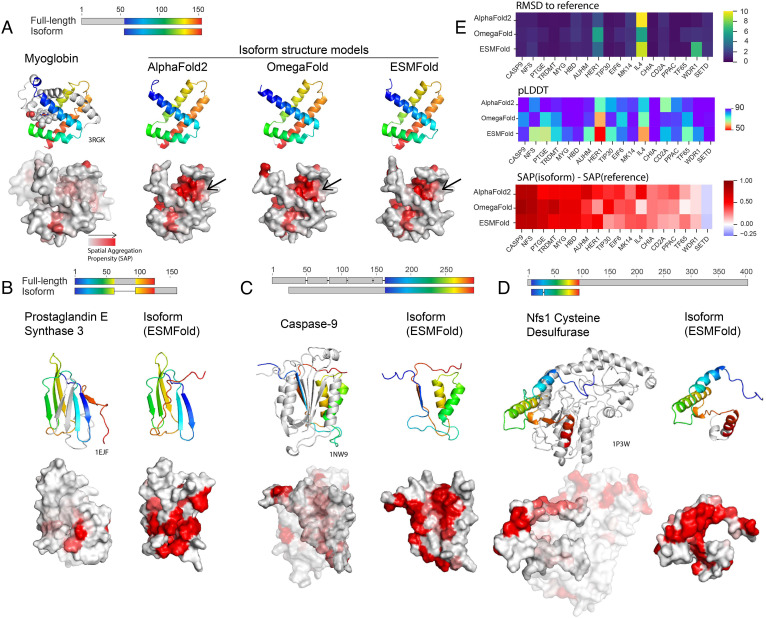
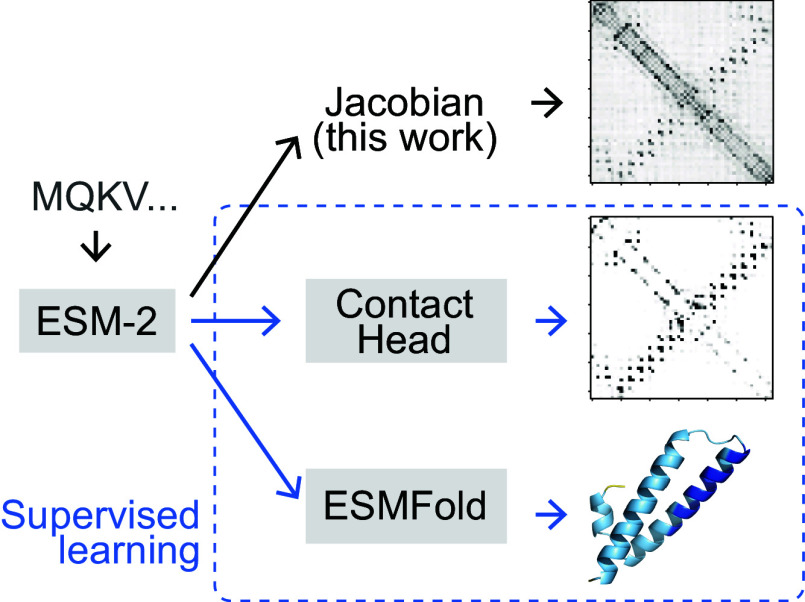
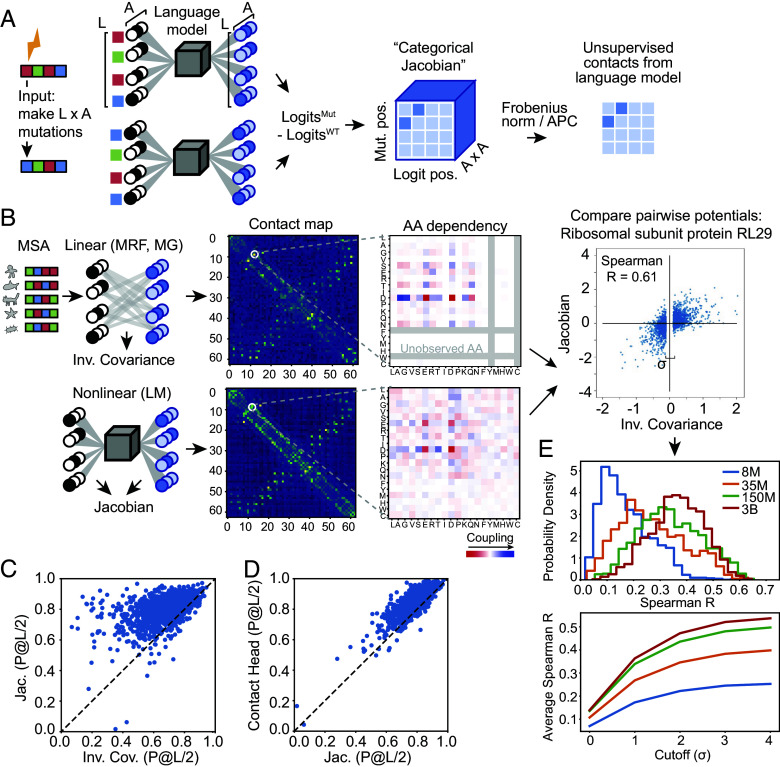
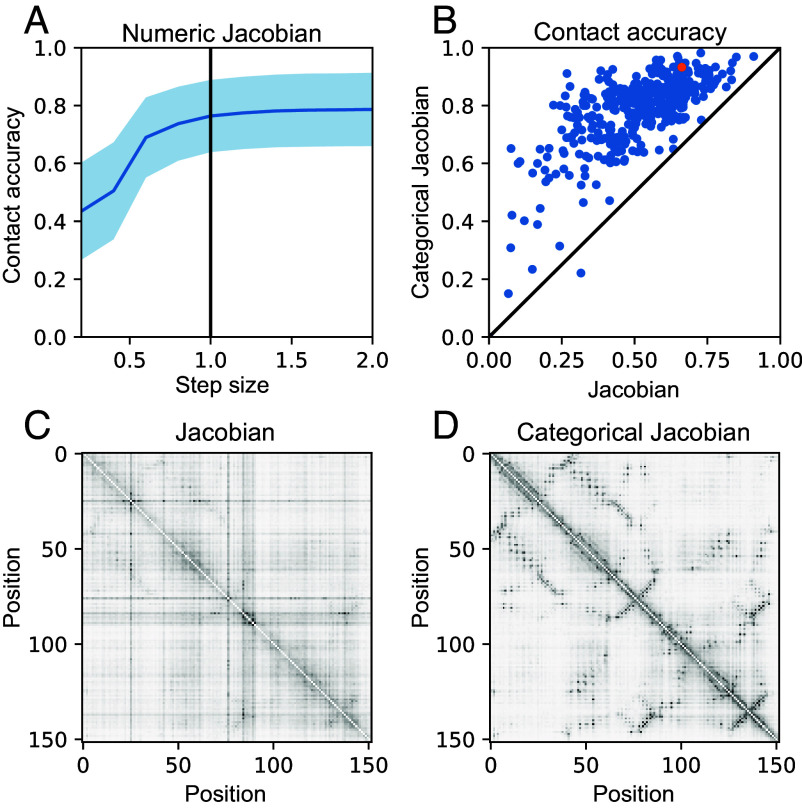
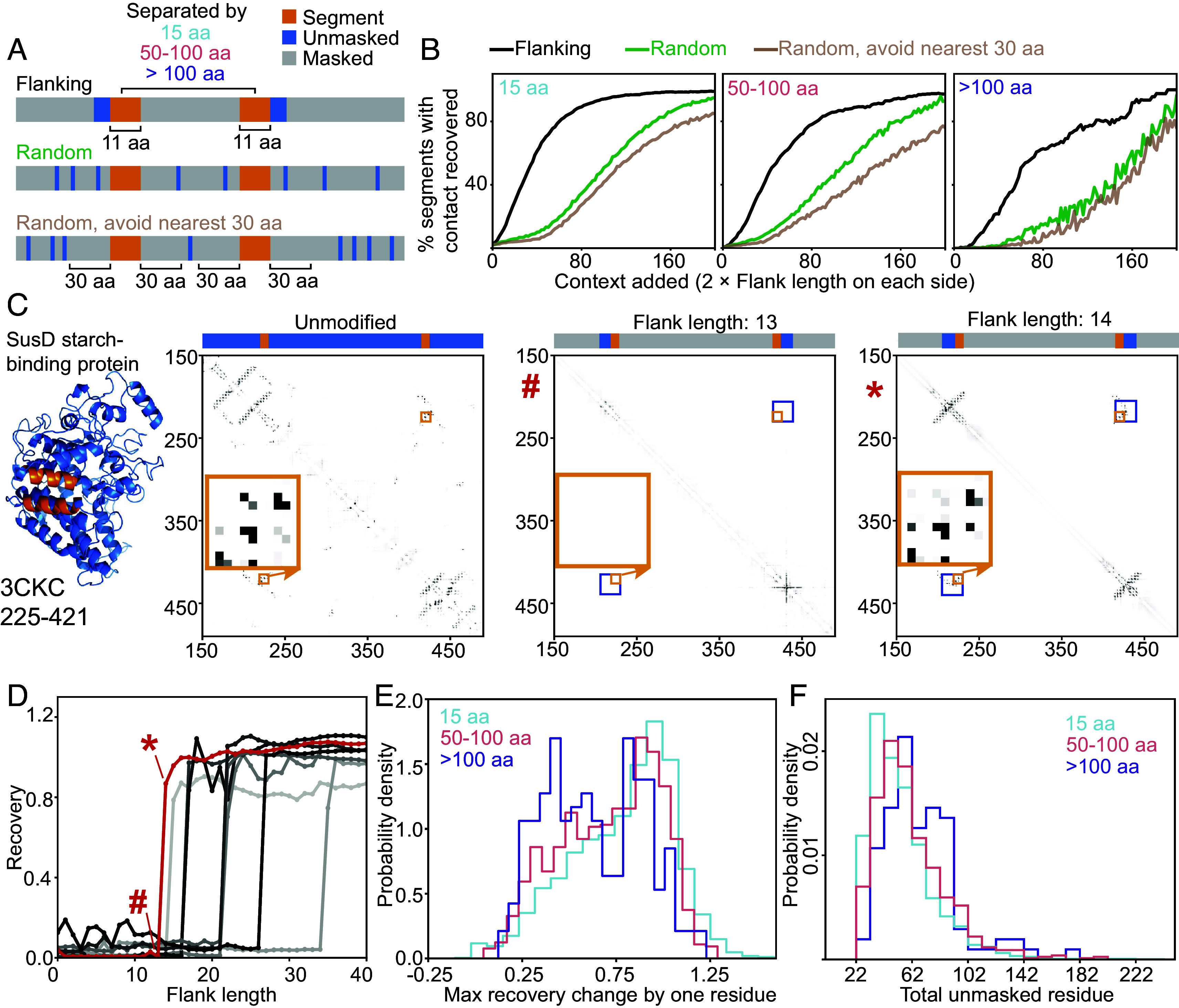
Protein language models (pLMs) have emerged as potent tools for predicting and designing protein structure and function, and the degree to which these models fundamentally understand the inherent biophysics of protein structure stands as an open question. Motivated by a finding that pLM-based structure predictors erroneously predict nonphysical structures for protein isoforms, we investigated the nature of sequence context needed for contact predictions in the pLM Evolutionary Scale Modeling (ESM-2). We demonstrate by use of a “categorical Jacobian” calculation that ESM-2 stores statistics of coevolving residues, analogously to simpler modeling approaches like Markov Random Fields and Multivariate Gaussian models. We further investigated how ESM-2 “stores” information needed to predict contacts by comparing sequence masking strategies, and found that providing local windows of sequence information allowed ESM-2 to best recover predicted contacts. This suggests that pLMs predict contacts by storing motifs of pairwise contacts. Our investigation highlights the limitations of current pLMs and underscores the importance of understanding the underlying mechanisms of these models.
Overview
The claims and statistics of this paper haven’t been checked yet.
Free: it reads the open-access text and checks the first 5 claims that cite a source we can check. Create a free account to check every claim.
Integrity signals
Registry
Cites
Statistics
Figures
Verification
Claims the paper makes
The claims and statistics of this paper haven’t been checked yet.
Free: it reads the open-access text and checks the first 5 claims that cite a source we can check. Create a free account to check every claim.
Claims other papers make about this one
Each is checked against this paper’s own text: does it say what the citing paper says it does?
The check wasn’t confident either way, so it gives no verdict — never disputed.
In the citing paper
“We observed that the model uses information from one end to specify the other end across a distance of ~1 to 2 kb, reflecting the model’s understanding of the tight evolutionary linkage of the two terminal elements”
From Sequence modeling and design from molecular to genome scale with Evo (2024) · cites this paper as [70]
Experimental — accuracy not yet measured
Self-check
Percentages, sums and reported differences re-computed from the paper’s own numbers.
The self-check needs the paper’s full text.
Citations
Cites
Highly accurate protein structure prediction with AlphaFold
Jumper, J., Evans, R., Pritzel, A., Green, T., Figurnov, M., Ronneberger, O., Tunyasuvunakool, K., Bates, R., Žídek, A., Potapenko, A., et al. (2021) · Nature · doi:10.1038/s41586-021-03819-2 · Cited by 43,764
SciPy 1.0: fundamental algorithms for scientific computing in Python
Virtanen, P., Gommers, R., Oliphant, T. E., Haberland, M., Reddy, T., Cournapeau, D., Burovski, E., Peterson, P., Weckesser, W., Bright, J., et al. (2020) · Nature Methods · doi:10.1038/s41592-019-0686-2 · Cited by 38,430
Kabsch, W., & Sander, C. (1983) · Biopolymers · doi:10.1002/bip.360221211 · Cited by 15,320
SciPy 1.0: fundamental algorithms for scientific computing in Python
Virtanen, P., Gommers, R., Oliphant, T. E., Haberland, M., Reddy, T., Cournapeau, D., Burovski, E., Peterson, P., Weckesser, W., Bright, J., et al. (2019) · Apollo - University of Cambridge Repository · doi:10.17863/cam.64134 · Cited by 10,460
ColabFold - Making protein folding accessible to all
Mirdita, M., Schütze, K., Moriwaki, Y., Heo, L., Ovchinnikov, S., & Steinegger, M. (2021) · doi:10.1101/2021.08.15.456425 · Cited by 9,391
Self-citationEvolutionary-scale prediction of atomic level protein structure with a language model
Lin, Z., Akin, H., Rao, R., Hie, B., Zhu, Z., Lu, W., Smetanin, N., Verkuil, R., Kabeli, O., Shmueli, Y., et al. (2022) · doi:10.1101/2022.07.20.500902 · Cited by 5,990
Accurate prediction of protein structures and interactions using a 3-track network
Baek, M., DiMaio, F., Anishchenko, I., Dauparas, J., Ovchinnikov, S., Lee, G. R., Wang, J., Cong, Q., Kinch, L. N., Schaeffer, R. D., et al. (2021) · doi:10.1101/2021.06.14.448402 · Cited by 5,549
Self-citationTM-align: a protein structure alignment algorithm based on the TM-score
Zhang, Y. (2005) · Nucleic Acids Research · doi:10.1093/nar/gki524 · Cited by 3,774
Rives, A., Meier, J., Sercu, T., Goyal, S., Lin, Z., Liu, J., Guo, D., Ott, M., Zitnick, C. L., Ma, J., et al. (2021) · Proceedings of the National Academy of Sciences · doi:10.1073/pnas.2016239118 · Cited by 3,286
Rives, A., Meier, J., Sercu, T., Goyal, S., Lin, Z., Liu, J., Guo, D., Ott, M., Zitnick, C. L., Ma, J., et al. (2019) · doi:10.1101/622803 · Cited by 3,280
Cited by
Items 101–175 of 175
Orlov, A. V., Makus, Y. V., Ashniev, G. A., Orlova, N. N., & Nikitin, P. I. (2026) · bioRxiv (Cold Spring Harbor Laboratory) · doi:10.64898/2026.03.04.709491 · Cited by 3
Sethi, P., Pereira, L. A., & Zhou, J. (2026) · bioRxiv (Cold Spring Harbor Laboratory) · doi:10.64898/2026.03.07.710335 · Cited by 2
Simple baselines rival protein language models in dense combinatorial protein landscapesPreprint
Talpir, I., & Fleishman, S. J. (2026) · bioRxiv (Cold Spring Harbor Laboratory) · doi:10.64898/2026.05.01.722313 · Cited by 2
Disentangling RNA evolution and thermodynamics in genomic language modelsPreprint
Xu, Y., Pai, N., & Wayment-Steele, H. K. (2026) · bioRxiv (Cold Spring Harbor Laboratory) · doi:10.64898/2026.05.28.728275 · Cited by 2
Self-citationEnergy-driven innovations in computational de novo protein engineering
Kırboğa, K. K., & Küçüksille, E. U. (2026) · Progress in Biophysics and Molecular Biology · doi:10.1016/j.pbiomolbio.2026.01.005 · Cited by 1
A deep learning framework for comprehensive prediction of human RNA G-quadruplex-binding proteins
Rosignoli, S., Taraglio, S., Luzio, F. D., Lustrino, E., Marzella, D. F., Elofsson, A., Panella, M., & Paiardini, A. (2026) · Bioinformatics · doi:10.1093/bioinformatics/btag088 · Cited by 1
Bukhari, S. N. H., & Ogudo, K. A. (2026) · Viruses · doi:10.3390/v18030380 · Cited by 1
Deep Learning-based Design of Peptide Binders
Pačesa, M. (2026) · CHIMIA International Journal for Chemistry · doi:10.2533/chimia.2026.265 · Cited by 1
SCOP-KHNET: An Interpretable Hybrid Network for Protein Structural Class Prediction
Dhibar, S., Karmakar, R., & Jana, B. (2026) · The Journal of Physical Chemistry Letters · doi:10.1021/acs.jpclett.6c01417 · Cited by 1
Adapting Co-Folding Models for Structure-Based Protein-Protein Docking Through Flow Matching
Xu, D. Z., Chu, L., & Gray, J. J. (2026) · PRX Life · doi:10.1103/zfn9-18y7 · Cited by 1
Gatlin, W., Ludwick, M., Turano, L., Foley, B., Riedlová, K., Škrhák, V., Novotný, M., Hoksza, D., & Verkhivker, G. M. (2026) · Protein Science · doi:10.1002/pro.70714 · Cited by 1
Benchmarking protein sequence and structure search methods for remote homology detection
Liu, Y., Zhou, Y., Huang, Y., Xin, H., Pan, X., & Shen, H.-B. (2026) · Genome biology · doi:10.1186/s13059-026-04201-z · Cited by 2
Zhang, J., Basu, S., Qian, J., & Kurgan, L. (2026) · Nucleic Acids Research · doi:10.1093/nar/gkag779 · Cited by 1
Murakami, T., Hashidate, Y., & Matsunaga, Y. (2026) · Bioinformatics · doi:10.1093/bioinformatics/btag685 · Cited by 2
Cazals, F., & Sarti, E. (2024) · bioRxiv (Cold Spring Harbor Laboratory) · doi:10.1101/2024.11.16.623929 · Cited by 1
What does a language model know about proteins?
Ruffolo, J. A. (2025) · Nature Methods · doi:10.1038/s41592-025-02837-6 · Cited by 1
Meng, D., Alvarez, H. M. G., Glavina, J., Leonetti, C. O., Pollastri, G., & Chemes, L. B. (2025) · bioRxiv (Cold Spring Harbor Laboratory) · doi:10.1101/2025.10.29.685455 · Cited by 1
Machine learning reveals hidden dimensions of functional similarity in proteins
Youssef, N., Gurev, S. F., & Marks, D. S. (2026) · Proceedings of the National Academy of Sciences · doi:10.1073/pnas.2524802122 · Cited by 1
FrustrAI-Seq: Scaling Local Energetic Frustration to the Protein Sequence SpacePreprint
Leusch, J.-P., Poley-Gil, M., Fernandez-Martin, M., Simonetti, F. L., Schlensok, J., Bordin, N., Rost, B., Parra, R. G., & Heinzinger, M. (2026) · bioRxiv (Cold Spring Harbor Laboratory) · doi:10.64898/2026.02.03.703498 · Cited by 3
Hoffert, M., Myerscough, D., Dragone, N. B., Gebert, M. J., Silberg, J. J., & Fierer, N. (2026) · bioRxiv (Cold Spring Harbor Laboratory) · doi:10.64898/2026.06.15.732269 · Cited by 1
High-resolution dissection of concept acquisition in different families of protein language modelsPreprint
Whitfield, S., Marty, T., Vernon, R. M., LANGMEAD, C. J., Sridhar, D., & Fournier, Q. (2026) · bioRxiv (Cold Spring Harbor Laboratory) · doi:10.64898/2026.07.20.739599 · Cited by 1
pLM representations unlock metagenomic space beyond homologyPreprint
Breton, L. L., Heurtel-Depeiges, D., Millar, D. C., Zetzsche, L. E., Vernon, R. M., LANGMEAD, C. J., Chandar, S., & Fournier, Q. (2026) · bioRxiv (Cold Spring Harbor Laboratory) · doi:10.64898/2026.07.28.739874 · Cited by 1
A Structural Antibody Benchmark of AlphaFold3 reveals Hallucinated Epitopes and a Bias for OrdernessPreprint
Solanki, A., Maurya, N. S., Ramlakhan, M., Li, R., Chen, W., Wu, Z., & Zheng, W. J. (2026) · bioRxiv (Cold Spring Harbor Laboratory) · doi:10.64898/2026.07.30.741792 · Cited by 1
Boosting Protein Language Models with Negative Sample Mining
Xu, Y., Zhao, X., Song, X., Wang, B., & Yu, T. (2024) · Lecture notes in computer science · doi:10.1007/978-3-031-70381-2_13
HieVi: Protein Large Language Model for proteome-based phage clusteringPreprint
Panigrahi, S., Ansaldi, M., & Ginet, N. (2024) · bioRxiv (Cold Spring Harbor Laboratory) · doi:10.1101/2024.12.17.627486
Signal peptides as potential structural modulators of human splice isoformsPreprint
Tsaban, T., & Schueler‐Furman, O. (2025) · bioRxiv (Cold Spring Harbor Laboratory) · doi:10.1101/2025.05.27.656295
Predicting Protein Folding Dynamics Using Sequence Information
Galpern, E. A., Caamaño, F., & Ferreiro, D. U. (2025) · Methods in molecular biology · doi:10.1007/978-1-0716-4828-5_2 · Cited by 1
Dickson, A. M., Mouline, S., Tamadon, A., & Mofrad, M. R. K. (2022) · Bioinformatics · doi:10.1093/bioinformatics/btag642
SpecMER: Fast Protein Generation with K-mer Guided Speculative DecodingPreprint
Walton, T. A., Tsui, D., Musharaf, A., & Aghazadeh, A. (2025) · Neural Information Processing Systems · doi:10.48550/arxiv.2509.21689 · Cited by 3
Kalantar, M., Buxton, E. K., Reid, K. M., Bleyl, D., Leitner, D., & Raeeszadeh-Sarmazdeh, M. (2025) · Biomolecules · doi:10.3390/biom16010031
Sequence-Only Prediction of Antibody Fab Thermostability Using Protein Language Model EmbeddingsPreprint
Sennett, M. A. (2026) · bioRxiv (Cold Spring Harbor Laboratory) · doi:10.64898/2025.12.30.697053
Oloko, B., & Cheng, X. (2026) · International Journal on Smart & Sustainable Intelligent Computing · doi:10.63503/j.ijssic.2025.207
Predicting evolutionary rate as a pretraining task improves genome language model representationsPreprint
Consens, M. E., Yang, K. K., Hall, J., Conard, A. M., Wang, B., Crawford, L. A., Moses, A. M., & Lu, A. X. (2026) · bioRxiv (Cold Spring Harbor Laboratory) · doi:10.64898/2026.02.02.703275 · Cited by 2
Neurotox: Deep learning decodes conserved hallmarks of neurotoxicity across venomous speciesPreprint
Bedraoui, A., Mejjad, S. E., Enezari, S., Hajji, F. Z. E., Galan, J. A., Fatimy, R. E., & Daouda, T. (2026) · bioRxiv (Cold Spring Harbor Laboratory) · doi:10.64898/2026.03.07.710323
A DNN Biophysics Model with Topological and Electrostatic Features
Sliheet, E., Talha, M. A., & Geng, W. (2026) · Journal of Chemical Information and Modeling · doi:10.1021/acs.jcim.5c03104
Protein Design Enters the Artificial Intelligence Era: Foundations, Tools, and Emerging Paradigms
Mi, Y., Shukla, A., Tangney, M., Tabirca, S., & Yallapragada, V. V. B. (2026) · Computational and Structural Biotechnology Journal · doi:10.34133/csbj.0105 · Cited by 1
Harnessing Nature's Algorithm: From Test Tubes to Autonomous In Vivo Evolution
Shang, W., Lyu, Z., & Chen, G. (2026) · Biotechnology Journal · doi:10.1002/biot.70237
ProtmRNA: Cross-Modal Knowledge Transfer from Proteins to Messenger RNAPreprint
Xu, G., Wu, X., & Ma, J. Y. (2026) · bioRxiv (Cold Spring Harbor Laboratory) · doi:10.64898/2026.05.19.726141
Fourier vs. Attention: A Re-look at Protein Sequence Generation Models
Shah, R. R., Jawagal, R. K., Rajpurohit, S., Venkat, N., Achyuthan, N., & Das, B. (2026) · Communications in computer and information science · doi:10.1007/978-3-032-26028-4_2
From prediction to discovery: AI as an observatory of physical organization in protein space
Zheng, Y., Zhang, Z., Wang, Y., Kang, W., Ren, W., & Tang, Q.-Y. (2026) · AI for Science · doi:10.1088/3050-287x/ae78ea
Self-citationA Hybrid Taxonomy-Aware Efficient Framework for Protein Function Prediction
Haque, M. N., Akter, A., Rahman, M. M., Tanvir, M. I., Mozumder, A.-A., Trisha, A. J., & Dhoom, T. (2026) · IEEE International Conference on Quantum Photonics, Artificial Intelligence & Networking (QPAIN) · doi:10.1109/qpain69676.2026.11546445
Paco, K., Mendivil, M. P., Zhang, Z., Zebardast, S., Davila, C., Mooney, R. F., Olatoyinbo, P. O., Yang, T., Bassi, S., Gonzales, V., et al. (2026) · Research Square · doi:10.21203/rs.3.rs-9710622/v1
Self-citationContextualizing Biological Language Models across Modalities via Logit-Space Contrastive AlignmentPreprint
Shao, Y., Chen, Y., Patel, Y., Pélissier, A., & Martínez, M. R. (2026) · arXiv (Cornell University) · doi:10.48550/arxiv.2606.18703
Ansari, M. I., Ahmed, K. T., Wang, D. D., Medvedev, K. E., & Zhang, W. (2026) · PLoS Computational Biology · doi:10.1371/journal.pcbi.1014440
Peptide:MHC Binding Stability Prediction Using Protein Language ModelsPreprint
Karthikeyan, D., Vincent, B. G., & Rubinsteyn, A. (2026) · bioRxiv (Cold Spring Harbor Laboratory) · doi:10.64898/2026.06.28.735023
MacLean, O. A., lamb, K., Lytras, S., Mojsiejczuk, L. N., Yuan, K., Hughes, J., & Robertson, D. L. (2026) · bioRxiv (Cold Spring Harbor Laboratory) · doi:10.64898/2026.07.06.736753
Fei, X., Gu, J., Zhou, C., Liu, Y., Li, Z., & Kang, Y. (2026) · Journal of Chemical Information and Modeling · doi:10.1021/acs.jcim.6c00969
TEDlm: domain-centric protein language models with optional structural pre-trainingPreprint
Wei, T., Kandathil, S. M., Buchan, D. W. A., & Jones, D. T. (2026) · bioRxiv (Cold Spring Harbor Laboratory) · doi:10.64898/2026.07.09.737428
De Novo Design of Protein Nanopores: From Minimal Peptides to AI-Driven Design
Vorobieva, A. A., Samanta, R., & Thillo, T. V. (2026) · Chemical Reviews · doi:10.1021/acs.chemrev.5c00990
Chowdhury, R., Vaishnavey, S. R., Dey, S., Ferdous, S., Danurdoro, R., & Zeller, M. A. (2026) · Bioinformatics · doi:10.1093/bioinformatics/btag529
Endoh, T., Camer, G. A., Kayama, K., Endoh, D., & Teraoka, H. (2026) · Proteomes · doi:10.3390/proteomes14030036
SimBinder-IF: structure-aware antibody affinity optimization via efficient preference learning
Zhao, X., Tang, Y.-C., Monsia, R., Cantu, V., Ramesh, A. K., Yang, S., Liu, X., An, Z., Jiang, X., & Kim, Y. (2026) · Bioinformatics · doi:10.1093/bioinformatics/btag548
Mondal, S., MONDAL, T., Pramanik, S., & Mehra, R. (2026) · Nucleic Acids Research · doi:10.1093/nar/gkag820
SpecMER: Fast Protein Generation with K-mer Guided Speculative Decoding
Walton, T., Tsui, D., Musharaf, A., & Aghazadeh, A. (2025) · neural information processing systems · doi:10.52202/085713-0570
Local energetic frustration: Protein evolution, conformational dynamics and design in the age of AI
Simonetti, F. L., Draizen, E. J., Espada, R., & Parra, R. G. (2026) · Biochimica et Biophysica Acta (BBA) - Proteins and Proteomics · doi:10.1016/j.bbapap.2026.141170 · Cited by 1
Multi-Peptide Prompting Enables In-Context Learning in Protein Language ModelsPreprint
Almonte, J., Vu, M., Ahn, A., & Thiede, E. (2026) · bioRxiv · doi:10.64898/2026.08.26.747074
Cell Type-Specific Isoform Function Prediction by Multiplex Heterogeneous Network
Gu, T., Luo, H., Wang, Y., Wang, M., Wang, J., Yan, Z., & Yu, G. (2026) · IEEE Transactions on Computational Biology and Bioinformatics · doi:10.1109/tcbbio.2026.3728504
Tzavella, K., Olsen, C., & Vranken, W. (2026) · Computational and Structural Biotechnology Journal · doi:10.34133/csbj.0226
Wang, Y., Mengmeng, Y. U., Jiang, Z., Zhou, C., Feng, W., Yu, K. Q., Ju, J., & Li, F. (2026) · Journal of Natural Products · doi:10.1021/acs.jnatprod.6c00686
Self-Architecting Protein Transformers: An Empirical StudyPreprint
Cirrincione, G., Ficarra, E., & Lovino, M. (2026) · bioRxiv (Cold Spring Harbor Laboratory) · doi:10.64898/2026.09.09.750410
Naworski, L. E., Good, L. L., Scrutton, R. M., & Knowles, T. P. J. (2026) · bioRxiv (Cold Spring Harbor Laboratory) · doi:10.64898/2026.09.10.750691
Generative Design of New-to-nature Biosynthetic Assembly Lines with Genomic Language ModelingPreprint
Lanclos, N., Ibrahim, K. E., Cornman, A., Huang, M., Gill, V., Jiang, A., Abraham, J., Gin, J., Chen, Y., Petzold, C. J., et al. (2026) · bioRxiv (Cold Spring Harbor Laboratory) · doi:10.64898/2026.09.11.750945
Hierarchical Organization of Evolutionary Constraint in Duplicated EF-Hand Motifs
Basit, A. (2026) · Journal of Molecular Evolution · doi:10.1007/s00239-026-10353-0
Mechanistic classification of the AAA superfamily with protein language modelsPreprint
Swan, J. A., & Hill, C. P. (2026) · bioRxiv (Cold Spring Harbor Laboratory) · doi:10.64898/2026.10.05.756829
Hou, Z., He, W., Cao, W., Li, J., Li, H., Sun, S., & Yang, H. (2026) · ACS Omega · doi:10.1021/acsomega.6c08819
Representing biological concepts as directions in foundation model embeddingsPreprint
Shamail, A., & McWhite, C. D. (2026) · bioRxiv (Cold Spring Harbor Laboratory) · doi:10.64898/2026.10.10.758204
recAMPLIFY: Large-Scale Pretraining of Recursive Protein Language ModelsPreprint
Jha, S., Liao, Q., Vernon, R., Chandar, S., & Fournier, Q. (2026) · arXiv (Cornell University) · doi:10.48550/arxiv.2610.26747
Systematic mapping of the prokaryotic noncoding sequence space with a genomic language modelPreprint
Sun, G., Hudelmaier, T., Gilligan, J. C., Gonzalez, G. A., Yin, P., Wan, F., Ma, Z. (., Durrant, M. G., Ricci-Tam, C., Pawluk, A., et al. (2026) · bioRxiv (Cold Spring Harbor Laboratory) · doi:10.64898/2026.10.21.760802
Ho, N. H. E., Yang, C., Ng, I., & Chang, J. (2026) · Journal of Chemical Information and Modeling · doi:10.1021/acs.jcim.6c01844
Few-shot regulatory sequence design with a genomic language modelPreprint
Hao, Y. A., Liu, M., Nori, D., Brixi, G., Lau, T., Ramakrishnan, C., Chang, D., Park, R., Allen, W. E., & Hie, B. L. (2026) · bioRxiv (Cold Spring Harbor Laboratory) · doi:10.64898/2026.10.28.762639
Self-citationLIMBER: A Hybrid RNA Foundation Model for Predicting and Understanding RNA Structure and FunctionPreprint
Wang, Z., Qiu, Y., He, Y., THOMPSON, I., Wang, H., Porter, A., & Li, A. (2026) · bioRxiv (Cold Spring Harbor Laboratory) · doi:10.64898/2026.10.28.762670
Self-citationLearning inhibitor interactions from protein deep mutational scanning data and deep learning modelsPreprint
Zou, Z., Hazelwood, I., Estevam, G. O., Rao, J. N. K., Chrispens, K. M., Howard, M., Coyote‐Maestas, W., & Fraser, J. S. (2026) · bioRxiv (Cold Spring Harbor Laboratory) · doi:10.64898/2026.11.01.763444 · Cited by 1
Evolutionary Intelligence: How Coevolution Opened the Way to the AlphaFold Revolution
Bastolla, U., Aurell, E., Cocco, S., Liberles, D. A., Micheletti, C., Orellana, L., Rojas, A., Talavera, D., & Valencia, A. (2026) · Journal of Molecular Evolution · doi:10.1007/s00239-026-10354-z
A language model-informed minimalistic design of functional coacervate vesicles
Guo, W., Wang, Y., Biswas, S., Junnan, Z., Chakraborty, G., Schadt, M., Wiertz, F., Chen, G., Liu, S., Song, Y., et al. (2026) · Nature Communications · doi:10.1038/s41467-026-78912-z
Metadata
- Authors
- Zhang, Z., Wayment-Steele, H. K., Brixi, G., Wang, H., Kern, D., & Ovchinnikov, S.
- Affiliations
- Harvard University (US)
- Howard Hughes Medical Institute (US)
- Corresponding author
- Ovchinnikov, Sergey
- ORCID
- Venue
- Proceedings of the National Academy of Sciences
- Publisher
- National Academy of Sciences
- Published
- 2024-10-28
- Volume
- 121
- Issue
- 45
- Pages
- e2406285121-e2406285121
- ISSN
- 0027-8424 (ISSN-L)
- 1091-6490
- PMC
- PMC11551344
- OpenAlex
- W4403824354
- Cited by
- 140
- References
- 39
- Citations by year
- 2026: 66 · 2025: 56 · 2024: 16
- FWCI
- 18.79
- Type
- journal article
- Language
- en
- Open access
- hybrid
- doi.org
- Licence
- Locations
- Proceedings of the National Academy of Sciences (publishedVersion, cc-by)
- bioRxiv (Cold Spring Harbor Laboratory) (acceptedVersion, cc-by)
- PubMed Central (publishedVersion, cc-by)
- PubMed (publishedVersion)
- Infoscience (Ecole Polytechnique Fédérale de Lausanne) (submittedVersion, cc-by-nc-nd)
- Funders
- Jane Coffin Childs (N/A)
- Howard Hughes Medical Institute (N/A)
- National Institutes of Health (DP5OD026389)
- National Foundation of Science (MCB2032259)
- Swiss National Science Foundation (205321_192371)
- Topics
- Life Sciences › Biochemistry, Genetics and Molecular Biology › Molecular Biology › Protein Structure and Dynamics
- Life Sciences › Biochemistry, Genetics and Molecular Biology › Molecular Biology › Machine Learning in Bioinformatics
- Life Sciences › Biochemistry, Genetics and Molecular Biology › Molecular Biology › RNA and protein synthesis mechanisms
- Keywords
- protein language models, ESM-2, contact prediction, sequence motifs, protein isoforms, sequence masking, protein structure prediction, model interpretability
- MeSH terms
- Markov Chains, Models, Molecular, Protein Conformation, Proteins, Evolution, Molecular, Amino Acid Motifs
About these checks
Registry, retraction, Cites and statistics results are computed, not judged, with one exception: a printed reference that no index lists is read once by a model before it counts as a citation error. Claims are extracted by a model and kept only when their quote appears verbatim in the text; each cited source is then checked, with a model’s help, for whether it says what the claim relies on. Those verdicts can be wrong — read the claim’s quote and the cited source before relying on one.
Statistics and arithmetic are recomputed, not judged.
Confidence bands are shown only for fields calibrated on our annotated test set. None is calibrated yet, so no band is shown.
What counts as a claim ›How we measure confidence ›How we check this ›
Are you an author, or do you see a problem with this page? Request a review
Data sources
Bibliographic data: Semantic Scholar, OpenAlex, Crossref.
Contains information from the Semantic Scholar Academic Graph Datasets, made available under the ODC Attribution License (ODC-BY 1.0).
Semantic Scholar’s data is described in: Kinney, R., et al. (2023). The Semantic Scholar Open Data Platform. arXiv:2301.10140.
