

Telosome, a Mammalian Telomere-associated Complex Formed by Multiple Telomeric Proteins
Open accessThe DOI matches its Crossref record; 31 of the 31 references it cites were found in a registry or an index.
Abstract
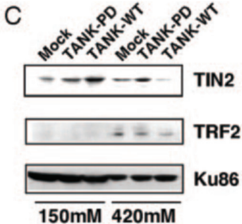
In mammalian cells, telomere-binding proteins TRF1 and TRF2 play crucial roles in telomere biology. They interact with several other telomere regulators including TIN2, PTOP, POT1, and RAP1 to ensure proper maintenance of telomeres. TRF1 and TRF2 are believed to exert distinct functions. TRF1 forms a complex with TIN2, PTOP, and POT1 and regulates telomere length, whereas TRF2 mediates t-loop formation and end protection. However, whether cross-talk occurs between the TRF1 and TRF2 complexes and how the signals from these complexes are integrated for telomere maintenance remain to be elucidated. Through gel filtration and co-immunoprecipitation experiments, we found that TRF1 and TRF2 are in fact subunits of a telomere-associated high molecular weight complex (telosome) that also contains POT1, PTOP, RAP1, and TIN2. We demonstrated that the TRF1-interacting protein TIN2 binds TRF2 directly and in vivo, thereby bridging TRF2 to TRF1. Consistent with this multi-protein telosome model, stripping TRF1 off the telomeres by expressing tankyrase reduced telomere recruitment of not only TIN2 but also TRF2. These results help to unify previous observations and suggest that telomere maintenance depends on the multi-subunit telosome.
Overview
The claims and statistics of this paper haven’t been checked yet.
Free: it reads the open-access text and checks the first 5 claims that cite a source we can check. Create a free account to check every claim.
Integrity signals
Registry
Cites
Statistics
Figures


Verification
Claims the paper makes
The claims and statistics of this paper haven’t been checked yet.
Free: it reads the open-access text and checks the first 5 claims that cite a source we can check. Create a free account to check every claim.
Claims other papers make about this one
Each is checked against this paper’s own text: does it say what the citing paper says it does?
The source backs part of the claim, not all of it — or backs it for a different population, condition or comparison.
In the citing paper
“Mammalian telomeres associate with the shelterin complex of six core proteins — telomeric-repeat binding factor 1 (TRF1), TRF2, TRF1 interacting protein 2 (TIN2), protection of telomeres 1 (POT1), the POT1 and TIN2 interacting protein TPP1 and the transcriptional repressor/activator protein RAP115, 16”
From Telomere dysfunction and tumour suppression: the senescence connection (2008) · cites this paper as [16]
Experimental — accuracy not yet measured
Self-check
Percentages, sums and reported differences re-computed from the paper’s own numbers.
The self-check needs the paper’s full text.
Citations
Cites
Mammalian Telomeres End in a Large Duplex Loop
Griffith, J. D., Comeau, L., Rosenfield, S., Stansel, R. M., Bianchi, A., Moss, H., & de Lange, T. (1999) · Cell · doi:10.1016/s0092-8674(00)80760-6 · Cited by 2,447
TRF2 Protects Human Telomeres from End-to-End Fusions
van Steensel, B., Smogorzewska, A., & de Lange, T. (1998) · Cell · doi:10.1016/s0092-8674(00)80932-0 · Cited by 1,709
Control of telomere length by the human telomeric protein TRF1
van Steensel, B., & de Lange, T. (1997) · Nature · doi:10.1038/385740a0 · Cited by 1,219
Pot1, the Putative Telomere End-Binding Protein in Fission Yeast and Humans
Baumann, P., & Cech, T. R. (2001) · Science · doi:10.1126/science.1060036 · Cited by 1,028
Tankyrase, a Poly(ADP-Ribose) Polymerase at Human Telomeres
Smith, S., Giriat, I., Schmitt, A., & de Lange, T. (1998) · Science · doi:10.1126/science.282.5393.1484 · Cited by 1,012
Protection of mammalian telomeres
de Lange, T. (2002) · Oncogene · doi:10.1038/sj.onc.1205080 · Cited by 942
Senescence Induced by Altered Telomere State, Not Telomere Loss
Karlseder, J., Smogorzewska, A., & de Lange, T. (2002) · Science · doi:10.1126/science.1069523 · Cited by 796
Control of Human Telomere Length by TRF1 and TRF2
Smogorzewska, A., van Steensel, B., Bianchi, A., Oelmann, S., Schaefer, M. R., Schnapp, G., & de Lange, T. (2000) · Molecular and Cellular Biology · doi:10.1128/mcb.20.5.1659-1668.2000 · Cited by 768
POT1 as a terminal transducer of TRF1 telomere length control
Loayza, D., & de Lange, T. (2003) · Nature · doi:10.1038/nature01688 · Cited by 699
Cell-cycle-regulated association of RAD50/MRE11/NBS1 with TRF2 and human telomeres
Zhu, X.-D., Küster, B., Mann, M., Petrini, J. H. J., & Lange, T. D. (2000) · Nature Genetics · doi:10.1038/77139 · Cited by 606
Li, B., Oestreich, S., & de Lange, T. (2000) · Cell · doi:10.1016/s0092-8674(00)80858-2 · Cited by 583
Plasma antioxidants from chocolate
Serafini, M., Bugianesi, R., Maiani, G., Valtuena, S., De Santis, S., & Crozier, A. (2003) · Nature · doi:10.1038/4241013a · Cited by 539
Histone-like TAFs within the PCAF Histone Acetylase Complex
Ogryzko, V. V., Kotani, T., Zhang, X., Schiltz, R. L., Howard, T., Yang, X.-J., Howard, B. H., Qin, J., & Nakatani, Y. (1998) · Cell · doi:10.1016/s0092-8674(00)81219-2 · Cited by 536
Self-citationTIN2, a new regulator of telomere length in human cells
Kim, S.-H., Kaminker, P., & Campisi, J. (1999) · Nature Genetics · doi:10.1038/70508 · Cited by 525
Ye, J. Z.-S., Hockemeyer, D., Krutchinsky, A. N., Loayza, D., Hooper, S. M., Chait, B. T., & de Lange, T. (2004) · Genes & Development · doi:10.1101/gad.1215404 · Cited by 459
PTOP interacts with POT1 and regulates its localization to telomeres
Liu, D., Safari, A., O'Connor, M. S., Chan, D. W., Laegeler, A., Qin, J., & Songyang, Z. (2004) · Nature Cell Biology · doi:10.1038/ncb1142 · Cited by 450
Self-citationTankyrase promotes telomere elongation in human cells
Smith, S., & de Lange, T. (2000) · Current Biology · doi:10.1016/s0960-9822(00)00752-1 · Cited by 418
Zhu, X.-D., Niedernhofer, L., Kuster, B., Mann, M., Hoeijmakers, J. H. J., & de Lange, T. (2003) · Molecular Cell · doi:10.1016/s1097-2765(03)00478-7 · Cited by 386
TIN2 Binds TRF1 and TRF2 Simultaneously and Stabilizes the TRF2 Complex on Telomeres
Ye, J. Z.-S., Donigian, J. R., van Overbeek, M., Loayza, D., Luo, Y., Krutchinsky, A. N., Chait, B. T., & de Lange, T. (2004) · Journal of Biological Chemistry · doi:10.1074/jbc.m409047200 · Cited by 347
The Pin2/TRF1-Interacting Protein PinX1 Is a Potent Telomerase Inhibitor
Zhou, X. Z., & Lu, K. P. (2001) · Cell · doi:10.1016/s0092-8674(01)00538-4 · Cited by 309
Saccharomyces telomeres assume a non-nucleosomal chromatin structure.
Wright, J. H., Gottschling, D. E., & Zakian, V. A. (1992) · Genes & Development · doi:10.1101/gad.6.2.197 · Cited by 272
Telomeres, aging and cancer: In search of a happy ending
Kim, S.-H., Kaminker, P., & Campisi, J. (2002) · Oncogene · doi:10.1038/sj.onc.1205077 · Cited by 230
TIN2 Mediates Functions of TRF2 at Human Telomeres
Kim, S.-H., Beausejour, C., Davalos, A. R., Kaminker, P., Heo, S.-J., & Campisi, J. (2004) · Journal of Biological Chemistry · doi:10.1074/jbc.m408650200 · Cited by 214
Human POT1 Facilitates Telomere Elongation by Telomerase
Colgin, L. M., Baran, K., Baumann, P., Cech, T. R., & Reddel, R. R. (2003) · Current Biology · doi:10.1016/s0960-9822(03)00339-7 · Cited by 212
TRF1 is degraded by ubiquitin-mediated proteolysis after release from telomeres
Chang, W., Dynek, J. N., & Smith, S. (2003) · Genes & Development · doi:10.1101/gad.1077103 · Cited by 202
TIN2 is a tankyrase 1 PARP modulator in the TRF1 telomere length control complex
Ye, J. Z.-S., & de Lange, T. (2004) · Nature Genetics · doi:10.1038/ng1360 · Cited by 197
The Human Rap1 Protein Complex and Modulation of Telomere Length
O'Connor, M. S., Safari, A., Liu, D., Qin, J., & Songyang, Z. (2004) · Journal of Biological Chemistry · doi:10.1074/jbc.m312913200 · Cited by 182
Self-citationImportance of TRF1 for Functional Telomere Structure
Iwano, T., Tachibana, M., Reth, M., & Shinkai, Y. (2004) · Journal of Biological Chemistry · doi:10.1074/jbc.m309138200 · Cited by 111
Chiang, Y. J., Kim, S.-H., Tessarollo, L., Campisi, J., & Hodes, R. J. (2004) · Molecular and Cellular Biology · doi:10.1128/mcb.24.15.6631-6634.2004 · Cited by 86
Protecting the terminus: t-loops and telomere end-binding proteins
Wei, C., & Price, C. M. (2003) · Cellular and Molecular Life Sciences · doi:10.1007/s00018-003-3244-z · Cited by 66
Dubrana, K., Perrod, S., & Gasser, S. M. (2001) · Current Opinion in Cell Biology · doi:10.1016/s0955-0674(00)00210-6 · Cited by 60
Cited by
Shelterin: the protein complex that shapes and safeguards human telomeres
de Lange, T. (2005) · Genes & Development · doi:10.1101/gad.1346005 · Cited by 3,056
Mechanisms of DNA damage, repair, and mutagenesis
Chatterjee, N., & Walker, G. C. (2017) · Environmental and Molecular Mutagenesis · doi:10.1002/em.22087 · Cited by 2,039
How Shelterin Protects Mammalian Telomeres
Palm, W., & de Lange, T. (2008) · Annual Review of Genetics · doi:10.1146/annurev.genet.41.110306.130350 · Cited by 1,802
Aubert, G., & Lansdorp, P. M. (2008) · Physiological Reviews · doi:10.1152/physrev.00026.2007 · Cited by 1,188
Shelterin-Mediated Telomere Protection
de Lange, T. (2018) · Annual Review of Genetics · doi:10.1146/annurev-genet-032918-021921 · Cited by 816
Metadata
- Authors
- Liu, D., O'Connor, M. S., Qin, J., & Songyang, Z.
- Affiliations
- Baylor College of Medicine (US)
- Corresponding author
- Liu, Dan
- Songyang, Zhou
- Venue
- Journal of Biological Chemistry
- Publisher
- Elsevier BV
- Published
- 2004-12
- Volume
- 279
- Issue
- 49
- Pages
- 51338-51342
- ISSN
- 0021-9258 (ISSN-L)
- OpenAlex
- W2051990601
- Cited by
- 405
- References
- 31
- Citations by year
- 2026: 3 · 2025: 9 · 2024: 10 · 2023: 10 · 2022: 13 · 2021: 17 · 2020: 10 · 2019: 17 · 2018: 16 · 2017: 15 · 2016: 19 · 2015: 20 · 2014: 26 · 2013: 18 · 2012: 22
- FWCI
- 10.92
- Type
- journal article
- Language
- en
- Open access
- hybrid
- doi.org
- Licence
- cc-by
- www.elsevier.com/tdm/userlicense/1.0/ (tdm)
- creativecommons.org/licenses/by/4.0/ (vor, 5792 d)
- Locations
- Journal of Biological Chemistry (publishedVersion, cc-by)
- PubMed (publishedVersion)
- Funders
- U.S. Department of Defense
- Topics
- Life Sciences › Biochemistry, Genetics and Molecular Biology › Cell Biology › Telomeres, Telomerase, and Senescence
- Life Sciences › Biochemistry, Genetics and Molecular Biology › Molecular Biology › DNA and Nucleic Acid Chemistry
- Life Sciences › Biochemistry, Genetics and Molecular Biology › Molecular Biology › Nuclear Structure and Function
- Keywords
- telosome, telomere-binding proteins, TRF1, TRF2, TIN2, POT1, Rap1, telomere maintenance, telomere protection, tankyrase, telomere length regulation, protein complex formation
- MeSH terms
- Shelterin Complex, Cell Line, Cell Nucleus, Electrophoresis, Polyacrylamide Gel, HeLa Cells, Humans, Microscopy, Fluorescence, Mutation, Protein Binding, Mass Spectrometry, Blotting, Western, Telomere, Gene Deletion, Protein Structure, Tertiary, Fluorescent Antibody Technique, Indirect, rap1 GTP-Binding Proteins, Telomere-Binding Proteins, Telomeric Repeat Binding Protein 1, Telomeric Repeat Binding Protein 2, Tankyrases, Multiprotein Complexes, Immunoprecipitation
About these checks
Registry, retraction, Cites and statistics results are computed, not judged, with one exception: a printed reference that no index lists is read once by a model before it counts as a citation error. Claims are extracted by a model and kept only when their quote appears verbatim in the text; each cited source is then checked, with a model’s help, for whether it says what the claim relies on. Those verdicts can be wrong — read the claim’s quote and the cited source before relying on one.
Statistics and arithmetic are recomputed, not judged.
Confidence bands are shown only for fields calibrated on our annotated test set. None is calibrated yet, so no band is shown.
What counts as a claim ›How we measure confidence ›How we check this ›
Are you an author, or do you see a problem with this page? Request a review
Data sources
Bibliographic data: Semantic Scholar, OpenAlex, Crossref.
Contains information from the Semantic Scholar Academic Graph Datasets, made available under the ODC Attribution License (ODC-BY 1.0).
Semantic Scholar’s data is described in: Kinney, R., et al. (2023). The Semantic Scholar Open Data Platform. arXiv:2301.10140.
