

Telosome, a Mammalian Telomere-associated Complex Formed by Multiple Telomeric Proteins
Open accessThe DOI matches its Crossref record; 31 of the 31 references it cites were found in a registry or an index.
Abstract
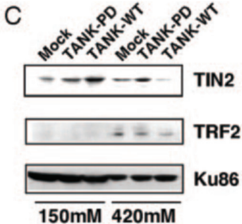
In mammalian cells, telomere-binding proteins TRF1 and TRF2 play crucial roles in telomere biology. They interact with several other telomere regulators including TIN2, PTOP, POT1, and RAP1 to ensure proper maintenance of telomeres. TRF1 and TRF2 are believed to exert distinct functions. TRF1 forms a complex with TIN2, PTOP, and POT1 and regulates telomere length, whereas TRF2 mediates t-loop formation and end protection. However, whether cross-talk occurs between the TRF1 and TRF2 complexes and how the signals from these complexes are integrated for telomere maintenance remain to be elucidated. Through gel filtration and co-immunoprecipitation experiments, we found that TRF1 and TRF2 are in fact subunits of a telomere-associated high molecular weight complex (telosome) that also contains POT1, PTOP, RAP1, and TIN2. We demonstrated that the TRF1-interacting protein TIN2 binds TRF2 directly and in vivo, thereby bridging TRF2 to TRF1. Consistent with this multi-protein telosome model, stripping TRF1 off the telomeres by expressing tankyrase reduced telomere recruitment of not only TIN2 but also TRF2. These results help to unify previous observations and suggest that telomere maintenance depends on the multi-subunit telosome.
Overview
The claims and statistics of this paper haven’t been checked yet.
Free: it reads the open-access text and checks the first 5 claims that cite a source we can check. Create a free account to check every claim.
Integrity signals
Registry
Cites
Statistics
Figures


Verification
Claims the paper makes
The claims and statistics of this paper haven’t been checked yet.
Free: it reads the open-access text and checks the first 5 claims that cite a source we can check. Create a free account to check every claim.
Claims other papers make about this one
Each is checked against this paper’s own text: does it say what the citing paper says it does?
The source backs part of the claim, not all of it — or backs it for a different population, condition or comparison.
In the citing paper
“Mammalian telomeres associate with the shelterin complex of six core proteins — telomeric-repeat binding factor 1 (TRF1), TRF2, TRF1 interacting protein 2 (TIN2), protection of telomeres 1 (POT1), the POT1 and TIN2 interacting protein TPP1 and the transcriptional repressor/activator protein RAP115, 16”
From Telomere dysfunction and tumour suppression: the senescence connection (2008) · cites this paper as [16]
Experimental — accuracy not yet measured
Self-check
Percentages, sums and reported differences re-computed from the paper’s own numbers.
The self-check needs the paper’s full text.
Citations
Cites
Mammalian Telomeres End in a Large Duplex Loop
Griffith, J. D., Comeau, L., Rosenfield, S., Stansel, R. M., Bianchi, A., Moss, H., & de Lange, T. (1999) · Cell · doi:10.1016/s0092-8674(00)80760-6 · Cited by 2,447
TRF2 Protects Human Telomeres from End-to-End Fusions
van Steensel, B., Smogorzewska, A., & de Lange, T. (1998) · Cell · doi:10.1016/s0092-8674(00)80932-0 · Cited by 1,709
Control of telomere length by the human telomeric protein TRF1
van Steensel, B., & de Lange, T. (1997) · Nature · doi:10.1038/385740a0 · Cited by 1,219
Pot1, the Putative Telomere End-Binding Protein in Fission Yeast and Humans
Baumann, P., & Cech, T. R. (2001) · Science · doi:10.1126/science.1060036 · Cited by 1,028
Tankyrase, a Poly(ADP-Ribose) Polymerase at Human Telomeres
Smith, S., Giriat, I., Schmitt, A., & de Lange, T. (1998) · Science · doi:10.1126/science.282.5393.1484 · Cited by 1,012
Protection of mammalian telomeres
de Lange, T. (2002) · Oncogene · doi:10.1038/sj.onc.1205080 · Cited by 942
Senescence Induced by Altered Telomere State, Not Telomere Loss
Karlseder, J., Smogorzewska, A., & de Lange, T. (2002) · Science · doi:10.1126/science.1069523 · Cited by 796
Control of Human Telomere Length by TRF1 and TRF2
Smogorzewska, A., van Steensel, B., Bianchi, A., Oelmann, S., Schaefer, M. R., Schnapp, G., & de Lange, T. (2000) · Molecular and Cellular Biology · doi:10.1128/mcb.20.5.1659-1668.2000 · Cited by 768
POT1 as a terminal transducer of TRF1 telomere length control
Loayza, D., & de Lange, T. (2003) · Nature · doi:10.1038/nature01688 · Cited by 699
Cell-cycle-regulated association of RAD50/MRE11/NBS1 with TRF2 and human telomeres
Zhu, X.-D., Küster, B., Mann, M., Petrini, J. H. J., & Lange, T. D. (2000) · Nature Genetics · doi:10.1038/77139 · Cited by 606
Cited by
Shelterin: the protein complex that shapes and safeguards human telomeres
de Lange, T. (2005) · Genes & Development · doi:10.1101/gad.1346005 · Cited by 3,056
Mechanisms of DNA damage, repair, and mutagenesis
Chatterjee, N., & Walker, G. C. (2017) · Environmental and Molecular Mutagenesis · doi:10.1002/em.22087 · Cited by 2,039
How Shelterin Protects Mammalian Telomeres
Palm, W., & de Lange, T. (2008) · Annual Review of Genetics · doi:10.1146/annurev.genet.41.110306.130350 · Cited by 1,802
Aubert, G., & Lansdorp, P. M. (2008) · Physiological Reviews · doi:10.1152/physrev.00026.2007 · Cited by 1,188
Shelterin-Mediated Telomere Protection
de Lange, T. (2018) · Annual Review of Genetics · doi:10.1146/annurev-genet-032918-021921 · Cited by 816
Telomere length, stem cells and aging
Blasco, M. A. (2007) · Nature Chemical Biology · doi:10.1038/nchembio.2007.38 · Cited by 747
Telomerase and cancer therapeutics
Harley, C. B. (2008) · Nature Reviews Cancer · doi:10.1038/nrc2275 · Cited by 728
The POT1-TPP1 telomere complex is a telomerase processivity factor.
Wang, F., Podell, E. R., Zaug, A. J., Yang, Y., Baciu, P., Cech, T. R., & Lei, M. (2007) · Nature · doi:10.1038/nature05454 · Cited by 704
DNA processing is not required for ATM-mediated telomere damage response after TRF2 deletion
Celli, G. B., & de Lange, T. (2005) · Nature Cell Biology · doi:10.1038/ncb1275 · Cited by 623
The epigenetic regulation of mammalian telomeres
Blasco, M. A. (2007) · Nature Reviews Genetics · doi:10.1038/nrg2047 · Cited by 600
Targeting telomeres and telomerase
De Cian, A., Lacroix, L., Douarre, C., Temime-Smaali, N., Trentesaux, C., Riou, J.-F., & Mergny, J.-L. (2008) · Biochimie · doi:10.1016/j.biochi.2007.07.011 · Cited by 572
Human RecQ Helicases in DNA Repair, Recombination, and Replication
Croteau, D. L., Popuri, V., Opresko, P. L., & Bohr, V. A. (2014) · Annual Review of Biochemistry · doi:10.1146/annurev-biochem-060713-035428 · Cited by 538
TPP1 is a homologue of ciliate TEBP-β and interacts with POT1 to recruit telomerase
Xin, H., Liu, D., Wan, M., Safari, A., Kim, H., Sun, W., O’Connor, M. S., & Songyang, Z. (2007) · Nature · doi:10.1038/nature05469 · Cited by 488
Self-citationRodriguez, R., Müller, S., Yeoman, J. A., Trentesaux, C., Riou, J.-F., & Balasubramanian, S. (2008) · Journal of the American Chemical Society · doi:10.1021/ja805615w · Cited by 517
Wu, L., Multani, A. S., He, H., Cosme-Blanco, W., Deng, Y., Deng, J. M., Bachilo, O., Pathak, S., Tahara, H., Bailey, S. M., et al. (2006) · Cell · doi:10.1016/j.cell.2006.05.037 · Cited by 422
Telomere dysfunction and tumour suppression: the senescence connection
Deng, Y., Chan, S. S., & Chang, S. (2008) · Nature Reviews Cancer · doi:10.1038/nrc2393 · Cited by 411
Finding the end: recruitment of telomerase to telomeres
Nandakumar, J., & Cech, T. R. (2013) · Nature Reviews Molecular Cell Biology · doi:10.1038/nrm3505 · Cited by 378
Martínez, P., Thanasoula, M., Muñoz, P., Liao, C., Tejera, A., McNees, C., Flores, J. M., Fernández-Capetillo, O., Tarsounas, M., & Blasco, M. A. (2009) · Genes & Development · doi:10.1101/gad.543509 · Cited by 370
Telomeres: Cancer to Human Aging
Stewart, S. A., & Weinberg, R. A. (2006) · Annual Review of Cell and Developmental Biology · doi:10.1146/annurev.cellbio.22.010305.104518 · Cited by 334
GUARDIN is a p53-responsive long non-coding RNA that is essential for genomic stability
Hu, W. L., Jin, L., Xu, A., Wang, Y. F., Thorne, R. F., Zhang, X. D., & Wu, M. (2018) · Nature Cell Biology · doi:10.1038/s41556-018-0066-7 · Cited by 347
Hug, N., & Lingner, J. (2006) · Chromosoma · doi:10.1007/s00412-006-0067-3 · Cited by 291
Telomeres—structure, function, and regulation
Lu, W., Zhang, Y., Liu, D., Songyang, Z., & Wan, M. (2013) · Experimental Cell Research · doi:10.1016/j.yexcr.2012.09.005 · Cited by 263
Self-citationShaping human telomeres: from shelterin and CST complexes to telomeric chromatin organization
Lim, C. J., & Cech, T. R. (2021) · Nature Reviews Molecular Cell Biology · doi:10.1038/s41580-021-00328-y · Cited by 273
SIRT1 contributes to telomere maintenance and augments global homologous recombination
Palacios, J. A., Herranz, D., De Bonis, M. L., Velasco, S., Serrano, M., & Blasco, M. A. (2010) · Journal of Cell Biology · doi:10.1083/jcb.201005160 · Cited by 253
Dysfunctional telomeres activate an ATM‐ATR‐dependent DNA damage response to suppress tumorigenesis
Guo, X., Deng, Y., Lin, Y., Cosme‐Blanco, W., Chan, S., He, H., Yuan, G., Brown, E. J., & Chang, S. (2007) · The EMBO Journal · doi:10.1038/sj.emboj.7601893 · Cited by 258
In Vivo Stoichiometry of Shelterin Components
Takai, K. K., Hooper, S., Blackwood, S., Gandhi, R., & de Lange, T. (2010) · Journal of Biological Chemistry · doi:10.1074/jbc.m109.038026 · Cited by 243
Telomere Protection by TPP1/POT1 Requires Tethering to TIN2
Takai, K. K., Kibe, T., Donigian, J. R., Frescas, D., & de Lange, T. (2011) · Molecular Cell · doi:10.1016/j.molcel.2011.08.043 · Cited by 228
A critical role for TPP1 and TIN2 interaction in high-order telomeric complex assembly
O'Connor, M. S., Safari, A., Xin, H., Liu, D., & Songyang, Z. (2006) · Proceedings of the National Academy of Sciences · doi:10.1073/pnas.0605303103 · Cited by 248
Self-citationNovel roles for A-type lamins in telomere biology and the DNA damage response pathway
Gonzalez‐Suarez, I., Redwood, A. B., Perkins, S. M., Vermolen, B., Lichtensztejin, D., Grotsky, D. A., Morgado‐Palacin, L., Gapud, E. J., Sleckman, B. P., Sullivan, T., et al. (2009) · The EMBO Journal · doi:10.1038/emboj.2009.196 · Cited by 246
The telosome/shelterin complex and its functions
Xin, H., Liu, D., & Songyang, Z. (2008) · Genome Biology · doi:10.1186/gb-2008-9-9-232 · Cited by 222
Self-citationTelomerase regulation and stem cell behaviour
Flores, I., Benetti, R., & Blasco, M. A. (2006) · Current Opinion in Cell Biology · doi:10.1016/j.ceb.2006.03.003 · Cited by 232
Stewart, J. A., Chaiken, M. F., Wang, F., & Price, C. M. (2012) · Mutation Research - Fundamental and Molecular Mechanisms of Mutagenesis · doi:10.1016/j.mrfmmm.2011.08.011 · Cited by 209
POT1 Stimulates RecQ Helicases WRN and BLM to Unwind Telomeric DNA Substrates
Opresko, P. L., Mason, P. A., Podell, E. R., Lei, M., Hickson, I. D., Cech, T. R., & Bohr, V. A. (2005) · Journal of Biological Chemistry · doi:10.1074/jbc.m505211200 · Cited by 202
Human premature aging, DNA repair and RecQ helicases
Brosh, R. M., & Bohr, V. A. (2007) · Nucleic Acids Research · doi:10.1093/nar/gkm1008 · Cited by 206
Telomeric Strategies: Means to an End
Jain, D., & Cooper, J. P. (2010) · Annual Review of Genetics · doi:10.1146/annurev-genet-102108-134841 · Cited by 196
POT1–TPP1 enhances telomerase processivity by slowing primer dissociation and aiding translocation
Latrick, C. M., & Cech, T. R. (2010) · The EMBO Journal · doi:10.1038/emboj.2009.409 · Cited by 188
Shelterin complex and associated factors at human telomeres
Diotti, R., & Loayza, D. (2011) · Nucleus · doi:10.4161/nucl.2.2.15135 · Cited by 187
Pathways connecting telomeres and p53 in senescence, apoptosis, and cancer
Artandi, S. E., & Attardi, L. D. (2005) · Biochemical and Biophysical Research Communications · doi:10.1016/j.bbrc.2005.03.211 · Cited by 191
Deng, Z., Wang, Z., Stong, N., Plasschaert, R., Moczan, A., Chen, H., Hu, S., Wikramasinghe, P., Davuluri, R. V., Bartolomei, M. S., et al. (2012) · The EMBO Journal · doi:10.1038/emboj.2012.266 · Cited by 175
DNA damage response at functional and dysfunctional telomeres
Longhese, M. P. (2008) · Genes & Development · doi:10.1101/gad.1626908 · Cited by 180
Switching Human Telomerase On and Off with hPOT1 Protein in Vitro
Lei, M., Zaug, A. J., Podell, E. R., & Cech, T. R. (2005) · Journal of Biological Chemistry · doi:10.1074/jbc.m502212200 · Cited by 175
Stop pulling my strings — what telomeres taught us about the DNA damage response
Lazzerini-Denchi, E., & Sfeir, A. (2016) · Nature Reviews Molecular Cell Biology · doi:10.1038/nrm.2016.43 · Cited by 170
Deng, Z., Glousker, G., Molczan, A., Fox, A. J., Lamm, N., Dheekollu, J., Weizman, O.-E., Schertzer, M., Wang, Z., Vladimirova, O., et al. (2013) · Proceedings of the National Academy of Sciences · doi:10.1073/pnas.1300600110 · Cited by 161
The Emerging Roles of TERRA in Telomere Maintenance and Genome Stability
Bettin, N., Oss Pegorar, C., & Cusanelli, E. (2019) · Cells · doi:10.3390/cells8030246 · Cited by 169
Tejera, A. M., Stagno d'Alcontres, M., Thanasoula, M., Marion, R. M., Martinez, P., Liao, C., Flores, J. M., Tarsounas, M., & Blasco, M. A. (2010) · Developmental Cell · doi:10.1016/j.devcel.2010.03.011 · Cited by 145
TERRA transcripts are bound by a complex array of RNA-binding proteins
de Silanes, I. L., d’Alcontres, M. S., & Blasco, M. A. (2010) · Nature Communications · doi:10.1038/ncomms1032 · Cited by 172
Loss of hPot1 Function Leads to Telomere Instability and a cut-like Phenotype
Veldman, T., Etheridge, K. T., & Counter, C. M. (2004) · Current Biology · doi:10.1016/j.cub.2004.12.031 · Cited by 151
Yang, H., Lu, P., Wang, Y., & Mā, H. (2010) · The Plant Journal · doi:10.1111/j.1365-313x.2010.04439.x · Cited by 150
Unraveling the pathogenesis of Hoyeraal–Hreidarsson syndrome, a complex telomere biology disorder
Glousker, G., Touzot, F., Revy, P., Tzfati, Y., & Savage, S. A. (2015) · British Journal of Haematology · doi:10.1111/bjh.13442 · Cited by 141
Human telomeric proteins occupy selective interstitial sites
Yang, D., Xiong, Y., Kim, H., He, Q., Li, Y., Chen, R., & Songyang, Z. (2011) · Cell Research · doi:10.1038/cr.2011.39 · Cited by 161
Self-citationWan, M., Qin, J., Songyang, Z., & Liu, D. (2009) · Journal of Biological Chemistry · doi:10.1074/jbc.m109.021105 · Cited by 138
Self-citationKim, H., Lee, O.-H., Xin, H., Chen, L., Qin, J., Chae, H. K., Lin, S., Safari, A., Liu, D., & Songyang, Z. (2009) · Nature Structural & Molecular Biology · doi:10.1038/nsmb.1575 · Cited by 156
Self-citationPOT1b protects telomeres from end‐to‐end chromosomal fusions and aberrant homologous recombination
He, H., Multani, A. S., Cosme‐Blanco, W., Tahara, H., Ma, J., Pathak, S., Deng, Y., & Chang, S. S. (2006) · The EMBO Journal · doi:10.1038/sj.emboj.7601294 · Cited by 155
Telomere and Telomerase Biology
Giardini, M. A., Segatto, M., da Silva, M. S., Nunes, V. S., & Cano, M. I. N. (2014) · Progress in molecular biology and translational science · doi:10.1016/b978-0-12-397898-1.00001-3 · Cited by 166
Chen, Y., Rai, R., Zhou, Z.-R., Kanoh, J., Ribeyre, C., Yang, Y., Zheng, H., Damay, P., Wang, F., Tsujii, H., et al. (2011) · Nature Structural & Molecular Biology · doi:10.1038/nsmb.1974 · Cited by 123
Telomere uncapping and alternative lengthening of telomeres
Cesare, A. J., & Reddel, R. R. (2007) · Mechanisms of Ageing and Development · doi:10.1016/j.mad.2007.11.006 · Cited by 143
TRF2 promotes, remodels and protects telomeric Holliday junctions
Poulet, A., Buisson, R., Faivre-Moskalenko, C., Koelblen, M., Amiard, S., Montel, F., Cuesta‐López, S., Bornet, O., Guerlesquin, F., Godet, T., et al. (2009) · The EMBO Journal · doi:10.1038/emboj.2009.11 · Cited by 125
Arnoult, N., Schluth-Bolard, C., Letessier, A., Drascovic, I., Bouarich-Bourimi, R., Campisi, J., Kim, S.-H., Boussouar, A., Ottaviani, A., Magdinier, F., et al. (2010) · PLoS Genetics · doi:10.1371/journal.pgen.1000920 · Cited by 118
A quantitative telomeric chromatin isolation protocol identifies different telomeric states
Grolimund, L., Aeby, E., Hamelin, R., Armand, F., Chiappe, D., Moniatte, M., & Lingner, J. (2013) · Nature Communications · doi:10.1038/ncomms3848 · Cited by 134
Human single-stranded DNA binding proteins are essential for maintaining genomic stability
Ashton, N. W., Bolderson, E., Cubeddu, L., O'Byrne, K. J., & Richard, D. J. (2013) · BMC Molecular Biology · doi:10.1186/1471-2199-14-9 · Cited by 124
G‐Quadruplex Recognition by Quinacridines: a SAR, NMR, and Biological Study
Hounsou, C., Guittat, L., Monchaud, D., Jourdan, M., Saettel, N., Mergny, J., & Teulade‐Fichou, M. (2007) · ChemMedChem · doi:10.1002/cmdc.200600286 · Cited by 118
Arora, A., Chandramouli, B., Kumar, N., Agrawal, S., Ojha, R. P., & Maiti, S. (2008) · FEBS Journal · doi:10.1111/j.1742-4658.2008.06541.x · Cited by 117
Telomere Maintenance through Spatial Control of Telomeric Proteins
Chen, L.-Y., Liu, D., & Songyang, Z. (2007) · Molecular and Cellular Biology · doi:10.1128/mcb.00603-07 · Cited by 111
Self-citationMuñoz-Najar, U., & Sedivy, J. M. (2011) · Antioxidants & Redox Signaling · doi:10.1089/ars.2010.3250 · Cited by 114
Structural and functional analysis of the human POT1-TPP1 telomeric complex
Rice, C., Shastrula, P. K., Kossenkov, A. V., Hills, R., Baird, D. M., Showe, L. C., Doukov, T., Janicki, S., & Skordalakes, E. (2017) · Nature Communications · doi:10.1038/ncomms14928 · Cited by 111
Lee, O.-H., Kim, H., He, Q., Baek, H. J., Yang, D., Chen, L., Liang, J., Chae, H. K., Safari, A., Liu, D., et al. (2010) · Molecular & Cellular Proteomics · doi:10.1074/mcp.m110.001628 · Cited by 120
Self-citationProtein requirements for sister telomere association in human cells
Canudas, S., Houghtaling, B. R., Kim, J. Y., Dynek, J. N., Chang, W. G., & Smith, S. H. (2007) · The EMBO Journal · doi:10.1038/sj.emboj.7601903 · Cited by 111
Mitochondrial Localization of Telomeric Protein TIN2 Links Telomere Regulation to Metabolic Control
Chen, L.-Y., Zhang, Y., Zhang, Q., Li, H., Luo, Z., Fang, H., Kim, S. H., Qin, L., Yotnda, P., Xu, J., et al. (2012) · Molecular Cell · doi:10.1016/j.molcel.2012.07.002 · Cited by 104
Self-citationPoly(ADP-ribosyl)ation in mammalian ageing
Beneke, S., & Burkle, A. (2007) · Nucleic Acids Research · doi:10.1093/nar/gkm735 · Cited by 106
A role for heterochromatin protein 1γ at human telomeres
Canudas, S., Houghtaling, B. R., Bhanot, M., Sasa, G., Savage, S. A., Bertuch, A. A., & Smith, S. H. (2011) · Genes & Development · doi:10.1101/gad.17325211 · Cited by 129
Hu, G., Wu, Z., Uversky, V. N., & Kurgan, L. (2017) · International Journal of Molecular Sciences · doi:10.3390/ijms18122761 · Cited by 115
Boeck, G. D., Forsyth, R. G., Praet, M. M., & Hogendoorn, P. C. W. (2009) · The Journal of Pathology · doi:10.1002/path.2500 · Cited by 118
Chung, J., Khadka, P., & Chung, I. K. (2012) · Journal of Cell Science · doi:10.1242/jcs.099267 · Cited by 97
The mechanism of telomere protection: a comparison between Drosophila and humans
Cenci, G., Ciapponi, L., & Gatti, M. (2005) · Chromosoma · doi:10.1007/s00412-005-0005-9 · Cited by 111
Telomere instability and cancer
Londoño‐Vallejo, A. (2007) · Biochimie · doi:10.1016/j.biochi.2007.07.009 · Cited by 105
Li, X., Liu, J., Zhou, G., Sang, Y., Zhang, Y., Li, J., Shi, Z., Zhou, X., & Sun, Z. (2020) · Environment International · doi:10.1016/j.envint.2020.106307 · Cited by 98
Conservation of telomere protein complexes: shuffling through evolution
Linger, B. R., & Price, C. M. (2009) · Critical Reviews in Biochemistry and Molecular Biology · doi:10.3109/10409230903307329 · Cited by 111
Human telomerase activity regulation
Wojtyla, A., Machnik, M., & Rubiś, B. (2010) · Molecular Biology Reports · doi:10.1007/s11033-010-0439-x · Cited by 105
WRN at telomeres: implications for aging and cancer
Multani, A. S., & Chang, S. (2007) · Journal of Cell Science · doi:10.1242/jcs.03397 · Cited by 95
Telomeres, Telomerase and Ageing
Saretzki, G. (2018) · Subcellular Biochemistry · doi:10.1007/978-981-13-2835-0_9 · Cited by 93
Telomere dynamic in humans and animals: Review and perspectives in environmental toxicology
Louzon, M., Cœurdassier, M., Gimbert, F., Pauget, B., & de Vaufleury, A. (2019) · Environment International · doi:10.1016/j.envint.2019.105025 · Cited by 100
TRF1 Controls Telomere Length and Mitotic Fidelity in Epithelial Homeostasis
Muñoz, P., Blanco, R., de Carcer, G., Schoeftner, S., Benetti, R., Flores, J. M., Malumbres, M., & Blasco, M. A. (2009) · Molecular and Cellular Biology · doi:10.1128/mcb.01339-08 · Cited by 91
Using naturally occurring tumours in dogs and cats to study telomerase and cancer stem cell biology
Pang, L. Y., & Argyle, D. J. (2009) · Biochimica et Biophysica Acta (BBA) - Molecular Basis of Disease · doi:10.1016/j.bbadis.2009.02.010 · Cited by 109
Bull, C., & Fenech, M. (2008) · Proceedings of the Nutrition Society · doi:10.1017/s0029665108006988 · Cited by 91
Rapid regulation of telomere length is mediated by poly(ADP-ribose) polymerase-1
Beneke, S., Cohausz, O., Malanga, M., Boukamp, P., Althaus, F., & Bürkle, A. (2008) · Nucleic Acids Research · doi:10.1093/nar/gkn615 · Cited by 88
Ouyang, K. J., Woo, L. L., & Ellis, N. A. (2008) · Mechanisms of Ageing and Development · doi:10.1016/j.mad.2008.03.003 · Cited by 105
HipHop interacts with HOAP and HP1 to protect Drosophila telomeres in a sequence‐independent manner
Gao, G., Walser, J., Beaucher, M., Morciano, P., Wesolowska, N., Chen, J., & Rong, Y. S. (2010) · The EMBO Journal · doi:10.1038/emboj.2009.394 · Cited by 104
Postnatal telomere dysfunction induces cardiomyocyte cell-cycle arrest through p21 activation
Aix, E., Gutiérrez-Gutiérrez, Ó., Sánchez-Ferrer, C., Aguado, T., & Flores, I. (2016) · Journal of Cell Biology · doi:10.1083/jcb.201510091 · Cited by 84
Targeting telomerase-expressing cancer cells
Ouellette, M. M., Wright, W. E., & Shay, J. W. (2011) · Journal of Cellular and Molecular Medicine · doi:10.1111/j.1582-4934.2011.01279.x · Cited by 88
The N-terminal domains of TRF1 and TRF2 regulate their ability to condense telomeric DNA
Poulet, A., Pisano, S., Faivre-Moskalenko, C., Pei, B., Tauran, Y., Haftek-Terreau, Z., Brunet, F., Le Bihan, Y.-V., Ledu, M.-H., Montel, F., et al. (2012) · Nucleic Acids Research · doi:10.1093/nar/gkr1116 · Cited by 77
TRF1 is a stem cell marker and is essential for the generation of induced pluripotent stem cells
Schneider, R. P., Garrobo, I., Foronda, M., Palacios, J., Marión, R. M., Flores, I., Ortega, S., & Blasco, M. A. (2013) · Nature Communications · doi:10.1038/ncomms2946 · Cited by 92
Lee, J. H., Khadka, P., Baek, S. H., & Chung, I. K. (2010) · Journal of Biological Chemistry · doi:10.1074/jbc.m110.149831 · Cited by 96
Post-translational modifications of TRF1 and TRF2 and their roles in telomere maintenance
Walker, J. R., & Zhu, X. (2012) · Mechanisms of Ageing and Development · doi:10.1016/j.mad.2012.05.002 · Cited by 99
TRF2-Tethered TIN2 Can Mediate Telomere Protection by TPP1/POT1
Frescas, D., & de Lange, T. (2014) · Molecular and Cellular Biology · doi:10.1128/mcb.01052-13 · Cited by 78
Bejarano, L., Schuhmacher, A. J., Méndez, M., Megías, D., Blanco‐Aparicio, C., Martínez, S., Pastor, J., Squatrito, M., & Blasco, M. A. (2017) · Cancer Cell · doi:10.1016/j.ccell.2017.10.006 · Cited by 82
Baumann, P., & Price, C. M. (2010) · FEBS Letters · doi:10.1016/j.febslet.2010.05.024 · Cited by 94
The BUB3-BUB1 Complex Promotes Telomere DNA Replication
Li, F., Kim, H., Ji, Z., Zhang, T., Chen, B., Ge, Y., Hu, Y., Feng, X., Han, X., Xu, H., et al. (2018) · Molecular Cell · doi:10.1016/j.molcel.2018.03.032 · Cited by 77
Self-citationDetermination of local chromatin composition by CasID
Schmidtmann, E., Anton, T., Rombaut, P., Herzog, F., & Leonhardt, H. (2016) · Nucleus · doi:10.1080/19491034.2016.1239000 · Cited by 83
Lim, C. J., Zaug, A. J., Kim, H. J., & Cech, T. R. (2017) · Nature Communications · doi:10.1038/s41467-017-01313-w · Cited by 72
Churikov, D., Wei, C., & Price, C. M. (2006) · Molecular and Cellular Biology · doi:10.1128/mcb.01011-06 · Cited by 90
Metadata
- Authors
- Liu, D., O'Connor, M. S., Qin, J., & Songyang, Z.
- Affiliations
- Baylor College of Medicine (US)
- Corresponding author
- Liu, Dan
- Songyang, Zhou
- Venue
- Journal of Biological Chemistry
- Publisher
- Elsevier BV
- Published
- 2004-12
- Volume
- 279
- Issue
- 49
- Pages
- 51338-51342
- ISSN
- 0021-9258 (ISSN-L)
- OpenAlex
- W2051990601
- Cited by
- 405
- References
- 31
- Citations by year
- 2026: 3 · 2025: 9 · 2024: 10 · 2023: 10 · 2022: 13 · 2021: 17 · 2020: 10 · 2019: 17 · 2018: 16 · 2017: 15 · 2016: 19 · 2015: 20 · 2014: 26 · 2013: 18 · 2012: 22
- FWCI
- 10.92
- Type
- journal article
- Language
- en
- Open access
- hybrid
- doi.org
- Licence
- cc-by
- www.elsevier.com/tdm/userlicense/1.0/ (tdm)
- creativecommons.org/licenses/by/4.0/ (vor, 5792 d)
- Locations
- Journal of Biological Chemistry (publishedVersion, cc-by)
- PubMed (publishedVersion)
- Funders
- U.S. Department of Defense
- Topics
- Life Sciences › Biochemistry, Genetics and Molecular Biology › Cell Biology › Telomeres, Telomerase, and Senescence
- Life Sciences › Biochemistry, Genetics and Molecular Biology › Molecular Biology › DNA and Nucleic Acid Chemistry
- Life Sciences › Biochemistry, Genetics and Molecular Biology › Molecular Biology › Nuclear Structure and Function
- Keywords
- telosome, telomere-binding proteins, TRF1, TRF2, TIN2, POT1, Rap1, telomere maintenance, telomere protection, tankyrase, telomere length regulation, protein complex formation
- MeSH terms
- Shelterin Complex, Cell Line, Cell Nucleus, Electrophoresis, Polyacrylamide Gel, HeLa Cells, Humans, Microscopy, Fluorescence, Mutation, Protein Binding, Mass Spectrometry, Blotting, Western, Telomere, Gene Deletion, Protein Structure, Tertiary, Fluorescent Antibody Technique, Indirect, rap1 GTP-Binding Proteins, Telomere-Binding Proteins, Telomeric Repeat Binding Protein 1, Telomeric Repeat Binding Protein 2, Tankyrases, Multiprotein Complexes, Immunoprecipitation
About these checks
Registry, retraction, Cites and statistics results are computed, not judged, with one exception: a printed reference that no index lists is read once by a model before it counts as a citation error. Claims are extracted by a model and kept only when their quote appears verbatim in the text; each cited source is then checked, with a model’s help, for whether it says what the claim relies on. Those verdicts can be wrong — read the claim’s quote and the cited source before relying on one.
Statistics and arithmetic are recomputed, not judged.
Confidence bands are shown only for fields calibrated on our annotated test set. None is calibrated yet, so no band is shown.
What counts as a claim ›How we measure confidence ›How we check this ›
Are you an author, or do you see a problem with this page? Request a review
Data sources
Bibliographic data: Semantic Scholar, OpenAlex, Crossref.
Contains information from the Semantic Scholar Academic Graph Datasets, made available under the ODC Attribution License (ODC-BY 1.0).
Semantic Scholar’s data is described in: Kinney, R., et al. (2023). The Semantic Scholar Open Data Platform. arXiv:2301.10140.
