

A Targeted Spatial-Temporal Proteomics Approach Implicates Multiple Cellular Trafficking Pathways in Human Cytomegalovirus Virion Maturation
Open accessThe DOI matches its Crossref record; 51 of the 51 references it cites were found in a registry or an index.
Abstract
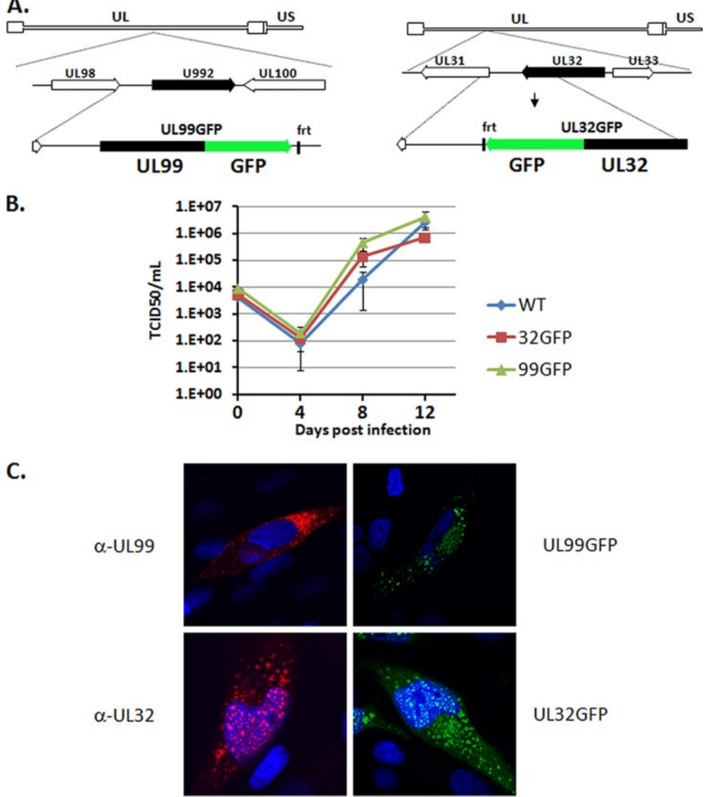
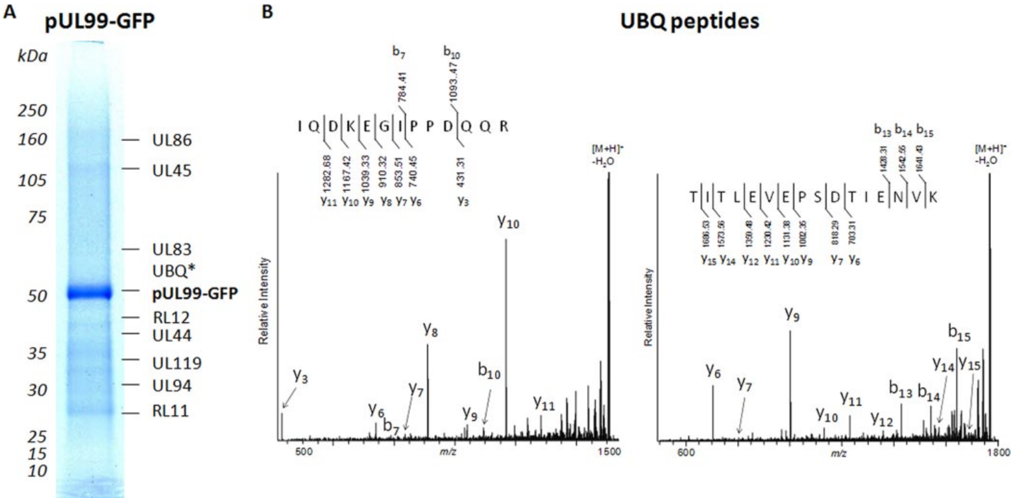
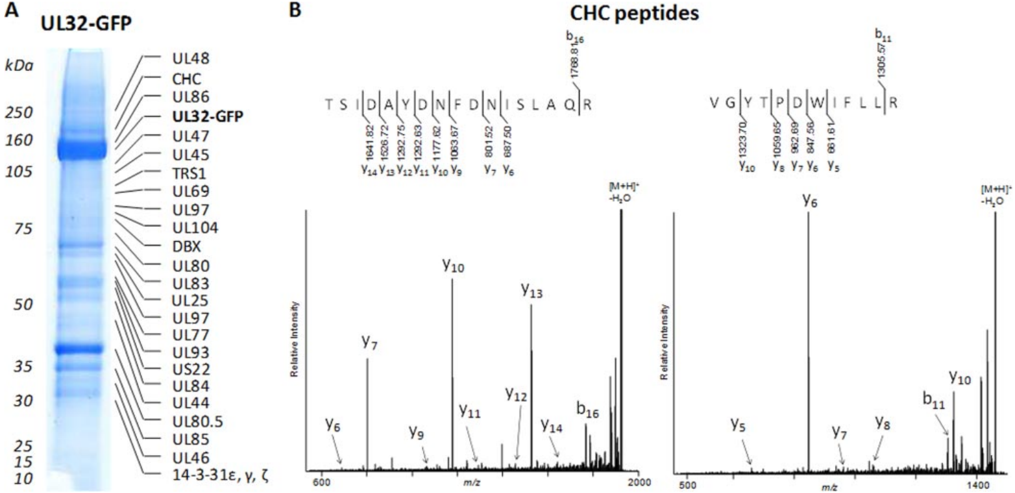
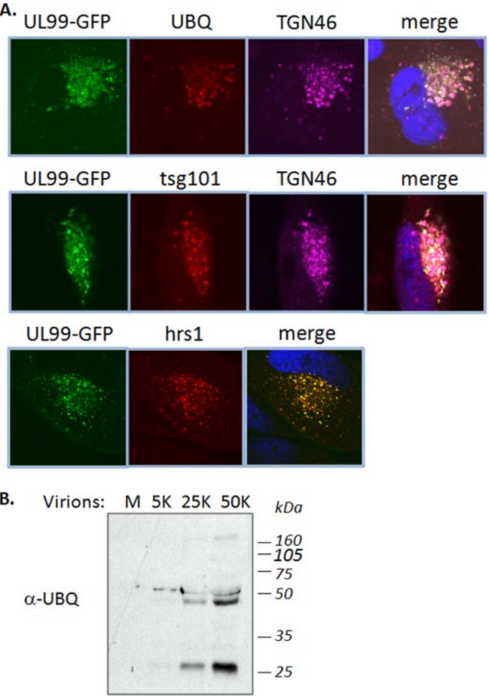
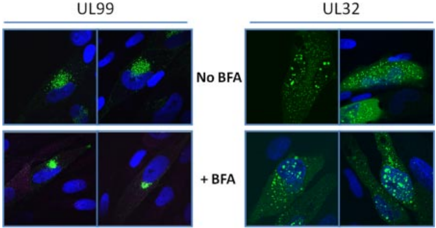
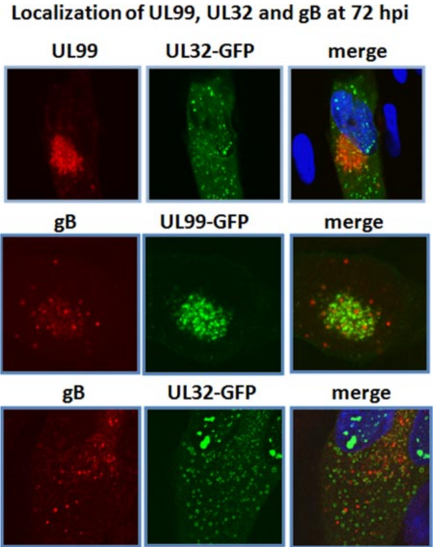
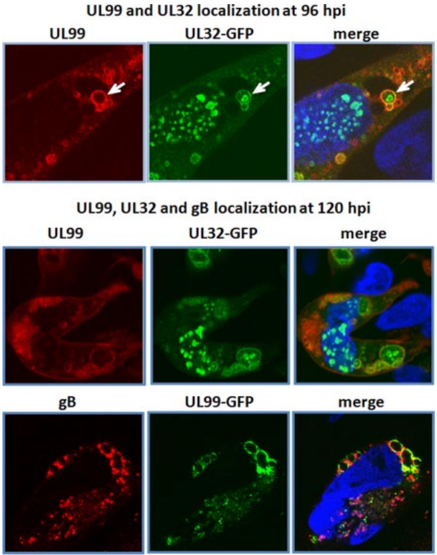
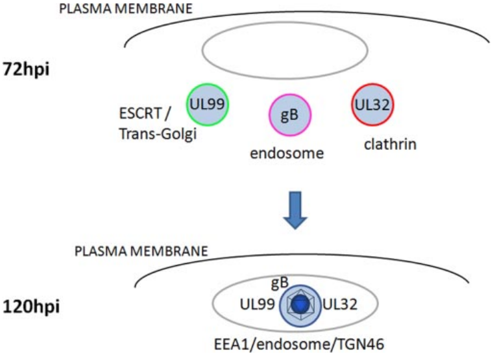
The assembly of infectious virus particles is a complex event. For human cytomegalovirus (HCMV) this process requires the coordinated expression and localization of at least 60 viral proteins that comprise the infectious virion. To gain insight into the mechanisms controlling this process, we identified protein binding partners for two viral proteins, pUL99 (also termed pp28) and pUL32 (pp150), which are essential for HCMV virion assembly. We utilized HCMV strains expressing pUL99 or pUL32 carboxyl-terminal green fluorescent protein fusion proteins from their native location in the HCMV genome. Based on the presence of ubiquitin in the pUL99 immunoisolation, we discovered that this viral protein colocalizes with components of the cellular endosomal sorting complex required for transport (ESCRT) pathway during the initial stages of virion assembly. We identified the nucleocapsid and a large number of tegument proteins as pUL32 binding partners, suggesting that events controlling trafficking of this viral protein in the cytoplasm regulate nucleocapsid/tegument maturation. The finding that pUL32, but not pUL99, associates with clathrin led to the discovery that the two viral proteins traffic via distinct pathways during the early stages of virion assembly. Additional investigation revealed that the majority of the major viral glycoprotein gB initially resides in a third compartment. Analysis of the trafficking of these three viral proteins throughout a time course of virion assembly allowed us to visualize their merger into a single large cytoplasmic structure during the late stages of viral assembly. We propose a model of HCMV virion maturation in which multiple components of the virion traffic independently of one another before merging.
Overview
The claims and statistics of this paper haven’t been checked yet.
Free: it reads the open-access text and checks the first 5 claims that cite a source we can check. Create a free account to check every claim.
Integrity signals
Registry
Cites
Statistics
Figures
Verification
Claims the paper makes
The claims and statistics of this paper haven’t been checked yet.
Free: it reads the open-access text and checks the first 5 claims that cite a source we can check. Create a free account to check every claim.
Claims other papers make about this one
Each is checked against this paper’s own text: does it say what the citing paper says it does?
In the citing paper
“Interestingly, at the same time, the viral glycoprotein gB localized to endosomes, and it was not until late in infection that all three proteins merged within a large virion assembly structure (42).”
From The Impact of Mass Spectrometry–Based Proteomics on Fundamental Discoveries in Virology (2014) · cites this paper as [42]
In the citing paper
“The existing functional knowledge regarding these factors led to the model that pUL99 associates with the ESCRT/TGN pathway, whereas pUL32 traffics in clathrin-coated vesicles.”
From The Impact of Mass Spectrometry–Based Proteomics on Fundamental Discoveries in Virology (2014) · cites this paper as [42]
Self-check
Percentages, sums and reported differences re-computed from the paper’s own numbers.
The self-check needs the paper’s full text.
Citations
Cites
Brefeldin A: insights into the control of membrane traffic and organelle structure.
Klausner, R. D., Donaldson, J. G., & Lippincott-Schwartz, J. (1992) · The Journal of cell biology · doi:10.1083/jcb.116.5.1071 · Cited by 1,846
Katzmann, D. J., Babst, M., & Emr, S. D. (2001) · Cell · doi:10.1016/s0092-8674(01)00434-2 · Cited by 1,429
The ESCRT machinery in endosomal sorting of ubiquitylated membrane proteins
Raiborg, C., & Stenmark, H. (2009) · Nature · doi:10.1038/nature07961 · Cited by 1,359
Functional profiling of a human cytomegalovirus genome
Dunn, W., Chou, C., Li, H., Hai, R., Patterson, D., Stolc, V., Zhu, H., & Liu, F. (2003) · Proceedings of the National Academy of Sciences · doi:10.1073/pnas.2334032100 · Cited by 645
Identification of Proteins in Human Cytomegalovirus (HCMV) Particles: the HCMV Proteome
Varnum, S. M., Streblow, D. N., Monroe, M. E., Smith, P., Auberry, K. J., Paša-Tolić, L., Wang, D., Camp, D. G., Rodland, K., Wiley, S., et al. (2004) · Journal of Virology · doi:10.1128/jvi.78.20.10960-10966.2004 · Cited by 598
Self-citationZhang, W., & Chait, B. T. (2000) · Analytical Chemistry · doi:10.1021/ac991363o · Cited by 595
Coding potential of laboratory and clinical strains of human cytomegalovirus
Murphy, E., Yu, D., Grimwood, J., Schmutz, J., Dickson, M., Jarvis, M. A., Hahn, G., Nelson, J. A., Myers, R. M., & Shenk, T. E. (2003) · Proceedings of the National Academy of Sciences · doi:10.1073/pnas.2136652100 · Cited by 498
Self-citationFunctional map of human cytomegalovirus AD169 defined by global mutational analysis
Yu, D., Silva, M. C., & Shenk, T. (2003) · Proceedings of the National Academy of Sciences · doi:10.1073/pnas.1635160100 · Cited by 409
Self-citationInfluence of Secondary Structure on the Fragmentation of Protonated Peptides
Tsaprailis, G., Nair, H., Somogyi, Á., Wysocki, V. H., Zhong, W., Futrell, J. H., Summerfield, S. G., & Gaskell, S. J. (1999) · Journal of the American Chemical Society · doi:10.1021/ja982980h · Cited by 350
Sanchez, V., Greis, K. D., Sztul, E., & Britt, W. J. (2000) · Journal of Virology · doi:10.1128/jvi.74.2.975-986.2000 · Cited by 339
Cited by
Jean Beltran, P. M., Federspiel, J. D., Sheng, X., & Cristea, I. M. (2017) · Molecular Systems Biology · doi:10.15252/msb.20167062 · Cited by 212
Self-citationMass spectrometry‐based protein–protein interaction networks for the study of human diseases
Richards, A. L., Eckhardt, M., & Krogan, N. J. (2021) · Molecular Systems Biology · doi:10.15252/msb.20188792 · Cited by 201
Morris, J. H., Knudsen, G. M., Verschueren, E., Johnson, J. R., Cimermancic, P., Greninger, A. L., & Pico, A. R. (2014) · Nature Protocols · doi:10.1038/nprot.2014.164 · Cited by 198
A Portrait of the Human Organelle Proteome In Space and Time during Cytomegalovirus Infection
Jean Beltran, P. M., Mathias, R. A., & Cristea, I. M. (2016) · Cell Systems · doi:10.1016/j.cels.2016.08.012 · Cited by 174
Self-citationDas, S., & Pellett, P. E. (2011) · Journal of Virology · doi:10.1128/jvi.00155-11 · Cited by 152
Metadata
- Authors
- Moorman, N. J., Sharon-Friling, R., Shenk, T., & Cristea, I. M.
- Affiliations
- Princeton University (US)
- Corresponding author
- Cristea, Ileana M.
- Venue
- Molecular & Cellular Proteomics
- Publisher
- Elsevier BV
- Published
- 2010-05
- Volume
- 9
- Issue
- 5
- Pages
- 851-860
- ISSN
- 1535-9476 (ISSN-L)
- PMC
- PMC2871419
- OpenAlex
- W2109177153
- Cited by
- 97
- References
- 51
- Citations by year
- 2026: 1 · 2025: 1 · 2024: 2 · 2023: 3 · 2022: 6 · 2021: 10 · 2020: 5 · 2019: 2 · 2018: 6 · 2017: 9 · 2016: 5 · 2015: 11 · 2014: 11 · 2013: 5 · 2012: 9
- FWCI
- 4.50
- Type
- journal article
- Language
- en
- Open access
- hybrid
- doi.org
- Licence
- cc-by
- www.elsevier.com/tdm/userlicense/1.0/ (tdm)
- www.elsevier.com/legal/tdmrep-license (tdm)
- creativecommons.org/licenses/by/4.0/ (vor, 3799 d)
- Locations
- Molecular & Cellular Proteomics (publishedVersion, cc-by)
- PubMed Central (publishedVersion)
- PubMed (publishedVersion)
- Carolina Digital Repository (University of North Carolina at Chapel Hill) (submittedVersion)
- UNC Libraries
- Funders
- Princeton University
- National Institutes of Health
- National Institute on Drug Abuse (DP1DA026192)
- National Cancer Institute (CA85786, CA 82396, R01CA085786, R01CA082396)
- Topics
- Health Sciences › Medicine › Epidemiology › Cytomegalovirus and herpesvirus research
- Health Sciences › Medicine › Infectious Diseases › Herpesvirus Infections and Treatments
- Life Sciences › Biochemistry, Genetics and Molecular Biology › Cell Biology › Cellular transport and secretion
- Keywords
- human cytomegalovirus, viral assembly, virion maturation, ESCRT pathway, clathrin, viral protein trafficking, nucleocapsid, tegument proteins, gB glycoprotein, ubiquitin, protein-protein interaction, spatial proteomics
- MeSH terms
- Amino Acid Sequence, Cell Compartmentation, Clathrin, Cytomegalovirus, Fibroblasts, Humans, Models, Biological, Molecular Sequence Data, Protein Binding, Recombination, Genetic, Time Factors, Viral Proteins, Virion, Virus Assembly, Nucleocapsid, Brefeldin A, Protein Transport, Proteomics, Host-Pathogen Interactions, Endosomal Sorting Complexes Required for Transport
About these checks
Registry, retraction, Cites and statistics results are computed, not judged, with one exception: a printed reference that no index lists is read once by a model before it counts as a citation error. Claims are extracted by a model and kept only when their quote appears verbatim in the text; each cited source is then checked, with a model’s help, for whether it says what the claim relies on. Those verdicts can be wrong — read the claim’s quote and the cited source before relying on one.
Statistics and arithmetic are recomputed, not judged.
Confidence bands are shown only for fields calibrated on our annotated test set. None is calibrated yet, so no band is shown.
What counts as a claim ›How we measure confidence ›How we check this ›
Are you an author, or do you see a problem with this page? Request a review
How to cite
Cite CoChat for the checks on this page, and the paper for its own findings.
- This page
- CoChat. (2026). Citation check: A Targeted Spatial-Temporal Proteomics Approach Implicates Multiple Cellular Trafficking Pathways in Human Cytomegalovirus Virion Maturation. https://app.cochat.ai/papers/10.1074/mcp.m900485-mcp200
- The paper
- Moorman, N. J., Sharon-Friling, R., Shenk, T., & Cristea, I. M. (2010). A Targeted Spatial-Temporal Proteomics Approach Implicates Multiple Cellular Trafficking Pathways in Human Cytomegalovirus Virion Maturation. Molecular & Cellular Proteomics. https://doi.org/10.1074/mcp.m900485-mcp200
Data sources
Bibliographic data: Semantic Scholar, OpenAlex, Crossref.
Contains information from the Semantic Scholar Academic Graph Datasets, made available under the ODC Attribution License (ODC-BY 1.0).
Semantic Scholar’s data is described in: Kinney, R., et al. (2023). The Semantic Scholar Open Data Platform. arXiv:2301.10140.
