

Fixed or Fluid? Sexual Identity Fluidity in a Large National Panel Study of New Zealand Adults
Open accessThe DOI matches its Crossref record; 106 of the 110 references it cites were found in a registry or an index; 6 of the 56 sources its claims cite were checked for support.
Abstract
Sexual orientation has been defined as an enduring aspect of the self, but emerging evidence reveals that people’s sexual attractions, behaviors, and identities can shift over time. To examine this possibility, we present a large longitudinal analysis of sexual orientation identity fluidity among New Zealand adults (Ntotal = 45,856; age = 18–99; lesbian, gay, bisexual, and other sexual minority (LGB+) ns = 746–3,387). Over seven years, 5.7% of participants changed sexual identities at least once. Change was bi-directional (i.e. toward and away from LGB+ identities) and most common in people who initially reported a plurisexual identity. Although women reported higher rates of plurisexuality than men, they were not more fluid in their identities, contradicting the notion of male fixedness and female plasticity in sexuality. Moreover, openness to experience was associated with increased odds of changing from a heterosexual to a plurisexual identity, while political liberalism and lower conscientiousness were associated with increased odds of changing from a heterosexual to a plurisexual identity and more identity changes over time. Overall, our study shows that sexual identity can be fluid into adulthood and has implications for how we understand contemporary human sexuality.
Overview
CoChat Summary
TL;DR
In eight waves of the New Zealand Attitudes and Values Study (N total = 45,856), 5.7% of adults changed sexual identity at least once over seven years, with change bi-directional and most common among initially plurisexual participants. The study challenges linear “coming out” and female-specific plasticity accounts, finding that women had higher plurisexuality rates but were not more fluid than men.
Key findings
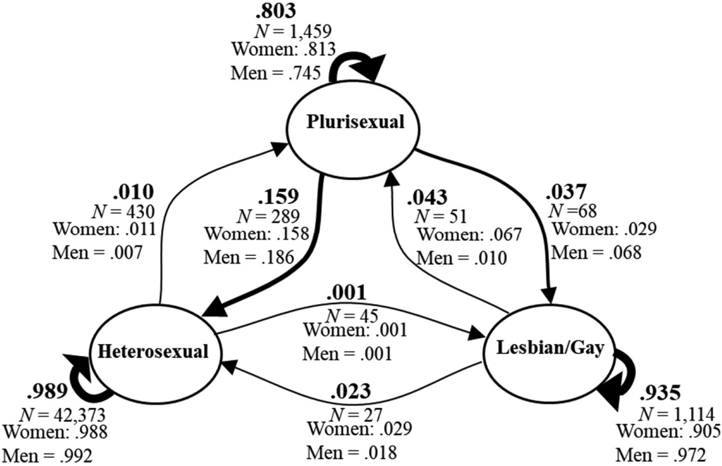
- Over seven years, 5.7% changed sexual identity at least once; heterosexual identity was most stable (97.7% same at seven years), followed by lesbian/gay (88.5%) and plurisexual (63.6%). One-year consistency probabilities were .989 for heterosexual, .935 for lesbian/gay, and .803 for plurisexual participants.
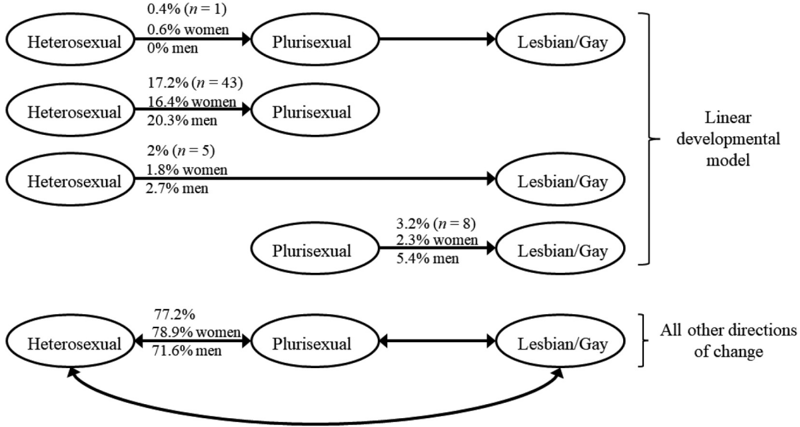
- Change was mostly non-linear: 22.8% of those who changed followed a linear developmental model, while 77.2% (n = 193) did not. Plurisexual participants showed 21.3% one-year change and 41.3% seven-year change, with a higher probability of shifting to heterosexual (.159) than to lesbian/gay (.037).
- Women reported more plurisexuality (4.7%) than men (2.6%), but there was no overall gender difference in number of identity changes (p = .133). Among plurisexual participants, men were more fluid than women (25.5% vs. 18.7% one-year change); men were more likely to shift from plurisexual to gay (OR = 2.634), while women were more likely to shift from lesbian/gay to plurisexual (OR = 0.121).
- Younger age was associated with more changes (77.6% of the youngest group reported no changes vs. over 90% in other age groups; 10.2% of the youngest reported two changes vs. 2.6% and 1.3% in middle and older groups). Openness to experience and lower conscientiousness predicted heterosexual-to-plurisexual change; psychological distress was positively associated with number of changes (p = .005) and heterosexual-to-plurisexual shifting (p < .001); political conservatism was negatively associated with fluidity (p = .001).
Methods
- Design: eight annual waves of the national probability New Zealand Attitudes and Values Study (NZAVS), 2013/14–2020/21 (NZAVS Times 5–12). Sexual identity was assessed with an open-ended question and coded into heterosexual, lesbian/gay, plurisexual, and asexual categories; asexual participants were excluded from consistency/change analyses but included in overall fluidity analyses.
- Sample: pooled sample N = 45,856 (42,848 heterosexual; 1,192 lesbian/gay; 1,816 plurisexual at first measurement), age 18–99; LGB+ ns = 746–3,387. The all-wave negative binomial sample consisted of 4,269 participants.
- Analysis: pooled one-year transition probabilities; logistic regressions for heterosexual–plurisexual transitions; negative binomial regression for number of identity changes over seven years. Predictors included age, gender, Mini-IPIP personality traits, Kessler-6 psychological distress, subjective health, religiosity, and political conservatism; listwise deletion was used for missing predictor data.
Limitations
- The paper states that it assessed identity only, not attractions or behavior, and that behavior and attraction show more change over time; results therefore speak only to identity fluidity.
- The paper states that societal constraints and sexual prejudice may affect reporting, and some change away from LGB+ identities may reflect pressure or discrimination rather than genuine fluidity; cross-national studies are needed.
- The paper states that the sample overrepresents women and European ethnicities relative to 2018 New Zealand census estimates (51.4% women, 70.2% European), that LGB+ and asexual samples were small, that gender-diverse participants were excluded from gender analyses (n = 236, 0.3% of the total NZAVS sample), and that eight annual waves provide a limited window for observing identity change, which may include random noise.
Model-written summary. Check it against the paper before relying on it.
Integrity signals
Registry
Cites
Statistics
Figures



Verification
Claims the paper makes
6 Valid · 1 Not valid · 32 Not checked · 125 Own results and interpretations
The sources with a verdict support this claim; the rest weren’t checked yet, have no full text we could read, or their verdicts aren’t rated yet.
In the paper
“a growing body of literature reveals that sexual behavior, attractions, and identity do change over time (Diamond, 2016;Katz-Wise & Todd, 2022).”
§ Fixed or Fluid? Sexual Identity Fluidity in a Large National Panel Study of New Zealand Adults > Abstract
What the sources say
- Not checked — no full text of the sourcecites Diamond, 2016 matched to “Sexual Fluidity in Male and Females” (2016) source
- Supportedcites Katz-Wise & Todd, 2022 matched to “The current state of sexual fluidity research” (2022) source
In “Sexual Fluidity Research in the Past Decade,” the paper describes sexual fluidity as change in any dimension of sexual orientation. Its “Change Across Sexual Orientation Dimensions” subsection identifies identity, attractions, and behavior as the three primary dimensions studied for fluidity. The supplied passages do not give page numbers. (LLM, conf=0.92)
plain- Asserted: passes — The authors put it forward as true.
- Checkable: passes — It can be checked against evidence.
- Load-bearing: passes — The paper’s conclusions depend on it.
- Based: passes — The paper gives a reason why it holds.
The cited sources support only part of this claim — read each source’s verdict below.
In the paper
“the greater legal and social oppression LGB+ people face, the more likely they are to suppress their identities (Charlton et al., 2016).”
§ Fixed or Fluid? Sexual Identity Fluidity in a Large National Panel Study of New Zealand Adults > Abstract
What the sources say
- Partly supportedcites Charlton et al., 2016 matched to “Changes in Reported Sexual Orientation Following US States Recognition of Same-Sex Couples” (2016) sourceExperimental — accuracy not yet measured
Charlton et al. (2016) support the direction of the claim: the Abstract states that sexual minorities in a state without any relationship recognition 'may have been less likely to disclose their sexual orientation,' and the DISCUSSION notes that an earlier one-time measure 'undercounted sexual minority women in states with more institutionalized discrimination,' with state recognition of same-sex relationships predicting a 30% higher likelihood of changing report from heterosexual to sexual minority (RESULTS, RR 1.30; 95% CI = 1.05, 1.61). However, the paper hedges this as possibility rather than establishing it as a graded causal rule ('the greater the oppression, the more likely'), its exposure was a binary categorisation (any recognition vs no rights) rather than a measure of degree of oppression, and the DISCUSSION explicitly concedes 'we could not determine or test the reason for the change in reported sexual orientation.' The finding is also restricted to midlife women in the Nurses' Health Study II (n = 69 790), not LGB+ people generally, so the generalised, factual formulation of the claim overstates this source. (LLM, conf=0.78)
hedgedstates an association- Asserted: passes — The authors put it forward as true.
- Checkable: passes — It can be checked against evidence.
- Load-bearing: passes — The paper’s conclusions depend on it.
- Based: passes — The paper gives a reason why it holds.
- Partly supported
Every source the paper cites for this claim was checked and supports it.
In the paper
“those that do use large samples typically focus on adolescents and young adults (Ott et al., 2011).”
§ Fixed or Fluid? Sexual Identity Fluidity in a Large National Panel Study of New Zealand Adults > Abstract
What the sources say
- Supportedcites Ott et al., 2011 matched to “Stability and Change in Self-Reported Sexual Orientation Identity in Young People: Application of Mobility Metrics” (2011) source
The Method (Participants) identifies this as a study of adolescents and young adults aged 12–25. The Method (Statistical Analysis) reports 13,913 respondents to the sexual-orientation question, and the Discussion (Limitations) describes the cohort as comparatively large. The paper therefore supports the citation as an example of a large-sample study focused on this age group. (LLM, conf=0.88)
plain- Asserted: passes — The authors put it forward as true.
- Checkable: passes — It can be checked against evidence.
- Load-bearing: passes — The paper’s conclusions depend on it.
- Based: passes — The paper gives a reason why it holds.
- Supported
The paper states this without a source or data behind it here, so there is nothing to check it against. The quote shows it is in the paper.
In the paper
“Over seven years, 5.7% of participants changed sexual identities at least once.”
§ Fixed or Fluid? Sexual Identity Fluidity in a Large National Panel Study of New Zealand Adults > Abstract
- Asserted: passes — The authors put it forward as true.
- Checkable: passes — It can be checked against evidence.
- Load-bearing: passes — The paper’s conclusions depend on it.
- Based: unclear — It is unclear why the paper says it holds.
A result the paper reports from its own data — it cites no other source for it, so there is none to check. The quote shows it is in the paper.
In the paper
“Overall, the heterosexual category was the most fixed over time (97.7% of those who identified as heterosexual in Time 1 also identified as heterosexual seven years later).”
§ Fixed or Fluid? Sexual Identity Fluidity in a Large National Panel Study of New Zealand Adults > Sexual Identity Stability and Change
plain- Asserted: passes — The authors put it forward as true.
- Checkable: passes — It can be checked against evidence.
- Load-bearing: passes — The paper’s conclusions depend on it.
- Based: passes — The paper gives a reason why it holds.
103 more claims
Create a free account to see all 164 claims and to verify the 7 references still open.
- Probably not a substantial claim. 19
- It may state two separate claims as one. 34
- The quote only partly states this claim. 6
Self-check
Percentages, sums and reported differences re-computed from the paper’s own numbers.
Each contradiction between two passages listed here was confirmed by an independent check.
Rated major: it would touch a result — a value a result rests on, reported and recomputed p-values on opposite sides of the significance level, two passages that conflict with no sign which is right, or a cited work retracted before this paper was published.
In the paper
§ Fixed or Fluid? Sexual Identity Fluidity in a Large National Panel Study of New Zealand Adults > Personality, Health, and Political Differences
“only political conservatism (p = .001)and psychological distress (p = .036)were associated with increased odds of shifting in this direction over time”
§ Fixed or Fluid? Sexual Identity Fluidity in a Large National Panel Study of New Zealand Adults > Conclusion
“| Kessler-6 | 0.376*** .091 | 1.456 | <.001 -0.266* | .127 | 0.766 | .036 | 0.471** | 0.139, 0.802 | .169 | .005 | | |”
Rated minor: it would not touch a result — a value no result rests on, a p-value that stays on the same side of the significance level, or a conflict that is clerical, resolved elsewhere in the paper, or outside its own findings.
In the paper
§ Fixed or Fluid? Sexual Identity Fluidity in a Large National Panel Study of New Zealand Adults > What are the Ideological, Health, and Personality Correlates of Sexual Fluidity?
“Moreover, openness to experience and less conscientiousness predicted changes toward plurisexual identities and the number of changes reported.”
§ Fixed or Fluid? Sexual Identity Fluidity in a Large National Panel Study of New Zealand Adults > Personality, Health, and Political Differences
“Big-Five personality traits were also not uniquely associated with the number of identity changes (ps > .232),except conscientiousness, which was negatively associated with the number of identity changes (p = .032).”
Rated minor: it would not touch a result — a value no result rests on, a p-value that stays on the same side of the significance level, or a conflict that is clerical, resolved elsewhere in the paper, or outside its own findings.
In the paper
§ Fixed or Fluid? Sexual Identity Fluidity in a Large National Panel Study of New Zealand Adults > Sexual Identity Stability and Change
“a higher proportion changed their identity at least once over a sevenyear period (41.6%).”
§ Fixed or Fluid? Sexual Identity Fluidity in a Large National Panel Study of New Zealand Adults > Conclusion
“| Total n (%) | 120 (0.9%) | 486 (3.6%) | 9 (2.8%) | 47 (14.6%) | 84 (21.3%) | 164 (41.3%) |”
Citations
Cites
(1992) · PubMed · Cited by 33,716
The MOS 36-ltem Short-Form Health Survey (SF-36): I. Conceptual Framework and Item Selection
Ware, J. E., & Sherbourne, C. D. (1992) · Medical Care · doi:10.1097/00005650-199206000-00002 · Cited by 30,033 · cited 1×
“Subjective health was assessed through the items “I seem to get sick a little easier than other people” and “I expect my health to get worse” (α at Time 1 = .61; Ware & Sherbourne, 1992), which participants rated from 1 ( strongly disagree ) to 7 ( strongly agree ).”
(2023) · doi:10.1126/science · Cited by 6,063
The Mini-IPIP Scales: Tiny-yet-effective measures of the Big Five Factors of Personality.
Donnellan, M. B., Oswald, F. L., Baird, B. M., & Lucas, R. E. (2006) · Psychological Assessment · doi:10.1037/1040-3590.18.2.192 · Cited by 2,442 · cited 2×
“Personality was measured using the Mini-IPIP (Donnellan et al., 2006), a short form inventory assessing the Big-Five facets on a 1 ( very inaccurate ) to 7 ( very accurate ) scale ( α s at Time 1 for Extraversion = .75, Agreeableness = .70, Conscientiousness = .66, Emotionality = .70, and Openness = .69).”
Homosexual Identity Formation: A Theoretical Model
Cass, V. C. (1979) · Journal of Homosexuality · doi:10.1300/j082v04n03_01 · Cited by 2,192
The end of the end of ideology.
Jost, J. T. (2006) · American Psychologist · doi:10.1037/0003-066x.61.7.651 · Cited by 1,532
Kessler, R. C., Green, J. G., Gruber, M. J., Sampson, N. A., Bromet, E., Cuitan, M., Furukawa, T. A., Gureje, O., Hinkov, H., Hu, C., et al. (2010) · International Journal of Methods in Psychiatric Research · doi:10.1002/mpr.310 · Cited by 1,434
The Psychology of Sexual Prejudice
Herek, G. M. (2000) · Current Directions in Psychological Science · doi:10.1111/1467-8721.00051 · Cited by 1,099 · cited 3×
“Each finding is consistent with the idea that conservatives are generally more negative toward LGB+ people and identities (Herek, 2000).”
InfluentialGender differences in erotic plasticity: The female sex drive as socially flexible and responsive.
Baumeister, R. F. (2000) · Psychological Bulletin · doi:10.1037/0033-2909.126.3.347 · Cited by 808 · cited 3×
“While there has been much excitement about women showing erotic plasticity (Baumeister, 2000), our study did not support this notion.”
InfluentialBornstein, K. (2013) · Routledge eBooks · doi:10.4324/9780203365991 · Cited by 581
Female bisexuality from adolescence to adulthood: Results from a 10-year longitudinal study
Diamond, L. M. (2008) · Developmental Psychology · doi:10.1037/0012-1649.44.1.5 · Cited by 564
Large-scale GWAS reveals insights into the genetic architecture of same-sex sexual behavior
Ganna, A., Verweij, K. J. H., Nivard, M. G., Maier, R., Wedow, R., Busch, A. S., Abdellaoui, A., Guo, S., Sathirapongsasuti, J. F., 23andMe Research Team, et al. (2019) · Science · doi:10.1126/science.aat7693 · Cited by 406 · cited 2×
“Notably, research suggests aggregate genetic overlaps between personality traits and traits underlying same-gender sexual behavior (see Ganna et al., 2019).”
Legate, N., Ryan, R. M., & Weinstein, N. (2012) · Social Psychological and Personality Science · doi:10.1177/1948550611411929 · Cited by 377
Alencar Albuquerque, G., de Lima Garcia, C., da Silva Quirino, G., Alves, M. J. H., Belém, J. M., dos Santos Figueiredo, F. W., da Silva Paiva, L., do Nascimento, V. B., da Silva Maciel, É., Valenti, V. E., et al. (2016) · BMC International Health and Human Rights · doi:10.1186/s12914-015-0072-9 · Cited by 377
Prevalence and Stability of Sexual Orientation Components During Adolescence and Young Adulthood
Savin-Williams, R. C., & Ream, G. L. (2007) · Archives of Sexual Behavior · doi:10.1007/s10508-006-9088-5 · Cited by 365
Dual Attraction: Understanding Bisexuality.
Kimmel, M. S., Weinberg, M. S., Williams, C. J., & Pryor, D. W. (1995) · Contemporary Sociology · doi:10.2307/2076509 · Cited by 325
Minority Stress and Mental Health: A Review of the Literature
Hoy-Ellis, C. P. (2023) · Journal of Homosexuality · doi:10.1080/00918369.2021.2004794 · Cited by 294
Lippa, R. A. (2010) · Archives of Sexual Behavior · doi:10.1007/s10508-008-9380-7 · Cited by 291
Dual Attraction: Understanding Bisexuality
Weinberg, M. S., Williams, C. J., & Pryor, D. W. (1994) · doi:10.1093/oso/9780195084825.001.0001 · Cited by 283
Was it a phase? Young women's relinquishment of lesbian/bisexual identities over a 5-year period.
Diamond, L. M. (2003) · Journal of Personality and Social Psychology · doi:10.1037//0022-3514.84.2.352 · Cited by 278
Savin-Williams, R. C., & Vrangalova, Z. (2013) · Developmental Review · doi:10.1016/j.dr.2013.01.001 · Cited by 277 · cited 1×
“While some people do indeed explore same-gender attractions before “reverting” to heterosexuality, heterosexuality is a continuum (Savin-Williams & Vrangalova, 2013), and fluidity itself can be an identity (Savin-Williams, 2022, 2023).”
Suen, L. W., Lunn, M. R., Katuzny, K., Finn, S., Duncan, L., Sevelius, J., Flentje, A., Capriotti, M. R., Lubensky, M. E., Hunt, C., et al. (2020) · Archives of Sexual Behavior · doi:10.1007/s10508-020-01810-y · Cited by 251
Prevalence and stability of self-reported sexual orientation identity during young adulthood
Savin-Williams, R. C., Joyner, K., & Rieger, G. (2012) · Archives of Sexual Behavior · doi:10.1007/s10508-012-9913-y · Cited by 244
Sexual Fluidity in Male and Females
Diamond, L. M. (2016) · Current Sexual Health Reports · doi:10.1007/s11930-016-0092-z · Cited by 243 · cited 7×
“…were the most likely to show fluidity in all directions, potentially supporting the idea that plurisexual identities can be open to change and may shift in response to different relationships or experiences (Blumstein & Schwartz, 1977; Diamond, 2016; Ross et al., 2012; Weinberg et al., 1995).”
InfluentialSexual Arousal Patterns of Bisexual Men
Rieger, G., Chivers, M. L., & Bailey, J. M. (2005) · Psychological Science · doi:10.1111/j.1467-9280.2005.01578.x · Cited by 235
Ott, M. Q., Corliss, H. L., Wypij, D., Rosario, M., & Austin, S. B. (2011) · Archives of Sexual Behavior · doi:10.1007/s10508-010-9691-3 · Cited by 230
Transitions from heterosexuality to lesbianism: The discursive production of lesbian identities.
Kitzinger, C., & Wilkinson, S. (1995) · Developmental Psychology · doi:10.1037//0012-1649.31.1.95 · Cited by 216
Stability and Change in Sexual Orientation Identity Over a 10-Year Period in Adulthood
Mock, S. E., & Eibach, R. P. (2012) · Archives of Sexual Behavior · doi:10.1007/s10508-011-9761-1 · Cited by 209 · cited 3×
“Although some smaller studies find that age is unrelated to adult sexual identity change (e.g., Mock & Eibach, 2012), younger people are more likely to report plurisexual identities (Greaves et al., 2017), and plur-isexual people show the most sexual fluidity (Diamond, 2016).”
Sexual Orientation and Personality
Lippa, R. A. (2005) · Annual Review of Sex Research · doi:10.1080/10532528.2005.10559831 · Cited by 206
Identity Formation for Lesbian, Bisexual, and Gay Persons: Beyond a ææMinoritizingÆÆ View
Eliason, M. J. (1996) · Journal of Homosexuality · doi:10.1300/j082v30n03_03 · Cited by 206 · cited 2×
“A popular theory of sexual fluidity proposes a linear pathway: people begin heterosexual and then either remain so (i.e., are stable) or travel (i.e., are fluid) unidirectionally to either an LGB+ identity or through a bisexual identity to a gay/lesbian identity (Cass, 1979; Eliason, 1996).”
Mountian, I. (2013) · Psychology and Sexuality · doi:10.1080/19419899.2011.595080 · Cited by 206
Sexual Orientation Microaggressions and the Experience of Sexual Minorities
Platt, L. F., & Lenzen, A. L. (2013) · Journal of Homosexuality · doi:10.1080/00918369.2013.774878 · Cited by 193
Complicating the Coming Out Narrative: Becoming Oneself in a Heterosexist and Cissexist World
Klein, K. E., Holtby, A., Cook, K., & Travers, R. (2014) · Journal of Homosexuality · doi:10.1080/00918369.2014.970829 · Cited by 187
Hall, W. J., Dawes, H. C., & Plocek, N. (2021) · Frontiers in Psychology · doi:10.3389/fpsyg.2021.753954 · Cited by 186
Rees, S. N., Crowe, M., & Harris, S. (2021) · Journal of Psychiatric and Mental Health Nursing · doi:10.1111/jpm.12720 · Cited by 176
Not Gay: Sex between Straight White Men
Ward, J. (2015) · New York University Press eBooks · doi:10.18574/nyu/9781479898978.001.0001 · Cited by 175
Not gay: sex between straight white men
(2016) · Choice Reviews Online · doi:10.5860/choice.193932 · Cited by 165
Non-binary and genderqueer: An overview of the field
Monro, S. (2019) · International Journal of Transgenderism · doi:10.1080/15532739.2018.1538841 · Cited by 161
The Diversity and Prevalence of Sexual Orientation Self-Labels in a New Zealand National Sample
Greaves, L. M., Barlow, F. K., Lee, C. H. J., Matika, C. M., Wang, W., Lindsay, C.-J., Case, C. J. B., Sengupta, N. K., Huang, Y., Cowie, L. J., et al. (2016) · Archives of Sexual Behavior · doi:10.1007/s10508-016-0857-5 · Cited by 148
Self-citationStability of Sexual Attractions Across Different Timescales: The Roles of Bisexuality and Gender
Diamond, L. M., Dickenson, J. A., & Blair, K. L. (2017) · Archives of Sexual Behavior · doi:10.1007/s10508-016-0860-x · Cited by 147 · cited 3×
“Rather than cate-gorizing sexual orientation as static categories, this alternative model of sexual fluidity argues that these dimensions can change in response to situational, interpersonal, and societal factors (Diamond, 2008b; Diamond et al., 2017).”
Bisexuality: Some Social Psychological Issues
Blumstein, P. W., & Schwartz, P. (1977) · Journal of Social Issues · doi:10.1111/j.1540-4560.1977.tb02004.x · Cited by 147
Proposed Model of Lesbian Identity Development: An Empirical Examination
Chapman, B. E., & Brannock, J. C. (1987) · Journal of Homosexuality · doi:10.1300/j082v14n03_05 · Cited by 142
Galupo, M. P., Henise, S. B., & Mercer, N. L. (2016) · International Journal of Transgenderism · doi:10.1080/15532739.2016.1189373 · Cited by 136
The Invisible Stereotypes of Bisexual Men
Zivony, A., & Lobel, T. E. (2014) · Archives of Sexual Behavior · doi:10.1007/s10508-014-0263-9 · Cited by 131
Evaluating inclusive gender identity measures for use in quantitative psychological research
Fraser, G. (2018) · Psychology & Sexuality · doi:10.1080/19419899.2018.1497693 · Cited by 128 · cited 1×
“Additionally, our single-item gender measure likely underestimates the number of TGD participants in our sample (see Fraser, 2018, for discussion).”
Same-sex attraction in a birth cohort: prevalence and persistence in early adulthood
Dickson, N., Paul, C., & Herbison, P. (2003) · Social Science & Medicine · doi:10.1016/s0277-9536(02)00161-2 · Cited by 124
Data for queer lives: How LGBTQ gender and sexuality identities challenge norms of demographics
Ruberg, B., & Ruelos, S. (2020) · Big Data & Society · doi:10.1177/2053951720933286 · Cited by 109
Sampling procedure and sample details for the New Zealand Attitudes and Values Study
Sibley, C. G. (2021) · doi:10.31234/osf.io/wgqvy · Cited by 108
Self-citationMostly Straight: Sexual Fluidity among Men
Savin-Williams, R. C. (2017) · Harvard University Press eBooks · doi:10.4159/9780674981034 · Cited by 104
Katz-Wise, S. L., Reisner, S. L., Hughto, J. W., & St. Amand, C. (2016) · The Journal of Sex Research · doi:10.1080/00224499.2014.1003028 · Cited by 102
Sexual Stigma: An Interactionist Account.
Simon, W., & Plummer, K. J. (1977) · Contemporary Sociology A Journal of Reviews · doi:10.2307/2066375 · Cited by 100
Diamond, L. M. (2006) · Sexual orientation and mental health: Examining identity and development in lesbian, gay, and bisexual people. · doi:10.1037/11261-004 · Cited by 98 · cited 5×
“Likewise, the impact of the sociopolitical context is largely overlooked despite considerable evidence suggesting that one’s context plays a significant role in sexual identity development (Diamond, 2006; Kitzinger, 1995; Kitzinger & Wilkinson, 1995).”
InfluentialMohr, J. J., Israel, T., & Sedlacek, W. E. (2001) · Journal of Counseling Psychology · doi:10.1037/0022-0167.48.2.212 · Cited by 97
Pachankis, J. E., Hatzenbuehler, M. L., Mirandola, M., Weatherburn, P., Berg, R. C., Marcus, U., & Schmidt, A. J. (2016) · Archives of Sexual Behavior · doi:10.1007/s10508-016-0819-y · Cited by 94
Matsick, J. L., & Rubin, J. D. (2018) · Psychology of Sexual Orientation and Gender Diversity · doi:10.1037/sgd0000283 · Cited by 94
Is Cass's Model of Homosexual Identity Formation Relevant to Today's Society?
Kenneady, D. A., & Oswalt, S. B. (2014) · American Journal of Sexuality Education · doi:10.1080/15546128.2014.900465 · Cited by 87
The invention of heterosexuality*
Katz, J. N. (2019) · Routledge eBooks · doi:10.4324/9780429440731-4 · Cited by 84
Sexual orientations in perspective.
Garnets, L. D. (2002) · Cultural Diversity and Ethnic Minority Psychology · doi:10.1037/1099-9809.8.2.115 · Cited by 82 · cited 1×
“Sociocultural norms and beliefs about sexual identity may preclude whether, when, and how sexual fluidity occurs (Garnets, 2002).”
Dickson, N., van Roode, T., Cameron, C., & Paul, C. (2013) · Archives of Sexual Behavior · doi:10.1007/s10508-012-0063-z · Cited by 80
Foreclosing Fluidity at the Intersection of Gender and Sexual Normativities
Sumerau, J. E., Mathers, L. A. B., & Moon, D. (2019) · Symbolic Interaction · doi:10.1002/symb.431 · Cited by 73
Sex and Sexual Orientation Differences in Personality in China
Zheng, L., Lippa, R. A., & Zheng, Y. (2010) · Archives of Sexual Behavior · doi:10.1007/s10508-010-9700-6 · Cited by 68
Diamond, L. M. (2008) · Harvard University Press eBooks · doi:10.4159/9780674033696 · Cited by 68
Kaestle, C. E. (2019) · The Journal of Sex Research · doi:10.1080/00224499.2019.1577351 · Cited by 66 · cited 5×
“…among LGB+ individuals, given that many people experience continued sexual orientation development throughout young adulthood (Diamond, 2006; Kaestle, 2019; see also Rosario, 2019, for discussion) and changes in one’s socio-political context (namely, greater equality and legal protections)…”
InfluentialPersonality and Sexual Orientation: New Data and Meta-analysis
Allen, M. S., & Robson, D. A. (2020) · The Journal of Sex Research · doi:10.1080/00224499.2020.1768204 · Cited by 61 · cited 6×
“Finally, plurisexual people are often stereotyped as emotionally unstable (see Hectors, 2023; Mohr et al., 2001; Zivony & Lobel, 2014), and meta-analyses reveal that LGB+ people report slightly higher levels of neuroticism than heterosexual people (Allen & Robson, 2020).”
InfluentialAsexual Identity in a New Zealand National Sample: Demographics, Well-Being, and Health
Greaves, L. M., Barlow, F. K., Huang, Y., Stronge, S., Fraser, G., & Sibley, C. G. (2017) · Archives of Sexual Behavior · doi:10.1007/s10508-017-0977-6 · Cited by 60
Self-citationThe current state of sexual fluidity research
Katz-Wise, S. L., & Todd, K. P. (2022) · Current Opinion in Psychology · doi:10.1016/j.copsyc.2022.101497 · Cited by 57 · cited 3×
“Since Diamond’s seminal work, sexual fluidity research has exponentially increased, with research across multiple populations and dimensions of fluidity (Katz-Wise & Todd, 2022).”
Przeworski, A., Peterson, E., & Piedra, A. (2021) · Clinical Psychology: Science and Practice · doi:10.1111/cpsp.12377 · Cited by 55
Voting Behaviour among the Gay, Lesbian, Bisexual and Transgendered Electorate
Perrella, A. M. L., Brown, S. D., & Kay, B. J. (2012) · Canadian Journal of Political Science · doi:10.1017/s000842391100093x · Cited by 55
Identity management in Lesbian women
(1978) · Cited by 52
Coding Responses to an Open-ended Gender Measure in a New Zealand National Sample
Fraser, G., Bulbulia, J. A., Greaves, L. M., Wilson, M., & Sibley, C. G. (2019) · The Journal of Sex Research · doi:10.1080/00224499.2019.1687640 · Cited by 52
Self-citationReligious Conversion Practices and LGBTQA + Youth
(2021) · doi:10.1007/s13178-021-00615-5 · Cited by 51
Statement on conversion therapy
Alempijevic, D. M., Beriashvili, R., Beynon, J., et al. (2020) · Journal of Forensic and Legal Medicine · doi:10.1016/j.jflm.2020.101930 · Cited by 51
Constructing a queer population? Asking about sexual orientation in Scotland’s 2022 census
Guyan, K. (2021) · Journal of Gender Studies · doi:10.1080/09589236.2020.1866513 · Cited by 51
Sexual Stigma: An Interactionist Account
Plummer, K. (1975) · Open Access at Essex (University of Essex) · Cited by 50
Sexual orientation and mental health over the life course in a birth cohort
Spittlehouse, J. K., Boden, J. M., & Horwood, L. J. (2020) · Psychological Medicine · doi:10.1017/s0033291719001284 · Cited by 48 · cited 2×
“Indeed, the extant literature supports this possibility (Charlton et al., 2016; Dickson et al., 2013; Kaestle, 2019; Mock & Eibach, 2012; Savin-Williams & Ream, 2007; Savin-Williams et al., 2012; Scheitle & Wolf, 2018; Spittlehouse et al., 2020).”
Bisexuality: Some Comments on Research and Theory
MacDonald, Jr. (1981) · Journal of Homosexuality · doi:10.1300/j082v06n03_02 · Cited by 46
Campbell, A., Perales, F., & Baxter, J. (2021) · The Journal of Sex Research · doi:10.1080/00224499.2020.1814092 · Cited by 43 · cited 1×
“…and behaviors, and subsequently The extant literature suggests that those who are sexually fluid often experience multiple changes in sexual identity and behavior over the lifespan, both to and away from LGB+ identities (e.g., Campbell et al., 2021; Kaestle, 2019; Savin-Williams et al., 2012).”
Bisexuality: From margin to center.
Israel, T. (2018) · Psychology of Sexual Orientation and Gender Diversity · doi:10.1037/sgd0000294 · Cited by 43
Who Counts as Sexually Fluid? Comparing Four Different Types of Sexual Fluidity in Women
Diamond, L. M., Alley, J., Dickenson, J., & Blair, K. L. (2020) · Archives of Sexual Behavior · doi:10.1007/s10508-019-01565-1 · Cited by 43 · cited 4×
“For example, while some forms of sexual fluidity resemble bisexuality (Ross et al., 2012), others relate to more situationally variable forms of sexuality, and these discrete forms of sexual fluidity are largely uncorrelated (Diamond et al., 2020).”
InfluentialWorthen, M. G. F. (2019) · Sexuality Research and Social Policy · doi:10.1007/s13178-019-00393-1 · Cited by 37
Diamond, L. M. (2021) · The Journal of Sex Research · doi:10.1080/00224499.2021.1879721 · Cited by 36
Stages of Identity Development Among College Students with Minority Sexual Orientations
Meyer, S., & Schwitzer, A. M. “. (1999) · Journal of College Student Psychotherapy · doi:10.1300/j035v13n04_05 · Cited by 35
Fluid Versus Fixed: A New Perspective on Bisexuality as a Fluid Sexual Orientation Beyond Gender
Ross, M. W., Daneback, K., & Månsson, S.-A. (2012) · Journal of Bisexuality · doi:10.1080/15299716.2012.702609 · Cited by 35
Changes in Reported Sexual Orientation Following US States Recognition of Same-Sex Couples
Charlton, B. M., Corliss, H. L., Spiegelman, D., Williams, K., & Austin, S. B. (2016) · American Journal of Public Health · doi:10.2105/ajph.2016.303449 · Cited by 31
Katz-Wise, S. L., Williams, D. N., Keo-Meier, C. L., Budge, S. L., Pardo, S., & Sharp, C. (2017) · Psychology of Sexual Orientation and Gender Diversity · doi:10.1037/sgd0000246 · Cited by 30
Reis, H. T., & Sprecher, S. (2009) · Sage eBooks · doi:10.4135/9781412958479.n487 · Cited by 29
Callander, D., Newman, C. E., Holt, M., Rosenberg, S., Duncan, D. T., Pony, M., Timmins, L., Cornelisse, V. J., Duck-Chong, L., Wang, B., et al. (2020) · Transgender Health · doi:10.1089/trgh.2020.0050 · Cited by 29
Are you angry or are you heterosexual?
(2014) · doi:10.4324/9781315824390-3 · Cited by 24
Religion and Sexual Identity Fluidity in a National Three-Wave Panel of U.S. Adults
Scheitle, C. P., & Wolf, J. K. (2018) · Archives of Sexual Behavior · doi:10.1007/s10508-017-0979-4 · Cited by 22
Katz-Wise, S. L., & Hyde, J. S. (2017) · Journal of Bisexuality · doi:10.1080/15299716.2016.1259138 · Cited by 21
Su, Y., & Zheng, L. (2022) · The Journal of Sex Research · doi:10.1080/00224499.2022.2045889 · Cited by 20
Counting gender and sexual identity in the Australian census
Lyons, A., Rasmussen, M. L., Anderson, J., & Gray, E. (2021) · Australian Population Studies · doi:10.37970/aps.v5i1.80 · Cited by 19
Personality across Sexual Identity and Gender in a National Probability Sample in New Zealand
Greaves, L. M., Barlow, F. K., Huang, Y., Stronge, S., & Sibley, C. G. (2017) · Sex Roles · doi:10.1007/s11199-017-0752-0 · Cited by 19
Self-citationRosario, M. (2019) · The Journal of Sex Research · doi:10.1080/00224499.2019.1590796 · Cited by 18
(2008) · doi:10.1080/15299710802142127 · Cited by 18
Klein, F. (2014) · doi:10.4324/9781315784007 · Cited by 12
Browne, K. (2010) · University of Brighton Repository (University of Brighton) · Cited by 11
Sexual and romantic spectrums: Mostly straights and mostly gays/lesbians
Savin‐Williams, R. C. (2022) · Current Opinion in Psychology · doi:10.1016/j.copsyc.2022.101503 · Cited by 10
Straightwashing the CensusPreprint
Velte, K. (2019) · SSRN Electronic Journal · doi:10.2139/ssrn.3358453 · Cited by 9
Large-scale GWAS reveals insights into the genetic architecture of same-sex sexual behavior
Ganna, A., Verweij, K. J. H., Nivard, M. G., Maier, R., Wedow, R., Busch, A. S., Abdellaoui, A., Guo, S., Sathirapongsasuti, J. F., Lichtenstein, P., et al. (2020) · Yearbook of pediatric endocrinology · doi:10.1530/ey.17.15.15 · Cited by 6
Bi: Bisexual, Pansexual, Fluid, and Nonbinary Youth
(2023) · doi:10.1080/0966369x.2023.2233833 · Cited by 2
Bi bisexual, pansexual, fluid, and nonbinary youth
Savin‐Williams, R. C. (2022) · Project Muse (Johns Hopkins University) · Cited by 1
(2019)
Conclusions: Understanding Bisexuality
Weinberg, M. S., Williams, C. J., & Pryor, D. W. (1994) · Dual Attraction · doi:10.1093/oso/9780195084825.003.0026
(2020) · ResearchSpace (University of Auckland)
(1995)
Research works printed but not linked: 4
- 6. Blumstein, P., & Schwartz, P. (1977). Bisexuality: Some social psycholo- gical issues. Journal of Social Issues, 33(2), 30-45. https://doi.org/10. 1111/j.1540-4560.1977.tb02004.x · DOI · Paper page
- 40. Hectors, A. (2023). Homosexuality in the DSM: A critique of depatholo- gisation and heteronormativity. New Zealand Sociology, 38(1), 18-28. https://search.informit.org/doi/10.3316/informit.895234069042134 · doi:10.3316/informit.895234069042134
- 42. Herek, G. M. (2009). Sexual prejudice. In T. D. Nelson (Ed.), Handbook of prejudice, stereotyping, and discrimination (pp. 441-467).
- 96. Spittlehouse, J. K., Boden, J. M., & Horwood, L. J. (2020). Sexual orienta- tion and mental health over the life course in a birth cohort. Psychological Medicine, 50(8), 1348-1355. https://doi.org/10.1017/ s0033291719001284 · DOI · Paper page
Cited by
Problematic Pornography Use and Psychological Distress in the USA: A Nationally Representative Study
Engelhardt, R., Maes, J., Grubbs, J. B., Trommer, D., & Kraus, S. W. (2026) · Archives of Sexual Behavior · doi:10.1007/s10508-025-03266-4 · Cited by 8
Clarke, E. V., Sibley, C. G., & Osborne, D. (2024) · Psychology of Women Quarterly · doi:10.1177/03616843241275579 · Cited by 3
Self-citationSexual Identities: The State of the Field and Future Directions
Silva, T. J. (2025) · Sex & Sexualities · doi:10.1177/3033371251331903 · Cited by 7
Gunn, J. F., Brown, Z. A., & Ambron, J. (2025) · Archives of Suicide Research · doi:10.1080/13811118.2024.2445244 · Cited by 3
Clarke, E. V., Lilly, K. J., Osborne, D., Cone, D. H., Fluit, S., Simionato, N. M., Sibley, C. G., & Barlow, F. K. (2025) · The Journal of Sex Research · doi:10.1080/00224499.2025.2458636 · Cited by 4
Self-citation
Metadata
- Authors
- Lilly, K. J., Satherley, N., Sibley, C. G., Barlow, F. K., & Greaves, L. M.
- Affiliations
- University of Auckland (NZ)
- The University of Queensland (AU)
- Corresponding author
- Lilly, Kieren J.
- Venue
- The Journal of Sex Research
- Publisher
- Informa UK Limited
- Published
- 2023-12-14
- Volume
- 61
- Issue
- 9
- Pages
- 1351-1366
- ISSN
- 0022-4499 (ISSN-L)
- 1559-8519
- OpenAlex
- W4389731504
- Cited by
- 32
- References
- 104
- Citations by year
- 2026: 15 · 2025: 13 · 2024: 4
- FWCI
- 6.40
- Type
- journal article
- Language
- en
- Open access
- hybrid
- doi.org
- Licence
- Locations
- The Journal of Sex Research (publishedVersion, cc-by)
- PubMed (publishedVersion)
- ResearchSpace (University of Auckland) (submittedVersion, cc-by)
- Funders
- Templeton Religion Trust (TRT-2021-10418)
- Topics
- Social Sciences › Psychology › Social Psychology › LGBTQ Health, Identity, and Policy
- Social Sciences › Gender Studies › Gender and Feminist Studies
- Social Sciences › Gender Studies › Gender Roles and Identity Studies
- Keywords
- sexual orientation change, sexual minority identity, openness to experience, political liberalism, conscientiousness, New Zealand adults
- MeSH terms
- Sexual and Gender Minorities, Adolescent, Adult, Aged, Aged, 80 and over, Female, Gender Identity, Humans, Longitudinal Studies, Male, Middle Aged, New Zealand, Sexual Behavior, Young Adult
About these checks
Registry, retraction, Cites and statistics results are computed, not judged, with one exception: a printed reference that no index lists is read once by a model before it counts as a citation error. Claims are extracted by a model and kept only when their quote appears verbatim in the text; each cited source is then checked, with a model’s help, for whether it says what the claim relies on. Those verdicts can be wrong — read the claim’s quote and the cited source before relying on one.
The claim verdicts this report counts are experimental: their accuracy is not yet measured.
A language model drew the claims from the paper on 2026-10-10, under version 3 of the claim definition (model deepseek-v4.1-flash, prompt extract-v3).
A second model labelled each claim on 2026-10-10 (model jev-1.13-20260917, definition revision gold-guideline-v0.2).
Cited sources are checked with a language model’s help (gpt-6-sol and qwen3.8-omni-flash).
Statistics and arithmetic are recomputed, not judged.
Confidence bands are shown only for fields calibrated on our annotated test set. None is calibrated yet, so no band is shown.
What counts as a claim ›How we measure confidence ›How we check this ›
Are you an author, or do you see a problem with this page? Request a review
Data sources
Bibliographic data: Semantic Scholar, OpenAlex, Crossref.
Contains information from the Semantic Scholar Academic Graph Datasets, made available under the ODC Attribution License (ODC-BY 1.0).
Semantic Scholar’s data is described in: Kinney, R., et al. (2023). The Semantic Scholar Open Data Platform. arXiv:2301.10140.
