

Work engagement in health professions education
Open accessThe DOI matches its Crossref record; 71 of the 72 references it cites were found in a registry or an index; 13 of the 78 sources its claims cite were checked for support.
Abstract
Work engagement deserves more attention in health professions education because of its positive relations with personal well-being and performance at work. For health professions education, these outcomes have been studied on various levels. Consider engaged clinical teachers, who are seen as better clinical teachers; consider engaged residents, who report committing fewer medical errors than less engaged peers. Many topics in health professions education can benefit from explicitly including work engagement as an intended outcome such as faculty development programs, feedback provision and teacher recognition. In addition, interventions aimed at strengthening resources could provide teachers with a solid foundation for well-being and performance in all their work roles. Work engagement is conceptually linked to burnout. An important model that underlies both burnout and work engagement literature is the job demands-resources (JD-R) model. This model can be used to describe relationships between work characteristics, personal characteristics and well-being and performance at work. We explain how using this model helps identifying aspects of teaching that foster well-being and how it paves the way for interventions which aim to increase teacher's well-being and performance.
Overview
CoChat Summary
TL;DR
This AMEE Guide reviews the literature on work engagement in health professions education, framing it through the Job Demands-Resources (JD-R) model as a positive form of well-being linked to performance and well-being at work. It argues that job and personal resources drive engagement, and offers practical suggestions for interventions and future research aimed at teachers and faculty.
Key findings
- Work engagement is defined as experiencing high levels of vigor, dedication and absorption, and is conceptually distinct from burnout, job satisfaction (a "passive state") and flow (a short-term state).
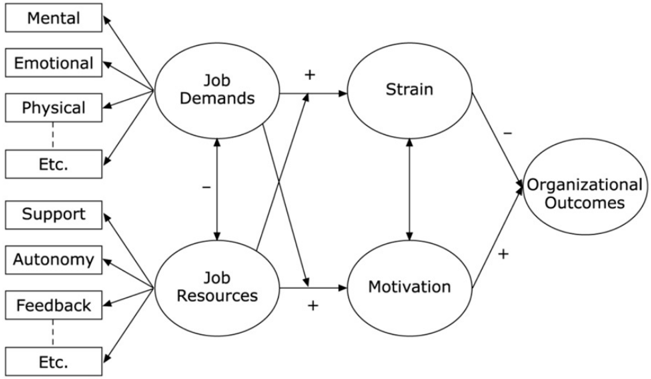
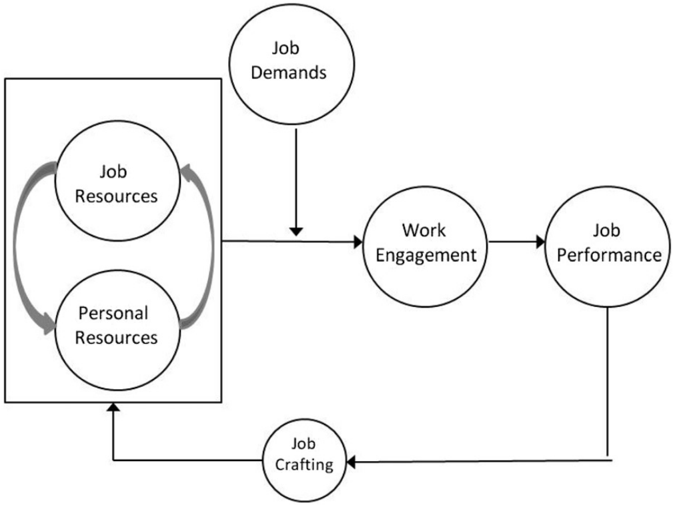
- In the JD-R model, job demands and job resources evoke two relatively independent processes: a negative health-impairment process (demands → burnout) and a positive motivational process (resources → commitment, engagement, high performance). For work engagement specifically, job demands do not affect engagement directly but moderate the positive resource–engagement relationship, which becomes stronger when demands are high.
- Role differences are repeatedly found: physicians and researchers report higher work engagement for their physician and research work than for teaching (van den Berg et al. 2013, 2016; Scheepers et al. 2014). Scheepers et al. (2014) found physicians highly engaged for patient care were not always recognized by residents as better teachers, while those highly engaged for teaching were recognized both as better supervisors and better role models.
- Cited intervention evidence: a one-year resources development program for recently graduated veterinarians significantly improved self-efficacy and reflective behavior (Mastenbroek et al. 2015); a facilitated small-group intervention for physicians improved meaningfulness in work and work engagement and reduced overall burnout (West et al. 2014). A 2012 review found evidence for positive effects of teaching awards scarce, with negative consequences also reported (Huggett et al. 2012).
Methods
- Design: narrative AMEE Guide synthesizing existing literature on work engagement, burnout and the JD-R model, with the stated aim of providing a concise overview of positive well-being of teachers in health professions education and suggestions for practice and future research.
- Data: no primary data collection; the guide draws on published studies selected on stated criteria — fundamental work in occupational well-being and performance, work relating to engagement in health professions education or (where informative for the teacher role) other health professional roles, and key literature from other health professions education topics that could link to work engagement.
- Analysis: conceptual/theoretical synthesis organized around the JD-R model, including definitions of job demands, job resources and personal resources, consequences of engagement, role-interaction, measurement (e.g. the nine-item Utrecht Work Engagement Scale, scored from never (0) to daily/always (6)), and intervention approaches.
Limitations
- The paper states that "there is still a lot left to be studied," noting limited insight into how teachers balance multiple roles, how determinants of engagement differ across roles, and how best to develop personal resources in students; it also notes that effectiveness of interventions during periods of autonomous personal growth is particularly difficult to measure (Rhind et al. 2011).
- The paper acknowledges that a relatively large amount of literature on work engagement specifically in health professions education originates from the Netherlands, though it states generalizability and transferability were discussed within those peer-reviewed international articles.
- Evident from the text (not stated as a formal limitation): this is a narrative guide rather than a systematic review, so literature selection is purposive rather than exhaustive; several cited sources were listed as "under submission" or "accepted for publication" at the time, and the guide explicitly excludes job satisfaction, flow, and student stress/coping from its scope.
Model-written summary. Check it against the paper before relying on it.
Integrity signals
Registry
Cites
Statistics
Figures


Verification
Claims the paper makes
13 Valid · 7 Not valid · 55 Not checked · 17 Own results and interpretations
Every source the paper cites for this claim was checked and supports it.
In the paper
“Performance feedback is one of the previously known resources positively affecting work engagement in medical education (van den Berg et al. 2013).”
What the sources say
- Supportedcites van den Berg et al. 2013 matched to “Key factors in work engagement and job motivation of teaching faculty at a university medical centre” (2013) source
The Results section reports a positive correlation between feedback on teaching performance and teaching engagement (r = 0.36, p < 0.01), with feedback showing the strongest predictive value among the seven factors examined. The Discussion identifies performance feedback as a job resource for teaching faculty at a university medical centre. (LLM, conf=0.91)
boostedstates a cause- Asserted: passes — The authors put it forward as true.
- Checkable: passes — It can be checked against evidence.
- Load-bearing: passes — The paper’s conclusions depend on it.
- Based: passes — The paper gives a reason why it holds.
- Rests on an assumption not shown here.
- Supported
Every source the paper cites for this claim was checked and supports it.
In the paper
“Recognition of the teaching task has been described as a job resource by teachers in medical education (van den Berg et al. 2015).”
What the sources say
- Supportedcites van den Berg et al. 2015 matched to “A qualitative interview study on the positive well-being of medical school faculty in their teaching role: job demands, job resources and role interaction” (2015) source
In Results, under “Organization and department related demands and resources,” the authors include perceived recognition for teaching among the demands and resources described by medical school faculty. They also report that several participants felt acknowledged by teaching awards, although one participant did not view the awards positively. (LLM, conf=0.91)
plain- Asserted: passes — The authors put it forward as true.
- Checkable: passes — It can be checked against evidence.
- Load-bearing: passes — The paper’s conclusions depend on it.
- Based: passes — The paper gives a reason why it holds.
- Supported
The cited sources support only part of this claim — read each source’s verdict below.
In the paper
“Looking carefully to individual needs regarding valued job resources in one role might be the key to improving work engagement in other roles (van den Berg et al. 2015).”
What the sources say
- Partly supportedcites van den Berg et al. 2015 matched to “A qualitative interview study on the positive well-being of medical school faculty in their teaching role: job demands, job resources and role interaction” (2015) sourceExperimental — accuracy not yet measured
The Results (Role interaction; page unavailable) describe resources from clinical work and research benefiting participants in their teaching role. The Results (Identified themes) and Discussion also say that what counts as a resource varies by individual and that support should reflect this. The study examines effects on teaching engagement, however, rather than showing that resources in any one role improve engagement in other roles generally. (LLM, conf=0.84)
hedgedstates a possible cause- Asserted: passes — The authors put it forward as true.
- Checkable: unclear — It is unclear whether it could be checked against evidence.
- Load-bearing: passes — The paper’s conclusions depend on it.
- Based: passes — The paper gives a reason why it holds.
- Rests on an assumption not shown here.
- Partly supported
The sources with a verdict support this claim; the rest weren’t checked yet, have no full text we could read, or their verdicts aren’t rated yet.
In the paper
“We have not gained much insight yet in how teachers themselves find the right balance in this complexity -we do know teachers may find this difficult (Kumar et al. 2011; van den Berg et al. 2015).”
What the sources say
- Not checked — no full text of the sourcecites Kumar et al. 2011 matched to “Entering and navigating academic medicine: academic clinician-educators’ experiences” (2011) source
- Supportedcites van den Berg et al. 2015 matched to “A qualitative interview study on the positive well-being of medical school faculty in their teaching role: job demands, job resources and role interaction” (2015) source
In Results > Role interaction, participants describe scheduling conflicts, increased work pressure, and the energy required to shift between tasks. The Conclusion also says that fulfilling different tasks may lead to role conflict. Together, these passages support the qualified claim that teachers may find managing multiple roles difficult. (LLM, conf=0.90)
hedged- Asserted: passes — The authors put it forward as true.
- Checkable: passes — It can be checked against evidence.
- Load-bearing: unclear — It is unclear whether the paper’s conclusions depend on it.
- Based: passes — The paper gives a reason why it holds.
Every source the paper cites for this claim was checked and supports it.
In the paper
“Participants mention that the reflective process made them aware of their limiting beliefs, and that they had a choice to whether they allowed these beliefs to determine their behavior or not (Mastenbroek et al. 2015).”
What the sources say
- Supportedcites Mastenbroek et al. 2015 matched to “Effects of a 1 year development programme for recently graduated veterinary professionals on personal and job resources: a combined quantitative and qualitative approach” (2015) source
The Results section (“Self-acceptance and self-esteem”; page not provided) says participants became aware of their own thoughts and could choose whether to let limiting factors determine their behaviour. This supports the citing sentence’s paraphrase of those factors as limiting beliefs. (LLM, conf=0.92)
plainstates a cause- Asserted: passes — The authors put it forward as true.
- Checkable: passes — It can be checked against evidence.
- Load-bearing: unclear — It is unclear whether the paper’s conclusions depend on it.
- Based: passes — The paper gives a reason why it holds.
- Supported
37 more claims · 4 with their cited sources checked
Create a free account to see all 92 claims and to verify the 9 references still open.
- It may state two separate claims as one. 29
- Probably not a substantial claim. 30
Citations
Cites
(1999) · Cited by 28,356
Communities of Practice: Learning, Meaning, and Identity
Wenger, E. (1998) · doi:10.1017/cbo9780511803932 · Cited by 23,500 · cited 1×
“Besides a common goal, it is necessary that members of such a community share activities to actually feel connected (Wenger 1998; Akkerman et al. 2008).”
Conservation of resources: A new attempt at conceptualizing stress
Hobfoll, S. E. (1989) · American Psychologist · doi:10.1037/0003-066x.44.3.513 · Cited by 18,187 · cited 1×
“According to Hobfoll (1989) people strive to obtain, retain, protect and foster resources and when people develop a resource surplus, they are likely to experience positive well-being.”
Stress, social support, and the buffering hypothesis
Cohen, S., & Wills, T. A. (1985) · Psychological Bulletin · doi:10.1037/0033-2909.98.2.310 · Cited by 18,093 · cited 1×
“Social support can prevent stress and stressful events (Cohen and Wills 1985).”
The job demands-resources model of burnout.
Demerouti, E., Bakker, A. B., Nachreiner, F., & Schaufeli, W. B. (2001) · Journal of Applied Psychology · doi:10.1037/0021-9010.86.3.499 · Cited by 13,643 · cited 1×
“According to the health impairment process high job demands may exhaust employee ’ s mental and physical resources and may therefore lead to burnout and health problems (Demerouti and Bakker 2001).”
The Job Demands‐Resources model: state of the art
Bakker, A. B., & Demerouti, E. (2007) · Journal of Managerial Psychology · doi:10.1108/02683940710733115 · Cited by 12,996 · cited 2×
“An important model that underlies both burnout and work engagement literature is the Job Demands-Resources (JD-R) model (Bakker and Demerouti 2007) (Figure 1).”
Positive psychology: An introduction.
Seligman, M. E. P., & Csikszentmihalyi, M. (2000) · American Psychologist · doi:10.1037/0003-066x.55.1.5 · Cited by 11,351 · cited 1×
“Subsequent research largely remained focused on burnout and illness and researchers were called upon to include positive outcomes as well (Seligman and Csikszentmihalyi 2000).”
PSYCHOLOGICAL CONDITIONS OF PERSONAL ENGAGEMENT AND DISENGAGEMENT AT WORK.
Kahn, W. A. (1990) · Academy of Management Journal · doi:10.2307/256287 · Cited by 10,975 · cited 2×
“One of the earliest descriptions of engagement as a psychological concept focused on personal engagement and the degree of investment of the self in work (Kahn 1990).”
The measurement of engagement and burnout: a two sample confirmatory factor analytic approach.
Schaufeli, W. B., Salanova, M., González-romá, V., & Bakker, A. B. (2002) · Journal of Happiness Studies · doi:10.1023/a:1015630930326 · Cited by 10,014 · cited 1×
“The concept of engagement was then revisited and adopted into the broader operationalization of work engagement as a distinct and positive form of well-being alongside burnout (Schaufeli et al. 2002).”
Job demands, job resources, and their relationship with burnout and engagement: a multi‐sample study
Schaufeli, W. B., & Bakker, A. B. (2004) · Journal of Organizational Behavior · doi:10.1002/job.248 · Cited by 9,297 · cited 4×
“Secondly, according to the motivational process, the availability of job resources has motivational potential and leads to commitment, work engagement and high performance (Schaufeli and Bakker 2004; Bakker and Demerouti 2007).”
Influential
Research works printed but not linked: 1
- Joint Commission. 2009. Comprehensive accreditation manual for hospitals: the official handbook. Oakbrook Terrace: Joint Commission Resources.
Cited by
Achieving Operational Excellence Through Artificial Intelligence: Driving Forces and Barriers
Tariq, M. U., Poulin, M., & Abonamah, A. A. (2021) · Frontiers in Psychology · doi:10.3389/fpsyg.2021.686624 · Cited by 194
“It can provide a direct influence on employee benefits and improve organizational excellence (Alvi et al., 2020).”
BackgroundGe, J., He, J., Liu, Y., Zhang, J.-Y., Pan, J.-P., Zhang, X., & Liu, D.-P. (2020) · BMC Public Health · doi:10.1186/s12889-021-10233-w · Cited by 101
“Work engagement is de ned as a positive, ful lling, work-related state of mind characterized by vigour, dedication, and absorption [23].”
BackgroundJob satisfaction, work engagement, and turnover intention of CTE health science teachers
Park, K. A., & Johnson, K. R. (2019) · International Journal for Research in Vocational Education and Training · doi:10.13152/ijrvet.6.3.2 · Cited by 155
“Faculty development through continuing education also leads to positive work engagement (van den Berg, Mastenbroek, Scheepers, & Jaarsma, 2017).”
Student engagement in health professions education: AMEE Guide No. 152
Kassab, S. E., Taylor, D., & Hamdy, H. (2022) · Medical Teacher · doi:10.1080/0142159x.2022.2137018 · Cited by 104
Srimulyani, V. A., & Hermanto, Y. B. (2022) · Humanities and Social Sciences Communications · doi:10.1057/s41599-022-01289-z · Cited by 109
Burnout Syndrome in Paediatric Oncology Nurses: A Systematic Review and Meta-Analysis
Fuente-Solana, E. I. D. L., Pradas‐Hernández, L., Ramiro-Salmerón, A., Suleiman‐Martos, N., Gómez‐Urquiza, J. L., Albendín‐García, L., & la Fuente, G. A. C. (2020) · Healthcare · doi:10.3390/healthcare8030309 · Cited by 88
“Its effects have been observed among diverse occupational groups, including firefighters [4], police officers [5,6], military personnel [7], teachers [8,9] and, above all, healthcare workers [10–13].”
BackgroundAgarwal, G., Mosquera, M., Ring, M., & Victorson, D. (2020) · Medical Teacher · doi:10.1080/0142159x.2019.1679746 · Cited by 60
“…aspects that (1) reduce job demands and the associated physiological and psychological costs; (2) are functional in achieving work goals; (3) or stimulate personal growth, learning and development (Bakker et al. 2005; Xanthopoulou et al. 2007; Bakker and Demerouti 2017; van den Berg et al. 2017).’”
BackgroundWork engagement and associated factors among dental nurses in China
Wang, Y., Gao, Y., & Xun, Y. (2021) · BMC Oral Health · doi:10.1186/s12903-021-01766-y · Cited by 71
“01) between work engagement and subjective well-being, similar to other studies [52].”
ResultHealth science student teachers' perceptions of teacher competence: A qualitative study
Kuivila, H., Mikkonen, K., Sjögren, T., Koivula, M., Koskimäki, M., Männistö, M., Lukkarila, P., & Kääriäinen, M. (2019) · Nurse Education Today · doi:10.1016/j.nedt.2019.104210 · Cited by 54
Shorten, G., ROBERTIS, E. D., Goldik, Z., Kietaibl, S. A., Niemi‐Murola, L., & Sabeļņikovs, O. (2020) · European Journal of Anaesthesiology · doi:10.1097/eja.0000000000001201 · Cited by 55
Zhai, Y., Xiao, W., Sun, C., Sun, B., & Yue, G. (2023) · Psychological Reports · doi:10.1177/00332941231189217 · Cited by 44
“The JD-R model can explain this fi nding by assuming that two relatively independent psychology processes can evoke well-being: the adverse health impairment process and the positive motivational process (van den Berg et al., 2017).”
Kool, L. E., Jong, E. F., Schellevis, F., & Jaarsma, D. A. D. C. (2018) · Midwifery · doi:10.1016/j.midw.2018.10.012 · Cited by 34
Self-citationJob Crafting to Persist in Surgical Training: A Qualitative Study From the Resident's Perspective
Domínguez, L. C., Dolmans, D. H. J. M., de Grave, W. S., Sanabria, Á., & Stassen, L. P. S. (2019) · Journal of Surgical Research · doi:10.1016/j.jss.2019.02.005 · Cited by 22
Factors influencing work engagement among male nurses: A structural equation model
Wu, C., Cheng, S., Wu, J., Zhang, Y., Lin, Y., Li, L., Du, J., Zhang, Y., & Lang, H. (2023) · Nursing Open · doi:10.1002/nop2.2016 · Cited by 21
“Good work engagement was conductive to improving individual work satisfaction, achieving better work resources and reducing turnover intentions, as well as improving the overall work performance (van den Berg et al., 2017 ; Wang et al., 2021 ).”
BackgroundSupporting health professional educators in the workplace: A scoping review
Tassoni, D., Kent, F., Simpson, J., & Farlie, M. K. (2022) · Medical Teacher · doi:10.1080/0142159x.2022.2102467 · Cited by 22
Síndrome de Burn-out: um olhar para o esgotamento profissional do docente universitário
Ferreira, E. C., & Pezuk, J. A. (2021) · Avaliação Revista da Avaliação da Educação Superior (Campinas) · doi:10.1590/s1414-40772021000200008 · Cited by 28
The role of feedback in ameliorating burnout
Gordon, E. K. B., Baranov, D. Y., & Fleisher, L. A. (2018) · Current Opinion in Anaesthesiology · doi:10.1097/aco.0000000000000583 · Cited by 16
Strategies to promote nurse educator well-being and prevent burnout: An integrative review
Lovern, A., Quinlan, L., Brogdon, S., Rabe, C., & Bonanno, L. S. (2023) · Teaching and learning in nursing · doi:10.1016/j.teln.2023.09.004 · Cited by 21
Medina-Córdoba, M., Cadavid, S. E., Espinosa-Aranzales, A.-F., Rojas, K. A., Bermúdez-Hernández, P.-A., Torres, D. A. Q., & Dueñas, W. R. R. (2023) · Advances in Health Sciences Education · doi:10.1007/s10459-023-10300-4 · Cited by 25
Scheepers, R. A., Boxem, A. J., & Blezer, M. M. J. (2023) · Medical Teacher · doi:10.1080/0142159x.2023.2240000 · Cited by 10
“On the other hand, junior doctors experience optimal well-being when they are engaged in their work; they are dedicated, energetic, and concentrated (Bakker 2011; van den Berg et al. 2017).”
BackgroundSelf-citationMhlanga, T. S., Mjoli, T. Q., Chamisa, S. F., & Marange, C. S. (2021) · SA Journal of Industrial Psychology · doi:10.4102/sajip.v47i0.1804 · Cited by 14
The effects of job characteristics on physicians’ orientation toward lifelong learning
Lin, Y.-L., Chen, H., Chen, Y., Cheng, S., Chen, W., Chiu, Y., & Chiu, Y. (2023) · Advances in Health Sciences Education · doi:10.1007/s10459-022-10202-x · Cited by 8
“With respect to teaching duties, a teaching role may be perceived as a job resource that provides health professionals with satisfying information and job control in clinical teaching (van den Berg et al., 2017).”
BackgroundDomínguez, L. C., Vega, N. V., Sandoval-Reyes, J. G., & Sanabria, Á. (2024) · Revista Colombiana de Cirugía · doi:10.30944/20117582.2508 · Cited by 6
Suliman, S., Kalfah, A., Jeganath, M. T. S. V., Alsaid, A., Mills, D. R., Al-Aamri, K. J., Rudwan, H. M. A., & Al‐Khal, A. (2025) · BMC Medical Education · doi:10.1186/s12909-025-07435-w · Cited by 7
“In addition, teacher work engagement positively correlates with teaching performance, which is further positively linked to the perception of being positive role models [9].”
Impact of faculty well-being on medical student education
Bynum, R. C., Richman, J., Corey, B., & Fazendin, J. M. (2022) · Global Surgical Education - Journal of the Association for Surgical Education · doi:10.1007/s44186-022-00082-5 · Cited by 7
“This process of training not only clinically and academically strong physicians, but those with high levels of work engagement is an important focus, which may be beneficial to begin as early as in undergraduate medical education [14].”
Wisdom, C. M. (2023) · Journal of Physical Therapy Education · doi:10.1097/jte.0000000000000293 · Cited by 4
Findyartini, A., Lee, S. S., Felaza, E., Mustika, R., & Greviana, N. (2022) · Springer eBooks · doi:10.1007/978-981-16-7232-3_12 · Cited by 5
Maoz, L. B., Lavy, S., & Berkovich‐Ohana, A. (2025) · Psychology in the Schools · doi:10.1002/pits.23546 · Cited by 5
Cornejo, C. O., & Figueroa, A. J. (2021) · Cuadernos de Administración · doi:10.11144/javeriana.cao34.recvtf · Cited by 12
Die Rolle von persönlichen Ressourcen bei der Stressbewältigung
Thielmann, B., & Böckelmann, I. (2020) · PPmP - Psychotherapie · Psychosomatik · Medizinische Psychologie · doi:10.1055/a-1208-5333 · Cited by 5
“Berücksichtigung von Beziehungen zwischen Arbeitsmerkmalen, Persönlichkeitsmerkmalen sowie Wohlbefinden und Arbeitsleistung können Aspekte der Arbeit identifiziert werden, die das Wohlbefinden fördern oder beeinflussen [22].”
BackgroundNavigating burnout and professional identity among allied health educators
Lee, W. C., Dong, C., Quah, L. H. T., & Yan, C. C. K. (2025) · Medical Teacher · doi:10.1080/0142159x.2025.2579094 · Cited by 4
“Such pressures were perceived as potentially undermining both educator identity and career sustainability [19 – 21].”
Bruggen, J., Chen, H. C., van der Schaaf, M. F., & Pennings, H. J. M. (2025) · BMC Medical Education · doi:10.1186/s12909-025-07628-3 · Cited by 11
Early Education Care from Its Practitioners to Achieve Sustainability
Gavín-Chocano, Ó., López-Barajas, D. M., & García‐Martínez, I. (2021) · Sustainability · doi:10.3390/su13063396 · Cited by 5
Teacher engagement in health profession education: a scoping review
Rathan, R., Kassab, S. E., Schmidt, H. G., Nederhand, M. L., & Woltman, A. M. (2025) · BMC Medical Education · doi:10.1186/s12909-025-08352-8 · Cited by 5
“These educators are often drawn from diverse backgrounds, including physicians, nurses, scientists, and other health professionals, reflecting healthcare education’s interdisciplinary–but challenging–nature [9].”
Enhancing clinical educator well‐being
Moffett, J., Crawford, R., & Pawlikowska, T. R. B. (2019) · The Clinical Teacher · doi:10.1111/tct.13046 · Cited by 2
Yang, G., Wei, H., Wan, L., Dong, H., Liang, X., & He, Y. (2022) · Frontiers in Public Health · doi:10.3389/fpubh.2022.939649 · Cited by 8
Thielmann, B., Zavgorodnii, I., & Böckelmann, I. (2021) · Psychiatrische Praxis · doi:10.1055/a-1360-9207 · Cited by 2
“[18] van den Berg JW, Mastenbroek NJJM, Scheepers RA et al.”
BackgroundThe struggle to support the transition to medical educator
van den Berg, J. W., & Lombarts, K. M. J. M. H. (2018) · Medical Education · doi:10.1111/medu.13500 · Cited by 4
Self-citationHubungan spiritualitas dengan kesejahteraan psikologis pasien positif Covid-19 di RS Islam Jakarta
Kurniati, D. R., Gayatri, D., & Natashia, D. (2023) · Jurnal Kebidanan dan Keperawatan Aisyiyah · doi:10.31101/jkk.2444 · Cited by 6
Persistence in surgical training: the role of job crafting and leadership
Domínguez, L. C. (2021) · Research Publications (Maastricht University) · doi:10.26481/dis.20210223ld · Cited by 13
Park, K. A. (2018) · University of North Texas Digital Library (University of North Texas) · doi:10.12794/metadc1404567 · Cited by 1
Pengaruh Resilience at Work terhadap Work Engagement pada Dokter Hewan
Genita, B. S., & Dwarawati, D. (2023) · Bandung Conference Series Psychology Science · doi:10.29313/bcsps.v3i1.5464 · Cited by 4
WORK ENGAGEMENT OF DENTISTS AND DENTAL ASSISTANTS IN PRIMARY HEALTHCARE CORPORATION IN QATAR
Abbas, K. Z., Tayyem, A. S., AlBaw, M. I., Mathew, T., Jaleel, B. N. F., Alyafei, N. A., & Hatwish, A. (2022) · GLOBAL JOURNAL FOR RESEARCH ANALYSIS · doi:10.36106/gjra/1210671
Course Crafting in the Pandemic: Examination of Students’ Positive Experiences
Narayanan, L., Nasser, R. N., Menon, S., & Wallace, B. (2024) · Education Sciences · doi:10.3390/educsci14020131 · Cited by 2
Investigation of the Effects of Coaches' Work Limitations on Work Values and Work Engagement
Ağırbaş, İ. S., & Belli, E. (2022) · Akdeniz Spor Bilimleri Dergisi · doi:10.38021/asbid.1200023
Sun, J., Lu, Z., Song, X., Guo, D., & Wang, L. (2025) · Research Square · doi:10.21203/rs.3.rs-6732491/v1
Uddin, M. (2022) · IIUC Studies · doi:10.3329/iiucs.v18i1.61272 · Cited by 1
Cong, H., Qin, A., Bian, X., Nie, H., & Xu, L. (2026) · BMC Health Services Research · doi:10.1186/s12913-026-14626-8
“Emotional labor and insufficient organizational support have increasingly been recognized as common challenges affecting healthcare workforce engagement and well-being across healthcare systems worldwide [37].”
The Resilient Academic Surgeon
Rogers, D. A., & Lindeman, B. M. (2020) · Success in academic surgery · doi:10.1007/978-3-030-29271-3_6
Employee Engagement and Performance Management ‐Critical Role of Employee Potentials
Bano, A., & Khatun, A. (2025) · Wiley eBooks · doi:10.1002/9781394238354.ch11 · Cited by 3
Compromiso laboral: precursores, desenlaces e intervenciones en residentes de cirugía
Domínguez, L. C., Vega, N. V., & Sanabria, Á. (2024) · Revista Colombiana de Cirugía · doi:10.30944/20117582.2608
Metadata
- Authors
- van den Berg, J. W., Mastenbroek, N. J. J. M., Scheepers, R. A., & Jaarsma, A. D. C.
- Affiliations
- Institute of Education and Training, Professional Performance Research Group, Academic Medical Center (AMC-UvA), Amsterdam, The Netherlands;
- Utrecht University (NL)
- Amsterdam UMC Location University of Amsterdam (NL)
- Center for Education Development and Research in Health Professions, University Medical Center Groningen, University of Groningen, Groningen, The Netherlands
- Venue
- Medical Teacher
- Publisher
- Informa UK Limited
- Published
- 2017-08-22
- Volume
- 39
- Issue
- 11
- Pages
- 1110-1118
- ISSN
- 0142-159X (ISSN-L)
- 1466-187X
- OpenAlex
- W2746013717
- Semantic Scholar
- 4b4f5be4eaad0f1547e955b9976c452883e3d624
- Cited by
- 55
- References
- 72
- Citations by year
- 2026: 1 · 2025: 7 · 2024: 3 · 2023: 9 · 2022: 10 · 2021: 10 · 2020: 5 · 2019: 6 · 2018: 4
- FWCI
- 6.63
- Type
- journal article
- Language
- en
- Open access
- hybrid
- doi.org
- Licence
- cc-by-nc-nd
- Locations
- Medical Teacher (publishedVersion, cc-by-nc-nd)
- PubMed (publishedVersion)
- Pure Amsterdam UMC (publishedVersion, other-oa)
- University of Groningen research database (University of Groningen / Centre for Information Technology) (publishedVersion, cc-by-nc-nd)
- Data Archiving and Networked Services (DANS) (submittedVersion)
- Utrecht University Repository (Utrecht University) (submittedVersion, other-oa)
- University of Groningen research database (University of Groningen / Centre for Information Technology) (submittedVersion, cc-by-nc-nd)
- Topics
- Health Sciences › Health Professions › General Health Professions › Healthcare professionals’ stress and burnout
- Social Sciences › Business, Management and Accounting › Organizational Behavior and Human Resource Management › Job Satisfaction and Organizational Behavior
- Social Sciences › Psychology › Social Psychology › Workaholism, burnout, and well-being
- Keywords
- work engagement, health professions education, clinical instructors, burnout, job demands-resources model, teacher well-being, teacher performance, faculty development, medical residents, medical errors, teacher recognition, feedback provision
- MeSH terms
- Work Engagement, Burnout, Professional, Faculty, Feedback, Goals, Health Occupations, Humans, Mental Health, Social Support, Staff Development, Professional Role, Resilience, Psychological
About these checks
Registry, retraction, Cites and statistics results are computed, not judged, with one exception: a printed reference that no index lists is read once by a model before it counts as a citation error. Claims are extracted by a model and kept only when their quote appears verbatim in the text; each cited source is then checked, with a model’s help, for whether it says what the claim relies on. Those verdicts can be wrong — read the claim’s quote and the cited source before relying on one.
The claim verdicts this report counts are experimental: their accuracy is not yet measured.
A language model drew the claims from the paper on 2026-10-10, under version 3 of the claim definition (model deepseek-v4.1-flash, prompt extract-v3).
A second model labelled each claim on 2026-10-10 (model jev-1.13-20260917, definition revision gold-guideline-v0.2).
Cited sources are checked with a language model’s help (gpt-6-sol).
Statistics and arithmetic are recomputed, not judged.
Confidence bands are shown only for fields calibrated on our annotated test set. None is calibrated yet, so no band is shown.
What counts as a claim ›How we measure confidence ›How we check this ›
Are you an author, or do you see a problem with this page? Request a review
Data sources
Bibliographic data: Semantic Scholar, OpenAlex, Crossref.
Contains information from the Semantic Scholar Academic Graph Datasets, made available under the ODC Attribution License (ODC-BY 1.0).
Semantic Scholar’s data is described in: Kinney, R., et al. (2023). The Semantic Scholar Open Data Platform. arXiv:2301.10140.
