

Comparing Generative AI and teacher feedback: student perceptions of usefulness and trustworthiness
Open accessThe DOI matches its Crossref record; 37 of the 37 references it cites were found in a registry or an index; 20 of the 43 sources its claims cite were checked for support.
Abstract
The rapid integration of Generative Artificial Intelligence (GenAI) into educational contexts has presented both opportunities and challenges for students seeking and using feedback. While AI-generated feedback can offer increased access, timely responses and personalised insights, concerns about the quality of AI-generated feedback still persist, including issues of bias, factual inaccuracies, and homogenisation. This study investigates how students use, value and trust AI-generated feedback compared to feedback from educators. This paper draws on a large-scale cross-sectional survey administered across four major Australian universities. A quantitative analysis of 6960 respondents revealed that half of the students sought feedback from GenAI. Overall, students reported teacher feedback to be more helpful, and especially trustworthy. This paper also reports on the thematic analysis of 8642 open-ended responses, providing deeper insights into students’ experiences. This includes findings that students valued the feedback from GenAI because of its ease of access, timeliness, volume, understandability and that it was perceived to be less risky than seeking feedback from teachers. At the same time, students were concerned about GenAI’s reliability as well as contextual and disciplinary expertise. We argue that GenAI and teacher feedback appear to serve different needs, and therefore are complementary but not interchangeable.
Overview
CoChat Summary
TL;DR
In a cross-institutional Australian survey, about half of 6,960 students used GenAI for feedback, and students rated teacher feedback as more helpful and especially more trustworthy than GenAI feedback. Qualitative responses suggest GenAI and teacher feedback serve different needs and are complementary rather than interchangeable.
Key findings
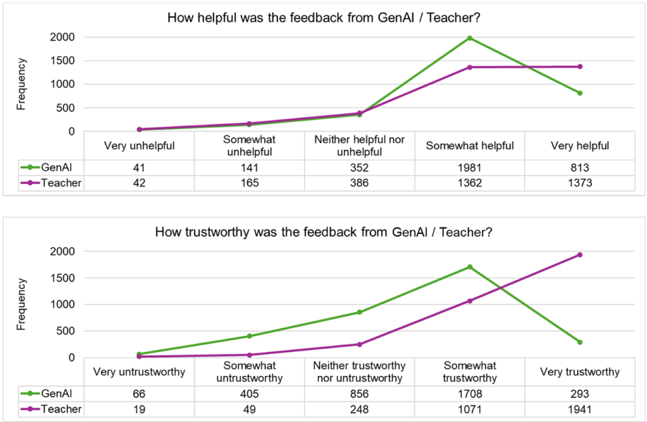
- Of 6,960 respondents, 49.7% (n = 3,461) sought feedback from GenAI and 50.3% (n = 3,499) did not. Among GenAI feedback users, 83.9% rated AI feedback somewhat/very helpful versus 82.2% for teacher feedback; 60.1% rated AI feedback somewhat/very trustworthy versus 90.5% for teacher feedback.
- Paired-samples t-tests found teacher feedback was rated more helpful than GenAI feedback (mean difference 0.14, SD = 1.15, t(3327) = -7.17, p < .001, Cohen’s d = -0.13, small effect) and more trustworthy (mean difference 0.93, SD = 1.09, t(3327) = -49.30, p < .001, Cohen’s d = -0.89, large effect). Means: helpfulness GenAI 4.02 vs teacher 4.16; trustworthiness GenAI 3.53 vs teacher 4.46.
- Qualitative analysis of 8,642 open-ended responses (11,903 coded instances) found most comparisons concerned the nature of feedback information (54.8%), followed by feedback processes (22.7%). GenAI was seen as less reliable, relevant, and contextualised but more objective and understandable; it was valued for access (ease n = 875, speed n = 614, volume n = 304).
- Among non-users, reasons included being unaware of the option or how to use it (28.1%, n = 957), trustworthiness concerns (28.7%), quality concerns (37.5%), privacy concerns (2.7%, n = 93), and integrity concerns (9.1%, n = 310). The authors conclude GenAI and teacher feedback are complementary but not interchangeable.
Methods
- Cross-sectional online survey across four Australian universities; approximately 192,000 students were invited, 5% (n = 10,132) volunteered, and 79% (n = 8,028) completed the survey. This paper draws on 6,960 students who responded to the GenAI-for-feedback item. Sample: 57% women, 72% aged 18–24, 58% spoke English as the main language at home, 89% full time, 58% domestic, 61% undergraduate, 92% on campus.
- Nine feedback-specific survey items; four Likert items on helpfulness and trustworthiness of GenAI versus teacher feedback were treated as continuous data, with two paired-samples t-tests conducted in SPSS version 29.
- Qualitative thematic analysis of open-ended responses following Braun and Clarke (2006), using inductive semantic coding; initial 18 codes were refined and expanded to 48 codes organised into themes and subthemes, yielding 8,642 usable text responses and 11,903 coded instances.
Limitations
- Stated: the response rate of about 8,000 from over 200,000 enrolled students cannot claim to be representative; the optional survey may have attracted students with stronger views about GenAI; Australian higher education may differ from other contexts; and the survey was completed when few students would have experienced GenAI feedback explicitly grounded in their curriculum/assignment resources, which could change perceptions.
- Stated/acknowledged: helpfulness findings are self-reported perceptions, and the paper notes this for helpfulness; the study does not measure learning impact or feedback accuracy.
- Evident from the text: qualitative inter-coder agreement was assessed subjectively rather than reported as a statistic, and the paper cites concerns that short open-ended survey responses may not support rigorous latent qualitative insights; the cross-sectional design also cannot show how perceptions change over time.
Model-written summary. Check it against the paper before relying on it.
Integrity signals
Registry
Cites
Statistics
Figures


Verification
Claims the paper makes
15 Valid · 0 Not valid · 19 Not checked · 86 Own results and interpretations
Every source the paper cites for this claim was checked and supports it.
In the paper
“These findings affirm and further expand on the literature that claims GenAI can be a valuable feedback source (e.g.Chan and Hu 2023;Lee and Moore 2024;Shi and Aryadoust 2024).”
§ Comparing Generative AI and teacher feedback: student perceptions of usefulness and trustworthiness > Students who used GenAI feedback
What the sources say
- Supportedcites Chan and Hu 2023 matched to “Students’ voices on generative AI: perceptions, benefits, and challenges in higher education” (2023) source
In “Personalized and immediate learning support” (p. 9), students value GenAI’s customized feedback, and the authors suggest it may help provide feedback on assignments. The claim describes this potential without asserting that the study demonstrated feedback effectiveness. (LLM, conf=0.92)
- Supportedcites Lee and Moore 2024 matched to “Harnessing Generative AI (GenAI) for Automated Feedback in Higher Education: A Systematic Review” (2024) source
The Included Articles section describes GenAI feedback systems as enhancing teaching effectiveness and offering substantial cognitive and emotional benefits to students. This supports the broad claim that GenAI can be a valuable feedback source. (LLM, conf=0.93)
- Supportedcites Shi and Aryadoust 2024 matched to “A systematic review of AI-based automated written feedback research” (2024) source
Section 5.2 says generative AI such as ChatGPT and GPT-4 offers opportunities for more in-depth, nuanced writing feedback. The Conclusion likewise says it promises more personalized feedback. These passages support the modest claim that GenAI can be a valuable feedback source, though the review does not establish its effectiveness empirically. (LLM, conf=0.88)
plain- Asserted: passes — The authors put it forward as true.
- Checkable: passes — It can be checked against evidence.
- Load-bearing: passes — The paper’s conclusions depend on it.
- Based: passes — The paper gives a reason why it holds.
- Supported
Every source the paper cites for this claim was checked and supports it.
In the paper
“This aligns with Wang's (2024) study of language learners which found their anxiety around feedback was lower when feedback is from GenAI rather than a teacher.”
§ Comparing Generative AI and teacher feedback: student perceptions of usefulness and trustworthiness > Students who used GenAI feedback
What the sources say
- Supportedcites Wang 2024 matched to “Teacher- Versus AI-Generated (Poe Application) Corrective Feedback and Language Learners’ Writing Anxiety, Complexity, Fluency, and Accuracy” (2024) source
The Abstract reports that learners receiving AI-generated feedback experienced a greater reduction in writing anxiety than those receiving teacher feedback. The Discussion likewise says the Poe application outperformed teacher feedback in reducing anxiety. The study measured writing anxiety, which is the specific form of anxiety behind this paraphrase. (LLM, conf=0.91)
plainstates a cause- Asserted: passes — The authors put it forward as true.
- Checkable: passes — It can be checked against evidence.
- Load-bearing: unclear — It is unclear whether the paper’s conclusions depend on it.
- Based: passes — The paper gives a reason why it holds.
- Supported
A result the paper reports from its own data — it cites no other source for it, so there is none to check. The quote shows it is in the paper.
In the paper
“Overall, students reported teacher feedback to be more helpful, and especially trustworthy.”
- Also stated in: § Results · plain
“Students reported teachers providing more helpful feedback than GenAI, and similarly rated them as more trustworthy than GenAI.”
- Also stated in: § Students who used GenAI feedback · plain
“In terms of helpfulness, there is a statistically significant difference (small effect size), in which teachers are rated more helpful.”
§ Comparing Generative AI and teacher feedback: student perceptions of usefulness and trustworthiness > Abstract
plainn = 6,960- Asserted: passes — The authors put it forward as true.
- Checkable: passes — It can be checked against evidence.
- Load-bearing: passes — The paper’s conclusions depend on it.
- Based: passes — The paper gives a reason why it holds.
- Also stated in: § Results · plain
A result the paper reports from its own data — it cites no other source for it, so there is none to check. The quote shows it is in the paper.
In the paper
“At the same time, students were concerned about GenAI's reliability as well as contextual and disciplinary expertise.”
- Also stated in: § Comparing GenAI to teacher-provided feedback · plain
“GenAI, in comparison to teacher-provided feedback, was considered less reliable, relevant and contextualised”
§ Comparing Generative AI and teacher feedback: student perceptions of usefulness and trustworthiness > Abstract
plain- Asserted: passes — The authors put it forward as true.
- Checkable: passes — It can be checked against evidence.
- Load-bearing: passes — The paper’s conclusions depend on it.
- Based: passes — The paper gives a reason why it holds.
- Also stated in: § Comparing GenAI to teacher-provided feedback · plain
A result the paper reports from its own data — it cites no other source for it, so there is none to check. The quote shows it is in the paper.
In the paper
“Overall, students reported teacher feedback to be more helpful, and especially trustworthy.”
- Also stated in: § Results · plain
“Students reported teachers providing more helpful feedback than GenAI, and similarly rated them as more trustworthy than GenAI.”
- Also stated in: § Students who used GenAI feedback · hedged
“These relational, contextually-expert and authoritative factors may underlie the striking difference in how students judged the trustworthiness of GenAI feedback to be less than that of teacher feedback (statistically significant, with large effect size).”
§ Comparing Generative AI and teacher feedback: student perceptions of usefulness and trustworthiness > Abstract
plainn = 6,960- Asserted: passes — The authors put it forward as true.
- Checkable: passes — It can be checked against evidence.
- Load-bearing: passes — The paper’s conclusions depend on it.
- Based: passes — The paper gives a reason why it holds.
- Also stated in: § Results · plain
58 more claims
Create a free account to see all 120 claims and to verify the 9 references still open.
- Probably not a substantial claim. 32
- It may state two separate claims as one. 35
- The quote only partly states this claim. 3
Claims other papers make about this one
Each is checked against this paper’s own text: does it say what the citing paper says it does?
The source backs part of the claim, not all of it — or backs it for a different population, condition or comparison.
In the citing paper
“Knowing it was AI-generated may have reduced trust compared to teacher feedback, making students more cautious in acting on it (Henderson et al., 2025; Nazaretsky et al., 2024).”
From Directive, metacognitive, or a blend of both? A comparison of AI-generated feedback types on student engagement, confidence, and outcomes (2026) · cites this paper as Henderson et al., 2025
Experimental — accuracy not yet measuredThe source backs part of the claim, not all of it — or backs it for a different population, condition or comparison.
In the citing paper
“The mere awareness that feedback originates from AI rather than a human instructor triggers distinct cognitive and affective responses-including differences in perceived trustworthiness, interpersonal risk, and emotional reactions-that influence how learners engage with and process the feedback (Henderson et al., 2025;Jacobsen et al., 2025).”
From Personalized language learning with an LLM chatbot: effects of immediate vs. delayed corrective feedback (2026) · cites this paper as Henderson et al., 2025
Experimental — accuracy not yet measuredIn the citing paper
“Accordingly, GenAI should not be viewed as indisputably superior, but rather as a feasible and scalable complement to human feedback (Henderson et al., 2025; Nazaretsky et al., 2024; Zhang et al., 2025).”
From Supporting self-regulated learning through generative AI feedback in online higher education: the importance of student perceptions of the source of feedback (2026) · cites this paper as Henderson et al., 2025
In the citing paper
“Recent largescale evidence demonstrates that learners perceive and trust feedback differently based on its attributed source, even when the quality and helpfulness are comparable (Henderson et al., 2025).”
From Personalized language learning with an LLM chatbot: effects of immediate vs. delayed corrective feedback (2026) · cites this paper as Henderson et al., 2025
Statistics recomputed
Every reported test result, recomputed from its test statistic and degrees of freedom. A result shows as not adding up only once an independent check has confirmed it.
- Consistentt(3327) = -7.17reported p < .001 · recomputed p < .001
“t(3327) = -7.17,p < .001”
- Consistentt(3327) = -49.3reported p < .001 · recomputed p < .001
“t(3327) = -49.30,p < .001”
Self-check
Percentages, sums and reported differences re-computed from the paper’s own numbers.
Each contradiction between two passages listed here was confirmed by an independent check.
Rated minor: it would not touch a result — a value no result rests on, a p-value that stays on the same side of the significance level, or a conflict that is clerical, resolved elsewhere in the paper, or outside its own findings.
In the paper
§ Comparing Generative AI and teacher feedback: student perceptions of usefulness and trustworthiness > Exploring why students chose not to use GenAI for feedback
“such as a general preference for human connection (4.3%)”
§ Comparing Generative AI and teacher feedback: student perceptions of usefulness and trustworthiness > Conclusion
“| | Personal | values the role of a teacher, or connection with | 204 (6%) | 359 (10.5%) |”
Citations
Cites
Using thematic analysis in psychology
Braun, V., & Clarke, V. (2006) · Qualitative Research in Psychology · doi:10.1191/1478088706qp063oa · Cited by 194,414
Guest, G., MacQueen, K., & Namey, E. (2012) · doi:10.4135/9781483384436 · Cited by 7,924 · cited 2×
“In addition, an audit trail (Guest, MacQueen, and Namey 2012) was kept by both coders, which helped the lead author (MH) to engage in internal replication (Dey 1993) of a random sample of codes from both coders, with any discrepancies leading to a further round of negotiation.”
Campbell, J. L., Quincy, C., Osserman, J., & Pedersen, O. K. (2013) · Sociological Methods & Research · doi:10.1177/0049124113500475 · Cited by 2,974 · cited 1×
“The coders (JH, XL) then continued with the coding, consulting with each other as a process of forming consensus and sustaining inter-coder agreement as described by Campbell et al. (2013).”
Students' voices on generative ai: perceptions, benefits, and challenges in higher education
Chan, C. K. Y., & Hu, W. (2023) · arXiv · doi:10.48550/arxiv.2305.00290 · Cited by 2,504 · cited 2×
“These findings affirm and further expand on the literature that claims GenAI can be a valuable feedback source (e.g. Chan and Hu 2023; Lee and Moore 2024; Shi and Aryadoust 2024).”
The development of student feedback literacy: Enabling uptake of feedback
Carless, D., & Boud, D. (2018) · Assessment & Evaluation in Higher Education · doi:10.1080/02602938.2018.1463354 · Cited by 2,428 · cited 2×
“Carless and Boud (2018) conceptualise feedback literacy as having three aspects that directly influence the learner’s actions, roughly: understanding feedback processes, making evaluative judgements, and managing ‘feelings, emotions and attitudes’ (p. 1317).”
Qualitative Data Analysis: A User Friendly Guide for Social Scientists
Dey, I. (2003) · Routledge eBooks · doi:10.4324/9780203412497 · Cited by 2,388
Students’ voices on generative AI: perceptions, benefits, and challenges in higher education
Chan, C. K. Y., & Hu, W. (2023) · International Journal of Educational Technology in Higher Education · doi:10.1186/s41239-023-00411-8 · Cited by 2,301 · cited 2×
“These findings affirm and further expand on the literature that claims GenAI can be a valuable feedback source (e.g. Chan and Hu 2023; Lee and Moore 2024; Shi and Aryadoust 2024).”
Varpio, L., Ajjawi, R., Monrouxe, L. V., O'Brien, B. C., & Rees, C. E. (2017) · Medical Education · doi:10.1111/medu.13124 · Cited by 1,028 · cited 1×
“An inductive approach was used, acknowledging that as feedback researchers, we bring domain theory to the topic and actively construct themes (varpio et al. 2017).”
Winstone, N. E., Nash, R. A., Rowntree, J., & Parker, M. (2017) · Studies in Higher Education · doi:10.1080/03075079.2015.1130032 · Cited by 417 · cited 1×
“This is promising because it reveals a large proportion of students actively engaging in feedback seeking behaviours which is regularly communicated in feedback literature as a valuable condition that supports effective feedback (Henderson, Molloy, et al., 2019; Winstone et al. 2017).”
Will generative AI replace teachers in higher education? A study of teacher and student perceptions
Chan, C. K. Y., & Tsi, L. H. Y. (2024) · Studies in Educational Evaluation · doi:10.1016/j.stueduc.2024.101395 · Cited by 387 · cited 1×
“This directly challenges the claims that GenAI feedback is an opportunity for ‘liberating teachers from time-consuming tasks and allowing them to concentrate on higher-level responsibilities’ (Chan and Tsi 2024, p.2).”
Cited by
Çelik, İ., Kontkanen, S., Laru, J., & Dalyanci, A. A. (2025) · Computers & Education · doi:10.1016/j.compedu.2025.105485 · Cited by 89
Teacher, peer, or AI? Comparing effects of feedback sources in higher education
Weidlich, J., Gotsch, F., Schudel, K., Marusic-Würscher, C., Mazzarella, J., Bolten, H., Bütler, D., Luger, S., Wohlfender, B., & Merki, K. M. (2025) · Computers and Education Open · doi:10.1016/j.caeo.2025.100300 · Cited by 36
Walton, J., Bearman, M., Crawford, N., Tai, J., & Boud, D. (2026) · Assessment & Evaluation in Higher Education · doi:10.1080/02602938.2025.2570328 · Cited by 28
“Some determine if, when, and how GenAI should provide them with feedback information, and then make judgements about what to do next (Henderson et al. 2025).”
Self-citationWho Gives Feedback Matters: Student Biases Towards Human and AI ‐Generated Formative Feedback
Nazaretsky, T., Mejia‐Domenzain, P., Swamy, V., Frej, J., & Käser, T. (2026) · Journal of Computer Assisted Learning · doi:10.1111/jcal.70153 · Cited by 26
Farrokhnia, M., Latifi, S., Papadopoulos, P. M., Hogenkamp, L., Gijlers, H., Khosravi, H., & Noroozi, O. (2026) · International Journal of Educational Technology in Higher Education · doi:10.1186/s41239-026-00579-9 · Cited by 55
Feedback by Design: Understanding and Overcoming User Feedback Barriers in Conversational Agents
Sharma, N., Zhang, Z., Lee, D., Krishnan, N., Ren, G.-J., Xiao, Z., & Li, Y. (2026) · Proceedings of the 2026 CHI Conference on Human Factors in Computing Systems · doi:10.1145/3772318.3791600 · Cited by 21
Lo, N., & Chan, S. (2025) · SN Computer Science · doi:10.1007/s42979-025-04532-x · Cited by 21
Dong, Y. (2026) · Humanities and Social Sciences Communications · doi:10.1057/s41599-026-06903-y · Cited by 39
Martin, A. F., Tubaltseva, S., Harrison, A., & Rubin, G. J. (2025) · Behavioral Sciences · doi:10.3390/bs15060808 · Cited by 16
“Interest in the role of AI in education has accelerated rapidly in recent years (Strielkowski et al., 2025), with growing attention being paid to its implications for assessment and feedback practices (e.g., Henderson et al., 2025; Usher, 2025).”
Ruwe, T., & Kuklick, L. (2025) · British Journal of Educational Technology · doi:10.1111/bjet.70011 · Cited by 22
Quan, Y. (2025) · Learning and Motivation · doi:10.1016/j.lmot.2025.102192 · Cited by 27
Chang, Q. (2025) · RELC Journal · doi:10.1177/00336882251399226 · Cited by 22
“Even users who maintain a positive perception of ChatGPT as writing feedback and learning partner are wary of inaccurate information and various ‘ hallucinations ’ in its responses (Henderson et al., 2025).”
M. Kamelabad, A., Turano, B., Lundin, M., & Skantze, G. (2026) · Frontiers in Education · doi:10.3389/feduc.2026.1703664 · Cited by 13
On the essay in a time of GenAI
Corbin, T., Walton, J., Bannister, P., & Deranty, J. (2025) · Educational Philosophy and Theory · doi:10.1080/00131857.2025.2572802 · Cited by 27
“We have mounting evidence that students use AI to support their reading (Corbin et al., 2024), to generate and interpret feedback (henderson et al., 2025), and, most disruptively for our purposes, to understand, produce, reference, critique, and polish assessment tasks (Walton et al., 2025).”
AI assistance in peer feedback provision: Pedagogically sound, but minimally adopted
Pozdniakov, S., Brazil, J., Banihashem, S. K., Noroozi, O., Gašević, D., Sadiq, S., & Khosravi, H. (2026) · Computers & Education · doi:10.1016/j.compedu.2026.105591 · Cited by 11
The care-full craft of feedback in an age of generative AI
Winstone, N., Gravett, K., Bearman, M., Noble, C., Jensen, L. X., Jones, A., & Nicola‐Richmond, K. (2026) · Assessment & Evaluation in Higher Education · doi:10.1080/02602938.2026.2643333 · Cited by 12
“Similarly, Henderson et al. (2025) surveyed Australian students and found that 90.5% reported educator feedback information as somewhat or very trustworthy, compared with only 60.1% for AI-generated feedback information.”
InfluentialSelf-citationÖzhan, Ş. Ç., Tekeli, P., & Kocadere, S. A. (2025) · Journal of Computer Assisted Learning · doi:10.1111/jcal.70134 · Cited by 14
Ning, Y., Seah, W. T., Chen, J., Liu, J., & Tan, P. (2026) · Computers & Education · doi:10.1016/j.compedu.2026.105572 · Cited by 11
A Critical Review of Privacy, Bias, and Trust Challenges in Generative AI for Educational Contexts
Kumar, G., & Vavekanand, R. (2025) · IEEE International Conference on Data and Software Engineering (ICoDSE) · doi:10.1109/icodse68111.2025.11351807 · Cited by 10
“The studies needs to track the equity and access thus more emphasis on marginalised groups should be on these studies to avoid widening educational inequalities [21], [23].”
Wang, S., & Hew, K. F. (2026) · Computers & Education · doi:10.1016/j.compedu.2026.105621 · Cited by 16
Think–Pair–Chatbot–Share: AI-Facilitated Peer Learning in Chemistry
Naeyaert, P. J. P., Scarratt, L. R. J., Murphy, T., & Pullen, R. (2025) · Journal of Chemical Education · doi:10.1021/acs.jchemed.5c00438 · Cited by 9
Navío-Inglés, M., Mora, J. G., O’Connor-Jiménez, P., & González, A. G. (2025) · Education Sciences · doi:10.3390/educsci15111534 · Cited by 15
“Finally, the cross-sectional study carried out by Henderson et al. (2025) showed that participants viewed generative AI as a valuable tool for feedback.”
Student perspectives on AI‐supported formative assessment in pharmacology
Berg, J. A., Repstad, Ø., Serkland, T. T., Mork, T. E., Bru, C., Tenstad, O., & Kvernenes, M. (2025) · British Journal of Clinical Pharmacology · doi:10.1002/bcp.70267 · Cited by 8
Almutlaq, S. A., & Alsaleh, Z. M. (2025) · Assessment & Evaluation in Higher Education · doi:10.1080/02602938.2025.2586124 · Cited by 8
“EFL learners generally value teacher feedback more than their peer and AI-generated feedback (GenAI) (Fithriani, 2018; Henderson et al. 2025; Hyland & Hyland, 2019; Link et al. 2022; Nazaretsky et al. 2024; Srichanyachon, 2012; Tsui & Ng, 2000; Yang et al. 2006; Zou et al. 2025).”
Seneviratne, T., Manathunga, S. S., Idirisingha, W., Somaratne, K., Marambe, K. N., & Dangahadeniya, U. (2025) · PLoS ONE · doi:10.1371/journal.pone.0336154 · Cited by 6
“Studies done by Henderson et al, Zhang et al and Nazaretsky et al emphasize the importance of AI-human co-produced feed-back over AI feedback alone [32–34].”
Yilmaz, M., Temur, H. B., Emmungil, L., Çelik, E., Gauthier, A., & Cukurova, M. (2026) · International Journal of Educational Technology in Higher Education · doi:10.1186/s41239-026-00592-y · Cited by 10
“Accord-ingly, GenAI should not be viewed as indisputably superior, but rather as a feasible and scalable complement to human feedback (Henderson et al., 2025; Nazaretsky et al., 2024; Zhang et al., 2025).”
InfluentialDurak, G., Çankaya, S., Esinbay, E., Yaman, H. E., Can, S., Özdemir, D., İkizler, Z., & İncemen, S. (2025) · International Journal of Technology and Design Education · doi:10.1007/s10798-025-10025-y · Cited by 9
Aziz, Z., Mazeh, A. C., Ilić, D., Ciardulli, M., Hadi, S. N. E., Camuccio, C. A., Moore, J. D., & Kiegaldie, D. (2026) · Nurse Education in Practice · doi:10.1016/j.nepr.2026.104711 · Cited by 8
Alsaiari, O., Baghaei, N., Lodge, J. M., Noroozi, O., Gašević, D., Boden, M., & Khosravi, H. (2026) · Computers and Education: Artificial Intelligence · doi:10.1016/j.caeai.2026.100553 · Cited by 5
Cooper, G., Ilich, K., & Sturrock, K. (2026) · Assessment & Evaluation in Higher Education · doi:10.1080/02602938.2026.2653889 · Cited by 8
Relational pedagogies in an age of GenAI: a critical conversation
Gravett, K., Winstone, N., & Balloo, K. (2026) · Teaching in Higher Education · doi:10.1080/13562517.2026.2643828 · Cited by 6
“Students are also engaging with GenAI independently of educators, and in ways that are not fully understood (Henderson et al. 2025).”
Lupton, D. A., & Bailey‐Charteris, B. (2026) · Big Data & Society · doi:10.1177/20539517261442430 · Cited by 7
“A cross-sectional survey administered across four Australian universities (Henderson et al., 2025) showed that half the student respondents had sought feedback on their work from generative AI, valuing the ease and timeliness of obtaining such feedback, but were aware that it was less trustworthy…”
LLM-generated formative feedback in education: A qualitative systematic literature review
Maier, U., Seibold, M., & Klotz, C. (2026) · Computers and Education Open · doi:10.1016/j.caeo.2026.100374 · Cited by 14
Lai, C., Pan, M., Guo, K., & Cui, Y. (2026) · Computers & Education · doi:10.1016/j.compedu.2026.105675 · Cited by 13
AI-teacher agreement in evaluating learning diaries
Reinhold, L., Händel, M., & Naujoks-Schober, N. (2025) · Frontiers in Education · doi:10.3389/feduc.2025.1601789 · Cited by 4
Fredriksson, A.-L. (2025) · Frontiers in Education · doi:10.3389/feduc.2025.1612398 · Cited by 4
Li, X., Wang, W., & Gu, L. (2025) · Assessment & Evaluation in Higher Education · doi:10.1080/02602938.2025.2587925 · Cited by 6
“While some students acknowledged a reduced personal risk interacting with GenAI for feedback, the majority were keenly aware of its lessened sense of connection (Henderson et al. 2025).”
InfluentialMahalingam, T. V. (2025) · Quality Assurance in Education · doi:10.1108/qae-07-2025-0215 · Cited by 17
Chea, P., & Deng, F. (2026) · Innovative Higher Education · doi:10.1007/s10755-026-09886-5 · Cited by 6
Curtis, G. J., Arness, D. C., Baird, M., Price, C., Thomson, S., Tremayne, K. S., & White, A. W. (2026) · International Journal for Educational Integrity · doi:10.1007/s40979-026-00215-z · Cited by 6
Autograder+: A Multi-Faceted AI Framework for Rich Pedagogical Feedback in Programming Education
Sahu, V., Gupta, G. R., Borikar, R., & Mane, N. G. (2025) · Joint International Conference on Data Science & Management of Data (CODS-COMAD) · doi:10.1145/3799830.3799878 · Cited by 11
“[22] Each of them was manually evaluated by Teaching Assistants (TAs), who provided "gold-standard" pedagogical feedback.”
Ng, O., Lim, S. Y., Goh, N., Ho, B., Cleland, J., Samuel, A., & Han, S. P. (2026) · Medical Teacher · doi:10.1080/0142159x.2026.2667280 · Cited by 5
Ebrahimzadeh, M., Shibani, A., & Shum, S. B. (2026) · Computers and Education Artificial Intelligence · doi:10.1016/j.caeai.2026.100609 · Cited by 14
Self-citationUsing DeepSeek’s reasoning-based AI model to support written feedback practices
Wu, C., Li, A. W., & Moorhouse, B. L. (2026) · Assessing Writing · doi:10.1016/j.asw.2026.101077 · Cited by 5
Du, Y., & Yuan, Y. (2026) · Assessment & Evaluation in Higher Education · doi:10.1080/02602938.2026.2732250 · Cited by 13
Jinowat, N., Wiboolyasarin, K., Chomchuen, F., & Wiboolyasarin, W. (2025) · Foreign Language Annals · doi:10.1111/flan.70042 · Cited by 4
Juliebø‐Jones, P., & Beisland, C. (2025) · Advances in Medical Education and Practice · doi:10.2147/amep.s557951 · Cited by 2
“30 In some settings, the project will already have been decided by the supervisor, but in other situations, the general area may have been agreed upon, but the specifics of the thesis have not been decided.”
Hartshorn, K. J., & Pack, A. (2026) · RELC Journal · doi:10.1177/00336882251405498 · Cited by 8
“Additionally, Henderson et al. (2025) reported that L2 writers perceived teacher-based WCF as more useful and dependable compared to AI-generated feedback.”
Macnaught, L. (2026) · Journal of English for Academic Purposes · doi:10.1016/j.jeap.2026.101646 · Cited by 5
Liu, J., Shi, Z., & Li, W. (2026) · Assessing Writing · doi:10.1016/j.asw.2026.101030 · Cited by 16
Feeling AI: Circulating emotions, institutional climates, and moral boundaries in student use of AI
Oberg, G., Liang, Y., Bearman, M., Fawns, T., Henderson, M., & Matthews, K. (2026) · Higher Education · doi:10.1007/s10734-026-01658-6 · Cited by 10
Self-citationMan, D., Zhang, L., & Kong, B. (2026) · International Journal of Applied Linguistics · doi:10.1111/ijal.70195 · Cited by 2
Huang, C.-Q., Lu, L.-N., Huang, Q., Zhang, Y., He, T., Tu, Y., & Hwang, G. (2026) · Educational Psychology Review · doi:10.1007/s10648-026-10166-z · Cited by 10
Rose, S. E., Taylor, L., Pheiffer, G., Fortune, Z., & Wilde, N. (2026) · Assessment & Evaluation in Higher Education · doi:10.1080/02602938.2026.2658633 · Cited by 2
Fruitman, H., Severin, S., Miah, A., Gao, C., Gim, H., Qian, C., Park, S.-O., Hou, K., Kong, E. L., Cook, B., et al. (2026) · Neurology Education · doi:10.1212/ne9.0000000000200320 · Cited by 3
“26 In future investigations, acceptability and perceptions of LLM feedback among medical students should be explored, recognizing that learner acceptance of feedback in fl uences meta-cognition and self-directed learning and improvement.”
Fawns, T., Bearman, M., Corbin, T., Henderson, M., McLean, J., Matthews, K., Oberg, G., Liang, Y., & Walton, J. (2026) · Higher Education · doi:10.1007/s10734-026-01730-1 · Cited by 3
Self-citationTseng, S.-S. (2026) · Assessment & Evaluation in Higher Education · doi:10.1080/02602938.2026.2658636 · Cited by 2
The Psychological Effects of AI Learning Assistants in Immersive Virtual Reality Environments
Tsinakos, A. A., Teazi, N., & Tsinakou, S. (2025) · Information · doi:10.3390/info16121062 · Cited by 1
Yang, C., Shao, J., & Guo, Y. (2025) · Innovation in Language Learning and Teaching · doi:10.1080/17501229.2025.2609877 · Cited by 6
Zeivots, S., Wright, S., Harris, L., Cram, A., Huber, E., Raduescu, C., White, A. W., & Brodzeli, A. (2026) · Studies in Higher Education · doi:10.1080/03075079.2026.2619909 · Cited by 3
The pedagogical power of recognition in feedback
Corbin, T., Tai, J., & Flenady, G. (2026) · Teaching in Higher Education · doi:10.1080/13562517.2026.2633634 · Cited by 3
“Emerging evidence shows that students frequently use GenAI for feedback (Henderson et al., 2025), which, from a recognition perspective, makes very good sense.”
Tishenina, M. (2026) · Studies in Philosophy and Education · doi:10.1007/s11217-026-10051-w · Cited by 5
Trust, ethical, and learning impact of artificial intelligence feedback in English education
BinJwair, A., & Alsaleh, A. A. (2026) · Frontiers in Psychology · doi:10.3389/fpsyg.2026.1809661 · Cited by 1
“Data were collected using a structured questionnaire, grounded in prior research on AI-GF and formative assessment in higher education (Henderson et al., 2025; Xu et al., 2025).”
InfluentialStudents’ psychological biases towards teacher and AI-generated feedback: an experimental study
Haiyan, Y. U. (2026) · BMC Psychology · doi:10.1186/s40359-026-04568-5 · Cited by 1
“There is minimal risk of revealing personal deficiencies to AI systems [20].”
InfluentialAlvero, J. C., & Saldua, M. (2026) · Journal of interdisciplinary perspectives · doi:10.69569/jip.2026.150 · Cited by 5
Hà, T. A. (2026) · TechTrends · doi:10.1007/s11528-026-01190-5 · Cited by 1
“GenAI has been applied to support both teachers and learners, to give feedback and instruction for learners’ writing (Henderson et al., 2025), to provide read-aloud question prompts (Yang et al., 2025), however, there are also questions over students’ technology dependence, AI manipulation and…”
Feedback futures: Beyond the limits of human and GenAI capacities
Zhan, Y., Wood, J., Carless, D., & Yan, Z. (2026) · Assessment & Evaluation in Higher Education · doi:10.1080/02602938.2026.2672830 · Cited by 2
Instructional Mechanisms for Professional Writing: A Comparison of Scaffolded Annotation and ChatGPT
Corvite, S., Matz, R. L., Mills, M., & Hui, J. S. (2026) · CHI Conference on Human Factors in Computing Systems · doi:10.1145/3772318.3790915
AI in the classroom: assessing GPTs’ capability in undergraduate finance tests
Pizzutilo, F., Massari, M., & Roncone, V. (2026) · Applied Economics · doi:10.1080/00036846.2026.2726529
Liyanagamage, N., & Gallage, N. (2025) · SSRN Electronic Journal · doi:10.2139/ssrn.5554497
Macnaught, L. (2025) · SSRN Electronic Journal · doi:10.2139/ssrn.5558287
Learning to Work With Artificial Intelligence as Part of Clinical Education
Bearman, M. (2025) · The Clinical Teacher · doi:10.1111/tct.70260
Self-citationHamzehloo, M., & Azar, A. S. (2025) · SSRN Electronic Journal · doi:10.2139/ssrn.5960775
Redefining Quality Assurance in AI-Augmented Transnational Education
Malik, M. H., Rosunally, Y. Z., & Younis, N. (2026) · Advances in computational intelligence and robotics book series · doi:10.4018/979-8-3373-5403-3.ch001
Zhao¹, Y., & Li², D. (2026) · Research Square · doi:10.21203/rs.3.rs-8386846/v1
Feedback from peers or teachers: The preferences and perceptions of pre-service EFL teachers
YILDIRIM, Ş. (2026) · Mehmet Akif Ersoy üniversitesi eğitim fakültesi dergisi. · doi:10.21764/maeuefd.1749277 · Cited by 1
Research challenges and future perspectives for e-assessment technologies in higher education
Striewe, M., Strickroth, S., & Ullrich, M. (2026) · i-com · doi:10.1515/icom-2026-0008 · Cited by 2
Ariel, Y. (2026) · Information and Learning Sciences · doi:10.1108/ils-12-2025-0234 · Cited by 1
Gündoğdu, B., & Merç, A. (2026) · SSRN Electronic Journal · doi:10.2139/ssrn.6428286
Moryossef, I. G., & Emanuelli, C. (2026) · Research Square · doi:10.21203/rs.3.rs-8888154/v1
Bao, M., Cao, C., & Zhang, Y. (2025) · International Conference on Artificial Intelligence and Teacher Education (ICAITE) · doi:10.1109/icaite68636.2025.11442463
“Related studies have also highlighted their advantages, including real-time feedback and wide accessibility of knowledge [12].”
TAFM: A Trust-Aware Feedback Module for Enhancing Reliability in Aipowered Educational Systems
Meng, X., & Yang, Y. (2025) · International Conference on Modern Educational Technology (ICMET) · doi:10.1109/icmet67594.2025.11452075 · Cited by 3
“These cues were selected based on prior work suggesting that language signaling uncertainty, authority, or narrative focus plays a key role in shaping trust perceptions [2, 7].”
genAI and Professional Learning: Governance, Upskilling, and Assessment Resilience
Ulbrick, R., & Pechenkina, E. (2026) · IGI Global eBooks · doi:10.4018/979-8-3373-3638-1.ch010
Brisk Teaching: An AI Tool Worth a Serious Look
Khoury, G. E. (2026) · The FLTmag. · doi:10.69732/ehbu6644
Generative Artificial Intelligence (GenAI) in Language Education: Current Trends and Perspectives
Trang, B. T. T., & Hoa, C. T. H. (2026) · Studies in computational intelligence · doi:10.1007/978-3-032-18392-7_1
Chen, Z., & Liu, F. (2026) · The Journal of Educational Research · doi:10.1080/00220671.2026.2650157
Sirnoorkar, A., & Rebello, N. S. (2026) · Physical Review Physics Education Research · doi:10.1103/v3pj-8491 · Cited by 7
Lê, N. H., & Doan, D. M. (2026) · Journal of Hospitality Leisure Sport & Tourism Education · doi:10.1016/j.jhlste.2026.100609 · Cited by 1
Grading in the Digital Age: AI Feedback Versus Professor Feedback
Russell, L. T. M., Zeiser, A. J., Mickler, R. D., & Winkel, D. E. (2026) · Journal of Marketing Education · doi:10.1177/02734753261440971 · Cited by 2
AI-Generated Slides: Are They Good? Can Students Tell?
Leinonen, J., Zhang, L., & Hellas, A. (2026) · Western Canadian Conference on Computing Education · doi:10.1145/3828792.3828803 · Cited by 2
“Similarly, Henderson et al. [9] compared student perceptions of generative AI versus teacher feedback, finding differences in perceived usefulness and trustworthiness.”
Visual Hermeneutic Prompting: an AI-assisted approach for Analysis & Design modelling
Meresz, M., & Sammon, D. (2026) · Journal of Decision System · doi:10.1080/12460125.2026.2673375
Toward Intelligent Assessment in HyFlex Learning: Opportunities and Challenges for AI Integration
Heil, J., Fromm, Y. M., & Ifenthaler, D. (2026) · Advances in computational intelligence and robotics book series · doi:10.4018/979-8-3373-6182-6.ch010
When LLMs meet creativity: rethinking GFL writing through Human–LLM co-creation
Guo, X. (2026) · Innovation in Language Learning and Teaching · doi:10.1080/17501229.2026.2678315
Dai, Z. (2026) · Frontiers in Psychology · doi:10.3389/fpsyg.2026.1829268 · Cited by 5
“Thus, the study supports a balanced view of AI-assisted writing: AI tools can provide useful feedback, but their learning value is more likely to be realized when students are supported in making independent judgments about that feedback (Kasneci et al., 2023; Henderson et al., 2025).”
The Potential of Generative AI in Supporting Learning
Mustamam, N. I., Yaacob, Y., Ahmad, R., A’seri, M. S. M., & Mahmud, M. M. (2026) · International Conference on Information and Education Technology (ICIET) · doi:10.1109/iciet69664.2026.11561689
“Henderson et al. (2025) report that students appreciate AI’s ease of access, timeliness, and clarity of feedback, as well as the low risk associated with its use [12].”
Student AI resistance: status anxiety and trust in Kazakhstani higher education
Cespedes, A. A., & Courtney, M. G. R. (2026) · Asian Education and Development Studies · doi:10.1108/aeds-11-2025-0604 · Cited by 3
Meyer, J., Steinbach, M., Schiller, R., Mertens, U., Schaller, N.-J., Horbach, A., Fleckenstein, J., Köller, O., Kizilcec, R. F., & Jansen, T. (2026) · ACM Conference on Learning @ Scale (L@S) · doi:10.1145/3774398.3811602 · Cited by 3
“Survey-based work suggested stronger trust in teacher feedback [34, 51].”
Maier, M. L. (2026) · Journal of Intelligence · doi:10.3390/jintelligence14070112 · Cited by 4
“Henderson et al. (2025) and Weidlich et al. (2025) show that students appreciate AI feedback for its speed and accessibility, but continue to regard human feedback as more contextualized and more useful for understanding.”
Liu, S., Ye, R., Eaton, C., Simion, B., & Liut, M. (2026) · Lecture notes in computer science · doi:10.1007/978-3-032-29760-0_57 · Cited by 4
“This also echoes recent studies [4,14], in which learners are developing assessment literacy in which the actionable content of a critique supersedes the attributed identity of its author.”
The Effects of Agent Type and Feedback Style on Self-Directed Learning: A Mixed-Methods Study
Han, X., Cao, J., Wang, Z., & Luo, H. (2026) · Behavioral Sciences · doi:10.3390/bs16071069 · Cited by 1
“When feedback is perceived as vague, generic, or insufficiently grounded, learners may question its credibility and become more cautious in using it (Henderson et al., 2025; Thomas et al., 2026).”
Metadata
- Authors
- Henderson, M., Bearman, M., Chung, J., Fawns, T., Buckingham Shum, S., Matthews, K. E., & de Mello Heredia, J.
- Affiliations
- Monash University (AU)
- Deakin University (AU)
- University of Technology Sydney
- The University of Queensland (AU)
- Monash University
- Corresponding author
- Henderson, Michael
- ORCID
- Venue
- Assessment & Evaluation in Higher Education
- Publisher
- Informa UK Limited
- Published
- 2025-05-13
- Volume
- 51
- Issue
- 5
- Pages
- 863-878
- ISSN
- 0260-2938 (ISSN-L)
- 1469-297X
- OpenAlex
- W4410317321
- Cited by
- 211
- References
- 34
- Citations by year
- 2026: 170 · 2025: 41
- FWCI
- 174.63
- Type
- journal article
- Language
- en
- Open access
- hybrid
- doi.org
- Licence
- cc-by-nc-nd
- creativecommons.org/licenses/by-nc-nd/4.0/ (vor)
- doi.org/10.1080/policies-text-data-mining (tdm)
- Locations
- Assessment & Evaluation in Higher Education (publishedVersion, cc-by-nc-nd)
- Figshare (submittedVersion)
- OPUS - Open Publications of UTS Scholars (University of Technology Sydney) (submittedVersion, cc-by-nc-nd)
- Topics
- Social Sciences › Education › Artificial Intelligence in Education
- Social Sciences › Education › Student Assessment and Feedback
- Physical Sciences › Computer Science › Artificial Intelligence › Intelligent Tutoring Systems and Adaptive Learning
- Keywords
- generative AI, AI-generated feedback, teacher feedback, student perceptions, trustworthiness, perceived usefulness, university students, feedback quality, student use of AI
About these checks
Registry, retraction, Cites and statistics results are computed, not judged, with one exception: a printed reference that no index lists is read once by a model before it counts as a citation error. Claims are extracted by a model and kept only when their quote appears verbatim in the text; each cited source is then checked, with a model’s help, for whether it says what the claim relies on. Those verdicts can be wrong — read the claim’s quote and the cited source before relying on one.
The claim verdicts this report counts are experimental: their accuracy is not yet measured.
A language model drew the claims from the paper on 2026-10-05, under version 3 of the claim definition (model deepseek-v4.1-flash, prompt extract-v3).
A second model labelled each claim on 2026-10-05 (model jev-1.13-20260917, definition revision gold-guideline-v0.2).
Cited sources are checked with a language model’s help (gpt-6-sol).
Statistics and arithmetic are recomputed, not judged.
Confidence bands are shown only for fields calibrated on our annotated test set. None is calibrated yet, so no band is shown.
What counts as a claim ›How we measure confidence ›How we check this ›
Are you an author, or do you see a problem with this page? Request a review
Data sources
Bibliographic data: Semantic Scholar, OpenAlex, Crossref.
Contains information from the Semantic Scholar Academic Graph Datasets, made available under the ODC Attribution License (ODC-BY 1.0).
Semantic Scholar’s data is described in: Kinney, R., et al. (2023). The Semantic Scholar Open Data Platform. arXiv:2301.10140.
