

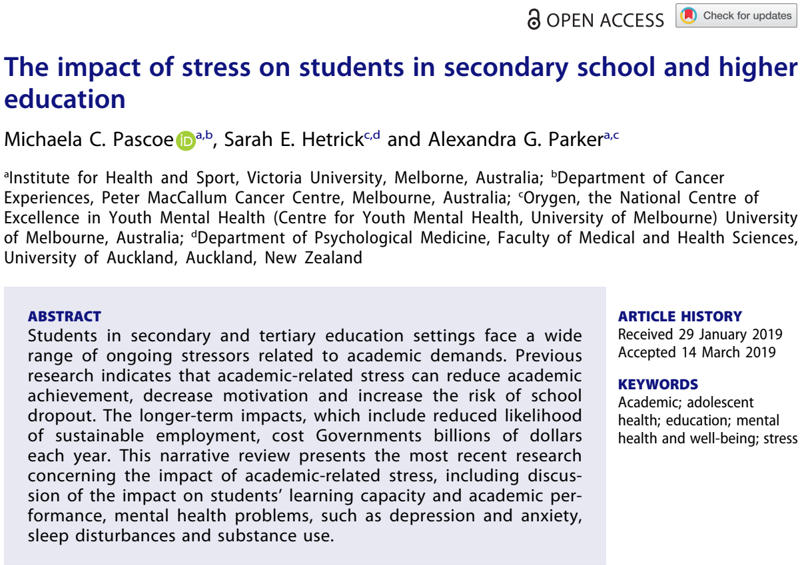
The impact of stress on students in secondary school and higher education
Open accessThe DOI matches its Crossref record; 68 of the 70 references it cites were found in a registry or an index, and 1 are not checked yet; 23 of the 99 sources its claims cite were checked for support.
Abstract
Students in secondary and tertiary education settings face a wide range of ongoing stressors related to academic demands. Previous research indicates that academic-related stress can reduce academic achievement, decrease motivation and increase the risk of school dropout. The longer-term impacts, which include reduced likelihood of sustainable employment, cost Governments billions of dollars each year. This narrative review presents the most recent research concerning the impact of academic-related stress, including discussion of the impact on students’ learning capacity and academic performance, mental health problems, such as depression and anxiety, sleep disturbances and substance use.
Verified 2026-11-19 · 1 reference not checked yet
Overview
CoChat Summary
## TL;DR
This narrative review concludes that academic-related stress is a major, cross-cultural concern for secondary and tertiary students and is linked to worse mental health, sleep, physical health, substance use, and academic outcomes. The paper argues that improving students’ stress-management and coping skills is an important target for schools and universities.
## Key findings
- The review states that academic-related stress has negative impacts on students’ learning capacity, academic performance, education and employment attainment, sleep quality and quantity, physical health, mental health, and substance use outcomes.
- On academic performance, the paper cites OECD data showing that among students in the bottom quarter of academic performance, 63% of those in science reported feeling anxious about tests no matter how well prepared they were, versus 46% in the top quarter.
- On sleep, the paper reports that 42% of 384 surveyed students in grades 9–12 said stress impeded good sleep; it also notes that over 90% of grades 9–12 students in one U.S. study reported inadequate sleep on most school nights.
- On mental health, the paper reports prevalence estimates of anxiety as high as 35% and depression as 30% in tertiary students, and it cites a systematic review of 13 studies linking stress in higher education to poorer quality of life and well-being.
## Methods
- Narrative review design.
- Single author searched PubMed and Google Scholar for peer-reviewed English-language articles, using terms related to academic/school/university stress, mental health, depression, anxiety, resilience, stress management, substance use, sleep, dropout, physical health, and related concepts; references of included papers were also screened.
- Included studies from all countries if they involved a school-based population (secondary, defined as grade 7 or higher, or university) and assessed stress’s impact on mental health, substance use, sleep, dropout, physical activity, or academic outcomes; study design was unrestricted.
## Limitations
- The authors state that they did not delineate between studies assessing academic-related stress during different phases of secondary and tertiary education, so the review does not separate findings by educational stage.
- Because it is a narrative review, evidence synthesis is not described as systematic or quantitative in the text provided; this is evident from the review design and the absence of meta-analysis.
- The paper’s own discussion also indicates that some sections rely on cited studies and examples rather than reporting new primary data; this is evident from the text.
Model-written summary. Check it against the paper before relying on it.
Integrity signals
Registry
Cites
Statistics
Figures


Verification
Claims the paper makes
22 Valid · 0 Not valid · 51 Not checked · 30 Own results and interpretations
The cited sources support only part of this claim — read each source’s verdict below.
In the paper
“The reciprocal relationship between stress and depression and anxiety is well established (Dantzer, 2012;Dantzer, O'Connor, Lawson, & Kelley, 2011;Maes, 2008).”
§ The impact of stress on students in secondary school and higher education > Academic-related stress and mental health
What the sources say
- Not checked — no full text of the sourcecites Dantzer, 2012 matched to “Depression and Inflammation: An Intricate Relationship” (2012) source
- Partly supportedcites Dantzer, O'Connor, Lawson, & Kelley, 2011 matched to “Inflammation-associated depression: From serotonin to kynurenine” (2011) sourceExperimental — accuracy not yet measured
The Human studies section links psychosocial stress to inflammatory activity and reports a correlation between inflammation and depression-like neural activity during bereavement. It does not establish a reciprocal relationship between stress and depression, or address a reciprocal relationship with anxiety. Page numbers were not available in our copy. (LLM, conf=0.76)
- Not checked — no full text of the sourcecites Maes, 2008
boostedstates an association- Asserted: passes — The authors put it forward as true.
- Checkable: passes — It can be checked against evidence.
- Load-bearing: unclear — It is unclear whether the paper’s conclusions depend on it.
- Based: passes — The paper gives a reason why it holds.
Every source the paper cites for this claim was checked and supports it.
In the paper
“In a survey study of 128 Grade 11 students attending competitive private schools in the United States, students who reported experiencing high ongoing stress, particularly in relation to academic achievement and the tertiary education admissions process, also reported high rates of drug and alcohol use (Leonard et al., 2015).”
§ The impact of stress on students in secondary school and higher education > Academic-related stress and substance use
What the sources say
- Supportedcites Leonard et al., 2015 matched to “A multi-method exploratory study of stress, coping, and substance use among high school youth in private schools” (2015) source
Materials and Methods (Research Phase 2; page unavailable) identifies a survey of 128 11th-grade students at two highly selective private schools in the northeastern United States. The Results (Stress and Coping; page unavailable) report high daily stress and substantial recent alcohol and illegal-drug use; the Discussion identifies academic achievement and college admission as the greatest sources of stress. The claim describes these findings together, without asserting that the survey established a statistical association or causation. (LLM, conf=0.92)
plainstates an association- Asserted: passes — The authors put it forward as true.
- Checkable: passes — It can be checked against evidence.
- Load-bearing: passes — The paper’s conclusions depend on it.
- Based: passes — The paper gives a reason why it holds.
- Supported
Every source the paper cites for this claim was checked and supports it.
In the paper
“A systematic review of 13 studies showed that in individuals undertaking higher education, self-reported levels of stress are associated with poorer quality of life and well-being (Ribeiro et al., 2017).”
§ The impact of stress on students in secondary school and higher education > Academic-related stress and mental health
What the sources say
- Supportedcites Ribeiro et al., 2017 matched to “Stress and Quality of Life Among University Students: A Systematic Literature Review” (2018) source
The Abstract reports that 13 studies were eligible and that quality of life was frequently negatively associated with stress. The Conclusion (section 5) likewise identifies a negative association between stress and quality of life in university students, including effects on physical and mental health; the Results (section 3) specifically discuss perceived stress and mental health. (LLM, conf=0.93)
plainstates an association- Asserted: passes — The authors put it forward as true.
- Checkable: passes — It can be checked against evidence.
- Load-bearing: unclear — It is unclear whether the paper’s conclusions depend on it.
- Based: passes — The paper gives a reason why it holds.
- Supported
The cited sources support only part of this claim — read each source’s verdict below.
In the paper
“Importantly, adolescent depression can also result in longer-term poor employment outcomes, as demonstrated by a 25year longitudinal study of New Zealand children (n = 982).”
§ The impact of stress on students in secondary school and higher education > Academic-related stress and mental health
What the sources say
- Partly supportedcites Fergusson, Boden, & Horwood, 2007 matched to “Recurrence of major depression in adolescence and early adulthood, and later mental health, educational and economic outcomes” (2007) sourceExperimental — accuracy not yet measured
The Results report an association between depressive episodes at ages 16–21 and unemployment at ages 21–25 in the 982-person cohort. However, the Adjustment for confounding factors section says the unemployment association was no longer statistically significant after accounting for co-occurring disorders. The study therefore does not establish that adolescent depression results in poorer employment outcomes. (LLM, conf=0.86)
boostedstates a causen = 982- Asserted: passes — The authors put it forward as true.
- Checkable: passes — It can be checked against evidence.
- Load-bearing: unclear — It is unclear whether the paper’s conclusions depend on it.
- Based: passes — The paper gives a reason why it holds.
- Partly supported
Every source the paper cites for this claim was checked and supports it.
In the paper
“Indeed, an Australian randomised control trial reported that a gamified online cognitive behaviour therapy intervention was effective in reducing depressive symptoms in 540 final year secondary students (Perry et al., 2017).”
§ The impact of stress on students in secondary school and higher education > Academic-related stress and mental health
What the sources say
- Supportedcites Perry et al., 2017 matched to “Preventing Depression in Final Year Secondary Students: School-Based Randomized Controlled Trial” (2017) source
The Abstract (Methods) reports a randomized trial in Sydney, Australia, with 540 final-year secondary students. The Abstract (Objective) identifies SPARX-R as a gamified online cognitive behaviour therapy intervention, and the Discussion (Principal Findings) reports that it reduced depressive symptoms before final exams. (LLM, conf=0.94)
plainstates a cause- Asserted: passes — The authors put it forward as true.
- Checkable: passes — It can be checked against evidence.
- Load-bearing: passes — The paper’s conclusions depend on it.
- Based: passes — The paper gives a reason why it holds.
- Supported
72 more claims · 12 with their cited sources checked
Create a free account to see all 103 claims and to verify the 3 references still open.
- Borderline: one of the tests for a substantial claim is unclear. 1
- It may state two separate claims as one. 13
- Probably not a substantial claim. 14
Claims other papers make about this one
Each is checked against this paper’s own text: does it say what the citing paper says it does?
The source backs part of the claim, not all of it — or backs it for a different population, condition or comparison.
In the citing paper
“In Germany, Bulgaria, and Poland, a huge sample of respondents consider assignments a burden on their lives that cannot stand compared to relationships or any other concern in life (14).”
From Family and Academic Stress and Their Impact on Students' Depression Level and Academic Performance (2022) · cites this paper as [14]
Experimental — accuracy not yet measuredThe source backs part of the claim, not all of it — or backs it for a different population, condition or comparison.
In the citing paper
“many university students in the particular screen above clinical cut-off scores for huge depression (14, 32).”
From Family and Academic Stress and Their Impact on Students' Depression Level and Academic Performance (2022) · cites this paper as [14]
Experimental — accuracy not yet measuredThe source backs part of the claim, not all of it — or backs it for a different population, condition or comparison.
In the citing paper
“Although, a few studies have investigated stress and depression and its impact on Students' academic performance (14, 114), however, their background i.e., family and institutions are largely ignored.”
From Family and Academic Stress and Their Impact on Students' Depression Level and Academic Performance (2022) · cites this paper as [14]
Experimental — accuracy not yet measuredThe source backs part of the claim, not all of it — or backs it for a different population, condition or comparison.
In the citing paper
“In university students, high levels of psychological distress have been linked to lower academic performance, poorer self-care, breakdowns in relationships, and increased tendency to drop out”
From A Scoping Review of Acceptance and Commitment Therapy in Higher Education (2024) · cites this paper as Pascoe et al., 2019
Experimental — accuracy not yet measuredThe check wasn’t confident either way, so it gives no verdict — never disputed.
In the citing paper
“These results differ from those of Murdina (2021), Huki et al. (2026), and Pascoe et al. (2020), who found that academic pressure was associated with unethical academic behavior”
From The Relationship between Academic Stress and Academic Integrity among University Students Moderated by Social Support (2026) · cites this paper as Pascoe et al. (2020)
Experimental — accuracy not yet measured
2 more claims about this paper
Create a free account to see every claim other papers make about this one.
Citations
Cites
Adolescence: A foundation for future health
Sawyer, S. M., Afifi, R. A., Bearinger, L. H., Blakemore, S.-J., Dick, B., Ezeh, A. C., & Patton, G. C. (2012) · The Lancet · doi:10.1016/s0140-6736(12)60072-5 · Cited by 2,635 · cited 4×
“a diverse range of backgrounds, during a formative developmental period (Sawyer et al., 2012).”
InfluentialInternational Standard Classification of Education, ISCED 1997
UNESCO United Nations Educational, S. A. C. O. (2003) · Advances in Cross-National Comparison · doi:10.1007/978-1-4419-9186-7_10 · Cited by 2,351
THE EFFECTS OF STRESSFUL LIFE EVENTS ON DEPRESSION
Kessler, R. C. (1997) · Annual Review of Psychology · doi:10.1146/annurev.psych.48.1.191 · Cited by 2,111 · cited 4×
“Ongoing stress also precipitates the development of more serious mental health issues such as anxiety and depression (Kessler, 1997; Moylan, Maes, Wray, & Berk, 2013).”
InfluentialA systematic review of studies of depression prevalence in university students
Ibrahim, A. K., Kelly, S. J., Adams, C. E., & Glazebrook, C. (2013) · Journal of Psychiatric Research · doi:10.1016/j.jpsychires.2012.11.015 · Cited by 1,988 · cited 1×
“The prevalence of anxiety is as high as 35% in tertiary students (Bayram & Bilgel, 2008; Eisenberg, Gollust, Golberstein, & Hefner, 2007; Ozen, Ercan, Irgil, & Sigirli, 2010) and the prevalence of depression is 30% (Ibrahim, Kelly, Adams, & Glazebrook, 2013).”
Prevalence and correlates of depression, anxiety, and suicidality among university students
Eisenberg, D., Gollust, S. E., Golberstein, E., & Hefner, J. L. (2007) · American Journal of Orthopsychiatry · doi:10.1037/0002-9432.77.4.534 · Cited by 1,592 · cited 1×
“The prevalence of anxiety is as high as 35% in tertiary students (Bayram & Bilgel, 2008; Eisenberg, Gollust, Golberstein, & Hefner, 2007; Ozen, Ercan, Irgil, & Sigirli, 2010) and the prevalence of depression is 30% (Ibrahim, Kelly, Adams, & Glazebrook, 2013).”
The role of neuropeptide Y in the antiobesity action of the obese gene product
Stephens, T. W., Basinski, M., Bristow, P. K., Bue-Valleskey, J. M., Burgett, S. G., Craft, L., Hale, J., Hoffmann, J., Hsiung, H. M., Kriauciunas, A., et al. (1995) · Nature · doi:10.1038/377530a0 · Cited by 1,498 · cited 1×
“Similarly, stress has been shown to be associated with increased appetite (Dallman et al., 1993) and higher body weight (Stephens et al., 1995).”
Insufficient Sleep in Adolescents and Young Adults: An Update on Causes and Consequences
Owens, J., ADOLESCENT SLEEP WORKING GROUP, COMMITTEE ON ADOLESCENCE, Au, R., Carskadon, M., Millman, R., Wolfson, A., Braverman, P. K., Adelman, W. P., Breuner, C. C., et al. (2014) · Pediatrics · doi:10.1542/peds.2014-1696 · Cited by 1,413 · cited 2×
“Association and the American Academy of Sleep Medicine, who report that many young people do not get enough hours of sleep (Owens, 2014).”
Bayram, N., & Bilgel, N. (2008) · Social Psychiatry and Psychiatric Epidemiology · doi:10.1007/s00127-008-0345-x · Cited by 1,391 · cited 1×
“The prevalence of anxiety is as high as 35% in tertiary students (Bayram & Bilgel, 2008; Eisenberg, Gollust, Golberstein, & Hefner, 2007; Ozen, Ercan, Irgil, & Sigirli, 2010) and the prevalence of depression is 30% (Ibrahim, Kelly, Adams, & Glazebrook, 2013).”
PISA 2015 Results (Volume I): Excellence and Equity in Education
OECD (2016) · PISA · doi:10.1787/9789264266490-en · Cited by 1,316
Sleep loss, learning capacity and academic performance
CURCIO, G., FERRARA, M., & DEGENNARO, L. (2006) · Sleep Medicine Reviews · doi:10.1016/j.smrv.2005.11.001 · Cited by 1,310 · cited 3×
“Loss of sleep is frequently associated with poor learning (Curcio et al., 2006).”
Influential
Research works printed but not linked: 8
- 9. Canadian Institute for Health. (2005). Improving the health of young canadians. Ottawa, Ontario: Canadian Institute for Health Information.
- 20. Hanson, T. L., & Austin, G. A. (2002). Health risks, resilience, and the academic performance index (California healthy kids survey factsheet 1). Los Alamitos, CA: WestEd. Retrieved from http://surveydata.wested.org/resources/ factsheet.pdf
- 40. Muir, K., Family, S., Maguire, A., Slack-Smith, D., & Murray, M. (2003). Youth unemployment in Australia: A contextual, governmental and organisational perspective: A report by the Smith family for the AMP foundation. Camperdown: The Smith Family. National Centre on Addiction and Substance Abuse at Columbia University (CASA) United States of America. (2003). Depression, substance abuse and college student engagement: A review of the literature. Ney York: National Ctr on Addiction and Substance Abuse at Columbia University (CASA).
- National Centre on Addiction and Substance Abuse at Columbia University (CASA) United States of America, 2003, Depression, substance abuse and college student engagement: A review of the literature
- 42. Noland, H., Price, J. H., Dake, J., & Telljohann, S. K. (2009). Adolescents' sleep behaviors and perceptions of sleep. The Journal of School Health, 795, 224-230. Retrieved from https://www.ncbi.nlm.nih.gov/pubmed/19341441 OECD. (2015). PISA 2015 Results (Volume III). Paris, France. OECD. (2017). PISA 2015 Results (Volume III). Paris, France.
- 49. Rickwood, D., Telford, N., O'Sullivan, S., Crisp, D., & Magyar, R. (2016). National tertiary student wellbeing survey 2016.
- Turrell G., 2006, Health inequalities in Australia: Morbidity, health factors, risk factors and health service use
- 65. World Health Organisation. (2004). Young people's health in context. Health behaviour in school-aged children study: International report from the 2001-2 survey. Denmark.
Cited by
Iglesias-Pradas, S., Hernández-García, Á., Chaparro-Peláez, J., & Prieto, J. L. (2021) · Computers in Human Behavior · doi:10.1016/j.chb.2021.106713 · Cited by 693
Barbayannis, G., Bandari, M., Zheng, X., Baquerizo, H., Pecor, K. W., & Ming, X. (2022) · Frontiers in Psychology · doi:10.3389/fpsyg.2022.886344 · Cited by 555
“Academic stress can reduce motivation, hinder academic achievement, and lead to increased college dropout rates (Pascoe et al., 2020).”
BackgroundResultCrawford, J., Cowling, M., & Allen, K.-A. (2023) · Journal of University Teaching and Learning Practice · doi:10.53761/1.20.3.02 · Cited by 547
“Stress has substantial implications resulting in often adverse effects on students' academic performance, a concern given that it is also widely reported that University students face significant psychosocial challenges during their studies (Deng et al., 2022; Pascoe et al., 2020).”
BackgroundProwse, R., Sherratt, F., Abizaid, A., Gabrys, R. L., Hellemans, K. G. C., Patterson, Z. R., & McQuaid, R. J. (2021) · Frontiers in Psychiatry · doi:10.3389/fpsyt.2021.650759 · Cited by 429
“was associated with substance use among students (70).”
BackgroundFamily and Academic Stress and Their Impact on Students' Depression Level and Academic Performance
Deng, Y., Cherian, J., Khan, N. U. N., Kumari, K., Sial, M. S., Comite, U., Gavurova, B., & Popp, J. (2022) · Frontiers in Psychiatry · doi:10.3389/fpsyt.2022.869337 · Cited by 371
“In Germany, Bulgaria, and Poland, a huge sample of respondents consider assignments a burden on their lives that cannot stand compared to relationships or any other concern in life (14).”
BackgroundInfluentialKristensen, S. M., Larsen, T. B., Urke, H. B., & Danielsen, A. G. (2023) · Journal of Youth and Adolescence · doi:10.1007/s10964-023-01770-1 · Cited by 271
Janeczko, E., Bielinis, E., Wójcik, R., Woźnicka, M., Kędziora, W., Łukowski, A., Elsadek, M., Szyc, K., & Janeczko, K. (2020) · Forests · doi:10.3390/f11050591 · Cited by 133
“Students face a wide range of ongoing stressors related to academic demands [62], resulting in many having mental health problems such as depression and anxiety, sleep disorders and substance use [63].”
BackgroundZhang, J., Peng, C., & Chen, C. (2024) · Acta Psychologica · doi:10.1016/j.actpsy.2024.104351 · Cited by 125
Zhao, H. M., Jian-ping, X., Zhang, Z., & Qi, C. (2021) · Frontiers in Psychology · doi:10.3389/fpsyg.2021.621094 · Cited by 147
A review of the benefits and drawbacks of high-stakes final examinations in higher education
French, S., Dickerson, A., & Mulder, R. A. (2024) · Higher Education · doi:10.1007/s10734-023-01148-z · Cited by 126
“This shift is in part a response to the growing concern that heavily weighted summative examinations may negatively impact student learning and wellbeing (Ecclestone, 1999; Jones et al., 2021; Pascoe et al., 2020) and debate about their efficacy and validity as assessment instruments (Knight, 2002).”
Romano, L., Tang, X., Hietajärvi, L., Salmela-Aro, K., & Fiorilli, C. (2020) · International Journal of Environmental Research and Public Health · doi:10.3390/ijerph17134771 · Cited by 117
Brewster, L., Jones, E. J., Priestley, M. J., Wilbraham, S. J., Spanner, L., & Hughes, G. (2021) · Journal of Further and Higher Education · doi:10.1080/0309877x.2021.1986473 · Cited by 186
“…wherein positive wellbeing is associated with enhanced cognitive and psychological functioning, including: higher academic engagement; creativity; decision-making; problem-solving; concentration; productivity; retention; outcomes (Pascoe, Hetrick, and Parker 2019; Postareff et al. 2016).”
BackgroundKrokstad, S., Weiß, D., Krokstad, M. A., Rangul, V., Kvaløy, K., Ingul, J. M., Bjerkeset, O. A., Twenge, J. M., & Sund, E. R. (2022) · BMJ Open · doi:10.1136/bmjopen-2021-057654 · Cited by 147
Mahapatra, A., & Sharma, P. (2020) · International Journal of Social Psychiatry · doi:10.1177/0020764020961801 · Cited by 136
“This in turn makes them vulnerable to dropping out, future unemployment, and increased incidence of psychiatric disorders such as depression, anxiety and substance use disorders (Pascoe et al., 2020).”
BackgroundStudent wellbeing and assessment in higher education: the balancing act
Jones, E., Priestley, M., Brewster, L., Wilbraham, S. J., Hughes, G., & Spanner, L. (2021) · Assessment & Evaluation in Higher Education · doi:10.1080/02602938.2020.1782344 · Cited by 109
“…indicates that elevated levels of anxiety have a detrimental impact on students’ academic achievement, with higher selfreported levels of examination stress, anxiety and depression associated with poorer productivity, motivation and test scores (Reschly et al. 2008; Liu 2015; Kotter et al. 2017).”
BackgroundStress and Mental Health: The Benefits of Resiliency in Nontraditional Students
WHITEHORN, J. C. (2022) · Advances in higher education and professional development book series · doi:10.4018/978-1-7998-8323-4.ch006 · Cited by 110
Academic burnout among medical students: respective importance of risk and protective factors
Kilic, R., Nasello, J., Melchior, V., & Triffaux, J. (2021) · Public Health · doi:10.1016/j.puhe.2021.07.025 · Cited by 153
Fu, Y. H. H., Ren, W., & Liang, Z. (2021) · Journal of Affective Disorders · doi:10.1016/j.jad.2021.09.060 · Cited by 104
Ragusa, A., González-Bernal, J., Trigueros, R., Caggiano, V., Navarro, N., Minguez-Minguez, L. A., Obregón, A. I., & Fernandez-Ortega, C. (2023) · Frontiers in Psychology · doi:10.3389/fpsyg.2023.1073529 · Cited by 92
“Stress and anxiety have been positively associated with depression, poor academic performance (Karaman and Watson, 2017), school dropout (Pascoe et al., 2020) and even sleep quality (Wunsch et al.”
BackgroundStress Factors, Stress Levels, and Coping Mechanisms among University Students
Alkhawaldeh, A., Omari, O. A., Aldawi, S. A., Hashmi, I. A., Ballad, C. A. C., Ibrahim, A. S., Sabei, S. D. A., Alsaraireh, A. M., Qadire, M. I. A., & ALBashtawy, M. (2023) · The Scientific World JOURNAL · doi:10.1155/2023/2026971 · Cited by 166
Perceived stress among university students in Oman during COVID-19-induced e-learning
Malik, M., & Javed, S. (2021) · Middle East Current Psychiatry · doi:10.1186/s43045-021-00131-7 · Cited by 145
“[36] argue that enhancing student support in the education setting may improve the mental health of young people.”
BackgroundLaparoscopic surgery using spinal anesthesia.
Sinha, R., Gurwara, A. K., & Gupta, S. C. (2008) · PubMed Central · Cited by 115
Slack, H. R., & Priestley, M. J. (2022) · Assessment & Evaluation in Higher Education · doi:10.1080/02602938.2022.2076804 · Cited by 105
Stress, working memory, and academic performance: a neuroscience perspective
Almarzouki, A. F. (2024) · Stress · doi:10.1080/10253890.2024.2364333 · Cited by 136
“Poor academic performance is linked to worse social, mental, and physical well-being, along with higher substance use and school dropout rates (Pascoe et al., 2020).”
Chinese school adolescents’ stress experience and coping strategies: a qualitative study
Zhou, X., Bambling, M., Bai, X., & Edirippulige, S. (2023) · BMC Psychology · doi:10.1186/s40359-023-01137-y · Cited by 113
“Results from student interviewees The results from focus interviews with students were categorised into four themes: [1] sources of stress; [2] impact of stress; [3] stress management; and [4] recommendations for professional help (Table 2).”
BackgroundAnderson, T., Valiauga, R., Tallo, C., Hong, C. B., Manoranjithan, S., Domingo, C. N., Paudel, M., Untaroiu, A., Barr, S., & Goldhaber, K. (2024) · Journal of Child and Adolescent Psychiatric Nursing · doi:10.1111/jcap.70009 · Cited by 140
Heo, H., Bonk, C. J., & Doo, M. Y. (2022) · The Internet and Higher Education · doi:10.1016/j.iheduc.2022.100856 · Cited by 104
“It made me feel like it was okay to be wrong”: Student experiences with ungrading
Gorichanaz, T. (2022) · Active Learning in Higher Education · doi:10.1177/14697874221093640 · Cited by 81
“This stress can lead to mental health issues such as anxiety, depression and substance abuse (Pascoe et al., 2020); suicide is also a growing concern, as it is the second leading cause of death among college students (Aslanian and Roth, 2021).”
BackgroundLu, D., He, Y., & Tan, Y. (2022) · Frontiers in Psychology · doi:10.3389/fpsyg.2021.719425 · Cited by 66
Zimmer‐Gembeck, M. J., Skinner, E. A., Scott, R. A., Ryan, K. M., Hawes, T., Gardner, A. A., & Duffy, A. L. (2023) · Journal of Youth and Adolescence · doi:10.1007/s10964-023-01864-w · Cited by 128
“…of this study are generally consistent with other research showing the increasing academic pressures that occur as adolescents get older (e.g., Pascoe et al., 2020), but the fi ndings extend on this past research identifying that the associations of age with academic coping that have been…”
ResultFernandes, M. D. S. V., Mendonça, C. R., da Silva, T. M. V., Noll, P. R. E. S., de Abreu, L. C., & Noll, M. A. (2023) · Scientific Reports · doi:10.1038/s41598-023-33584-3 · Cited by 96
Hitches, E., Woodcock, S., & Ehrich, J. F. (2022) · International Journal of Educational Research Open · doi:10.1016/j.ijedro.2022.100124 · Cited by 125
Jiménez-Mijangos, L. P., Rodríguez-Arce, J., Martínez-Méndez, R., & Lagos, J. J. R. (2022) · Education and Information Technologies · doi:10.1007/s10639-022-11324-w · Cited by 106
Beatson, R. M., Quach, J., Canterford, L. D., Farrow, P., Bagnall, C. L., Hockey, P., Phillips, E., Patton, G. C., Olsson, C. A., Ride, J., et al. (2023) · Educational Research Review · doi:10.1016/j.edurev.2023.100553 · Cited by 104
Saleem, M. S., Isha, A. S. N., Awan, M. I., Yusop, Y. M., & Naji, G. M. A. (2022) · Frontiers in Psychology · doi:10.3389/fpsyg.2022.920395 · Cited by 83
“Since the stress for students results in their decreased well-being and anxiety (Pascoe et al., 2020), therefore specific elements that cause stress for post-graduate students are needed to be identified.”
BackgroundAutism voices: Perspectives of the needs, challenges, and hopes for the future of autistic youth
Tesfaye, R., Courchesne, V., Mirenda, P., Mitchell, W., Nicholas, D. B., Singh, I., Zwaigenbaum, L., & Elsabbagh, M. (2022) · Autism · doi:10.1177/13623613221132108 · Cited by 79
“The factors contributing to stress were similar to concerns raised by many typically developing youth (Pascoe et al., 2020), including feeling overwhelmed by course work, academic expectations, and evaluations.”
BackgroundWang, H., & Fan, X. (2023) · International Journal of Environmental Research and Public Health · doi:10.3390/ijerph20032219 · Cited by 96
“After prolonged exposure to high academic stress, adolescents may experience anxiety, depression, and sleep disorders [5].”
BackgroundKarki, A., Thapa, B., Pradhan, P. M. S., & Basel, P. L. (2022) · PLOS Global Public Health · doi:10.1371/journal.pgph.0000516 · Cited by 77
“This persistent academic related stress might accelerate the development of mood disorders such as depression, anxiety and stress among the adolescents [51].”
BackgroundLatorre, M. F., Estrada-Araoz, E. G., Condori, W. G. L., Ulloa-Gallardo, N. J., Álvarez, D. A. C., Orue, L. A. M., Yancachajlla-Quispe, L. I., & Ramírez, S. S. R. (2023) · Sustainability · doi:10.3390/su151511924 · Cited by 74
Chen, H., Guo, H., Chen, H., Cao, X., Liu, J., Chen, X., Tian, Y., Tang, H., Wang, X., & Zhou, J. (2023) · Frontiers in Public Health · doi:10.3389/fpubh.2022.1049051 · Cited by 55
“With great peer pressure, high academic expectations, and a large amount of homework, students have experienced greater academic pressure than before (23).”
BackgroundGavurová, B., Ivanková, V., Rigelský, M., Mudarri, T., & Miovský, M. (2022) · Frontiers in Public Health · doi:10.3389/fpubh.2022.859107 · Cited by 67
“All of this can mean a huge psychological burden for young people, which has many consequences in their lives (17).”
BackgroundEfstathiou, M., Kakaidi, V., Tsitsas, G. D., Mantzoukas, S., Gouva, M., & Dragioti, E. (2025) · International Journal of Nursing Studies · doi:10.1016/j.ijnurstu.2025.104993 · Cited by 80
Thi, T. D. P., & Duong, N. T. (2024) · BMC Psychology · doi:10.1186/s40359-024-01725-6 · Cited by 95
“Additionally, excessive stress has a negative impact on student learning [41].”
BackgroundInterventions to reduce academic procrastination: A systematic review
Salguero-Pazos, M. R., & de Cózar, S. R. (2023) · International Journal of Educational Research · doi:10.1016/j.ijer.2023.102228 · Cited by 117
“Other studies also relate stress or anxiety to depression, poor academic performance, and school dropout (Karaman & Watson, 2017; Pascoe, Hetrick & Parker, 2020), so there is a high correlation in adolescents between their stress levels and the presence of behavioral or emotional problems (Anggoro,…”
Chiramba, O., & Ndofirepi, E. S. (2023) · South African Journal of Higher Education · doi:10.20853/37-6-6021 · Cited by 48
“…that may have lasting impacts on their future, restricted access to essential resources that can significantly influence their learning outcomes, heightened mental and emotional strain, limited employment opportunities, and fewer desirable educational pathways (Pascoe, Hetrick, and Parker 2020).”
BackgroundMeints, K., Brelsford, V. L., Dimolareva, M., Maréchal, L., Pennington, K., Rowan, E., & Gee, N. R. (2022) · PLoS ONE · doi:10.1371/journal.pone.0269333 · Cited by 72
“To counter stressrelated negative effects, support needs to be provided and effective interventions are required (see [10] for recent overview).”
BackgroundSchool-Related Stressors and the Intensity of Perceived Stress Experienced by Adolescents in Poland
Kaczmarek, M., & Trambacz-Oleszak, S. (2021) · International Journal of Environmental Research and Public Health · doi:10.3390/ijerph182211791 · Cited by 62
“School is for young people a social environment for both learning (stressful educational demands from teachers and high expectations from parents) and interpersonal relationships with teachers and sameaged peers [16].”
BackgroundXu, T., Zuo, F., & Zheng, K. (2024) · International Journal of Mental Health Promotion · doi:10.32604/ijmhp.2023.043226 · Cited by 68
“However, evidence from Western countries also supported that academic pressure was the most signi fi cant source of stress for adolescents [36], compared to adolescents in Western countries, Chinese students had faced greater academic pressure [37].”
Prevalence of sleep disorders among university students and its impact on academic performance
Salmani, A. A. A., Shidhani, A. S. A., Qassabi, S. S. A., Yaaribi, S. A. A., & Musharfi, A. M. A. (2020) · International Journal of Adolescence and Youth · doi:10.1080/02673843.2020.1815550 · Cited by 53
Prevalence and associated factors of alexithymia among Chinese adolescents in Hong Kong
Ng, C. S. M., & Chan, V. C. W. (2020) · Psychiatry Research · doi:10.1016/j.psychres.2020.113126 · Cited by 59
Acosta-Enriquez, B. G., Ballesteros, M. A. A., Guzman Valle, M. D. L. A., Angaspilco, J. E. M., Aquino Lalupú, J. D. R., Jaico, J. L. B., Germán Reyes, N. C., Alarcón García, R. E., & Castillo, W. E. J. (2025) · Computers and Education: Artificial Intelligence · doi:10.1016/j.caeai.2025.100381 · Cited by 48
de la Fuente, J., Paoloni, P. V., Vera, M. M., & Garzón-Umerenkova, A. (2020) · International Journal of Environmental Research and Public Health · doi:10.3390/ijerph17124293 · Cited by 65
“In the university setting, previous research has shown that a higher level of emotional well-being in university students was associated with a greater experience of positive emotions [41–43], while stress was associated with less psychological well-being and greater negative emotionality [44,45].”
BackgroundAcademic Stress Interventions in High Schools: A Systematic Literature Review
Jagiello, T., Belcher, J., Neelakandan, A., Boyd, K., & Wuthrich, V. M. (2024) · Child Psychiatry & Human Development · doi:10.1007/s10578-024-01667-5 · Cited by 114
“Academic stress is defined as the transient experience of pressure, anxiety, or distress related to achieving academic goals [1].”
Deep Learning Models for Stress Analysis in University Students: A Sudoku-Based Study
Chen, Q., & Lee, B. G. (2023) · Sensors · doi:10.3390/s23136099 · Cited by 53
“Prolonged exposure to stress can result in severe mental health issues such as anxiety and depression [3].”
BackgroundA systematic – Review of academic stress intended to improve the educational journey of learners
Iqra (2024) · Methods in Psychology · doi:10.1016/j.metip.2024.100163 · Cited by 105
Beribe, M. F. B. (2023) · At-Tasyrih jurnal pendidikan dan hukum Islam · doi:10.55849/attasyrih.v9i1.157 · Cited by 97
Omari, O. A., Khalaf, A., Sabei, S. D. A., Hashmi, I. A., Qadire, M. I. A., Joseph, M. A., & Damra, J. K. M. (2022) · Nordic Journal of Psychiatry · doi:10.1080/08039488.2022.2038666 · Cited by 58
“with peers; a higher incidence of substance misuse [3], and”
BackgroundBruxism, Related Factors and Oral Health-Related Quality of Life Among Vietnamese Medical Students
Phương, N. T. T., Ngọc, V. T. N., Linh, L. M., Nguyen, D. M., Tra, N. T., & Anh, L. Q. (2020) · International Journal of Environmental Research and Public Health · doi:10.3390/ijerph17207408 · Cited by 41
“Students suffer a stressful study process during their undergraduate course which causes high levels of stress to be reported in students [17].”
BackgroundCassaretto, M., Vilela, P., & Gamarra, L. (2021) · Liberabit Revista Peruana de Psicología · doi:10.24265/liberabit.2021.v27n2.07 · Cited by 114
Alhasani, M., Mulchandani, D., Oyebode, O., Baghaei, N., & Orji, R. (2022) · Frontiers in Public Health · doi:10.3389/fpubh.2022.777567 · Cited by 46
Offline vs online problem-based learning: a case study of student engagement and learning outcomes
Kristianto, H., & Gandajaya, L. (2022) · Interactive Technology and Smart Education · doi:10.1108/itse-09-2021-0166 · Cited by 63
Desai, R., Porob, P., Rebelo, P., et al. (2020) · Wireless Personal Communications · doi:10.1007/s11277-020-07675-7 · Cited by 38
Alhasani, M., & Orji, R. (2024) · International Journal of Human-Computer Interaction · doi:10.1080/10447318.2023.2297330 · Cited by 63
“Similarly, stress can lead to several mental health issues, such as panic attacks, anxiety, low cognitive performance, depression, and sleep disorders (Hollifield et al., 2018; Kuiper et al., 1986; Pascoe et al., 2020; Sch € onfeld et al., 2016; Shankar & Park, 2016).”
Dettweiler, U., Gerchen, M. F., Mall, C., Simon, P. D., & Kirsch, P. (2022) · British Journal of Educational Psychology · doi:10.1111/bjep.12528 · Cited by 47
Wright, L. J., Zanten, J. V., & Williams, S. E. (2023) · Journal of Adolescence · doi:10.1002/jad.12201 · Cited by 53
Wijaya, T. T., Rahmadi, I. F., Chotimah, S., Jailani, J., & Wutsqa, D. U. (2022) · International Journal of Environmental Research and Public Health · doi:10.3390/ijerph192316247 · Cited by 59
“Several preliminary studies also found that students’ stress levels reduce interest in learning [91].”
ResultAnsiedad en universitarios durante la pandemia de COVID-19: un estudio cuantitativo
Márquez, I. L. C. (2021) · PSICUMEX · doi:10.36793/psicumex.v11i1.420 · Cited by 77
Rasheduzzaman, M., Al‐Mamun, F., Faruk, M. O., Hosen, I., & Mamun, M. A. (2021) · Perspectives In Psychiatric Care · doi:10.1111/ppc.12722 · Cited by 36
Watson, P. W. S. J., Sotardi, V. A., Park, J. J., & Roy, D. (2021) · Journal of Adolescence · doi:10.1016/j.adolescence.2021.02.009 · Cited by 42
Vestad, L., & Tharaldsen, K. B. (2021) · Scandinavian Journal of Educational Research · doi:10.1080/00313831.2021.1939145 · Cited by 60
Валеріївна, А. О., Byshevets, N., Kashuba, V., et al. (2023) · Physical rehabilitation and recreational health technologies · doi:10.15391/prrht.2023-8(2).01 · Cited by 31
The Spread of COVID-19 in Russia: Immediate Impact on Mental Health of University Students
Zinchenko, Y. P., Shaigerova, L. A., Almazova, O. V., Shilko, R. S., Vakhantseva, O. V., Dolgikh, A. G., Veraksa, А., & Минимансурович, К. А. (2021) · Psychological Studies · doi:10.1007/s12646-021-00610-1 · Cited by 37
“(American College Health Association, 2019; Pascoe et al., 2020; Rickwood et al., 2017).”
Chua, J. H., Cheng, C. K. T., Cheng, L. J., Ang, W. H. D., & Lau, Y. (2022) · Current Psychology · doi:10.1007/s12144-022-03366-7 · Cited by 45
“Academic-related stress is common among higher education students, and this includes concerns about receiving poor grades and pressures to achieve high marks (Pascoe et al., 2020).”
BackgroundZhang, Z., Qiu, A., Zhang, X., Zhao, Y., Lu, Y., Yi, J., Zhang, Q., Lin, R., Lin, R., & Zhang, X. (2024) · BMC Public Health · doi:10.1186/s12889-024-20130-7 · Cited by 40
“For example, when girls fear underperforming academically or being excluded socially, their anxiety may escalate rapidly, eventually resulting in depressive symptoms [54, 55].”
BackgroundMore prevalent and more severe: gender differences of depressive symptoms in Chinese adolescents
Sun, Y., Zhong, Y., Sun, W., Chu, L., Long, J., & Fan, X. W. (2023) · Frontiers in Public Health · doi:10.3389/fpubh.2023.1167234 · Cited by 54
“This means that Chinese students experience intense academic stress early on, which often hurts adolescents’ mental health (50).”
BackgroundStudent Stress Due to Online Learning During the Covid-19 Pandemic
Wahyu, A., & Simanullang, R. H. (2020) · Jurnal Aisyah Jurnal Ilmu Kesehatan · doi:10.30604/jika.v5i2.346 · Cited by 44
Lai, K. Y. C., Hung, S., Lee, H. W. S., & Leung, P. W. L. (2022) · Frontiers in Psychiatry · doi:10.3389/fpsyt.2022.866323 · Cited by 48
“Aims and Operation of the SMHSS With an emphasis on multi-disciplinary collaboration within the school setting, the SMHSS aims at (1) strengthening the support to students with mental health problems through early identification and prompt access to interventions, (2) equipping teachers and school social workers with…”
BackgroundJahara, S. F., Hussain, M., Kumar, T., Goodarzi, A., & Assefa, Y. (2022) · Language Testing in Asia · doi:10.1186/s40468-022-00170-9 · Cited by 45
“Academic stress is one of the important educational challenges that might have negative impacts on students’ academic performance (O’Neill et al., 2019; Paralkar & Knutson, 2021; Pascoe et al., 2020; Reddy, et al., 2018).”
BackgroundAgah, J. J., Ede, M. O., Asor, L. J., Ekesionye, E. N., & Ejionueme, L. K. (2021) · Current Psychology · doi:10.1007/s12144-021-01657-z · Cited by 35
Gamble, B. J., & Crouse, D. (2020) · SciMedicine Journal · doi:10.28991/scimedj-2020-0202-4 · Cited by 33
“Similar trends have been reported in other countries [2, 3].”
ResultZhao, L., Niu, X., Wang, L., Niu, J., Zhu, X., & Dai, Z. (2023) · IEEE Sensors Journal · doi:10.1109/jsen.2023.3314718 · Cited by 34
Sun, N., Liu, W., & Zheng, Z. (2023) · Frontiers in Public Health · doi:10.3389/fpubh.2023.1143635 · Cited by 38
“The adverse effects of learning engagement and academic performance can in turn affect students’ overall mental health (17, 69).”
BackgroundTharaldsen, K. B., Tvedt, M. S., Caravita, S. C. S., & Bru, E. (2022) · Scandinavian Journal of Educational Research · doi:10.1080/00313831.2022.2116480 · Cited by 42
“A link between school-related stress and emotional problems has been suggested (Pascoe et al., 2020).”
BackgroundYap, S. Y., Foo, C. N., Lim, Y. M., Ng, F. L., Sidik, S. M., Tang, P. Y., Singh, J. K. N., & Pheh, K. S. (2021) · International Journal of Environmental Research and Public Health · doi:10.3390/ijerph18105366 · Cited by 34
“These ongoing stresses can negatively affect students’ learning capacity, academic performance, education, employment attainment, sleep quality and quantity, physical health, mental health, and substance use outcomes [48].”
BackgroundComPeer: A Generative Conversational Agent for Proactive Peer Support
Liu, T., Zhao, H., Liu, Y., Wang, X., & Peng, Z. (2024) · ACM Symposium on User Interface Software and Technology (UIST) · doi:10.1145/3654777.3676430 · Cited by 77
“In this paper, we specifically target university students, a representative group that commonly encounters stressful issues [60, 70].”
BackgroundInfluence of stress and coping strategies on undergraduate students' performance
Oyewobi, L. O., Bolarin, G., Oladosu, N. T., & Jimoh, R. A. (2020) · Journal of Applied Research in Higher Education · doi:10.1108/jarhe-03-2020-0066 · Cited by 50
“However, Pascoe et al. (2020) asserted that self-reported level of stress such as depression is linked to poorer academic Influence of stress and coping strategies performance of students.”
BackgroundSystematic review of machine learning techniques to predict anxiety and stress in college students
Vergaray, A. D., Saboya, N., Necochea-Chamorro, J. I., Ramos, K. J. Z., & Valencia, Y. D. R. V. (2023) · Informatics in Medicine Unlocked · doi:10.1016/j.imu.2023.101391 · Cited by 36
Ekman, R., Fletcher, A. K., Giota, J., Eriksson, A., Thomas, B., & Bååthe, F. (2021) · Mind Brain and Education · doi:10.1111/mbe.12305 · Cited by 45
“The ongoing stress relating to education has demonstrated a negative impact on students’ learning capacity, academic performance, sleep quality and quantity, physical health, mental health, and substance use outcomes (Giota & Gustafsson, 2017; Pascoe, Hetrick, & Parker, 2020).”
BackgroundPascoe, M. C., Bailey, A. P., Craike, M. J., Carter, T., Patten, R. K., Stepto, N. K., & Parker, A. G. (2021) · Sports Medicine - Open · doi:10.1186/s40798-021-00358-y · Cited by 31
Self-citationUnemployment anxiety of last year college students
Yaşar, O. M., & Turğut, M. (2020) · Cypriot Journal of Educational Sciences · doi:10.18844/cjes.v15i1.4588 · Cited by 44
Song, Y., Wu, J., Zhou, Z., Tian, Y., Li, W., & Xie, H. (2024) · Frontiers in Psychology · doi:10.3389/fpsyg.2024.1288644 · Cited by 40
“Such dynamics, emblematic of the Confucian valorization of education, may lead to a range of negative outcomes, including academic burnout, anxiety, and in severe cases, disengagement from the educational process (Peleg et al., 2016; Ribeiro et al., 2018; Pascoe et al., 2020).”
BackgroundSocio-Emotional Competencies and School Performance in Adolescence: What Role for School Adjustment?
Mella, N., Pansu, P., Batruch, A., Bressan, M., Bressoux, P., Brown, G., Butera, F., Cherbonnier, A., Darnon, C., Demolliens, M., et al. (2021) · Frontiers in Psychology · doi:10.3389/fpsyg.2021.640661 · Cited by 67
“, sweating, upset stomach, and tremors) and/or inappropriate behaviors such as avoidance or procrastination, which may affect the socio-emotional life at school, academic strategies and performance (McDonald, 2001; Wren and Benson, 2004; Chapell et al., 2005; Pascoe et al., 2020).”
BackgroundStudents’ Well-Being and Academic Engagement: A Multivariate Analysis of the Influencing Factors
Puiu, S., Udriștioiu, M. T., Petrişor, I., Yılmaz, S. E., Pfefferova, M. S., Raykova, Z., Yıldızhan, H., & Marekova, E. (2024) · Healthcare · doi:10.3390/healthcare12151492 · Cited by 50
“Pascoe et al. [53] highlight the negative impact of stress on mental and physical health and Khan et al. [55] emphasize its influence on performance.”
BackgroundWhat is the purpose of education? A context for early childhood education
Murray, J. (2023) · International Journal of Early Years Education · doi:10.1080/09669760.2023.2238399 · Cited by 59
Wijaya, T. T., Yu, B., Xu, F., Yuan, Z., & Mailizar, M. (2023) · International Journal of Environmental Research and Public Health · doi:10.3390/ijerph20054518 · Cited by 44
Benny, C., Patte, K. A., Veugelers, P. J., Leatherdale, S. T., & Pabayo, R. (2021) · SSM - Population Health · doi:10.1016/j.ssmph.2021.100994 · Cited by 33
“In addition, the high school experience might be an especially challenging time for students, who may experience stress due to puberty, as well as academic and social pressures (Pascoe et al., 2020).”
BackgroundEngelbrecht, M. (2022) · Curationis · doi:10.4102/curationis.v45i1.2276 · Cited by 26
Alamoush, R. A., Al-sawaeir, S., Baker, D. A., Aljamani, S., Al-Omoush, S. A., & AL-Omiri, M. K. (2024) · Journal of Occupational Health · doi:10.1093/joccuh/uiae006 · Cited by 43
Sharisha Shanbhog, M., & Medikonda, J. (2023) · Computer Methods and Programs in Biomedicine · doi:10.1016/j.cmpb.2023.107521 · Cited by 37
Ang, W. H. D., Shorey, S., Zheng, Z. J., Ng, W. H. D., Chen, E. C., Shah, L., Chew, H. S. J., & Lau, Y. (2022) · International Journal of Environmental Research and Public Health · doi:10.3390/ijerph191912729 · Cited by 41
“When students are unable to learn properly, they may experience greater stress and anxiety [10,11].”
Background
Metadata
- Authors
- Pascoe, M. C., Hetrick, S. E., & Parker, A. G.
- Affiliations
- Peter MacCallum Cancer Centre (AU)
- University of Auckland (NZ)
- The University of Melbourne (AU)
- Corresponding author
- Pascoe, Michaela C.
- Venue
- International Journal of Adolescence and Youth
- Publisher
- Informa UK Limited
- Published
- 2019-04-11
- Volume
- 25
- Issue
- 1
- Pages
- 104-112
- ISSN
- 0267-3843 (ISSN-L)
- 2164-4527
- OpenAlex
- W2936355586
- Semantic Scholar
- cb875214c2157d53611d7fdf2992e4edf829f677
- Cited by
- 1,359
- References
- 66
- Citations by year
- 2026: 239 · 2025: 268 · 2024: 277 · 2023: 253 · 2022: 151 · 2021: 114 · 2020: 51 · 2019: 3
- FWCI
- 144.92
- Type
- journal article
- Language
- en
- Open access
- gold
- doi.org
- Locations
- International Journal of Adolescence and Youth (publishedVersion, cc-by)
- Victoria University Research Repository (Victoria University) (submittedVersion, cc-by)
- DOAJ (DOAJ: Directory of Open Access Journals) (submittedVersion)
- Minerva Access (University of Melbourne) (submittedVersion)
- ResearchSpace (University of Auckland) (submittedVersion, cc-by)
- Funders
- no financial
- Topics
- Social Sciences › Psychology › Developmental and Educational Psychology › Student Stress and Coping
- Social Sciences › Psychology › Social Psychology › Stress and Burnout Research
- Social Sciences › Education › Educational Outcomes and Influences
- Keywords
- academic stress, student stress, high school students, university students, academic performance, learning ability, mental health, depression, anxiety, sleep disorders, substance use, school dropout, motivation
About these checks
Registry, retraction, Cites and statistics results are computed, not judged, with one exception: a printed reference that no index lists is read once by a model before it counts as a citation error. Claims are extracted by a model and kept only when their quote appears verbatim in the text; each cited source is then checked, with a model’s help, for whether it says what the claim relies on. Those verdicts can be wrong — read the claim’s quote and the cited source before relying on one.
The claim verdicts this report counts are experimental: their accuracy is not yet measured.
A language model drew the claims from the paper on 2026-09-28, under version 3 of the claim definition (model deepseek-v4.1-flash, prompt extract-v3).
A second model labelled each claim on 2026-09-28 (model jev-1.13-20260917, definition revision gold-guideline-v0.2).
Cited sources are checked with a language model’s help (gpt-6-sol).
Statistics and arithmetic are recomputed, not judged.
Confidence bands are shown only for fields calibrated on our annotated test set. None is calibrated yet, so no band is shown.
What counts as a claim ›How we measure confidence ›How we check this ›
Are you an author, or do you see a problem with this page? Request a review
Data sources
Bibliographic data: Semantic Scholar, OpenAlex, Crossref.
Contains information from the Semantic Scholar Academic Graph Datasets, made available under the ODC Attribution License (ODC-BY 1.0).
Semantic Scholar’s data is described in: Kinney, R., et al. (2023). The Semantic Scholar Open Data Platform. arXiv:2301.10140.
