

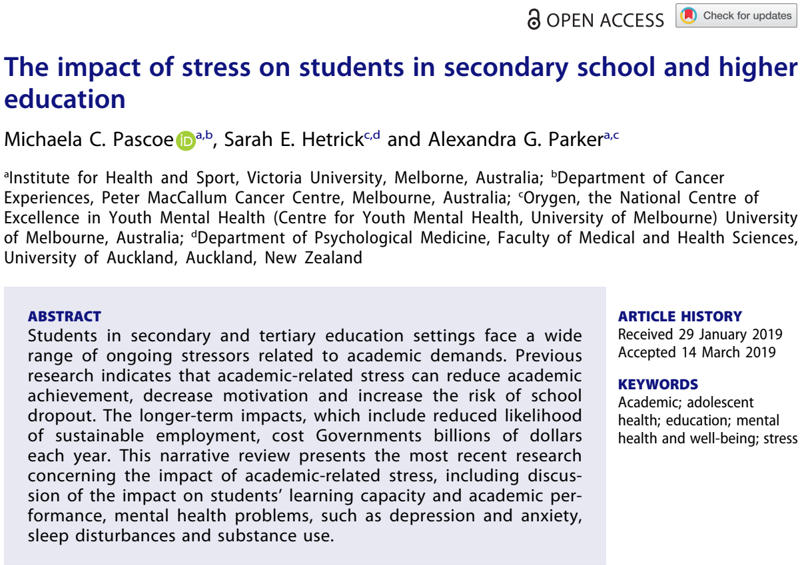
The impact of stress on students in secondary school and higher education
Open accessThe DOI matches its Crossref record; 68 of the 70 references it cites were found in a registry or an index, and 1 are not checked yet; 23 of the 99 sources its claims cite were checked for support.
Abstract
Students in secondary and tertiary education settings face a wide range of ongoing stressors related to academic demands. Previous research indicates that academic-related stress can reduce academic achievement, decrease motivation and increase the risk of school dropout. The longer-term impacts, which include reduced likelihood of sustainable employment, cost Governments billions of dollars each year. This narrative review presents the most recent research concerning the impact of academic-related stress, including discussion of the impact on students’ learning capacity and academic performance, mental health problems, such as depression and anxiety, sleep disturbances and substance use.
Verified 2026-11-19 · 1 reference not checked yet
Overview
CoChat Summary
## TL;DR
This narrative review concludes that academic-related stress is a major, cross-cultural concern for secondary and tertiary students and is linked to worse mental health, sleep, physical health, substance use, and academic outcomes. The paper argues that improving students’ stress-management and coping skills is an important target for schools and universities.
## Key findings
- The review states that academic-related stress has negative impacts on students’ learning capacity, academic performance, education and employment attainment, sleep quality and quantity, physical health, mental health, and substance use outcomes.
- On academic performance, the paper cites OECD data showing that among students in the bottom quarter of academic performance, 63% of those in science reported feeling anxious about tests no matter how well prepared they were, versus 46% in the top quarter.
- On sleep, the paper reports that 42% of 384 surveyed students in grades 9–12 said stress impeded good sleep; it also notes that over 90% of grades 9–12 students in one U.S. study reported inadequate sleep on most school nights.
- On mental health, the paper reports prevalence estimates of anxiety as high as 35% and depression as 30% in tertiary students, and it cites a systematic review of 13 studies linking stress in higher education to poorer quality of life and well-being.
## Methods
- Narrative review design.
- Single author searched PubMed and Google Scholar for peer-reviewed English-language articles, using terms related to academic/school/university stress, mental health, depression, anxiety, resilience, stress management, substance use, sleep, dropout, physical health, and related concepts; references of included papers were also screened.
- Included studies from all countries if they involved a school-based population (secondary, defined as grade 7 or higher, or university) and assessed stress’s impact on mental health, substance use, sleep, dropout, physical activity, or academic outcomes; study design was unrestricted.
## Limitations
- The authors state that they did not delineate between studies assessing academic-related stress during different phases of secondary and tertiary education, so the review does not separate findings by educational stage.
- Because it is a narrative review, evidence synthesis is not described as systematic or quantitative in the text provided; this is evident from the review design and the absence of meta-analysis.
- The paper’s own discussion also indicates that some sections rely on cited studies and examples rather than reporting new primary data; this is evident from the text.
Model-written summary. Check it against the paper before relying on it.
Integrity signals
Registry
Cites
Statistics
Figures


Verification
Claims the paper makes
22 Valid · 0 Not valid · 51 Not checked · 30 Own results and interpretations
The cited sources support only part of this claim — read each source’s verdict below.
In the paper
“The reciprocal relationship between stress and depression and anxiety is well established (Dantzer, 2012;Dantzer, O'Connor, Lawson, & Kelley, 2011;Maes, 2008).”
§ The impact of stress on students in secondary school and higher education > Academic-related stress and mental health
What the sources say
- Not checked — no full text of the sourcecites Dantzer, 2012 matched to “Depression and Inflammation: An Intricate Relationship” (2012) source
- Partly supportedcites Dantzer, O'Connor, Lawson, & Kelley, 2011 matched to “Inflammation-associated depression: From serotonin to kynurenine” (2011) sourceExperimental — accuracy not yet measured
The Human studies section links psychosocial stress to inflammatory activity and reports a correlation between inflammation and depression-like neural activity during bereavement. It does not establish a reciprocal relationship between stress and depression, or address a reciprocal relationship with anxiety. Page numbers were not available in our copy. (LLM, conf=0.76)
- Not checked — no full text of the sourcecites Maes, 2008
boostedstates an association- Asserted: passes — The authors put it forward as true.
- Checkable: passes — It can be checked against evidence.
- Load-bearing: unclear — It is unclear whether the paper’s conclusions depend on it.
- Based: passes — The paper gives a reason why it holds.
Every source the paper cites for this claim was checked and supports it.
In the paper
“In a survey study of 128 Grade 11 students attending competitive private schools in the United States, students who reported experiencing high ongoing stress, particularly in relation to academic achievement and the tertiary education admissions process, also reported high rates of drug and alcohol use (Leonard et al., 2015).”
§ The impact of stress on students in secondary school and higher education > Academic-related stress and substance use
What the sources say
- Supportedcites Leonard et al., 2015 matched to “A multi-method exploratory study of stress, coping, and substance use among high school youth in private schools” (2015) source
Materials and Methods (Research Phase 2; page unavailable) identifies a survey of 128 11th-grade students at two highly selective private schools in the northeastern United States. The Results (Stress and Coping; page unavailable) report high daily stress and substantial recent alcohol and illegal-drug use; the Discussion identifies academic achievement and college admission as the greatest sources of stress. The claim describes these findings together, without asserting that the survey established a statistical association or causation. (LLM, conf=0.92)
plainstates an association- Asserted: passes — The authors put it forward as true.
- Checkable: passes — It can be checked against evidence.
- Load-bearing: passes — The paper’s conclusions depend on it.
- Based: passes — The paper gives a reason why it holds.
- Supported
Every source the paper cites for this claim was checked and supports it.
In the paper
“A systematic review of 13 studies showed that in individuals undertaking higher education, self-reported levels of stress are associated with poorer quality of life and well-being (Ribeiro et al., 2017).”
§ The impact of stress on students in secondary school and higher education > Academic-related stress and mental health
What the sources say
- Supportedcites Ribeiro et al., 2017 matched to “Stress and Quality of Life Among University Students: A Systematic Literature Review” (2018) source
The Abstract reports that 13 studies were eligible and that quality of life was frequently negatively associated with stress. The Conclusion (section 5) likewise identifies a negative association between stress and quality of life in university students, including effects on physical and mental health; the Results (section 3) specifically discuss perceived stress and mental health. (LLM, conf=0.93)
plainstates an association- Asserted: passes — The authors put it forward as true.
- Checkable: passes — It can be checked against evidence.
- Load-bearing: unclear — It is unclear whether the paper’s conclusions depend on it.
- Based: passes — The paper gives a reason why it holds.
- Supported
The cited sources support only part of this claim — read each source’s verdict below.
In the paper
“Importantly, adolescent depression can also result in longer-term poor employment outcomes, as demonstrated by a 25year longitudinal study of New Zealand children (n = 982).”
§ The impact of stress on students in secondary school and higher education > Academic-related stress and mental health
What the sources say
- Partly supportedcites Fergusson, Boden, & Horwood, 2007 matched to “Recurrence of major depression in adolescence and early adulthood, and later mental health, educational and economic outcomes” (2007) sourceExperimental — accuracy not yet measured
The Results report an association between depressive episodes at ages 16–21 and unemployment at ages 21–25 in the 982-person cohort. However, the Adjustment for confounding factors section says the unemployment association was no longer statistically significant after accounting for co-occurring disorders. The study therefore does not establish that adolescent depression results in poorer employment outcomes. (LLM, conf=0.86)
boostedstates a causen = 982- Asserted: passes — The authors put it forward as true.
- Checkable: passes — It can be checked against evidence.
- Load-bearing: unclear — It is unclear whether the paper’s conclusions depend on it.
- Based: passes — The paper gives a reason why it holds.
- Partly supported
Every source the paper cites for this claim was checked and supports it.
In the paper
“Indeed, an Australian randomised control trial reported that a gamified online cognitive behaviour therapy intervention was effective in reducing depressive symptoms in 540 final year secondary students (Perry et al., 2017).”
§ The impact of stress on students in secondary school and higher education > Academic-related stress and mental health
What the sources say
- Supportedcites Perry et al., 2017 matched to “Preventing Depression in Final Year Secondary Students: School-Based Randomized Controlled Trial” (2017) source
The Abstract (Methods) reports a randomized trial in Sydney, Australia, with 540 final-year secondary students. The Abstract (Objective) identifies SPARX-R as a gamified online cognitive behaviour therapy intervention, and the Discussion (Principal Findings) reports that it reduced depressive symptoms before final exams. (LLM, conf=0.94)
plainstates a cause- Asserted: passes — The authors put it forward as true.
- Checkable: passes — It can be checked against evidence.
- Load-bearing: passes — The paper’s conclusions depend on it.
- Based: passes — The paper gives a reason why it holds.
- Supported
72 more claims · 12 with their cited sources checked
Create a free account to see all 103 claims and to verify the 3 references still open.
- Borderline: one of the tests for a substantial claim is unclear. 1
- It may state two separate claims as one. 13
- Probably not a substantial claim. 14
Claims other papers make about this one
Each is checked against this paper’s own text: does it say what the citing paper says it does?
The source backs part of the claim, not all of it — or backs it for a different population, condition or comparison.
In the citing paper
“In Germany, Bulgaria, and Poland, a huge sample of respondents consider assignments a burden on their lives that cannot stand compared to relationships or any other concern in life (14).”
From Family and Academic Stress and Their Impact on Students' Depression Level and Academic Performance (2022) · cites this paper as [14]
Experimental — accuracy not yet measuredThe source backs part of the claim, not all of it — or backs it for a different population, condition or comparison.
In the citing paper
“many university students in the particular screen above clinical cut-off scores for huge depression (14, 32).”
From Family and Academic Stress and Their Impact on Students' Depression Level and Academic Performance (2022) · cites this paper as [14]
Experimental — accuracy not yet measuredThe source backs part of the claim, not all of it — or backs it for a different population, condition or comparison.
In the citing paper
“Although, a few studies have investigated stress and depression and its impact on Students' academic performance (14, 114), however, their background i.e., family and institutions are largely ignored.”
From Family and Academic Stress and Their Impact on Students' Depression Level and Academic Performance (2022) · cites this paper as [14]
Experimental — accuracy not yet measuredThe source backs part of the claim, not all of it — or backs it for a different population, condition or comparison.
In the citing paper
“In university students, high levels of psychological distress have been linked to lower academic performance, poorer self-care, breakdowns in relationships, and increased tendency to drop out”
From A Scoping Review of Acceptance and Commitment Therapy in Higher Education (2024) · cites this paper as Pascoe et al., 2019
Experimental — accuracy not yet measuredThe check wasn’t confident either way, so it gives no verdict — never disputed.
In the citing paper
“These results differ from those of Murdina (2021), Huki et al. (2026), and Pascoe et al. (2020), who found that academic pressure was associated with unethical academic behavior”
From The Relationship between Academic Stress and Academic Integrity among University Students Moderated by Social Support (2026) · cites this paper as Pascoe et al. (2020)
Experimental — accuracy not yet measured
2 more claims about this paper
Create a free account to see every claim other papers make about this one.
Citations
Cites
Adolescence: A foundation for future health
Sawyer, S. M., Afifi, R. A., Bearinger, L. H., Blakemore, S.-J., Dick, B., Ezeh, A. C., & Patton, G. C. (2012) · The Lancet · doi:10.1016/s0140-6736(12)60072-5 · Cited by 2,635 · cited 4×
“a diverse range of backgrounds, during a formative developmental period (Sawyer et al., 2012).”
InfluentialInternational Standard Classification of Education, ISCED 1997
UNESCO United Nations Educational, S. A. C. O. (2003) · Advances in Cross-National Comparison · doi:10.1007/978-1-4419-9186-7_10 · Cited by 2,351
THE EFFECTS OF STRESSFUL LIFE EVENTS ON DEPRESSION
Kessler, R. C. (1997) · Annual Review of Psychology · doi:10.1146/annurev.psych.48.1.191 · Cited by 2,111 · cited 4×
“Ongoing stress also precipitates the development of more serious mental health issues such as anxiety and depression (Kessler, 1997; Moylan, Maes, Wray, & Berk, 2013).”
InfluentialA systematic review of studies of depression prevalence in university students
Ibrahim, A. K., Kelly, S. J., Adams, C. E., & Glazebrook, C. (2013) · Journal of Psychiatric Research · doi:10.1016/j.jpsychires.2012.11.015 · Cited by 1,988 · cited 1×
“The prevalence of anxiety is as high as 35% in tertiary students (Bayram & Bilgel, 2008; Eisenberg, Gollust, Golberstein, & Hefner, 2007; Ozen, Ercan, Irgil, & Sigirli, 2010) and the prevalence of depression is 30% (Ibrahim, Kelly, Adams, & Glazebrook, 2013).”
Prevalence and correlates of depression, anxiety, and suicidality among university students
Eisenberg, D., Gollust, S. E., Golberstein, E., & Hefner, J. L. (2007) · American Journal of Orthopsychiatry · doi:10.1037/0002-9432.77.4.534 · Cited by 1,592 · cited 1×
“The prevalence of anxiety is as high as 35% in tertiary students (Bayram & Bilgel, 2008; Eisenberg, Gollust, Golberstein, & Hefner, 2007; Ozen, Ercan, Irgil, & Sigirli, 2010) and the prevalence of depression is 30% (Ibrahim, Kelly, Adams, & Glazebrook, 2013).”
The role of neuropeptide Y in the antiobesity action of the obese gene product
Stephens, T. W., Basinski, M., Bristow, P. K., Bue-Valleskey, J. M., Burgett, S. G., Craft, L., Hale, J., Hoffmann, J., Hsiung, H. M., Kriauciunas, A., et al. (1995) · Nature · doi:10.1038/377530a0 · Cited by 1,498 · cited 1×
“Similarly, stress has been shown to be associated with increased appetite (Dallman et al., 1993) and higher body weight (Stephens et al., 1995).”
Insufficient Sleep in Adolescents and Young Adults: An Update on Causes and Consequences
Owens, J., ADOLESCENT SLEEP WORKING GROUP, COMMITTEE ON ADOLESCENCE, Au, R., Carskadon, M., Millman, R., Wolfson, A., Braverman, P. K., Adelman, W. P., Breuner, C. C., et al. (2014) · Pediatrics · doi:10.1542/peds.2014-1696 · Cited by 1,413 · cited 2×
“Association and the American Academy of Sleep Medicine, who report that many young people do not get enough hours of sleep (Owens, 2014).”
Bayram, N., & Bilgel, N. (2008) · Social Psychiatry and Psychiatric Epidemiology · doi:10.1007/s00127-008-0345-x · Cited by 1,391 · cited 1×
“The prevalence of anxiety is as high as 35% in tertiary students (Bayram & Bilgel, 2008; Eisenberg, Gollust, Golberstein, & Hefner, 2007; Ozen, Ercan, Irgil, & Sigirli, 2010) and the prevalence of depression is 30% (Ibrahim, Kelly, Adams, & Glazebrook, 2013).”
PISA 2015 Results (Volume I): Excellence and Equity in Education
OECD (2016) · PISA · doi:10.1787/9789264266490-en · Cited by 1,316
Sleep loss, learning capacity and academic performance
CURCIO, G., FERRARA, M., & DEGENNARO, L. (2006) · Sleep Medicine Reviews · doi:10.1016/j.smrv.2005.11.001 · Cited by 1,310 · cited 3×
“Loss of sleep is frequently associated with poor learning (Curcio et al., 2006).”
Influential
Research works printed but not linked: 8
- 9. Canadian Institute for Health. (2005). Improving the health of young canadians. Ottawa, Ontario: Canadian Institute for Health Information.
- 20. Hanson, T. L., & Austin, G. A. (2002). Health risks, resilience, and the academic performance index (California healthy kids survey factsheet 1). Los Alamitos, CA: WestEd. Retrieved from http://surveydata.wested.org/resources/ factsheet.pdf
- 40. Muir, K., Family, S., Maguire, A., Slack-Smith, D., & Murray, M. (2003). Youth unemployment in Australia: A contextual, governmental and organisational perspective: A report by the Smith family for the AMP foundation. Camperdown: The Smith Family. National Centre on Addiction and Substance Abuse at Columbia University (CASA) United States of America. (2003). Depression, substance abuse and college student engagement: A review of the literature. Ney York: National Ctr on Addiction and Substance Abuse at Columbia University (CASA).
- National Centre on Addiction and Substance Abuse at Columbia University (CASA) United States of America, 2003, Depression, substance abuse and college student engagement: A review of the literature
- 42. Noland, H., Price, J. H., Dake, J., & Telljohann, S. K. (2009). Adolescents' sleep behaviors and perceptions of sleep. The Journal of School Health, 795, 224-230. Retrieved from https://www.ncbi.nlm.nih.gov/pubmed/19341441 OECD. (2015). PISA 2015 Results (Volume III). Paris, France. OECD. (2017). PISA 2015 Results (Volume III). Paris, France.
- 49. Rickwood, D., Telford, N., O'Sullivan, S., Crisp, D., & Magyar, R. (2016). National tertiary student wellbeing survey 2016.
- Turrell G., 2006, Health inequalities in Australia: Morbidity, health factors, risk factors and health service use
- 65. World Health Organisation. (2004). Young people's health in context. Health behaviour in school-aged children study: International report from the 2001-2 survey. Denmark.
Cited by
Items 901–1,000 of 1,333
APA calls for safe work environments for adolescents
Knopf, A. (2023) · The Brown University Child and Adolescent Behavior Letter · doi:10.1002/cbl.30742
COMPARISON OF TURKISH AND AZERBAIJANI UNIVERSITY STUDENTS IN TERMS OF PERCEIVED
SHELALE, N. (2023) · International Journal of Education Technology and Scientific Researches · doi:10.35826/ijetsar.613
Baen, S., & Wahyuni, E. (2023) · JURNAL MAHASISWA BK AN-NUR BERBEDA BERMAKNA MULIA · doi:10.31602/jmbkan.v9i2.11050
สมชัย, ว., & กาญจนถวัลย์, บ. (2022) · doi:10.58837/chula.the.2022.976
Dudafa, U. J. (2023) · WILBERFORCE JOURNAL OF THE SOCIAL SCIENCES · doi:10.36108/wjss/3202.80.0210
An analysis of the innovation strategy of student management in universities based on big data
Cuicui, W. (2023) · Applied Mathematics and Nonlinear Sciences · doi:10.2478/amns.2023.2.00443
ÇİÇEK, B., Çopur, Z., Erkal, S., & Boylu, A. A. (2023) · Gençlik Araştırmaları Dergisi · doi:10.52528/genclikarastirmalari.1239272 · Cited by 1
The Role of Fear and Stigma in Perpetuating Racial Health Orientation Disparities in Emerging Adults
Zeligman, M. R., Wood, A. W., Fakhro, D., & Foulk, M. (2022) · Adultspan Journal · doi:10.33470/2161-0029.1001
Molefe, L. L. (2023) · Research Square · doi:10.21203/rs.3.rs-3400368/v1
Martin, T. (2023) · Psi Beta Research Journal - Brief Reports · doi:10.54581/zpzn5093
Bhatta, K. R., Shakya, S., Luitel, N. P., & Rai, B. (2023) · Journal of Psychiatrists Association of Nepal · doi:10.3126/jpan.v12i1.59418
ACADEMIC STRESS AMONG THE PARAMEDICAL SCIENCE STUDENTS: A DESCRIPTIVE CROSS SECTIONAL STUDY
Shah, S. V. A., Alam, K., Rajbhat, S., et al. (2022) · DENTAL JOURNAL OF INDIRA GANDHI INSTITUTE OF MEDICAL SCIENCES · doi:10.25259/djigims_20220101_01
Indonesia, A. (2022) · ACEReSearch Repository (Australian Council for Educational Research) · doi:10.37517/978-1-74286-697-0 · Cited by 1
Understanding Learners’ Experiences of Using ePortfolio in a High School Physics Course
Carroll, D. P., Uribe-Flórez, L., Ching, Y.-H., Perkins, R., & Figus, E. (2023) · TechTrends · doi:10.1007/s11528-023-00908-z
Hempel, C. (2023) · Digital Repository Service (Northeastern University) · doi:10.17760/d20483547
Efstratopoulou, M., & AlQahtani, O. (2023) · Advances in psychology, mental health, and behavioral studies (APMHBS) book series · doi:10.4018/978-1-6684-6040-5.ch009
Nutrition Balance Knowledge Improvement for High School Student: Fit for The Exam
Mulyasari, I., & Pontang, G. S. (2023) · Jurnal Pengabdian Masyarakat Svasta Harena · doi:10.33860/jpmsh.v3i1.1903
Causes of Stress Among Students in Education Institutions
Oloo, Z. O. (2023) · Advances in higher education and professional development book series · doi:10.4018/979-8-3693-0708-3.ch008
Njoroge, J. N., Wawire, C. K., Kigen, E., et al. (2023) · SSRN Electronic Journal · doi:10.2139/ssrn.4641191
Povertà educativa e marginalità. Il ruolo delle comunità educanti per la prevenzione della devianza
Conte, M., & Cardanobile, M. (2023) · IUL Research · doi:10.57568/iulresearch.v4i8.491 · Cited by 1
Lu, C. (2023) · Optical and Quantum Electronics · doi:10.1007/s11082-023-06002-1
RetractedThe Impact of Education Setup Towards Teachers Capability and Development Priority
Jaluague, J. A. (2023) · Jurnal Pendidikan Progresif · doi:10.23960/jpp.v13.i3.202308
Harapan Siswa yang Mengalami Stres Akademik
Yulianti, F., Ilfiandra, I., & Saripah, I. (2023) · G-Couns Jurnal Bimbingan dan Konseling · doi:10.31316/gcouns.v8i01.5261 · Cited by 2
Psychology Techniques in Education Improve Student Academic Outcomes and Mental Health
Pautz, D., & Honeycutt, C. F. (2023) · IEEE Frontiers in Education Conference (FIE) · doi:10.1109/fie58773.2023.10343250 · Cited by 1
Precursors to University Students Burnout: Developing a Typology on the Role of Personality
Nonis, S. P., Ying, C. Y., Cheah, C. S., & Yusof, A. (2023) · Advances in Social Science, Education and Humanities Research/Advances in social science, education and humanities research · doi:10.2991/978-2-38476-196-8_16 · Cited by 1
Effects of Meditative Practices on Academic Stress and Resilience of Ninth-graders
Kaur, R., & Sharma, L. (2024) · Journal of Applied Consciousness Studies · doi:10.4103/jacs.jacs_130_23
Implications of chronic diseases and academic stress on students’ quality of life
Păduraru, A. E. (2023) · The Medical-Surgical Journal · doi:10.22551/msj.2023.04.13
Peer Relationship and Mental Health Damage from Academic-Stress and Depersonalization in High School
Ha, Z., & Kelly, C. (2023) · Journal of Student Research · doi:10.47611/jsrhs.v12i3.4890 · Cited by 1
Managing Academic Stress: Case Study of High School Students and Strategies in Biology Learning
Qisthi, N., Juniarti, M. A., Hamdiyati, Y., Rahmat, A., & Winarno, N. (2024) · Jurnal Psikologi Teori dan Terapan · doi:10.26740/jptt.v15n01.p32-47 · Cited by 6
Resilience of Students in Higher Education: a systematic literature review about assessment scales
Vivian, R. L., Machado, L. R., Longhi, M. T., & Behar, P. A. (2024) · Concilium · doi:10.53660/clm-2849-24c37 · Cited by 1
Insights in Leadership in Education: 2022
Grogan, M. (2024) · Frontiers research topics · doi:10.3389/978-2-8325-4520-1 · Cited by 1
Student Involvement in Online Tutorial Activities for Environmental Chemistry Course
Adji, S. S., & Novianti, I. (2024) · International Journal of Social Science Research and Review · doi:10.47814/ijssrr.v7i3.1901
Ahmad, S., & Latif, N. F. A. (2023) · EDUCATUM Journal of Social Sciences · doi:10.37134/ejoss.vol9.2.2.2023 · Cited by 3
Müller, V., & Piko, B. F. (2023) · Iskolakultúra · doi:10.14232/iskkult.2023.12.87
Cintra, A. C. R., Michelotto, P. V., Wéber, H., & Michelotto, A. L. L. (2024) · Seven Editora eBooks · doi:10.56238/innovhealthknow-052
PANULAYA, A. S. H. (2024) · International Journal of Research Publications · doi:10.47119/ijrp1001441320246183
Factors Affecting Perceived Stress-Cortisol Responses in Young Adults
Seo, S., Kim, C., Kang, H. S., & Schlenk, E. A. (2024) · Daehan imsang geon-gang jeungjin hakoeji/Daehan imsang geon'gang jeungjin haghoeji · doi:10.15384/kjhp.2024.00031 · Cited by 1
Schlechter, P., Meyer, T., Hagen, M., Baranova, K., & Nexhmedin Morina, B. (2024) · doi:10.31219/osf.io/ngxtz
Results of a Formative Process Evaluation of Canada’s Student Mental Health Network (Preprint)Preprint
Ecclestone, A., Linden, B., Rose, J., et al. (2024) · doi:10.2196/preprints.58992
Academic stress among higher secondary school adolescents during the covid-19 pandemic context
Sujithran, P., & Bindhu, T. S. (2024) · i-manager’s Journal on Educational Psychology · doi:10.26634/jpsy.17.3.20026
Prevalence of Restless Leg Syndrome in School Going Students and Assessment of Fatigue
-, P. F., -, P. H., Shende, M., & -, K. G. (2024) · International Journal For Multidisciplinary Research · doi:10.36948/ijfmr.2024.v06i02.16607
Ramos, H. C., da Costa, S. R. R., & Leão, D. D. A. (2024) · Revista Contemporânea · doi:10.56083/rcv4n4-207
Correlation between stress and insomnia with learning outcomes: a cross sectional study
Hatmanti, N. M., Zurmida, U. M., Septianingrum, Y., et al. (2023) · Bali Medical Journal · doi:10.15562/bmj.v12i2.4294
Relationship of Learning Pressure to Achievement of Business Subject Grade in High School Students
Marcus, C., Rahman, R. S. A. R. A., & Othman, N. B. H. (2024) · International Journal of Academic Research in Business and Social Sciences · doi:10.6007/ijarbss/v14-i5/21558
de, J. N. M.-M., Romero-Morales, H., Torres-García, A. A., & Villaseñor-Pineda, L. (2023) · IEEE EMBS R9 Conference · doi:10.1109/ieeeconf60929.2023.10525395
Pooja, C. N. G. (2023) · International Journal of Science and Research (IJSR) · doi:10.21275/sr23508123955
Academic stress among students of Van Lang University, Vietnam
Van, T. P. (2024) · International Journal of Psychology Sciences · doi:10.33545/26648377.2024.v6.i1a.42 · Cited by 2
Oracion Carl Rafael, B., Primero Princess Jasmine, P., Dela Torre Edsil, B., & Lazaro Bryan Louis, G. (2024) · International Journal of Advanced Multidisciplinary Research and Studies · doi:10.62225/2583049x.2024.4.3.2820
Academic Procrastination and School Satisfaction: Mediating Role of Academic Stress
Akbaba, M. F. (2024) · International Journal of Educational Research Review · doi:10.24331/ijere.1467963
Chemnad, K., Aziz, M., Al-Harahsheh, S. T., Abdelmoneium, A., Baghdady, A., Hassan, D. A., & Ali, R. (2024) · doi:10.2196/preprints.62955
Trang, N. H. T., Phuc, L. T. V., & Quỳnh, H. H. N. (2024) · Tạp chí Nghiên cứu Y học · doi:10.52852/tcncyh.v178i5.2366
Ndlovu, J. (2024) · International Journal of Research Publication and Reviews · doi:10.55248/gengpi.5.0624.1567 · Cited by 1
Metry, S. (2024) · Queensland University of Technology · doi:10.5204/thesis.eprints.249220 · Cited by 1
Advancing Wellbeing in Higher Education Through Instructional Leadership
Shaked, H. (2024) · Emerald Group Publishing Limited eBooks · doi:10.1108/978-1-83797-504-420241017 · Cited by 3
Abbasi, G., khalilnezhadevati, M., & Rezaei, M. (2023) · Journal of Assessment and Research in Applied Counseling · doi:10.61838/kman.jarac.5.4.16 · Cited by 1
Ihsani, C. V., Sudirman, D., Ramdani, Z., & Dinulloh, A. F. (2024) · Jurnal Psikologi Islam dan Budaya · doi:10.15575/jpib.v7i1.29796 · Cited by 2
Emotional intelligence predicting subject-specific academic success: EQ-i Youth in South Africa
Stols, A., Erasmus, P., & Tsabedze, W. F. (2024) · African Journal of Career Development · doi:10.4102/ajcd.v6i1.114 · Cited by 2
Петрик, Р., & Кравченко, В. (2024) · Перспективи та інновації науки · doi:10.52058/2786-4952-2024-7(41)-836-847
Strydom, D. (2024) · DUT Open Scholar (Durban University of Technology) · doi:10.51415/10321/5371
Altered Neurodevelopmental Trajectories
Colvin, M. K., Reesman, J. L., & Glen, T. (2024) · Oxford University Press eBooks · doi:10.1093/9780197762660.003.0009
Burnout: A Silent Rising Phenomenon
Prabhakaran, A., & Burton, S. (2024) · Journal of Student Research · doi:10.47611/jsrhs.v13i1.6372
Tedam, P., & Mano, I. (2024) · Social Work Education · doi:10.1080/02615479.2024.2361740 · Cited by 2
Perbedaan Stres Akademik Ditinjau dari Tahun Studi
Safitri, L., & Nurfarhanah, N. (2024) · ANWARUL · doi:10.58578/anwarul.v4i4.3633
Ntem, A. (2024) · Psychology and Behavioral Sciences · doi:10.11648/j.pbs.20241304.12
Institutional-Based Factors Influencing the Wellbeing of Students in Universities
Birech, J. K., & Onyango, P. A. (2024) · Advances in higher education and professional development book series · doi:10.4018/979-8-3693-8860-0.ch011
Jiang, D., Huang, Z., & Lee, J. C. (2024) · Innovation in Aging · doi:10.1093/geroni/igae075
Adaptasi Instrumen Academic Expectation Stress Inventory-9 (AESI-9) pada Siswa SMA
Rachmawati, A. N. P., Nararya, C. B., Samodra, W., & Nurmalitasari, F. (2024) · Flourishing Journal · doi:10.17977/um070v4i82024p347-357
Stress Among the Undergraduate Students in Public Universities in Kenya
Onderi, P. O., Moracha, S. N. O., Opondo, C. M., & Omare, J. M. (2024) · Advances in higher education and professional development book series · doi:10.4018/979-8-3693-4417-0.ch009 · Cited by 1
Løhre, A., Uthus, M., & Aas, H. K. (2024) · Scandinavian Journal of Educational Research · doi:10.1080/00313831.2024.2394402 · Cited by 2
Ma’rof, A. A., Abdullah, H. B., & Rosnon, M. R. (2024) · International Journal of Academic Research in Business and Social Sciences · doi:10.6007/ijarbss/v14-i8/22579
Letting Go: Parenting Teens and Young Adults in a Time of Uncertainty
Kurz, D. (2024) · doi:10.1093/9780190222482.001.0001 · Cited by 1
Kurz, D. (2024) · Oxford University Press eBooks · doi:10.1093/9780190222482.003.0001
Becoming Adolescents and Pulling Away
Kurz, D. (2024) · Oxford University Press eBooks · doi:10.1093/9780190222482.003.0002
Kurz, D. (2024) · Oxford University Press eBooks · doi:10.1093/9780190222482.003.0006
Kurz, D. (2024) · Oxford University Press eBooks · doi:10.1093/9780190222482.005.0001
Kurz, D. (2024) · Oxford University Press eBooks · doi:10.1093/9780190222482.002.0004
Promoting School Success and Preparing for Postsecondary Education
Kurz, D. (2024) · Oxford University Press eBooks · doi:10.1093/9780190222482.003.0004
Parenting Young Adults and Letting Go
Kurz, D. (2024) · Oxford University Press eBooks · doi:10.1093/9780190222482.003.0005
Keeping Teens Safe at a Time of Risk
Kurz, D. (2024) · Oxford University Press eBooks · doi:10.1093/9780190222482.003.0003
Cultivating Self-Compassion for Enhanced Student Well-Being
Gupta, R. K., & Walia, Y. (2024) · Advances in educational marketing, administration, and leadership book series · doi:10.4018/979-8-3693-1455-5.ch003 · Cited by 1
Mike, E. (2024) · Occupational Therapy in Mental Health · doi:10.1080/0164212x.2024.2405828
Zhou, X., Li, R., Gao, Q., Wang, X., Cheng, P., & Zhu, H. (2024) · Research Square · doi:10.21203/rs.3.rs-4934481/v1 · Cited by 2
Millena, G., & Magcalen, M. (2024) · JPAIR Multidisciplinary Research · doi:10.7719/jpair.v57i1.902
Сыздыкбаевa, A. Д., Sarzhanova, G. B., & Kнисаринa, M. М. (2024) · Habaršy. Pedagogika ġylymdary seriâsy · doi:10.51889/2959-5762.2024.83.3.010 · Cited by 2
Examining the Coping Styles of Teachers and Students to Gain Insights into Their Well-Being
Deepa, R., Deborah, D. S., & Sathya, R. (2024) · Springer Proceedings in Humanities and Social Sciences · doi:10.1007/978-981-97-3701-7_35
Association Between Adequate Sleep and Participation in Occupational Areas in School-Age Children
Ha, Y.-N., Park, S., Roh, G., Kim, J., Kim, E., & Hong, I. (2024) · OTJR Occupational Therapy Journal of Research · doi:10.1177/15394492241271154
The influence of interaction and student characteristics in canine-assisted interventions
Dinçer, F., Schmidt, C., & Schworm, S. (2024) · Journal of Further and Higher Education · doi:10.1080/0309877x.2024.2418925
COMPARATIVE ANALYSIS OF STRESS LEVEL IN UNIVERSITY STUDENTS
Rueda, K. H., Pérez, S. E. H., & Vargas, M. P. M. (2024) · International Journal of Human Sciences Research · doi:10.22533/at.ed.5584332429102
Perceived Causes of Sleep Problems in Higher Education Students: An Exploratory Study
Marques, D. R., Gomes, A. A., & de Azevedo, M. H. P. (2024) · Psychological Reports · doi:10.1177/00332941241299730 · Cited by 2
Prosocial Behavior of College Students: A Self-determination Perspective
Utomo, H. B., Farida, I. A., Retnowati, D., & Teguh, C. A. M. (2024) · KnE Social Sciences · doi:10.18502/kss.v9i30.17516
PERCEPTION OF ACADEMIC STRESS IN THE LEARNING OF FIRST YEAR STUDENTS
Sukma, M. A., Karim, D., & Damanik, S. R. H. (2024) · Jurnal Smart Keperawatan · doi:10.34310/86vc2330 · Cited by 1
The Role of Resilience in Business Students’ Motivation to Continue Their Studies in Time of WarPreprint
Mykolenko, O., Mittelstaedt, E., & Wiepcke, C. (2024) · SSRN Electronic Journal · doi:10.2139/ssrn.5047927
Gervacio, A. P. (2024) · Environment and Social Psychology · doi:10.59429/esp.v9i11.3166
Ramesh, A., Mayya, S. S., Martis, M., & Mayya, A. (2024) · Pertanika journal of social science & humanities · doi:10.47836/pjssh.32.4.03 · Cited by 1
Akpınar, A. (2024) · PEYZAJ · doi:10.53784/peyzaj.1553777 · Cited by 1
Analisis School Well Being Pada Mahasiswa Keperawatan di Yogyakarta Melalui Peer Mentoring
Utami, K. D., Sumiyarini, R., & Syah, M. E. (2024) · JURNAL DIVERSITA · doi:10.31289/diversita.v10i2.12958 · Cited by 1
Quinto, E. (2024) · Divine Word International Journal of Management and Humanities (DWIJMH) · doi:10.62025/dwijmh.v3i4.93
Khennou, K., & Touri, B. (2024) · Journal of Education and Health Promotion · doi:10.4103/jehp.jehp_90_24
Metadata
- Authors
- Pascoe, M. C., Hetrick, S. E., & Parker, A. G.
- Affiliations
- Peter MacCallum Cancer Centre (AU)
- University of Auckland (NZ)
- The University of Melbourne (AU)
- Corresponding author
- Pascoe, Michaela C.
- Venue
- International Journal of Adolescence and Youth
- Publisher
- Informa UK Limited
- Published
- 2019-04-11
- Volume
- 25
- Issue
- 1
- Pages
- 104-112
- ISSN
- 0267-3843 (ISSN-L)
- 2164-4527
- OpenAlex
- W2936355586
- Semantic Scholar
- cb875214c2157d53611d7fdf2992e4edf829f677
- Cited by
- 1,359
- References
- 66
- Citations by year
- 2026: 239 · 2025: 268 · 2024: 277 · 2023: 253 · 2022: 151 · 2021: 114 · 2020: 51 · 2019: 3
- FWCI
- 144.92
- Type
- journal article
- Language
- en
- Open access
- gold
- doi.org
- Locations
- International Journal of Adolescence and Youth (publishedVersion, cc-by)
- Victoria University Research Repository (Victoria University) (submittedVersion, cc-by)
- DOAJ (DOAJ: Directory of Open Access Journals) (submittedVersion)
- Minerva Access (University of Melbourne) (submittedVersion)
- ResearchSpace (University of Auckland) (submittedVersion, cc-by)
- Funders
- no financial
- Topics
- Social Sciences › Psychology › Developmental and Educational Psychology › Student Stress and Coping
- Social Sciences › Psychology › Social Psychology › Stress and Burnout Research
- Social Sciences › Education › Educational Outcomes and Influences
- Keywords
- academic stress, student stress, high school students, university students, academic performance, learning ability, mental health, depression, anxiety, sleep disorders, substance use, school dropout, motivation
About these checks
Registry, retraction, Cites and statistics results are computed, not judged, with one exception: a printed reference that no index lists is read once by a model before it counts as a citation error. Claims are extracted by a model and kept only when their quote appears verbatim in the text; each cited source is then checked, with a model’s help, for whether it says what the claim relies on. Those verdicts can be wrong — read the claim’s quote and the cited source before relying on one.
The claim verdicts this report counts are experimental: their accuracy is not yet measured.
A language model drew the claims from the paper on 2026-09-28, under version 3 of the claim definition (model deepseek-v4.1-flash, prompt extract-v3).
A second model labelled each claim on 2026-09-28 (model jev-1.13-20260917, definition revision gold-guideline-v0.2).
Cited sources are checked with a language model’s help (gpt-6-sol).
Statistics and arithmetic are recomputed, not judged.
Confidence bands are shown only for fields calibrated on our annotated test set. None is calibrated yet, so no band is shown.
What counts as a claim ›How we measure confidence ›How we check this ›
Are you an author, or do you see a problem with this page? Request a review
Data sources
Bibliographic data: Semantic Scholar, OpenAlex, Crossref.
Contains information from the Semantic Scholar Academic Graph Datasets, made available under the ODC Attribution License (ODC-BY 1.0).
Semantic Scholar’s data is described in: Kinney, R., et al. (2023). The Semantic Scholar Open Data Platform. arXiv:2301.10140.
