

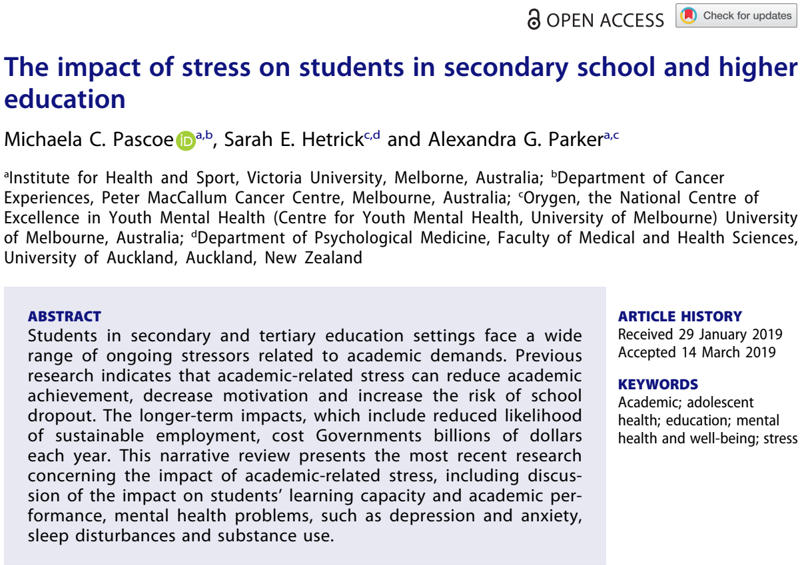
The impact of stress on students in secondary school and higher education
Open accessThe DOI matches its Crossref record; 68 of the 70 references it cites were found in a registry or an index, and 1 are not checked yet; 23 of the 99 sources its claims cite were checked for support.
Abstract
Students in secondary and tertiary education settings face a wide range of ongoing stressors related to academic demands. Previous research indicates that academic-related stress can reduce academic achievement, decrease motivation and increase the risk of school dropout. The longer-term impacts, which include reduced likelihood of sustainable employment, cost Governments billions of dollars each year. This narrative review presents the most recent research concerning the impact of academic-related stress, including discussion of the impact on students’ learning capacity and academic performance, mental health problems, such as depression and anxiety, sleep disturbances and substance use.
Verified 2026-11-19 · 1 reference not checked yet
Overview
CoChat Summary
## TL;DR
This narrative review concludes that academic-related stress is a major, cross-cultural concern for secondary and tertiary students and is linked to worse mental health, sleep, physical health, substance use, and academic outcomes. The paper argues that improving students’ stress-management and coping skills is an important target for schools and universities.
## Key findings
- The review states that academic-related stress has negative impacts on students’ learning capacity, academic performance, education and employment attainment, sleep quality and quantity, physical health, mental health, and substance use outcomes.
- On academic performance, the paper cites OECD data showing that among students in the bottom quarter of academic performance, 63% of those in science reported feeling anxious about tests no matter how well prepared they were, versus 46% in the top quarter.
- On sleep, the paper reports that 42% of 384 surveyed students in grades 9–12 said stress impeded good sleep; it also notes that over 90% of grades 9–12 students in one U.S. study reported inadequate sleep on most school nights.
- On mental health, the paper reports prevalence estimates of anxiety as high as 35% and depression as 30% in tertiary students, and it cites a systematic review of 13 studies linking stress in higher education to poorer quality of life and well-being.
## Methods
- Narrative review design.
- Single author searched PubMed and Google Scholar for peer-reviewed English-language articles, using terms related to academic/school/university stress, mental health, depression, anxiety, resilience, stress management, substance use, sleep, dropout, physical health, and related concepts; references of included papers were also screened.
- Included studies from all countries if they involved a school-based population (secondary, defined as grade 7 or higher, or university) and assessed stress’s impact on mental health, substance use, sleep, dropout, physical activity, or academic outcomes; study design was unrestricted.
## Limitations
- The authors state that they did not delineate between studies assessing academic-related stress during different phases of secondary and tertiary education, so the review does not separate findings by educational stage.
- Because it is a narrative review, evidence synthesis is not described as systematic or quantitative in the text provided; this is evident from the review design and the absence of meta-analysis.
- The paper’s own discussion also indicates that some sections rely on cited studies and examples rather than reporting new primary data; this is evident from the text.
Model-written summary. Check it against the paper before relying on it.
Integrity signals
Registry
Cites
Statistics
Figures


Verification
Claims the paper makes
22 Valid · 0 Not valid · 51 Not checked · 30 Own results and interpretations
The cited sources support only part of this claim — read each source’s verdict below.
In the paper
“The reciprocal relationship between stress and depression and anxiety is well established (Dantzer, 2012;Dantzer, O'Connor, Lawson, & Kelley, 2011;Maes, 2008).”
§ The impact of stress on students in secondary school and higher education > Academic-related stress and mental health
What the sources say
- Not checked — no full text of the sourcecites Dantzer, 2012 matched to “Depression and Inflammation: An Intricate Relationship” (2012) source
- Partly supportedcites Dantzer, O'Connor, Lawson, & Kelley, 2011 matched to “Inflammation-associated depression: From serotonin to kynurenine” (2011) sourceExperimental — accuracy not yet measured
The Human studies section links psychosocial stress to inflammatory activity and reports a correlation between inflammation and depression-like neural activity during bereavement. It does not establish a reciprocal relationship between stress and depression, or address a reciprocal relationship with anxiety. Page numbers were not available in our copy. (LLM, conf=0.76)
- Not checked — no full text of the sourcecites Maes, 2008
boostedstates an association- Asserted: passes — The authors put it forward as true.
- Checkable: passes — It can be checked against evidence.
- Load-bearing: unclear — It is unclear whether the paper’s conclusions depend on it.
- Based: passes — The paper gives a reason why it holds.
Every source the paper cites for this claim was checked and supports it.
In the paper
“In a survey study of 128 Grade 11 students attending competitive private schools in the United States, students who reported experiencing high ongoing stress, particularly in relation to academic achievement and the tertiary education admissions process, also reported high rates of drug and alcohol use (Leonard et al., 2015).”
§ The impact of stress on students in secondary school and higher education > Academic-related stress and substance use
What the sources say
- Supportedcites Leonard et al., 2015 matched to “A multi-method exploratory study of stress, coping, and substance use among high school youth in private schools” (2015) source
Materials and Methods (Research Phase 2; page unavailable) identifies a survey of 128 11th-grade students at two highly selective private schools in the northeastern United States. The Results (Stress and Coping; page unavailable) report high daily stress and substantial recent alcohol and illegal-drug use; the Discussion identifies academic achievement and college admission as the greatest sources of stress. The claim describes these findings together, without asserting that the survey established a statistical association or causation. (LLM, conf=0.92)
plainstates an association- Asserted: passes — The authors put it forward as true.
- Checkable: passes — It can be checked against evidence.
- Load-bearing: passes — The paper’s conclusions depend on it.
- Based: passes — The paper gives a reason why it holds.
- Supported
Every source the paper cites for this claim was checked and supports it.
In the paper
“A systematic review of 13 studies showed that in individuals undertaking higher education, self-reported levels of stress are associated with poorer quality of life and well-being (Ribeiro et al., 2017).”
§ The impact of stress on students in secondary school and higher education > Academic-related stress and mental health
What the sources say
- Supportedcites Ribeiro et al., 2017 matched to “Stress and Quality of Life Among University Students: A Systematic Literature Review” (2018) source
The Abstract reports that 13 studies were eligible and that quality of life was frequently negatively associated with stress. The Conclusion (section 5) likewise identifies a negative association between stress and quality of life in university students, including effects on physical and mental health; the Results (section 3) specifically discuss perceived stress and mental health. (LLM, conf=0.93)
plainstates an association- Asserted: passes — The authors put it forward as true.
- Checkable: passes — It can be checked against evidence.
- Load-bearing: unclear — It is unclear whether the paper’s conclusions depend on it.
- Based: passes — The paper gives a reason why it holds.
- Supported
The cited sources support only part of this claim — read each source’s verdict below.
In the paper
“Importantly, adolescent depression can also result in longer-term poor employment outcomes, as demonstrated by a 25year longitudinal study of New Zealand children (n = 982).”
§ The impact of stress on students in secondary school and higher education > Academic-related stress and mental health
What the sources say
- Partly supportedcites Fergusson, Boden, & Horwood, 2007 matched to “Recurrence of major depression in adolescence and early adulthood, and later mental health, educational and economic outcomes” (2007) sourceExperimental — accuracy not yet measured
The Results report an association between depressive episodes at ages 16–21 and unemployment at ages 21–25 in the 982-person cohort. However, the Adjustment for confounding factors section says the unemployment association was no longer statistically significant after accounting for co-occurring disorders. The study therefore does not establish that adolescent depression results in poorer employment outcomes. (LLM, conf=0.86)
boostedstates a causen = 982- Asserted: passes — The authors put it forward as true.
- Checkable: passes — It can be checked against evidence.
- Load-bearing: unclear — It is unclear whether the paper’s conclusions depend on it.
- Based: passes — The paper gives a reason why it holds.
- Partly supported
Every source the paper cites for this claim was checked and supports it.
In the paper
“Indeed, an Australian randomised control trial reported that a gamified online cognitive behaviour therapy intervention was effective in reducing depressive symptoms in 540 final year secondary students (Perry et al., 2017).”
§ The impact of stress on students in secondary school and higher education > Academic-related stress and mental health
What the sources say
- Supportedcites Perry et al., 2017 matched to “Preventing Depression in Final Year Secondary Students: School-Based Randomized Controlled Trial” (2017) source
The Abstract (Methods) reports a randomized trial in Sydney, Australia, with 540 final-year secondary students. The Abstract (Objective) identifies SPARX-R as a gamified online cognitive behaviour therapy intervention, and the Discussion (Principal Findings) reports that it reduced depressive symptoms before final exams. (LLM, conf=0.94)
plainstates a cause- Asserted: passes — The authors put it forward as true.
- Checkable: passes — It can be checked against evidence.
- Load-bearing: passes — The paper’s conclusions depend on it.
- Based: passes — The paper gives a reason why it holds.
- Supported
72 more claims · 12 with their cited sources checked
Create a free account to see all 103 claims and to verify the 3 references still open.
- Borderline: one of the tests for a substantial claim is unclear. 1
- It may state two separate claims as one. 13
- Probably not a substantial claim. 14
Claims other papers make about this one
Each is checked against this paper’s own text: does it say what the citing paper says it does?
The source backs part of the claim, not all of it — or backs it for a different population, condition or comparison.
In the citing paper
“In Germany, Bulgaria, and Poland, a huge sample of respondents consider assignments a burden on their lives that cannot stand compared to relationships or any other concern in life (14).”
From Family and Academic Stress and Their Impact on Students' Depression Level and Academic Performance (2022) · cites this paper as [14]
Experimental — accuracy not yet measuredThe source backs part of the claim, not all of it — or backs it for a different population, condition or comparison.
In the citing paper
“many university students in the particular screen above clinical cut-off scores for huge depression (14, 32).”
From Family and Academic Stress and Their Impact on Students' Depression Level and Academic Performance (2022) · cites this paper as [14]
Experimental — accuracy not yet measuredThe source backs part of the claim, not all of it — or backs it for a different population, condition or comparison.
In the citing paper
“Although, a few studies have investigated stress and depression and its impact on Students' academic performance (14, 114), however, their background i.e., family and institutions are largely ignored.”
From Family and Academic Stress and Their Impact on Students' Depression Level and Academic Performance (2022) · cites this paper as [14]
Experimental — accuracy not yet measuredThe source backs part of the claim, not all of it — or backs it for a different population, condition or comparison.
In the citing paper
“In university students, high levels of psychological distress have been linked to lower academic performance, poorer self-care, breakdowns in relationships, and increased tendency to drop out”
From A Scoping Review of Acceptance and Commitment Therapy in Higher Education (2024) · cites this paper as Pascoe et al., 2019
Experimental — accuracy not yet measuredThe check wasn’t confident either way, so it gives no verdict — never disputed.
In the citing paper
“These results differ from those of Murdina (2021), Huki et al. (2026), and Pascoe et al. (2020), who found that academic pressure was associated with unethical academic behavior”
From The Relationship between Academic Stress and Academic Integrity among University Students Moderated by Social Support (2026) · cites this paper as Pascoe et al. (2020)
Experimental — accuracy not yet measured
2 more claims about this paper
Create a free account to see every claim other papers make about this one.
Citations
Cites
Adolescence: A foundation for future health
Sawyer, S. M., Afifi, R. A., Bearinger, L. H., Blakemore, S.-J., Dick, B., Ezeh, A. C., & Patton, G. C. (2012) · The Lancet · doi:10.1016/s0140-6736(12)60072-5 · Cited by 2,635 · cited 4×
“a diverse range of backgrounds, during a formative developmental period (Sawyer et al., 2012).”
InfluentialInternational Standard Classification of Education, ISCED 1997
UNESCO United Nations Educational, S. A. C. O. (2003) · Advances in Cross-National Comparison · doi:10.1007/978-1-4419-9186-7_10 · Cited by 2,351
THE EFFECTS OF STRESSFUL LIFE EVENTS ON DEPRESSION
Kessler, R. C. (1997) · Annual Review of Psychology · doi:10.1146/annurev.psych.48.1.191 · Cited by 2,111 · cited 4×
“Ongoing stress also precipitates the development of more serious mental health issues such as anxiety and depression (Kessler, 1997; Moylan, Maes, Wray, & Berk, 2013).”
InfluentialA systematic review of studies of depression prevalence in university students
Ibrahim, A. K., Kelly, S. J., Adams, C. E., & Glazebrook, C. (2013) · Journal of Psychiatric Research · doi:10.1016/j.jpsychires.2012.11.015 · Cited by 1,988 · cited 1×
“The prevalence of anxiety is as high as 35% in tertiary students (Bayram & Bilgel, 2008; Eisenberg, Gollust, Golberstein, & Hefner, 2007; Ozen, Ercan, Irgil, & Sigirli, 2010) and the prevalence of depression is 30% (Ibrahim, Kelly, Adams, & Glazebrook, 2013).”
Prevalence and correlates of depression, anxiety, and suicidality among university students
Eisenberg, D., Gollust, S. E., Golberstein, E., & Hefner, J. L. (2007) · American Journal of Orthopsychiatry · doi:10.1037/0002-9432.77.4.534 · Cited by 1,592 · cited 1×
“The prevalence of anxiety is as high as 35% in tertiary students (Bayram & Bilgel, 2008; Eisenberg, Gollust, Golberstein, & Hefner, 2007; Ozen, Ercan, Irgil, & Sigirli, 2010) and the prevalence of depression is 30% (Ibrahim, Kelly, Adams, & Glazebrook, 2013).”
The role of neuropeptide Y in the antiobesity action of the obese gene product
Stephens, T. W., Basinski, M., Bristow, P. K., Bue-Valleskey, J. M., Burgett, S. G., Craft, L., Hale, J., Hoffmann, J., Hsiung, H. M., Kriauciunas, A., et al. (1995) · Nature · doi:10.1038/377530a0 · Cited by 1,498 · cited 1×
“Similarly, stress has been shown to be associated with increased appetite (Dallman et al., 1993) and higher body weight (Stephens et al., 1995).”
Insufficient Sleep in Adolescents and Young Adults: An Update on Causes and Consequences
Owens, J., ADOLESCENT SLEEP WORKING GROUP, COMMITTEE ON ADOLESCENCE, Au, R., Carskadon, M., Millman, R., Wolfson, A., Braverman, P. K., Adelman, W. P., Breuner, C. C., et al. (2014) · Pediatrics · doi:10.1542/peds.2014-1696 · Cited by 1,413 · cited 2×
“Association and the American Academy of Sleep Medicine, who report that many young people do not get enough hours of sleep (Owens, 2014).”
Bayram, N., & Bilgel, N. (2008) · Social Psychiatry and Psychiatric Epidemiology · doi:10.1007/s00127-008-0345-x · Cited by 1,391 · cited 1×
“The prevalence of anxiety is as high as 35% in tertiary students (Bayram & Bilgel, 2008; Eisenberg, Gollust, Golberstein, & Hefner, 2007; Ozen, Ercan, Irgil, & Sigirli, 2010) and the prevalence of depression is 30% (Ibrahim, Kelly, Adams, & Glazebrook, 2013).”
PISA 2015 Results (Volume I): Excellence and Equity in Education
OECD (2016) · PISA · doi:10.1787/9789264266490-en · Cited by 1,316
Sleep loss, learning capacity and academic performance
CURCIO, G., FERRARA, M., & DEGENNARO, L. (2006) · Sleep Medicine Reviews · doi:10.1016/j.smrv.2005.11.001 · Cited by 1,310 · cited 3×
“Loss of sleep is frequently associated with poor learning (Curcio et al., 2006).”
Influential
Research works printed but not linked: 8
- 9. Canadian Institute for Health. (2005). Improving the health of young canadians. Ottawa, Ontario: Canadian Institute for Health Information.
- 20. Hanson, T. L., & Austin, G. A. (2002). Health risks, resilience, and the academic performance index (California healthy kids survey factsheet 1). Los Alamitos, CA: WestEd. Retrieved from http://surveydata.wested.org/resources/ factsheet.pdf
- 40. Muir, K., Family, S., Maguire, A., Slack-Smith, D., & Murray, M. (2003). Youth unemployment in Australia: A contextual, governmental and organisational perspective: A report by the Smith family for the AMP foundation. Camperdown: The Smith Family. National Centre on Addiction and Substance Abuse at Columbia University (CASA) United States of America. (2003). Depression, substance abuse and college student engagement: A review of the literature. Ney York: National Ctr on Addiction and Substance Abuse at Columbia University (CASA).
- National Centre on Addiction and Substance Abuse at Columbia University (CASA) United States of America, 2003, Depression, substance abuse and college student engagement: A review of the literature
- 42. Noland, H., Price, J. H., Dake, J., & Telljohann, S. K. (2009). Adolescents' sleep behaviors and perceptions of sleep. The Journal of School Health, 795, 224-230. Retrieved from https://www.ncbi.nlm.nih.gov/pubmed/19341441 OECD. (2015). PISA 2015 Results (Volume III). Paris, France. OECD. (2017). PISA 2015 Results (Volume III). Paris, France.
- 49. Rickwood, D., Telford, N., O'Sullivan, S., Crisp, D., & Magyar, R. (2016). National tertiary student wellbeing survey 2016.
- Turrell G., 2006, Health inequalities in Australia: Morbidity, health factors, risk factors and health service use
- 65. World Health Organisation. (2004). Young people's health in context. Health behaviour in school-aged children study: International report from the 2001-2 survey. Denmark.
Cited by
Items 1,201–1,300 of 1,333
Editorial: Well-being and cognitive science in higher education: measures and intervention
Calvetti, P. Ü., Carvalho, S., & Leite, J. (2026) · Frontiers in Psychology · doi:10.3389/fpsyg.2026.1847789
Wiggins, B. L., Wingert, K., & Crowther, G. J. (2026) · Science Education · doi:10.1002/sce.70082 · Cited by 1
Collado, M. F. S., Lucero, H. R., Tungpalan, D. M., Espiritu, C. Y. D., Gal, A. S., & Meneses, J. K. D. (2026) · International Journal of Latest Technology in Engineering Management & Applied Science · doi:10.51583/ijltemas.2026.150500087
Fogarty, J. S., Yifan, W., Yuvaraj, R., Ali, F., & Hoe, L. N. (2026) · Trends in Neuroscience and Education · doi:10.1016/j.tine.2026.100291
Tian, J., Kong, Q., Zhu, T., & Yu, H. (2026) · Psychology and Health · doi:10.1080/08870446.2026.2677078
Multidimensional student adjustment and perceived stress among first-year university students
Lajuma, S. B., Abdullah, N., Wider, W., Wu, C., Wu, H., Zhou, F., & Zhu, M. (2026) · Discover Psychology · doi:10.1007/s44202-026-00756-x · Cited by 3
Koziy, V., Melnyk, L., Пасічник, Н. О., Poroshynska, O. A., Shmayun, S., & Lukyanenko, K. (2026) · Naukovij vìsnik veterinarnoï medicini · doi:10.33245/2310-4902-2026-204-1-101-115
Jijón-Gordillo, E. R., Flores-Poveda, J. A., Bennett, E. A., & Tomala-Estrada, M. J. (2026) · Frontiers in Education · doi:10.3389/feduc.2026.1837489
Alhasani, M., & Orji, R. (2026) · International Journal of Human-Computer Interaction · doi:10.1080/10447318.2026.2659301
Zada, O. C., & Har-Zvi, S. (2026) · International Journal of Mentoring and Coaching in Education · doi:10.1108/ijmce-05-2025-0055
Stress Level and Its Effect on Academic Performance of Computer Science Students
Camague, J. M. G. A. R. G., & Fernandez, J. R. E. (2026) · International Journal of Advanced Research in Science Communication and Technology · doi:10.48175/ijarsct-36708
Raufelder, D., Schlesier, J., & Hoferichter, F. (2026) · European Journal of Teacher Education · doi:10.1080/02619768.2026.2682385
Cuadros, O., & del Barco, B. L. (2026) · Revista de Investigación Educativa · doi:10.6018/rie.678921 · Cited by 1
Fareed, M., Alshahri, A., Alharthi, S., Almasood, A., Newigy, M. K., & Jeivanth, S. B. (2026) · Advanced Health Science and Technology Journal · doi:10.4103/ahstj.ahstj_42_25
Perceived Faculty Support and Nursing Student Stress and Anxiety: A Systematic Review
Harris, C. M., Strout, K. A., Bonnet, J., & O’Brien, L. M. (2026) · Journal of Nursing Education · doi:10.3928/01484834-20260519-05
A scoping review of stress among college students: With implications for student support programs
Sevilla, G. D., Escalante, V. G., & Fernandez, R. (2026) · International Journal of Research Studies in Education · doi:10.5861/ijrse.2026.26864
Lazakovych, Y. (2026) · Academic Visions · doi:10.66556/2786-586x.55.lazakovych-y
Singh, K., Layeeq, S., Gupta, B., Umman, R., Jain, A., Sharma, S., Sharma, S., Rana, R. K., Tripathi, A., Rao, B. T., et al. (2026) · Journal of Research in Ayurvedic Sciences · doi:10.4103/jras.jras_382_25
How Do Assignment Workload and Time Management Relate to Academic Stress in Early Adolescence?
Syahraini, K., Nurhayati, & Fatimah, K. (2026) · Women Education and Social Welfare · doi:10.70211/wesw.v3i2.504 · Cited by 1
Lynch, R. J., Thrill, C. R., & Eldridge, B. (2026) · Community College Review · doi:10.1177/00915521261454664
Determining the relationship between health anxiety and religious coping among university students
TÜRKMENOĞLU, B., & Güler, A. (2026) · International Journal Of Eurasia Social Sciences · doi:10.70736/ijoess.2358
Suhardiningsih, A. S., Sustrami, D., Rustini, S. A., et al. (2026) · Journal of Applied Nursing and Health · doi:10.55018/janh.v8i2.649
Identifying predictors of student depression through validated machine learning pipelines
Washton, J., Owens, T., Sierra, A., & Toma, M. (2026) · Frontiers in Medicine · doi:10.3389/fmed.2026.1864665 · Cited by 1
Addressing the Overlooked: Understanding and Supporting Youth with Mild to Moderate Depression
Kong, L., & Wang, B. (2026) · SHS Web of Conferences · doi:10.1051/shsconf/202623504008
Zhang, J., & Liu, Y. (2026) · Frontiers in Psychology · doi:10.3389/fpsyg.2026.1831018
Kapil, M., Hadwin, A. F., & Rostampour, R. (2026) · Psychology International · doi:10.3390/psycholint8030041
Sewell, M. E., & Duffy, M. C. (2025) · Emerald Group Publishing Limited eBooks · doi:10.1108/979-8-88730-897-520251009
Li, Z., Wang, L., Fan, W., Cheng, M., Sun, W., & Yang, Z. (2026) · Psychological Science and Education · doi:10.17759/pse.2026310318
Avriline, Y. D., Adam, H., & Mandagi, C. K. F. (2026) · Jurnal Lentera - Penelitian dan Pengabdian Masyarakat · doi:10.57207/zxvkqy15
Ulyanina, O. A., Vikhrova, E. N., & Marunevich, O. (2026) · Vestnik of Samara State Technical University Psychological and Pedagogical Sciences · doi:10.17673/vsgtu-pps.2026.2.12
Patel, A., Bhati, P., Bhatt, V., & Rajai, R. (2026) · SN Social Sciences · doi:10.1007/s43545-026-01562-x
A dichotomous structure does not capture the coping behavior of emerging adults
Trumbach, L. M. D., & Roesch, S. C. (2026) · Journal of American College Health · doi:10.1080/07448481.2026.2685591
Lazakovich, Y. I. (2026) · Academic Visions · doi:10.66556/2786-586x.55.lazakovich-y
Academic stress and coping strategies among Vietnamese healthcare students: A cross-sectional study
Nguyen, D. T., Pham, N. H., Nguyen, N. M. H., & Nguyen-Thi, T.-T. (2026) · Multidisciplinary Science Journal · doi:10.31893/multiscience.2026941
Ren, Y., Feng, M., Jia, S., & He, L. (2026) · Journal of School Health · doi:10.1111/josh.70194
Paygozar, R., Tahery, N., & Rameazani, S. A. (2026) · Acta Psychologica · doi:10.1016/j.actpsy.2026.107445
Umerani, A., Sachs, A. L., Karsan, S., Saeed, A., Rogers, H. P., Sprague, N. L., & Ekenga, C. C. (2026) · Journal of School Health · doi:10.1111/josh.70197 · Cited by 3
Azmi, A. H. M., Hussin, Z. B., & Mohsin, N. B. (2026) · International Journal of Entrepreneurship and Management Practices · doi:10.35631/ijepc.1163023
Wang, J., Zhang, M., & Zhang, L. (2026) · Frontiers in Psychiatry · doi:10.3389/fpsyt.2026.1867360
Estilos de vida en adolescentes
Bernal, L. S. M., Merchan, S. S. D., Posada-Bernal, S., et al. (2026) · MOTRICIDADES Revista da Sociedade de Pesquisa Qualitativa em Motricidade Humana · doi:10.29181/2594-6463-2026-v10-n2-p205-219
Bravante, M. A., Guidote, A. M., & Adarlo, G. (2026) · Journal of Chemical Education · doi:10.1021/acs.jchemed.6c00001
Andrade-Girón, D., Rodriguez, W. J. M., Zúñiga-Rojas, M. G., Ayala, A. C. N., Ramírez, E. T. S., & Aguilar-Luna-Victoria, M. A. (2026) · AI · doi:10.3390/ai7070268
Exam anxiety, occupational balance, and participation in adolescents across education levels
Şimşek, S., Yılmaz, G. G., & Abaoğlu, H. (2026) · Cadernos Brasileiros de Terapia Ocupacional · doi:10.1590/2526-8910.cto413240582
Camacho, C. R., & Delgado, M. G. (2026) · Social Sciences · doi:10.3390/socsci15070486
Luong, T.-H., Nguyen, H.-K., Bui, H.-P., & Phan, T. M.-H. (2026) · Acta Psychologica · doi:10.1016/j.actpsy.2026.107477
Zhong, L., Zhu, G., Li, J. R., Zhang, X., Wang, D., & Li, Y. P. (2026) · BMC Psychology · doi:10.1186/s40359-026-05167-0
Shao, H., & Azam, S. M. F. (2026) · International Journal of Social Science Education and Humanities · doi:10.63313/ijsseh.9059
Schlechter, P., Wilkinson, P. O., Jefferies, P., & Fritz, J. (2026) · Scientific Reports · doi:10.1038/s41598-026-63690-x
Le vécu du stress chez les étudiants en interprétation de conférence au Cameroun
Roger, A. N. L., & Sènami, D. D. S. J. (2026) · EPASA MOTO · doi:10.67305/90zda312
Student Stress Level Prediction using Voting Classifier based on Random Forest and XGBoost
Putra, R. R., Wijaya, D. R., Febiyanti, W., & Ramadhana, M. R. (2026) · IEEE International Conference on Industry 4.0, Artificial Intelligence, and Communications Technology (IAICT) · doi:10.1109/iaict71158.2026.11620866
Duc, T. M. (2026) · London Journal of Research In Humanities and Social Sciences · doi:10.34257/ljrhss228434uk
The benefits of creative writing in performance-oriented educational systems
Christensen, S. T., & Görlich, A. (2026) · Educational Research · doi:10.1080/00131881.2026.2710048
Ayesha, A. (2026) · Frontiers in Education · doi:10.3389/feduc.2026.1889391 · Cited by 2
AYDOĞAN, M., Özbek, E., & Kırkbir, H. (2026) · Research Square · doi:10.21203/rs.3.rs-10079086/v1
Mersal, M., & Masaeed, M. (2026) · Frontiers in Psychology · doi:10.3389/fpsyg.2026.1895781
Nowakowska, A., Nowak, M., Bigas, J., Gaweł, Z., Nęcki, M., & Rutkowski, S. (2026) · Healthcare · doi:10.3390/healthcare14152322
Usman, R. A., Razak, A., & Halima, A. (2026) · Indonesian Journal of Innovation Multidisipliner Research · doi:10.69693/ijim.v4i3.1861
Arjona, A. A. M., Moscato, G., Moreno, I. S. E., & Jacinto, L. G. (2026) · Social Sciences · doi:10.3390/socsci15080519
Abankwah, C. A., Senoo-Dogbey, V. E., Donkor, T., Emmanuella, K., Abdul-Razak, I., Anatsui, P. J., & Amankona, R. K. (2026) · Nursing & Midwifery Research Journal · doi:10.1177/0974150x261465501
Koutsoni, A., & González, H. G. (2026) · Trends in Higher Education · doi:10.3390/higheredu5030073
The Impact of Humor Styles on Perceived Stress Among Young Adults in Pakistan
Ahmed, F., & Rubbab, U. (2026) · Pakistan Journal of Positive Psychology · doi:10.67785/pjpp.2.95
Achievement goals shape emotion regulation during goal pursuit
Katz‐Vago, I., & Benita, M. (2026) · Learning and Instruction · doi:10.1016/j.learninstruc.2026.102456
Predictive model of students' academic performance based on their levels of stress
Morada, M. H., Lacap, M. P., & Reyes, R. (2026) · Multidisciplinary Science Journal · doi:10.31893/multiscience.2027094
AHMED, T., & Asif, M. R. A. (2026) · medRxiv · doi:10.64898/2026.08.09.26360019
Melzer, D. K., Yeater, D. B., DeRubis, M., Kohlroser, C., & Pierce, B. J. (2026) · Frontiers in Psychology · doi:10.3389/fpsyg.2026.1876920
Puerta, J. G., Gijón, M. K., Manzano, M. J. L., & Botella, M. C. (2026) · Healthcare · doi:10.3390/healthcare14162494
Zhang, T., Duan, M., Guo, L., Hanmudu, Z., & Wang, W. (2026) · Computers in Human Behavior Reports · doi:10.1016/j.chbr.2026.101258
Wangdi, P., Wangmo, C., Rabjay, S. W., Lhundrup, S., Chophel, U., Wangchuk, K., Galey, K., Dorji, J. Y., & Dorji, T. (2026) · Public Health Challenges · doi:10.1002/puh2.70348
Patrick, S. C., Akyala, I., Efe, E. E., & Aremu, S. O. (2026) · Discover Public Health · doi:10.1186/s12982-026-02084-w · Cited by 1
Huang, L., Yan, M., Sun, W., Dai, L., Gou, Y., Li, T., Duan, Y., Shi, L., & Liu, D. (2026) · Frontiers in Public Health · doi:10.3389/fpubh.2026.1842996
Cariaga, G. B. B., & Fermin, J. N. E. (2026) · International Journal of Research on Multidisciplinary Studies · doi:10.67903/ijroms0349
Ibraimi, Z. (2026) · Research Square · doi:10.21203/rs.3.rs-10739648/v1
Zhou, M., & Ni, N. (2026) · Frontiers in Psychiatry · doi:10.3389/fpsyt.2026.1897109
The impact of AI-based fitness applications on perceived stress in university students
Alecu, Ş. (2026) · Timisoara Physical Education and Rehabilitation Journal · doi:10.2478/tperj-2026-0002
Zou, H., Liu, C., Luo, J., Chen, Y., He, Y., & Liu, Y. (2026) · Frontiers in Psychology · doi:10.3389/fpsyg.2026.1922862
Academic stress and self-esteem in students of a Public Educational Institution in Trujillo, 2026
Rojas-Salazar, K. N., Guevara-Alcalde, H. E., Olivera-Orihuela, J. L., & Cumpa-Sandoval, A. N. (2026) · TUMI Health Sciences Research · doi:10.64716/hye1eh23
Helping adolescents navigate examination stress: Evaluation of an accessible yogic intervention
Reshu, Kumar, S., & Rathi, A. (2026) · Applied Developmental Science · doi:10.1080/10888691.2026.2717094
Trauma-Informed Career Counselling in Educational Settings
Cardello, L. M., & Phillips, P. (2026) · Springer eBooks · doi:10.1007/978-3-031-83986-3_74-1
Muhibbuddin, H., & Muslikah, M. (2026) · Konselor · doi:10.24036/02026152194-0-86
Cognitive Harmony: Anxiety, Motivation, and Academic Success.
Valdés-León, G., & Medina-Déniz, K. (2026) · IGI Global eBooks · doi:10.4018/979-8-3373-1042-8.ch001
Huyen, N. T. T., Lien, N. T. B., Thang, H. T., Nga, D. T., Sáu, N. T. Ú., & Doat, D. V. (2026) · International Journal of Learning Teaching and Educational Research · doi:10.26803/ijlter.25.8.12
Daeng-udom, C., Prayai, N., & Suwanwong, C. (2026) · Social Sciences & Humanities Open · doi:10.1016/j.ssaho.2026.103579
Iqra, Ishfaq, U., Tahir, T., et al. (2026) · The regional tribune. · doi:10.55737/trt/v-ii.364
A Stem Approach to Addressing Science Learning Anxiety Among Fifth-Grade Elementary School Students
Mahardika, K. L., Riastini, P. N., & Asril, N. M. (2026) · Journal of Education Research and Evaluation · doi:10.23887/jere.v10i2.112005
Contemplative AI for Youth Stress: A New Paradigm for Digital Mental Health Support
Wu, E. (2026) · IEEE/ACM Conference on Connected Health: Applications, Systems and Engineering Technologies · doi:10.1109/chase69719.2026.00057
Xue, B., & Luo, H. (2026) · Frontiers in Psychology · doi:10.3389/fpsyg.2026.1915779
Wang, Z., Wang, Y., Pang, M., & Xu, Z. (2026) · Frontiers in Psychology · doi:10.3389/fpsyg.2026.1922858
Ahmad, Oka, I. M. D., Mudana, I. G., et al. (2026) · Research in Hospitality Management · doi:10.1080/22243534.2026.2685385
Factors contributing to academic stress among first-year EFL university students
Safitri, C. D., Sunusi, S. L., Sudding, M. F. J., & Hajar, A. (2026) · Priviet Social Sciences Journal · doi:10.55942/pssj.v6i8.2050
Gong, Z., Qiu, K., & 薛峰 (2026) · Frontiers in Psychology · doi:10.3389/fpsyg.2026.1852116
Проненко, Е. А. (2026) · Innovative science psychology pedagogy defectology · doi:10.23947/2658-7165-2026-9-3-67-74
Gomes, C., Klatter, E. B., Meeuwisse, M., & Severiens, S. E. (2026) · Research in Post-Compulsory Education · doi:10.1080/13596748.2026.2721871
Mamun, M. A., Abdelall, M. M. R., & Al‐Mamun, F. (2026) · International Journal of Methods in Psychiatric Research · doi:10.1002/mpr.70106
Assessment of academic stress: measurement invariance by sex
Karpova, A. D., Тарасов, С. В., & Kanonire, T. (2026) · Psychological Science and Education · doi:10.17759/pse.2026310404
Baguio, J. D. (2026) · International Journal of Sustainable and Integrated Studies · doi:10.65339/ijsis.v1.i2.63
Agafonov, А. R., & Zdyumaeva, N. P. (2026) · Current Issues of Sports Psychology and Pedagogy · doi:10.15826/spp.2026.3.209
Tokbergenov, Z., Simtikov, Z. K., Seitzhanov, D., & Abdrassilov, A. (2026) · Frontiers in Sociology · doi:10.3389/fsoc.2026.1820442
Rodríguez, A. M. M., & Rodríguez, F. M. M. (2026) · European Journal of Investigation in Health Psychology and Education · doi:10.3390/ejihpe16090135 · Cited by 1
Predicting academic success: The roles of emotions, stress and prior grades
Batra, N., Roy, K., & Chowdhury, I. (2026) · Acta Psychologica · doi:10.1016/j.actpsy.2026.107762
Neurocognitive effects of stress in higher education: Mechanisms, challenges, and opportunities
Ochoa-Amaya, J. E., Álzate, Ó. E. T., & Rojas-Peña, J. I. (2026) · Behavioural Brain Research · doi:10.1016/j.bbr.2026.116470 · Cited by 2
Metadata
- Authors
- Pascoe, M. C., Hetrick, S. E., & Parker, A. G.
- Affiliations
- Peter MacCallum Cancer Centre (AU)
- University of Auckland (NZ)
- The University of Melbourne (AU)
- Corresponding author
- Pascoe, Michaela C.
- Venue
- International Journal of Adolescence and Youth
- Publisher
- Informa UK Limited
- Published
- 2019-04-11
- Volume
- 25
- Issue
- 1
- Pages
- 104-112
- ISSN
- 0267-3843 (ISSN-L)
- 2164-4527
- OpenAlex
- W2936355586
- Semantic Scholar
- cb875214c2157d53611d7fdf2992e4edf829f677
- Cited by
- 1,359
- References
- 66
- Citations by year
- 2026: 239 · 2025: 268 · 2024: 277 · 2023: 253 · 2022: 151 · 2021: 114 · 2020: 51 · 2019: 3
- FWCI
- 144.92
- Type
- journal article
- Language
- en
- Open access
- gold
- doi.org
- Locations
- International Journal of Adolescence and Youth (publishedVersion, cc-by)
- Victoria University Research Repository (Victoria University) (submittedVersion, cc-by)
- DOAJ (DOAJ: Directory of Open Access Journals) (submittedVersion)
- Minerva Access (University of Melbourne) (submittedVersion)
- ResearchSpace (University of Auckland) (submittedVersion, cc-by)
- Funders
- no financial
- Topics
- Social Sciences › Psychology › Developmental and Educational Psychology › Student Stress and Coping
- Social Sciences › Psychology › Social Psychology › Stress and Burnout Research
- Social Sciences › Education › Educational Outcomes and Influences
- Keywords
- academic stress, student stress, high school students, university students, academic performance, learning ability, mental health, depression, anxiety, sleep disorders, substance use, school dropout, motivation
About these checks
Registry, retraction, Cites and statistics results are computed, not judged, with one exception: a printed reference that no index lists is read once by a model before it counts as a citation error. Claims are extracted by a model and kept only when their quote appears verbatim in the text; each cited source is then checked, with a model’s help, for whether it says what the claim relies on. Those verdicts can be wrong — read the claim’s quote and the cited source before relying on one.
The claim verdicts this report counts are experimental: their accuracy is not yet measured.
A language model drew the claims from the paper on 2026-09-28, under version 3 of the claim definition (model deepseek-v4.1-flash, prompt extract-v3).
A second model labelled each claim on 2026-09-28 (model jev-1.13-20260917, definition revision gold-guideline-v0.2).
Cited sources are checked with a language model’s help (gpt-6-sol).
Statistics and arithmetic are recomputed, not judged.
Confidence bands are shown only for fields calibrated on our annotated test set. None is calibrated yet, so no band is shown.
What counts as a claim ›How we measure confidence ›How we check this ›
Are you an author, or do you see a problem with this page? Request a review
Data sources
Bibliographic data: Semantic Scholar, OpenAlex, Crossref.
Contains information from the Semantic Scholar Academic Graph Datasets, made available under the ODC Attribution License (ODC-BY 1.0).
Semantic Scholar’s data is described in: Kinney, R., et al. (2023). The Semantic Scholar Open Data Platform. arXiv:2301.10140.
