

How Does Reading Fiction Support Adolescents’ Wellbeing? A Qualitative Study Examining Positive Affect, Connection and Personal Growth
Open accessThe DOI matches its Crossref record; 63 of the 63 references it cites were found in a registry or an index; 23 of the 49 sources its claims cite were checked for support.
Abstract
This study provides novel and nuanced insights into the relationship between adolescents’ fiction reading and their wellbeing. In total, 19 adolescents (aged 15–17-years-old) living in the UK participated in semi-structured interviews exploring three aspects of wellbeing: positive affect, connection and personal growth. In relation to positive affect, adolescents reported a range of rich and diverse emotions in relation to reading, with current emotional state and/or reading environment often influencing this. Regarding connection, adolescents shared feelings of connection to fictional characters, friends, family and online reading communities through reading, with each of these connections enriching them in different ways. Finally, in relation to personal growth, adolescents expressed that books nurtured their own personal development, supported their empathy and understanding of others, and improved their general knowledge and literacy skills. This research significantly deepens and expands our understanding of the enriching effects that fiction reading can have for adolescents and highlights the need for research-informed practices to increase their engagement with books.
Overview
CoChat Summary
TL;DR
This qualitative study interviewed 19 UK adolescents aged 15–17 who were fiction readers and found that fiction reading supported wellbeing through positive affect, connection, and personal growth. The authors conclude these benefits were described by adolescents who choose to read and enjoy reading, limiting the scope of the findings.
Key findings
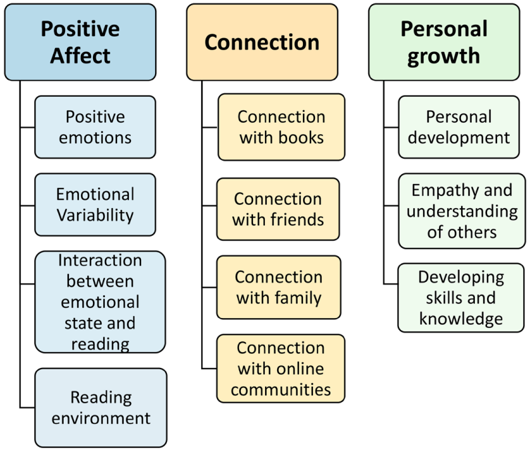
- Positive affect was reported across four subthemes: positive emotions (44 references by 16 adolescents), emotional variability (17 references by 15 adolescents), interaction between emotional state and reading (32 references by 17 adolescents), and reading environment (41 references by all 19 adolescents).
- Connection was reported through books (80 references by all 19 adolescents), friends (52 references by 18 adolescents), family (24 references by 13 adolescents), and online communities (17 references by 7 adolescents).
- Personal growth included personal development (76 references by all 19 adolescents), empathy and understanding of others (31 references by 16 adolescents), and improved skills and knowledge such as vocabulary, spelling, writing, imagination, concentration, memory, analytical skills, history, and human nature.
- The authors conclude that reading fiction offers considerable potential to support adolescents’ wellbeing, but only among those who choose to read and enjoy reading.
Methods
- Qualitative interview study with 19 adolescents (11 female, 7 male, 1 prefer not to say; 15–17 years old) recruited from four secondary schools in the UK; all identified themselves as fiction readers and/or were identified by teachers/school librarians as keen readers of fiction.
- Adolescents were interviewed online via MS Teams during school using a pre-registered interview schedule covering positive affect, connection, personal growth, and social context; they also completed a brief demographic and reading habits survey.
- Thematic analysis followed Braun and Clarke’s six stages, using both deductive (predefined wellbeing concepts) and inductive (subthemes) approaches, managed in NVivo.
Limitations
- The paper states that wellbeing was explored through positive affect, connection, and personal growth, but adolescents themselves may conceptualize wellbeing differently, for example in terms of “having a say,” being listened to, having rights, and feeling respected, safe, and valued.
- The paper states that although participants reflected a range of nationalities, the majority were White and all were living in the UK, so findings are limited in scope and more diverse populations and contexts are needed.
- Evident from the text: the sample was small and selected for being fiction readers/keen readers, so findings apply to engaged readers and cannot establish causality or generalizability; the authors also note benefits were found only among those who choose to read and enjoy reading.
Model-written summary. Check it against the paper before relying on it.
Integrity signals
Registry
Cites
Statistics
Figures


Verification
Claims the paper makes
15 Valid · 0 Not valid · 20 Not checked · 51 Own results and interpretations
The cited sources support only part of this claim — read each source’s verdict below.
In the paper
“Finally, adolescents felt that fiction reading provided opportunities to develop their academic skills in addition to their general knowledge (Martin-Chang et al., 2020; Nation et al., 2022; Torppa et al., 2020) and knowledge of the wider world (Howard, 2011).”
What the sources say
- Partly supportedcites Martin-Chang et al., 2020 matched to “What's Your Pleasure? Exploring the Predictors of Leisure Reading for Fiction and Nonfiction” (2020) sourceExperimental — accuracy not yet measured
The Fiction versus Nonfiction and Reading Motivations sections link fiction exposure with stronger verbal ability, which partly supports the academic-skills portion of the citation. The study examined undergraduates, however, and does not report that adolescents felt fiction offered opportunities to develop academic skills or general knowledge. The wider-world claim is cited to Howard (2011), not this paper; page numbers are unavailable in our copy. (LLM, conf=0.84)
- Partly supportedcites Nation et al., 2022 matched to “Book Language and Its Implications for Children’s Language, Literacy, and Development” (2022) sourceExperimental — accuracy not yet measured
Nation et al. (2022) frame reading as a learning channel — 'As children progress through the education system, reading becomes an increasingly important vehicle for learning... This framing resonates with the concept of academic language... extending through the middle- and high-school years' (Writing and Speaking, Reading and Listening, p. 2) — and note fiction's distinctive linguistic content ('books provide access to situations and characters beyond the everyday'; fiction contains more complex emotion words; Beyond Language and Literacy, pp. 4). That covers the academic-learning/fiction-reading part of the attributed claim, but our copy nowhere reports adolescents' own perceptions or any study in which adolescents 'felt' fiction reading developed their academic skills or general knowledge; the paper is a corpus-based review of book language, so the subjective-perception component attributed to this source is unsupported (it likely rests on the co-cited empirical work). (LLM, conf=0.65)
- Could not verifycites Torppa et al., 2020 matched to “Leisure Reading (But Not Any Kind) and Reading Comprehension Support Each Other—A Longitudinal Study Across Grades 1 and 9” (2020) sourceExperimental — accuracy not yet measured
Our copy of Torppa et al. (2020) is a cross-lagged longitudinal study (Grades 1-9, n = 2,525, Finland) in which the adolescent self-report measures tap only reading FREQUENCY of genres — 'reading frequency was assessed via self-report with items tapping reading frequency of different reading materials … books, newspapers, magazines, comics, and digital texts' (Measures, Leisure reading) — with no items on perceived or felt benefits for academic skills, general knowledge, or knowledge of the wider world. The paper's genre-related findings are the authors' own skill estimates (e.g., Discussion: book reading, unlike newspapers/comics, magazines and digital texts, predicted subsequent reading comprehension; Introduction: 'Do Genres of Leisure Reading Produce Dissimilar Fruit?' cites Spear-Swerling et al., 2010 for fiction-comprehension links), which is a different level of claim from what the citing sentence attributes. Searched: adolescents' perceived/felt benefits of fiction reading, academic skills, general knowledge, knowledge of the world, questionnaire items — no passage in our copy addresses the perception claim, and none contradicts it. (LLM, conf=0.72)
plainstates a cause- Asserted: passes — The authors put it forward as true.
- Checkable: passes — It can be checked against evidence.
- Load-bearing: unclear — It is unclear whether the paper’s conclusions depend on it.
- Based: passes — The paper gives a reason why it holds.
- Rests on an assumption not shown here.
- Partly supported
The cited sources support only part of this claim — read each source’s verdict below.
In the paper
“In addition to fiction providing a means of better understanding themselves, adolescents also recognized the potential of fiction reading for developing empathy and helping them to understand others (Djikic et al., 2013; Eekhof et al., 2022; Vezzali et al., 2015).”
What the sources say
- Not checked — no full text of the sourcecites Djikic et al., 2013 matched to “Reading other minds: Effects of literature on empathy” (2013) source
- Partly supportedcites Eekhof et al., 2022 matched to “Reading about minds: The social-cognitive potential of narratives” (2022) sourceExperimental — accuracy not yet measured
The ‘Correlational and longitudinal studies’ section reports an association between fiction exposure and self-reported perspective-taking among 8- to 16-year-olds, while noting mixed findings for other measures and adolescent samples. The paper discusses fiction’s potential social-cognitive benefits, but it does not report that adolescents themselves recognized those benefits. (LLM, conf=0.82)
- Partly supportedcites Vezzali et al., 2015 matched to “The greatest magic of Harry Potter: Reducing prejudice” (2015) sourceExperimental — accuracy not yet measured
The Theoretical implications section reports that reading Harry Potter was associated with perspective-taking toward stigmatized groups, which supports the idea that fiction can help readers understand others. But the paper does not report adolescents recognizing that potential themselves; its adolescent study used questionnaires about Harry Potter and social attitudes (Participants and Procedure, page unavailable). The authors also say they did not assess whether reading improved a general ability to understand others’ inner lives. (LLM, conf=0.84)
plain- Asserted: passes — The authors put it forward as true.
- Checkable: passes — It can be checked against evidence.
- Load-bearing: passes — The paper’s conclusions depend on it.
- Based: passes — The paper gives a reason why it holds.
- Rests on an assumption not shown here.
The cited sources support only part of this claim — read each source’s verdict below.
In the paper
“However, for adolescents to achieve these benefits from books, they need to have reading experiences in which they feel deeply engaged (both cognitively and affectively) in what they read, and which align with their own personal goals for reading (Webber et al., 2025).”
What the sources say
- Partly supportedcites Webber et al., 2025 matched to “Motivating book reading during adolescence: qualitative insights from adolescents” (2025) sourceExperimental — accuracy not yet measured
The Introduction and Conclusion (pages unavailable) connect adolescents’ volitional book reading with its benefits, while the Access and Relatable messaging sections emphasize books suited to adolescents’ interests and differing goals for reading. The paper does not establish that deeply cognitive and affective engagement, together with alignment to personal goals, is necessary for adolescents to obtain those benefits. (LLM, conf=0.86)
plainstates a possible cause- Asserted: passes — The authors put it forward as true.
- Checkable: passes — It can be checked against evidence.
- Load-bearing: passes — The paper’s conclusions depend on it.
- Based: passes — The paper gives a reason why it holds.
- Partly supported
The cited sources support only part of this claim — read each source’s verdict below.
In the paper
“In addition, reading fiction supports social and emotional development, by providing personal, interpersonal and social-cognitive learning opportunities (Barnes, 2018; Eekhof et al., 2022; Howard, 2011).”
What the sources say
- Not checked — no full text of the sourcecites Barnes, 2018 matched to “Imaginary Engagement, Real-World Effects: Fiction, Emotion, and Social Cognition” (2018) source
- Partly supportedcites Eekhof et al., 2022 matched to “Reading about minds: The social-cognitive potential of narratives” (2022) sourceExperimental — accuracy not yet measured
Theoretical background (page unavailable) describes narratives as opportunities to practise understanding others and learn about relationships. The Empirical evidence section reports some social-cognitive and emotional benefits, but also mixed findings and uncertainty about whether reading itself causes them. The paper does not establish the broader claim of personal development, which it identifies as a topic for future research. (LLM, conf=0.84)
- Not checked — no full text of the sourcecites Howard, 2011 matched to “The importance of pleasure reading in the lives of young teens: Self-identification, self-construction and self-awareness” (2011) source
plainstates a cause- Asserted: passes — The authors put it forward as true.
- Checkable: passes — It can be checked against evidence.
- Load-bearing: passes — The paper’s conclusions depend on it.
- Based: passes — The paper gives a reason why it holds.
The cited sources support only part of this claim — read each source’s verdict below.
In the paper
“In addition to connecting with fictional characters, books can also facilitate connections with real life others, for example, by enriching understanding of others and/or developing relationships with those who have shared reading interests and/or experiences (Merga, 2014; Sellers, 2019; Vezzali et al., 2015).”
What the sources say
- Supportedcites Merga, 2014 matched to “Are Western Australian adolescents keen book readers?” (2014) sourceExperimental — accuracy not yet measured
Merga’s paper has no available full-text snippets, so the claim cannot be checked against it directly. Secondary papers cite Merga (2014) when discussing how friends’ attitudes affect adolescent reading and how adolescents enjoy book-related conversations with peers. That supports the shared-reading and relationship aspect of the citing sentence, though it does not independently establish the part about understanding others. (LLM, conf=0.73)
- Not checked — no full text of the sourcecites Sellers, 2019 matched to “‘Fitting in’ and ‘standing out’: the peer group and young people’s development of reader identity” (2019) source
- Partly supportedcites Vezzali et al., 2015 matched to “The greatest magic of Harry Potter: Reducing prejudice” (2015) sourceExperimental — accuracy not yet measured
The Theoretical implications section reports that reading about Harry Potter’s interactions with stigmatized characters may help readers understand disadvantaged real-world groups. The Practical implications section suggests discussion groups after reading, but our copy does not show that books develop relationships between people with shared reading interests or experiences. Page numbers are unavailable in our copy. (LLM, conf=0.86)
plainstates a cause- Asserted: passes — The authors put it forward as true.
- Checkable: passes — It can be checked against evidence.
- Load-bearing: passes — The paper’s conclusions depend on it.
- Based: passes — The paper gives a reason why it holds.
- Supported
26 more claims · 2 with their cited sources checked
Create a free account to see all 86 claims and to verify the 4 references still open.
- Probably not a substantial claim. 30
- It may state two separate claims as one. 31
Citations
Cites
Using thematic analysis in psychology
Braun, V., & Clarke, V. (2006) · Qualitative Research in Psychology · doi:10.1191/1478088706qp063oa · Cited by 194,414
On Happiness and Human Potentials: A Review of Research on Hedonic and Eudaimonic Well-Being
Ryan, R. M., & Deci, E. L. (2001) · Annual Review of Psychology · doi:10.1146/annurev.psych.52.1.141 · Cited by 11,567 · cited 2×
“…between hedonism (e.g., positive affect) and eudaimonism (e.g., connection, personal growth) is widely used within the research literature (Ryan & Deci, 2001), we recognize that adolescents themselves may conceptualize well-being in different ways, for example in terms of “having a say,”…”
Psychological Well-Being Revisited: Advances in the Science and Practice of Eudaimonia
Ryff, C. D. (2014) · Psychotherapy and Psychosomatics · doi:10.1159/000353263 · Cited by 2,976 · cited 1×
“…traditions: hedonism (happiness; the presence of positive affect and the absence of negative affect) and eudaimonism (meaningfulness; a focus on autonomy, mastery, personal growth, positive relatedness, sense of belonging, and self-acceptance) (Diener et al., 2018; Ryan & Deci, 2001; Ryff, 2014).”
Oblinger, D. G., Oblinger, J. L., & Lippincott, J. K. (2005) · Bibliothèque et Archives nationales du Québec (Québec government) · Cited by 2,416
Advances and Open Questions in the Science of Subjective Well-Being
Diener, E., Lucas, R. E., & Oishi, S. (2018) · Collabra: Psychology · doi:10.1525/collabra.115 · Cited by 1,062 · cited 1×
“…traditions: hedonism (happiness; the presence of positive affect and the absence of negative affect) and eudaimonism (meaningfulness; a focus on autonomy, mastery, personal growth, positive relatedness, sense of belonging, and self-acceptance) (Diener et al., 2018; Ryan & Deci, 2001; Ryff, 2014).”
Making Mental Health Count: The Social and Economic Costs of Neglecting Mental Health Care
Hewlett, E., & Moran, V. (2014) · OECD Health Policy Studies · doi:10.1787/9789264208445-en · Cited by 1,036 · cited 1×
“Adolescents may be especially vulnerable to mental ill-health, with the OECD-wide median age of onset for mental disorders being 14 years old (Hewlett & Moran, 2014), and an internationally documented trend for wellbeing levels to decline across years of schooling (Joing et al., 2020).”
Mar, R. A., Oatley, K., Hirsh, J., dela Paz, J., & Peterson, J. B. (2006) · Journal of Research in Personality · doi:10.1016/j.jrp.2005.08.002 · Cited by 614 · cited 1×
“Previous research has been dominated by a focus on the positive effects of reading fiction (Eekhof et al., 2022; Van der Kleij, Apperly, et al., 2022), often when directly compared to nonfiction (Jerrim & Moss, 2019; Mar et al., 2006, 2021; Mar & Rain, 2015; Martin-Chang et al., 2021).”
Bal, P. M., & Veltkamp, M. (2013) · PLoS ONE · doi:10.1371/journal.pone.0055341 · Cited by 588 · cited 3×
“…(e.g., Jerrim & Moss, 2019; Torppa et al., 2020; van der Kleij, Burgess, et al., 2022), fiction reading has also been associated with empathy (Bal & Veltkamp, 2013; Eekhof et al., 2022), emotional vocabulary (Dylman et al., 2020) and per-spective-taking skills, for example, theory of mind…”
Emotion and narrative fiction: Interactive influences before, during, and after reading
Mar, R. A., Oatley, K., Djikic, M., & Mullin, J. (2011) · Cognition & Emotion · doi:10.1080/02699931.2010.515151 · Cited by 429 · cited 6×
“…aged 17) Other adolescents reflected on specific mood-related factors that influenced their reading choices, including their own emotional state (Mar et al., 2011), the influence of the season on their mood and the emotions created by the last book they read: If I’m happy, then I want to read,…”
Influential21st-Century Readers: Developing Literacy Skills in a Digital World
OECD (2021) · PISA · doi:10.1787/a83d84cb-en · Cited by 337
The Role of a Narrative's Emotional Flow in Promoting Persuasive Outcomes
Nabi, R. L., & Green, M. C. (2015) · Media Psychology · doi:10.1080/15213269.2014.912585 · Cited by 318 · cited 1×
“Indeed, fiction books that take readers on an emotional journey have potential to encourage deeper investment and engagement in a story (Koopman, 2015; Nabi & Green, 2015), and can support a closer sense of connection with the characters (Kuzmičová & Cremin, 2022; Mar et al., 2011).”
"You gotta be the book": teaching engaged and reflective reading with adolescents
(2008) · Choice Reviews Online · doi:10.5860/choice.45-5124 · Cited by 292 · cited 3×
“In this way, reading fiction can support adolescents’ perspective taking, empathy and identity development (Eekhof et al., 2022; Howard, 2011; van der Kleij, Apperly, et al., 2022; Webber et al., 2024; Wilhelm, 2016).”
The greatest magic of Harry Potter: Reducing prejudice
Vezzali, L., Stathi, S., Giovannini, D., Capozza, D., & Trifiletti, E. (2015) · Journal of Applied Social Psychology · doi:10.1111/jasp.12279 · Cited by 228 · cited 1×
“…to connecting with fictional characters, books can also facilitate connections with real life others, for example, by enriching understanding of others and/or developing relationships with those who have shared reading interests and/or experiences (Merga, 2014; Sellers, 2019; Vezzali et al., 2015).”
Slater, M. D., Johnson, B. K., Cohen, J., Comello, M. L. G., & Ewoldsen, D. R. (2014) · Journal of Communication · doi:10.1111/jcom.12100 · Cited by 215 · cited 1×
“…characters, for example, by seeing their own life, experiences or characteristics reflected in the books that they read, can have a powerful effect on adolescents’ sense of belonging, self-under-standing and self-acceptance (Howard, 2011; Mathies, 2020; Slater et al., 2014; Webber et al., 2024).”
Youth mental health in the time of COVID-19
Power, E., Hughes, S., Cotter, D., & Cannon, M. (2020) · Irish Journal of Psychological Medicine · doi:10.1017/ipm.2020.84 · Cited by 192 · cited 1×
“Furthermore, as many adolescents were disproportionately affected by the COVID-19 pandemic (Power et al., 2020), there has been increasing recognition of the importance of supporting their wellbeing post-COVID-19.”
BookTok 101: TikTok, Digital Literacies, and Out‐of‐School Reading Practices
Jerasa, S., & Boffone, T. (2021) · Journal of Adolescent & Adult Literacy · doi:10.1002/jaal.1199 · Cited by 191 · cited 1×
“…their reading practices, by influencing the books they choose to read and providing opportunities to find popular book recommendations and reviews (Jerasa & Boffone, 2021; Merga, 2021): I go on Instagram Reels lot and there’s like these videos that are, like, one hook line and it’s like reading a…”
Reading other minds: Effects of literature on empathy
Djikic, M., Oatley, K., & Moldoveanu, M. C. (2013) · Scientific Study of Literature · doi:10.1075/ssol.3.1.06dji · Cited by 187 · cited 1×
“In addition to fiction providing a means of better understanding themselves, adolescents also recognized the potential of fiction reading for developing empathy and helping them to understand others (Djikic et al., 2013; Eekhof et al., 2022; Vezzali et al., 2015).”
How can Booktok on TikTok inform readers' advisory services for young people?
Merga, M. K. (2021) · Library & Information Science Research · doi:10.1016/j.lisr.2021.101091 · Cited by 178 · cited 3×
“…also highlighted the essential role of their school libraries, and activities within them, to support feelings of connection with others (Merga, 2021; Webber et al., 2024c): That it’s just a nice space, you know, you can make friends with other people who also like books, share books…”
Torppa, M., Niemi, P., Vasalampi, K., Lerkkanen, M.-K., Tolvanen, A., & Poikkeus, A.-M. (2020) · Child Development · doi:10.1111/cdev.13241 · Cited by 177 · cited 4×
“For example, fiction books have been found to support adolescents’ language and literacy skills, and other academic outcomes (Jerrim & Moss, 2019; Martin-Chang et al., 2020; Torppa et al., 2020).”
InfluentialMemory and comprehension of narrative versus expository texts: A meta-analysis
Mar, R. A., Li, J., Nguyen, A. T. P., & Ta, C. P. (2021) · Psychonomic Bulletin & Review · doi:10.3758/s13423-020-01853-1 · Cited by 175 · cited 1×
“Previous research has been dominated by a focus on the positive effects of reading fiction (Eekhof et al., 2022; Van der Kleij, Apperly, et al., 2022), often when directly compared to nonfiction (Jerrim & Moss, 2019; Mar et al., 2006, 2021; Mar & Rain, 2015; Martin-Chang et al., 2021).”
Kuijpers, M. M., Hakemulder, F., Tan, E. S., & Doicaru, M. M. (2014) · Scientific Study of Literature · doi:10.1075/ssol.4.1.05kui · Cited by 173 · cited 1×
“…the book was important for their wellbeing, and future correlational studies could explore this, for example, by examining the relationship between story-world absorption (e.g., Kuijpers et al., 2014; Prezioso & Harris, 2023), reading engagement (e.g., McGeown & Conradi-Smith, 2024) and wellbeing.”
Shame, self-criticism, and self-compassion in adolescence
Gilbert, P., & Irons, C. (2008) · Adolescent Emotional Development and the Emergence of Depressive Disorders · doi:10.1017/cbo9780511551963.011 · Cited by 165 · cited 1×
“This may be particularly important during adolescence, which is often characterized as a period of time associated with exploration and development of identity (e.g., Erikson, 1968), and well as a need to belong and feel accepted (Gilbert & Irons, 2009; Oblinger & Oblinger, 2005).”
Improving student wellbeing: having a say at school
Anderson, D. L., & Graham, A. P. (2016) · School Effectiveness and School Improvement · doi:10.1080/09243453.2015.1084336 · Cited by 142 · cited 1×
“…is widely used within the research literature (Ryan & Deci, 2001), we recognize that adolescents themselves may conceptualize well-being in different ways, for example in terms of “having a say,” being listened to, having rights, and feeling respected, safe and valued (Anderson & Graham, 2016).”
Building Communities of Engaged Readers: Reading for pleasure
Cremin, T., Mottram, M., Collins, F. M., Powell, S., & Safford, K. (2014) · doi:10.4324/9781315772585 · Cited by 142 · cited 1×
“…books, adolescents also demonstrated awareness of their own identity as a reader and instances of being inspired by friends to try new genres (Cremin et al., 2014): Personally, I do read, like, more light-hearted stuff, like, but my friend has started, like, making more recommendations to me…”
Adolescent Emotional Development and the Emergence of Depressive Disorders
Burke, M. G. (2009) · JAMA · doi:10.1001/jama.2009.1766 · Cited by 124
Jerrim, J., & Moss, G. (2019) · British Educational Research Journal · doi:10.1002/berj.3498 · Cited by 110 · cited 4×
“For example, fiction books have been found to support adolescents’ language and literacy skills, and other academic outcomes (Jerrim & Moss, 2019; Martin-Chang et al., 2020; Torppa et al., 2020).”
InfluentialSelf-citationHoward, V. (2011) · Journal of Librarianship and Information Science · doi:10.1177/0961000610390992 · Cited by 103 · cited 7×
“Finally, adolescents felt that fiction reading provided opportunities to develop their academic skills in addition to their general knowledge (Martin-Chang et al., 2020; Nation et al., 2022; Torppa et al., 2020) and knowledge of the wider world (Howard, 2011).”
InfluentialBook Language and Its Implications for Children’s Language, Literacy, and Development
Nation, K., Dawson, N. J., & Hsiao, Y. (2022) · Current Directions in Psychological Science · doi:10.1177/09637214221103264 · Cited by 89 · cited 1×
“Finally, adolescents felt that fiction reading provided opportunities to develop their academic skills in addition to their general knowledge (Martin-Chang et al., 2020; Nation et al., 2022; Torppa et al., 2020) and knowledge of the wider world (Howard, 2011).”
Effectiveness of school-based mental well-being interventions among adolescents: A systematic review
Cilar, L., Štiglic, G., Kmetec, S., Barr, O., & Pajnkihar, M. (2020) · Journal of Advanced Nursing · doi:10.1111/jan.14408 · Cited by 85 · cited 1×
“The psychological wellbeing of adolescents is also of growing concern globally, and activities which promote mental health are being viewed as increasingly essential (Cilar et al., 2020).”
Reading Engagement Matters! A New Scale to Measure and Support Children's Engagement with Books
McGeown, S. P., & Conradi, K. (2023) · The Reading Teacher · doi:10.1002/trtr.2267 · Cited by 82
Self-citationNarrative Fiction and Expository Nonfiction Differentially Predict Verbal Ability
Mar, R. A., & Rain, M. (2015) · Scientific Studies of Reading · doi:10.1080/10888438.2015.1069296 · Cited by 72 · cited 1×
“Previous research has been dominated by a focus on the positive effects of reading fiction (Eekhof et al., 2022; Van der Kleij, Apperly, et al., 2022), often when directly compared to nonfiction (Jerrim & Moss, 2019; Mar et al., 2006, 2021; Mar & Rain, 2015; Martin-Chang et al., 2021).”
Personal Relevance in Story Reading
Kuzmičová, A., & Bálint, K. (2019) · Poetics Today · doi:10.1215/03335372-7558066 · Cited by 69 · cited 1×
“…affect in determining subjective wellbeing, it may be that a range of emotional responses to fiction books can be desirable and/or beneficial (Kuzmičová & Bálint, 2019; Kuzmičová & Cremin, 2022), as fiction books provide safe spaces for adolescents to work through negative or difficult…”
Sun, Y.-J., Sahakian, B. J., Langley, C., Yang, A., Jiang, Y., Kang, J., Zhao, X., Li, C., Cheng, W., & Feng, J. (2024) · Psychological Medicine · doi:10.1017/s0033291723001381 · Cited by 68 · cited 2×
“In Malaysia, positive reading attitude has been positively associated with adolescent subjective wellbeing (Kaur et al., 2022), while in the U.S., frequency of reading for pleasure at 9–11-years old has been negatively associated with mental health difficulties at 11–13 years old (Sun et al., 2024).”
Reading habits and emotional vocabulary in adolescents
Dylman, A. S., Blomqvist, E., & Champoux‐Larsson, M. (2020) · Educational Psychology · doi:10.1080/01443410.2020.1732874 · Cited by 52 · cited 2×
“…et al., 2020; van der Kleij, Burgess, et al., 2022), fiction reading has also been associated with empathy (Bal & Veltkamp, 2013; Eekhof et al., 2022), emotional vocabulary (Dylman et al., 2020) and per-spective-taking skills, for example, theory of mind (van der Kleij, Apperly, et al., 2022).”
Benefits of Positive Psychology-Based Story Reading on Adolescent Mental Health and Well-Being
Arslan, G., Yıldırım, M., Zangeneh, M., & Ak, İ. (2022) · Child Indicators Research · doi:10.1007/s12187-021-09891-4 · Cited by 51 · cited 3×
“For some adolescents, the act of reading itself (rather than specific content) was reported to have a positive impact on their mood and wellbeing (Arslan et al., 2022), demonstrating the power of fiction reading as a potential wellbeing tool/strategy for adolescents: …whenever I feel low or I…”
Peer Group and Friend Influences on the Social Acceptability of Adolescent Book Reading
Merga, M. K. (2014) · Journal of Adolescent & Adult Literacy · doi:10.1002/jaal.273 · Cited by 48 · cited 2×
“Many adolescents talked about the enjoyment of sharing book-related conversations with their friends and peers (see also Merga, 2014; Sellers, 2019).”
Absorption in narrative fiction and its possible impact on social abilities
Calarco, N., Fong, K., Rain, M., & Mar, R. A. (2017) · Linguistic Approaches to Literature · doi:10.1075/lal.27.15cal · Cited by 47 · cited 2×
“(Male, aged 17) Realistic events and recognizable character traits (see also Calarco et al., 2017) also helped to facilitate connection for adolescents: It’s got humans and the people who you can relate to, things that you could see happening in real life, despite how unbelievable it may seem, it…”
Moment‐To‐Moment Emotions During Reading
Graesser, A. C., & D’Mello, S. K. (2012) · The Reading Teacher · doi:10.1002/trtr.01121 · Cited by 46 · cited 1×
“When engaging with a text, readers experience a variety of emotions which fluctuate dynamically (Graesser & D’Mello, 2012), and reading can elicit emotions and affective states which are maintained long after a reading activity has ended (Mar et al., 2011).”
Why do we read sad books? Eudaimonic motives and meta-emotions
Koopman, E. M. (. (2015) · Poetics · doi:10.1016/j.poetic.2015.06.004 · Cited by 42 · cited 2×
“Furthermore, research with adults has indicated that a preference for “sad books” may be driven by a desire for meaning-making (a eudaimonic experience) and to experience a range of emotions through reading (Koopman, 2015), although this has not yet been explored with adolescent readers.”
What’s your pleasure? exploring the predictors of leisure reading for fiction and nonfiction
Martin‐Chang, S., Kozak, S., Levesque, K., Calarco, N., & Mar, R. A. (2021) · Reading and Writing · doi:10.1007/s11145-020-10112-7 · Cited by 41 · cited 1×
“Previous research has been dominated by a focus on the positive effects of reading fiction (Eekhof et al., 2022; Van der Kleij, Apperly, et al., 2022), often when directly compared to nonfiction (Jerrim & Moss, 2019; Mar et al., 2006, 2021; Mar & Rain, 2015; Martin-Chang et al., 2021).”
Kennewell, E., Curtis, R. G., Maher, C., Luddy, S., & Virgara, R. (2022) · BMC Pediatrics · doi:10.1186/s12887-022-03322-1 · Cited by 40 · cited 2×
“…findings from quantitative studies which suggest a positive, albeit weak, relationship between reading and wellbeing (Clark & Teravainen-Goff, 2018; Kennewell et al., 2022; Sun et al., 2024) by highlighting the diverse ways in which reading can support adolescents’ wellbeing, but specifically for…”
The pleasures of reading non‐fiction
Alexander, J., & Jarman, R. (2018) · Literacy · doi:10.1111/lit.12152 · Cited by 39 · cited 1×
“…reading helps young readers to become more confident, develops their knowledge, broadens their mind, inspires learning, provides an opportunity for them to learn more about personally important issues, and feel more connected to the world and/or others around them (Alexander & Jarman, 2018).”
Reading about minds: The social-cognitive potential of narratives
Eekhof, L. S., van Krieken, K., & Willems, R. M. (2022) · Psychonomic Bulletin & Review · doi:10.3758/s13423-022-02079-z · Cited by 39 · cited 6×
“Previous research has been dominated by a focus on the positive effects of reading fiction (Eekhof et al., 2022; Van der Kleij, Apperly, et al., 2022), often when directly compared to nonfiction (Jerrim & Moss, 2019; Mar et al., 2006, 2021; Mar & Rain, 2015; Martin-Chang et al., 2021).”
InfluentialImaginary Engagement, Real-World Effects: Fiction, Emotion, and Social Cognition
Barnes, J. L. (2018) · Review of General Psychology · doi:10.1037/gpr0000124 · Cited by 38 · cited 1×
“In addition, reading fiction supports social and emotional development, by providing personal, interpersonal and social-cognitive learning opportunities (Barnes, 2018; Eekhof et al., 2022; Howard, 2011).”
Reading During Adolescence: Why Adolescents Choose (or Do Not Choose) Books
Wilkinson, K., Andries, V., Howarth, D., Bonsall, J., Sabeti, S., & McGeown, S. (2020) · Journal of Adolescent & Adult Literacy · doi:10.1002/jaal.1065 · Cited by 37 · cited 5×
“This aligns with previous research, for example, which has highlighted positive emotional experiences from reading books (Howard, 2011; Wilkinson et al., 2020), benefits to literacy, language and academic outcomes (e.g., Jerrim & Moss, 2019; Dylman et al., 2020; Torppa et al., 2020), in addition to…”
InfluentialSelf-citationJoing, I., Vors, O., & Potdevin, F. (2019) · Child Indicators Research · doi:10.1007/s12187-019-09714-7 · Cited by 32 · cited 1×
“Adolescents may be especially vulnerable to mental ill-health, with the OECD-wide median age of onset for mental disorders being 14 years old (Hewlett & Moran, 2014), and an internationally documented trend for wellbeing levels to decline across years of schooling (Joing et al., 2020).”
van der Kleij, S. W., Burgess, A., Ricketts, J., & Shapiro, L. R. (2022) · Scientific Studies of Reading · doi:10.1080/10888438.2022.2068418 · Cited by 31 · cited 1×
“In addition to supporting reading skills and achievement outcomes (e.g., Jerrim & Moss, 2019; Torppa et al., 2020; van der Kleij, Burgess, et al., 2022), fiction reading has also been associated with empathy (Bal & Veltkamp, 2013; Eekhof et al., 2022), emotional vocabulary (Dylman et al., 2020) and…”
Time to read Young Adult fiction: print exposure and linguistic correlates in adolescents
Martin‐Chang, S., Kozak, S., & Rossi, M. (2019) · Reading and Writing · doi:10.1007/s11145-019-09987-y · Cited by 27
Adolescents' perspectives on the barriers to reading for pleasure
Webber, C., Wilkinson, K., Duncan, L. G., & McGeown, S. (2024) · Literacy · doi:10.1111/lit.12359 · Cited by 24 · cited 2×
“…reading experiences in school which have undermined reading enjoyment and/or autonomy, previous negative emotional experiences with reading, a lack of time, and/or preferring to engage in other extra-curricular or entertainment activities (Webber et al., 2024b; Wilkinson et al., 2020).”
Self-citationDifferent fiction genres take children’s memories to different places
Kuzmičová, A., & Cremin, T. (2022) · Cambridge Journal of Education · doi:10.1080/0305764x.2021.1937523 · Cited by 22 · cited 2×
“…subjective wellbeing, it may be that a range of emotional responses to fiction books can be desirable and/or beneficial (Kuzmičová & Bálint, 2019; Kuzmičová & Cremin, 2022), as fiction books provide safe spaces for adolescents to work through negative or difficult emotions (personal growth) or…”
Report: Children and young people's reading in 2024
Clark, C., Picton, I., Cole, A., & Oram, N. (2025) · Children and Young People Now · doi:10.12968/cypn.2025.1.42 · Cited by 22 · cited 2×
“…book reading, the majority of adolescents do not choose to read books (Clark et al., 2024), and educators, librarians, literacy organizations, policymakers, researchers and others are becoming increasingly concerned about adolescents’ lack of reading engagement (Clark et al., 2024; OECD, 2021).”
Self-citation‘Fitting in’ and ‘standing out’: the peer group and young people’s development of reader identity
Sellers, C. (2019) · British Journal of Sociology of Education · doi:10.1080/01425692.2019.1622407 · Cited by 21 · cited 2×
“Many adolescents talked about the enjoyment of sharing book-related conversations with their friends and peers (see also Merga, 2014; Sellers, 2019).”
Reading fiction and reading minds in early adolescence: A longitudinal study
van der Kleij, S. W., Apperly, I., Shapiro, L. R., Ricketts, J., & Devine, R. T. (2022) · Journal of Experimental Child Psychology · doi:10.1016/j.jecp.2022.105476 · Cited by 19 · cited 4×
“Previous research has been dominated by a focus on the positive effects of reading fiction (Eekhof et al., 2022; Van der Kleij, Apperly, et al., 2022), often when directly compared to nonfiction (Jerrim & Moss, 2019; Mar et al., 2006, 2021; Mar & Rain, 2015; Martin-Chang et al., 2021).”
InfluentialWebber, C., Santi, E. A., Crompton, C. J., Cebula, K. R., Fletcher‐Watson, S., & McGeown, S. P. (2024) · Neurodiversity · doi:10.1177/27546330241237881 · Cited by 18 · cited 7×
“( Male, aged 15) Finally, some adolescents felt that emotional state or mood didn’t necessarily impact their book choices but did influence when or even if they chose to read at all, especially when they were busy or had other things on their mind (Webber et al., 2024b)”
InfluentialSelf-citationWerneck, A. O., Araujo, R. H. O., Oyeyemi, A. L., & Silva, D. R. (2023) · Preventive Medicine · doi:10.1016/j.ypmed.2023.107677 · Cited by 16 · cited 1×
“Given that adolescents may be at increased risk of experiencing loneliness (Werneck et al., 2023), understanding how books can facilitate feelings of social connection is crucial.”
Approaches for supporting adolescents' reading motivation: existing research and future priorities
Webber, C., Wilkinson, K., Duncan, L., & McGeown, S. (2023) · Frontiers in Education · doi:10.3389/feduc.2023.1254048 · Cited by 14
Self-citationMindful Text Comprehension: Meditation Training Improves Reading Comprehension of Meditation Novices
Lusnig, L., Hofmann, M., & Radach, R. R. (2023) · Mindfulness · doi:10.1007/s12671-023-02079-7 · Cited by 13
Motivating book reading during adolescence: qualitative insights from adolescents
Webber, C., Wilkinson, K., Duncan, L. G., & McGeown, S. (2025) · Educational Research · doi:10.1080/00131881.2024.2445618 · Cited by 9 · cited 4×
“This research has highlighted the importance of adolescents having access (e.g., via school libraries or online, Merga, 2021; Webber et al., 2025) to a diverse range of books, to ensure they can find books aligned with their own interests, preferences, lives and experiences, to explore personally…”
InfluentialSelf-citationMathies, S. (2020) · Philosophia · doi:10.1007/s11406-019-00079-3 · Cited by 8 · cited 1×
“…characters, for example, by seeing their own life, experiences or characteristics reflected in the books that they read, can have a powerful effect on adolescents’ sense of belonging, self-under-standing and self-acceptance (Howard, 2011; Mathies, 2020; Slater et al., 2014; Webber et al., 2024).”
Webber, C., Bohan, K., Collins, H., Ewens, J., Wilkinson, K., & McGeown, S. (2025) · Journal of Librarianship and Information Science · doi:10.1177/09610006241230101 · Cited by 6 · cited 7×
“( Male, aged 15) Finally, some adolescents felt that emotional state or mood didn’t necessarily impact their book choices but did influence when or even if they chose to read at all, especially when they were busy or had other things on their mind (Webber et al., 2024b)”
InfluentialSelf-citationChildren’s absorption in fiction: Self-reports by avid and occasional readers.
Prezioso, M. G., & Harris, P. L. (2025) · Psychology of Aesthetics, Creativity, and the Arts · doi:10.1037/aca0000611 · Cited by 4 · cited 1×
“…the book was important for their wellbeing, and future correlational studies could explore this, for example, by examining the relationship between story-world absorption (e.g., Kuijpers et al., 2014; Prezioso & Harris, 2023), reading engagement (e.g., McGeown & Conradi-Smith, 2024) and wellbeing.”
(2022) · Unimas Institutional Repository (Universiti Malaysia Sarawak) · Cited by 2
What's Your Pleasure? Exploring the Predictors of Leisure Reading for Fiction and Nonfiction
Martin-Chang, S., Kozak, S., Levesque, K., Calarco, N., & Mar, R. A. (2020) · doi:10.31219/osf.io/uymja · Cited by 1
Research works printed but not linked: 3
- Clawson, A. J. (2019). Understanding the relation between mindfulness-based interventions, reading and attention [Master's thesis]. Syracuse University.
- Erikson, E. H. (1968). Identity: Youth in crisis . W . W . Norton.
- Oatley, K. (2021). Books as friends. PSYCHOLOGIST , 34 , 64-67.
Cited by
Reading and Empathy: Qualitative insights into adolescents' experiences with fiction books
Santi, E., Cebula, K., & McGeown, S. (2025) · Literacy · doi:10.1111/lit.70006 · Cited by 7
“…’ volitional reading (Curriculum for Excellence, 2024; Department for Education, 2023; OECD, 2021), given the breadth of positive outcomes associated with reading (e.g., Currie et al., 2025; Jerrim and Moss, 2019; Sun et al., 2024; Van Der Kleij et al., 2022a; Van Der Kleij et al., 2022b).”
Self-citationDOYUMĞAÇ, İ. (2026) · Dil Eğitimi ve Araştırmaları Dergisi · doi:10.31464/jlere.1966609 · Cited by 3
Jamila, S., Lestari, W., & Hikam, A. I. (2026) · ETDC Indonesian Journal of Research and Educational Review · doi:10.51574/ijrer.v5i4.5215
“Adolescents' interest in reading novels is also shaped by the extent to which narrative content resonates with their emotional experiences, positioning the novel as a space for understanding the social and psychological dimensions of life (Currie et al., 2025).”
ÇALIK, T., Akpınar, S., Varlık, S., GÜRER, G. T., Çilek, A., & Şahin, E. (2026) · SAGE Open · doi:10.1177/21582440261464678
Fiction Book Reading and Wellbeing: In‐Depth Insights From Children
Currie, N. K., Wilkinson, K., Clark, C., Moss, G., & McGeown, S. P. (2026) · Journal of Research in Reading · doi:10.1111/1467-9817.70024 · Cited by 1
Self-citation
Metadata
- Authors
- Currie, N., Webber, C., Wilkinson, K., Clark, C., Moss, G., & McGeown, S.
- Affiliations
- Edge Hill University (GB)
- University of Edinburgh (GB)
- Research and Evaluation, Scottish Book Trust
- National Literacy Trust (GB)
- University College London (GB)
- Corresponding author
- McGeown, Sarah
- Venue
- Reading Psychology
- Publisher
- Informa UK Limited
- Published
- 2025-05-19
- Volume
- 46
- Issue
- 7
- Pages
- 654-679
- ISSN
- 0270-2711 (ISSN-L)
- 1521-0685
- OpenAlex
- W4410503738
- Semantic Scholar
- 4b8b0202133bf167459c27a3cac85ec8b30b34e2
- Cited by
- 12
- References
- 61
- Citations by year
- 2026: 9 · 2025: 3
- FWCI
- 37.30
- Type
- journal article
- Language
- en
- Open access
- hybrid
- doi.org
- Licence
- Locations
- Reading Psychology (publishedVersion, cc-by)
- Edge Hill University Research Information Repository (Edge Hill University) (publishedVersion, cc-by-nc-nd)
- Strathprints: The University of Strathclyde institutional repository (University of Strathclyde) (acceptedVersion, cc-by)
- Edinburgh Research Explorer (University of Edinburgh) (submittedVersion, cc-by-nc-nd)
- Funders
- Leverhulme Trust
- Topics
- Social Sciences › Education › Literacy and Educational Practices
- Social Sciences › Communication › Media Influence and Health
- Social Sciences › Arts and Humanities › Literature and Literary Theory › Themes in Literature Analysis
- Keywords
- fiction reading, adolescents, well-being, positive affect, social connectedness, online reading communities, personal growth, empathy, literacy skills, reading engagement
About these checks
Registry, retraction, Cites and statistics results are computed, not judged, with one exception: a printed reference that no index lists is read once by a model before it counts as a citation error. Claims are extracted by a model and kept only when their quote appears verbatim in the text; each cited source is then checked, with a model’s help, for whether it says what the claim relies on. Those verdicts can be wrong — read the claim’s quote and the cited source before relying on one.
The claim verdicts this report counts are experimental: their accuracy is not yet measured.
A language model drew the claims from the paper on 2026-10-10, under version 3 of the claim definition (model deepseek-v4.1-flash, prompt extract-v3).
A second model labelled each claim on 2026-10-10 (model jev-1.13-20260917, definition revision gold-guideline-v0.2).
Cited sources are checked with a language model’s help (gpt-6-sol and qwen3.8-omni-flash).
Statistics and arithmetic are recomputed, not judged.
Confidence bands are shown only for fields calibrated on our annotated test set. None is calibrated yet, so no band is shown.
What counts as a claim ›How we measure confidence ›How we check this ›
Are you an author, or do you see a problem with this page? Request a review
Data sources
Bibliographic data: Semantic Scholar, OpenAlex, Crossref.
Contains information from the Semantic Scholar Academic Graph Datasets, made available under the ODC Attribution License (ODC-BY 1.0).
Semantic Scholar’s data is described in: Kinney, R., et al. (2023). The Semantic Scholar Open Data Platform. arXiv:2301.10140.
