

What do people know about fertility? A systematic review on fertility awareness and its associated factors
Open accessThe DOI matches its Crossref record; 129 of the 130 references it cites were found in a registry or an index.
Abstract
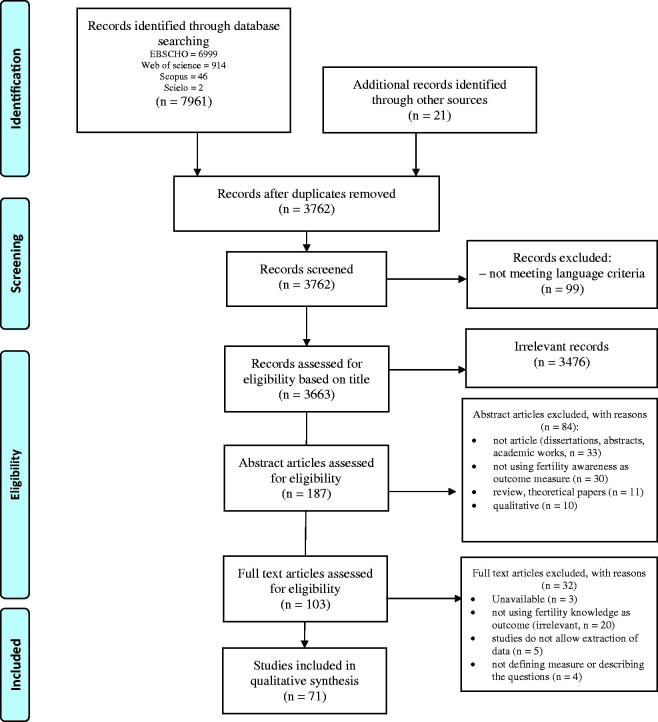
INTRODUCTION: Recent evidence indicates that reproductive-age people have inadequate fertility awareness (FA) concerning fertility, infertility risk factors, and consequences of delaying childbearing. However, no study has tried to summarize these studies and to clarify the variables associated with FA, namely the role of gender, age, education, and reproductive status on FA. METHODS: A literature search up to February 2017 was conducted using the EBSCO, Web of Science, Scielo, and Scopus electronic databases with combinations of keywords and MeSH terms (e.g. 'awareness' OR 'health knowledge, attitudes, practice' AND 'fertility'; 'fertile period'; 'assisted reprod*'). RESULTS: Seventy-one articles met the eligibility criteria and were included. The main results showed that participants report low-to-moderate FA. Higher levels of FA were shown by women, highly educated individuals, people who reported difficulties with conceiving, and those who had planned their pregnancies. Having or desiring to have children was not related to FA level. An inconsistent association between study participant age and FA was observed, with some studies indicating that older participants had higher FA, but others found an opposite result or did not find any association. CONCLUSION: The current findings suggest that interventions to increase FA are warranted, especially those targeting men, people with low education, and in family planning settings. Interventions and campaigns should be customized to meet individuals' needs regarding FA. Because of the high heterogeneity regarding the assessment of FA, these conclusions must be interpreted with caution.
Overview
The claims and statistics of this paper haven’t been checked yet.
Free: it reads the open-access text and checks the first 5 claims that cite a source we can check. Create a free account to check every claim.
Integrity signals
Registry
Cites
Statistics
Figures
Verification
Claims the paper makes
The claims and statistics of this paper haven’t been checked yet.
Free: it reads the open-access text and checks the first 5 claims that cite a source we can check. Create a free account to check every claim.
Claims other papers make about this one
Each is checked against this paper’s own text: does it say what the citing paper says it does?
The cited source says what the claim attributes to it.
In the citing paper
“Lay populations, especially, have a limited and misconstrued understanding of both the relationship of age to infertility and the limitations of available reproductive technologies to overcome the effects of age (Bunting et al., 2013; Pedro et al., 2018; Delbaere et al., 2020; Choi et al., 2023).”
From Declining global fertility rates and the implications for family planning and family building: an IFFS consensus document based on a narrative review of the literature (2024) · cites this paper as Pedro et al., 2018
Self-check
Percentages, sums and reported differences re-computed from the paper’s own numbers.
The self-check needs the paper’s full text.
Citations
Cites
Preferred Reporting Items for Systematic Reviews and Meta-Analyses: the PRISMA statement
Moher, D., Liberati, A., Tetzlaff, J., Altman, D. G., & for the PRISMA Group (2009) · BMJ · doi:10.1136/bmj.b2535 · Cited by 83,823
Preferred Reporting Items for Systematic Reviews and Meta-Analyses: The PRISMA Statement
Moher, D., Liberati, A., Tetzlaff, J., Altman, D. G., & The PRISMA Group (2009) · PLoS Medicine · doi:10.1371/journal.pmed.1000097 · Cited by 64,042 · cited 2×
“We followed the Preferred Reporting Items for Systematic Reviews and Meta-Analyses (PRISMA) guidelines for reporting the data analysed (46).”
BackgroundMethodPreferred reporting items for systematic reviews and meta-analyses: the PRISMA Statement.
(2009) · PubMed Central · Cited by 44,859
Reprint—Preferred Reporting Items for Systematic Reviews and Meta-Analyses: The PRISMA Statement
Moher, D., Liberati, A., Tetzlaff, J., Altman, D. G., & and the PRISMA Group (2009) · Physical Therapy · doi:10.1093/ptj/89.9.873 · Cited by 2,486 · cited 1×
“From Moher et al., 2009 (46). risk factors, age-related fertility decline, the fertile period, and the consequences of delaying childbearing.”
BackgroundBoivin, J., Bunting, L., Collins, J. A., & Nygren, K. G. (2007) · Human Reproduction · doi:10.1093/humrep/dem046 · Cited by 2,437 · cited 1×
“problem (8,9) that affects people around the world.”
Mascarenhas, M. N., Flaxman, S. R., Boerma, T., Vanderpoel, S., & Stevens, G. A. (2012) · PLoS Medicine · doi:10.1371/journal.pmed.1001356 · Cited by 2,312 · cited 1×
“problem (8,9) that affects people around the world.”
BackgroundThe International Glossary on Infertility and Fertility Care, 2017
Zegers-Hochschild, F., Adamson, G. D., Dyer, S., Racowsky, C., de Mouzon, J., Sokol, R., Rienzi, L., Sunde, A., Schmidt, L., Cooke, I. D., et al. (2017) · Fertility and Sterility · doi:10.1016/j.fertnstert.2017.06.005 · Cited by 1,505
Self-citationMays, N., Pope, C., & Popay, J. (2005) · Journal of Health Services Research & Policy · doi:10.1258/1355819054308576 · Cited by 1,375
The variability of female reproductive ageing
te Velde, E. R. (2002) · Human Reproduction Update · doi:10.1093/humupd/8.2.141 · Cited by 1,214
Effectiveness of strategies for informing, educating, and involving patients
Coulter, A., & Ellins, J. (2007) · BMJ · doi:10.1136/bmj.39246.581169.80 · Cited by 1,128 · cited 1×
“There is evidence that web-based educational interventions positively impact health behaviour (135).”
Background
Research works printed but not linked: 9
- Sobotka T, Zeman K, Potancokova M, Eder J, Brzozowska Z, Beaujouan E, et al. Fertility datasheet 2015 2015.
- Barnett EC Beating the biological clock. USA Seattle News and Events. Seattle; 2006 Oct 9; Available from: http://archive.seattleweekly.com/20011128/%0Anews/beatingthebiologicalclock/
- Weizhen T Fertility ads give birth to controversy. The Straits Times. Singapore; 2016 Feb 5; Available from: http://www.straitstimes.com/singapore/health/fertilityadsgivebirthtocontroversy
- Boon TH, Yee HS, Ting HW Financial literacy and personal financial planning in Klang Valley, Malaysia. Int J Econ Manag. 2011; 5: 149– 68.
- Fotopoulou V, Chasiakou A, Gryparis A, Baka S Greek medical student’s knowledge and attitudes towards infertility and assisted reproductive technologies (Greek medical students and ART). Womens Health Care. 2015; 4: 4– 7.
- Holton S, Hammarberg K, Rowe H, Kirkman M, Jordan L, McNamee K, et al. Men’s fertility-related knowledge and attitudes, and childbearing desires, expectations and outcomes: findings from the Understanding Fertility Management in Contemporary Australia Survey. Int J Mens Health. 2016; 15: 315– 28.
- Ola T, Aladekomo F, Oludare B Knowledge and beliefs of the general public about infertility in Osun state, southwest Nigeria. J Reprod Infer. 2010; 1: 26– 32.
- Ozsoy S, Adana F, Colakoglu HS University students’ knowledge about fertile period. Healthmed. 2012; 6: 3174– 9.
- Coulter A, Jo E Patient-focused interventions: a review of the evidence. London, UK: The Health Foundation and Picker Institute Europe; 2006.
Cited by
Items 101–200 of 262
Sexual and Reproductive Health Among Men With Cystic Fibrosis
Campbell, K., Zarli, M., Schuppe, K., Wong, R., Rahman, F., & Ramasamy, R. (2023) · Urology · doi:10.1016/j.urology.2023.06.017 · Cited by 8
Gong, J., Wu, Y., Qiu, C., Yin, G., & Yuan, P. (2025) · BMC Public Health · doi:10.1186/s12889-025-23369-w · Cited by 6
“Moreover, previous studies have indicated that there is a general lack of awareness regarding infertility issues among men [24].”
Wainwright, E., Ali, Z. E., Lawrie, L., Getreu, N., & O’Neill, H. C. (2025) · Reproductive Health · doi:10.1186/s12978-025-02079-x · Cited by 5
“A systematic review from Pedro et al. (2018) concluded low to moderate fertility awareness (encompassing age-related fertility decline, infertility and common myths) in reproductive-age individuals [3].”
Fertility and fertility preservation knowledge in Portuguese women
Nunes, T., Galhardo, A. B., Moniz, S., Massano‐Cardoso, I., & Cunha, M. I. V. A. (2023) · Journal of Reproductive and Infant Psychology · doi:10.1080/02646838.2023.2209603 · Cited by 6
“Furthermore, a systematic review revealed that although there is a high heterogeneity concerning the assessment of fertility awareness, people of reproductive age present low to moderate fertility awareness (Pedro et al., 2018).”
InfluentialBalen, J., & The Fertility Care in the Global South Network (2023) · Global Reproductive Health · doi:10.1097/grh.0000000000000073 · Cited by 9
“Addressing these issues is of key importance because, as highlighted by a recent worldwide systematic review, there is generally low to moderate fertility awareness among people of reproductive age [22] , and men are particularly impacted by lowest levels of awareness.”
BackgroundAt risk of reproductive disadvantage? Exploring fertility awareness among migrant women in Germany
Milewski, N., & Haug, S. (2021) · Reproductive Biomedicine & Society Online · doi:10.1016/j.rbms.2021.11.007 · Cited by 5
“Garcia et al. (2018) and Pedro et al. (2018) noted in their review papers that some studies lacked quality (for different reasons), that findings were inconsistent, and that results were not fully comparable.”
BackgroundResultInfluentialHammarberg, K., & de Silva, R. (2021) · Reproductive Biomedicine & Society Online · doi:10.1016/j.rbms.2021.11.006 · Cited by 10
“A review of studies investigating knowledge about fertility, risk factors for infertility, and consequences of delaying childbearing found that most participants had low-tomoderate awareness about fertility, and concluded that interventions are needed to improve this (Pedro et al., 2018).”
BackgroundPredictors of Childbearing Willingness in the Center of Iran in 2019: A cross Sectional StudyPreprint
Torkian, S., Heidari, Z., Shoushtari-Moghaddam, E., & Zamani‐Alavijeh, F. (2020) · Research Square · doi:10.21203/rs.3.rs-53261/v1 · Cited by 5
“The variables, namely age, monthly income, employment status and residential place do not make a difference in couples' fertility attitude in terms of number and sex of future offspring (16).”
BackgroundUnrealized fertility in demography
Yeatman, S. E., & Smith‐Greenaway, E. (2025) · Demographic Research · doi:10.4054/demres.2025.53.36 · Cited by 8
“…of infertility, better education about the physiological constraints of later-life fertility, and more widespread and equitable access to reproductive technologies and parenting rights, including for same-sex partners (Carvalho et al. 2019; Pedro et al. 2018; Van Gerwen, Muzny, and Marrazzo 2022).”
Optimizing advice and approaches for elective fertility preservation
Mahajan, N. (2025) · Best Practice & Research Clinical Obstetrics & Gynaecology · doi:10.1016/j.bpobgyn.2025.102591 · Cited by 7
Determining the Effects of Women’s Fertility Awareness Levels on Obstetric History
Özşahin, Z., & Altıparmak, S. (2021) · MIDDLE BLACK SEA JOURNAL OF HEALTH SCIENCE · doi:10.19127/mbsjohs.892012 · Cited by 5
“This actually shows that planning pregnancy or using contraception is not always an informed action (17).”
BackgroundInfluentialEmotional consequences of male infertility
Glazyrine, V., Stephens, D. A., WENTZELL, E. A., Wallace-Young, K., & Nangia, A. K. (2021) · Elsevier eBooks · doi:10.1016/b978-0-12-822288-1.00004-x · Cited by 5
Sylvest, R., Vittrup, I., Vassard, D., Saupstad, M., Ziebe, S., Larsen, E. C., Hvidman, H. W., Petersen, K. B., Nielsen, H. S., Schmidt, L., et al. (2025) · Acta Obstetricia Et Gynecologica Scandinavica · doi:10.1111/aogs.15071 · Cited by 4
Self-citationZhang, L., & Qiao, D. (2025) · Healthcare · doi:10.3390/healthcare13050555 · Cited by 8
“In recent years, global attention to infertility has increased, with some countries expanding investments in research, policies, and practices [4,5].”
Gharacheh, M., Farahani, F. K., Mirghafourvand, M., Janani, L., & Ranjbar, F. (2020) · BMC Public Health · doi:10.1186/s12889-020-10029-4 · Cited by 4
Erkeklerde fertiliteyi etkileyebilecek riskli yaşam biçimi davranışlarının belirlenmesi
Aşcı, Ö., & Gökdemir, F. (2020) · Androloji Bülteni · doi:10.24898/tandro.2020.56833 · Cited by 6
Infertility: A Hidden Cost of Medical Training
Lindekugel, S. M. K., Kota, H., Chiba, A., Deaton, J. L., & Moulder, J. K. (2022) · Journal of Graduate Medical Education · doi:10.4300/jgme-d-22-00189.1 · Cited by 6
Hamilton, K., & Harper, J. C. (2024) · Human Fertility · doi:10.1080/14647273.2024.2345675 · Cited by 8
“Unfortunately, studies have shown that people of reproductive age have low fertility awareness (Almeida-Santos et al., 2017; Bunting et al., 2013; Daniluk & Koert, 2013, 2015; Hammarberg et al., 2013; Pedro et al., 2018; Vassard et al., 2016).”
Walker, C., Begum, T., Boyle, J. A., Ward, J. S., & Barzi, F. (2024) · International Journal of Environmental Research and Public Health · doi:10.3390/ijerph21030345 · Cited by 9
“Other preconception factors that can influence reproductive health outcomes include maternal and paternal age, chronic diseases such as type 2 diabetes and hypertension, and environmental exposures [2,6,12].”
BackgroundDoxsey, M., Patel, K., Faschan, K., & Reyes, L. (2024) · Cureus · doi:10.7759/cureus.70244 · Cited by 4
“…as a concept defined as "the understanding of reproduction, fecundity, fecundability, and related individual and non-individual risk factors, including the awareness of societal and cultural factors affecting options to meet reproductive family planning, as well as family building needs" [21,22].”
BackgroundInfluentialHow do coping strategies influence fertility-related information seeking/avoidance?
Smith, C., Tang, M. Y., Clark, G. I., & Madgwick, S. (2025) · Human Fertility · doi:10.1080/14647273.2025.2488759 · Cited by 3
“%) but still suboptimal, consistent with Pedro et al. (2018).”
InfluentialTilahun, W. M., Yohannes, L., Aragaw, F. M., Gebreegziabher, Z. A., & Tesfie, T. K. (2025) · Frontiers in Reproductive Health · doi:10.3389/frph.2025.1505749 · Cited by 3
“This fi nding is supported by a systematic review (38) and by studies conducted in Africa (4, 11), Ghana (13), Nigeria (30), Haiti (2), and the United States (6).”
Lakjuni, S., Schmidt, L., Ziebe, S., Sylvest, R., Vassard, D., & Malling, G. M. H. (2025) · Reproductive BioMedicine Online · doi:10.1016/j.rbmo.2025.105342 · Cited by 4
Self-citationAbdennebi, I., Pasquier, M., Vernet, T., Levaillant, J., & Massin, N. (2022) · Journal of Gynecology Obstetrics and Human Reproduction · doi:10.1016/j.jogoh.2022.102461 · Cited by 6
Moridi, M., Damghanian, M., & Keshavarz, S. (2024) · Reproductive Health · doi:10.1186/s12978-024-01760-x · Cited by 5
“This lack of knowledge inadvertently exposes them to infertility and fertility disorders, thereby increasing the need for Assisted Reproductive Technology (ART) [18].”
BackgroundFarahani, F. K., Gharacheh, M., Montazeri, S., Mirghafourvand, M., Sadeghi, T., Taheri, M., Haghani, S., & Ranjbar, F. (2025) · Journal of Population Research · doi:10.1007/s12546-025-09363-4 · Cited by 6
“…study (Bunting et al., 2013 ), individual studies con - ducted in different countries (Akoku et al., 2022 ; Almeida-Santos et al., 2017 ; Mohammadi et al., 2023 ), and a systematic review (Pedro et al., 2018 ) indicate that individuals’ knowledge of fertility is at a low to moderate level.”
Koert, E., Sylvest, R., Vittrup, I., Hvidman, H. W., Petersen, K. B., Boivin, J., Andersen, A. N., & Schmidt, L. (2021) · Human Fertility · doi:10.1080/14647273.2021.1950851 · Cited by 6
“Fertility education interventions such as the FAC clinic have been developed with the goal of promoting informed and satisfying fertility decisions and to assist men and women to achieve their family building goals (e.g., Hvidman et al., 2015; Pedro et al., 2018).”
BackgroundSelf-citationAli, Z. E., Liperis, G., Mincheva, M. N., Serdarogullari, M., Uraji, J., Ammar, O. F., & Fraire-Zamora, J. J. (2023) · Human Reproduction · doi:10.1093/humrep/dead159 · Cited by 4
Thoughts on education, reproduction, and sexual function. Futures directions and obstacles
Lawson, A. K. (2021) · Elsevier eBooks · doi:10.1016/b978-0-12-822288-1.00002-6 · Cited by 4
Zewdia, W. F., & Zeru, M. A. (2024) · Frontiers in Nutrition · doi:10.3389/fnut.2024.1355808 · Cited by 3
“This finding is in line with a study done in Ethiopia based on EDHS 2016 and Bangladesh (5, 20, 23, 33, 46).”
BackgroundResultInfluentialNilsson, J., Röing, M., Malmros, J., & Winterling, J. (2019) · European Journal of Oncology Nursing · doi:10.1016/j.ejon.2019.101710 · Cited by 5
Infertility Among Women in Low- and Middle-Income Countries
Withers, M. H. (2020) · Springer eBooks · doi:10.1007/978-3-030-05325-3_43-1 · Cited by 4
Venkatesh, A., Boots, C. E., Anderson, J. E., Anderson, D., Citro, L., & Lawson, A. K. (2021) · Journal of Psychosomatic Obstetrics & Gynecology · doi:10.1080/0167482x.2021.2011855 · Cited by 4
“regarding realistic monthly chances of conception likely fuels fears about decreased chances of conceiving after a delay of even a few months [13].”
Changing childbearing age norms in Europe in times of fertility postponementPreprint
Lazzari, E., Compans, M., & Beaujouan, É. (2022) · doi:10.31235/osf.io/xbheq · Cited by 3
Role, benefits, and risks of AMH testing for non-ART related indications
Ali, Z. E., Massarotti, C., Liperis, G., Mincheva, M. N., Ammar, O. F., Uraji, J., Marca, A. L., Mathur, R., O’Neill, H. C., Moura‐Ramos, M., et al. (2024) · Human Reproduction · doi:10.1093/humrep/deae234 · Cited by 2
A qualitative study of Australian adolescent perceptions of fertility and infertility
Ford, E. A., Medley, A., Chojenta, C., Bagade, T., Sweeney, S., & Sutherland, J. M. (2025) · Human Fertility · doi:10.1080/14647273.2025.2506790 · Cited by 2
“…systems as a crucial asset in promoting sexual and reproductive health outcomes (Fauser et al., 2019; Hammarberg et al., 2017; Harper et al., 2021; Johnson et al., 2015; Moghadam et al., 2022; O’Brien et al., 2017; OECD, 2019; Pedro et al., 2018; Ramasamy et al., 2015; Schmidt et al., 2012).”
Prémusz, V., Mesfin, M. D., Atmaca, L., Chauhan, S., Tándor, Z., Bodor, L. A., Várnagy, Á., & Galgalo, D. A. (2025) · Healthcare · doi:10.3390/healthcare13182342 · Cited by 2
“Fertility awareness includes, among other things, knowledge about the menstrual cycle, ovulation, and the biological factors that influence reproduction [10–12].”
Bruckamp, L., & Lazzari, E. (2025) · Population Studies · doi:10.1080/00324728.2025.2561595 · Cited by 5
“This directly challenges the widespread belief that ART using autologous eggs can extend the reproductive window (Pedro et al. 2018).”
Mei, R., Tan, M., Liu, M., & Lin, L. K. (2025) · BMC Public Health · doi:10.1186/s12889-025-25842-y · Cited by 4
“While previous studies have attempted to summarize evidence on fertility intentions in this population [23–25], they largely focused on qualitative rationales and have not provided a comprehensive assessment of the magnitude of fertility intentions.”
“What's wrong with me?”: Women's perceptions of gendered infertility stigma
Bornstein, M., Church, A. C., Masterson, K., Gipson, J. D., & Norris, A. H. (2025) · Social Science & Medicine · doi:10.1016/j.socscimed.2025.118913 · Cited by 4
“…group was homogenous by educational attainment to help promote open dialogue (Freeman, 2006) and based on prior literature demonstrating differences in perceptions, experiences, and knowledge of infertility by education (R. E. Jensen et al., 2018; Nugent and Chandra, 2024; Pedro et al., 2018).”
Aragie, T. G., & Seyoum, G. (2022) · International Journal of Reproductive Medicine · doi:10.1155/2022/8520323 · Cited by 2
Attitudes toward fertility and childbearing among female University students
Koçak, D. Y., Duman, N. B., & Akarsu, R. H. (2023) · Universa Medicina · doi:10.18051/univmed.2023.v42.195-205 · Cited by 3
“Postponing parenting for individual, social, economic, and social reasons is not always a conscious process, but it can also cause an increase in the incidence of infertility.((4)) In Turkey, the acceptance of childbearing and having an active sexual life is associated with marriage.”
Mushlih, Y., Adli, I., Araysi, L. A., Suryoadji, K. A., Rachman, R. I., Nurullah, G., Christanto, R. B. I., Savira, M., Shah, R. S., Agarwal, A. K., et al. (2023) · F1000Research · doi:10.12688/f1000research.136305.1 · Cited by 4
Darabı, F., Shabanı, S. M., Mardi, A., & NeJhaddadgar, N. (2023) · Journal of Research and Health · doi:10.32598/jrh.13.6.821.1 · Cited by 2
Validity and reliability study of the Cardiff Fertility Knowledge Scale in Turkish
Odabaş, R. K., Ergin, A., & Birinci, F. B. (2024) · Journal of obstetrics and gynaecology research · doi:10.1111/jog.15903 · Cited by 3
“3 Therefore, identifying factors that affect fertility and fertility potential is crucial for implementing necessary interventions.”
BackgroundPsychometric properties of persian version of the cardiff fertility knowledge scale (CFKS–P)
Mirghafourvand, M., Jafarabadi, M. A., Gharacheh, M., Maeda, E., Haghani, S., & Ranjbar, F. (2024) · Heliyon · doi:10.1016/j.heliyon.2024.e30534 · Cited by 2
“There were some items [1,6,8,9,11,13] which were explained in both factors but these items were related more strongly to one factor than another.”
BackgroundYoung Adults’ Understanding of Modifiable Risk Factors of Infertility
Lim, L. M., Hoppe, M., Kennedy, L., Gunderson, A., Wang, L., & Etezadi-Amoli, N. (2024) · Women s Health Reports · doi:10.1089/whr.2024.0058 · Cited by 6
“15,17,20 Given the increased use of social media for health-related content, having up-to-date awareness of young adults ’ understanding of fertility is critical.”
Reflections on timing of motherhood - a qualitative online study with women of reproductive age
Temmesen, C. G., Nielsen, H. S., Petersen, K. B., & Clemensen, J. (2024) · BMC Women s Health · doi:10.1186/s12905-024-03409-0 · Cited by 6
“Several studies highlight that both men and women of reproductive age lack fertility knowledge, especially regarding the age-related fertility decline [17–19].”
BackgroundHarnett, Z., O’Donoghue, K., Linehan, L. A., Sánchez, T. E., Cotter, R., Dineen, S., Fitzgerald, B., Power, O. M., Whelan, S., Peters, H., et al. (2025) · Health Promotion International · doi:10.1093/heapro/daae205 · Cited by 2
Ennis, C. I. T., Fernando, N. G., & Phillips, K. P. (2025) · Journal of Health Population and Nutrition · doi:10.1186/s41043-024-00729-7 · Cited by 3
Martins, M. V., Pereira, L., Veleva, Z., Popova, I., Rautakallio-Hokkanen, S., & Galhardo, A. B. (2025) · Human Fertility · doi:10.1080/14647273.2025.2451334 · Cited by 5
“Several studies have shown that fertility awareness levels tend to be low in the general population (e.g. Pedro et al., 2018; Ren et al., 2023).”
Self-citationMartani, A., Neeser, N. B., Verghote, K., Geyter, C. D., & Wangmo, T. (2025) · Ethik in der Medizin · doi:10.1007/s00481-025-00864-7 · Cited by 3
“It is known that people often have a limited knowledge of age-related fertility decline (García et al. 2018; Delbaere et al. 2020; Pedro et al. 2018).”
Peter-Spiess, M.-H., & Hofmann, D. (2025) · Contraception · doi:10.1016/j.contraception.2025.110975 · Cited by 4
Prevalence and Risk Factors of Urinary Incontinence in Poorly Educated Female Population
Yüksel, B., Özgör, F., Çağlar, U., Ekmez, M., İnce, Ş. B., Baykal, M., & Sarılar, Ö. (2020) · European Archives of Medical Research · doi:10.4274/eamr.galenos.2020.88700 · Cited by 2
Gym lifestyle factors and male reproductive health: a study into young adult usage and perceptions
Newman-Sanders, A., Kirkman‐Brown, J., & Gallagher, M. T. (2023) · Reproductive BioMedicine Online · doi:10.1016/j.rbmo.2023.103623 · Cited by 4
Dağlı, E. (2024) · Black Sea Journal of Health Science · doi:10.19127/bshealthscience.1409554 · Cited by 2
Fertilite Farkındalığının Önemi ve Ebenin Sorumlulukları
Hasbek, Ö. K., & Dağlar, G. (2023) · Cumhuriyet Üniversitesi Sağlık Bilimleri Enstitüsü Dergisi · doi:10.51754/cusbed.1311926 · Cited by 1
Yağcan, H., Özöztürk, S., Sezer, M. K., Yanık, F., Ellialtıoğlu, A. B., Doğan, Ö. E., Okyay, R. E., Güngör, S. S., Uğur, G. T., & Yıldız, F. Ç. (2023) · Akademisyen Kitabevi eBooks · doi:10.37609/akya.2767 · Cited by 1
Exploring Lifestyle and Fertility Knowledge: A Comparative Study of Fertile and Infertile Women
Uncu, B., Duman, R., Doğan, E., & Yaman, A. (2024) · Journal of Clinical Medicine of Kazakhstan · doi:10.23950/jcmk/15570 · Cited by 1
Drivers of contraceptive non-use among women and men who are not trying to get pregnant
Passet-Wittig, J., & Lück, D. (2025) · Population Studies · doi:10.1080/00324728.2024.2416533 · Cited by 3
“Adults tend to underestimate the impact of declining fecundity with age (Bunting et al. 2013; Pedro et al. 2018).”
Saranti, E., Harizopoulou, V. C., Christoforaki, V., Bili, E., Pados, G., Goulis, D. G., & Vavilis, D. (2025) · European Journal of Midwifery · doi:10.18332/ejm/200843 · Cited by 4
“It is difficult to compare the results of the present study with those of similar studies globally due to the heterogeneity and diversity of the samples, different ways to assess fertility awareness, different analytic strategies, and differential findings 8 .”
InfluentialGothwal, M., Singh, P., Agrawal, N., Ghuman, N. K., Yadav, G., Gupta, M. K., Sharma, C., & Kathuria, P. (2025) · Indian Journal of Community Medicine · doi:10.4103/ijcm.ijcm_875_24 · Cited by 1
“[7] This lack of knowledge affects couple’s timely approach to proper healthcare, potentially leading to delayed infertility management.”
Tayebi, Z., Behmaneshpour, F., Tourzani, Z. M., Khoshakhlagh, F., Falahatdari, M., Khorasani, M. M., Zaferanlou, H., Goudarzi, M., Rezanejad-Asl, P., & Harikandeie, S. S. T. (2025) · BMC Nursing · doi:10.1186/s12912-025-03763-w · Cited by 3
“Many factors, including social and cultural factors, as well as individual and environmental risk factors, influence the understanding and awareness of fertility [3].”
Fertility knowledge and employment status among Japanese pregnant women: J-PEARL study
Namimatsu, K., Takeda, J., Endo, M., Ueda, Y., Makino, S., Tanigawa, T., & Itakura, A. (2025) · Obstetrics & Gynecology Science · doi:10.5468/ogs.25146 · Cited by 1
“Low fertility knowledge increases the risk of sexually transmitted infection [5], unintended teenage pregnancies [6], and infertility [7,8].”
Why we need to teach everyone about reproductive health
Harper, J. C., Biswakarma, R., Maslowski, K., & Reiss, M. J. (2026) · Health Education Journal · doi:10.1177/00178969251385733 · Cited by 2
“Unfortunately, studies have shown that many people of reproductive age have low fertility awareness which can impede informed decision-making (Bunting et al., 2013; Daniluk and Koert, 2013; Hammarberg et al., 2013; Pedro et al., 2018; Vassard et al., 2016).”
Afzal, F., Wong, L. Y. F., Purkayastha, M., Lu, Y., Rees, P., Richard, M. A., Williams, C. L., Lupo, P. J., Luke, B., Eisenberg, M. L., et al. (2026) · Journal of Assisted Reproduction and Genetics · doi:10.1007/s10815-026-03835-z · Cited by 2
“In contrast, Pedro et al.’s systematic review found that fertility awareness is generally higher in women than men [22], with an included UK survey reporting women’s moderate-to-high awareness of age-related pregnancy complications such as diabetes and hypertension [23].”
Sugihara, M., Ota, K., Maeda, E., Morimoto, Y., Matsumoto, R., Ota, Y., & Shimoya, K. (2026) · Journal of obstetrics and gynaecology research · doi:10.1111/jog.70235 · Cited by 1
Fertility awareness and choices among young people
Balen, A. H., & Dugdale, G. (2026) · Reproductive BioMedicine Online · doi:10.1016/j.rbmo.2026.105746 · Cited by 1
ANGERHOFER, S., Yoshida, M., Atogami, F., Nakamura, Y., Takeishi, Y., & Yoshizawa, T. (2026) · BMC Women s Health · doi:10.1186/s12905-026-04600-1 · Cited by 1
“Reportedly, insufficient awareness of age-related fertility decline reduces timely pregnancy planning [11, 46, 47], while long working hours and inflexible schedules discourage pregnancy intentions in various low-fertility contexts [48–50].”
Seki, T., Miyake, N., Goto, M., Osuka, S., Nukaya, K., Ohsawa, I., Tonoike, T., Uno, T., Tsuzuki, K., Iwase, A., et al. (2026) · Journal of obstetrics and gynaecology research · doi:10.1111/jog.70425 · Cited by 1
Awareness of infertility amongst women of reproductive age in southern Nigerian study
Dan-Jumbo, A., Eli, S., Okagua, K. E., Owhonda, G., Wakama, I. E., Iwo Amah, R. S., Ocheche, U. S., Ozigbo, C. J., & Inimgba, N. M. (2023) · International Journal of Science and Research Archive · doi:10.30574/ijsra.2023.8.1.0111 · Cited by 1
Fertility Planning Is More Critical Now Than Ever
Wood, S. C., & Stevenson, E. L. (2023) · Nursing for Women s Health · doi:10.1016/j.nwh.2023.07.002 · Cited by 1
Research Progress on Influencing Factors of Medical Delay in Infertile Patients
Qian, B. (2024) · Frontiers in Medical Science Research · doi:10.25236/fmsr.2024.060306 · Cited by 1
Exploring the demand for elective egg freezing: A laboratory experiment
Keller, E., Ortmann, A., & Chambers, G. M. (2024) · Journal of Behavioral and Experimental Economics · doi:10.1016/j.socec.2024.102224 · Cited by 1
Miserez, L., Holder, L. V., Bogaerts, A., & Steijvoort, E. V. (2025) · Reproductive BioMedicine Online · doi:10.1016/j.rbmo.2025.105069 · Cited by 2
Place, J. M., Horowitz, J., Nguyen, M., Guinn, M., & Peterson, B. D. (2025) · Frontiers in Global Women s Health · doi:10.3389/fgwh.2025.1538455 · Cited by 1
Current Resources for Evidence-Based Practice, March 2019
Bovbjerg, M. L. (2019) · Journal of Obstetric, Gynecologic & Neonatal Nursing · doi:10.1016/j.jogn.2019.01.007 · Cited by 1
Pedro, J., Fernandes, J., Schmidt, L., Costa, M. E., & Martins, M. V. (2021) · Human Fertility · doi:10.1080/14647273.2021.1960436 · Cited by 2
“In fact, there is evidence suggesting that women are more knowledgeable about fertility issues than men (Hammarberg, Collins, et al., 2017; Hammarberg, Norman, et al., 2017; Pedro et al., 2018).”
BackgroundSelf-citationThe acquisition of sexual and reproductive health knowledge
Petok, W. D., & Marcell, A. V. (2021) · Elsevier eBooks · doi:10.1016/b978-0-12-822288-1.00014-2 · Cited by 1
Williamson, L. E. (2019) · HARVEST (University of Saskatchewan) · Cited by 5
Zhao, X., Wang, R., Ding, Y., & Jing, F. (2023) · Research Square · doi:10.21203/rs.3.rs-3139499/v1 · Cited by 1
Peterson, B. D. (2019) · Journal of Women s Health · doi:10.1089/jwh.2019.7923
Walentynowicz-Moryl, K., & Mianowska, E. (2020) · Kwartalnik Pedagogiczny · doi:10.32346/2657-6007.kp.2020-1.8
„Infektionen auf dem Vormarsch“ – was ist wichtig für den Kinderwunsch?
Amrani, M., & Seufert, R. (2020) · Journal für Gynäkologische Endokrinologie/Österreich · doi:10.1007/s41974-020-00147-7
Pregnancy, Childbirth and Puerperium Health Problems in Women Over 35 Years of Age
Kiersnowska, I., Sys, D., Baranowska, B. M., Bączek, G., & Węgrzyn, P. (2021) · Kwartalnik Naukowy Fides et Ratio · doi:10.34766/fetr.v47i3.878
“Women are increasingly choosing to postpone motherhood, despite age being an important factor that impacts the ability to become naturally pregnant, with many believing in the possibilities of modern medicine to assist them with their pregnancies (Pedro, Brandão, Schmidt, Costa, Martins, 2018).”
BackgroundBanerjee, S., & Mathews, N. M. (2021) · Journal of Pharmacy And Bioallied Sciences · doi:10.4103/jpbs.jpbs_283_21
“[10,11] Indian scenario is equally consistent in terms of poor knowledge, as results of a study showed that only 17% of the respondents were familiar about ovulation, and only 8% could comprehend progressive age was a threat to nonconception.”
Burjaq, H., Khogali, F., Burjaq, R., 968th Street, D., Albader, M., Abd El Hadi, A., & Hammoudeh, S. (2021) · Austin Journal of Reproductive Medicine & Infertility · doi:10.26420/austinjreprodmedinfertil.2021.1056
“com interventions be individualized for a stronger effect [41].”
BackgroundWikström, G., & Welsh, M. (2022) · Upsala Journal of Medical Sciences · doi:10.48101/ujms.v127.8630
Alzubier, M. A. A., Twair, A. A. A., Muaddi, A. M. Z. A., Alnefea, A. Z. J., Salamh, A. F., Alqahtani, A., Alqahtani, N. A. S., & Ali, A. H. A. (2022) · Medical Science · doi:10.54905/disssi/v26i125/ms273e2362
“Acta Obstet Gynecol Scand 2018; 97(12): 1471-1477.”
Result"The Changes of Paradigm in the Gynecology of the 21st Century"
Neyro, J. L. (2022) · Biomedical Journal of Scientific & Technical Research · doi:10.26717/bjstr.2022.44.007052
“…an alternative fertility to the natural one of the past 400,000 years (with in vitro fertilization, fertility deferred or without a partner [6], the possibility of procreating even beyond menopause in “older” women [7], the cryopreservation of ovarian tissue before its definitive damage…”
BackgroundDittrich, R., & Lotz, L. (2022) · Forum · doi:10.1007/s12312-022-01152-x
"What am I running after so short of breath?"
Pápay, N. (2022) · doi:10.14232/sztep.chpp.2022.10
A Idade Materna Avançada: Uma Perspetiva da Realidade Portuguesa
Costa, R. V., Marafona, A. S., & Martins, A. O. (2023) · Acta Médica Portuguesa · doi:10.20344/amp.19115
Familie und Reproduktionsmedizin
Kuhnt, A., & Passet-Wittig, J. (2023) · Springer eBooks · doi:10.1007/978-3-658-35219-6_25
Baseline reproductive and sexual health knowledge among undergraduate students in Manitoba, CanadaPreprint
Jain, K., Jain, E., Rai, K., Wilson, L., Blachman-Braun, R., & Patel, P. (2023) · Research Square · doi:10.21203/rs.3.rs-3173966/v1
Weibliche Fertilitätsstörungen
Amrani, M. (2023) · Springer eBooks · doi:10.1007/978-3-662-65371-5_4
A cross-sectional study on Polish Medical Students’ knowledge of Fertility Awareness-based Methods
Zgodzińska, K., Ślizień-Kuczapska, E., Tęsny, T., Czeczelewski, M., Sys, D., & Rabijewski, M. (2023) · Kwartalnik naukowy Fides et Ratio · doi:10.34766/fetr.v55i3.1195 · Cited by 1
Let’s Talk About Sex: Tyrolean Online Study on Reproductive Health Issues
Hosa, H., Böttcher, B., Schatzl, V., Gahl, M., Weigel, B., Riedl, D., Reiser, E., Mariacher, P., Toth, C., & Tóth, B. (2023) · Geburtshilfe und Frauenheilkunde · doi:10.1055/a-2154-5134
“The invitation to participate in the study including web links and QR codes to the questionnaires, was distributed online via emails to various study program directors ffi”
Metadata
- Authors
- Pedro, J., Brandão, T., Schmidt, L., Costa, M. E., & Martins, M. V.
- Affiliations
- Universidade do Porto (PT)
- Autonomous University of Lisbon (PT)
- University of Copenhagen (DK)
- Corresponding author
- Pedro, Juliana
- Venue
- Upsala Journal of Medical Sciences
- Publisher
- Uppsala Medical Society
- Published
- 2018-04-03
- Volume
- 123
- Issue
- 2
- Pages
- 71-81
- ISSN
- 0300-9734 (ISSN-L)
- 2000-1967
- PMC
- PMC6055749
- OpenAlex
- W2810816237
- Cited by
- 263
- References
- 130
- Citations by year
- 2026: 34 · 2025: 49 · 2024: 37 · 2023: 48 · 2022: 25 · 2021: 32 · 2020: 28 · 2019: 8 · 2018: 1
- FWCI
- 2.60
- Type
- journal article
- Language
- en
- Open access
- diamond
- doi.org
- Licence
- Locations
- Upsala Journal of Medical Sciences (publishedVersion, cc-by)
- Europe PMC (PubMed Central) (publishedVersion, cc-by)
- PubMed Central (publishedVersion, cc-by)
- PubMed (publishedVersion)
- Research at the University of Copenhagen (University of Copenhagen) (publishedVersion, cc-by)
- Repositório Institucional da Universidade Autónoma de Lisboa (Universidade Autónoma de Lisboa) (submittedVersion, cc-by-nc-nd)
- DOAJ (DOAJ: Directory of Open Access Journals) (submittedVersion)
- Portuguese National Funding Agency for Science, Research and Technology (RCAAP Project by FCT) (submittedVersion, other-oa)
- Funders
- Portuguese Foundation for Science and Technology (SFRH/BD/103234/2014, SFRH/BPD/85789/2012, UID/PSI/04345/2013)
- Topics
- Health Sciences › Medicine › Reproductive Medicine › Reproductive Health and Technologies
- Health Sciences › Medicine › Public Health, Environmental and Occupational Health › Reproductive Health and Contraception
- Social Sciences › Gender Studies › Demographic Trends and Gender Preferences
- Keywords
- fertility awareness, fertility knowledge, infertility risk factors, delayed childbearing, gender differences, educational attainment, age, reproductive status, family planning, pregnancy planning
- MeSH terms
- Age Factors, Female, Fertility, Health Policy, Humans, Infertility, Health Knowledge, Attitudes, Practice, Male, Patient Education as Topic, Risk Factors
About these checks
Registry, retraction, Cites and statistics results are computed, not judged, with one exception: a printed reference that no index lists is read once by a model before it counts as a citation error. Claims are extracted by a model and kept only when their quote appears verbatim in the text; each cited source is then checked, with a model’s help, for whether it says what the claim relies on. Those verdicts can be wrong — read the claim’s quote and the cited source before relying on one.
Statistics and arithmetic are recomputed, not judged.
Confidence bands are shown only for fields calibrated on our annotated test set. None is calibrated yet, so no band is shown.
What counts as a claim ›How we measure confidence ›How we check this ›
Are you an author, or do you see a problem with this page? Request a review
Data sources
Bibliographic data: Semantic Scholar, OpenAlex, Crossref.
Contains information from the Semantic Scholar Academic Graph Datasets, made available under the ODC Attribution License (ODC-BY 1.0).
Semantic Scholar’s data is described in: Kinney, R., et al. (2023). The Semantic Scholar Open Data Platform. arXiv:2301.10140.
