

What do people know about fertility? A systematic review on fertility awareness and its associated factors
Open accessThe DOI matches its Crossref record; 129 of the 130 references it cites were found in a registry or an index.
Abstract
INTRODUCTION: Recent evidence indicates that reproductive-age people have inadequate fertility awareness (FA) concerning fertility, infertility risk factors, and consequences of delaying childbearing. However, no study has tried to summarize these studies and to clarify the variables associated with FA, namely the role of gender, age, education, and reproductive status on FA. METHODS: A literature search up to February 2017 was conducted using the EBSCO, Web of Science, Scielo, and Scopus electronic databases with combinations of keywords and MeSH terms (e.g. 'awareness' OR 'health knowledge, attitudes, practice' AND 'fertility'; 'fertile period'; 'assisted reprod*'). RESULTS: Seventy-one articles met the eligibility criteria and were included. The main results showed that participants report low-to-moderate FA. Higher levels of FA were shown by women, highly educated individuals, people who reported difficulties with conceiving, and those who had planned their pregnancies. Having or desiring to have children was not related to FA level. An inconsistent association between study participant age and FA was observed, with some studies indicating that older participants had higher FA, but others found an opposite result or did not find any association. CONCLUSION: The current findings suggest that interventions to increase FA are warranted, especially those targeting men, people with low education, and in family planning settings. Interventions and campaigns should be customized to meet individuals' needs regarding FA. Because of the high heterogeneity regarding the assessment of FA, these conclusions must be interpreted with caution.
Overview
The claims and statistics of this paper haven’t been checked yet.
Free: it reads the open-access text and checks the first 5 claims that cite a source we can check. Create a free account to check every claim.
Integrity signals
Registry
Cites
Statistics
Figures
Verification
Claims the paper makes
The claims and statistics of this paper haven’t been checked yet.
Free: it reads the open-access text and checks the first 5 claims that cite a source we can check. Create a free account to check every claim.
Claims other papers make about this one
Each is checked against this paper’s own text: does it say what the citing paper says it does?
The cited source says what the claim attributes to it.
In the citing paper
“Lay populations, especially, have a limited and misconstrued understanding of both the relationship of age to infertility and the limitations of available reproductive technologies to overcome the effects of age (Bunting et al., 2013; Pedro et al., 2018; Delbaere et al., 2020; Choi et al., 2023).”
From Declining global fertility rates and the implications for family planning and family building: an IFFS consensus document based on a narrative review of the literature (2024) · cites this paper as Pedro et al., 2018
Self-check
Percentages, sums and reported differences re-computed from the paper’s own numbers.
The self-check needs the paper’s full text.
Citations
Cites
Preferred Reporting Items for Systematic Reviews and Meta-Analyses: the PRISMA statement
Moher, D., Liberati, A., Tetzlaff, J., Altman, D. G., & for the PRISMA Group (2009) · BMJ · doi:10.1136/bmj.b2535 · Cited by 83,823
Preferred Reporting Items for Systematic Reviews and Meta-Analyses: The PRISMA Statement
Moher, D., Liberati, A., Tetzlaff, J., Altman, D. G., & The PRISMA Group (2009) · PLoS Medicine · doi:10.1371/journal.pmed.1000097 · Cited by 64,042 · cited 2×
“We followed the Preferred Reporting Items for Systematic Reviews and Meta-Analyses (PRISMA) guidelines for reporting the data analysed (46).”
BackgroundMethodPreferred reporting items for systematic reviews and meta-analyses: the PRISMA Statement.
(2009) · PubMed Central · Cited by 44,859
Reprint—Preferred Reporting Items for Systematic Reviews and Meta-Analyses: The PRISMA Statement
Moher, D., Liberati, A., Tetzlaff, J., Altman, D. G., & and the PRISMA Group (2009) · Physical Therapy · doi:10.1093/ptj/89.9.873 · Cited by 2,486 · cited 1×
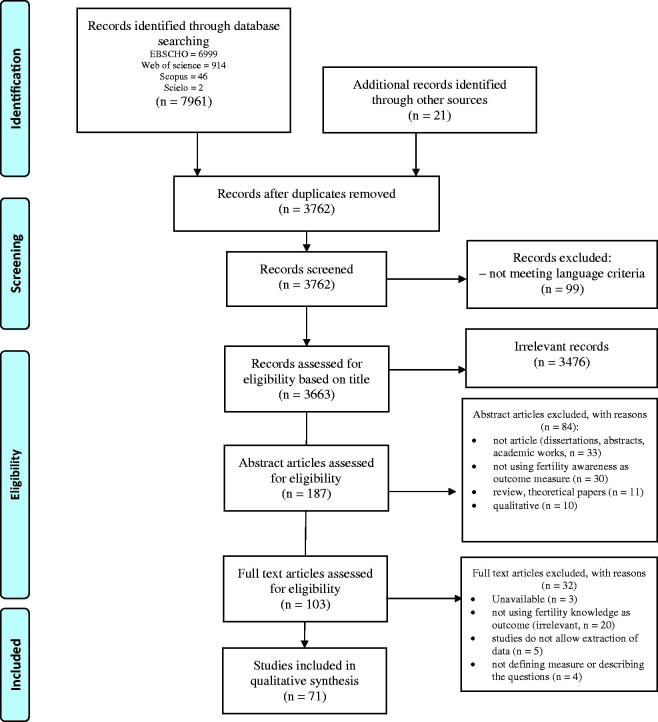
“From Moher et al., 2009 (46). risk factors, age-related fertility decline, the fertile period, and the consequences of delaying childbearing.”
BackgroundBoivin, J., Bunting, L., Collins, J. A., & Nygren, K. G. (2007) · Human Reproduction · doi:10.1093/humrep/dem046 · Cited by 2,437 · cited 1×
“problem (8,9) that affects people around the world.”
Mascarenhas, M. N., Flaxman, S. R., Boerma, T., Vanderpoel, S., & Stevens, G. A. (2012) · PLoS Medicine · doi:10.1371/journal.pmed.1001356 · Cited by 2,312 · cited 1×
“problem (8,9) that affects people around the world.”
BackgroundThe International Glossary on Infertility and Fertility Care, 2017
Zegers-Hochschild, F., Adamson, G. D., Dyer, S., Racowsky, C., de Mouzon, J., Sokol, R., Rienzi, L., Sunde, A., Schmidt, L., Cooke, I. D., et al. (2017) · Fertility and Sterility · doi:10.1016/j.fertnstert.2017.06.005 · Cited by 1,505
Self-citationMays, N., Pope, C., & Popay, J. (2005) · Journal of Health Services Research & Policy · doi:10.1258/1355819054308576 · Cited by 1,375
The variability of female reproductive ageing
te Velde, E. R. (2002) · Human Reproduction Update · doi:10.1093/humupd/8.2.141 · Cited by 1,214
Effectiveness of strategies for informing, educating, and involving patients
Coulter, A., & Ellins, J. (2007) · BMJ · doi:10.1136/bmj.39246.581169.80 · Cited by 1,128 · cited 1×
“There is evidence that web-based educational interventions positively impact health behaviour (135).”
Background
Research works printed but not linked: 9
- Sobotka T, Zeman K, Potancokova M, Eder J, Brzozowska Z, Beaujouan E, et al. Fertility datasheet 2015 2015.
- Barnett EC Beating the biological clock. USA Seattle News and Events. Seattle; 2006 Oct 9; Available from: http://archive.seattleweekly.com/20011128/%0Anews/beatingthebiologicalclock/
- Weizhen T Fertility ads give birth to controversy. The Straits Times. Singapore; 2016 Feb 5; Available from: http://www.straitstimes.com/singapore/health/fertilityadsgivebirthtocontroversy
- Boon TH, Yee HS, Ting HW Financial literacy and personal financial planning in Klang Valley, Malaysia. Int J Econ Manag. 2011; 5: 149– 68.
- Fotopoulou V, Chasiakou A, Gryparis A, Baka S Greek medical student’s knowledge and attitudes towards infertility and assisted reproductive technologies (Greek medical students and ART). Womens Health Care. 2015; 4: 4– 7.
- Holton S, Hammarberg K, Rowe H, Kirkman M, Jordan L, McNamee K, et al. Men’s fertility-related knowledge and attitudes, and childbearing desires, expectations and outcomes: findings from the Understanding Fertility Management in Contemporary Australia Survey. Int J Mens Health. 2016; 15: 315– 28.
- Ola T, Aladekomo F, Oludare B Knowledge and beliefs of the general public about infertility in Osun state, southwest Nigeria. J Reprod Infer. 2010; 1: 26– 32.
- Ozsoy S, Adana F, Colakoglu HS University students’ knowledge about fertile period. Healthmed. 2012; 6: 3174– 9.
- Coulter A, Jo E Patient-focused interventions: a review of the evidence. London, UK: The Health Foundation and Picker Institute Europe; 2006.
Cited by
Items 201–262 of 262
Osazee, K., Okpala, A. E., Iribhogbe, O. I., & Sodje, J. D. K. (2023) · Annals of African Medical Research · doi:10.4081/aamr.2023.182 · Cited by 1
Association between Occupational Chemical Exposure and Sperm Parameters; A Narrative Review
Pourmasumi, S., Vazirinejad, R., Ahmadi, Z., Mehdipour, A., & Nazari, A. (2023) · Journal of Occupational Health and Epidemiology · doi:10.61186/johe.12.1.50 · Cited by 1
“The impact of the work environment on male fertility varies from person to person, and many people who work in high-risk jobs may never experience infertility [9].”
Hasbek, Ö. K., & Dağlar, G. (2024) · Advances in Women’s Studies · doi:10.51621/aws.1432578
Determination of Women's Fertility Awareness Levels and Influencing Factors
Reyhan, F. A., GÜLEK, İ. B., & Ertaş, E. (2024) · Sakarya Üniversitesi Holistik Sağlık Dergisi · doi:10.54803/sauhsd.1448679
Infertility amid the COVID-19 pandemic: Emotion rules
Carneiro, M. M., Bossi, R. D. L., Xavier, A. C., Hurtado, R., Mattos, T., Alvarenga, D. M., & Sampaio, M. (2024) · Global Reproductive Health · doi:10.1097/grh.0000000000000101
“Patients, in fact, fancy using social media to obtain information and give or receive support although some fear the information provided may not be evidence based [12] .”
ART Outcomes in Latinx Patients
Pershad, A., & Yeshua, A. S. (2024) · Springer eBooks · doi:10.1007/978-3-031-76204-8_7
Assessment of reproductive knowledge among young adults utilizing Amazon mechanical Turk survey
Varnum, A. A., Velasquez, D. A., Codrington, J. M., Evans, A., Dubin, J. M., & Ramasamy, R. (2024) · Therapeutic Advances in Reproductive Health · doi:10.1177/26334941241309890
What midwives should know about fertility awareness and its impact on reproductive behavior
Saranti, E., Harizopoulou, V. C., Bili, E., Pados, G., Goulis, D. G., Vavilis, D., & Vivilaki, V. G. (2025) · European Journal of Midwifery · doi:10.18332/ejm/195830 · Cited by 1
“Fertility awareness can be a means to improve the issues mentioned above, including the increased use of assisted reproduction methods and the formulation of realistic expectations during fertility treatments 20 .”
LITERACY OF FEMALE UNIVERSITY STUDENTS IN RELATION TO FERTILITY
Mazúchová, L., & Krajčíková, A. (2025) · Ošetřovatelské perspektivy · doi:10.25142/osp.2024.004
Ware, M. E., We, R. K., Kutteh, W. H., Tillery, R., Delaney, A., Yu, C. H., Shelton, K., Srivastava, D. K., Taneja, S., Sapkota, Y., et al. (2025) · Journal of Cancer Survivorship · doi:10.1007/s11764-025-01793-6
“In the general population, pregnancies are heavily relied upon as a metric of fertility [24].”
Medvedovska, N. V., & Стовбан, І. В. (2024) · Health of Society · doi:10.32782/2306-2436.14.2.2024.315
Medvedovska, N. V., & Стовбан, І. В. (2024) · Health of Society · doi:10.32782/2306-2436.13.1.2024.319
First reproductive experience: A survey module
Beaujouan, É., Singh, S., Šťastná, A., Kreidl, M., Dvořák, D., Hubatková, B., Darina, K., Slabá, J., Passet-Wittig, J., Goisis, A., et al. (2025) · Demographic Research · doi:10.4054/demres.2025.53.37 · Cited by 7
Aksak, T. (2025) · Black Sea Journal of Health Science · doi:10.19127/bshealthscience.1595087 · Cited by 1
Nikukaran, J., Fallahzadeh, A., Yazdi, M., Aghda, S. A. F., Torkashvand, H., Akbarzade, R., Fallahnezhad, M., aqda, H. K., Asr, R. T., & Hazhir, S. (2025) · BMC Health Services Research · doi:10.1186/s12913-025-12900-9
“Considering the prevalence of infertility and its impact on the lives of couples and their social circles (relatives, friends, acquaintances, etc.), the need for planning and education is more crucial than ever before [27, 28].”
Meddőség és asszisztált reprodukció demográfiai, pszichoszociális és szociokulturális kontextusban
Lengyel, A., & Danis, I. (2025) · Szociológiai szemle · doi:10.51624/szocszemle.15567 · Cited by 3
Advancing fertility education to address changing societal and demographic trends
Serdarogullari, M., Liperis, G., Makieva, S., Massarotti, C., Fraire-Zamora, J. J., Sharma, K., Grace, B., Fincham, A., Pedro, J., & Ali, Z. E. (2025) · Human Reproduction · doi:10.1093/humrep/deaf125
Self-citationKaroń, Ł. M., Karoń, K., Zygmunt, A. E., & Dębiec, P. (2025) · Research Square · doi:10.21203/rs.3.rs-6893652/v1
Klami, R., & Perheentupa, A. H. (2025) · Acta Obstetricia Et Gynecologica Scandinavica · doi:10.1111/aogs.70033
Machine Learning-XGBoost Analysis of Fertility Intension
Wu, T. F., & Zhou, J. (2025) · International Conference on Machine Learning and Intelligent Systems Engineering (MLISE) · doi:10.1109/mlise66443.2025.11100268
“A meta-analysis incorporating 71 surveys indicates that fertility awareness is unrelated to age but positively correlated with being female and having a higher level of education [17].”
Arciniegas, S. H., & Makenzius, M. (2025) · Contraception and Reproductive Medicine · doi:10.1186/s40834-025-00401-3
“Low fertility awareness (LFA) is common among both women and men, even among those attempting to conceive [11–13].”
Bracewell‐Milnes, T., Ostrysz, P., Trigg, B., Khalil, O. R. S., Kasaven, L. S., Jones, B. P., Saso, S., Faris, R., Nicopoullos, J. D. M., & Thum, M. (2025) · Human Fertility · doi:10.1080/14647273.2025.2543118
“The number of women from this study who are overestimating the success of ART as women get older is very high, which is a consistent finding from other studies (Evans et al., 2018; Mills et al., 2011; Pedro et al., 2018; Wyndham et al., 2012; Yu et al., 2016).”
Variables Associated with Knowledge of the Fertile Window in Women and Men in Colombia and Ecuador
Rodríguez-López, A., Griffin-Valdivieso, M. I., & Marí-Espejo, A. C. (2025) · Women s Health Reports · doi:10.1177/26884844251374979
“32 Similarly, participants of higher socioeconomic status demonstrated signi fi cantly greater awareness than those of lower status, re fl ecting the role of economic resources in facilitating access to reliable information, as documented in prior studies information.”
Gigolaeva, L. A., Dubenkina, E. A., Semkina, E. V., Ushkova, K. D., Mazka, S. V., Zhadanova, P. Y., Imamova, Z. A., Barmenkova, P. M., Zhiltsova, N. D., Amayeva, D. S., et al. (2025) · Obstetrics Gynecology and Reproduction · doi:10.17749/2313-7347/ob.gyn.rep.2025.683
Hussein, D., Tadesse, M., Mukuria, M., Girma, D., Oyato, B. T., Gesisa, H. I., Ibrahim, S. M., & Lakew, M. S. (2025) · Scientific Reports · doi:10.1038/s41598-025-22292-9
Afferri, A., Dierickx, S., Allen, H., Bittaye, M., Marena, M., Pacey, A. A., & Balen, J. (2024) · Figshare · doi:10.6084/m9.figshare.26689385
Afferri, A., Dierickx, S., Allen, H., Bittaye, M., Marena, M., Pacey, A. A., & Balen, J. (2024) · Figshare · doi:10.6084/m9.figshare.25347037
Hoffman, J. R., Delaney, M. A., Valdés, C. T., Herrera, D., Washington, S. L., Aghajanova, L., Smith, J. F., & Herndon, C. N. (2020) · Figshare · doi:10.6084/m9.figshare.12813475
Afferri, A., Dierickx, S., Allen, H., Bittaye, M., Marena, M., Pacey, A. A., & Balen, J. (2024) · Figshare · doi:10.6084/m9.figshare.25347262
Mayette, E., Scalise, A. L., Li, A., McGeorge, N., James, K., & Mahalingaiah, S. (2024) · Figshare · doi:10.6084/m9.figshare.26043649
Ren, Y., Xie, Y., Xu, Q., Long, M., Zheng, Y., Li, L., & Niu, C. (2023) · Figshare · doi:10.6084/m9.figshare.23304836
Nadjarzadeh, A., Fallahzadeh, A. R., Abasi, A., Poornematy, M. M., Farahzadi, H. R., & Aghda, S. A. F. (2023) · Figshare · doi:10.6084/m9.figshare.24558151
How well do women understand their menstrual cycles? Insights from 383,085 UK based women
Ali, Z. E., Wainwright, E., Murugesu, S., Moraru, S., Lawrie, L., Getreu, N., & O’Neill, H. C. (2026) · Reproductive Health · doi:10.1186/s12978-026-02275-3
“Menstrual cycle self-awareness in this study improved through the 30s, likely reflecting increased engagement with reproductive healthcare during fertility planning or pregnancy-related care [27, 28].”
Rusatira, J. C., Ahmed, S., & Moreau, C. (2026) · BMJ Public Health · doi:10.1136/bmjph-2025-003191
“As such, men’s gender views and fertility preferences are rarely considered in SRH research, 11–14 limiting our understanding of how male gender egalitarian attitudes influence maternal health in the region.”
Rehman, R. (2021) · Elsevier eBooks · doi:10.1016/b978-0-323-75945-8.00013-x
Effects of fertility education on people of reproductive age: a systematic review and meta-analysis
Chen, M., Wang, G. G., Fu, B., Zhao, J., Yang, Q., & Lei, J. (2026) · Sex Education · doi:10.1080/14681811.2026.2640185 · Cited by 1
Dakowicz, A. L., Milewska, A. J., Nowakowski, D., Zańko, A., Pawłowski, M., Skórka, J., Warpechowski, M., Skowrońska, M., & Milewski, R. J. (2026) · Scientific Reports · doi:10.1038/s41598-026-45648-1
Zikarsky, L., Hancke, K., & Bundschu, K. (2026) · Wiener Medizinische Wochenschrift · doi:10.1007/s10354-026-01150-x
Psychological Aspects of Infertility Among Men
Harrison, C., & Gamiero, S. (2026) · Endocrinology · doi:10.1007/978-3-319-29456-8_63-1
Gurung, O., Dhakal, R. D., Sigdel, P., & Ghimire, A. (2026) · Public Health Challenges · doi:10.1002/puh2.70277 · Cited by 1
“Similar misconceptions have been reported in European and North American studies, where young adults often associate fertility decline primarily with menopause rather than gradual age-related changes across the reproductive lifespan [ 20, 29 ].”
Adhikary, P., Mburu, G., Habib, N., Kabra, R., Kiarie, J., Dhabhai, N., & Mazumder, S. (2026) · PLOS Global Public Health · doi:10.1371/journal.pgph.0006265 · Cited by 1
The Right to Know: Fertility Awareness and Bioethical Decision-Making
Barajas, J. A. C., Domínguez, M. F. D., Vela, F. P. R., Lerma, C., Lerma, A., Castro, J. M. F., & Viruette, A. L. V. (2026) · New paradigms in healthcare · doi:10.1007/978-3-032-25294-4_2
Huang, S.-H., Ji, H.-P., Tang, X.-H., Li, M. Y., Jiang, S.-C., & Yin, M. (2026) · World Journal of Psychiatry · doi:10.5498/wjp.116396
Wang, L. N., Zhao, Y. F., Chen, H., Zhang, L., Cui, C., Zhang, C. L., & Liang, L. (2026) · Frontiers in Public Health · doi:10.3389/fpubh.2026.1830907
Qualitative study of childbearing challenges among married Iranian university students
Rigi, Z. E., Fard, S. B., Ghonchehpour, A., & Dehghan, M. (2026) · Discover Social Science and Health · doi:10.1007/s44155-026-00437-z
“International studies show that university students frequently delay childbearing due to financial insecurity, academic pressure, limited fertility awareness, and work–family conflict [6].”
Kumar, R., Sharma, S., Saini, M., & Rabbani, S. A. (2026) · International Journal of Infertility & Fetal Medicine · doi:10.5005/jp-journals-10016-1407
Perceptions of infertility: The roles of age, knowledge, and motivated reasoning
Tierney, K., Greil, A. L., & Bell, A. V. (2026) · Population Studies · doi:10.1080/00324728.2026.2687514
Olcenoglu, M. F., Olcenoglu, M., Demircioğlu, H., Savcı, G., & Kaya, A. Z. O. (2026) · Frontiers in Medicine · doi:10.3389/fmed.2026.1884680
Tighe, J., Okorocha, E., Mitra, A., Anson, N., Jones, B. P., Roberts, R. E., Elshieikh, M., Theodorou, E., Nagi, J. B., & Kasaven, L. S. (2026) · PLoS ONE · doi:10.1371/journal.pone.0353073
“The possibly over optimistic expectations of male fertility observed within this cohort may reflect the longstanding lack of fertility knowledge within the general population [26,68].”
Viciglione, F., Immediata, V., Morenghi, E., Alviggi, C., Baggiani, A., Cirillo, F., & Levi-Setti, P. E. (2026) · Human Reproduction Open · doi:10.1093/hropen/hoag063
“A systematic review by Pedro et al. (2018), including 71 studies from 26 countries, showed that fertility knowledge in the general population remains suboptimal.”
Gogova, T., Mivšek, A. P., & Jančar, N. (2026) · European Journal of Midwifery · doi:10.18332/ejm/218635
“A literature review found that fertility awareness among people of reproductive age is generally low to moderate 20 .”
Empowering oocyte autonomy: A critical exploration of choice in fertility preservation
Tsonis, O., & Kopeika, J. (2026) · Journal of Gynecology Obstetrics and Human Reproduction · doi:10.1016/j.jogoh.2026.103278
Mushlih, Y., Adli, I., Araysi, L. A., Suryoadji, K. A., Rachman, R. I., Nurullah, G., Christanto, R. B. I., Savira, M., Shah, R. S., Agarwal, A. K., et al. (2026) · F1000Research · doi:10.12688/f1000research.136305.3
Bennett, G. A., Smyth, S. P., Gardner, D. K., & Bromfield, E. G. (2026) · Human Reproduction Update · doi:10.1093/humupd/dmag027
Semen, stigma, and spectacle: reclaiming the narrative around male reproductive health
Trinchant, R., & Azpiroz, F. M. (2026) · Human Reproduction · doi:10.1093/humrep/deag151
Karadeniz, H., Yavuzcan, A., & Demırcı, N. (2026) · Ordu Üniversitesi Hemşirelik Çalışmaları Dergisi · doi:10.38108/ouhcd.1766230
Infertility and inequality: a plea for action
Piani, L. L., & Somigliana, E. (2026) · Human Reproduction · doi:10.1093/humrep/deag157
Tern, H., Flivik, E., Tern, H. L., & Ekstrand, M. (2026) · Sexual & Reproductive Healthcare · doi:10.1016/j.srhc.2026.101292
Yadav, R., & Dutta, N. (2026) · Middle East Fertility Society Journal · doi:10.1186/s43043-026-00369-3
Stern, J., Grandahl, M., Cato, K., & Ragnar, M. E. (2026) · Sexual & Reproductive Healthcare · doi:10.1016/j.srhc.2026.101291
Beyond Choice: Infertility and/as Disability
Vidali, A. (2024) · Peitho. · doi:10.37514/pei-j.2024.26.2.07
Metadata
- Authors
- Pedro, J., Brandão, T., Schmidt, L., Costa, M. E., & Martins, M. V.
- Affiliations
- Universidade do Porto (PT)
- Autonomous University of Lisbon (PT)
- University of Copenhagen (DK)
- Corresponding author
- Pedro, Juliana
- Venue
- Upsala Journal of Medical Sciences
- Publisher
- Uppsala Medical Society
- Published
- 2018-04-03
- Volume
- 123
- Issue
- 2
- Pages
- 71-81
- ISSN
- 0300-9734 (ISSN-L)
- 2000-1967
- PMC
- PMC6055749
- OpenAlex
- W2810816237
- Cited by
- 263
- References
- 130
- Citations by year
- 2026: 34 · 2025: 49 · 2024: 37 · 2023: 48 · 2022: 25 · 2021: 32 · 2020: 28 · 2019: 8 · 2018: 1
- FWCI
- 2.60
- Type
- journal article
- Language
- en
- Open access
- diamond
- doi.org
- Licence
- Locations
- Upsala Journal of Medical Sciences (publishedVersion, cc-by)
- Europe PMC (PubMed Central) (publishedVersion, cc-by)
- PubMed Central (publishedVersion, cc-by)
- PubMed (publishedVersion)
- Research at the University of Copenhagen (University of Copenhagen) (publishedVersion, cc-by)
- Repositório Institucional da Universidade Autónoma de Lisboa (Universidade Autónoma de Lisboa) (submittedVersion, cc-by-nc-nd)
- DOAJ (DOAJ: Directory of Open Access Journals) (submittedVersion)
- Portuguese National Funding Agency for Science, Research and Technology (RCAAP Project by FCT) (submittedVersion, other-oa)
- Funders
- Portuguese Foundation for Science and Technology (SFRH/BD/103234/2014, SFRH/BPD/85789/2012, UID/PSI/04345/2013)
- Topics
- Health Sciences › Medicine › Reproductive Medicine › Reproductive Health and Technologies
- Health Sciences › Medicine › Public Health, Environmental and Occupational Health › Reproductive Health and Contraception
- Social Sciences › Gender Studies › Demographic Trends and Gender Preferences
- Keywords
- fertility awareness, fertility knowledge, infertility risk factors, delayed childbearing, gender differences, educational attainment, age, reproductive status, family planning, pregnancy planning
- MeSH terms
- Age Factors, Female, Fertility, Health Policy, Humans, Infertility, Health Knowledge, Attitudes, Practice, Male, Patient Education as Topic, Risk Factors
About these checks
Registry, retraction, Cites and statistics results are computed, not judged, with one exception: a printed reference that no index lists is read once by a model before it counts as a citation error. Claims are extracted by a model and kept only when their quote appears verbatim in the text; each cited source is then checked, with a model’s help, for whether it says what the claim relies on. Those verdicts can be wrong — read the claim’s quote and the cited source before relying on one.
Statistics and arithmetic are recomputed, not judged.
Confidence bands are shown only for fields calibrated on our annotated test set. None is calibrated yet, so no band is shown.
What counts as a claim ›How we measure confidence ›How we check this ›
Are you an author, or do you see a problem with this page? Request a review
Data sources
Bibliographic data: Semantic Scholar, OpenAlex, Crossref.
Contains information from the Semantic Scholar Academic Graph Datasets, made available under the ODC Attribution License (ODC-BY 1.0).
Semantic Scholar’s data is described in: Kinney, R., et al. (2023). The Semantic Scholar Open Data Platform. arXiv:2301.10140.
