

Educators’ emotions involved in the transition to online teaching in higher education
Open accessThe DOI matches its Crossref record; 35 of the 35 references it cites were found in a registry or an index.
Abstract
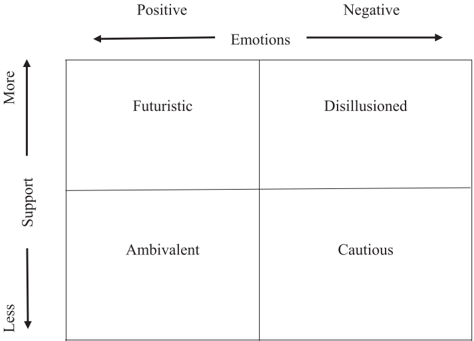
Higher education (HE) has seen a growing trend towards online study. However, teaching is deeply connected to one’s beliefs, values, commitments and to relationships with students. A change in the mode of instruction and pedagogy has the potential to disrupt these deep and personal connections giving rise to an emotional response. The purpose of this phenomenological study was to explore the nature and significance of emotions in HE educators transitioning to online teaching. Findings indicate a dynamic relationship between the type of emotional responses and the amount of institutional support. Based on the type of emotional response and amount of support, four emergent orientations of educators are presented: Futuristic, Ambivalent, Disillusioned and Cautious. Implications for practice are also presented.
Overview
The claims and statistics of this paper haven’t been checked yet.
Free: it reads the open-access text and checks the first 5 claims that cite a source we can check. Create a free account to check every claim.
Integrity signals
Registry
Cites
Statistics
Figures


Verification
Claims the paper makes
The claims and statistics of this paper haven’t been checked yet.
Free: it reads the open-access text and checks the first 5 claims that cite a source we can check. Create a free account to check every claim.
Claims other papers make about this one
Each is checked against this paper’s own text: does it say what the citing paper says it does?
The source backs part of the claim, not all of it — or backs it for a different population, condition or comparison.
In the citing paper
“The participants' reflections illustrate a transformative experience through the UST series and their testimonials reflect a blend of cognitive and affective learning outcomes (Brinkley-Etzkorn, 2020;Naylor & Nyanjom, 2021;Sangwan et al., 2021), driving a commitment to apply this new knowledge.”
From Transforming Online Teacher Training Through Expansive Learning: A Case Study Applying Cultural-Historical Activity Theory and the Change Laboratory Method (2025) · cites this paper as Naylor & Nyanjom, 2021
Experimental — accuracy not yet measured
Self-check
Percentages, sums and reported differences re-computed from the paper’s own numbers.
The self-check needs the paper’s full text.
Citations
Cites
Rogers, E. M., Singhal, A., & Quinlan, M. M. (2019) · An Integrated Approach to Communication Theory and Research · doi:10.4324/9780203710753-35 · Cited by 37,322
Valente, T. W. (2003) · Genetics in Medicine · doi:10.1097/01.gim.0000061743.67794.c4 · Cited by 13,723
Interpretative Phenomenological Analysis: Theory, Method and Research
(2010) · QMiP Bulletin · doi:10.53841/bpsqmip.2010.1.10.44 · Cited by 8,189 · cited 4×
“The interactive analytical process proceeded in accordance with established guidelines (Smith et al., 2009).”
BackgroundMethodInfluentialQualitative Psychology: A Practical Guide to Research Methods
(2008) · QMiP Bulletin · doi:10.53841/bpsqmip.2008.1.6.47 · Cited by 4,351
Interpretative Phenomenological Analysis
(2020) · SAGE Research Methods Foundations · doi:10.4135/9781526421036813346 · Cited by 4,040
Dilemmas in qualitative health research
Yardley, L. (2000) · Psychology & Health · doi:10.1080/08870440008400302 · Cited by 2,310 · cited 1×
“To enhance the quality of the study, we applied the criteria for validity of qualitative studies as proposed by Yardley (2000).”
MethodInterpretative phenomenological analysis.
Smith, J. A., & Shinebourne, P. (2012) · APA handbook of research methods in psychology, Vol 2: Research designs: Quantitative, qualitative, neuropsychological, and biological. · doi:10.1037/13620-005 · Cited by 1,634
The British Journal of Educational Psychology
(1983) · Serials Review · doi:10.1016/0098-7913(83)90056-4 · Cited by 1,052
Martin, F., Ritzhaupt, A., Kumar, S., & Budhrani, K. (2019) · The Internet and Higher Education · doi:10.1016/j.iheduc.2019.04.001 · Cited by 385
Committed for life? Variations in teachers’ work, lives and effectiveness
Day, C. (2008) · Journal of Educational Change · doi:10.1007/s10833-007-9054-6 · Cited by 366 · cited 2×
“…by its very nature is a complex social, personal and cognitive process that relies on effective communication and relationships between educators and students, and as such it is an emotional experience for both (Day, 2008; Hagenauer & Volet, 2014; Jephcote & Salisbury, 2009; Schutz et al., 2006).”
Background
Cited by
Items 101–160 of 160
Exploring Online Writing Assessment in the New Normal: Challenges from Teachers’ Perspective
Dacillo, M. M., Paracueles, L. H. P., Villacorta, L. J. C., & Licaros, O. J. (2022) · American Journal of Education and Technology · doi:10.54536/ajet.v1i2.515 · Cited by 3
Öğretmen Adaylarının Çevrimiçi Eğitmenlik Deneyimlerinin İncelenmesi
Özen, S. O., & Mazman, S. G. (2022) · Muğla Sıtkı Koçman Üniversitesi Eğitim Fakültesi Dergisi · doi:10.21666/muefd.1110034 · Cited by 2
Let's Give Ear to the University Students Attending and Not Attending Synchronous Online Lessons!
Koşar, G. (2022) · International Journal of Adult Education and Technology · doi:10.4018/ijaet.315775 · Cited by 2
Akhtar, S. (2023) · Annals of Human and Social Sciences · doi:10.35484/ahss.2023(4-ii)42 · Cited by 2
Cain, M., Fanshawe, M., & Goodwin, P. (2024) · International Journal of Inclusive Education · doi:10.1080/13603116.2024.2303106 · Cited by 2
“The range of studies investigating how teachers and students experienced restrictions and school closures (Cain et al. 2021; Cain and Fanshawe 2021; Naylor and Nyanjom 2021) have provided clear implications for students BLV and future practice.”
Saputra, D. B., Puspa, A., Haryana, L., & Muswari, R. (2024) · English Learning Innovation · doi:10.22219/englie.v5i1.30357 · Cited by 5
No One Is on an Island: Connecting, Collaborating, and Coping During the Pandemic
Carpenter, P. A., Stylianides, K. J., Weiler-Timmins, R. A., Randolph-Krisova, A., Sprinkle, K., & Angulo-Kinzler, R. M. (2021) · Kinesiology Review · doi:10.1123/kr.2021-0038 · Cited by 2
“…faculty participants not only supported a culture of open communication, collaboration, and innovation (Couris, 2020) but also allowed others to take a deep breath and realize that many shared the same physical, psychological, and sociological impacts of the pandemic (Naylor & Nyanjom, 2020).”
BackgroundSwitching Gears: Online Teaching in Higher Education in the First Wave of the COVID-19 Pandemic
Mössenlechner, C., Obexer, R., Pammer, M., & Waldegger, J. (2021) · International Journal of Advanced Corporate Learning (iJAC) · doi:10.3991/ijac.v14i2.24085 · Cited by 6
Ummi, R., Baker, D., Kerr-Sims, S., & Galib, M. H. (2024) · Journal of Educational Technology Development and Exchange · doi:10.18785/jetde.1701.06 · Cited by 1
“Institutional support is vital for teachers in higher education when transitioning to online teaching and learning (Joshi et al., 2022; Naylor & Nyanjom, 2020).”
BackgroundBusby, S., Espiritu, E. W., Noven, M. V., Mills, J. R., & Hunt, J. W. (2024) · Online Learning · doi:10.24059/olj.v28i3.3964 · Cited by 3
“…in educators experiencing significant challenges as they learned new technology and applied different pedagogy so they could continue teaching while also managing their own personal circumstances and emotional responses to the ever-changing situation (Hodges et al., 2020; Naylor & Nyanjom, 2020).”
BackgroundNostalgia and connection in academic imaginaries of digital pedagogies
Black, R., Owen, C., Bearman, M., & Ajjawi, R. (2025) · Pedagogy Culture and Society · doi:10.1080/14681366.2025.2531997 · Cited by 1
“…studies of the impacts of this shift on academics have focused on academics with a diverse range of roles, histories and career positions (e.g., Naylor and Nyanjom 2021; Fox et al. 2021; Gourlay et al. 2021; Suoranta et al. 2022), we have adopted the strategy used by a much smaller number of…”
Young, R. A., Domene, J. F., Liu, Y., Pradhan, K., Botia, L. A., & Chi, E. (2025) · Journal of Career Development · doi:10.1177/08948453251382176 · Cited by 1
Teaching behind the Screen: Emotional Labor of Iranian Language Teachers in Online Classes
Boroughani, T., Rivera, H. H., & Xodabande, I. (2025) · Springer eBooks · doi:10.1007/978-981-95-2569-0_8 · Cited by 3
Zhu, S., & Wang, J. (2026) · Humanities and Social Sciences Communications · doi:10.1057/s41599-026-06950-5 · Cited by 1
Tafahomi, R. (2022) · The Universal Academic Research Journal · doi:10.55236/tuara.1134986 · Cited by 1
Altan, B. A. (2023) · Education Quarterly Reviews · doi:10.31014/aior.1993.06.01.687 · Cited by 2
Martin, R. A., Mandrusiak, A., Fuentes‐Cimma, J., Henrico, K., Patterson, F., Hill, A. E., Hoyle, M. F., Penman, A. M., & Forbes, R. (2022) · Focus on Health Professional Education A Multi-Professional Journal · doi:10.11157/fohpe.v23i3.588 · Cited by 3
Distance Education from Teacher and Learner Perspective
SÖYLEMEZ, N. H. (2023) · International Journal of Contemporary Educational Research · doi:10.33200/ijcer.1158906 · Cited by 1
Talosa, A. D., Javier, B. S., & Dirain, E. L. (2023) · Multidisciplinary Science Journal · doi:10.31893/multiscience.2024017 · Cited by 9
“The paradigm shifts from traditional face-to-face classes to going online did not only conform to the mandate under memorandum circular number 4 series of 2020 of the Commission on Higher Education on Flexible Teaching and Learning but has offered higher education institutions the opportunity to embrace a teaching and…”
Amin, M. A., Hossain, M. A., & Sharmin, R. (2023) · Khulna University Studies · doi:10.53808/kus.si.2023.icssi75-ss · Cited by 1
Altunçekiç, A., & Bi̇rbudak, T. S. (2023) · Participatory Educational Research · doi:10.17275/per.23.100.10.6 · Cited by 1
Supriadi, N., Putra, F. G., Cahyaningtyas, E., & Imama, K. (2024) · Journal of Philology and Educational Sciences · doi:10.53898/jpes2024313 · Cited by 1
“Converting verbal representations into symbolic forms is vital for problem-solving and effective teaching (Boshoff-Knoetze et al., 2022; Naylor & Nyanjom, 2020).”
BackgroundTracing affective trajectories and triggers in university teachers – a mixed methods study
Kvernenes, M., Tjølsen, A., Gilbertson, S., Gray, R., Rakner, L., & Kordts-Freudinger, R. (2025) · Discover Education · doi:10.1007/s44217-025-00707-z · Cited by 1
Pauletto, C. (2023) · Emerald Group Publishing Limited eBooks · doi:10.1108/978-1-80382-517-520231003 · Cited by 2
Hammond, K., Erlam, G. D., & Cedro, C. (2021) · Advancing Scholarship and Research in Higher Education · doi:10.59197/asrhe.v2i1.5711
Emotional Dynamics of Postgraduate Students in Completing their Thesis: A Narrative Inquiry
Amin, M. A., Thohir, L., & Soepriyanti, H. (2023) · International Journal of Multicultural and Multireligious Understanding · doi:10.18415/ijmmu.v10i5.4574 · Cited by 9
“…emotions has been conducted quite extensively in the contexts of learning such as students’ emotions during online learning (Sun and Zhang, 2021; and Naylor & Nyanjom, 2020), not much is found about the dynamic of students’ emotions in the process of completing their final project of a thesis,…”
Early career researcher pathways: A narrative inquiry
Gasson, S. (2023) · Queensland University of Technology · doi:10.5204/thesis.eprints.239442 · Cited by 10
Peng, S.-H. L. (2024) · doi:10.33774/coe-2024-fzws6
Babić, T., & Grgić, S. (2021) · International Convention on Information and Communication Technology, Electronics and Microelectronics · doi:10.23919/mipro52101.2021.9597187
Role of Data Analysis in Higher Education
Gautam, S. (2021) · International Conference on Signal Processing, Computing and Control (ISPCC) · doi:10.1109/ispcc53510.2021.9609509
Таран, Г., Chornomordenko, D., Bondarenko, N., Bohatyrov, D., & Spiridonov, M. (2022) · Revista Tempos e Espaços em Educação · doi:10.20952/revtee.v15i34.17256 · Cited by 1
Grand manuel de psychologie positive
Tan, T. Y., Wachsmuth, L. S., & Tugade, M. M. (2021) · Dunod eBooks · doi:10.3917/dunod.marti.2021.02.0401
Jha, S., Choudhary, S. K., & Kumar, R. (2022) · Journal of Engineering Education/Journal of engineering education transformations/Journal of engineering education transformation · doi:10.16920/jeet/2022/v35is1/22021
Lyn, J. C. I., & Beng, L. Y. (2022) · Journal of Techno Social · doi:10.30880/jts.2022.14.01.003
Shumba, T., & Munkuli, T. (2023) · Education and human development · doi:10.5772/intechopen.109414 · Cited by 1
Gurney, L., & Grossi, V. (2023) · Journal of University Teaching and Learning Practice · doi:10.53761/1.20.6.18 · Cited by 4
Teachers’ Perceptions of Emergency Remote Teaching During COVID-19 at Sultan Qaboos University, Oman
Balushi, S. A., & Khan, M. A. A. (2023) · European Journal of Theoretical and Applied Sciences · doi:10.59324/ejtas.2023.1(5).109
الجهوري, م. (2023) · University of Sharjah (UoS) Journal of Humanities and Social Sciences · doi:10.36394/jhss/20/2/16
Instructors' lived experiences of using learning analytics to improve online course design
Wood, E. A. (2023) · Digital Repository Service (Northeastern University) · doi:10.17760/d20483502 · Cited by 1
Teachers’ preparedness and professionalism for online teaching during COVID-19: Evidence from India
Tokas, S., Sharma, A., & Tomar, B. (2023) · AIP conference proceedings · doi:10.1063/5.0182114
Emociones de un formador de maestros enseñando Didáctica de las Matemáticas en un contexto online
Marbán, M., Montes, M., & Rodríguez-Piñero, P. T. (2023) · Avances de Investigación en Educación Matemática · doi:10.35763/aiem24.4387
Doing Design Differently: Hybrid Teaching in the age of Covid-19
Chadha, D., Williams, D., Hale, C. P., & Luckham, P. F. (2024) · ASEE Annual Conference & Exposition · doi:10.18260/1-2--40548
“An exclusively remote model of teaching does not allow the important relationships students need to foster with one another and members of staff to develop in an exclusively online teaching environment [8].”
BackgroundSelf-Reported Emotions of Engineering Instructors During and After a Sudden Change
Panther, G., Diefes‐Dux, H. A., & Mowat, K. (2024) · ASEE Annual Conference & Exposition · doi:10.18260/1-2--44191
Tafahomi, R. (2024) · International Journal of Social Sciences and Education Research · doi:10.24289/ijsser.1372887
García, J. A. (2024) · University of North Texas Digital Library (University of North Texas) · doi:10.12794/metadc2332586
Li, M., Mo, X., Tang, C., & Yang, X. (2024) · SSRN Electronic Journal · doi:10.2139/ssrn.4904357
Bharattej, R. R. V. S. S., Rupavath, R. V. S. S. B., Ramadan, G. M., Khanam, P. K., & Sharma, N. (2024) · International Conference on Networks, Multimedia and Information Technology (NMITCON) · doi:10.1109/nmitcon62075.2024.10699179
“Dawn Naylor & Julie Nyanjom [12] suggested online teaching transition utilized Educators’ emotions involved higher education.”
BackgroundEducational Innovation and Digitalization During the Crisis
Mulakaluri, S. C. (2024) · Emerald Group Publishing Limited eBooks · doi:10.1108/978-1-83797-052-020241017
Cruz, G., Brito, W., Venancio, R., Ferreira, T., Guerra, M., & Cravino, J. (2025) · Communications in computer and information science · doi:10.1007/978-3-032-02669-9_15
University student experiences of feedback: timing and credibility are key
Willis, A. S., Sempowicz, T., & Robertson, A. (2025) · Teaching in Higher Education · doi:10.1080/13562517.2025.2605679 · Cited by 1
“Building relationships with students in online classes is a challenge’ (Martin 2019; Naylor & Nyanjom 2021).”
InfluentialEmotional Patterns of Engineering University Instructors Through Cluster Analysis
Magara, I., & Panther, G. (2025) · IEEE Frontiers in Education Conference (FIE) · doi:10.1109/fie63693.2025.11328643
“A study by Naylor & Nyanjom [7] documented the emotional strain instructors faced during the transition to remote teaching, including challenges in maintaining student motivation and engagement.”
Preparing Technical Educators for Multilingual Classrooms in Transitional Times
Patil, R. Y., & Patil, Y. H. (2026) · IGI Global eBooks · doi:10.4018/979-8-3373-4536-9.ch006
Karaharju‐Suvanto, T., Raekallio, M. R., Nevgi, A., Korsberg, H., Laakkonen, J., Sivén, M., & Myyry, L. (2026) · European Journal of Higher Education · doi:10.1080/21568235.2026.2631635
Physical and Virtual Research Spaces
Gasson, S. (2025) · Emerald Group Publishing Limited eBooks · doi:10.1108/978-1-83549-089-120251013
Kim, M., Knotts, T. L., Albers‐Miller, N. D., & James, K. E. (2026) · Education Sciences · doi:10.3390/educsci16050734
Wang, C., Zhang, D., & Yin, H. (2026) · International Journal of Information Management · doi:10.1016/j.ijinfomgt.2026.103090 · Cited by 3
Emotion dynamics in online learning communities: Temporal networks, motifs, and links to achievement
Su, Z., Ouyang, Z., Sun, J., Shi, Y., & Liu, S. (2026) · The Internet and Higher Education · doi:10.1016/j.iheduc.2026.101093
“So connected yet distant”: Exploring EMI teachers’ emotional geographies in ICT-integrated contexts
Chu, T., Wang, Y., & Wang, W. (2026) · Emotion, space and society · doi:10.1016/j.emospa.2026.101192
The toll of tertiary educators’ emotional labor due to academic misconduct
Forbes, J. K. (2026) · International Journal for Educational Integrity · doi:10.1007/s40979-026-00239-5
“Naylor (2021) “found that emotions, whether strong or weak, have the potential to make the change process slow and laborious or progressive and rewarding” (1248).”
Metadata
- Authors
- Naylor, D., & Nyanjom, J.
- Affiliations
- Edith Cowan University (AU)
- Corresponding author
- Naylor, Dawn
- Venue
- Higher Education Research & Development
- Publisher
- Informa UK Limited
- Published
- 2020-09-02
- Volume
- 40
- Issue
- 6
- Pages
- 1236-1250
- ISSN
- 0729-4360 (ISSN-L)
- 1469-8366
- OpenAlex
- W3083371668
- Cited by
- 160
- References
- 34
- Citations by year
- 2026: 9 · 2025: 19 · 2024: 33 · 2023: 46 · 2022: 36 · 2021: 15 · 2020: 2
- FWCI
- 37.51
- Type
- journal article
- Language
- en
- Open access
- hybrid
- doi.org
- Licence
- Locations
- Higher Education Research & Development (publishedVersion, cc-by-nc-nd)
- Australasian Journal of Paramedicine (submittedVersion, cc-by-nc-nd)
- Topics
- Social Sciences › Education › Education during COVID-19 pandemic
- Social Sciences › Education › Online and Blended Learning
- Social Sciences › Education › Digital Transformation of Higher Education
- Keywords
- transition to online teaching, online learning, university teaching, institutional support, emotional responses, teacher beliefs and values, teacher-student relationship, pedagogical change, teacher orientation
About these checks
Registry, retraction, Cites and statistics results are computed, not judged, with one exception: a printed reference that no index lists is read once by a model before it counts as a citation error. Claims are extracted by a model and kept only when their quote appears verbatim in the text; each cited source is then checked, with a model’s help, for whether it says what the claim relies on. Those verdicts can be wrong — read the claim’s quote and the cited source before relying on one.
Statistics and arithmetic are recomputed, not judged.
Confidence bands are shown only for fields calibrated on our annotated test set. None is calibrated yet, so no band is shown.
What counts as a claim ›How we measure confidence ›How we check this ›
Are you an author, or do you see a problem with this page? Request a review
Data sources
Bibliographic data: Semantic Scholar, OpenAlex, Crossref.
Contains information from the Semantic Scholar Academic Graph Datasets, made available under the ODC Attribution License (ODC-BY 1.0).
Semantic Scholar’s data is described in: Kinney, R., et al. (2023). The Semantic Scholar Open Data Platform. arXiv:2301.10140.
