

Educators’ emotions involved in the transition to online teaching in higher education
Open accessThe DOI matches its Crossref record; 35 of the 35 references it cites were found in a registry or an index.
Abstract
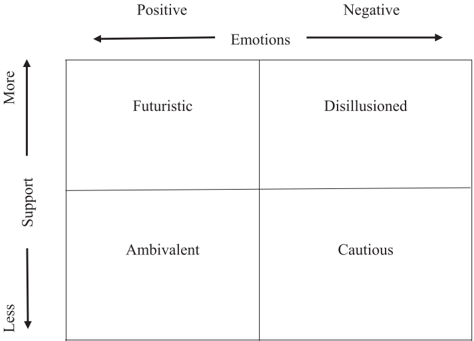
Higher education (HE) has seen a growing trend towards online study. However, teaching is deeply connected to one’s beliefs, values, commitments and to relationships with students. A change in the mode of instruction and pedagogy has the potential to disrupt these deep and personal connections giving rise to an emotional response. The purpose of this phenomenological study was to explore the nature and significance of emotions in HE educators transitioning to online teaching. Findings indicate a dynamic relationship between the type of emotional responses and the amount of institutional support. Based on the type of emotional response and amount of support, four emergent orientations of educators are presented: Futuristic, Ambivalent, Disillusioned and Cautious. Implications for practice are also presented.
Overview
The claims and statistics of this paper haven’t been checked yet.
Free: it reads the open-access text and checks the first 5 claims that cite a source we can check. Create a free account to check every claim.
Integrity signals
Registry
Cites
Statistics
Figures


Verification
Claims the paper makes
The claims and statistics of this paper haven’t been checked yet.
Free: it reads the open-access text and checks the first 5 claims that cite a source we can check. Create a free account to check every claim.
Claims other papers make about this one
Each is checked against this paper’s own text: does it say what the citing paper says it does?
The source backs part of the claim, not all of it — or backs it for a different population, condition or comparison.
In the citing paper
“The participants' reflections illustrate a transformative experience through the UST series and their testimonials reflect a blend of cognitive and affective learning outcomes (Brinkley-Etzkorn, 2020;Naylor & Nyanjom, 2021;Sangwan et al., 2021), driving a commitment to apply this new knowledge.”
From Transforming Online Teacher Training Through Expansive Learning: A Case Study Applying Cultural-Historical Activity Theory and the Change Laboratory Method (2025) · cites this paper as Naylor & Nyanjom, 2021
Experimental — accuracy not yet measured
Self-check
Percentages, sums and reported differences re-computed from the paper’s own numbers.
The self-check needs the paper’s full text.
Citations
Cites
Rogers, E. M., Singhal, A., & Quinlan, M. M. (2019) · An Integrated Approach to Communication Theory and Research · doi:10.4324/9780203710753-35 · Cited by 37,322
Valente, T. W. (2003) · Genetics in Medicine · doi:10.1097/01.gim.0000061743.67794.c4 · Cited by 13,723
Interpretative Phenomenological Analysis: Theory, Method and Research
(2010) · QMiP Bulletin · doi:10.53841/bpsqmip.2010.1.10.44 · Cited by 8,189 · cited 4×
“The interactive analytical process proceeded in accordance with established guidelines (Smith et al., 2009).”
BackgroundMethodInfluentialQualitative Psychology: A Practical Guide to Research Methods
(2008) · QMiP Bulletin · doi:10.53841/bpsqmip.2008.1.6.47 · Cited by 4,351
Interpretative Phenomenological Analysis
(2020) · SAGE Research Methods Foundations · doi:10.4135/9781526421036813346 · Cited by 4,040
Dilemmas in qualitative health research
Yardley, L. (2000) · Psychology & Health · doi:10.1080/08870440008400302 · Cited by 2,310 · cited 1×
“To enhance the quality of the study, we applied the criteria for validity of qualitative studies as proposed by Yardley (2000).”
MethodInterpretative phenomenological analysis.
Smith, J. A., & Shinebourne, P. (2012) · APA handbook of research methods in psychology, Vol 2: Research designs: Quantitative, qualitative, neuropsychological, and biological. · doi:10.1037/13620-005 · Cited by 1,634
The British Journal of Educational Psychology
(1983) · Serials Review · doi:10.1016/0098-7913(83)90056-4 · Cited by 1,052
Martin, F., Ritzhaupt, A., Kumar, S., & Budhrani, K. (2019) · The Internet and Higher Education · doi:10.1016/j.iheduc.2019.04.001 · Cited by 385
Committed for life? Variations in teachers’ work, lives and effectiveness
Day, C. (2008) · Journal of Educational Change · doi:10.1007/s10833-007-9054-6 · Cited by 366 · cited 2×
“…by its very nature is a complex social, personal and cognitive process that relies on effective communication and relationships between educators and students, and as such it is an emotional experience for both (Day, 2008; Hagenauer & Volet, 2014; Jephcote & Salisbury, 2009; Schutz et al., 2006).”
Background
Cited by
Profiling teachers' readiness for online teaching and learning in higher education: Who's ready?
Scherer, R., Howard, S. K., Tondeur, J., & Siddiq, F. (2021) · Computers in Human Behavior · doi:10.1016/j.chb.2020.106675 · Cited by 543
“The teachers working in such teams can potentially motivate and mentor each other, share experiences, strategies, and learning (Downing & Dyment, 2013; Naylor & Nyanjom, 2020).”
BackgroundRevolutionizing education: Artificial intelligence empowered learning in higher education
Rahiman, H. U., & Kodikal, R. (2024) · Cogent Education · doi:10.1080/2331186x.2023.2293431 · Cited by 301
Boredom in online English language classes: Mediating variables and coping strategies
Pawlak, M., Derakhshan, A., Mehdizadeh, M., & Kruk, M. (2025) · Language Teaching Research · doi:10.1177/13621688211064944 · Cited by 159
“Online education is probably as old as the internet itself (Harasim, 2000), but very little is known about the emotional experience of online learning/teaching, specifically how negative emotions may curb or foster learning/teaching efforts (Naylor & Nyanjom, 2020).”
Wang, Y. (2024) · Current Psychology · doi:10.1007/s12144-022-04223-3 · Cited by 121
“In this regard, different scholars (e.g., Derakhshan et al., 2022; Naylor & Nyanjom, 2020; Wang & Other, 2021) have argued that negative emotions boredom can limit or foster learning/teaching efforts and prevent users from enjoying the full profits of digital platforms.”
The effect of self-efficacy and self-set grade goals on academic outcomes
Saks, K. (2024) · Frontiers in Psychology · doi:10.3389/fpsyg.2024.1324007 · Cited by 126
“Although increased e-learning opportunities are recognized as a way out and an opportunity to continue studies when contact learning is no longer possible, it may increase interruptions and dropouts (Naylor and Nyanjom, 2020) if the necessary learning skills and prerequisites are unavailable.”
Background‘Let emotion ring’: An autoethnographic self-study of an EFL instructor in Wuhan during COVID-19
Liu, S., Yuan, R. E., & Wang, C. (2021) · Language Teaching Research · doi:10.1177/13621688211053498 · Cited by 63
“In a recent study based in an Australian university, Naylor and Nyanjom (2020) categorized 20 online educators into four types – i.e. futuristic, disillusioned, ambivalent, and cautious – based on two factors, i.e. teachers’ emotions (positive or negative) and amount of institutional support…”
The reshaping of higher education: technological impacts, pedagogical change, and future projections
Marshall, S. J., Blaj‐Ward, L., Dreamson, N., Nyanjom, J., & Tani, M. (2024) · Higher Education Research & Development · doi:10.1080/07294360.2024.2329393 · Cited by 91
“(Koh & Kan, 2021) Educators ’ emotions involved in the transition to online teaching in higher education (Naylor & Nyanjom, 2021) A conceptual framework to enhance student online learning and engagement in higher education (Brown et al., 2022) (Huang et al., 2022) ( Continued ) HERD published in…”
BackgroundSelf-citationTeaching and learning using virtual labs: Investigating the effects on students’ self-regulation
Govender, R. G. (2023) · Cogent Education · doi:10.1080/2331186x.2023.2172308 · Cited by 96
“The rapid development of ICTs has made our daily lives easier (Govender, 2021) however it has altered the pattern of humanity from how we process information to our emotions (Naylor & Nyanjom, 2021).”
BackgroundSeetal, I., Gunness, S., & Teeroovengadum, V. (2021) · International Review of Education · doi:10.1007/s11159-021-09902-0 · Cited by 49
“Each of these phases include increasing levels of interactivity, which start with high levels of technical support in the first phase (Naylor and Nyanjom 2020) and gradually require less scaffolding from both the technical team and the tutor as learners take on more and more responsibility for their learning.”
BackgroundHeyang, T., & Martin, R. (2022) · Research in Dance Education · doi:10.1080/14647893.2022.2114446 · Cited by 55
“However, in a time where COVID-19 has resulted in a ‘race to learn new technologies and apply a different type of pedagogy’ (Naylor and Nyanjom 2021, 1), we see that there is benefit in exploring a huge variety of possibilities and opportunities.”
Cain, M., Campbell, C., & Coleman, K. S. (2022) · The Australian Educational Researcher · doi:10.1007/s13384-022-00552-1 · Cited by 53
“Naylor and Nyanjom (2020) suggest that teaching “is deeply connected to one’s beliefs, values, commitments and relationships with students” (p. 1).”
BackgroundInfluentialXavier, M., & Meneses, J. (2021) · The International Review of Research in Open and Distributed Learning · doi:10.19173/irrodl.v23i1.5652 · Cited by 49
“…higher education (HE) stakeholders, as we face the online turn —the growing trend in HE towards transitioning to online teaching (Han et al., 2019), which has recently been exacerbated by the impact of COVID-19, forcing HE institutions to adopt online delivery overnight (Naylor & Nyanjom, 2020).”
Coping with English for Academic Purposes Provision during COVID-19
Kohnke, L., & Jarvis, A. (2021) · Sustainability · doi:10.3390/su13158642 · Cited by 44
Gu, H., Mao, Y., & Wang, Q. (2022) · Sustainability · doi:10.3390/su14148264 · Cited by 46
The Experience of Being a Full-Time Academic Nurse Educator During the COVID-19 Pandemic
Gazza, E. A. (2022) · Nursing Education Perspectives · doi:10.1097/01.nep.0000000000000933 · Cited by 31
Schwab, C., Frenzel, A. C., Daumiller, M. H., Dresel, M., Dickhäuser, O., Janke, S., & Marx, A. K. G. (2022) · PLoS ONE · doi:10.1371/journal.pone.0272738 · Cited by 30
“Furthermore, SDT is a promising framework to approach faculty well-being, including discrete emotions and teaching satisfaction, in online teaching.”
BackgroundResultInfluentialDerakhshan, A., & Gao, X. A. (2025) · Psychology in the Schools · doi:10.1002/pits.23374 · Cited by 31
Nazari, M., Karimpour, S., & Xodabande, I. (2023) · Journal of Education · doi:10.1177/00220574221150000 · Cited by 38
“In recent years, a few studies have explored language teachers ’ emotions in online teaching environments and the emotion predicaments of online teaching (e.g., Naylor & Nyanjom, 2021; Song, 2021a, 2022; Wang, 2014).”
BackgroundHuang, T.-Y., Chen, W.-K., Nalluri, V., & Huynh-Cam, T.-T. (2022) · Mathematics · doi:10.3390/math10132175 · Cited by 28
Kallunki, V., Katajavuori, N., Kinnunen, P., Anttila, H., Tuononen, T., Haarala-Muhonen, A., Pyörälä, E., & Myyry, L. (2023) · Education and Information Technologies · doi:10.1007/s10639-022-11559-7 · Cited by 35
“…offered a lot of support and education with clear institutional guidance during both periods: it has been shown that institutional support and education are vital for teachers when they are transitioning to online teaching and adopting digital tools in their teaching (Naylor & Nyanjom, 2021).”
BackgroundA Study of Perception on Students’ Motivation, Burnout and Reasons for Dropout
Yusof, R., Harith, N. H. M., Lokman, A., Batau, M. F. A., Zain, Z. M., & Rahmat, N. H. (2023) · International Journal of Academic Research in Business and Social Sciences · doi:10.6007/ijarbss/v13-i7/17187 · Cited by 41
“…the growing trend in higher education towards transitioning to online teaching, which has recently been exacerbated by the impact of COVID-19, forcing institutions to adopt online delivery overnight, which has caused the problem of dropout, has become extremely important (Naylor & Nyanjom, 2020).”
BackgroundLesman, I., Mulianti, M., Primawati, P., & Kassymova, G. K. (2023) · Jurnal Pendidikan Teknologi Kejuruan · doi:10.24036/jptk.v6i3.34023 · Cited by 77
“Education is a systematic process that involves transferring knowledge, skills, values, and norms from generation to generation (Naylor & Nyanjom, 2021; Pradana et al., 2021).”
BackgroundRajan, M. H., Herbert, C. A., & Polly, P. (2024) · Thinking Skills and Creativity · doi:10.1016/j.tsc.2024.101732 · Cited by 42
Xu, S., Wang, Y., & Luo, W. (2024) · PLoS ONE · doi:10.1371/journal.pone.0308630 · Cited by 24
The emotional transition to online teaching: grief, loss, and implications for academic development
Taylor, D., Bearman, M., Scarparo, S., & Thomas, M. K. E. (2022) · The International Journal for Academic Development · doi:10.1080/1360144x.2022.2083141 · Cited by 17
“Teachers’ emotional states influence their wellbeing, job satisfaction, retention, and risk of burnout, while also influencing teaching quality and student learning (Naylor & Nyanjom, 2020; Trigwell, 2012).”
BackgroundInfluentialA caring transformation of international education: possibilities, challenges and change
Deuchar, A., & Görur, R. (2023) · Higher Education Research & Development · doi:10.1080/07294360.2023.2193726 · Cited by 23
Wellbeing in education unveiled: teachers’ insights in Irish post-primary education
O’Brien, N., O’Brien, W., & Goodwin, J. (2024) · Discover Education · doi:10.1007/s44217-024-00307-3 · Cited by 18
“This approach was adopted as familiarity with participants can promote rapport during the research process [2, 16, 37], this strengthened the credibility of the study.”
Walsh, C., Bradley, S. K., & Goodwin, J. (2022) · Perspectives In Psychiatric Care · doi:10.1111/ppc.13085 · Cited by 13
What’s an innovation? Capitalising on disruptive innovation in higher education
Cain, M., Campbell, C., & Fanshawe, M. (2024) · Teachers and Teaching · doi:10.1080/13540602.2024.2365141 · Cited by 14
“A change in methods of teaching and delivery of content, therefore, can ‘disrupt these deep and personal connections giving rise to an emotional response’ (Naylor & Nyanjom, 2021, p. 1).”
BackgroundMethodTeacher’s pet or rebel? Practitioners’ perspectives on the impacts of ChatGPT on course design
Tran, T. M., Bakajic, M., & Pullman, M. (2024) · Higher Education · doi:10.1007/s10734-024-01350-7 · Cited by 31
“Educators’ responses to this rapid transition were influenced by the level of institutional support they received (Naylor & Nyanjom, 2021).”
Understanding EFL university teachers’ synchronous online teaching belief change
Sun, P. P. (2022) · Language Teaching Research · doi:10.1177/13621688221093833 · Cited by 15
“The drastic change of teaching needed may not only have caused unpredictable challenges for teachers’ adaption to online teaching (Naylor & Nyanjom, 2021), but also have influenced their cognitions about education and teaching (Gao & Zhang, 2020).”
Sun, P. P., & Luo, X. (2023) · Journal of Computer Assisted Learning · doi:10.1111/jcal.12891 · Cited by 17
Guo, M. (2024) · SAGE Open · doi:10.1177/21582440241280793 · Cited by 26
“During this time, positive and negative emotions could significantly impact the transformation of educational workers (Naylor & Nyanjom, 2021).”
Turner, K., O’Brien, S., Wallström, H., Samuelsson, K., & Uusimaki, S.-L. M. (2023) · International Journal of Educational Technology in Higher Education · doi:10.1186/s41239-023-00395-5 · Cited by 16
A contextual approach for exploring faculty readiness to teach online
Zgheib, G., Daia, R. A., & Serhan, M. (2023) · Heliyon · doi:10.1016/j.heliyon.2023.e20491 · Cited by 12
“Support in transitioning to online teaching is vital for its success [33].”
BackgroundAbbas, A., Hosseini, S., Escamilla, J., & Pego, L. (2021) · IEEE Global Engineering Education Conference (EDUCON) · doi:10.1109/educon46332.2021.9454041 · Cited by 12
“During the peak of the pandemic, more than 200 countries went under lockdown and most educational activities transitioned to the online format [2, 3].”
BackgroundDeveloping a Distance Education Self-Efficacy Belief Scale: A Validity and Reliability Study
Altunçekiç, A. (2021) · Participatory Educational Research · doi:10.17275/per.22.19.9.1 · Cited by 14
“Naylor & Nyanjom (2020) stated that technical problems in distance education environments cause negative feelings such as stress and anxiety on teachers.”
BackgroundLi, J., & Bai, B. (2025) · Computers & Education · doi:10.1016/j.compedu.2025.105295 · Cited by 13
Is Online Teaching Challenging Faculty Well-Being?
Mosquera, P., Albuquerque, P., & Picoto, W. N. (2022) · Administrative Sciences · doi:10.3390/admsci12040147 · Cited by 20
Teachers' perceptions of challenges in online learning: Voices from secondary EFL teachers
Saputra, D. B., Ayudhia, H. Y., & Muswari, R. (2022) · JOALL (Journal of Applied Linguistics and Literature) · doi:10.33369/joall.v7i1.18855 · Cited by 19
Arefian, M. H., & Esfandiari, R. (2024) · Language Testing in Asia · doi:10.1186/s40468-024-00305-0 · Cited by 19
“This can be due to the social and institutional support ICR and ELOA can offer student teachers with feedback, suggestion, direction, and adaptation, as confirmed in Arefian (2023a, 2023b) and Naylor and Nyanjom (2021).”
BackgroundChiu, E. Y. Y. (2025) · Frontiers in Education · doi:10.3389/feduc.2025.1486449 · Cited by 16
A mobile pedagogical framework for enhancing online teaching and learning in higher education
Zhang, J., & Yu, S. (2022) · Interactive Learning Environments · doi:10.1080/10494820.2022.2039945 · Cited by 16
“However, Naylor and Nyanjom (2020) pointed out that in the transition to mobile pedagogy in higher education, educators ’ emotions, such as belief, values, personal connections, and educational environments, lack dynamic connections with relevant parties, such as stake-holders, environments, and…”
BackgroundGhasemy, M., & Frömbling, L. (2022) · Evidence-based HRM a Global Forum for Empirical Scholarship · doi:10.1108/ebhrm-09-2021-0207 · Cited by 9
Online education benefits instructors’ emotional labor management
Sonnenberg, D., & Rutledge, P. (2024) · Computers and Education Open · doi:10.1016/j.caeo.2024.100225 · Cited by 16
Papageorgiou, V., Meyer, E., & Ntonia, I. (2025) · The Internet and Higher Education · doi:10.1016/j.iheduc.2025.100997 · Cited by 9
When technology meets emotions: Exploring preschool teachers' emotion profiles in technology use
Li, J., Bai, B., & Liu, H. (2025) · Computers & Education · doi:10.1016/j.compedu.2025.105355 · Cited by 13
Psychological Capital Relates With Teacher Enjoyment: The Mediating Role of Reappraisal
Zhou, X., & Zheng, S. (2022) · Frontiers in Psychology · doi:10.3389/fpsyg.2022.879312 · Cited by 15
“, 2021), and the emotion, well-being and learning enjoyment of students (Badia et al., 2019; Eloff et al., 2021; Ergun and Dewaele, 2021; Goenner, 2021; Meishar-Tal and Levenberg, 2021; Naylor and Nyanjom, 2021).”
BackgroundEducational behavior of the students in the design studios during the pandemic time
Tafahomi, R. (2022) · International Journal of Social Sciences and Education Research · doi:10.24289/ijsser.1164545 · Cited by 8
Kohnke, L., Zou, D., & Zhang, R. (2023) · Knowledge Management & E-Learning An International Journal · doi:10.34105/j.kmel.2023.15.011 · Cited by 14
Mella, E. R., Villarroel, V., García-Hormazábal, R., Pérez, C., & Fuentes-Vilugrón, G. (2023) · Education Sciences · doi:10.3390/educsci13060561 · Cited by 11
“emotional competencies in professors [49].”
BackgroundZhou, S., & Song, H. (2022) · Journal of Education for Teaching International Research and Pedagogy · doi:10.1080/02607476.2022.2098006 · Cited by 10
“Qualitative studies in Australia (Naylor and Nyanjom 2021) and the United States (Stickney et al. 2019) indicate that instructors who were confident about providing online instruction might still feel dissatisfied or even conversant with it because the tools available fell short of their…”
BackgroundInfluentialEnglish language teachers' emotional labor and coping strategies in digital learning environments
Kiyanfar, Z., Jalal, P. Z., & Xodabande, I. (2025) · Social Sciences & Humanities Open · doi:10.1016/j.ssaho.2025.101597 · Cited by 14
Qi, J. (2024) · The Asia-Pacific Education Researcher · doi:10.1007/s40299-023-00812-3 · Cited by 7
“Naylor and Nyanjom (2021) conclude that regulating emotions and positive events reduces anxiety, and there is no difference between the two approaches in terms of effectiveness on anxiety.”
What motivates our design students during COVID-19?
Price, R. A., & van der Bijl-Brouwer, M. (2020) · Journal of Design Business & Society · doi:10.1386/dbs_00029_1 · Cited by 6
Xu, L., Xiao-hua, L., & Xiao, Y. (2024) · Asian-Pacific Journal of Second and Foreign Language Education · doi:10.1186/s40862-024-00301-0 · Cited by 13
“On the one hand, teachers’ emotions can shape their identity (Teng, 2017) and influence their decisions in trying out novel pedagogical methods to engage students and being committed to teaching (Naylor & Nyanjom, 2021; Richard, 2020).”
BackgroundAcademia in liquid modernity: Digital overload, cultivation, and authenticity in teaching work
Flynn, S. (2021) · The Review of Education Pedagogy & Cultural Studies · doi:10.1080/10714413.2021.2007208 · Cited by 13
“Because technology is progressive and tends to place educators in a position of perpetual novice, developing competency in online teaching can be a moving target (Brinkley-Etzkorn, 2018; Kilgour et al., 2019; Naylor & Nyanjom, 2020).”
BackgroundMangundu, J. (2023) · African Journal of Research in Mathematics Science and Technology Education · doi:10.1080/18117295.2023.2232667 · Cited by 11
“Therefore, institutional support for technological skills becomes of vital importance for teachers in online teaching (Naylor & Nyanjom, 2020).”
BackgroundCrisis Response and Higher Education: Social Innovations in Times of Global Challenges
Kayyali, M. (2024) · Advances in human and social aspects of technology book series · doi:10.4018/979-8-3693-2569-8.ch001 · Cited by 5
Bone, E. K., French, S., Deneen, C. C., & Prosser, M. (2024) · Teaching in Higher Education · doi:10.1080/13562517.2024.2394038 · Cited by 5
“We know that transitioning to online teaching and learning can elicit complex emotional responses in academics that can also interact with their perceptions of support (Naylor and Nyanjom 2021).”
Khodabandelou, R., Chaharbashloo, H., Ghaderi, M., Zeinabadi, H., & Karimi, L. (2022) · Interactive Learning Environments · doi:10.1080/10494820.2022.2152057 · Cited by 10
“This fi nding was in line with the previous studies which investigated the roles and competencies of online instructors (see Gómez-Rey et al., 2017; Naylor & Nyanjom, 2021; Northcote et al., 2019; Orcutt & Dringus, 2017).”
Being universitas: community and being present in times of pandemic
Fulford, A. J., & Locke, D. (2023) · Ethics and Education · doi:10.1080/17449642.2023.2188718 · Cited by 5
Using social connection to drive engagement in emergency remote teaching and learning
Raduescu, C., Hecimovic, A., & Coupe, J. (2023) · Higher Education Research & Development · doi:10.1080/07294360.2023.2203471 · Cited by 5
“…importance of building a rapport with students and for students to actively participate in T&L activities, however were often thwarted by students ’ behaviour, which was an attempt to show, rather than do engagement, limiting their ability to reach their learning potential (Naylor & Nyanjom, 2021).”
BackgroundMethodInfluentialAn, T., Wu, P., Wang, J., Zhang, H., & Chen, Z. (2024) · Psychology in the Schools · doi:10.1002/pits.23204 · Cited by 6
Hua, Z., Li, Y., Zuo, H., Ma, R., & Gao, R. (2024) · Teaching and Teacher Education · doi:10.1016/j.tate.2024.104762 · Cited by 8
Chen, K.-Z., Tseng, J.-Y., & Oakley, B. (2025) · The Asia-Pacific Education Researcher · doi:10.1007/s40299-024-00954-y · Cited by 5
“” The participants’ reflections illustrate a transformative experience through the UST series and their testimonials reflect a blend of cognitive and affective learning outcomes (Brinkley-Etzkorn, 2020; Naylor & Nyanjom, 2021; Sangwan et al., 2021), driving a commitment to apply this new knowledge.”
Hachem, H., Wiggberg, M., Osborne, T., Gulliksen, J., & Heintz, F. (2025) · Cogent Education · doi:10.1080/2331186x.2025.2529421 · Cited by 6
“…and subsequent deroutinisation benefit from favourable dispositions and institutional ownership is well documented in the literature (Hietanen & Svedholm-H € akkinen, 2023; Naylor & Nyanjom, 2021; Olsson, 2017; Smith, 2012) and theoretical works (Berg & € Ostergren, 1979; Gynnild, 2002).”
InfluentialVázquez, A. S., Álvarez, L. S., & Lanza, A. B. D. R. (2023) · The International Journal of Management Education · doi:10.1016/j.ijme.2023.100813 · Cited by 5
Winters, T. M. (2025) · Journal of Further and Higher Education · doi:10.1080/0309877x.2025.2465495 · Cited by 8
“Recently, Naylor and Nyanjom (2021) considered the emotional responses of HE educators propelled into online teaching due to the impact of COVID-19, contributing a much-needed departure from reports on the role of educational technologies and the design of curriculum.”
Šeďová, K., Nekardová, B., & Rozvadská, K. (2021) · Studia paedagogica · doi:10.5817/sp2021-3-3 · Cited by 5
An emotional rollercoaster: Exploring HE educators’ experiences of online teaching in a pandemic
Saetnan, E. R., Varga‐Atkins, T., Christopoulou, D., Crolley, L., Flynn, M., Haddley, J., Jeater, D., Jobling, J., & Klunder-Rosser, J. (2023) · Developing Academic Practice · doi:10.3828/dap.2023.6 · Cited by 4
Tadi, P., Veldsman, A., & Sadeghi, A. (2023) · Pacific Journal of Technology Enhanced Learning · doi:10.24135/pjtel.v4i3.151 · Cited by 4
Embodied place in disembodied space: The emotional geography of online classrooms
Harris, E. F., & Whiting, E. F. (2023) · Emotion, space and society · doi:10.1016/j.emospa.2023.100988 · Cited by 6
Understanding the impact of a pandemic on the work of educational developers
McSweeney, J. M., & Moore, R. E. (2023) · The International Journal for Academic Development · doi:10.1080/1360144x.2023.2297412 · Cited by 5
“Much work has explored the impact of the pandemic on students (see Coman et al., 2020; Gonzalez et al., 2020; Zhang et al., 2022) and faculty (Naylor & Nyanjom, 2020; Watermeyer et al., 2021), or have taken a broader examination of the transition to online for higher education as a whole (Nordmann…”
Measuring EFL teachers’ teaching anxiety in the online teaching environment
Peng, R., & Hu, Q. (2024) · Asia Pacific Journal of Education · doi:10.1080/02188791.2024.2326202 · Cited by 5
“When transitioning to online teaching, teachers’ emotions, whether anxiety or enjoyment, can hinder or facilitate the teaching process (Naylor & Nyanjom, 2020).”
Andrews, G., & Fouché, I. (2022) · International Journal of Information and Education Technology · doi:10.18178/ijiet.2022.12.6.1649 · Cited by 6
“satisfaction, burnout risk and retention, and their emotional bonds with students [21] as research has shown “a dynamic relationship between the type of emotional responses [in participating lecturers] and the amount of institutional support” [21].”
BackgroundMaster Students’ Perceptions of Online Teaching and Learning during the Pandemic
Lamanauskas, V., Pribeanu, C., Santi, E.-A., & Gorghiu, G. (2022) · Revista Romaneasca pentru Educatie Multidimensionala · doi:10.18662/rrem/14.3/616 · Cited by 4
Papavassiliou-Alexiou, I., Zourna, C., Κουτσουπιάς, Ν., & Papakota, A. (2023) · Emerald Group Publishing Limited eBooks · doi:10.1108/978-1-80382-517-520231006 · Cited by 5
Ryan, J., Garrard, K. A., & Black, R. (2023) · Discourse Studies in the Cultural Politics of Education · doi:10.1080/01596306.2023.2291053 · Cited by 4
Phenomenology meets self‐regulated learning: Exploring the lived experience of learning
Brziak, M., & Urban, K. (2025) · Review of Education · doi:10.1002/rev3.70063 · Cited by 6
The difficulty and implementation of online assessment in higher education
Jarrah, H. Y., Alwaely, S., Darawsheh, S. R., & Alkhasawneh, T. (2022) · Periodicals of Engineering and Natural Sciences (PEN) · doi:10.21533/pen.v10i1.2723 · Cited by 4
“Apart from the preliminary expenses of deploying learning management systems (LMS) and software, [8] point out that online courses can have cheaper material costs than face-to-face courses.”
BackgroundNekardová, B. (2022) · Studia paedagogica · doi:10.5817/sp2022-2-6 · Cited by 7
“Collaboration in teacher teams is an important approach for facilitating the transition to distance learning (Downing & Dyment, 2013; Naylor & Nyanjom, 2021).”
BackgroundRaveh, I., Morad, S., & Shacham, M. (2023) · Sustainability · doi:10.3390/su15054027 · Cited by 7
Zgheib, G., Salloum, S., & Azar, M. (2023) · Springer eBooks · doi:10.1007/978-3-031-33568-6_16 · Cited by 3
Lee, C., Manfreda, A., Bisson, A. J., Scerri, M. A., & Presbury, R. (2023) · Journal of Hospitality and Tourism Management · doi:10.1016/j.jhtm.2023.11.001 · Cited by 4
Sidik, D. F. (2023) · Indonesian Journal of Education and Social Studies · doi:10.33650/ijess.v1i2.7216 · Cited by 6
“Teacher readiness is a critical factor in the success of any curriculum implementation, and teacher professional development programs are essential in improving teacher readiness (Elshami et al., 2021; Naylor & Nyanjom, 2021).”
BackgroundMudau, T. S., Tshivhase, L., & Randa, M. B. (2022) · Journal of Culture and Values in Education · doi:10.46303/jcve.2022.14 · Cited by 3
“Naylor and Nyanjom (2021) reported that online teaching caused teachers to feel major embarrassment and inadequacy.”
BackgroundArtificial Intelligence Based Adaptive Learning Model for Distance Learning Readiness
Diren, D. D., & Horzum, M. B. (2022) · Advances in analytics for learning and teaching · doi:10.1007/978-3-031-14489-9_8 · Cited by 5
Liu, Q. (2022) · Advancing Scholarship and Research in Higher Education · doi:10.59197/asrhe.v3i1.6539 · Cited by 3
McRae, O. F., Downing, E., Motion, A., O’Reilly, C., & Pullen, R. (2022) · Journal of Science Communication · doi:10.22323/2.21030201 · Cited by 3
Silva, D., Silva, A. J., Pinheiro, P. G., & Sucena, A. (2025) · International journal of organizational analysis · doi:10.1108/ijoa-08-2024-4741 · Cited by 3
Addressing the Digital Divide in Online Education: Lessons to Be Drawn from Online Negotiation
Pauletto, C. (2023) · Springer proceedings in complexity · doi:10.1007/978-3-031-19560-0_31 · Cited by 2
Susarno, L. H., & Setiawan, B. I. (2023) · World Journal on Educational Technology Current Issues · doi:10.18844/wjet.v15i4.7967 · Cited by 2
Esternon, C. E. G., Lopres, J. R., Gomez, B. L., Lopres, G. M., Pilapil, G. M. P., Ramirez, W. N., Anjao, R. M., & Apatan, C. F. (2023) · International Journal of Science and Management Studies (IJSMS) · doi:10.51386/25815946/ijsms-v6i6p105 · Cited by 8
EMOTIONAL TRAINING FOR PROSPECTIVE TEACHERS IN SCIENCE EDUCATION
Mero, M. B., de Castro, Á. V. R., García, A. L., Pérez, I. L., & Anta, V. N. (2024) · Problems of Education in the 21st Century · doi:10.33225/pec/24.82.236 · Cited by 2
Martin, R. L., & Wilson, S. (2024) · The International Journal for Academic Development · doi:10.1080/1360144x.2024.2358832 · Cited by 5
“Taylor et al. (2022) investigates this using Kubler-Ross’s grief model which highlighted how academics’ need for trust and emotional connection are linked to well-being which, in turn, is connected to overall educator effectiveness (Naylor & Nyanjom, 2021; Trigwell, 2012).”
Bridging higher educators’ beliefs and practice in online education: A qualitative systematic review
Gwada, D., Tondeur, J., Bruggeman, B., Liyala, S., & Abeka, S. O. (2025) · Computers and Education Open · doi:10.1016/j.caeo.2025.100286 · Cited by 7
Mahbub, M. A., Amalia, K. N. S., Putri, C. S., Ro’ufiyati, D. F., & Hadi, S. (2022) · Konstruktivisme Jurnal Pendidikan dan Pembelajaran · doi:10.35457/konstruk.v13i2.1597 · Cited by 2
Pembelajaran Selama Pandemi Covid-19: Kesiapan Belajar Daring dan Stress Akademik pada Mahasiswa
Najib, K. H., Alvianto, A., Hidayatullah, A. S., & Ardhian, T. (2022) · Jurnal Imiah Pendidikan dan Pembelajaran · doi:10.23887/jipp.v6i2.42959 · Cited by 8
Çevrimiçi Eğitim Değerlendirme Ölçeği (ÇEDÖ) Geliştirme Çalışması
Emine Merve, U. S. L. U., & Genç, S. Z. (2022) · Eğitim Bilimleri Dergisi · doi:10.15285/maruaebd.1021748 · Cited by 3
Metadata
- Authors
- Naylor, D., & Nyanjom, J.
- Affiliations
- Edith Cowan University (AU)
- Corresponding author
- Naylor, Dawn
- Venue
- Higher Education Research & Development
- Publisher
- Informa UK Limited
- Published
- 2020-09-02
- Volume
- 40
- Issue
- 6
- Pages
- 1236-1250
- ISSN
- 0729-4360 (ISSN-L)
- 1469-8366
- OpenAlex
- W3083371668
- Cited by
- 160
- References
- 34
- Citations by year
- 2026: 9 · 2025: 19 · 2024: 33 · 2023: 46 · 2022: 36 · 2021: 15 · 2020: 2
- FWCI
- 37.51
- Type
- journal article
- Language
- en
- Open access
- hybrid
- doi.org
- Licence
- Locations
- Higher Education Research & Development (publishedVersion, cc-by-nc-nd)
- Australasian Journal of Paramedicine (submittedVersion, cc-by-nc-nd)
- Topics
- Social Sciences › Education › Education during COVID-19 pandemic
- Social Sciences › Education › Online and Blended Learning
- Social Sciences › Education › Digital Transformation of Higher Education
- Keywords
- transition to online teaching, online learning, university teaching, institutional support, emotional responses, teacher beliefs and values, teacher-student relationship, pedagogical change, teacher orientation
About these checks
Registry, retraction, Cites and statistics results are computed, not judged, with one exception: a printed reference that no index lists is read once by a model before it counts as a citation error. Claims are extracted by a model and kept only when their quote appears verbatim in the text; each cited source is then checked, with a model’s help, for whether it says what the claim relies on. Those verdicts can be wrong — read the claim’s quote and the cited source before relying on one.
Statistics and arithmetic are recomputed, not judged.
Confidence bands are shown only for fields calibrated on our annotated test set. None is calibrated yet, so no band is shown.
What counts as a claim ›How we measure confidence ›How we check this ›
Are you an author, or do you see a problem with this page? Request a review
Data sources
Bibliographic data: Semantic Scholar, OpenAlex, Crossref.
Contains information from the Semantic Scholar Academic Graph Datasets, made available under the ODC Attribution License (ODC-BY 1.0).
Semantic Scholar’s data is described in: Kinney, R., et al. (2023). The Semantic Scholar Open Data Platform. arXiv:2301.10140.
