

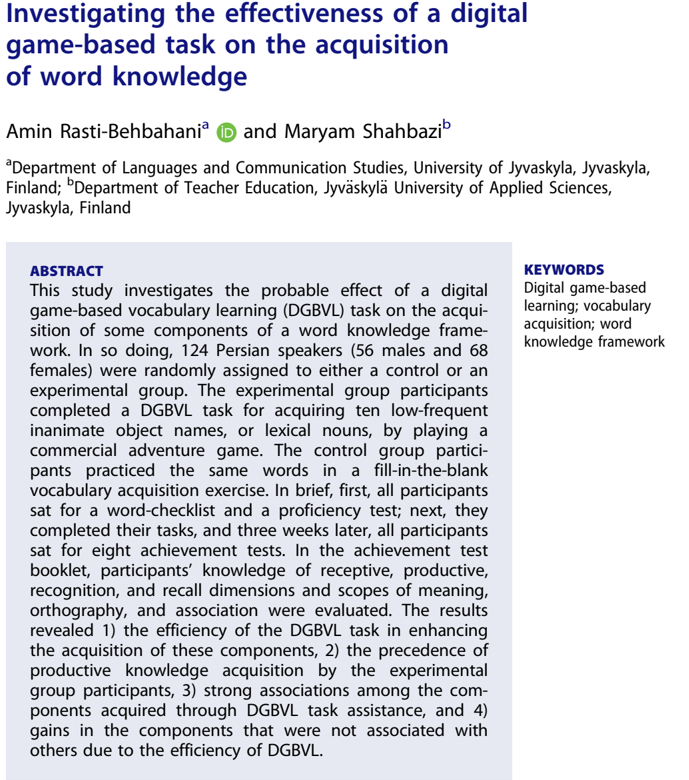
Investigating the effectiveness of a digital game-based task on the acquisition of word knowledge
Open accessThe DOI matches its Crossref record; 31 of the 31 references it cites were found in a registry or an index.
Abstract
This study investigates the probable effect of a digital game-based vocabulary learning (DGBVL) task on the acquisition of some components of a word knowledge framework. In so doing, 124 Persian speakers (56 males and 68 females) were randomly assigned to either a control or an experimental group. The experimental group participants completed a DGBVL task for acquiring ten low-frequent inanimate object names, or lexical nouns, by playing a commercial adventure game. The control group participants practiced the same words in a fill-in-the-blank vocabulary acquisition exercise. In brief, first, all participants sat for a word-checklist and a proficiency test; next, they completed their tasks, and three weeks later, all participants sat for eight achievement tests. In the achievement test booklet, participants’ knowledge of receptive, productive, recognition, and recall dimensions and scopes of meaning, orthography, and association were evaluated. The results revealed 1) the efficiency of the DGBVL task in enhancing the acquisition of these components, 2) the precedence of productive knowledge acquisition by the experimental group participants, 3) strong associations among the components acquired through DGBVL task assistance, and 4) gains in the components that were not associated with others due to the efficiency of DGBVL.
Overview
The claims and statistics of this paper haven’t been checked yet.
Free: it reads the open-access text and checks the first 5 claims that cite a source we can check. Create a free account to check every claim.
Integrity signals
Registry
Cites
Statistics
Figures



Verification
Claims the paper makes
The claims and statistics of this paper haven’t been checked yet.
Free: it reads the open-access text and checks the first 5 claims that cite a source we can check. Create a free account to check every claim.
Claims other papers make about this one
Each is checked against this paper’s own text: does it say what the citing paper says it does?
The source backs part of the claim, not all of it — or backs it for a different population, condition or comparison.
In the citing paper
“Linguistically, DGBVL has been demonstrated to be effective for contextual and collaborative learning and negotiation of meaning [33-35].”
From The Effect of Multiplayer Video Games on Incidental and Intentional L2 Vocabulary Learning: The Case of Among Us (2021) · cites this paper as [33]
Experimental — accuracy not yet measuredThe source backs part of the claim, not all of it — or backs it for a different population, condition or comparison.
In the citing paper
“previous studies have supported this finding, showing that exposure to linguistic input is a fundamental prerequisite for incidental vocabulary learning (Eckerth and Tavakoli, 2012; Rasti, 2020).”
From Incidental vocabulary learning from digital games: the predictive role of game playing time, foreign language motivation, and anxiety (2026) · cites this paper as Rasti, 2020
Experimental — accuracy not yet measuredThe cited source says what the claim attributes to it.
In the citing paper
“Digital games have been found to provide distinctive opportunities for acquiring, retaining, and contextualizing vocabulary [14,17,38].”
From Exploring the relationship between digital gaming, language attitudes, and academic success in EFL university students (2024) · cites this paper as [14]
The check wasn’t confident either way, so it gives no verdict — never disputed.
In the citing paper
“the wide variety and rapid development of digital games prevents the creation of a universal vocabulary test for digital game players [12,14].”
From Exploring the relationship between digital gaming, language attitudes, and academic success in EFL university students (2024) · cites this paper as [14]
Experimental — accuracy not yet measured
Self-check
Percentages, sums and reported differences re-computed from the paper’s own numbers.
The self-check needs the paper’s full text.
Citations
Cites
Learning Vocabulary in Another Language
Nation, I. S. P. (2001) · Cambridge University Press · doi:10.1017/cbo9781139524759 · Cited by 6,608
Levels of processing versus transfer appropriate processing
Morris, C. D., Bransford, J. D., & Franks, J. J. (1977) · Journal of Verbal Learning and Verbal Behavior · doi:10.1016/s0022-5371(77)80016-9 · Cited by 2,296 · cited 1×
“Furthermore, assumptions about the quality and durability of the resulting memory traces can only be determined relative to the appropriateness of testing situations ” (Morris, Bransford, & Franks, 1977, p. 528).”
BackgroundLanguage Learning with Technology: Perspectives from Asia
(2021) · Springer eBooks · doi:10.1007/978-981-16-2697-5 · Cited by 2,206
Vocabulary : description, acquisition and pedagogy
Schmitt, N., & McCarthy, M. (1990) · Cited by 1,709
We Acquire Vocabulary and Spelling by Reading: Additional Evidence for the Input Hypothesis
KRASHEN, S. (1989) · The Modern Language Journal · doi:10.1111/j.1540-4781.1989.tb05325.x · Cited by 1,274 · cited 1×
“Acquiring vocabulary is essential for language learners because “ all other things being equal, learners with big vocabularies are more proficient in a wide range of language skills than learners with smaller vocabularies ” (Krashen, 1989, p. 440).”
BackgroundSchmitt, N. (2010) · doi:10.1057/9780230293977 · Cited by 959
The Role of Vocabulary Teaching
Richards, J. C. (1976) · TESOL Quarterly · doi:10.2307/3585941 · Cited by 714 · cited 4×
“For example, Vahdat and Rasti-Behbahani (2013) reported that both female and male Iranian EFL learners who played a commercial adventure digital game acquired receptive form-meaning knowledge of 45 target words more effectively than those who tried to acquire the same target words through text-and-drill exercises.”
BackgroundInfluentialTesting Vocabulary Knowledge: Size, Strength, and Computer Adaptiveness
Laufer, B., & Goldstein, Z. (2004) · Language Learning · doi:10.1111/j.0023-8333.2004.00260.x · Cited by 660 · cited 1×
“Also, the receptive/productive dimension has been considered to encompass two scopes, namely, recognition and recall, and mainly in the form-meaning aspect of word knowledge, as defined in Table 2 (Laufer & Goldstein, 2004).”
BackgroundThe Role of First Language in Foreign Language Learning
Murphy, J. A., & Ringbom, H. (1988) · The Modern Language Journal · doi:10.2307/327765 · Cited by 640
RECEPTIVE AND PRODUCTIVE VOCABULARY LEARNING: The Effects of Reading and Writing on Word Knowledge
Webb, S. (2005) · Studies in Second Language Acquisition · doi:10.1017/s0272263105050023 · Cited by 527 · cited 10×
“However, the precedence of productive knowledge over receptive knowledge of form-meaning recognition is rare in both vocabulary acquisition and DGBVL literature (De La Fuente, 2002; Sundqvist, 2019; Webb, 2005).”
BackgroundResultInfluential
Research works printed but not linked: 6
- deHaan J., 2010, Language Learning & Technology, 14, 74
- Geranpayeh, A. (2003). A quick review of the English Quick Placement Test. Research Notes , 12 , 8 -10.
- Jasso, P. R. (2012). A non-academic computer video game: Its effect on vocabulary acquisition in the EFL classroom (Published master ' s thesis). New York: Syracuse University.
- Pivec, M., Dziabenko, O., & Schinnerl, I. (2003, July). Aspects of game-based learning . In 3rd International Conference on Knowledge Management, Graz, Austria (pp. 216 -225).
- Rabu, S. N. A., & Talib, Z. (2017). The effects of digital game-based learning on primary school students ' English vocabulary achievement and acceptance. Innovative Teaching and Learning Journal (ITLJ) , 1 (1), 61 -74.
- Rasti-Behbahani, A. (2017, March). The effect of video games on learning lexical word classes . Presented at Nordic Educational Research Association Conference, Aalborg University, Denmark.
Cited by
Xodabande, I., Iravi, Y., Mansouri, B., & Matinparsa, H. (2022) · Frontiers in Psychology · doi:10.3389/fpsyg.2022.893821 · Cited by 100
Calvo-Ferrer, J. R., & Belda-Medina, J. (2021) · Multimodal Technologies and Interaction · doi:10.3390/mti5120080 · Cited by 69
Exploring the potential of digital game-based vocabulary learning: a systematic review
Vnucko, G., & Klimova, B. (2023) · Systems · doi:10.3390/systems11020057 · Cited by 59
Far, F. F., & Taghizadeh, M. (2022) · Computer Assisted Language Learning · doi:10.1080/09588221.2022.2146724 · Cited by 68
“In a more recent study, Rasti-Behbahani and Shahbazi (2020) examined the impact of a digital game-based vocabulary learning task on improving learning some components of a word knowledge framework, including learning collocations.”
InfluentialZhang, R., Zou, D., & Cheng, G. (2024) · Computer Assisted Language Learning · doi:10.1080/09588221.2024.2344555 · Cited by 62
“Future researchers may conduct a longitudinal study on SR-DGBVL and assess vocabulary retention using delayed post-tests for a longer time span, such as the two-week (Chen et al., 2019b) or three-week span (Rasti-Behbahani & Shahbazi, 2020).”
Hashemi, A. (2021) · Journal for the Education of Gifted Young Scientists · doi:10.17478/jegys.846480 · Cited by 60
“They will also stimulate the imagination of students and develop their capability to practice the language entertainingly (Rasti-Behbahani and Shahbazi, 2020; Akramy, 2020).”
BackgroundMassive online multiplayer games as an environment for English learning among Iranian EFL students
Soyoof, A., Reynolds, B. L., Chan, K. K., Tseng, W., & McLay, K. F. (2023) · Computer Assisted Language Learning · doi:10.1080/09588221.2023.2171065 · Cited by 36
Namaziandost, E., & Çakmak, F. (2025) · Computers and Education Artificial Intelligence · doi:10.1016/j.caeai.2025.100505 · Cited by 32
Karimi, M. N., & Nasouri, A. (2024) · System · doi:10.1016/j.system.2024.103398 · Cited by 23
A Meta-Analysis of the Effect of Interactive Technologies on Language Education
He, R., Xu, W., Dong, D., & Yu, Z. (2024) · International Journal of Adult Education and Technology · doi:10.4018/ijaet.340933 · Cited by 20
Jia, W., Zhang, L., Pack, A., Guan, Y., & Zou, B. (2024) · Language Learning & Technology · doi:10.64152/10125/73554 · Cited by 14
“…a handful of studies make an explicit distinction among vocabulary knowledge types and draw specifically on productive vocabulary (deHaan et al., 2010; Franciosi, 2017) or both receptive vocabulary (RV) and productive vocabulary (PV) (Rasti-Behbahani & Shahbazi, 2020; Sundqvist & Wikström, 2015).”
BackgroundZhong, Y., Fryer, L. K., Zheng, S., Shum, A., & Chu, S. K. W. (2025) · International Journal of Educational Technology in Higher Education · doi:10.1186/s41239-025-00528-y · Cited by 16
Wang, X., & Feng, L. (2025) · Education Sciences · doi:10.3390/educsci15020125 · Cited by 13
Defining Game-Mediated Second and Foreign Language Teaching and Learning: A Review
Gao, Y., & Gee, E. R. (2023) · International Journal of Game-Based Learning · doi:10.4018/ijgbl.323210 · Cited by 12
Mining for words: the effect of Minecraft on incidental vocabulary learning of young EFL learners
Weisi, H., & Hajizadeh, S. (2025) · Entertainment Computing · doi:10.1016/j.entcom.2024.100801 · Cited by 8
Alipova, A. (2024) · International Journal of Information and Education Technology · doi:10.18178/ijiet.2024.14.6.2112 · Cited by 8
“Defined broadly, GBL encompasses any form of game play with clearly defined learning outcomes [11, 12].”
BackgroundVnucko, G., Kralova, Z., & Tirpakova, A. (2024) · Heliyon · doi:10.1016/j.heliyon.2024.e33301 · Cited by 7
“Although the selection of test items was based on the authors ’ teaching and gaming experience, the wide variety and rapid development of digital games prevents the creation of a universal vocabulary test for digital game players [12,14].”
BackgroundInvolvement Load and Vocabulary Acquisition in Digital Game-Based Tasks
Rasti-Behbahani, A. (2023) · Springer eBooks · doi:10.1007/978-981-99-1490-6_6 · Cited by 6
Self-citationVideo Game-based Digital Learning in the Development of Vocabulary Knowledge
Sandi, M., Murtiningsih, T., Riyanto, S., Ratih, K., & Kusparlina, E. P. (2023) · Jurnal Keilmuan dan Keislaman · doi:10.23917/jkk.v2i1.56 · Cited by 6
Kyle Lai, K.-W., & Howard Chen, H.-J. (2025) · Computers & Education · doi:10.1016/j.compedu.2025.105343 · Cited by 5
Li, X., & Shakibaei, G. (2026) · Computer Assisted Language Learning · doi:10.1080/09588221.2026.2613724 · Cited by 6
Meng, J., & Li, R. (2026) · International Journal of Applied Linguistics · doi:10.1111/ijal.70231 · Cited by 4
Yulianto, D., Juniawan, E. A., Anwar, S., & Junaedi, Y. (2025) · Southeast Asian Mathematics Education Journal · doi:10.46517/seamej.v15i1.465 · Cited by 4
“Rasti-Behbahani and Shahbazi (2020) found that digital game-based tasks significantly improve vocabulary comprehension and mastery, suggesting the effectiveness of this approach across various learning contexts, including mathematics.”
A Bayesian Meta‐Analysis of Digital Game‐Enhanced Vocabulary Learning
Shahiwala, S., & Rahul, D. R. (2026) · Journal of Computer Assisted Learning · doi:10.1002/jcal.70246 · Cited by 4
Gao, Y. (2023) · EuroAmerican Journal of Applied Linguistics and Languages · doi:10.21283//2376905x.1.10.1.2646 · Cited by 3
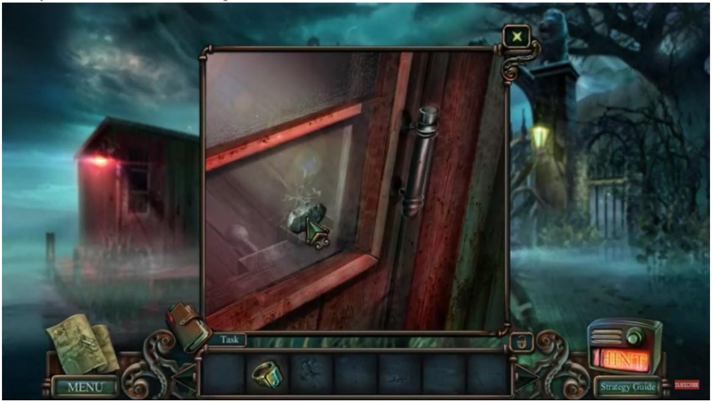
“For example, in a study investigating the effectiveness of a digital game-based task on the acquisition of word knowledge, Rasti-Behbahani and Shahbazi (2020) adopted a commercial adventure point-and-click PC game ( Haunted Hotel: Death Sentence-Collectors’ Edition ) and a walkthrough which is a…”
Rasti-Behbahani, A., Abugohar, M. A., & Khallaf, N. M. (2024) · International Journal of Interactive Mobile Technologies (iJIM) · doi:10.3991/ijim.v18i20.50247 · Cited by 3
Self-citationLai, S.-L., Hsu, H.-L., & Yang, H.-H. (2025) · Springer eBooks · doi:10.1007/978-3-031-51447-0_293-1 · Cited by 3
Raghbir, R. S. A. S., Luan, N. L., & Yi, C. S. (2025) · International Journal of Learning Teaching and Educational Research · doi:10.26803/ijlter.24.6.44 · Cited by 2
Cognitive Load Optimization of Context and Digital Game-Based Vocabulary Learning and Retention
Rasti-Behbahani, A., Khallaf, N. M., Sadeghi, K., & Sulaiman, M. A. B. A. (2026) · International Journal of Computer-Assisted Language Learning and Teaching · doi:10.4018/ijcallt.405414 · Cited by 2
Self-citationPratiwi, D. I., & Yonata, F. (2026) · Studies in Self-Access Learning Journal · doi:10.37237/170107 · Cited by 2
Current Status of Supplementary English Programs in East Java Indonesia
Yusuf, A. S., Rachmawati, A., & Munir, A. (2024) · New Language Dimensions · doi:10.26740/nld.v4n2.p117-126 · Cited by 1
Raghbir, R. S. A. S., Ng, L. L., & Chew, S. Y. (2025) · Malaysian Journal of ELT Research · doi:10.52696/xpom4284 · Cited by 1
Miranti, Nurhayati, L., Maujud, I., & Ilan, L. O. (2025) · International Workshop on Artificial Intelligence and Education (WAIE) · doi:10.1109/waie67422.2025.11381206 · Cited by 1
“…into immersive, goal-oriented contexts that encourage repeated exposure and contextualised use, DGBL can greatly aid in vocabulary building [13][14] The application of DGBL in language learning is supported by a number of learning theories, such as constructivism and social interactionism,…”
Fikri, A., Harisah, H., Zaid, A. H., Mukmin, M., & Hidayah, N. (2026) · Al-Muyassar Journal of Arabic Education · doi:10.31000/al-muyassar.v5i1.16149 · Cited by 1
Mary, T. S., & Raja, B. W. D. (2024) · Indian Journal of Science and Technology · doi:10.17485/ijst/v17i10.2439 · Cited by 1
Robles, L. D., Maridueña, K. A. C., Villao, L. E. B., & Véliz, G. A. J. (2024) · LATAM Revista Latinoamericana de Ciencias Sociales y Humanidades · doi:10.56712/latam.v5i2.1980 · Cited by 1
Charunin, W., Yunus, M. M., & Hashim, H. B. (2024) · International Journal of Academic Research in Business and Social Sciences · doi:10.6007/ijarbss/v14-i6/21718 · Cited by 1
Impact of digital games on early reading skills in a developing country context
Ahmad, F. (2023) · Research Commons (University of Waikato) · Cited by 4
Akbulut, S., Şimşek, B., Direkci, B., Koparan, B., Gülmez, M., Şimşek, E. E., & Kayır, G. (2026) · Frontiers in Psychology · doi:10.3389/fpsyg.2026.1798613
“Indeed, previous studies have supported this finding, showing that exposure to linguistic input is a fundamental prerequisite for incidental vocabulary learning (Eckerth and Tavakoli, 2012; Rasti, 2020).”
STUDENT’S GAMING EXPERIENCE IN MASTERING VOCABULARY
Fariz, L., & Suryaman, M. (2021) · PROJECT (Professional Journal of English Education) · doi:10.22460/project.v4i5.p822-831 · Cited by 2
Loewen, S., & Sato, M. (2024) · Cambridge University Press eBooks · doi:10.1017/9781108780520.007
Nurhaliza, N. (2025) · Journal of Education Method and Learning Strategy · doi:10.59653/jemls.v3i01.1414
Sunani, S., Hutagalung, G. U., & Ningsih, W. (2025) · Advances in Social Science, Education and Humanities Research/Advances in social science, education and humanities research · doi:10.2991/978-2-38476-396-2_3
Sulaiman, N. S., Zulkifli, N. S. A., Azman, M. W. M., Kadir, T. A. A., & Ahmad, A. (2025) · Smart innovation, systems and technologies · doi:10.1007/978-981-96-1154-6_22
Nuha, F. K. (2025) · Analisis Harga Pokok Produksi Rumah Pada (UIN Syarif Hidayatullah Jakarta)
Teknologiapedagogiikkaa kielten opetukseen
(2025) · Jyväskylä University Digital Archive (University of Jyväskylä)
Hollender, F., & Abed, A. (2023) · Diva portal (Dalarna University Library)
Çağdaş Resim Sanatında Doğa ve İnsan İlişkisinin Cennet Ütopyası Üzerinden Yorumlanışı
Baydemir, G. (2023) · Çanakkale Onsekiz Mart University AVESIS
Rasti-Behbahani, A., Khallaf, N. M., & Choubsaz, Y. (2026) · Australian Journal of Applied Linguistics · doi:10.29140/ajal.2026.103759 · Cited by 1
“Another interesting finding was that productive vocabulary knowledge showed a greater relative gain in effectiveness and retention, which supports the findings by Rasti-Behbahani and Shahbazi (2022), while receptive vocabulary knowledge was acquired at a higher absolute level.”
InfluentialSelf-citationHokama, M. M. (2026) · UA Campus Repository (The University of Arizona)
Comparison of Existing Educational Game Framework and Improvement of Educational Game (EG) Framework
Sulaiman, N. S., Zulkifli, N. S. A. B., Kadir, T. A. A., & Azman, M. W. B. M. (2026) · International Journal of Inventive Engineering and Sciences · doi:10.35940/ijies.i1087.13050526
Incorporating game-based language learning into vocational education: a quasi-experimental study
Zhang, J., & Osman, S. Z. M. (2026) · Scientific Reports · doi:10.1038/s41598-026-58165-y
A Systematic Review of Digital Game-Based Vocabulary Learning: Outcomes, Mechanics, and Challenges
Deng, H., & Mahfoodh, O. H. A. (2026) · International Journal of Game-Based Learning · doi:10.4018/ijgbl.415335
“Learners’ perceptions over using video games as a learning tool for vocabulary acquisition”
Mejía, C. D. R., & Fuentes, C. X. T. (2024) · Digital Repository Technical University of Cotopaxi (Universidad Técnica de Cotopaxi) · Cited by 2
Ishmatillah, K. N. (2025) · Walisongo Repository (Walisongo State Islamic University)
Bektaş, D., & BASKIN, S. (2026) · ODÜ Sosyal Bilimler Araştırmaları Dergisi (ODÜSOBİAD) · doi:10.48146/odusobiad.1829144
Improving young learners’ language practice and engagement through the BalaTalk digital platform
Baimenova, M., Mailybayeva, G. S., & Karimova, B. (2026) · Frontiers in Education · doi:10.3389/feduc.2026.1840920
An English Vocabulary Learning through Word Games: Serendipitous Community Service
Iman, J. N. (2026) · REKA ELKOMIKA Jurnal Pengabdian kepada Masyarakat · doi:10.26760/rekaelkomika.v7i1.10-19
Zhang, Z., Daungcharone, K., & Thongkoo, K. (2026) · Journal of Digital Education and Learning Engineering
LEVERAGING GRAMMAR GAMES FOR ELT: A SYSTEMATIC REVIEW
Putri, Z. E., Mudawamah, R. Y., & Tarihoran, N. (2025) · Integrative Perspectives of Social and Science Journal
Improving Students' Vocabulary Mastery by Using Eye Spy Game
Saputra, A., & Emi, E. (2024) · Journal of Teaching and Education. · doi:10.31327/jte.v3i2.2882
Hazza, H. B. (2026) · Scholar Commons (University of South Carolina)
Metadata
- Authors
- Rasti-Behbahani, A., & Shahbazi, M.
- Affiliations
- University of Jyväskylä (FI)
- Department of Teacher Education, Jyväskylä University of Applied Sciences, Jyvaskyla, Finland
- Corresponding author
- Rasti-Behbahani, Amin
- Venue
- Computer Assisted Language Learning
- Publisher
- Informa UK Limited
- Published
- 2020-12-01
- Volume
- 35
- Issue
- 8
- Pages
- 1920-1945
- ISSN
- 0958-8221 (ISSN-L)
- 1744-3210
- OpenAlex
- W3109309381
- Cited by
- 37
- References
- 30
- Citations by year
- 2026: 10 · 2025: 8 · 2024: 9 · 2023: 6 · 2022: 2 · 2021: 2
- FWCI
- 3.77
- Type
- journal article
- Language
- en
- Open access
- hybrid
- doi.org
- Licence
- Locations
- Computer Assisted Language Learning (publishedVersion, cc-by-nc-nd)
- Jyväskylä University Digital Archive (University of Jyväskylä) (submittedVersion, cc-by-nc-nd)
- Topics
- Social Sciences › Psychology › Developmental and Educational Psychology › Educational Games and Gamification
- Social Sciences › Psychology › Developmental and Educational Psychology › Second Language Acquisition and Learning
- Social Sciences › Arts and Humanities › Language and Linguistics › EFL/ESL Teaching and Learning
- Keywords
- vocabulary knowledge, vocabulary acquisition, adventure games, Persian learners of English, receptive vocabulary, expressive vocabulary, word recognition, word recall, word association, orthography, game-based language learning
About these checks
Registry, retraction, Cites and statistics results are computed, not judged, with one exception: a printed reference that no index lists is read once by a model before it counts as a citation error. Claims are extracted by a model and kept only when their quote appears verbatim in the text; each cited source is then checked, with a model’s help, for whether it says what the claim relies on. Those verdicts can be wrong — read the claim’s quote and the cited source before relying on one.
Statistics and arithmetic are recomputed, not judged.
Confidence bands are shown only for fields calibrated on our annotated test set. None is calibrated yet, so no band is shown.
What counts as a claim ›How we measure confidence ›How we check this ›
Are you an author, or do you see a problem with this page? Request a review
Data sources
Bibliographic data: Semantic Scholar, OpenAlex, Crossref.
Contains information from the Semantic Scholar Academic Graph Datasets, made available under the ODC Attribution License (ODC-BY 1.0).
Semantic Scholar’s data is described in: Kinney, R., et al. (2023). The Semantic Scholar Open Data Platform. arXiv:2301.10140.
