

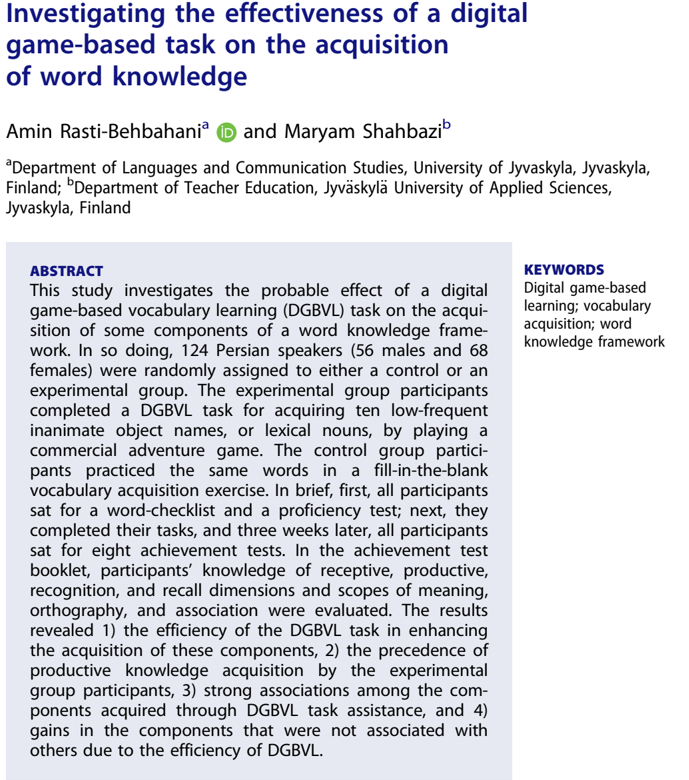
Investigating the effectiveness of a digital game-based task on the acquisition of word knowledge
Open accessThe DOI matches its Crossref record; 31 of the 31 references it cites were found in a registry or an index.
Abstract
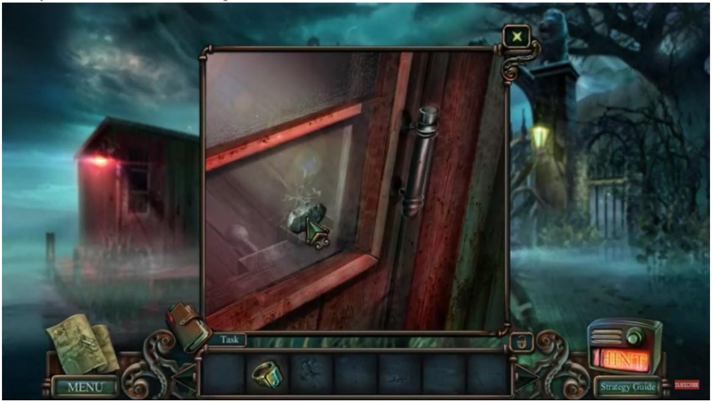
This study investigates the probable effect of a digital game-based vocabulary learning (DGBVL) task on the acquisition of some components of a word knowledge framework. In so doing, 124 Persian speakers (56 males and 68 females) were randomly assigned to either a control or an experimental group. The experimental group participants completed a DGBVL task for acquiring ten low-frequent inanimate object names, or lexical nouns, by playing a commercial adventure game. The control group participants practiced the same words in a fill-in-the-blank vocabulary acquisition exercise. In brief, first, all participants sat for a word-checklist and a proficiency test; next, they completed their tasks, and three weeks later, all participants sat for eight achievement tests. In the achievement test booklet, participants’ knowledge of receptive, productive, recognition, and recall dimensions and scopes of meaning, orthography, and association were evaluated. The results revealed 1) the efficiency of the DGBVL task in enhancing the acquisition of these components, 2) the precedence of productive knowledge acquisition by the experimental group participants, 3) strong associations among the components acquired through DGBVL task assistance, and 4) gains in the components that were not associated with others due to the efficiency of DGBVL.
Overview
The claims and statistics of this paper haven’t been checked yet.
Free: it reads the open-access text and checks the first 5 claims that cite a source we can check. Create a free account to check every claim.
Integrity signals
Registry
Cites
Statistics
Figures



Verification
Claims the paper makes
The claims and statistics of this paper haven’t been checked yet.
Free: it reads the open-access text and checks the first 5 claims that cite a source we can check. Create a free account to check every claim.
Claims other papers make about this one
Each is checked against this paper’s own text: does it say what the citing paper says it does?
The source backs part of the claim, not all of it — or backs it for a different population, condition or comparison.
In the citing paper
“Linguistically, DGBVL has been demonstrated to be effective for contextual and collaborative learning and negotiation of meaning [33-35].”
From The Effect of Multiplayer Video Games on Incidental and Intentional L2 Vocabulary Learning: The Case of Among Us (2021) · cites this paper as [33]
Experimental — accuracy not yet measuredThe source backs part of the claim, not all of it — or backs it for a different population, condition or comparison.
In the citing paper
“previous studies have supported this finding, showing that exposure to linguistic input is a fundamental prerequisite for incidental vocabulary learning (Eckerth and Tavakoli, 2012; Rasti, 2020).”
From Incidental vocabulary learning from digital games: the predictive role of game playing time, foreign language motivation, and anxiety (2026) · cites this paper as Rasti, 2020
Experimental — accuracy not yet measuredThe cited source says what the claim attributes to it.
In the citing paper
“Digital games have been found to provide distinctive opportunities for acquiring, retaining, and contextualizing vocabulary [14,17,38].”
From Exploring the relationship between digital gaming, language attitudes, and academic success in EFL university students (2024) · cites this paper as [14]
The check wasn’t confident either way, so it gives no verdict — never disputed.
In the citing paper
“the wide variety and rapid development of digital games prevents the creation of a universal vocabulary test for digital game players [12,14].”
From Exploring the relationship between digital gaming, language attitudes, and academic success in EFL university students (2024) · cites this paper as [14]
Experimental — accuracy not yet measured
Self-check
Percentages, sums and reported differences re-computed from the paper’s own numbers.
The self-check needs the paper’s full text.
Citations
Cites
Learning Vocabulary in Another Language
Nation, I. S. P. (2001) · Cambridge University Press · doi:10.1017/cbo9781139524759 · Cited by 6,608
Levels of processing versus transfer appropriate processing
Morris, C. D., Bransford, J. D., & Franks, J. J. (1977) · Journal of Verbal Learning and Verbal Behavior · doi:10.1016/s0022-5371(77)80016-9 · Cited by 2,296 · cited 1×
“Furthermore, assumptions about the quality and durability of the resulting memory traces can only be determined relative to the appropriateness of testing situations ” (Morris, Bransford, & Franks, 1977, p. 528).”
BackgroundLanguage Learning with Technology: Perspectives from Asia
(2021) · Springer eBooks · doi:10.1007/978-981-16-2697-5 · Cited by 2,206
Vocabulary : description, acquisition and pedagogy
Schmitt, N., & McCarthy, M. (1990) · Cited by 1,707
We Acquire Vocabulary and Spelling by Reading: Additional Evidence for the Input Hypothesis
KRASHEN, S. (1989) · The Modern Language Journal · doi:10.1111/j.1540-4781.1989.tb05325.x · Cited by 1,274 · cited 1×
“Acquiring vocabulary is essential for language learners because “ all other things being equal, learners with big vocabularies are more proficient in a wide range of language skills than learners with smaller vocabularies ” (Krashen, 1989, p. 440).”
BackgroundSchmitt, N. (2010) · doi:10.1057/9780230293977 · Cited by 959
The Role of Vocabulary Teaching
Richards, J. C. (1976) · TESOL Quarterly · doi:10.2307/3585941 · Cited by 714 · cited 4×
“For example, Vahdat and Rasti-Behbahani (2013) reported that both female and male Iranian EFL learners who played a commercial adventure digital game acquired receptive form-meaning knowledge of 45 target words more effectively than those who tried to acquire the same target words through text-and-drill exercises.”
BackgroundInfluentialTesting Vocabulary Knowledge: Size, Strength, and Computer Adaptiveness
Laufer, B., & Goldstein, Z. (2004) · Language Learning · doi:10.1111/j.0023-8333.2004.00260.x · Cited by 660 · cited 1×
“Also, the receptive/productive dimension has been considered to encompass two scopes, namely, recognition and recall, and mainly in the form-meaning aspect of word knowledge, as defined in Table 2 (Laufer & Goldstein, 2004).”
BackgroundThe Role of First Language in Foreign Language Learning
Murphy, J. A., & Ringbom, H. (1988) · The Modern Language Journal · doi:10.2307/327765 · Cited by 640
RECEPTIVE AND PRODUCTIVE VOCABULARY LEARNING: The Effects of Reading and Writing on Word Knowledge
Webb, S. (2005) · Studies in Second Language Acquisition · doi:10.1017/s0272263105050023 · Cited by 527 · cited 10×
“However, the precedence of productive knowledge over receptive knowledge of form-meaning recognition is rare in both vocabulary acquisition and DGBVL literature (De La Fuente, 2002; Sundqvist, 2019; Webb, 2005).”
BackgroundResultInfluentialRESEARCHING VOCABULARY THROUGH A WORD KNOWLEDGE FRAMEWORK: Word Associations and Verbal Suffixes
Schmitt, N., & Meara, P. (1997) · Studies in Second Language Acquisition · doi:10.1017/s0272263197001022 · Cited by 419 · cited 7×
“…that although components of the word knowledge framework can be associated, and gains in one component can elevate gains in other associated components (Schmitt, 1998; Schmitt & Meara, 1997), these associations are highly susceptible to the type and the structure of vocabulary acquisition tasks.”
BackgroundResultInfluentialTracking the Incremental Acquisition of Second Language Vocabulary: A Longitudinal Study
Schmitt, N. (1998) · Language Learning · doi:10.1111/1467-9922.00042 · Cited by 406 · cited 7×
“…that although components of the word knowledge framework can be associated, and gains in one component can elevate gains in other associated components (Schmitt, 1998; Schmitt & Meara, 1997), these associations are highly susceptible to the type and the structure of vocabulary acquisition tasks.”
BackgroundResultInfluentialDigital game-based vocabulary learning: where are we and where are we going?
Zou, D., Huang, Y., & Xie, H. (2021) · Computer Assisted Language Learning · doi:10.1080/09588221.2019.1640745 · Cited by 329 · cited 4×
“However, the focus of the available DGBVL literature is mainly on the acquisition of receptive (recognition or recall) word knowledge while the acquisition of productive word knowledge is neglected or rarely studied (Zou et al., 2019).”
BackgroundInfluentialde la Fuente, M. J. (2002) · Studies in Second Language Acquisition · doi:10.1017/s0272263102001043 · Cited by 305 · cited 7×
“However, the precedence of productive knowledge over receptive knowledge of form-meaning recognition is rare in both vocabulary acquisition and DGBVL literature (De La Fuente, 2002; Sundqvist, 2019; Webb, 2005).”
BackgroundMethodResultInfluentialWe Acquire Vocabulary and Spelling by Reading: Additional Evidence for the Input Hypothesis
Krashen, S. D. (1989) · Modern Language Journal · doi:10.2307/326879 · Cited by 292
The effect of interactivity with a music video game on second language vocabulary recall
deHaan, J., Reed, W. M., & Kuwanda, K. (2010) · Language Learning & Technology · doi:10.64152/10125/44215 · Cited by 266 · cited 1×
“Participants were given the walkthrough to prevent the negative effects of extensive interactivity, which can result in negative cognitive load and probably lead to difficulty in recalling vocabulary items (deHaan et al., 2010).”
BackgroundOut-of-school digital gameplay and in-school L2 English vocabulary outcomes
Sundqvist, P., & Wikström, P. (2015) · System · doi:10.1016/j.system.2015.04.001 · Cited by 256
A Guide to Doing Statistics in Second Language Research Using SPSS and R
Larson-Hall, J. (2015) · Routledge eBooks · doi:10.4324/9781315775661 · Cited by 249
Learning word pairs and glossed sentences: the effects of a single context on vocabulary knowledge
Webb, S. (2007) · Language Teaching Research · doi:10.1177/1362168806072463 · Cited by 188 · cited 10×
“Therefore, it might have provided them an opportunity to practice the target words product-ively, which was more beneficial for efficient vocabulary acquisition (Webb, 2007).”
BackgroundMethodInfluentialLee, J. S. (2019) · British Journal of Educational Technology · doi:10.1111/bjet.12599 · Cited by 163 · cited 1×
“For example, although some studies report about the potentials of DGBVL tasks (Chen, Tseng, & Hsiao, 2018; Zou, Huang, & Xie, 2019), the inefficacy of DGBVL tasks was reported and discussed in a few other studies (e.g., deHaan, Reed, & Kuwada, 2010; Lee, 2019).”
ResultCommercial-off-the-shelf games in the digital wild and L2 learner vocabulary
Sundqvist, P. (2019) · Language Learning & Technology · doi:10.64152/10125/44674 · Cited by 154 · cited 5×
“However, the precedence of productive knowledge over receptive knowledge of form-meaning recognition is rare in both vocabulary acquisition and DGBVL literature (De La Fuente, 2002; Sundqvist, 2019; Webb, 2005).”
BackgroundResultInfluentialMondria, J.-A., & Wiersma, B. (2004) · Language learning and language teaching · doi:10.1075/lllt.10.08mon · Cited by 130 · cited 2×
“Considering the experimental group participants ’ performance, the precedence of form-meaning and recognition knowledge over other aspects and scopes is not a peculiar and uncommon finding; besides, it supports the previous literature (Mondria & Wiersma, 2004; Webb, 2005).”
BackgroundResultThe effectiveness of digital game-based vocabulary learning: A framework-based view of meta-analysis
Chen, M., Tseng, W., & Hsiao, T. (2018) · British Journal of Educational Technology · doi:10.1111/bjet.12526 · Cited by 122 · cited 2×
“For example, although some studies report about the potentials of DGBVL tasks (Chen, Tseng, & Hsiao, 2018; Zou, Huang, & Xie, 2019), the inefficacy of DGBVL tasks was reported and discussed in a few other studies (e.g., deHaan, Reed, & Kuwada, 2010; Lee, 2019).”
BackgroundResultMoretti, B. (1989) · Bern Open Repository and Information System (University of Bern) · Cited by 109
The Impact of a Serious Game on Vocabulary and Content Learning
Chen, H.-J. H., & Hsu, H.-L. (2020) · Computer Assisted Language Learning · doi:10.1080/09588221.2019.1593197 · Cited by 109 · cited 1×
“Chen and Hsu (2019) found that digital games are not only effective in acquiring the receptive form-meaning knowledge of vocabulary items but also in content acquisition.”
BackgroundUsing verbal reports in research on language learning.
Cohen, A. D. (1987) · Cited by 74
The Effect of Video Games on Iranian EFL Learners' Vocabulary Learning
Vahdat, S., & Rasti-Behbahani, A. (2013) · The reading matrix · Cited by 57
Self-citationExploiting adventure video games for second language vocabulary recall: a mixed-methods study
Janebi Enayat, M., & Haghighatpasand, M. (2019) · Innovation in Language Learning and Teaching · doi:10.1080/17501229.2017.1359276 · Cited by 51 · cited 5×
“Digital games provide a rich multimedia context, in which textual, pictorial, and auditory information are easily accessible for gamers (Janebi Enayat & Haghighatpasand, 2019).”
BackgroundResultInfluentialkirriemuir, J. (2002) · doi:10.13140/rg.2.2.34765.03044 · Cited by 39
Game-based collaborative vocabulary learning in blended and distance L2 learning
Bahari, A. (2022) · Open Learning: The Journal of Open, Distance and e-Learning · doi:10.1080/02680513.2020.1814229 · Cited by 36 · cited 4×
“Bahari (2020) reported that digital games, in general, can increase both the depth and size of the gamers ’ English word knowledge.”
BackgroundInfluentialReaders, Players, and Watchers: Short and Long-term Vocabulary Retention through Digital Video Games
Ebrahimzadeh, M., & Alavi, S. (2017) · International Journal of Applied Linguistics & English Literature · doi:10.7575/aiac.ijalel.v.6n.4p.52 · Cited by 22 · cited 1×
“Ebrahimzadeh and Alavi (2017) reported that commercial digital games can support vocabulary acquisition and enhance the retention of receptive knowledge of form-meaning recognition.”
Background
Research works printed but not linked: 6
- deHaan J., 2010, Language Learning & Technology, 14, 74
- Geranpayeh, A. (2003). A quick review of the English Quick Placement Test. Research Notes , 12 , 8 -10.
- Jasso, P. R. (2012). A non-academic computer video game: Its effect on vocabulary acquisition in the EFL classroom (Published master ' s thesis). New York: Syracuse University.
- Pivec, M., Dziabenko, O., & Schinnerl, I. (2003, July). Aspects of game-based learning . In 3rd International Conference on Knowledge Management, Graz, Austria (pp. 216 -225).
- Rabu, S. N. A., & Talib, Z. (2017). The effects of digital game-based learning on primary school students ' English vocabulary achievement and acceptance. Innovative Teaching and Learning Journal (ITLJ) , 1 (1), 61 -74.
- Rasti-Behbahani, A. (2017, March). The effect of video games on learning lexical word classes . Presented at Nordic Educational Research Association Conference, Aalborg University, Denmark.
Cited by
Xodabande, I., Iravi, Y., Mansouri, B., & Matinparsa, H. (2022) · Frontiers in Psychology · doi:10.3389/fpsyg.2022.893821 · Cited by 95
Calvo-Ferrer, J. R., & Belda-Medina, J. (2021) · Multimodal Technologies and Interaction · doi:10.3390/mti5120080 · Cited by 69
Exploring the potential of digital game-based vocabulary learning: a systematic review
Vnucko, G., & Klimova, B. (2023) · Systems · doi:10.3390/systems11020057 · Cited by 59
Far, F. F., & Taghizadeh, M. (2022) · Computer Assisted Language Learning · doi:10.1080/09588221.2022.2146724 · Cited by 45
“In a more recent study, Rasti-Behbahani and Shahbazi (2020) examined the impact of a digital game-based vocabulary learning task on improving learning some components of a word knowledge framework, including learning collocations.”
InfluentialZhang, R., Zou, D., & Cheng, G. (2024) · Computer Assisted Language Learning · doi:10.1080/09588221.2024.2344555 · Cited by 62
“Future researchers may conduct a longitudinal study on SR-DGBVL and assess vocabulary retention using delayed post-tests for a longer time span, such as the two-week (Chen et al., 2019b) or three-week span (Rasti-Behbahani & Shahbazi, 2020).”
Metadata
- Authors
- Rasti-Behbahani, A., & Shahbazi, M.
- Affiliations
- University of Jyväskylä (FI)
- Department of Teacher Education, Jyväskylä University of Applied Sciences, Jyvaskyla, Finland
- Corresponding author
- Rasti-Behbahani, Amin
- Venue
- Computer Assisted Language Learning
- Publisher
- Informa UK Limited
- Published
- 2020-12-01
- Volume
- 35
- Issue
- 8
- Pages
- 1920-1945
- ISSN
- 0958-8221 (ISSN-L)
- 1744-3210
- OpenAlex
- W3109309381
- Cited by
- 37
- References
- 30
- Citations by year
- 2026: 10 · 2025: 8 · 2024: 9 · 2023: 6 · 2022: 2 · 2021: 2
- FWCI
- 3.77
- Type
- journal article
- Language
- en
- Open access
- hybrid
- doi.org
- Licence
- Locations
- Computer Assisted Language Learning (publishedVersion, cc-by-nc-nd)
- Jyväskylä University Digital Archive (University of Jyväskylä) (submittedVersion, cc-by-nc-nd)
- Topics
- Social Sciences › Psychology › Developmental and Educational Psychology › Educational Games and Gamification
- Social Sciences › Psychology › Developmental and Educational Psychology › Second Language Acquisition and Learning
- Social Sciences › Arts and Humanities › Language and Linguistics › EFL/ESL Teaching and Learning
- Keywords
- vocabulary knowledge, vocabulary acquisition, adventure games, Persian learners of English, receptive vocabulary, expressive vocabulary, word recognition, word recall, word association, orthography, game-based language learning
About these checks
Registry, retraction, Cites and statistics results are computed, not judged, with one exception: a printed reference that no index lists is read once by a model before it counts as a citation error. Claims are extracted by a model and kept only when their quote appears verbatim in the text; each cited source is then checked, with a model’s help, for whether it says what the claim relies on. Those verdicts can be wrong — read the claim’s quote and the cited source before relying on one.
Statistics and arithmetic are recomputed, not judged.
Confidence bands are shown only for fields calibrated on our annotated test set. None is calibrated yet, so no band is shown.
What counts as a claim ›How we measure confidence ›How we check this ›
Are you an author, or do you see a problem with this page? Request a review
Data sources
Bibliographic data: Semantic Scholar, OpenAlex, Crossref.
Contains information from the Semantic Scholar Academic Graph Datasets, made available under the ODC Attribution License (ODC-BY 1.0).
Semantic Scholar’s data is described in: Kinney, R., et al. (2023). The Semantic Scholar Open Data Platform. arXiv:2301.10140.
