

Ironies of Generative AI: Understanding and Mitigating Productivity Loss in Human-AI Interaction
The DOI matches its Crossref record; 149 of the 149 references it cites were found in a registry or an index.
Abstract
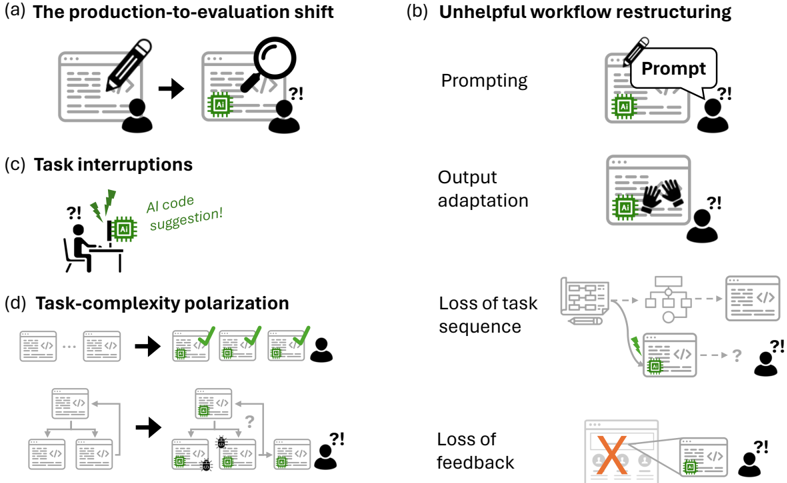
Generative AI (GenAI) systems offer opportunities to increase user productivity in many tasks, such as programming and writing. However, while they boost productivity in some studies, many others show that users are working ineffectively with GenAI systems and losing productivity. Despite the apparent novelty of these usability challenges, these ‘ironies of automation’ have been observed for over three decades in Human Factors research on the introduction of automation in domains such as aviation, automated driving, and intelligence. We draw on this extensive research alongside recent GenAI user studies to outline four key reasons for productivity loss with GenAI systems: a shift in users’ roles from production to evaluation, unhelpful restructuring of workflows, interruptions, and a tendency for automation to make easy tasks easier and hard tasks harder. We then suggest how Human Factors research can also inform GenAI system design to mitigate productivity loss by using approaches such as continuous feedback, system personalization, ecological interface design, task stabilization, and clear task allocation. Thus, we ground developments in GenAI system usability in decades of Human Factors research, ensuring that the design of human-AI interactions in this rapidly moving field learns from history instead of repeating it.
Overview
The claims and statistics of this paper haven’t been checked yet.
Free: it reads the open-access text and checks the first 5 claims that cite a source we can check. Create a free account to check every claim.
Integrity signals
Registry
Cites
Statistics
Figures
Verification
Claims the paper makes
The claims and statistics of this paper haven’t been checked yet.
Free: it reads the open-access text and checks the first 5 claims that cite a source we can check. Create a free account to check every claim.
Claims other papers make about this one
Each is checked against this paper’s own text: does it say what the citing paper says it does?
In the citing paper
“This phenomenon is welldocumented, as in Bainbridge's”
From The Impact of Generative AI on Critical Thinking: Self-Reported Reductions in Cognitive Effort and Confidence Effects From a Survey of Knowledge Workers (2025) · cites this paper as [122]
In the citing paper
“This is particularly important since research envisions a change in the role of a software developer to focus more on code verification [40], [41].”
From Same Scrutiny, More Time: Eye Tracking Insights into Reviewing LLM-Labelled Code (2026) · cites this paper as [41]
Self-check
Percentages, sums and reported differences re-computed from the paper’s own numbers.
The self-check needs the paper’s full text.
Citations
Cites
Humans and automation: Use, misuse, disuse, abuse
Parasuraman, R., & Riley, V. (1997) · Human Factors: The Journal of the Human Factors and Ergonomics Society · doi:10.1518/001872097778543886 · Cited by 4,554 · cited 2×
“Beyond diagnosing the usability challenges of automation, Human Factors research has spent decades studying approaches to mitigate these challenges (e.g., Endsley, 2017; Parasuraman et al., 1997; 2000; Sheridan & Parasuraman, 2005).”
A model for types and levels of human interaction with automation
Parasuraman, R., Sheridan, T. B., & Wickens, C. D. (2000) · IEEE Transactions on Systems, Man, and Cybernetics - Part A: Systems and Humans · doi:10.1109/3468.844354 · Cited by 4,195 · cited 2×
“In Barke et al. (2023), several participants chose to adapt Copilot suggestions to use as a template for their code.”
Feuerriegel, S., Hartmann, J., Janiesch, C., & Zschech, P. (2024) · Business & Information Systems Engineering · doi:10.1007/s12599-023-00834-7 · Cited by 2,267 · cited 2×
“Also in line with EID principles, Feuerriegel et al. (2024) argued that GenAI tools should be embedded in workflows via user interfaces that are tailored to users’ domain-specific needs and challenges.”
Bainbridge, L. (1983) · Automatica · doi:10.1016/0005-1098(83)90046-8 · Cited by 2,205 · cited 10×
“Automation research shows that low situational awareness can be exacerbated by several factors, including automation’s high output capacity and systems’ complexity, opaqueness, and low reliability.”
InfluentialExperimental Evidence on the Productivity Effects of Generative Artificial Intelligence
Noy, S., & Zhang, W. (2023) · doi:10.2139/ssrn.4375283 · Cited by 2,157
Experimental evidence on the productivity effects of generative artificial intelligence
Noy, S., & Zhang, W. (2023) · Science · doi:10.1126/science.adh2586 · Cited by 2,150 · cited 3×
“Recent research already suggests the enormous positive impact these systems could have on workers’ performance in domains including programming (Peng et al., 2023), writing (Noy & Zhang, 2023), law (Choi & Schwarcz, 2023), and consulting (Dell’Acqua et al., 2023).”
Measurement of Situation Awareness in Dynamic Systems
Endsley, M. R. (1995) · Human Factors: The Journal of the Human Factors and Ergonomics Society · doi:10.1518/001872095779049499 · Cited by 2,039 · cited 1×
“…of the situation, comprehension of the situation, and the � ‘Challenge theme’ refers to (1) the production-to-evaluation shift, (2) unhelpful workflow restructuring, (3) task interruptions, and (4) task-complexity polarization (as per Section 3). projection of future status (Endsley, 1995).”
Systemic risk in banking ecosystems
Haldane, A. G., & May, R. M. (2011) · Nature · doi:10.1038/nature09659 · Cited by 1,480 · cited 1×
“For example, when traders in the digital stock exchange changed roles from executing to monitoring trades, they under-performed as they were unable to effectively monitor the trades in real-time (Haldane & May, 2011).”
Chatting about ChatGPT: how may AI and GPT impact academia and libraries?
Lund, B. D., & Wang, T. (2023) · Library Hi Tech News · doi:10.1108/lhtn-01-2023-0009 · Cited by 1,355
Why Johnny Can’t Prompt: How Non-AI Experts Try (and Fail) to Design LLM Prompts
Zamfirescu-Pereira, J. D., Wong, R. Y., Hartmann, B., & Yang, Q. (2023) · Proceedings of the 2023 CHI Conference on Human Factors in Computing Systems · doi:10.1145/3544548.3581388 · Cited by 1,274 · cited 2×
“This not only makes prompting a challenge (e.g., Dang et al., 2023; Zamfirescu-Pereira et al., 2023) but also the evaluation of outputs (e.g., Barke et al., 2023; Liang et al., 2023; Weisz et al., 2021) as the two are inextricably intertwined in current systems.”
Research works printed but not linked: 4
- [42] Carl Benedikt Frey and Michael Osborne. 2023. Generative AI and the Future of Work: A Reappraisal. Brown Journal of World Affairs (2023). -
- [87] Kannan Nova. 2023. Generative AI in Healthcare: Advancements in Electronic Health Records, facilitating Medical Languages, and Personalized Patient Care. Journal of Advanced Analytics in Healthcare Management 7, 1 (April 2023), 115-131. https://research.tensorgate.org/index.php/ JAAHM/article/view/43 Number: 1. -
- Pasquale F. Malgieri G. (2023). Generative AI explainability and score-based natural language processing in benefits administration. Retrieved from https://papers.ssrn.com/abstract=4826707
- [102] Haocong Rao, Cyril Leung, and Chunyan Miao. 2023. Can ChatGPT Assess Human Personalities? A General Evaluation Framework. https: //arxiv.org/abs/2303.01248v2 -
Cited by
The Metacognitive Demands and Opportunities of Generative AI
Tankelevitch, L., Kewenig, V., Simkute, A., Scott, A. E., Sarkar, A., Sellen, A., & Rintel, S. (2024) · Proceedings of the CHI Conference on Human Factors in Computing Systems · doi:10.1145/3613904.3642902 · Cited by 493
Self-citationLee, H.-P. (., Sarkar, A., Tankelevitch, L., Drosos, I., Rintel, S., Banks, R., & Wilson, N. (2025) · Proceedings of the 2025 CHI Conference on Human Factors in Computing Systems · doi:10.1145/3706598.3713778 · Cited by 490
“This phenomenon is well-documented, as in Bainbridge’s “Ironies of Automation” [7], and has been recently revisited in the context of GenAI by Simkute et al. [122] as the “Ironies of Generative AI”.”
Self-citationEstablishing and evaluating trustworthy AI: overview and research challenges
Kowald, D., Scher, S., Pammer-Schindler, V., Müllner, P., Waxnegger, K., Demelius, L., Fessl, A., Toller, M., Mendoza Estrada, I. G., Šimić, I., et al. (2024) · Frontiers in Big Data · doi:10.3389/fdata.2024.1467222 · Cited by 59
Shukla, P., Bui, P., Levy, S. S., Kowalski, M., Baigelenov, A., & Parsons, P. (2025) · Proceedings of the Extended Abstracts of the CHI Conference on Human Factors in Computing Systems · doi:10.1145/3706599.3719931 · Cited by 43
Problematic ChatGPT Use Scale: AI-Human Collaboration or Unraveling the Dark Side of ChatGPT
Maral, S., Naycı, N., Bilmez, H., Erdemir, E. İ., & Satıcı, S. A. (2025) · International Journal of Mental Health and Addiction · doi:10.1007/s11469-025-01509-y · Cited by 60
“However, their widespread adoption raises concerns about unintended consequences, particularly problematic usage patterns, including over-reliance and digital addiction (Abbas et al., 2024; Duong et al., 2024; Simkute et al., 2024).”
What drives the corporate payoffs of using generative artificial intelligence?
Bughin, J. (2024) · Structural Change and Economic Dynamics · doi:10.1016/j.strueco.2024.09.011 · Cited by 40
Shi, X., Wang, Y., Rossi, R. A., & Zhao, J. (2025) · CHI Conference on Human Factors in Computing Systems · doi:10.1145/3706598.3714087 · Cited by 44
“The challenge of specifying design intent solely with natural language is well recognized [13, 80, 85, 98].”
Designing LLM Chains by Adapting Techniques from Crowdsourcing Workflows
Grunde-McLaughlin, M., Lam, M. S., Krishna, R., Weld, D. S., & Heer, J. (2025) · ACM Transactions on Computer-Human Interaction · doi:10.1145/3716134 · Cited by 45
Not the Silver Bullet: LLM-enhanced Programming Error Messages are Ineffective in Practice
Santos, E. A., & Becker, B. A. (2024) · Conference on United Kingdom & Ireland Computing Education Research (UKICER) · doi:10.1145/3689535.3689554 · Cited by 27
“Simkute et al. [42] argue that this supposed contradiction of LLM productivity is an already well-known phenomenon in human research: automation alters peoples’ workflows in unproductive ways, such as turning active producers into passive evaluators.”
Chen, P., Wu, Y., Li, Z., Zhang, H., Zhou, M., Yao, J., You, W., & Sun, L. (2025) · International Journal of Human-Computer Interaction · doi:10.1080/10447318.2025.2453003 · Cited by 17
“Specifically, while the generative uncertainty in outcomes can provide diverse inspiration (Liu, Lv, et al., 2024), if not effectively managed, this uncertainty and randomness have the potential to disrupt the design process and design rhythm (Simkute et al., 2024; Yang et al., 2020).”
Generative AI for Secure User Interface (UI) Design
Sindiramutty, S. R., Prabagaran, K. R. V., Akbar, R., Hussain, M., & Malik, N. A. (2024) · Advances in information security, privacy, and ethics book series · doi:10.4018/979-8-3693-5415-5.ch010 · Cited by 30
Requirements Are All You Need: The Final Frontier for End-User Software Engineering
Robinson, D., Cabrera, C., Gordon, A. D., Lawrence, N. D., & Mennen, L. (2025) · ACM Transactions on Software Engineering and Methodology · doi:10.1145/3708524 · Cited by 12
“Here are the requirements for an app to track the currency requirements 7 of an airline’s roster of pilots.”
Adapting to AI-mediated workplaces: how STEM trainees navigate new challenges and opportunities
Cingillioglu, I., & Schoettner, M. (2025) · Information Technology and People · doi:10.1108/itp-02-2025-0163 · Cited by 17
Singh, C. (2025) · Journal of Financial Crime · doi:10.1108/jfc-07-2024-0232 · Cited by 12
Qiao, H., Vermeulen, J., Fitzmaurice, G., & Matejka, J. (2025) · Proceedings of the 2025 CHI Conference on Human Factors in Computing Systems · doi:10.1145/3706598.3714103 · Cited by 11
“” In recent years, human-AI interaction researchers have also recognized that merely developing better models does not lead to effective collaboration between humans and automated systems [39, 53].”
InfluentialRecalibrating academic expertise in the age of generative AI
Lin, Z., & Sohail, A. (2026) · Patterns · doi:10.1016/j.patter.2025.101473 · Cited by 22
“22,28,29 The user’s role shifts from active production to passive evaluation of AI outputs, a mentally taxing task that degrades situational awareness and encourages overreliance.”
Managing the fatigue frontier: AI applications in air traffic control operations
Xin, S., Lim, K. Y. H., Hsieh, M.-H., Chen, C.-H., & Dong, L. (2025) · Advanced Engineering Informatics · doi:10.1016/j.aei.2025.103660 · Cited by 10
Constructivist psychology principles of human–AI collaboration
Pavlović, J. (2025) · Frontiers in Psychology · doi:10.3389/fpsyg.2025.1638774 · Cited by 9
Sculpt-to-Image: Exploring Clay-based Sculpting to Support Human-AI-Co-Creation of Images
Hesselbarth, L., Wenig, N., Döring, T., & Malaka, R. (2025) · Creativity and Cognition · doi:10.1145/3698061.3734408 · Cited by 10
Lu, X., Guo, W. R., Wang, Y., & Zhang, H. (2025) · International Journal of Human-Computer Interaction · doi:10.1080/10447318.2025.2520997 · Cited by 11
“This transformative potential has been widely recognized across fields, including education, commerce, and research (Dwivedi et al., 2023; Simkute et al., 2024).”
Developer Productivity With and Without GitHub Copilot: A Longitudinal Mixed-Methods Case Study
Stray, V., Brandtzæg, E. G., Wivestad, V., Barbala, A., & Moe, N. B. (2026) · Proceedings of the Annual Hawaii International Conference on System Sciences · doi:10.24251/hicss.2026.880 · Cited by 9
“Further, Simkute et al. (2025) identified a shift in the developer’s role when using GenAI: instead of creating outputs, developers now focus on supervising and evaluating AI-generated results.”
The role of firm AI capabilities in generative AI-pair coding
Bughin, J. (2024) · Journal of Decision Systems · doi:10.1080/12460125.2024.2428187 · Cited by 6
Li, J., & Yuan, Q. (2026) · Journal of Knowledge Management · doi:10.1108/jkm-02-2025-0231 · Cited by 8
Lan, Y.-L., Liu, S.-H., & Chen, H. (2026) · Frontiers Comput. Sci. · doi:10.3389/fcomp.2026.1756441 · Cited by 11
Exploring the Productivity Impacts of Generative AI in Organizations
Semujanga, B., & Mikalef, P. (2024) · Lecture notes in computer science · doi:10.1007/978-3-031-72234-9_9 · Cited by 13
Qadir, J. (2025) · IEEE Global Engineering Education Conference (EDUCON) · doi:10.1109/educon62633.2025.11016479 · Cited by 17
Guriță, A.-E., & Vatavu, R.-D. (2025) · International Web for All Conference (W4A) · doi:10.1145/3744257.3744266 · Cited by 13
“However, as reported by Simkute et al. [45], there can be significant productivity losses in human-AI interaction when developers rely too heavily on LLM suggestions without a proper understanding of accessibility requirements.”
Irons, J. L., Duenser, A., Pickett, T., Haysom, G., & McGrath, M. J. (2026) · Health and Technology · doi:10.1007/s12553-025-01042-x · Cited by 7
Qadir, J., & Mumtaz, M. (2026) · IEEE Global Engineering Education Conference (EDUCON) · doi:10.1109/educon67543.2026.11574165 · Cited by 10
“Building on four decades of automation research [12], [15], our study integrates insights from multiple traditions—human factors engineering, automation psychology, HCI, educational technology, and philosophical analyses of machine limitations [2], [16].”
From Dead-ends to Dialogue: Third Workshop on Design Research & GenAI
van der Maden, W., van der Burg, V., Halperin, B. A., Jääskeläinen, P., Kun, P., Lomas, D., Merritt, T. R., Lindley, J., Okopnyi, P., Guribye, F., et al. (2025) · Designing Interactive Systems Conference · doi:10.1145/3715668.3734170 · Cited by 5
“These challenges reflect what researchers have termed the ’ironies of AI’ [18, 49]—where implementation leads to unexpected contradictions, such as increased cognitive load from evaluation tasks and workflow disruptions, rather than the promised reduction in workload.”
Our place in the agentic AI loop: the value of information professional competencies
Cox, A. M. (2025) · Library Hi Tech News · doi:10.1108/lhtn-07-2025-0132 · Cited by 5
Investigating the Impact of AI-Assisted Tools on Software Practitioner Well-Being
Meem, F. N., & Johnson, B. (2025) · Annual Symposium on Human-Computer Interaction for Work (CHIWORK) · doi:10.1145/3707640.3731915 · Cited by 9
“Tools with more adaptive or emotionally aware interfaces could reduce frustration and improve the user experience [15].”
Em, S., Mok, S., Sam, R., Pen, D., & Serey, M. (2025) · Advances in computational intelligence and robotics book series · doi:10.4018/979-8-3693-7873-1.ch011 · Cited by 4
Towards a Criteria‐Based Approach to Selecting Human‐AI Interaction Mode
Irons, J. L., Cooper, P., McGrath, M. J., Tariq, S., & Duenser, A. (2025) · Human Factors and Ergonomics in Manufacturing & Service Industries · doi:10.1002/hfm.70022 · Cited by 11
Qi, J., Zhao, H., Xiang, R., Zhang, Y., Zhang, X., Wang, C., Jian, L., & Ji, F. (2026) · Journal of Research on Technology in Education · doi:10.1080/15391523.2025.2601067 · Cited by 9
From divergence to convergence: GenAI’s role in collaborative design thinking
Hutter, K., Rupp, J., & Füller, J. (2026) · Business Horizons · doi:10.1016/j.bushor.2026.04.001 · Cited by 6
Zhang, H., & Jiang, R.-J. (2026) · Education and Information Technologies : Official Journal of the IFIP technical committee on Education · doi:10.1007/s10639-026-14026-9 · Cited by 6
Fascinari, M., & English, V. (2025) · The Development of Humanities and Social Sciences · doi:10.71204/qeqqvj92 · Cited by 10
Bouha, C., & Benhayoun-Sadafiyine, L. (2026) · Knowledge and Process Management · doi:10.1002/kpm.70063 · Cited by 6
“These situations often compel employees to interact with AI systems without sufficient time to cognitively process outputs or validate results, leading to fragmentation of attention and higher perceived mental effort (Simkute et al. 2024; Zhao et al. 2023).”
Xiong, R., Netser, Y., Tang, P., Li, B., & Hwang, J. (2025) · SSRN Electronic Journal · doi:10.2139/ssrn.5168581 · Cited by 2
Cui, J. (2025) · SSRN Electronic Journal · doi:10.2139/ssrn.5047197 · Cited by 2
Kopkow, A., Bangerl, M. M., & Pammer‐Schindler, V. (2025) · Mensch und Computer (MuC) · doi:10.1145/3743049.3748576 · Cited by 1
Attorneys and AI: How Lawyers Use Artificial Intelligence and Analyze Its Impacts
Schieber, E. A. G., Kite, N., Hall, M. I., Turner, C., & Schlesinger, A. (2025) · Proceedings of the ACM on Human-Computer Interaction · doi:10.1145/3757554 · Cited by 4
“…into the foundational question how AI can help has been picking up steam in the age of generative AI, with studies exploring how generative AI can augment or replace knowledge work [e.g., 25, 97, 118] and how knowledge workers are making sense of generative AI in the workplace [e.g., 39, 99, 136].”
Magnani, F., Joblot, L., Rosin, F., Guillard, A., & Passalacqua, M. (2025) · Question(s) de management · doi:10.3917/qdm.236.0099 · Cited by 1
Kontodimou, K., Sentuc, N., Kostamis, D., Varsos, K., & Kepaptsoglou, K. L. (2026) · Transportation Research Record Journal of the Transportation Research Board · doi:10.1177/03611981261420135 · Cited by 1
“…has its limitations because it can lead to productivity challenges stemming from a shift in users’ roles from creation to evaluation, unhelpful restructuring of workflows, task inter-ruptions, and the tendency of automation to make simple tasks easier while complicating more difficult ones ( 26 ).”
Dwivedi, D., Banerjee, S., & Dé, R. (2026) · Information Systems Frontiers · doi:10.1007/s10796-026-10726-2 · Cited by 1
“Further, these systems can disrupt users’ thought processes through interruptions and unhelp-ful restructuring of workflows, resulting in cognitive cost and consequent productivity loss (Simkute et al., 2024).”
InfluentialFang, C., Guo, J., Khiatani, P. V., Lin, H., Zhang, B., Yenigün, E. Ö., & Wang, S. G. (2026) · International Journal of Human-Computer Interaction · doi:10.1080/10447318.2026.2658255 · Cited by 6
Why technology implementation fails: from adoption to dynamic technology integration
Mertens, A., Kho, M. C., Toni, F. D., & Parker, S. K. (2026) · European Journal of Work and Organizational Psychology · doi:10.1080/1359432x.2026.2684522 · Cited by 2
T2VTree: User-Centered Visual Analytics for Agent-Assisted Thought-to-Video Authoring
Zheng, Z.-Y., Dong, Y., Liang, G., Li, G., Shan, G., Cheng, S., Tian, D., Zhou, J. J., & Liang, J. (2026) · IEEE Pacific Visualization Conference (PacificVis) · doi:10.1109/pacificvis68791.2026.00046 · Cited by 3
“Users must infer correspondences between outputs, while evolving intentions, decision rationales, and abandoned alternatives are rarely captured explicitly [12,29,31].”
Human-AI interactions (HAII) in STEM education: A systematic review from 2010 to 2025
Wu, M., & Ouyang, F. (2026) · Educational Research Review · doi:10.1016/j.edurev.2026.100821 · Cited by 3
Artificial intelligence and job design: Insights from Job Demands–Resources theory
Bakker, A. B., Junker, T. L., Scharp, Y. S., & Černe, M. (2026) · Technology in Society · doi:10.1016/j.techsoc.2026.103533 · Cited by 2
Song, Y., Moon, H., Yang, H., & Kilgore, C. (2026) · arXiv · doi:10.48550/arxiv.2603.20220 · Cited by 1
Wu, M., & Ouyang, F. (2026) · Educational Psychology Review · doi:10.1007/s10648-026-10211-x
“Novices may misjudge their own work even without AI (Cloude et al., 2024 ) and lack the knowledge required to evaluate generated code (Prather et al., 2024 ; Simkute et al., 2024 ).”
Singh, C. (2025) · Frontiers in Law · doi:10.6000/2817-2302.2025.04.01
Recalibrating Academic Expertise in the Age of Generative AIPreprint
Sohail, A., & Lin, Z. (2025) · SSRN Electronic Journal · doi:10.2139/ssrn.5224452 · Cited by 1
Giuliani, F., Zingoni, A., Filieri, J., & Calabrò, G. (2025) · Springer proceedings in business and economics · doi:10.1007/978-3-031-80692-6_5
Pak, R., Rovira, E. M., & McLaughlin, A. C. (2026) · Ergonomics · doi:10.1080/00140139.2026.2686284 · Cited by 3
Mapping the Horizon: A Scoping Review of Generative AI in Collaborative Learning
Yao, Y., Yin, X., Lin, H., Lam, C. K., & Wei, W. (2025) · IEEE International Conference on Teaching, Assessment, and Learning for Engineering · doi:10.1109/tale66047.2025.11346681 · Cited by 2
Zhang, X., Fan, H., Zhou, J., Yang, Y., Liu, H., Zhang, Y., Tu, X., Chai, C., Morosi, F., & Cascini, G. (2026) · Journal of Engineering Design · doi:10.1080/09544828.2026.2622887
Artificial Intelligence and Its Role in the Healthcare Sector
Bastone, A. (2026) · SpringerBriefs in health care management and economics · doi:10.1007/978-3-032-14298-6_2
Chen, Y., & Xue, C. (2026) · International Journal of Human-Computer Interaction · doi:10.1080/10447318.2026.2634980
Automation and Augmentation: Practical Ethics of AI for Productivity in Retail Banking
Nani, A. (2026) · Journal of Ethics and Emerging Technologies · doi:10.55613/jeet.v36i1.200
Extended technology acceptance of workplace GenAI copilots: Evidence from PLS-SEM
Ibrahim, A. (2026) · Advances in Business and Management Research · doi:10.1016/j.abmr.2026.100003 · Cited by 1
THINKING ISSUES: On Activism within Academic Computing
Connolly, R. W. (2026) · ACM Inroads · doi:10.1145/3797965
Epistemic practices and beliefs of Chilean adolescents in digital environments
Reyes, M. S. A., Weinstein, F., & Vidal, M. (2026) · Frontiers in Education · doi:10.3389/feduc.2026.1818555
Stavola, F. D., & Peterlongo, G. (2026) · Sociological Theory · doi:10.1177/07352751261436791 · Cited by 1
Rahgozar, A., & Mortezaagha, P. (2026) · Artificial Intelligence Review · doi:10.1007/s10462-026-11599-2 · Cited by 1
Li, Z., Sun, H., Yang, T., & Zeng, K. (2026) · European Journal of Innovation Management · doi:10.1108/ejim-11-2025-1496 · Cited by 4
Reclaiming Productivity: Critical Perspectives on Speculative Futures
Wong, E., Dillon, T., Johal, W., Velloso, E., Howe, J., & Vetere, F. (2026) · Annual Symposium on Human-Computer Interaction for Work (CHIWORK) · doi:10.1145/3808045.3808064 · Cited by 1
Automation Gains, Human Costs: Deskilling Pressure in Human–AI Task AllocationPreprint
Pelechano, V., Mestre, A., Albert, M., & Gil, M. (2026) · SSRN Electronic Journal · doi:10.2139/ssrn.6993655
Lin, H., & Xie, L. (2026) · Frontiers in Psychology · doi:10.3389/fpsyg.2026.1839565 · Cited by 1
“Furthermore, human–GenAI collaboration itself may introduce additional coordination costs and interactional disruptions, which could negatively affect creative fluency (Simkute et al., 2025; Tankelevitch et al., 2024).”
Understanding and Predicting Accepted Code Suggestions in AI-Assisted Programming
Jiang, J., Li, L., Hou, J., Tan, X. L., & Zhang, L. (2026) · Proceedings of the ACM on software engineering. · doi:10.1145/3808125
Morad, M., & Essing, B. (2026) · Communications in computer and information science · doi:10.1007/978-3-032-30826-9_21
If AI Can Do It, It Should? Task Delegation Preferences of Future Professionals
Bangerl, M. M., Disch, L., Isailovic, E., & Pammer‐Schindler, V. (2026) · Annual Symposium on Human-Computer Interaction for Work (CHIWORK) · doi:10.1145/3805029.3818284
CreatureCreator: Co-Creating 3D Models with AI for Video Games via Sculpting and Drawing
Hesselbarth, L., Wenig, N., Ringe, R., Wald, I. Y., Hurrelbrink, L., Wagener, N., & Malaka, R. (2026) · Creativity and Cognition · doi:10.1145/3803784.3807572
Zhang, L., Chong, L., Hong, M. K., Hakimi, S., Filipowicz, A. L. S., Klenk, M., & Paredes, P. E. (2026) · Creativity and Cognition · doi:10.1145/3803784.3807551
“When people are presented with a multitude of GenAI outputs, attentional demands shift towards monitoring and verifying them for qualities of interest [39], which can impose a considerable cognitive workload [61].”
Altork, A., Wiese, I., & Melegati, J. (2026) · Journal of Software Evolution and Process · doi:10.1002/smr.70162 · Cited by 1
“This reflects that AI can hinder rather than enhance productivity [43].”
Does it pay off to use GenAI in the Russian labor market?
Rozhkova, K. V., Roshchin, S., & Roshchina, Y. M. (2026) · Voprosy Ekonomiki · doi:10.32609/0042-8736-2026-8-29-54
Uddin, A., & Shrestha, N. (2026) · LBEF Research Journal of Science Technology and Management · doi:10.67825/lrjstm.2026.8010116
Zhao, Y., Lyu, L., Zhang, H., & Gao, Y. (2026) · Information Systems Frontiers · doi:10.1007/s10796-026-10805-4
The role of (voluntary) large language model use and individual needs in shaping work design
Maisch, V., Bipp, T., & Walczok, M. (2026) · Work · doi:10.1177/10519815261476647
“26 Moreover, LLM integration may lead to task complexity polarization, 26 simplifying easier tasks while increasing the complexity of challenging tasks.”
Dickinson, R., & Sethna, Z. (2026) · Springer proceedings in business and economics · doi:10.1007/978-3-032-20432-5_14
Nguyen, T., Simoff, S. J., Qu, Z., Adam, R., Catchpoole, D. R., Kennedy, P. J., & Nguyễn, Q. V. (2026) · International Journal of Human-Computer Interaction · doi:10.1080/10447318.2026.2719170
Simulating Cognitive Styles in Conceptual Design: An LLM-Based Process Modeling Approach
Zhang, X., Gu, J., Tang, N., & Chai, C. (2025) · International Symposium on Computational Intelligence and Design · doi:10.1109/iscid68789.2025.00065
Exploring the Impact of AI-powered Creativity Support Tools on Professional Creative Workflows
Moruzzi, C., Bird, C., & Herman, L. M. (2026) · Proceedings of the ACM on Human-Computer Interaction · doi:10.1145/3816933
O’Hara, K., Massimi, M., & Khan, M. (2026) · Computer Supported Cooperative Work (CSCW) · doi:10.1007/s10606-026-09549-1
Fan, L., & Pei, Y. (2026) · International Journal of Human-Computer Interaction · doi:10.1080/10447318.2026.2741021
Assessing Workplace Technology Impacts on Employee Work and Wellbeing: A Post-Adoption Blind Spot
Valtonen, A., & Holopainen, M. (2026) · International Journal of Human-Computer Interaction · doi:10.1080/10447318.2026.2744837
Bounded Delegation: How Student Design Teams Keep Strategic Control over Generative AI
Wei, B., & Qiao, Y. (2026) · International Journal of Human-Computer Interaction · doi:10.1080/10447318.2026.2738102 · Cited by 1
Agents of Change: Teamwork and Collaboration with AI at the Table
Endersby, L., Jenkins, D. M., & Phelps, K. C. (2026) · Emerald Group Publishing Limited eBooks · doi:10.1108/978-1-83708-152-320261009 · Cited by 1
Vajda, S. R. L. (2026) · Research Square · doi:10.21203/rs.3.rs-11312211/v1
Jiang, Y., & Bian, Y. (2026) · British Educational Research Journal · doi:10.1002/berj.70304
Same Scrutiny, More Time: Eye Tracking Insights into Reviewing LLM-Labelled Code
Khojah, R., Gomes de Oliveira Neto, F., Mohamad, M., Frattini, J., & Leitner, P. (2026) · Proceedings of the 41st IEEE/ACM International Conference on Automated Software Engineering · doi:10.1145/3832783.3834423
“This is particularly important since research envisions a change in the role of a software developer to focus more on code verification [40], [41].”
Metadata
- Authors
- Simkute, A., Tankelevitch, L., Kewenig, V., Scott, A. E., Sellen, A., & Rintel, S.
- Affiliations
- University of Edinburgh (GB)
- Microsoft Research (United Kingdom) (GB)
- University College London (GB)
- Corresponding author
- Rintel, Sean
- Venue
- International Journal of Human–Computer Interaction
- Publisher
- Informa UK Limited
- Published
- 2024-10-15
- Pages
- 1-22
- ISSN
- 1044-7318 (ISSN-L)
- 1532-7590
- OpenAlex
- W4403430763
- Semantic Scholar
- 3f4ce5d3066ab47b3c68f261ee68177648b53228
- Cited by
- 89
- References
- 132
- Citations by year
- 2026: 51 · 2025: 31 · 2024: 7
- FWCI
- 42.11
- Type
- journal article
- Language
- en
- Open access
- closed
- Locations
- International Journal of Human-Computer Interaction (publishedVersion)
- Topics
- Social Sciences › Human Factors and Ergonomics › Human-Automation Interaction and Safety
- Physical Sciences › Computer Science › Human-Computer Interaction › Usability and User Interface Design
- Social Sciences › Business, Management and Accounting › Management Information Systems › Information Systems Theories and Implementation
- Keywords
- generative AI, productivity loss, human-AI interaction, interruptions, task allocation, ecological interface design, continuous feedback, usability, AI system design
About these checks
Registry, retraction, Cites and statistics results are computed, not judged, with one exception: a printed reference that no index lists is read once by a model before it counts as a citation error. Claims are extracted by a model and kept only when their quote appears verbatim in the text; each cited source is then checked, with a model’s help, for whether it says what the claim relies on. Those verdicts can be wrong — read the claim’s quote and the cited source before relying on one.
Statistics and arithmetic are recomputed, not judged.
Confidence bands are shown only for fields calibrated on our annotated test set. None is calibrated yet, so no band is shown.
What counts as a claim ›How we measure confidence ›How we check this ›
Are you an author, or do you see a problem with this page? Request a review
Data sources
Bibliographic data: Semantic Scholar, OpenAlex, Crossref.
Contains information from the Semantic Scholar Academic Graph Datasets, made available under the ODC Attribution License (ODC-BY 1.0).
Semantic Scholar’s data is described in: Kinney, R., et al. (2023). The Semantic Scholar Open Data Platform. arXiv:2301.10140.
