

Ironies of Generative AI: Understanding and Mitigating Productivity Loss in Human-AI Interaction
The DOI matches its Crossref record; 149 of the 149 references it cites were found in a registry or an index.
Abstract
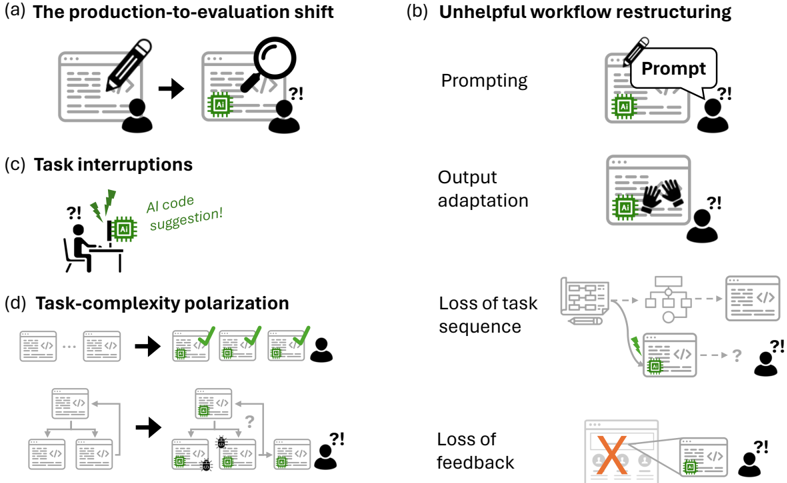
Generative AI (GenAI) systems offer opportunities to increase user productivity in many tasks, such as programming and writing. However, while they boost productivity in some studies, many others show that users are working ineffectively with GenAI systems and losing productivity. Despite the apparent novelty of these usability challenges, these ‘ironies of automation’ have been observed for over three decades in Human Factors research on the introduction of automation in domains such as aviation, automated driving, and intelligence. We draw on this extensive research alongside recent GenAI user studies to outline four key reasons for productivity loss with GenAI systems: a shift in users’ roles from production to evaluation, unhelpful restructuring of workflows, interruptions, and a tendency for automation to make easy tasks easier and hard tasks harder. We then suggest how Human Factors research can also inform GenAI system design to mitigate productivity loss by using approaches such as continuous feedback, system personalization, ecological interface design, task stabilization, and clear task allocation. Thus, we ground developments in GenAI system usability in decades of Human Factors research, ensuring that the design of human-AI interactions in this rapidly moving field learns from history instead of repeating it.
Overview
The claims and statistics of this paper haven’t been checked yet.
Free: it reads the open-access text and checks the first 5 claims that cite a source we can check. Create a free account to check every claim.
Integrity signals
Registry
Cites
Statistics
Figures
Verification
Claims the paper makes
The claims and statistics of this paper haven’t been checked yet.
Free: it reads the open-access text and checks the first 5 claims that cite a source we can check. Create a free account to check every claim.
Claims other papers make about this one
Each is checked against this paper’s own text: does it say what the citing paper says it does?
In the citing paper
“This phenomenon is welldocumented, as in Bainbridge's”
From The Impact of Generative AI on Critical Thinking: Self-Reported Reductions in Cognitive Effort and Confidence Effects From a Survey of Knowledge Workers (2025) · cites this paper as [122]
In the citing paper
“This is particularly important since research envisions a change in the role of a software developer to focus more on code verification [40], [41].”
From Same Scrutiny, More Time: Eye Tracking Insights into Reviewing LLM-Labelled Code (2026) · cites this paper as [41]
Self-check
Percentages, sums and reported differences re-computed from the paper’s own numbers.
The self-check needs the paper’s full text.
Citations
Cites
Humans and automation: Use, misuse, disuse, abuse
Parasuraman, R., & Riley, V. (1997) · Human Factors: The Journal of the Human Factors and Ergonomics Society · doi:10.1518/001872097778543886 · Cited by 4,554 · cited 2×
“Beyond diagnosing the usability challenges of automation, Human Factors research has spent decades studying approaches to mitigate these challenges (e.g., Endsley, 2017; Parasuraman et al., 1997; 2000; Sheridan & Parasuraman, 2005).”
A model for types and levels of human interaction with automation
Parasuraman, R., Sheridan, T. B., & Wickens, C. D. (2000) · IEEE Transactions on Systems, Man, and Cybernetics - Part A: Systems and Humans · doi:10.1109/3468.844354 · Cited by 4,195 · cited 2×
“In Barke et al. (2023), several participants chose to adapt Copilot suggestions to use as a template for their code.”
Feuerriegel, S., Hartmann, J., Janiesch, C., & Zschech, P. (2024) · Business & Information Systems Engineering · doi:10.1007/s12599-023-00834-7 · Cited by 2,267 · cited 2×
“Also in line with EID principles, Feuerriegel et al. (2024) argued that GenAI tools should be embedded in workflows via user interfaces that are tailored to users’ domain-specific needs and challenges.”
Bainbridge, L. (1983) · Automatica · doi:10.1016/0005-1098(83)90046-8 · Cited by 2,205 · cited 10×
“Automation research shows that low situational awareness can be exacerbated by several factors, including automation’s high output capacity and systems’ complexity, opaqueness, and low reliability.”
InfluentialExperimental Evidence on the Productivity Effects of Generative Artificial Intelligence
Noy, S., & Zhang, W. (2023) · doi:10.2139/ssrn.4375283 · Cited by 2,157
Experimental evidence on the productivity effects of generative artificial intelligence
Noy, S., & Zhang, W. (2023) · Science · doi:10.1126/science.adh2586 · Cited by 2,150 · cited 3×
“Recent research already suggests the enormous positive impact these systems could have on workers’ performance in domains including programming (Peng et al., 2023), writing (Noy & Zhang, 2023), law (Choi & Schwarcz, 2023), and consulting (Dell’Acqua et al., 2023).”
Measurement of Situation Awareness in Dynamic Systems
Endsley, M. R. (1995) · Human Factors: The Journal of the Human Factors and Ergonomics Society · doi:10.1518/001872095779049499 · Cited by 2,039 · cited 1×
“…of the situation, comprehension of the situation, and the � ‘Challenge theme’ refers to (1) the production-to-evaluation shift, (2) unhelpful workflow restructuring, (3) task interruptions, and (4) task-complexity polarization (as per Section 3). projection of future status (Endsley, 1995).”
Systemic risk in banking ecosystems
Haldane, A. G., & May, R. M. (2011) · Nature · doi:10.1038/nature09659 · Cited by 1,480 · cited 1×
“For example, when traders in the digital stock exchange changed roles from executing to monitoring trades, they under-performed as they were unable to effectively monitor the trades in real-time (Haldane & May, 2011).”
Chatting about ChatGPT: how may AI and GPT impact academia and libraries?
Lund, B. D., & Wang, T. (2023) · Library Hi Tech News · doi:10.1108/lhtn-01-2023-0009 · Cited by 1,355
Why Johnny Can’t Prompt: How Non-AI Experts Try (and Fail) to Design LLM Prompts
Zamfirescu-Pereira, J. D., Wong, R. Y., Hartmann, B., & Yang, Q. (2023) · Proceedings of the 2023 CHI Conference on Human Factors in Computing Systems · doi:10.1145/3544548.3581388 · Cited by 1,274 · cited 2×
“This not only makes prompting a challenge (e.g., Dang et al., 2023; Zamfirescu-Pereira et al., 2023) but also the evaluation of outputs (e.g., Barke et al., 2023; Liang et al., 2023; Weisz et al., 2021) as the two are inextricably intertwined in current systems.”
Vigilance Requires Hard Mental Work and Is Stressful
Warm, J. S., Parasuraman, R., & Matthews, G. (2008) · Human Factors: The Journal of the Human Factors and Ergonomics Society · doi:10.1518/001872008x312152 · Cited by 1,253 · cited 1×
“However, monitoring (or vigilance) is tedious and requires attention, and can, therefore, paradoxically impose a considerable workload on humans (Grubb et al., 1995; Warm et al., 2008).”
Narrative Reviews: Flexible, Rigorous, and Practical
Sukhera, J. (2022) · Journal of Graduate Medical Education · doi:10.4300/jgme-d-22-00480.1 · Cited by 1,062 · cited 1×
“We used a narrative review approach to identify, analyze, and synthesize the relevant literature into the presented themes (Sukhera, 2022).”
Budhwar, P., Chowdhury, S., Wood, G., Aguinis, H., Bamber, G. J., Beltran, J. R., Boselie, P., Lee Cooke, F., Decker, S., DeNisi, A., et al. (2023) · Human Resource Management Journal · doi:10.1111/1748-8583.12524 · Cited by 908 · cited 1×
“…domains such as healthcare (Nova, 2023), research (Lund & Wang, 2023), writing (Chen & Chan, 2023; Dang et al., 2023), creative work (Gmeiner et al., 2023; Kulkarni et al., 2023; Oppenlaender, 2022; Pennefather, 2023a), consulting (Dell’Acqua et al., 2023), and recruitment (Budhwar et al., 2023).”
From Here to Autonomy: Lessons Learned From Human–Automation Research
Endsley, M. R. (2017) · Human Factors: The Journal of the Human Factors and Ergonomics Society · doi:10.1177/0018720816681350 · Cited by 898
Performance Consequences of Automation-Induced 'Complacency'
Parasuraman, R., Molloy, R., & Singh, I. L. (1993) · The International Journal of Aviation Psychology · doi:10.1207/s15327108ijap0301_1 · Cited by 875 · cited 1×
“Complacency due to high-workload conditions has been observed in aviation, where pilots would fail to conduct sufficient checks of system state (Funk et al., 1999; Parasuraman et al., 1993).”
A diary study of task switching and interruptions
Czerwinski, M., Horvitz, E., & Wilhite, S. (2004) · Proceedings of the SIGCHI Conference on Human Factors in Computing Systems · doi:10.1145/985692.985715 · Cited by 830 · cited 1×
“Interruptions can be designed to support task stabilization, i.e., to help users prepare their current (main) task for the temporary switch in focus (Czerwinski et al., 2004; Parnin & DeLine, 2010).”
Making Sense of Sensemaking 1: Alternative Perspectives
Klein, G., Moon, B., & Hoffman, R. R. (2006) · IEEE Intelligent Systems · doi:10.1109/mis.2006.75 · Cited by 818 · cited 1×
“For example, when automation introduces new tasks in operators’ workflow, disrupting their familiar workflow, they struggle to adapt their strategies (Klein et al., 2006).”
Memory for goals: an activation‐based model
Altmann, E. M., & Trafton, J. G. (2002) · Cognitive Science · doi:10.1207/s15516709cog2601_2 · Cited by 795 · cited 1×
“Automation can restructure workflows in unhelpful ways by introducing new challenging tasks, disrupting familiar task sequences, and removing informative feedback (Figure 1b).”
Dell'Acqua, F., McFowland III, E., Mollick, E. R., Lifshitz-Assaf, H., Kellogg, K., Rajendran, S., Krayer, L., Candelon, F., & Lakhani, K. R. (2023) · SSRN Electronic Journal · doi:10.2139/ssrn.4573321 · Cited by 794 · cited 5×
“Over-reliance has been shown to lead to decreased performance; for example, management consultants showed overall poorer performance when they blindly adopted AI-generated outputs (Dell’Acqua et al., 2023).”
InfluentialThe contribution of latent human failures to the breakdown of complex systems
Reason, J. (1990) · Philosophical Transactions of the Royal Society of London. B, Biological Sciences · doi:10.1098/rstb.1990.0090 · Cited by 762 · cited 1×
“Otherwise, users may fall into “procedural traps” (Rasmussen & Vicente, 1989; Reason, 1990), novel situations where they rely on their normal rule set but without the usual success.”
The cost of interrupted work: more speed and stress
Mark, G., Gudith, D., & Klocke, U. (2008) · Proceedings of the SIGCHI Conference on Human Factors in Computing Systems · doi:10.1145/1357054.1357072 · Cited by 728 · cited 1×
“Particularly long and complex interruptions significantly disrupt people’s ability to resume their original tasks (Mark et al., 2008; 2012; Monk et al., 2008).”
Vaithilingam, P., Zhang, T., & Glassman, E. L. (2022) · CHI Conference on Human Factors in Computing Systems Extended Abstracts · doi:10.1145/3491101.3519665 · Cited by 660 · cited 18×
“The authors also suggested supporting debugging by automatically generating test cases and test data for users to validate and identify corner cases (Vaithilingam et al., 2022).”
InfluentialFlight-deck automation: promises and problems
WIENER, E. L., & CURRY, R. E. (1980) · Ergonomics · doi:10.1080/00140138008924809 · Cited by 599 · cited 5×
“Finally, we explore how automation such as GenAI can paradoxically lead to easy tasks being made easier and hard tasks made harder, a phenomenon we refer to as “task-complexity polarization” (also known as “clumsy automation” in Human Factors research (Wiener & Curry (1980); Section 3.4)).”
InfluentialThe ‘problem ’ with automation: inappropriate feedback and interaction, not ‘over-automation’
Norman, D. A. (1990) · Philosophical Transactions of the Royal Society of London. B, Biological Sciences · doi:10.1098/rstb.1990.0101 · Cited by 510
The Metacognitive Demands and Opportunities of Generative AI
Tankelevitch, L., Kewenig, V., Simkute, A., Scott, A. E., Sarkar, A., Sellen, A., & Rintel, S. (2024) · Proceedings of the CHI Conference on Human Factors in Computing Systems · doi:10.1145/3613904.3642902 · Cited by 493 · cited 2×
“…the information provided, seeing alternate solutions and usage examples, and having access to familiar information sources can help to support users’ ability to notice system mistakes and reduce the cognitive burden of monitoring (Liao & Vaughan, 2023; Sun et al., 2022; Tankelevitch et al., 2024).”
Self-citationWu, T., Terry, M., & Cai, C. J. (2022) · CHI Conference on Human Factors in Computing Systems · doi:10.1145/3491102.3517582 · Cited by 483 · cited 1×
“These features should be integrated directly into the interface (e.g., as in AI Chains Wu et al. (2022)), taking into consideration the work domain context and domain expert knowledge (DeGrave et al., 2023; Pasquale & Malgieri, 2023).”
Sheridan, T. B., & Parasuraman, R. (2005) · Reviews of Human Factors and Ergonomics · doi:10.1518/155723405783703082 · Cited by 474 · cited 1×
“Beyond diagnosing the usability challenges of automation, Human Factors research has spent decades studying approaches to mitigate these challenges (e.g., Endsley, 2017; Parasuraman et al., 1997; 2000; Sheridan & Parasuraman, 2005).”
What are you looking for?: an eye-tracking study of information usage in web search
Cutrell, E., & Guan, Z. (2007) · Proceedings of the SIGCHI Conference on Human Factors in Computing Systems · doi:10.1145/1240624.1240690 · Cited by 460 · cited 1×
“Similarly Cutrell et al. (2000), found that users interrupted earlier in a task were more likely to request a reminder after being interrupted, and Cutrell and Guan (2007) showed that the later in the main task an interruption occurs, the less recovery time is needed when subsequently returning to…”
Grounded Copilot: How Programmers Interact with Code-Generating Models
Barke, S., James, M. B., & Polikarpova, N. (2023) · Proceedings of the ACM on Programming Languages · doi:10.1145/3586030 · Cited by 436 · cited 38×
“This same pattern is now being observed in usability studies of GenAI systems (Barke et al., 2023; Sarkar et al., 2022).”
InfluentialSources of situation awareness errors in aviation.
Jones, D. G., & Endsley, M. R. (1996) · PubMed · Cited by 429
Coping with human errors through system design: implications for ecological interface design
Rasmussen, J., & Vicente, K. J. (1989) · International Journal of Man-Machine Studies · doi:10.1016/0020-7373(89)90014-x · Cited by 388 · cited 5×
“This way, users can guide their attention to the level of interest, depending on their level of expertise and current task demands (Rasmussen & Vicente, 1989).”
InfluentialWordcraft: Story Writing With Large Language Models
Yuan, A., Coenen, A., Reif, E., & Ippolito, D. (2022) · 27th International Conference on Intelligent User Interfaces · doi:10.1145/3490099.3511105 · Cited by 374
Bailey, B. P., & Iqbal, S. T. (2008) · ACM Transactions on Computer-Human Interaction · doi:10.1145/1314683.1314689 · Cited by 325 · cited 1×
“People respond faster to interrupting tasks if the interruption was scheduled as a breakpoint between main task chunks (Iqbal & Bailey, 2008) or when they occur at subtask boundaries (Bailey & Iqbal, 2008; Iqbal & Bailey, 2005; Janssen & Brumby, 2010).”
Loft, S., Sanderson, P., Neal, A., & Mooij, M. (2007) · Human Factors: The Journal of the Human Factors and Ergonomics Society · doi:10.1518/001872007x197017 · Cited by 317 · cited 1×
“During the monitoring stages, receiving continuous feed-back is crucial for the operator to remain in the loop and recognize moments when interruption and input are needed (Lee & Seppelt, 2009; Loft et al., 2007).”
The effect of interruption duration and demand on resuming suspended goals.
Monk, C. A., Trafton, J. G., & Boehm-Davis, D. A. (2008) · Journal of Experimental Psychology: Applied · doi:10.1037/a0014402 · Cited by 296 · cited 1×
“Particularly long and complex interruptions significantly disrupt people’s ability to resume their original tasks (Mark et al., 2008; 2012; Monk et al., 2008).”
The Creativity of Text-to-Image Generation
Oppenlaender, J. (2022) · Proceedings of the 25th International Academic Mindtrek Conference · doi:10.1145/3569219.3569352 · Cited by 290 · cited 4×
“…designer in Kulkarni et al. (2023) complains, “it felt like I was fighting it … I felt like it was helpful, but I also felt like I had to massage every word and select every character very carefully not to upset it so that it could generate something I wanted” (see also Oppenlaender (2022)).”
InfluentialThe Impact of AI on Developer Productivity: Evidence from GitHub Copilot
Peng, S., Kalliamvakou, E., Cihon, P., & Demirer, M. (2023) · arXiv · doi:10.48550/arxiv.2302.06590 · Cited by 287
Effects of Adaptive Task Allocation on Monitoring of Automated Systems
Parasuraman, R., Mouloua, M., & Molloy, R. (1996) · Human Factors: The Journal of the Human Factors and Ergonomics Society · doi:10.1518/001872096778827279 · Cited by 285 · cited 1×
“In Barke et al. (2023), several participants chose to adapt Copilot suggestions to use as a template for their code.”
Language Models of Code are Few-Shot Commonsense Learners
Madaan, A., Zhou, S., Alon, U., Yang, Y.-M., & Neubig, G. (2022) · Conference on Empirical Methods in Natural Language Processing · doi:10.48550/arxiv.2210.07128 · Cited by 285
Manzey, D., Reichenbach, J., & Onnasch, L. (2012) · Journal of Cognitive Engineering and Decision Making · doi:10.1177/1555343411433844 · Cited by 277 · cited 1×
“Passive processing resulting in decreased situation awareness has been observed with experienced air traffic controllers (Endsley et al., 1997; Metzger & Parasuraman, 2001) and in other automated tasks (Manzey et al., 2012).”
Expl(AI)ned: The Impact of Explainable Artificial Intelligence on Users’ Information Processing
Bauer, K., von Zahn, M., & Hinz, O. (2023) · Information Systems Research · doi:10.1287/isre.2023.1199 · Cited by 261 · cited 1×
“…highlight prompt changes and the resulting output changes (Zamfirescu-Pereira et al., 2023), use explain-ability features indicating factors that influenced the output (Bauer et al., 2023), or use an analytic dashboard that shows statistics of AI tools’ performance changes (Wang et al., 2024).”
Ross, S. I., Martinez, F., Houde, S., Muller, M., & Weisz, J. D. (2023) · Proceedings of the 28th International Conference on Intelligent User Interfaces · doi:10.1145/3581641.3584037 · Cited by 258 · cited 6×
“This would begin to address the challenge of helping users regain their prior context post-interruption, as has been raised in GenAI-assisted coding (Ross et al., 2023) and data science (Gu et al., 2023; 2023).”
InfluentialCreative Writing with a Machine in the Loop: Case Studies on Slogans and Stories
Clark, E., Ross, A. S., Tan, C., Ji, Y., & Smith, N. A. (2018) · 23rd International Conference on Intelligent User Interfaces · doi:10.1145/3172944.3172983 · Cited by 257 · cited 1×
“Beyond programming, similar inter-ruptions are reported in the writing domain (Bhat et al., 2023; Clark et al., 2018; Dang et al., 2023) and in data science (Gu et al., 2023; Mcnutt et al., 2023).”
Prather, J., Reeves, B. N., Denny, P., Becker, B. A., Leinonen, J., Luxton-Reilly, A., Powell, G., Finnie-Ansley, J., & Santos, E. A. (2024) · ACM Transactions on Computer-Human Interaction · doi:10.1145/3617367 · Cited by 256 · cited 17×
“…to effectively prompt systems, debug generated code, lose their state of flow when interrupted by long code suggestions, and get stuck in ineffective practices, such as reviewing, editing and then ultimately deleting suggestions (Barke et al., 2023; Prather et al., 2023; Sarkar et al., 2022).”
Influential"A pace not dictated by electrons": an empirical study of work without email
Mark, G., Voida, S., & Cardello, A. (2012) · Proceedings of the SIGCHI Conference on Human Factors in Computing Systems · doi:10.1145/2207676.2207754 · Cited by 242 · cited 1×
“Particularly long and complex interruptions significantly disrupt people’s ability to resume their original tasks (Mark et al., 2008; 2012; Monk et al., 2008).”
Momentary interruptions can derail the train of thought.
Altmann, E. M., Trafton, J. G., & Hambrick, D. Z. (2014) · Journal of Experimental Psychology: General · doi:10.1037/a0030986 · Cited by 230 · cited 1×
“Interruptions can disrupt the user’s thought processes (Altmann et al., 2014) and initiate a switch between tasks that requires time and cognitive resources, which negatively affects performance (Janssen et al., 2015).”
SPECIAL SECTION: Adapting to New Technology in the Operating Room
Cook, R. I., & Woods, D. D. (1996) · Human Factors: The Journal of the Human Factors and Ergonomics Society · doi:10.1518/001872096778827224 · Cited by 227 · cited 2×
“Human Factors studies have shown that when system personalization is constrained, the cognitive demands on operators and the associated productivity loss both increase (Cook & Woods, 1997).”
Investigating Explainability of Generative AI for Code through Scenario-based Design
Sun, J., Liao, Q. V., Muller, M., Agarwal, M., Houde, S., Talamadupula, K., & Weisz, J. D. (2022) · 27th International Conference on Intelligent User Interfaces · doi:10.1145/3490099.3511119 · Cited by 219
Metzger, U., & Parasuraman, R. (2005) · Human Factors: The Journal of the Human Factors and Ergonomics Society · doi:10.1518/0018720053653802 · Cited by 217 · cited 2×
“In the study by Metzger and Parasuraman (2005), air traffic controllers used automation designed to aid conflict detection and resolution tasks.”
AI Transparency in the Age of LLMs: A Human-Centered Research Roadmap
Liao, Q. V., & Wortman Vaughan, J. (2024) · Harvard Data Science Review · doi:10.1162/99608f92.8036d03b · Cited by 210
AI Transparency in the Age of LLMs: A Human-Centered Research Roadmap
Liao, Q. V., & Vaughan, J. W. (2023) · arXiv · doi:10.48550/arxiv.2306.01941 · Cited by 209 · cited 4×
“This is exacerbated by GenAI tools’ ability to produce outputs at a capacity too demanding for adequate evaluation, with questionable reliability, and with poor explainability (Chen et al., 2023; Liao & Vaughan, 2023; Schellaert et al., 2023).”
InfluentialCode Prediction by Feeding Trees to Transformers
Kim, S., Zhao, J., Tian, Y., & Chandra, S. (2021) · 2021 IEEE/ACM 43rd International Conference on Software Engineering (ICSE) · doi:10.1109/icse43902.2021.00026 · Cited by 209
A Large-Scale Survey on the Usability of AI Programming Assistants: Successes and Challenges
Liang, J. T., Yang, C., & Myers, B. A. (2023) · arXiv · doi:10.48550/arxiv.2303.17125 · Cited by 206 · cited 3×
“This not only makes prompting a challenge (e.g., Dang et al., 2023; Zamfirescu-Pereira et al., 2023) but also the evaluation of outputs (e.g., Barke et al., 2023; Liang et al., 2023; Weisz et al., 2021) as the two are inextricably intertwined in current systems.”
Large Language Model in Creative Work: The Role of Collaboration Modality and User Expertise
Chen, Z., & Chan, J. (2024) · Management Science · doi:10.1287/mnsc.2023.03014 · Cited by 204
Iqbal, S. T., & Bailey, B. P. (2005) · CHI '05 Extended Abstracts on Human Factors in Computing Systems · doi:10.1145/1056808.1056948 · Cited by 203 · cited 1×
“People respond faster to interrupting tasks if the interruption was scheduled as a breakpoint between main task chunks (Iqbal & Bailey, 2008) or when they occur at subtask boundaries (Bailey & Iqbal, 2008; Iqbal & Bailey, 2005; Janssen & Brumby, 2010).”
A Large-Scale Survey on the Usability of AI Programming Assistants: Successes and Challenges
Liang, J. T., Yang, C., & Myers, B. A. (2024) · Proceedings of the IEEE/ACM 46th International Conference on Software Engineering · doi:10.1145/3597503.3608128 · Cited by 203
Effects of intelligent notification management on users and their tasks
Iqbal, S. T., & Bailey, B. P. (2008) · Proceedings of the SIGCHI Conference on Human Factors in Computing Systems · doi:10.1145/1357054.1357070 · Cited by 197 · cited 1×
“People respond faster to interrupting tasks if the interruption was scheduled as a breakpoint between main task chunks (Iqbal & Bailey, 2008) or when they occur at subtask boundaries (Bailey & Iqbal, 2008; Iqbal & Bailey, 2005; Janssen & Brumby, 2010).”
Tailoring object descriptions to a user's level of expertise
Paris, C. L. (1988) · OLAC - Open Language Archives Community · doi:10.5555/58914.58918 · Cited by 193
Human factors and usability for health information technology: old and new challenges
Carayon, P., & Hoonakker, P. (2019) · Yearbook of Medical Informatics · doi:10.1055/s-0039-1677907 · Cited by 179 · cited 1×
“Besides targeting individual productivity loss challenges, these solutions share the underlying Human Factors principles of providing feedback and enabling system flexibility (Carayon & Hoonakker, 2019).”
Metzger, U., & Parasuraman, R. (2001) · Human Factors: The Journal of the Human Factors and Ergonomics Society · doi:10.1518/001872001775870421 · Cited by 176 · cited 1×
“Passive processing resulting in decreased situation awareness has been observed with experienced air traffic controllers (Endsley et al., 1997; Metzger & Parasuraman, 2001) and in other automated tasks (Manzey et al., 2012).”
Taking Flight with Copilot: Early insights and opportunities of AI-powered pair-programming tools
Bird, C., Ford, D., Zimmermann, T., Forsgren, N., Kalliamvakou, E., Lowdermilk, T., & Gazit, I. (2022) · Queue · doi:10.1145/3582083 · Cited by 158
In-IDE Code Generation from Natural Language: Promise and Challenges
Xu, F. F., Vasilescu, B., & Neubig, G. (2022) · ACM Transactions on Software Engineering and Methodology · doi:10.1145/3487569 · Cited by 154 · cited 2×
“In Xu et al. (2022), programmers using a code generation plugin invested significant effort in experimenting with prompts to understand how their queries worked best.”
In-IDE Code Generation from Natural Language: Promise and Challenges
Xu, F. F., Vasilescu, B., & Neubig, G. (2021) · arXiv · doi:10.48550/arxiv.2101.11149 · Cited by 153
Cork, R. D., Detmer, W. M., & Friedman, C. P. (1998) · Journal of the American Medical Informatics Association · doi:10.1136/jamia.1998.0050164 · Cited by 149 · cited 3×
“If tailoring the system is not possible, users are forced to tailor their tasks, often having to add new tasks to their workload (Cork et al., 1998).”
InfluentialSeven principles of efficient human robot interaction
Goodrich, M. A., & Olsen, D. R. (2004) · Conference proceedings/Conference proceedings - IEEE International Conference on Systems, Man, and Cybernetics · doi:10.1109/icsmc.2003.1244504 · Cited by 144 · cited 1×
“In practice, this approach suggests that an automation aid or AI system should be designed to perform consistently with operators’ mental models, preferences, and expectations in a given work domain (Goodrich & Olsen, 2003).”
Effects of instant messaging interruptions on computing tasks
Cutrell, E. B., Czerwinski, M., & Horvitz, E. (2000) · CHI '00 Extended Abstracts on Human Factors in Computing Systems · doi:10.1145/633292.633351 · Cited by 139 · cited 1×
“Similarly Cutrell et al. (2000), found that users interrupted earlier in a task were more likely to request a reminder after being interrupted, and Cutrell and Guan (2007) showed that the later in the main task an interruption occurs, the less recovery time is needed when subsequently returning to…”
Human Factors in Automation Design
Lee, J. D., & Seppelt, B. (2009) · Springer handbooks · doi:10.1007/978-3-540-78831-7_25 · Cited by 136 · cited 7×
“Introducing automation into paper-making plants moved operators away from the information associated with informal feedback (e.g., smells, sounds) and put them in control rooms (Lee & Seppelt, 2009).”
InfluentialGmeiner, F., Yang, H., Yao, L., Holstein, K., & Martelaro, N. (2023) · Proceedings of the 2023 CHI Conference on Human Factors in Computing Systems · doi:10.1145/3544548.3580999 · Cited by 130 · cited 6×
“In the design domain Gmeiner et al. (2023), found that manufacturing designers struggled with GenAI assistance.”
InfluentialKazemitabaar, M., Hou, X., Henley, A., Ericson, B. J., Weintrop, D., & Grossman, T. (2023) · Proceedings of the 23rd Koli Calling International Conference on Computing Education Research · doi:10.1145/3631802.3631806 · Cited by 130 · cited 1×
“This is especially prevalent for those with less experience, such as end-user programmers (Sarkar et al., 2022) or novices (Kazemitabaar et al., 2023; Prather et al., 2023).”
Perfection Not Required? Human-AI Partnerships in Code Translation
Weisz, J. D., Muller, M., Houde, S., Richards, J., Ross, S. I., Martinez, F., Agarwal, M., & Talamadupula, K. (2021) · 26th International Conference on Intelligent User Interfaces · doi:10.1145/3397481.3450656 · Cited by 129 · cited 3×
“This not only makes prompting a challenge (e.g., Dang et al., 2023; Zamfirescu-Pereira et al., 2023) but also the evaluation of outputs (e.g., Barke et al., 2023; Liang et al., 2023; Weisz et al., 2021) as the two are inextricably intertwined in current systems.”
Mission Control of Multiple Unmanned Aerial Vehicles: A Workload Analysis
Dixon, S. R., Wickens, C. D., & Chang, D. (2005) · Human Factors: The Journal of the Human Factors and Ergonomics Society · doi:10.1518/001872005774860005 · Cited by 125 · cited 1×
“In high-workload situations, there are fewer attentional resources available for monitoring imperfect automation, resulting in a risk of errors (McBride et al., 2011) and significantly longer error detection time (Dixon et al., 2005).”
Moreno, L., Bavota, G., Di Penta, M., Oliveto, R., & Marcus, A. (2015) · 2015 IEEE/ACM 37th IEEE International Conference on Software Engineering · doi:10.1109/icse.2015.98 · Cited by 125 · cited 1×
“It could also include more context and documentation with the output, e.g., links to Stack Overflow or official documentation pages (Xu et al., 2022), real-time information about libraries (Feuerriegel et al., 2024) or provide relevant usage examples (Moreno et al., 2015).”
Endsley, M. R., Bolstad, C. A., Jones, D. G., & Riley, J. M. (2003) · Proceedings of the Human Factors and Ergonomics Society Annual Meeting · doi:10.1177/154193120304700304 · Cited by 113 · cited 1×
“More features and modes create more possible interactions among system components and a corresponding reduction in system predictability as the system increasingly considers multiple factors or component states (Endsley et al., 2003).”
Generative Artificial Intelligence for Chest Radiograph Interpretation in the Emergency Department
Huang, J., Neill, L., Wittbrodt, M., Melnick, D., Klug, M., Thompson, M., Bailitz, J., Loftus, T., Malik, S., Phull, A., et al. (2023) · JAMA Network Open · doi:10.1001/jamanetworkopen.2023.36100 · Cited by 113 · cited 1×
“Without considering domain specifics, explanations (e.g., in dermatology) lacked important context and included unnecessary information (e.g., background skin texture) that confused expert dermatologists DeGrave et al. (2023) (see also Huang et al., (2023) for similar results in radiology).”
Workload and Reliability of Predictor Displays in Aircraft Traffic Avoidance
Wickens, C. D., Gempler, K., & Morphew, M. E. (2000) · Transportation Human Factors · doi:10.1207/sthf0202_01 · Cited by 111 · cited 1×
“Similar impacts of reliability were found for target detection and decision-making tasks (Galster et al., 2001; Wickens et al., 2000).”
How Novelists Use Generative Language Models: An Exploratory User Study.
Calderwood, A., Qiu, V., Gero, K. I., & Chilton, L. B. (2020) · Cited by 111
Drosos, I., Barik, T., Guo, P. J., DeLine, R., & Gulwani, S. (2020) · Proceedings of the 2020 CHI Conference on Human Factors in Computing Systems · doi:10.1145/3313831.3376442 · Cited by 107 · cited 1×
“Similarly, in data science, users report feeling out of control when unable to understand AI-generated suggestions (Mcnutt et al., 2023) and highlight readability “as being a critical feature of usable synthesized code” (Drosos et al., 2020).”
“How knowledge workers think generative AI will (not) transform their industries,”
Woodruff, A., Shelby, R., Kelley, P. G., Rousso-Schindler, S., Smith-Loud, J., & Wilcox, L. (2024) · Proceedings of the CHI Conference on Human Factors in Computing Systems · doi:10.1145/3613904.3642700 · Cited by 105 · cited 3×
“Woodruff et al. (2023) found that knowledge workers across domains overwhelmingly cited a lack of reliability as a key reason for humans having to review GenAI outputs.”
Brumby, D. P., Cox, A. L., Back, J., & Gould, S. J. J. (2013) · Journal of Experimental Psychology: Applied · doi:10.1037/a0032696 · Cited by 103 · cited 1×
“This aligns with studies showing that adding a brief lag period before inter-ruption helps users set place-keepers at their current task point, making it easier for them to return to it after being interrupted (Altmann & Gregory Trafton, 2015; Brumby et al., 2013).”
A simulator study of the interaction of pilot workload with errors, vigilance, and decisions
Smith, H. (1979) · NASA STI Repository (National Aeronautics and Space Administration) · Cited by 101
Endsley, M. R., & Rodgers, M. D. (1998) · Air Traffic Control Quarterly · doi:10.2514/atcq.6.1.21 · Cited by 100 · cited 1×
“More broadly, prompting seems to function as a new task that competes with other workflow tasks, adding to the workload and potentially increasing over-reliance on automation as users invest more time into it (Endsley & Rodgers, 2016).”
Funk, K., Lyall, B., Wilson, J., Vint, R., Niemczyk, M., Suroteguh, C., & Owen, G. (1999) · The International Journal of Aviation Psychology · doi:10.1207/s15327108ijap0902_2 · Cited by 100 · cited 1×
“Complacency due to high-workload conditions has been observed in aviation, where pilots would fail to conduct sufficient checks of system state (Funk et al., 1999; Parasuraman et al., 1993).”
Ironies of artificial intelligence
Endsley, M. R. (2023) · Ergonomics · doi:10.1080/00140139.2023.2243404 · Cited by 99 · cited 1×
“Endsley (2023) makes a similar parallel between the ironies of automation and the challenges of modern AI systems; however, whereas they cover both generative and non-generative AI and take a high-level view of AI, the current paper focuses specifically on GenAI and examines concrete usability…”
Generation Probabilities Are Not Enough: Uncertainty Highlighting in AI Code Completions
Vasconcelos, H., Bansal, G., Fourney, A., Liao, Q. V., & Vaughan, J. W. (2024) · ACM Transactions on Computer-Human Interaction · doi:10.1145/3702320 · Cited by 91
Strategic Adaptation to Performance Objectives in a Dual‐Task Setting
Janssen, C. P., & Brumby, D. P. (2010) · Cognitive Science · doi:10.1111/j.1551-6709.2010.01124.x · Cited by 87 · cited 1×
“People respond faster to interrupting tasks if the interruption was scheduled as a breakpoint between main task chunks (Iqbal & Bailey, 2008) or when they occur at subtask boundaries (Bailey & Iqbal, 2008; Iqbal & Bailey, 2005; Janssen & Brumby, 2010).”
Investigating and Designing for Trust in AI-powered Code Generation Tools
Wang, R., Cheng, R., Ford, D., & Zimmermann, T. (2024) · The 2024 ACM Conference on Fairness, Accountability, and Transparency · doi:10.1145/3630106.3658984 · Cited by 87 · cited 2×
“…highlight prompt changes and the resulting output changes (Zamfirescu-Pereira et al., 2023), use explain-ability features indicating factors that influenced the output (Bauer et al., 2023), or use an analytic dashboard that shows statistics of AI tools’ performance changes (Wang et al., 2024).”
InfluentialChu, Y.-Y., & Rouse, W. B. (1979) · IEEE Transactions on Systems, Man, and Cybernetics · doi:10.1109/tsmc.1979.4310128 · Cited by 86 · cited 2×
“Moreover, allocating tasks to automation systems and allowing the operator to deal with the queue items manually has also been shown to reduce cognitive workload (Chu & Rouse, 1979).”
Liao, Q. V., Subramonyam, H., Wang, J., & Wortman Vaughan, J. (2023) · Proceedings of the 2023 CHI Conference on Human Factors in Computing Systems · doi:10.1145/3544548.3580652 · Cited by 86 · cited 5×
“The opaqueness and complexity of GenAI systems are cited as key barriers to usability, including prompting and evaluating outputs (Liao et al., 2023; Sun et al., 2022).”
InfluentialDang, H., Goller, S., Lehmann, F., & Buschek, D. (2023) · Proceedings of the 2023 CHI Conference on Human Factors in Computing Systems · doi:10.1145/3544548.3580969 · Cited by 83 · cited 6×
“This not only makes prompting a challenge (e.g., Dang et al., 2023; Zamfirescu-Pereira et al., 2023) but also the evaluation of outputs (e.g., Barke et al., 2023; Liang et al., 2023; Weisz et al., 2021) as the two are inextricably intertwined in current systems.”
InfluentialLarge Language Model in Creative Work: The Role of Collaboration Modality and User ExpertisePreprint
Chen, Z., & Chan, J. (2023) · Social Science Research Network · doi:10.2139/ssrn.4575598 · Cited by 83 · cited 11×
“For example, in creative writing, choosing to receive feedback from GenAI, rather than a chunk of AI-generated text, preserved writers’ creativity and alleviated anchoring effects and over-reliance (Chen & Chan, 2023).”
InfluentialDeGrave, A. J., Cai, Z. R., Janizek, J. D., Daneshjou, R., & Lee, S. (2023) · Nature Biomedical Engineering · doi:10.1038/s41551-023-01160-9 · Cited by 83 · cited 2×
“These features should be integrated directly into the interface (e.g., as in AI Chains Wu et al. (2022)), taking into consideration the work domain context and domain expert knowledge (DeGrave et al., 2023; Pasquale & Malgieri, 2023).”
Sheridan, T. B. (2012) · Wiley eBooks · doi:10.1002/9781118131350.ch34 · Cited by 81 · cited 2×
“Particularly long and complex interruptions significantly disrupt people’s ability to resume their original tasks (Mark et al., 2008; 2012; Monk et al., 2008).”
Ecological Interface Design Two Decades On: Whatever Happened to the SRK Taxonomy?
McIlroy, R. C., & Stanton, N. A. (2015) · IEEE Transactions on Human-Machine Systems · doi:10.1109/thms.2014.2369372 · Cited by 80 · cited 1×
“…real-time signals; (ii) providing a consistent mapping between work domain constraints and interface cues; and (iii) showing the system’s key relationships directly on the screen, making it easier for users to form a mental model of the system (McIlroy & Stanton, 2015; Rasmussen & Vicente, 1989).”
AI Assistance in Legal Analysis: An Empirical Study
Choi, J. H., & Schwarcz, D. (2023) · doi:10.2139/ssrn.4539836 · Cited by 80 · cited 5×
“…domain (Gu et al., 2023; 2023; Srinivasa Ragavan et al., 2022); in the legal domain, where “AI-assisted exams were more likely to miss hidden issues” (Choi & Schwarcz, 2023); and in the design domain, where one participant commented, “I would never design it like that, but this [GenAI system]…”
InfluentialAcquisition of Process Control Skills
Moray, N., Lootsteen, P., & Pajak, J. (1986) · IEEE Transactions on Systems, Man, and Cybernetics · doi:10.1109/tsmc.1986.289252 · Cited by 79 · cited 2×
“Similarly, in aviation, relevant information from vibration and smell was lost in the automation of process control operations (Moray et al., 1986), and the automation of auto-feathering systems in commercial aircraft removed the signal telling pilots about engine shut-downs (Billings, 1991).”
Jiang, E., Toh, E., Molina, A., Olson, K., Kayacik, C., Donsbach, A., Cai, C. J., & Terry, M. (2022) · CHI Conference on Human Factors in Computing Systems · doi:10.1145/3491102.3501870 · Cited by 79 · cited 1×
“Likewise, in Jiang et al. (2022), participants using an LLM-driven tool developed various strategies to deal with model failures, for example, rewording prompts by reducing the scope of the request or looking for alternative wording.”
Janssen, C. P., Gould, S. J. J., Li, S. Y. W., Brumby, D. P., & Cox, A. L. (2015) · International Journal of Human-Computer Studies · doi:10.1016/j.ijhcs.2015.03.002 · Cited by 77 · cited 2×
“Automation research showed that operators’ reactions are slower and less integrated when they cannot generate the sequence of activity themselves (Janssen et al., 2015).”
Virtual Environments in Healthcare: Immersion, Disruption, and Flow
Taekman, J. M., & Shelley, K. H. (2010) · International Anesthesiology Clinics · doi:10.1097/aia.0b013e3181eace73 · Cited by 77 · cited 1×
“Moreover, interruptions can also break the user’s flow state (Taekman & Shelley, 2010).”
On the Design of AI-powered Code Assistants for Notebooks
Mcnutt, A. M., Wang, C., Deline, R. A., & Drucker, S. M. (2023) · Proceedings of the 2023 CHI Conference on Human Factors in Computing Systems · doi:10.1145/3544548.3580940 · Cited by 77 · cited 2×
“Similarly, in data science, users report feeling out of control when unable to understand AI-generated suggestions (Mcnutt et al., 2023) and highlight readability “as being a critical feature of usable synthesized code” (Drosos et al., 2020).”
The ironies of automation: still going strong at 30?
Baxter, G., Rooksby, J., Wang, Y., & Khajeh-Hosseini, A. (2012) · Proceedings of the 30th European Conference on Cognitive Ergonomics · doi:10.1145/2448136.2448149 · Cited by 75 · cited 2×
“In other domains, operators supervising automation also spent a significant amount of time and effort learning how to manage the new technology (Baxter et al., 2012) (see Section 3.2.2).”
InfluentialMaking the constraints visible: testing the ecological approach to interface design
Effken, J. A., Kim, N.-G., & Shaw, R. E. (1997) · Ergonomics · doi:10.1080/001401397188341 · Cited by 75 · cited 1×
“EID has been shown to reduce workload and improve performance in aviation risk management (King et al., 2022), medical domains (Effken et al., 1997), and automation-assisted driving (Stoner et al., 2003).”
Zając, H. D., Li, D., Dai, X., Carlsen, J. F., Kensing, F., & Andersen, T. O. (2023) · ACM Transactions on Computer-Human Interaction · doi:10.1145/3582430 · Cited by 74 · cited 2×
“For example, clinicians were ineffective working with decision-support systems when explanatory information was incomprehensible, or if interfaces presented multiple risk scores simultaneously (Zaja˛c et al., 2023).”
The Evolution of HCI and Human Factors: Integrating Human and Artificial Intelligence
Chignell, M., Wang, L., Zare, A., & Li, J. (2023) · ACM Transactions on Computer-Human Interaction · doi:10.1145/3557891 · Cited by 73 · cited 1×
“In this paper, we answer recent calls for bridging Human Factors and Human-Computer Interaction research to advance human augmentation by AI and human-AI interactions (Chignell et al., 2023).”
Better Together? An Evaluation of AI-Supported Code Translation
Weisz, J. D., Muller, M., Ross, S. I., Martinez, F., Houde, S., Agarwal, M., Talamadupula, K., & Richards, J. T. (2022) · 27th International Conference on Intelligent User Interfaces · doi:10.1145/3490099.3511157 · Cited by 69 · cited 6×
“Weisz et al. (2022) proposed using alternate translations, where the system showed users the alternative it had considered to help them identify errors.”
InfluentialToward a Human-Centered Aircraft Automation Philosophy
Billings, C. E. (1991) · The International Journal of Aviation Psychology · doi:10.1207/s15327108ijap0104_1 · Cited by 66 · cited 1×
“Similarly, in aviation, relevant information from vibration and smell was lost in the automation of process control operations (Moray et al., 1986), and the automation of auto-feathering systems in commercial aircraft removed the signal telling pilots about engine shut-downs (Billings, 1991).”
Ulfsnes, R., Moe, N. B., Stray, V., & Skarpen, M. (2024) · Generative AI for Effective Software Development · doi:10.1007/978-3-031-55642-5_10 · Cited by 62
Understanding the Effect of Workload on Automation Use for Younger and Older Adults
McBride, S. E., Rogers, W. A., & Fisk, A. D. (2011) · Human Factors: The Journal of the Human Factors and Ergonomics Society · doi:10.1177/0018720811421909 · Cited by 61 · cited 1×
“In high-workload situations, there are fewer attentional resources available for monitoring imperfect automation, resulting in a risk of errors (McBride et al., 2011) and significantly longer error detection time (Dixon et al., 2005).”
Evaluating Cues for Resuming Interrupted Programming Tasks
Parnin, C., & DeLine, R. (2010) · Proceedings of the SIGCHI Conference on Human Factors in Computing Systems · doi:10.1145/1753326.1753342 · Cited by 60 · cited 1×
“Interruptions can be designed to support task stabilization, i.e., to help users prepare their current (main) task for the temporary switch in focus (Czerwinski et al., 2004; Parnin & DeLine, 2010).”
Effect of Free Flight Conditions on Controller Performance, Workload, and Situation Awareness
Endsley, M. R., Mogford, R. H., Allendoerfer, K. R., Snyder, M. D., & Stein, E. S. (1997) · Cited by 53
Interruptive notifications in support of task management
Paul, C. L., Komlódi, A., & Lutters, W. G. (2015) · International Journal of Human-Computer Studies · doi:10.1016/j.ijhcs.2015.02.001 · Cited by 52 · cited 4×
“As such, feedback should be provided by applying methods of ecological interface design (Rasmussen & Vicente, 1989) (see Section 4.3) and notification design (Paul et al., 2015) (see Section 4.4), which are effective approaches for improving situational awareness and error detection.”
InfluentialSarkar, A. (2023) · Proceedings of the 2nd Annual Meeting of the Symposium on Human-Computer Interaction for Work · doi:10.1145/3596671.3597650 · Cited by 50 · cited 1×
“GenAI workflows have introduced a similar shift from manual control to monitoring—in this case, from the production of outputs to their evaluation—with Sarkar (2023) terming this new user role “critical integration” (see Figure 1a).”
What is it like to program with artificial intelligence?
Sarkar, A., Gordon, A. D., Negreanu, C., Poelitz, C., Ragavan, S. S., & Zorn, B. (2022) · arXiv · doi:10.48550/arxiv.2208.06213 · Cited by 47 · cited 20×
“This same pattern is now being observed in usability studies of GenAI systems (Barke et al., 2023; Sarkar et al., 2022).”
InfluentialBhat, A., Agashe, S., Oberoi, P., Mohile, N., Jangir, R., & Joshi, A. (2023) · Proceedings of the 28th International Conference on Intelligent User Interfaces · doi:10.1145/3581641.3584060 · Cited by 47 · cited 2×
“Similarly, in the writing domain, some users learned to ignore suggestions in certain contexts, whereas others deliberately sped up their writing to avoid getting distracted by a suggestion (Bhat et al., 2023).”
Bhat, A., Agashe, S., Mohile, N., Oberoi, P., Jangir, R., & Joshi, A. (2022) · arXiv · doi:10.48550/arxiv.2208.00636 · Cited by 47
Janssen, C. P., Brumby, D. P., Dowell, J. D., Chater, N., & Howes, A. (2011) · Topics in Cognitive Science · doi:10.1111/j.1756-8765.2010.01125.x · Cited by 41 · cited 1×
“There are various cognitive costs related to interruptions (Altmann & Gregory Trafton, 2002; Janssen et al., 2011; Salvucci & Taatgen, 2011).”
Exploring the Learnability of Program Synthesizers by Novice Programmers
Jayagopal, D., Lubin, J., & Chasins, S. E. (2022) · Proceedings of the 35th Annual ACM Symposium on User Interface Software and Technology · doi:10.1145/3526113.3545659 · Cited by 40 · cited 1×
“…disruptive to users’ workflows in the writing domain, as they “[force] writers to shift from thinking about their narrative or argument to thinking about instructions to the system” (Dang et al., 2023; see also Yuan et al., 2022), a finding echoed in the coding domain (Jayagopal et al., 2022).”
How Do Data Analysts Respond to AI Assistance? A Wizard-of-Oz Study
Gu, K., Grunde-McLaughlin, M., McNutt, A., Heer, J., & Althoff, T. (2024) · Proceedings of the CHI Conference on Human Factors in Computing Systems · doi:10.1145/3613904.3641891 · Cited by 40 · cited 14×
“Otherwise, during this stage, suggestions should carefully align with users’ flow (Gu et al., 2023), in line with ecological interface design.”
InfluentialEffects of Multiple-Signal Discrimination on Vigilance Performance and Perceived Workload
Grubb, P. L., Warm, J. S., Dember, W. N., & Berch, D. B. (1995) · Proceedings of the Human Factors and Ergonomics Society Annual Meeting · doi:10.1177/154193129503902101 · Cited by 39 · cited 1×
“However, monitoring (or vigilance) is tedious and requires attention, and can, therefore, paradoxically impose a considerable workload on humans (Grubb et al., 1995; Warm et al., 2008).”
Brief Lags in Interrupted Sequential Performance: Evaluating a Model and Model Evaluation Method
Altmann, E. M., & Trafton, J. G. (2015) · International Journal of Human-Computer Studies · doi:10.1016/j.ijhcs.2014.12.007 · Cited by 37 · cited 4×
“This aligns with studies showing that adding a brief lag period before inter-ruption helps users set place-keepers at their current task point, making it easier for them to return to it after being interrupted (Altmann & Gregory Trafton, 2015; Brumby et al., 2013).”
InfluentialHow Do Analysts Understand and Verify AI-Assisted Data Analyses?
Gu, K., Shang, R., Althoff, T., Wang, C., & Drucker, S. M. (2024) · Proceedings of the CHI Conference on Human Factors in Computing Systems · doi:10.1145/3613904.3642497 · Cited by 37 · cited 14×
“Otherwise, during this stage, suggestions should carefully align with users’ flow (Gu et al., 2023), in line with ecological interface design.”
InfluentialChatGPT is not the solution to physicians’ documentation burden
Preiksaitis, C. M., Sinsky, C. A., & Rose, C. C. (2023) · Nature Medicine · doi:10.1038/s41591-023-02341-4 · Cited by 36 · cited 2×
“In the healthcare domain, AI-generated medical records may lead physicians to become detached from patients’ medical history, and in turn spend additional time analysing GenAI outputs to compensate for the missing information (Preiksaitis et al., 2023).”
Stoner, H. A., Wiese, E. E., & Lee, J. D. (2003) · Proceedings of the Human Factors and Ergonomics Society Annual Meeting · doi:10.1177/154193120304700341 · Cited by 33 · cited 1×
“EID has been shown to reduce workload and improve performance in aviation risk management (King et al., 2022), medical domains (Effken et al., 1997), and automation-assisted driving (Stoner et al., 2003).”
Manzey, D., Bahner, J. E., & Hueper, A.-D. (2006) · Proceedings of the Human Factors and Ergonomics Society Annual Meeting · doi:10.1177/154193120605000303 · Cited by 33 · cited 1×
“In a spacecraft simulator study, operators did not properly assess the recommendations and simply complied with them, which resulted in missed failures (Manzey et al., 2006).”
Toward a Unified View of Cognitive Control
Salvucci, D. D., & Taatgen, N. A. (2011) · Topics in Cognitive Science · doi:10.1111/j.1756-8765.2011.01134.x · Cited by 33 · cited 1×
“There are various cognitive costs related to interruptions (Altmann & Gregory Trafton, 2002; Janssen et al., 2011; Salvucci & Taatgen, 2011).”
Generative Models can Help Writers without Writing for Them.
Arnold, K. C., Volzer, A. M., & Madrid, N. G. (2021) · IUI Workshops · Cited by 32
Cognitive consequences of clumsy automation on high workload, high consequence human performance
Cook, R. I., Woods, D. D., Mccolligan, E., & Howie, M. B. (1991) · NASA Technical Reports Server (NASA) · Cited by 23
Effects of Automated Cueing on Decision Implementation in a Visual Search Task
Galster, S. M., Bolia, R. S., Roe, M. M., & Parasuraman, R. (2001) · Proceedings of the Human Factors and Ergonomics Society Annual Meeting · doi:10.1177/154193120104500412 · Cited by 23
Grounded Copilot: How Programmers Interact with Code-Generating Models
Barke, S., James, M. B., & Polikarpova, N. (2022) · arXiv · doi:10.48550/arxiv.2206.15000 · Cited by 23 · cited 38×
“This same pattern is now being observed in usability studies of GenAI systems (Barke et al., 2023; Sarkar et al., 2022).”
InfluentialGeneration Probabilities Are Not Enough: Uncertainty Highlighting in AI Code Completions
Vasconcelos, H., Bansal, G., Fourney, A., Liao, Q. V., & Vaughan, J. W. (2023) · arXiv · doi:10.48550/arxiv.2302.07248 · Cited by 23 · cited 1×
“To understand outputs, Vaithilingam et al. (2022) suggested using inline comments or highlighting different parts of the code based on confidence to help users understand the code generated by Copilot (see also Vasconcelos et al. (2023); Weisz et al. (2021)).”
Enstrom, K. D., & Rouse, W. B. (1977) · IEEE Transactions on Systems, Man, and Cybernetics · doi:10.1109/tsmc.1977.4309679 · Cited by 22 · cited 1×
“Human Factors research shows that one of the ways to address this is by clearly specifying how tasks are allocated between the human and system, particularly during high workload periods (Enstrom & Rouse, 1977; Sinaiko, 1972).”
Rudisill, M. (1995) · NASA Technical Reports Server (NASA) · Cited by 22
A Word is Worth a Thousand Pictures: Prompts as AI Design Material
Kulkarni, C., Druga, S., Chang, M., Fiannaca, A., Cai, C. J., & Terry, M. (2023) · arXiv (Cornell University) · doi:10.48550/arxiv.2303.12647 · Cited by 20 · cited 3×
“…domains such as healthcare (Nova, 2023), research (Lund & Wang, 2023), writing (Chen & Chan, 2023; Dang et al., 2023), creative work (Gmeiner et al., 2023; Kulkarni et al., 2023; Oppenlaender, 2022; Pennefather, 2023a), consulting (Dell’Acqua et al., 2023), and recruitment (Budhwar et al., 2023).”
Your Prompt is My Command: On Assessing the Human-Centred Generality of Multimodal Models
Schellaert, W., Martínez-Plumed, F., Vold, K., Burden, J., A. M. Casares, P., Sheng Loe, B., Reichart, R., Ó hÉigeartaigh, S., Korhonen, A., & Hernández-Orallo, J. (2023) · Journal of Artificial Intelligence Research · doi:10.1613/jair.1.14157 · Cited by 19 · cited 4×
“This is exacerbated by GenAI tools’ ability to produce outputs at a capacity too demanding for adequate evaluation, with questionable reliability, and with poor explainability (Chen et al., 2023; Liao & Vaughan, 2023; Schellaert et al., 2023).”
InfluentialDissection of medical AI reasoning processes via physician and generative-AI collaborationPreprint
DeGrave, A. J., Cai, Z., Janizek, J. D., Daneshjou, R., & Lee, S.-I. (2023) · medRxiv · doi:10.1101/2023.05.12.23289878 · Cited by 17
GridBook: Natural Language Formulas for the Spreadsheet Grid
Srinivasa Ragavan, S., Hou, Z., Wang, Y., Gordon, A. D., Zhang, H., & Zhang, D. (2022) · 27th International Conference on Intelligent User Interfaces · doi:10.1145/3490099.3511161 · Cited by 15 · cited 1×
“Complacency and over-reliance have also been reported in the data science domain (Gu et al., 2023; 2023; Srinivasa Ragavan et al., 2022); in the legal domain, where “AI-assisted exams were more likely to miss hidden issues” (Choi & Schwarcz, 2023); and in the design domain, where one participant…”
King, B. J., Read, G. J. M., & Salmon, P. M. (2021) · Applied Ergonomics · doi:10.1016/j.apergo.2021.103643 · Cited by 13 · cited 1×
“EID has been shown to reduce workload and improve performance in aviation risk management (King et al., 2022), medical domains (Effken et al., 1997), and automation-assisted driving (Stoner et al., 2003).”
Next Steps for Human-Centered Generative AI: A Technical Perspective
Chen, X. '., Burke, J., Du, R., Hong, M. K., Jacobs, J., Laban, P., Li, D., Peng, N., Willis, K. D. D., Wu, C.-S., et al. (2023) · arXiv · doi:10.48550/arxiv.2306.15774 · Cited by 13 · cited 4×
“This is exacerbated by GenAI tools’ ability to produce outputs at a capacity too demanding for adequate evaluation, with questionable reliability, and with poor explainability (Chen et al., 2023; Liao & Vaughan, 2023; Schellaert et al., 2023).”
InfluentialIronies of Public Service Automation – Bainbridge Revisited
Lindgren, I. (2023) · Annual International Conference on Digital Government Research · doi:10.1145/3598469.3598514 · Cited by 11 · cited 4×
“This would begin to address the challenge of helping users regain their prior context post-interruption, as has been raised in GenAI-assisted coding (Ross et al., 2023) and data science (Gu et al., 2023; 2023).”
InfluentialAI and the Future of Creative Work
Pennefather, P. P. (2023) · Design Thinking · doi:10.1007/978-1-4842-9579-3_13 · Cited by 10
Design Principles for Collaborative Generative AI Systems in Software Development
Chen, J., & Zacharias, J. (2024) · Lecture notes in computer science · doi:10.1007/978-3-031-61175-9_23 · Cited by 10 · cited 2×
“In the case of automated suggestions, users expressed a need for more information on specifically which code and comments Copilot relies on as inputs (Barke et al., 2023) and explanations on why certain code and documentation suggestions were made (Chen & Zacharias, 2024).”
Kazemitabaar, M., Hou, X., Henley, A. Z., et al. (2023) · arXiv (Cornell University) · doi:10.48550/arxiv.2309.14049 · Cited by 9 · cited 1×
“This is especially prevalent for those with less experience, such as end-user programmers (Sarkar et al., 2022) or novices (Kazemitabaar et al., 2023; Prather et al., 2023).”
Human intervention and full automation in control systems
Sinaiko, H. W. (1972) · Applied Ergonomics · doi:10.1016/0003-6870(72)90003-8 · Cited by 7 · cited 1×
“Human Factors research shows that one of the ways to address this is by clearly specifying how tasks are allocated between the human and system, particularly during high workload periods (Enstrom & Rouse, 1977; Sinaiko, 1972).”
Andrew, A. M. (2003) · Robotica · doi:10.1017/s0263574702274858 · Cited by 2
How Do Data Analysts Respond to AI Assistance? A Wizard-of-Oz StudyPreprint
Gu, K., Grunde-McLaughlin, M., McNutt, A. M., et al. (2023) · arXiv (Cornell University) · doi:10.48550/arxiv.2309.10108 · Cited by 2 · cited 14×
“Otherwise, during this stage, suggestions should carefully align with users’ flow (Gu et al., 2023), in line with ecological interface design.”
InfluentialPennefather, P. P. (2023) · Design Thinking · doi:10.1007/978-1-4842-9579-3_12 · Cited by 1
How Do Analysts Understand and Verify AI-Assisted Data Analyses?Preprint
Gu, K., Shang, R., Althoff, T., et al. (2023) · arXiv (Cornell University) · doi:10.48550/arxiv.2309.10947 · Cited by 1 · cited 14×
“Otherwise, during this stage, suggestions should carefully align with users’ flow (Gu et al., 2023), in line with ecological interface design.”
Influential"It's Weird That it Knows What I Want": Usability and Interactions with Copilot for Novice Programmers
Prather, J., Reeves, B. N., Denny, P., Becker, B. A., Leinonen, J., Luxton-Reilly, A., Powell, G., Finnie-Ansley, J., & Santos, E. A. (2023) · arXiv · cited 17×
“…to effectively prompt systems, debug generated code, lose their state of flow when interrupted by long code suggestions, and get stuck in ineffective practices, such as reviewing, editing and then ultimately deleting suggestions (Barke et al., 2023; Prather et al., 2023; Sarkar et al., 2022).”
InfluentialHow Knowledge Workers Think Generative AI Will (Not) Transform Their Industries
Woodruff, A., Shelby, R., Kelley, P. G., Rousso-Schindler, S., Smith-Loud, J., & Wilcox, L. (2023) · arXiv · doi:10.48550/arxiv.2310.06778
Personalized Prompt for Sequential Recommendation
Wu, Y., Xie, R., Zhu, Y., Zhuang, F., Zhang, X., Lin, L., & He, Q. (2022) · arXiv · doi:10.48550/arxiv.2205.09666
Research works printed but not linked: 4
- [42] Carl Benedikt Frey and Michael Osborne. 2023. Generative AI and the Future of Work: A Reappraisal. Brown Journal of World Affairs (2023). -
- [87] Kannan Nova. 2023. Generative AI in Healthcare: Advancements in Electronic Health Records, facilitating Medical Languages, and Personalized Patient Care. Journal of Advanced Analytics in Healthcare Management 7, 1 (April 2023), 115-131. https://research.tensorgate.org/index.php/ JAAHM/article/view/43 Number: 1. -
- Pasquale F. Malgieri G. (2023). Generative AI explainability and score-based natural language processing in benefits administration. Retrieved from https://papers.ssrn.com/abstract=4826707
- [102] Haocong Rao, Cyril Leung, and Chunyan Miao. 2023. Can ChatGPT Assess Human Personalities? A General Evaluation Framework. https: //arxiv.org/abs/2303.01248v2 -
Cited by
The Metacognitive Demands and Opportunities of Generative AI
Tankelevitch, L., Kewenig, V., Simkute, A., Scott, A. E., Sarkar, A., Sellen, A., & Rintel, S. (2024) · Proceedings of the CHI Conference on Human Factors in Computing Systems · doi:10.1145/3613904.3642902 · Cited by 493
Self-citationLee, H.-P. (., Sarkar, A., Tankelevitch, L., Drosos, I., Rintel, S., Banks, R., & Wilson, N. (2025) · Proceedings of the 2025 CHI Conference on Human Factors in Computing Systems · doi:10.1145/3706598.3713778 · Cited by 490
“This phenomenon is well-documented, as in Bainbridge’s “Ironies of Automation” [7], and has been recently revisited in the context of GenAI by Simkute et al. [122] as the “Ironies of Generative AI”.”
Self-citationEstablishing and evaluating trustworthy AI: overview and research challenges
Kowald, D., Scher, S., Pammer-Schindler, V., Müllner, P., Waxnegger, K., Demelius, L., Fessl, A., Toller, M., Mendoza Estrada, I. G., Šimić, I., et al. (2024) · Frontiers in Big Data · doi:10.3389/fdata.2024.1467222 · Cited by 59
Shukla, P., Bui, P., Levy, S. S., Kowalski, M., Baigelenov, A., & Parsons, P. (2025) · Proceedings of the Extended Abstracts of the CHI Conference on Human Factors in Computing Systems · doi:10.1145/3706599.3719931 · Cited by 43
Problematic ChatGPT Use Scale: AI-Human Collaboration or Unraveling the Dark Side of ChatGPT
Maral, S., Naycı, N., Bilmez, H., Erdemir, E. İ., & Satıcı, S. A. (2025) · International Journal of Mental Health and Addiction · doi:10.1007/s11469-025-01509-y · Cited by 60
“However, their widespread adoption raises concerns about unintended consequences, particularly problematic usage patterns, including over-reliance and digital addiction (Abbas et al., 2024; Duong et al., 2024; Simkute et al., 2024).”
Metadata
- Authors
- Simkute, A., Tankelevitch, L., Kewenig, V., Scott, A. E., Sellen, A., & Rintel, S.
- Affiliations
- University of Edinburgh (GB)
- Microsoft Research (United Kingdom) (GB)
- University College London (GB)
- Corresponding author
- Rintel, Sean
- Venue
- International Journal of Human–Computer Interaction
- Publisher
- Informa UK Limited
- Published
- 2024-10-15
- Pages
- 1-22
- ISSN
- 1044-7318 (ISSN-L)
- 1532-7590
- OpenAlex
- W4403430763
- Cited by
- 89
- References
- 132
- Citations by year
- 2026: 51 · 2025: 31 · 2024: 7
- FWCI
- 42.11
- Type
- journal article
- Language
- en
- Open access
- closed
- Locations
- International Journal of Human-Computer Interaction (publishedVersion)
- Topics
- Social Sciences › Human Factors and Ergonomics › Human-Automation Interaction and Safety
- Physical Sciences › Computer Science › Human-Computer Interaction › Usability and User Interface Design
- Social Sciences › Business, Management and Accounting › Management Information Systems › Information Systems Theories and Implementation
- Keywords
- generative AI, productivity loss, human-AI interaction, interruptions, task allocation, ecological interface design, continuous feedback, usability, AI system design
About these checks
Registry, retraction, Cites and statistics results are computed, not judged, with one exception: a printed reference that no index lists is read once by a model before it counts as a citation error. Claims are extracted by a model and kept only when their quote appears verbatim in the text; each cited source is then checked, with a model’s help, for whether it says what the claim relies on. Those verdicts can be wrong — read the claim’s quote and the cited source before relying on one.
Statistics and arithmetic are recomputed, not judged.
Confidence bands are shown only for fields calibrated on our annotated test set. None is calibrated yet, so no band is shown.
What counts as a claim ›How we measure confidence ›How we check this ›
Are you an author, or do you see a problem with this page? Request a review
Data sources
Bibliographic data: Semantic Scholar, OpenAlex, Crossref.
Contains information from the Semantic Scholar Academic Graph Datasets, made available under the ODC Attribution License (ODC-BY 1.0).
Semantic Scholar’s data is described in: Kinney, R., et al. (2023). The Semantic Scholar Open Data Platform. arXiv:2301.10140.
