

Fanfiction in the Age of AI: Community Perspectives on Creativity, Authenticity and Adoption
Open accessThe DOI matches its Crossref record; 99 of the 103 references it cites were found in a registry or an index, and 2 are not checked yet; 19 of the 81 sources its claims cite were checked for support.
Abstract
The integration of Generative AI (GenAI) into creative communities, like fanfiction, is reshaping how stories are created, shared, and valued. This study investigates the perceptions of 157 active fanfiction members, both readers and writers, regarding AI-generated content in fanfiction. Our research explores the impact of GenAI on community dynamics, examining how AI affects the participatory and collaborative nature of these spaces. The findings reveal responses ranging from cautious acceptance of AI’s potential for creative enhancement to concerns about authenticity, ethical issues, and the erosion of human-centered values. Participants emphasized the importance of transparency and expressed worries about losing social connections. Our study highlights the need for thoughtful AI integration in creative platforms using design interventions that enable ethical practices, promote transparency, increase engagement and connection, and preserve the community’s core values.
Verified 2026-11-25 · 2 references not checked yet
Overview
CoChat Summary
TL;DR
This survey study examines how 157 active fanfiction readers and writers perceive generative AI in fanfiction, finding a spectrum from cautious acceptance to strong concern about authenticity, ethics, transparency, and community erosion. Participants largely value fanfiction as a human creative and social space, while some writers already use AI tools for limited tasks.
Key findings
- Most participants saw fanfiction as a space for human creativity (92%, 145/157), and many doubted AI could replicate emotional nuance and depth (84.7%, 133/157) or maintain authenticity while offering innovative storytelling (77.5%, 121/156).
- Transparency was central: 86% (135/157) said authors should disclose AI involvement; 66% (103/156) said knowing a story was AI-generated would decrease their interest, and 72.2% (112/155) reported negative feelings if they discovered after reading that a fic was AI-written, with 58% (90/155) feeling deceived.
- Writers were divided: 74.4% (67/90) reported using at least one AI tool, 33% (30/90) never used any, and 10% (9/90) supported AI fully generating fanfiction stories; more experienced writers (>10 years) were significantly more resistant to higher AI involvement than early-career writers (1–5 years).
- Concerns included AI posing a danger to the social aspects of the community (76.4%, 120/156), inundating platforms with AI-created stories (83.4%, 131/157), stifling human creativity (79.6%, 125/157), loss of personal touch/authenticity (78.2%, 122/156), low-quality content (73.7%, 115/156), and ethics (68.6%, 107/156).
Methods
- Structured online questionnaire distributed via email lists, Dreamwidth communities, private Discord servers, and social media; conducted May–July 2024, with questions for readers, writers, or all participants.
- Initial 489 respondents were cleaned to 157 after removing 221 bot responses from one location and 111 additional suspected bots; final sample included 90 writers and 67 exclusive readers, with one writer identifying as a non-reader.
- Quantitative analysis used Python, SPSS, and R, including Mann-Whitney U and chi-square tests; open-ended responses (Q29, Q36, Q46) were content-analyzed by two independent coders with agreement rates of 86.6%, 99.3%, and 86.3%, respectively.
Limitations
- Stated: the sample is skewed toward North American and English-speaking participants, limiting generalizability to global fanfiction communities, especially non-English contexts; the authors call for more regionally and linguistically diverse participants.
- Stated: the study captures a transition phase rather than a longitudinal view; the authors say future work should use longitudinal methods and in-depth interviews to trace evolving norms, attitudes, and covert/overt AI use.
- Evident from the text: the findings rely on self-reported survey responses and are cross-sectional, so they cannot establish causal effects of AI integration on community dynamics, creativity, or skill development.
Model-written summary. Check it against the paper before relying on it.
Integrity signals
Registry
Cites
Statistics
Figures




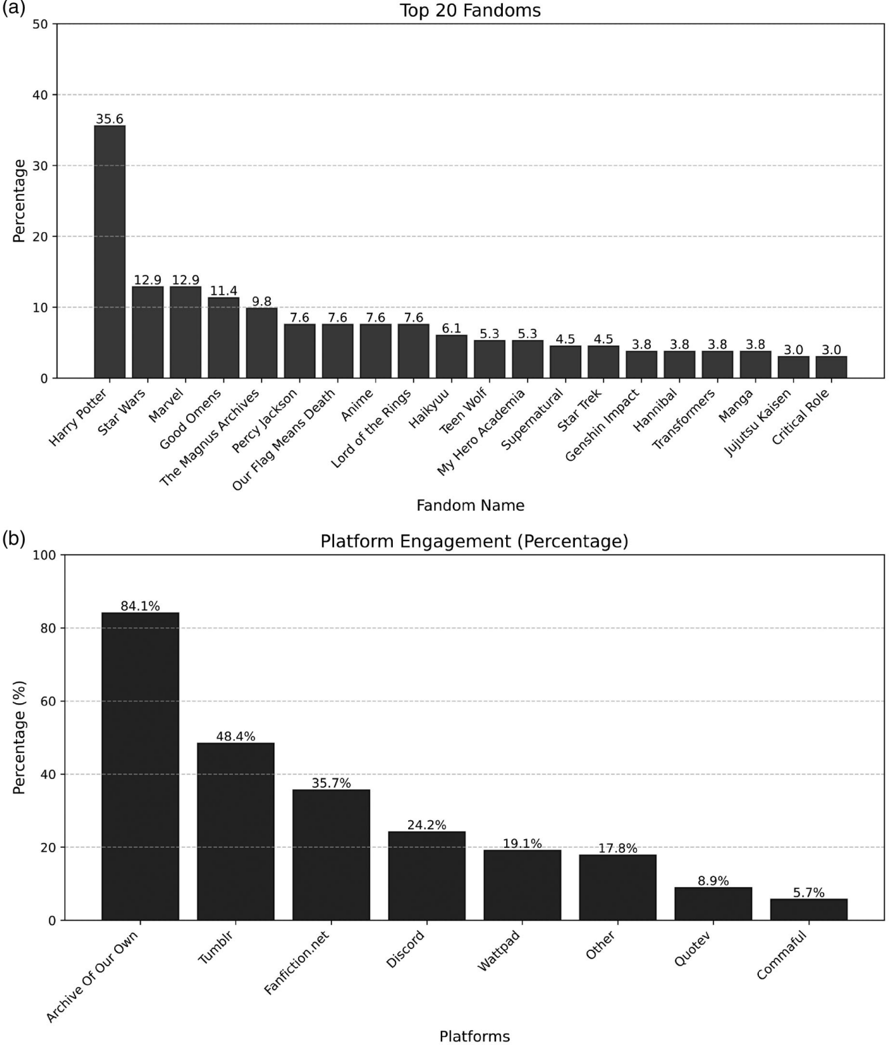
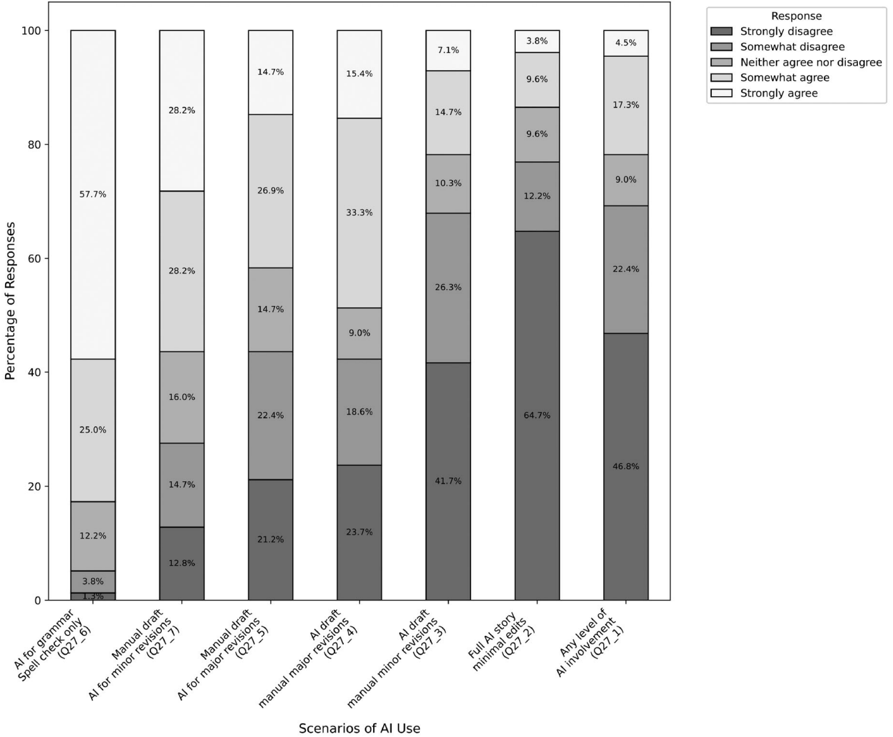
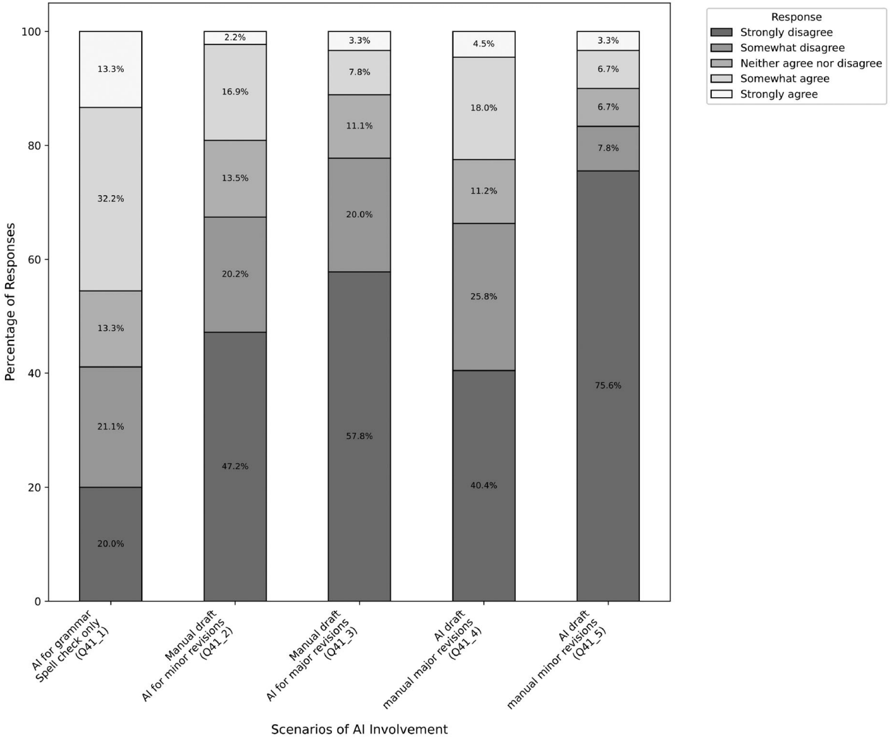
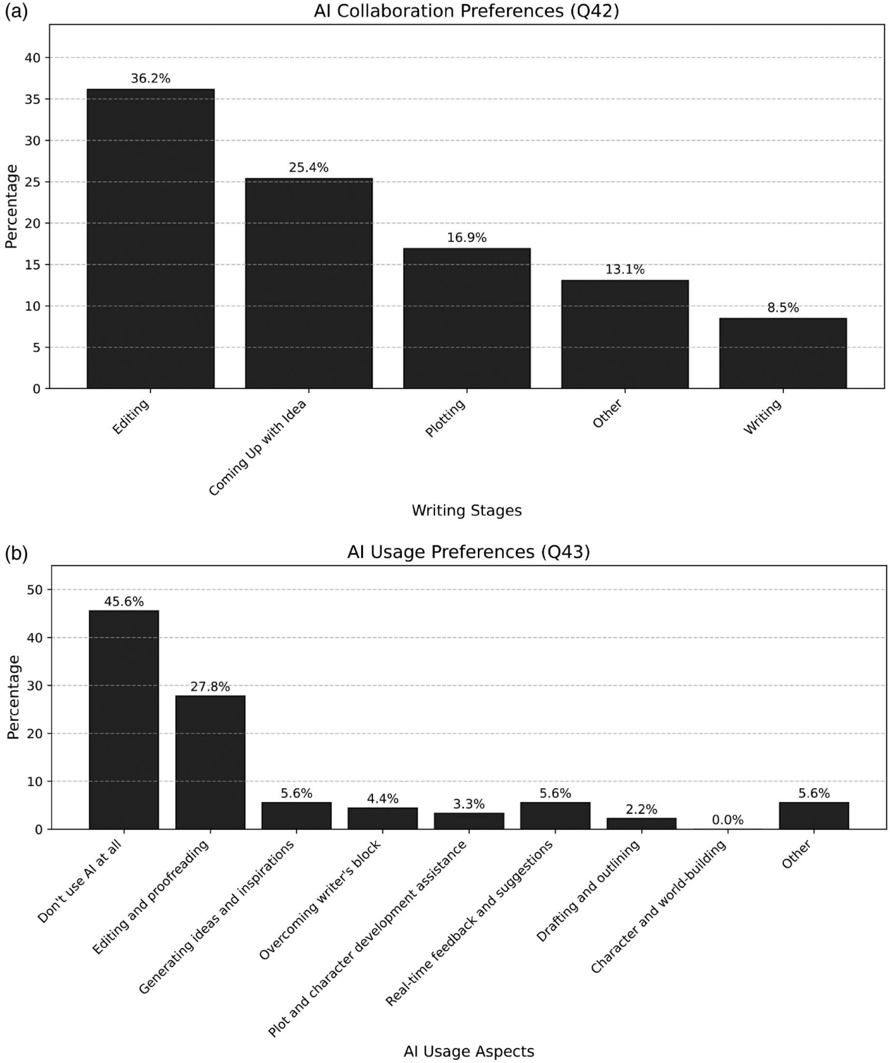


Verification
Claims the paper makes
16 Valid · 3 Not valid · 46 Not checked · 165 Own results and interpretations
Every source the paper cites for this claim was checked and supports it.
In the paper
“online spaces are seeing an increased presence of overt and covert intelligent agents that are altering the communities' culture and dynamics”
§ Community Perspectives on Creativity, Authenticity and Adoption > 1. Introduction
What the sources say
- Supportedcites Tsvetkova et al., 2024 matched to “A new sociology of humans and machines” (2024) source
The Abstract describes bots and algorithms proliferating across communication channels and social interactions. Box 2 describes covert Twitter bots changing discourse, while Box 4 describes evident Reddit bots influencing users’ language and sentiment. Together, these passages support the paraphrase about increasing presence and effects on online communities. (LLM, conf=0.89)
plainstates a cause- Asserted: passes — The authors put it forward as true.
- Checkable: passes — It can be checked against evidence.
- Load-bearing: passes — The paper’s conclusions depend on it.
- Based: passes — The paper gives a reason why it holds.
- Supported
Every source the paper cites for this claim was checked and supports it.
In the paper
“Recent investigations into creative communities have revealed widespread apprehension regarding the unauthorized use of artistic works in AI training (Kyi et al., 2025;Lovato et al., 2024).”
§ Community Perspectives on Creativity, Authenticity and Adoption > 6.2.3. Preserving community values
What the sources say
- Supportedcites Kyi et al., 2025 matched to “Governance of Generative AI in Creative Work: Consent, Credit, Compensation, and Beyond” (2025) source
The Abstract (p. 1) states that since generative AI's emergence, creative workers have spoken up about career-based harms, with 'a common theme in these accounts of harm is that generative AI models are trained on workers' creative output without their consent and without giving credit or compensation'. Our copy's empirical section corroborates this at the level of the sample: 4.2.3 (p. 8) is headed 'Generative AI models being trained on copyrighted content was a common concern', and 5.2 (p. 10) reports creatives 'worries about losing control over their work, such as it being used for training without their knowledge or consent'; 4.1.1 (p. 5) records that almost all participants wanted to be asked for consent. The apprehension is specifically about unauthorised (non-consented) use, which matches the claim; the only narrowing is that this study's sample is 20 creative workers in visual art/design, writing and programming rather than creative communities at large, though the paper itself frames the concern as a common theme across creative workers worldwide (2.3, p. 3). (LLM, conf=0.85)
- Supportedcites Lovato et al., 2024 matched to “Foregrounding Artist Opinions: A Survey Study on Transparency, Ownership, and Fairness in AI Generative Art” (2024) source
Lovato et al. (2024) is a survey of 459 artists (Results, p. null) whose findings the authors summarise as 'a strong sentiment among artists in favor of disclosing what art is being used in AI training ... and expressing concerns regarding AI's impact on the art industry's workforce and who profits from their art', with 80.17% requiring detailed disclosure and 61.87% agreeing AI models threaten art workers (Introduction/Results, p. null). The Abstract frames the grievance precisely as non-consensual use: 'Without explicit consent from artists, Generative AI creators scrape artists' digital work to train Generative AI models', and the Economic Context section states that harm 'can arise from the use of content without explicit consent' and that this concern 'is shared among artists, creative industries, and government agencies alike'. The one qualification worth noting is that the apprehension documented is about undisclosed/for-profit exploitation rather than training use per se ('artists are not wholesale against art being used in AI art models training data'), which still matches 'apprehension regarding the unauthorized use'. Population is US-recruited artists, narrower than 'creative communities' generally, but the claim's breadth is also carried by the co-cited Kyi et al. (LLM, conf=0.85)
plain- Asserted: passes — The authors put it forward as true.
- Checkable: passes — It can be checked against evidence.
- Load-bearing: unclear — It is unclear whether the paper’s conclusions depend on it.
- Based: passes — The paper gives a reason why it holds.
- Supported
Every source the paper cites for this claim was checked and supports it.
In the paper
“As Jo and Gebru (2020) and Lovato et al. (2024) note, questions of agency, visibility, and ownership are not evenly distributed within these sociotechnical systems.”
§ Community Perspectives on Creativity, Authenticity and Adoption > 6.4. Theoretical implications
What the sources say
- Supportedcites Jo and Gebru (2020) matched to “Lessons from archives: strategies for collecting sociocultural data in machine learning” (2020) source
Section 5.2 describes how researcher-defined labels constrain participants’ input, while Section 5.3 explicitly discusses power inequities and unequal data ownership. The Consent and Transparency sections address underrepresentation and what data-collection decisions are made visible. Together, these support the broad paraphrase in the context of ML data collection; page numbers are unavailable in our copy. (LLM, conf=0.88)
- Supportedcites Lovato et al. (2024) matched to “Foregrounding Artist Opinions: A Survey Study on Transparency, Ownership, and Fairness in AI Generative Art” (2024) source
The “Problems in the Pipeline of Generative AI Tools” section describes disparities in who creates, profits from, and uses AI tools, alongside companies’ secrecy about how the tools work. The Results and Discussion sections show that ownership of AI-generated artwork is contested. Together, these passages support the claim about uneven agency, visibility, and ownership in these systems. (LLM, conf=0.88)
plain- Asserted: passes — The authors put it forward as true.
- Checkable: passes — It can be checked against evidence.
- Load-bearing: passes — The paper’s conclusions depend on it.
- Based: passes — The paper gives a reason why it holds.
- Supported
The cited sources support only part of this claim — read each source’s verdict below.
In the paper
“Ilonka Gero et al. (2025) observe that fanfiction authors often experience this form of AI-driven repurposing as misrecognition or disempowerment, particularly when their stylistic voice is mimicked or reassembled without consent or attribution.”
§ Community Perspectives on Creativity, Authenticity and Adoption > 6.4. Theoretical implications
What the sources say
- Partly supportedcites Ilonka Gero et al. (2025) matched to “Creative Writers' Attitudes on Writing as Training Data for Large Language Models” (2025) sourceExperimental — accuracy not yet measured
Section 5.1.2 (page unavailable) reports that a fan-fiction writer found putting deeply personal work into a language model disturbing, and Section 5.2.1 reports writers’ lack of control over such use. The paper also discusses mimicked style and uncredited words as concerns among participants, but it does not establish that fanfiction authors often experience AI mimicry of their own voices as misrecognition or disempowerment. (LLM, conf=0.86)
plainstates a cause- Asserted: passes — The authors put it forward as true.
- Checkable: passes — It can be checked against evidence.
- Load-bearing: passes — The paper’s conclusions depend on it.
- Based: passes — The paper gives a reason why it holds.
- Partly supported
The cited sources support only part of this claim — read each source’s verdict below.
In the paper
“This can be seen through the lenses of forming an identity within the writers' domain, as writers with an established writing identity need to engage more in the sense-making of the change and its impact compared with novices (Schmitt et al., 2024).”
§ Community Perspectives on Creativity, Authenticity and Adoption > 6.3.2. Adoption of GenAI tools
What the sources say
- Partly supportedcites Schmitt et al., 2024 matched to “Generative AI in the Software Engineering Domain: Tensions of Occupational Identity and Patterns of Identity Protection” (2024) sourceExperimental — accuracy not yet measured
The Introduction says software engineers’ sense-making about generative AI differs with domain expertise, and §5.1.1 describes established occupational identity as potentially threatened by new technology. The paper studies software engineers, not writers, and does not establish that experienced workers need to engage in more sense-making than novices. (LLM, conf=0.84)
plainstates an association- Asserted: passes — The authors put it forward as true.
- Checkable: passes — It can be checked against evidence.
- Load-bearing: passes — The paper’s conclusions depend on it.
- Based: passes — The paper gives a reason why it holds.
- Partly supported
112 more claims
Create a free account to see all 230 claims and to verify the 5 references still open.
- Probably not a substantial claim. 81
- It may state two separate claims as one. 62
- The quote only partly states this claim. 3
Self-check
Percentages, sums and reported differences re-computed from the paper’s own numbers.
Rated major: it would touch a result — a value a result rests on, reported and recomputed p-values on opposite sides of the significance level, two passages that conflict with no sign which is right, or a cited work retracted before this paper was published.
In the paper
“When asked about use rather than familiarity, 74.4% (67/90) reported using at least one of the AI tools, and 33% (30/90) reported never using any AI tools.”
§ Community Perspectives on Creativity, Authenticity and Adoption > 4.2.1. Fandoms and platforms
Reported 90 · recomputed 97
Rated minor: it would not touch a result — a value no result rests on, a p-value that stays on the same side of the significance level, or a conflict that is clerical, resolved elsewhere in the paper, or outside its own findings.
In the paper
“14% have secondary education (24/157)”
§ Community Perspectives on Creativity, Authenticity and Adoption > 4.1. Participants demographics
Reported 14 · recomputed 15.286624
Rated minor: it would not touch a result — a value no result rests on, a p-value that stays on the same side of the significance level, or a conflict that is clerical, resolved elsewhere in the paper, or outside its own findings.
In the paper
“40.9% (36/90) of the writers did not find it played any role”
§ Community Perspectives on Creativity, Authenticity and Adoption > 5.1.2. Writers' views on AI use in their creative process
Reported 40.9 · recomputed 40
Rated minor: it would not touch a result — a value no result rests on, a p-value that stays on the same side of the significance level, or a conflict that is clerical, resolved elsewhere in the paper, or outside its own findings.
In the paper
“Education: (Q4) 55.4% (87/157) of the participants have an undergraduate degree, 25.48% (40/157) have a post-graduate degree, 14% have secondary education (24/157), 6 have vocational or technical training (e.g., apprenticeships, trade schools), 2 are undergrad students, and one preferred not to say.”
§ Community Perspectives on Creativity, Authenticity and Adoption > 4.1. Participants demographics
Reported 157 · recomputed 160
Rated minor: it would not touch a result — a value no result rests on, a p-value that stays on the same side of the significance level, or a conflict that is clerical, resolved elsewhere in the paper, or outside its own findings.
In the paper
“64.74%, 101/159”
§ Community Perspectives on Creativity, Authenticity and Adoption > 4.2.3. Engagement motivation
Reported 64.74 · recomputed 63.522013
1 more finding
Create a free account to see every finding of this check.
Citations
Cites
Valente, T. W. (2003) · Genetics in Medicine · doi:10.1097/01.gim.0000061743.67794.c4 · Cited by 13,723
On the Dangers of Stochastic Parrots: Can Language Models Be Too Big? 🦜
Bender, E. M., Gebru, T., McMillan-Major, A., & Shmitchell, S. (2021) · Proceedings of the 2021 ACM Conference on Fairness, Accountability, and Transparency · doi:10.1145/3442188.3445922 · Cited by 6,988
Convergence Culture: Where Old and New Media Collide
Jenkins, H., & Plasencia, A. (2017) · Is the Universe a Hologram? · doi:10.7551/mitpress/9780262036016.003.0012 · Cited by 6,944
Convergence Culture: Where Old and New Media Collide
Carbonell, C. (2007) · The Journal of Popular Culture · doi:10.1111/j.1540-5931.2007.00435.x · Cited by 5,530 · cited 3×
“Still, despite these technical proposals, many creators report feeling side-lined from the decisions that shape how their contributions are used, raising questions about representation, legitimacy, and the governance of creative labor in AI development [56, 62].”
Ray, P. P. (2023) · Internet of Things and Cyber-Physical Systems · doi:10.1016/j.iotcps.2023.04.003 · Cited by 2,463 · cited 1×
“Recent discussions in AI ethics increasingly emphasize that creative output should not be treated as neutral raw material, but rather as the outcome of human labor embedded in cultural, social, and emotional contexts [52].”
Data colonialism: rethinking big data’s relation to the contemporary subject
Couldry, N., & Mejias, U. A. (2019) · Television & New Media · doi:10.1177/1527476418796632 · Cited by 1,617 · cited 2×
“This includes tracing shifts in attitudes toward authorship, originality, and attribution, as well as concerns around consent, transparency, and the legitimacy of AI-assisted contributions.”
(2016) · Open Research Online (The Open University) · Cited by 1,410
Generative artificial intelligence enhances creativity but reduces the diversity of novel content
Doshi, A., & Hauser, O. (2023) · doi:10.2139/ssrn.4535536 · Cited by 1,350 · cited 6×
“To address these challenges, researchers emphasize the need for user-centered design of more effective AI tools for creative writing [59, 104].”
InfluentialThe Costs of Connection: How Data Is Colonizing Human Life and Appropriating It for Capitalism
Couldry, N., & Mejias, U. A. (2020) · doi:10.1515/9781503609754 · Cited by 1,246
Algorithms as culture: Some tactics for the ethnography of algorithmic systems
Seaver, N. (2017) · Big Data & Society · doi:10.1177/2053951717738104 · Cited by 1,010 · cited 1×
“Rather than viewing generative AI as a neutral technological tool, it is more appropriate to conceptualize it as a cultural system embedded with human assumptions, institutional agendas, and structural asymmetries [12, 79].”
AI models collapse when trained on recursively generated data
Shumailov, I., Shumaylov, Z., Zhao, Y., Papernot, N., Anderson, R., & Gal, Y. (2024) · Nature · doi:10.1038/s41586-024-07566-y · Cited by 793 · cited 1×
“Here, we ask both readers and writers, some of whom are already experienced with GenAI tools, about their views on the future of content generation with AI.”
Art and the science of generative AI
Epstein, Z., Hertzmann, A., the Investigators of Human Creativity, Akten, M., Farid, H., Fjeld, J., Frank, M. R., Groh, M., Herman, L., Leach, N., et al. (2023) · Science · doi:10.1126/science.adh4451 · Cited by 788
Enterprising women: television fandom and the creation of popular myth
(1992) · Choice Reviews Online · doi:10.5860/choice.30-1234 · Cited by 659
Studying Reddit: A Systematic Overview of Disciplines, Approaches, Methods, and Ethics
Proferes, N., Jones, N., Gilbert, S., Fiesler, C., & Zimmer, M. (2021) · Social Media + Society · doi:10.1177/20563051211019004 · Cited by 537 · cited 3×
“In platforms like fanfiction forums or Reddit, writing is often part of reciprocal exchange—commenting, mentoring, remixing.”
Proceedings of the 2025 CHI Conference on Human Factors in Computing Systems
(2025) · doi:10.1145/3706598 · Cited by 534
“Participant” Perceptions of Twitter Research Ethics
Fiesler, C., & Proferes, N. (2018) · Social Media + Society · doi:10.1177/2056305118763366 · Cited by 528 · cited 1×
“When data is collected in bulk — often through APIs or web scraping — individuals rarely know that their contributions might become training material [32].”
Participatory culture in a networked era: a conversation on youth, learning, commerce, and politics
(2016) · Choice Reviews Online · doi:10.5860/choice.195881 · Cited by 524 · cited 6×
“Standard notions of consent don’t always apply well in these cases.”
InfluentialHow Is ChatGPT’s Behavior Changing Over Time?
Chen, L., Zaharia, M., & Zou, J. (2024) · Harvard Data Science Review · doi:10.1162/99608f92.5317da47 · Cited by 507
How is ChatGPT's behavior changing over time?
Chen, L., Zaharia, M., & Zou, J. (2023) · arXiv · doi:10.48550/arxiv.2307.09009 · Cited by 507 · cited 1×
“Smith et al. [59] proposed a comprehensive design space framework that categorizes key aspects of intelligent writing assistants, including task , user , technology , interaction , and ecosystem .”
Textual Poachers: Television Fans and Participatory Culture
Jenkins, H. (2012) · Routledge eBooks · doi:10.4324/9780203114339 · Cited by 420
Power to the People? Opportunities and Challenges for Participatory AI
Birhane, A., Isaac, W., Prabhakaran, V., Diaz, M., Elish, M. C., Gabriel, I., & Mohamed, S. (2022) · Equity and Access in Algorithms Mechanisms and Optimization · doi:10.1145/3551624.3555290 · Cited by 330 · cited 2×
“The question of how GenAI is transforming creative communities, and the involved dynamics, is of much interest [9, 58].”
Plan-and-Write: Towards Better Automatic Storytelling
Yao, L., Peng, N., Weischedel, R., Knight, K., Zhao, D., & Yan, R. (2019) · Proceedings of the AAAI Conference on Artificial Intelligence · doi:10.1609/aaai.v33i01.33017378 · Cited by 308
Editorial: Convergence Culture
Jenkins, H., & Deuze, M. (2008) · Convergence: The International Journal of Research into New Media Technologies · doi:10.1177/1354856507084415 · Cited by 273
Co-Writing with Opinionated Language Models Affects Users’ Views
Jakesch, M., Bhat, A., Buschek, D., Zalmanson, L., & Naaman, M. (2023) · Proceedings of the 2023 CHI Conference on Human Factors in Computing Systems · doi:10.1145/3544548.3581196 · Cited by 265 · cited 1×
“Concerns have also been raised about the datasets used to train LLMs, which often include copyrighted material without the consent of the original authors, leading to potential intellectual property challenges [34, 84].”
A Fannish Field of Value: Online Fan Gift Culture
Hellekson, K. (2009) · Cinema Journal · doi:10.1353/cj.0.0140 · Cited by 261 · cited 2×
“Fanfiction communities are characterized by their strong emphasis on originality, community-driven feedback, and the reimagining of existing narratives [43, 105].”
Best humans still outperform artificial intelligence in a creative divergent thinking task
Koivisto, M., & Grassini, S. (2023) · Scientific Reports · doi:10.1038/s41598-023-40858-3 · Cited by 247 · cited 1×
“The use of GenAI has been shown to enhance human creativity [26], and AI co-created storytelling is used in diverse areas such as engaging children with literature and learning, medical training, and career development [25, 30, 65, 88, 106].”
Lessons from archives: strategies for collecting sociocultural data in machine learning
Jo, E. S., & Gebru, T. (2020) · Proceedings of the 2020 Conference on Fairness, Accountability, and Transparency · doi:10.1145/3351095.3372829 · Cited by 240
(2016) · Cited by 211
AI Transparency in the Age of LLMs: A Human-Centered Research Roadmap
Liao, Q. V., & Wortman Vaughan, J. (2024) · Harvard Data Science Review · doi:10.1162/99608f92.8036d03b · Cited by 210
AI Transparency in the Age of LLMs: A Human-Centered Research Roadmap
Liao, Q. V., & Vaughan, J. W. (2023) · arXiv · doi:10.48550/arxiv.2306.01941 · Cited by 209 · cited 1×
“However, when user-generated content is repur-posed as training data for commercial AI models, these participatory dynamics are subverted.”
How to do better with gender on surveys: a guide for HCI researchers
Spiel, K., Haimson, O. L., & Lottridge, D. (2019) · Interactions · doi:10.1145/3338283 · Cited by 207
AI and Its Impact on Creativity and Diversity: An Empirical Study of LLM-Generated Product Ideas
Terwiesch, C., Meincke, L., Girotra, K., Mollick, E. R., Nave, G., & Ulrich, K. T. (2023) · doi:10.2139/ssrn.4526071 · Cited by 174 · cited 2×
“AI tools help in narrative development [84, 91, 99, 104], and tools for character and persona development, like CharacterMeet [73] and Narra-tivePlay [107] have demonstrated that AI can facilitate dynamic character creation and immersive storytelling through interactive, multimodal experiences.”
Are Large Language Models Capable of Generating Human-Level Narratives?
Tian, Y., Huang, T., Liu, M., Jiang, D., Spangher, A., Chen, M., May, J., & Peng, N. (2024) · Conference on Empirical Methods in Natural Language Processing (EMNLP) · doi:10.18653/v1/2024.emnlp-main.978 · Cited by 171
Homosexuality at the Online Hogwarts: Harry Potter Slash Fanfiction
Tosenberger, C. (2008) · Children's literature · doi:10.1353/chl.0.0017 · Cited by 159 · cited 1×
“These platforms have established new norms for the production and consumption of fan works, promoting interaction through reviews and feedback, which are integral to the community’s learning and growth [4, 11, 35, 92].”
Who Gets Credit for AI-Generated Art?
Epstein, Z., Levine, S., Rand, D. G., & Rahwan, I. (2020) · iScience · doi:10.1016/j.isci.2020.101515 · Cited by 157 · cited 1×
“These concerns are amplified by the language used to describe GenAI tools and the language these tools use when interacting with humans, often designed to convey a sense of agency and human-like intent [29].”
An Archive of Their Own: A Case Study of Feminist HCI and Values in Design
Fiesler, C., Morrison, S., & Bruckman, A. S. (2016) · Proceedings of the 2016 CHI Conference on Human Factors in Computing Systems · doi:10.1145/2858036.2858409 · Cited by 153
How Generative AI Can Augment Human Creativity
Eapen, T. T., Finkenstadt, D. J., Folk, J., & Venkataswamy, L. (2024) · doi:10.2139/ssrn.4759930 · Cited by 148
Fic: Why Fanfiction Is Taking Over the World
Jamison, A. E. (2013) · Medical Entomology and Zoology · Cited by 141
A Design Space for Intelligent and Interactive Writing Assistants
Lee, M., Gero, K. I., Chung, J. J. Y., Shum, S. B., Raheja, V., Shen, H., Venugopalan, S., Wambsganss, T., Zhou, D., Alghamdi, E. A., et al. (2024) · Proceedings of the CHI Conference on Human Factors in Computing Systems · doi:10.1145/3613904.3642697 · Cited by 136 · cited 1×
“Most importantly, we explore here the community’s perspective on the future of human-GenAI collaboration.”
Brinkmann, L., Baumann, F., Bonnefon, J.-F., Derex, M., Müller, T. F., Nussberger, A.-M., Czaplicka, A., Acerbi, A., Griffiths, T. L., Henrich, J., et al. (2023) · Nature Human Behaviour · doi:10.1038/s41562-023-01742-2 · Cited by 132 · cited 3×
“Ultimately, such an approach promises a deeper understanding of how generative AI shapes not only creative output but also the ethical, social, and cultural values of participatory storytelling communities.”
Aspects of Data Ethics in a Changing World: Where Are We Now?
Hand, D. J. (2018) · Big Data · doi:10.1089/big.2018.0083 · Cited by 130 · cited 2×
“Some researchers suggest that consent should be reconceptualized as a dynamic and revocable process, mainly when applied to creative labor that wasn’t originally intended for algorithmic consumption [40, 72].”
AI-Augmented Brainwriting: Investigating the use of LLMs in group ideation
Shaer, O., Cooper, A., Mokryn, O., Kun, A. L., & Ben Shoshan, H. (2024) · Proceedings of the CHI Conference on Human Factors in Computing Systems · doi:10.1145/3613904.3642414 · Cited by 130 · cited 6×
“However, to maintain thriving participatory fanfiction communities, it is important that writers continue to share publicly and engage with community members, trusting the platform that their data will not be used to train AI without their consent.”
InfluentialSelf-citationLessons from Archives: Strategies for Collecting Sociocultural Data in Machine Learning
Jo, E. S., & Gebru, T. (2019) · arXiv (Cornell University) · doi:10.48550/arxiv.1912.10389 · Cited by 100
What Is Fanfiction and Why Are People Saying Such Nice Things about It??
Thomas, B. (2011) · Storyworlds: A Journal of Narrative Studies · doi:10.5250/storyworlds.3.2011.0001 · Cited by 99
Zhang, C., Liu, X., Ziska, K., Jeon, S., Yu, C.-L., & Xu, Y. (2024) · Proceedings of the CHI Conference on Human Factors in Computing Systems · doi:10.1145/3613904.3642647 · Cited by 96 · cited 1×
“The use of AI tools and large language models (LLMs) in creative writing and storytelling has been widely studied, exploring both the opportunities and challenges of these technologies in enhancing human creativity [21].”
Playing Fans: Negotiating Fandom and Media in the Digital Age
BOOTH, P. (2015) · doi:10.2307/j.ctt20p58ks · Cited by 93
Wan, Q., Hu, S., Zhang, Y., Wang, P., Wen, B., & Lu, Z. (2024) · Proceedings of the ACM on Human-Computer Interaction · doi:10.1145/3637361 · Cited by 88 · cited 5×
“However, despite these advancements in supporting writers, there are significant challenges and concerns regarding using GenAI in creative writing.”
InfluentialAmateur Creativity: Contemporary Literature and the Digital Publishing Scene
Vadde, A. (2017) · New Literary History · doi:10.1353/nlh.2017.0001 · Cited by 88 · cited 1×
“…could also be applied to other creative communities, which shares values with fanfiction communities [49] such as independent publishing platforms [95], collaborative writing forums, digital art communities, video-based fan and storytelling platforms [24], open-source software development…”
A new sociology of humans and machines
Tsvetkova, M., Yasseri, T., Pescetelli, N., & Werner, T. (2024) · arXiv · doi:10.48550/arxiv.2402.14410 · Cited by 83
Human-Computer Co-Creativity: Blending Human and Computational Creativity
Davis, N. (2013) · Proceedings of the AAAI Conference on Artificial Intelligence and Interactive Digital Entertainment · doi:10.1609/aiide.v9i6.12603 · Cited by 82 · cited 1×
“GenAI has been shown to assist in various creative tasks, such as idea generation and development [38, 80, 98], and writers often see GenAI as a co-creator, using its suggestions to introduce new ideas and narrative twists [37, 103].”
Qin, H. X., Jin, S., Gao, Z., Fan, M., & Hui, P. (2024) · Proceedings of the CHI Conference on Human Factors in Computing Systems · doi:10.1145/3613904.3642105 · Cited by 82 · cited 1×
“However, despite these advancements in supporting writers, there are significant challenges and concerns regarding using GenAI in creative writing.”
Sun, Y., Chen, J., Yao, B., Liu, J., Wang, D., Ma, X., Lu, Y., Xu, Y., & He, L. (2024) · Proceedings of the ACM on Human-Computer Interaction · doi:10.1145/3687035 · Cited by 71
Co-Intelligence: Living and Working with AI
Tan, J. M. (2025) · Anesthesiology · doi:10.1097/aln.0000000000005405 · Cited by 67 · cited 2×
“Designing such a system and introducing practices for fine-grained self-disclosure would both satisfy readers’ desire for transparency and support writers in highlighting their creative contributions, even when assisted by AI.”
Rogue Archives: Digital Cultural Memory and Media Fandom: Book Review
Ono, K. A. (2017) · Journal of Communication · doi:10.1111/jcom.12330 · Cited by 67
Beyond the author: Artificial intelligence, creative writing and intellectual emancipation
Tsao, J., & Nogues, C. (2024) · Poetics · doi:10.1016/j.poetic.2024.101865 · Cited by 67 · cited 2×
“Educators have also noted the potential for GenAI to foster intellectual emancipation, which involves liberating human thought by challenging norms within a knowledge domain [93].”
Using Artificial Intelligence for enhancing Human Creativity
Ali Elfa, M. A., & Dawood, M. E. T. (2023) · Journal of Art, Design and Music · doi:10.55554/2785-9649.1017 · Cited by 61
Barnes, J. L. (2015) · Poetics · doi:10.1016/j.poetic.2014.12.004 · Cited by 59 · cited 1×
“The rise of digital platforms such as FanFiction.net and Archive of Our Own (AO3) has increased the visibility and accessibility of fanfiction communities [51] and their participatory nature, making it easier to both consume (read) and contribute (through writing, editing, commenting) content [51].”
Fan, M., Cui, X., Hao, J., Ye, R., Ma, W., Tong, X., & Li, M. (2024) · CHI Conference Extended Abstracts on Human Factors in Computing Systems (CHI EA) · doi:10.1145/3613905.3651118 · Cited by 56
Automated Assistance for Creative Writing with an RNN Language Model
Roemmele, M., & Gordon, A. S. (2018) · Companion Proceedings of the 23rd International Conference on Intelligent User Interfaces · doi:10.1145/3180308.3180329 · Cited by 55 · cited 1×
“Additionally, the pervasive use of AI risks eroding writers’ creative autonomy and storytelling skills and might lead to an over-dependence on AI-generated outputs [75].”
A Redhead Walks into a Bar: Experiences of Writing Fiction with Artificial Intelligence
Ghajargar, M., Bardzell, J., & Lagerkvist, L. (2022) · Proceedings of the 25th International Academic Mindtrek Conference · doi:10.1145/3569219.3569418 · Cited by 54
Creative Writing with an AI-Powered Writing Assistant: Perspectives from Professional Writers
Ippolito, D., Yuan, A., Coenen, A., & Burnam, S. (2022) · arXiv · doi:10.48550/arxiv.2211.05030 · Cited by 52 · cited 1×
“Smith et al. [59] proposed a comprehensive design space framework that categorizes key aspects of intelligent writing assistants, including task , user , technology , interaction , and ecosystem .”
The Costs of Connection: How Data Are Colonizing Human Life and Appropriating It for Capitalism
Couldry, N., & Mejias, U. A. (2020) · Social Forces · doi:10.1093/sf/soz172 · Cited by 47
Rogue Archives: Digital Cultural Memory and Media Fandom
Baetens, J. D. (2017) · Leonardo · doi:10.1162/leon_r_01502 · Cited by 43 · cited 1×
“Ultimately, such an approach promises a deeper understanding of how generative AI shapes not only creative output but also the ethical, social, and cultural values of participatory storytelling communities.”
Co-intelligence living and working with AI
Mollick, E. (2024) · Cited by 41
Research Handbook on Intellectual Property and Artificial Intelligence
(2022) · Edward Elgar Publishing eBooks · doi:10.4337/9781800881907 · Cited by 39
Understanding Gaming Perceptions and Experiences in a Women's College Community
Shaer, O., Westendorf, L., Knouf, N. A., & Pederson, C. (2017) · CHI Conference on Human Factors in Computing Systems · doi:10.1145/3025453.3025623 · Cited by 37 · cited 1×
“Similarly to the approach described in a study on gaming perceptions [81], we designed our questionnaire to explore demographics, habits, attitudes, and opinions.”
Self-citationThe AI-Copyright Challenge: Tech-Neutrality, Authorship, and the Public Interest
Craig, D. (2021) · Edward Elgar Publishing eBooks · doi:10.4337/9781800881907.00013 · Cited by 35
Lovato, J., Zimmerman, J. W., Smith, I., Dodds, P., & Karson, J. L. (2024) · Proceedings of the AAAI/ACM Conference on AI, Ethics, and Society · doi:10.1609/aies.v7i1.31691 · Cited by 33
Feedback Exchange and Online Affinity: A Case Study of Online Fanfiction Writers
Cheng, R., & Frens, J. (2022) · Proceedings of the ACM on Human-Computer Interaction · doi:10.1145/3555127 · Cited by 32 · cited 2×
“Lastly, the fanfiction community has a well-documented affinity for written engagement and communication, whether through story-telling, reviews, or discussions [16, 46, 90].”
AI Writing Assistants Influence Topic Choice in Self-Presentation
Poddar, R., Sinha, R., Naaman, M., & Jakesch, M. (2023) · Extended Abstracts of the 2023 CHI Conference on Human Factors in Computing Systems · doi:10.1145/3544549.3585893 · Cited by 30 · cited 2×
“It was shown that GenAI support for writers goes beyond improving efficiency to also influencing the direction and diversity of content [45, 70, 80, 99].”
Perceptions of Professionalism and Authenticity in AI-Assisted Writing
Coman, A. W., & Cardon, P. (2026) · Business and Professional Communication Quarterly · doi:10.1177/23294906241233224 · Cited by 29 · cited 2×
“In the absence of such control, many writers have chosen to make their account private [42].”
Governance of Generative AI in Creative Work: Consent, Credit, Compensation, and Beyond
Kyi, L., Mahuli, A., Silberman, M. S., Binns, R., Zhao, J., & Biega, A. J. (2025) · Proceedings of the 2025 CHI Conference on Human Factors in Computing Systems · doi:10.1145/3706598.3713799 · Cited by 28 · cited 2×
“Thereby, encouraging the preservation of core community values such as creativity and appreciation for human labor.”
AI meets comedy: Viewers' reactions to GPT-4 generated humor translation
Abu-Rayyash, H. (2023) · Ampersand · doi:10.1016/j.amper.2023.100162 · Cited by 27 · cited 1×
“They discuss the use of AI to generate new content, for example, the Harry Potter Botfic [57] and AI-generated translations [1], in the context of potential depreciation of the value of fans’ labour within the fandom gift economy [60].”
‘Art happens not in isolation, but in community’: the collective literacies of media fandom
Jenkins, H. (2019) · Cultural Science Journal · doi:10.5334/csci.125 · Cited by 26 · cited 3×
“Standard notions of consent don’t always apply well in these cases.”
Where No One Has Gone Before: A Meta-Dataset of the World's Largest Fanfiction Repository
Yin, K., Aragon, C., Evans, S., & Davis, K. S. (2017) · CHI Conference on Human Factors in Computing Systems · doi:10.1145/3025453.3025720 · Cited by 26
The Neutrality Fallacy: When Algorithmic Fairness Interventions are (Not) Positive Action
Weerts, H., Xenidis, R., Tarissan, F., Olsen, H. P., & Pechenizkiy, M. (2024) · ACM Conference on Fairness, Accountability, and Transparency (FAccT) · doi:10.1145/3630106.3659025 · Cited by 25 · cited 1×
“Still, despite these technical proposals, many creators report feeling side-lined from the decisions that shape how their contributions are used, raising questions about representation, legitimacy, and the governance of creative labor in AI development [56, 62].”
Li, E. C.-Y., & Pang, K.-W. (2024) · European Journal of Cultural Studies · doi:10.1177/13675494241236146 · Cited by 24
Writers in the Secret Garden: Fanfiction, Youth, and New Forms of Mentoring
Aragon, C., & Davis, K. (2019) · doi:10.7551/mitpress/11650.001.0001 · Cited by 23
Domain-based Latent Personal Analysis and its use for impersonation detection in social media
Mokryn, O., & Shoshan, H. B. (2021) · User Modeling and User-Adapted Interaction · doi:10.1007/s11257-021-09295-7 · Cited by 18 · cited 1×
“Real-time creative metrics could also be integrated, offering insights into the uniqueness of a user’s work compared to platform-wide trends [66], thus inspiring users to strive for greater individuality.”
Self-citationDECORAIT - DECentralized Opt-in/out Registry for AI Training
Balan, K., Gilbert, A., Black, A., Jenni, S., Parsons, A., & Collomosse, J. P. (2023) · Conference on Visual Media Production · doi:10.1145/3626495.3626506 · Cited by 18
Creative Writers' Attitudes on Writing as Training Data for Large Language Models
Gero, K. I., Desai, M., Schnitzler, C., Eom, N., Cushman, J., & Glassman, E. L. (2025) · Proceedings of the 2025 CHI Conference on Human Factors in Computing Systems · doi:10.1145/3706598.3713287 · Cited by 16 · cited 10×
“Many creators emphasize that the intended audience of their work is human, not algorithmic, and they reject the notion that their labor can be treated as an undifferentiated input into computational systems [36].”
InfluentialReviews Matter: How Distributed Mentoring Predicts Lexical Diversity on Fanfiction.netPreprint
Frens, J., Davis, R., Lee, J., Zhang, D., & Aragon, C. (2018) · arXiv (Cornell University) · doi:10.48550/arxiv.1809.10268 · Cited by 16 · cited 1×
“Ad-ditionally, these communities have often served as early adopters of emerging technologies, integrating tools that enhance storytelling and participation [11].”
Jenkins, H. (2007) · MédiaMorphoses · doi:10.3406/memor.2007.2274 · Cited by 15
Fans Make Art: Authoring and Creativity in the Production of Fanvideos
Leão, A. L. M. D. S., Moura, B. M., de Santana, I. R. C., Nunes, W. K. D. S., & Henrique, V. D. M. R. (2019) · Revista de Negócios · doi:10.7867/1980-4431.2019v24n4p22-36 · Cited by 14
Donald, W. E., & Straby, R. (2024) · Career Development International · doi:10.1108/cdi-02-2024-0085 · Cited by 13 · cited 1×
“The use of AI tools and large language models (LLMs) in creative writing and storytelling has been widely studied, exploring both the opportunities and challenges of these technologies in enhancing human creativity [21].”
NarrativePlay: An Automated System for Crafting Visual Worlds in Novels for Role-Playing
Zhao, R., Zhang, W., Li, J., Zhu, L., Li, Y., He, Y., & Gui, L. (2024) · Proceedings of the AAAI Conference on Artificial Intelligence · doi:10.1609/aaai.v38i21.30589 · Cited by 13
Kelley, B. (2021) · doi:10.4324/9781003020547 · Cited by 12
Flegel, M., & Roth, J. (2016) · Contemporary Women s Writing · doi:10.1093/cww/vpw010 · Cited by 10 · cited 1×
“Fanfic-tion culture and platforms also have a significant impact on the book market [33, 85].”
The AI-Copyright Challenge: Tech-Neutrality, Authorship, and the Public InterestPreprint
Craig, D. (2021) · SSRN Electronic Journal · doi:10.2139/ssrn.4014811 · Cited by 10 · cited 1×
“Still, despite these technical proposals, many creators report feeling side-lined from the decisions that shape how their contributions are used, raising questions about representation, legitimacy, and the governance of creative labor in AI development [56, 62].”
DECORAIT -- DECentralized Opt-in/out Registry for AI Training
Balan, K., Black, A., Jenni, S., Gilbert, A., Parsons, A., & Collomosse, J. (2023) · arXiv · doi:10.48550/arxiv.2309.14400 · Cited by 10 · cited 2×
“Thereby, encouraging the preservation of core community values such as creativity and appreciation for human labor.”
Big data meets storytelling: using machine learning to predict popular fanfiction
Nguyen, D., Zigmond, S., Glassco, S., Tran, B., & Giabbanelli, P. J. (2024) · Social Network Analysis and Mining · doi:10.1007/s13278-024-01224-x · Cited by 9 · cited 1×
“Our work aims to contribute to the broader body of research on AI’s role in fanfiction communities, as well as the broader body of work on participatory creative communities.”
Are Large Language Models Capable of Generating Human-Level Narratives?
Tian, Y., Huang, T., Liu, M., Jiang, D., Spangher, A., Chen, M., May, J., & Peng, N. (2024) · arXiv · doi:10.48550/arxiv.2407.13248 · Cited by 5
Filing off the Serial Numbers:
Soller, B. (2019) · Amsterdam University Press eBooks · doi:10.2307/j.ctvpbnqd0.5 · Cited by 5
Communities of making: Exploring parallels between fandom and open source
Winter, R., Salter, A., & Stanfill, M. (2021) · First Monday · doi:10.5210/fm.v26i2.10870 · Cited by 3 · cited 2×
“…with the values of creativity, collaboration, appreciation for human labor, and originality that are central to communities of making and arts [70, 102], and promote our understanding of how AI can be harnessed to support or potentially disrupt not only individuals but also collective creative…”
Ai-Assisted Character Design in Medical Storytelling with Stable DiffusionPreprint
Mittenentzwei, S., Garrison, L., Budich, B., et al. (2024) · SSRN Electronic Journal · doi:10.2139/ssrn.4772811 · Cited by 2
Sun, Y., Chen, J., Yao, B., et al. (2024) · arXiv (Cornell University) · doi:10.48550/arxiv.2401.13804 · Cited by 2
3. Filing off the Serial Numbers : Fanfiction and its Adaptation to the Book Market
Soller, B. (2019) · Amsterdam University Press eBooks · doi:10.1515/9789048534012-003 · Cited by 1
Schmitt, A., Gajos, K. Z., & Mokryn, O. (2024) · arXiv · doi:10.48550/arxiv.2410.03571 · Cited by 1
Self-citationGovernance of Generative AI in Creative Work: Consent, Credit, Compensation, and BeyondPreprint
Kyi, L., Mahuli, A., Silberman, M. ‘., et al. (2025) · arXiv (Cornell University) · doi:10.48550/arxiv.2501.11457 · Cited by 1
Research works printed but not linked: 9
- 11. Black, R. W. (2008). Adolescents and online fan fiction (Vol. 23). Peter Lang.
- 24. De Cremer, D., Bianzino, N. M., & Falk, B. (2023). How generative AI could disrupt creative work. Harvard Business Review, 101(2), 102-111. https://hbr.org/2023/04/how-generative-ai-could-disrupt-creative-work Accessed: 2023-08-22.
- 28. Doshi, A. R., & Hauser, O. P. (2024). Generative AI enhances individual creativity but reduces the collective diver- sity of novel content. Science Advances, 10(28), eadn5290. Epub 2024 Jul 12. https://doi.org/10.1126/sciadv. · doi:10.1126/sciadv
- 58. Khan, S. (2024). Brave new words. Penguin Random House.
- 74. Prakash, N. (2024). The empire types back: Colonialism, resistance, and storytelling online [Ph.D. Dissertation]. University of Oxford.
- 80. Rouse, L., & Stanfill, M. (2023). Over à Flow: Fan demographics on archive of our own. Flow Journal. https://www. flowjournal.org/2023/02/fan-demographics-on-ao3/
- 84. Shope, M. (2023). Best practices for disclosure and citation when using artificial intelligence tools. Georgetown Law Journal Online, 112, 1-22. https://ssrn.com/abstract=4338115.
- 101. Yang, D., Zhou, Y., Zhang, Z., Li, T. J.-J., & Ray, L. C. (2022). AI as an active writer: Interaction strategies with generated text in human-AI collaborative fiction writing. In Alison Smith-Renner and Ofra Amir (Eds.), Joint Proceedings of the IUI 2022 Workshops: APEx-UI, HAI-GEN, HEALTHI, HUMANIZE, TExSS, SOCIALIZE co-located with the ACM International Conference on Intelligent User Interfaces (IUI 2022) (CEUR Workshop Proceedings) (Vol. 3124, pp. 56-65). CEUR-WS.org, Virtual Event.
- 110. Osnat Mokryn is with the Department of Information Systems at the University of Haifa, Israel, where she heads the Social, AI, and Networks lab. Her research focuses on cognitive processes in complex sociotechnical systems and learning via surprisability. She is the 2024-2025 chair-elect of the ACM IUI Steering Committee.
Cited by
Mind Your Manners: The Dynamics of Politeness in Human-AI vs. Human-Human Interactions
Lazebnik, T., Zalmanson, L., & Mokryn, O. (2025) · Proceedings of the ACM on Human-Computer Interaction · doi:10.1145/3757631 · Cited by 15
“The socio-demographic questions were designed to capture a wide range of participant characteristics that could influence their interaction with conversational AI tools from previous studies [2, 33, 44, 45, 53, 66].”
Self-citationResponsible and sustainable use of AIGC image tools in art education: an SEM–ANN–fsQCA study
Xia, B., Luo, Y., & Su, Y. (2026) · Education + Training · doi:10.1108/et-05-2026-0609
Cui, J. (2026) · International Journal of Cultural Studies · doi:10.1177/13678779261448882
Metadata
- Authors
- Alfassi, R., Cooper, A., Mitchell, Z., Calabro, M., Shaer, O., & Mokryn, O.
- Affiliations
- University of Haifa (IL)
- Wellesley College (US)
- Corresponding author
- Mokryn, Osnat
- Venue
- International Journal of Human–Computer Interaction
- Publisher
- Informa UK Limited
- Published
- 2025-08-12
- Volume
- 42
- Issue
- 5
- Pages
- 3062-3094
- ISSN
- 1044-7318 (ISSN-L)
- 1532-7590
- OpenAlex
- W4413197805
- Semantic Scholar
- c71471af6806524e978d3b2ca443be7e3bc22d2c
- Cited by
- 4
- References
- 86
- Citations by year
- 2026: 3 · 2025: 1
- FWCI
- 4.12
- Type
- journal article
- Language
- en
- Open access
- hybrid
- doi.org
- Licence
- Locations
- International Journal of Human-Computer Interaction (publishedVersion, cc-by-nc-nd)
- arXiv (Cornell University) (submittedVersion)
- arXiv (Cornell University)
- Topics
- Physical Sciences › Computer Science › Artificial Intelligence › Ethics and Social Impacts of AI
- Social Sciences › Law › Literary and Philosophical Studies
- Social Sciences › Communication › Literature, Culture, and Aesthetics
- Keywords
- fan fiction, generative AI, AI-generated content, creative communities, authenticity, community dynamics, collaborative creativity, transparency, ethical considerations, social connectedness, design interventions, creative platform
About these checks
Registry, retraction, Cites and statistics results are computed, not judged, with one exception: a printed reference that no index lists is read once by a model before it counts as a citation error. Claims are extracted by a model and kept only when their quote appears verbatim in the text; each cited source is then checked, with a model’s help, for whether it says what the claim relies on. Those verdicts can be wrong — read the claim’s quote and the cited source before relying on one.
The claim verdicts this report counts are experimental: their accuracy is not yet measured.
A language model drew the claims from the paper on 2026-10-12, under version 3 of the claim definition (model deepseek-v4.1-flash, prompt extract-v3).
A second model labelled each claim on 2026-10-12 (model jev-1.13-20260917, definition revision gold-guideline-v0.2).
Cited sources are checked with a language model’s help (gpt-6-sol and qwen3.8-omni-flash).
Statistics and arithmetic are recomputed, not judged.
Confidence bands are shown only for fields calibrated on our annotated test set. None is calibrated yet, so no band is shown.
What counts as a claim ›How we measure confidence ›How we check this ›
Are you an author, or do you see a problem with this page? Request a review
Data sources
Bibliographic data: Semantic Scholar, OpenAlex, Crossref.
Contains information from the Semantic Scholar Academic Graph Datasets, made available under the ODC Attribution License (ODC-BY 1.0).
Semantic Scholar’s data is described in: Kinney, R., et al. (2023). The Semantic Scholar Open Data Platform. arXiv:2301.10140.
