

Beyond Screen Time: Identity Development in the Digital Age
Open accessThe DOI matches its Crossref record; 277 of the 285 references it cites were found in a registry or an index.
Abstract
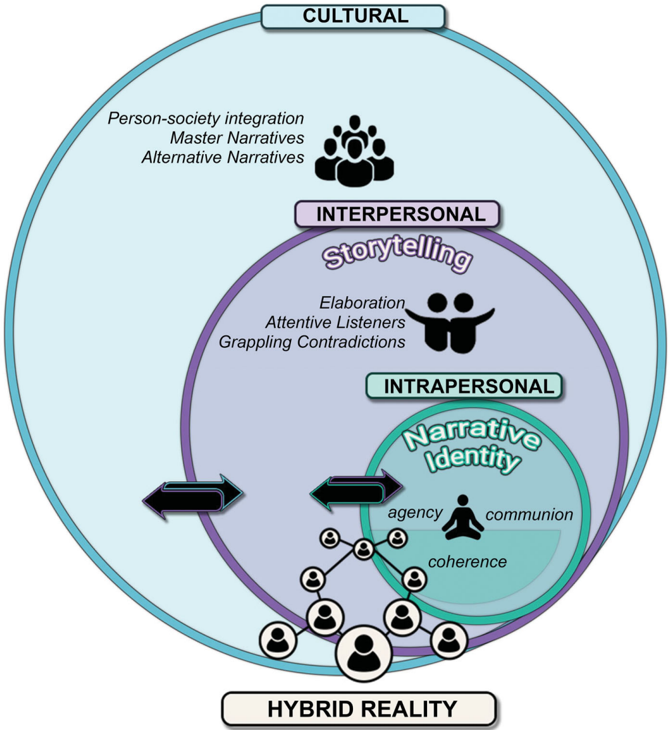
We are in the midst of a global transition in which digital “screens” are no longer simply entertainment devices and distractions; rather, adolescents are currently living in a hybrid reality that links digital spaces to offline contexts. Yet, psychological scientists studying the mental health impact of digital experiences largely focus on correlations with “screen time,” leading to oversimplified and atheoretical conclusions. We propose an alternative, functional approach to studying adolescent mental health in the digital age, one that examines why and how digital media affect adolescent development. Specifically, we suggest that understanding identity development—the core developmental task of adolescence—can help pinpoint the digital experiences that contribute to healthy versus problematic mental health outcomes. We have four objectives: (1) integrate principles from clinical and personality psychology with developmental theory to present a theoretical framework for investigating narrative identity; (2) show how this framework provides a useful lens for evaluating the impact of digital media on adolescents; (3) suggest a set of novel hypotheses that specify what kinds of digital contexts and experiences lead to healthy versus problematic mental health outcomes; and (4) propose a detailed research agenda that tests these hypotheses.
Overview
The claims and statistics of this paper haven’t been checked yet.
Free: it reads the open-access text and checks the first 5 claims that cite a source we can check. Create a free account to check every claim.
Integrity signals
Registry
Cites
Statistics
Figures

Verification
Claims the paper makes
The claims and statistics of this paper haven’t been checked yet.
Free: it reads the open-access text and checks the first 5 claims that cite a source we can check. Create a free account to check every claim.
Claims other papers make about this one
Each is checked against this paper’s own text: does it say what the citing paper says it does?
The source backs part of the claim, not all of it — or backs it for a different population, condition or comparison.
In the citing paper
“However, the permanence of digital platforms can confer benefits as well; reminiscing and nostalgia are encouraged by looking back over photographs, videos, and interactions from the past, and may assist youth in developing their narrative identity (Granic et al., 2020).”
From Technologizing Bronfenbrenner: Neo-ecological Theory. (2023) · cites this paper as Granic et al., 2020
Experimental — accuracy not yet measuredThe cited source says what the claim attributes to it.
In the citing paper
“The asychnronicity of virtual microsystems can create more opportunities for adolescents to engage on their terms (Granic et al., 2020).”
From Technologizing Bronfenbrenner: Neo-ecological Theory. (2023) · cites this paper as Granic et al., 2020
The cited source says what the claim attributes to it.
In the citing paper
“They proposed moving beyond how much time is spent online (i.e., screen time) to look at how and why digital interactions and activities impact identity development.”
From Technologizing Bronfenbrenner: Neo-ecological Theory. (2023) · cites this paper as Granic et al., 2020
The cited source says what the claim attributes to it.
In the citing paper
“Granic et al. proposed that by focusing on identity-formation processes, researchers “…can help pinpoint the digital experiences that will contribute to both healthy normative development as well as the emergence of serious mental health concerns” (p. 196).”
From Technologizing Bronfenbrenner: Neo-ecological Theory. (2023) · cites this paper as Granic et al., 2020
The cited source says what the claim attributes to it.
In the citing paper
“In conjunction with searchability (i.e., the ease with which people can find and verify information online; boyd, 2008; McFarland & Ployhart, 2015) this side of permanence can be detrimental and burdens today’s youth in ways unexperienced by previous generations (Granic et al., 2020).”
From Technologizing Bronfenbrenner: Neo-ecological Theory. (2023) · cites this paper as Granic et al., 2020
6 more claims about this paper
Create a free account to see every claim other papers make about this one.
Self-check
Percentages, sums and reported differences re-computed from the paper’s own numbers.
The self-check needs the paper’s full text.
Citations
Cites
Items 201–277 of 277
Collins, W. A., Laursen, B., Mortensen, N., Luebker, C., & Ferreira, M. (1997) · Journal of Adolescent Research · doi:10.1177/0743554897122003 · Cited by 173
Person–Group Dissimilarity in Involvement in Bullying and Its Relation with Social Status
Sentse, M., Scholte, R., Salmivalli, C., & Voeten, M. (2007) · Journal of Abnormal Child Psychology · doi:10.1007/s10802-007-9150-3 · Cited by 170
Narrative and the politics of meaning
Hammack, P. L. (2011) · Narrative Inquiry · doi:10.1075/ni.21.2.09ham · Cited by 169 · cited 1×
“Individuals who fashion narrative identities with redemption sequences exhibit fewer mental health concerns and higher levels of wellbeing overall (Hammack, 2011; McAdams & McLean, 2013).”
BackgroundHilgard, J., Engelhardt, C. R., & Rouder, J. N. (2017) · Psychological Bulletin · doi:10.1037/bul0000074 · Cited by 162
When the Body Defines the Self: Self-Concept Clarity, Internalization, and Body Image
Vartanian, L. R. (2009) · Journal of Social and Clinical Psychology · doi:10.1521/jscp.2009.28.1.94 · Cited by 158 · cited 1×
“For example, the narrative that stipulates that the value of a woman rests on how thin she is has been studied for long-ranging negative impacts on adolescent girls (e.g. Stice, 1994; Vartanian, 2009; Vartanian & Hopkinson, 2010).”
BackgroundMental Health Support and its Relationship to Linguistic Accommodation in Online Communities
Sharma, E., & De Choudhury, M. (2018) · Proceedings of the 2018 CHI Conference on Human Factors in Computing Systems · doi:10.1145/3173574.3174215 · Cited by 156 · cited 1×
“Then, the contingent peer responses that follow these expressions can be identified and the extent to which these responses either dampen or amplify further contamination expressions can be tested (e.g. De Choudhury & Kiciman, 2017; Sharma & De Choudhury, 2018).”
BackgroundFamily Narrative Interaction and Children's Sense of Self
BOHANEK, J. G., MARIN, K. A., FIVUSH, R., & DUKE, M. P. (2006) · Family Process · doi:10.1111/j.1545-5300.2006.00079.x · Cited by 154
#Proana: Pro-Eating Disorder Socialization on Twitter
Arseniev‐Koehler, A., Lee, H. E., McCormick, T. H., & Moreno, M. A. (2016) · Journal of Adolescent Health · doi:10.1016/j.jadohealth.2016.02.012 · Cited by 151
Peer Relations and Developmental Psychopathology
Prinstein, M. J., & Giletta, M. (2016) · Developmental Psychopathology · doi:10.1002/9781119125556.devpsy112 · Cited by 150 · cited 2×
“…goals during mid-adolescence: autonomy from parents (e.g. Collins, Laursen, Mortensen, Luebker, & Ferreira, 1997; Erikson, 1968), acceptance and admiration by peers (e.g. Brown & Larson, 2009; Prinstein & Giletta, 2016), and the construction of a coherent identity (Erikson, 1950, 1968).”
BackgroundNeurosis and Treatment: A Holistic Theory
Schwab, J. J. (1966) · Psychosomatics · doi:10.1016/s0033-3182(66)72151-3 · Cited by 148
Personality and the coherence of psychotherapy narratives
Adler, J. M., Wagner, J. W., & McAdams, D. P. (2007) · Journal of Research in Personality · doi:10.1016/j.jrp.2007.02.006 · Cited by 142
Bell, V. (2007) · Journal of Mental Health · doi:10.1080/09638230701482378 · Cited by 141 · cited 2×
“…are unmoderated, there is a risk of iatrogenic effects, for example when young people with eating disorders convene for “support” but end up amplifying problem behavior (Arseniev-Koehler, Lee, McCormick, & Moreno, 2016; Bell, 2007; Juarascio et al., 2010; Levine & Chapman, 2011; Yeshua-Katz, 2015).”
BackgroundNelson, K. L., & Fıvush, R. (2019) · Psychological Reports · doi:10.1177/0033294119852574 · Cited by 141
Longitudinal associations between changes in screen-time and mental health outcomes in adolescents
Babic, M. J., Smith, J. J., Morgan, P. J., Eather, N., Plotnikoff, R. C., & Lubans, D. R. (2017) · Mental Health and Physical Activity · doi:10.1016/j.mhpa.2017.04.001 · Cited by 137 · cited 1×
“In addition, some longitudinal work shows negative effects of screen time on mental health outcomes over time (Babic et al., 2017; Boers, Afzali, Newton, & Conrod, 2019; Booker, Kelly, & Sacker, 2018; Kim, 2017; Prescott et al., 2018; Riehm et al., 2019; Viner et al., 2019), whereas other studies…”
BackgroundMore than just ‘XP’: learning social skills in massively multiplayer online games
Ducheneaut, N., & Moore, R. J. (2005) · Interactive Technology and Smart Education · doi:10.1108/17415650580000035 · Cited by 135 · cited 2×
“…them with emotionally powerful opportunities to grapple with identity-relevant paradoxes that often reflect back on offline identity preferences and concerns (e.g. Bessi ere, Seay, & Kiesler, 2007; Ducheneaut & Moore, 2005; Granic & Lamey, 2000; Squire, 2006; Turkle, 1995; Williams et al., 2006).”
BackgroundChanges in PTSD patients' narratives during prolonged exposure therapy: A replication and extension
van Minnen, A., Wessel, I., Dijkstra, T., & Roelofs, K. (2002) · Journal of Traumatic Stress · doi:10.1023/a:1015263513654 · Cited by 132
Developmental perspectives on autobiographical recall.
Fıvush, R. (1993) · Cited by 130
Adolescent turning points: The association between meaning-making and psychological well-being.
Tavernier, R., & Willoughby, T. (2012) · Developmental Psychology · doi:10.1037/a0026326 · Cited by 128 · cited 1×
“Setbacks are reappraised as challenges that were personally overcome such that the initial “negative” event is transformed by an overall “better” outcome (e.g. King & Hicks, 2007; Lilgendahl & McAdams, 2011; Tavernier & Willoughby, 2012).”
BackgroundAggressive Video Games are Not a Risk Factor for Future Aggression in Youth: A Longitudinal Study
Ferguson, C. J., & Wang, J. (2019) · Journal of Youth and Adolescence · doi:10.1007/s10964-019-01069-0 · Cited by 125 · cited 3×
“…very small relations between mental health and screen use and that these effects are often bidirectional (Berryman et al., 2018; Elhai et al., 2018; Ferguson & Wang, 2019; Heffer et al., 2019; Hilgard, Engelhardt, & Rouder, 2017; Jensen et al., 2019; Markey & Ferguson, 2017; Orben & Przybylski,…”
BackgroundPro-Eating Disorder Communities on Social Networking Sites: A Content Analysis
Juarascio, A. S., Shoaib, A., & Timko, C. A. (2010) · Eating Disorders · doi:10.1080/10640266.2010.511918 · Cited by 119 · cited 2×
“…are unmoderated, there is a risk of iatrogenic effects, for example when young people with eating disorders convene for “support” but end up amplifying problem behavior (Arseniev-Koehler, Lee, McCormick, & Moreno, 2016; Bell, 2007; Juarascio et al., 2010; Levine & Chapman, 2011; Yeshua-Katz, 2015).”
BackgroundNewcombe, R., & Reese, E. (2004) · International Journal of Behavioral Development · doi:10.1080/01650250344000460 · Cited by 119 · cited 2×
“Stories of the self are seeded in parent-child conversations and they develop and become more sophisticated as parents prompt children for elaboration in characteristic ways (e.g. Fivush, 1991, 1993; Fivush, Haden, & Reese, 2006; McCabe & Peterson, 1991a; Newcombe & Reese, 2004).”
BackgroundKim, H. H.-S. (2017) · International Journal of Adolescence and Youth · doi:10.1080/02673843.2016.1197135 · Cited by 118 · cited 1×
“In addition, some longitudinal work shows negative effects of screen time on mental health outcomes over time (Babic et al., 2017; Boers, Afzali, Newton, & Conrod, 2019; Booker, Kelly, & Sacker, 2018; Kim, 2017; Prescott et al., 2018; Riehm et al., 2019; Viner et al., 2019), whereas other studies show little or no eff…”
BackgroundModeling and Understanding Visual Attributes of Mental Health Disclosures in Social Media
Manikonda, L., & De Choudhury, M. (2017) · Proceedings of the 2017 CHI Conference on Human Factors in Computing Systems · doi:10.1145/3025453.3025932 · Cited by 116 · cited 1×
“Facebook, Instagram, and Twitter can also host meaningful discourses around career or education choices, political views, gender identity concerns, and mental health advice (e.g. Manikonda & De Choudhury, 2017).”
BackgroundAllen, N. B., Nelson, B. W., Brent, D., & Auerbach, R. P. (2019) · Journal of Affective Disorders · doi:10.1016/j.jad.2019.03.044 · Cited by 115
King, L. A., & Smith, N. G. (2004) · Journal of Personality · doi:10.1111/j.0022-3506.2004.00287.x · Cited by 113 · cited 1×
“…coming-out experiences for gay and lesbian youth, psychotherapy), strong agentic themes expressed in personal narratives predict a range of positive mental health outcomes (e.g. Adler, 2012; Adler & McAdams, 2007; Adler, Skalina, & McAdams, 2008; Bauer & McAdams, 2004; King & Smith, 2004).”
BackgroundConstructing Identity Online: Identity Exploration and Self-Presentation
Subrahmanyam, K., & Šmahel, D. (2010) · Advancing responsible adolescent development · doi:10.1007/978-1-4419-6278-2_4 · Cited by 110
Social networking, age and privacy
Livingstone, S., Ólafsson, K., & Staksrud, E. (2011) · London School of Economics and Political Science Research Online (London School of Economics and Political Science) · Cited by 106
Agentic and Communal Social Motives
Locke, K. D. (2015) · Social and Personality Psychology Compass · doi:10.1111/spc3.12201 · Cited by 102 · cited 2×
“…essential challenge of adolescent identity development is to balance the two needs, that is, to pursue what one finds personally meaningful and to also feel accepted and supported by peers and society more broadly (Adams & Marshall, 1996; Erikson, 1950, 1968; Bosma & Kunnen, 2001; Locke, 2015).”
BackgroundBeyers, W., & Luyckx, K. (2016) · Journal of Adolescence · doi:10.1016/j.adolescence.2015.10.018 · Cited by 100 · cited 1×
“Indeed, such abundance of choices may lead to paralysis or ruminative exploration (Beyers & Luyckx, 2016; Schwartz, 2000).”
BackgroundPyrooz, D. C., Lafree, G. D., Decker, S. H., & James, P. A. (2017) · Justice Quarterly · doi:10.1080/07418825.2017.1311357 · Cited by 100
Twomey, C., & O'Reilly, G. (2017) · Cyberpsychology, Behavior, and Social Networking · doi:10.1089/cyber.2017.0247 · Cited by 96
Finding Common Ground in Meta-Analysis “Wars” on Violent Video Games
Mathur, M. B., & VanderWeele, T. J. (2019) · Perspectives on Psychological Science · doi:10.1177/1745691619850104 · Cited by 95 · cited 2×
“…different types of screen time (e.g. social media, video games) and negative mental health outcomes (Kelly, Zilanawala, Booker, & Sacker, 2018; Mathur & VanderWeele, 2019; Twenge & Campbell, 2019; Twenge, Joiner, Rogers, & Martin, 2018; Twenge, Martin, & Campbell, 2018), whereas others find…”
Peer selection and influence effects on adolescent alcohol use: a stochastic actor-based model
Mundt, M. P., Mercken, L. A. G., & Zakletskaia, L. I. (2012) · BMC Pediatrics · doi:10.1186/1471-2431-12-115 · Cited by 94
Formative Experiences: The Interaction of Caregiving, Culture, and Developmental Psychobiology
(2010) · Cambridge University Press eBooks · doi:10.1017/cbo9780511711879 · Cited by 89
Do good stories produce good health?: Exploring words, language, and culture
Ramírez-Esparza, N., & Pennebaker, J. W. (2006) · Narrative Inquiry · doi:10.1075/ni.16.1.26ram · Cited by 87
Alizadeh, M., Weber, I. G., Cioffi‐Revilla, C. A., Fortunato, S., & Macy, M. W. (2019) · EPJ Data Science · doi:10.1140/epjds/s13688-019-0193-9 · Cited by 87
Social Sensing for Psychology: Automated Interpersonal Behavior Assessment
Schmid Mast, M., Gatica-Perez, D., Frauendorfer, D., Nguyen, L., & Choudhury, T. (2015) · Current Directions in Psychological Science · doi:10.1177/0963721414560811 · Cited by 85
The Effortless Assessment of Risk States (EARS) Tool: An Interpersonal Approach to Mobile Sensing
Lind, M. N., Byrne, M. L., Wicks, G., Smidt, A. M., & Allen, N. B. (2018) · JMIR Mental Health · doi:10.2196/10334 · Cited by 84 · cited 1×
“…to either (a) go about their daily activities—digitally and offline—while passive data on their mobile devices is collected (e.g. with the EARS tool: Lind et al., 2018) or (b) do the same with the addition of being prompted—at the end of their day, in journal format—to reflect on the values and…”
MethodPasupathi, M., & Hoyt, T. (2010) · Memory · doi:10.1080/09658210902992917 · Cited by 80 · cited 2×
“…that peer listeners are responsive; that is, peers who listen without distraction and are receptive to the details of the narrative identity being shared must also feedback their responses and interpretations in a way that can be easily perceived and integrated (e.g. Pasupathi & Hoyt, 2010).”
BackgroundIdentity formation in suicidal and nonsuicidal youth: The role of self-continuity
Ball, L., & Chandler, M. (1989) · Development and Psychopathology · doi:10.1017/s0954579400000444 · Cited by 74 · cited 2×
“…are uniquely characterized by their inability to tell a causally coherent life narrative and to temporally link a future self with past and present versions of the self (Ball & Chandler, 1989; Boyes & Chandler, 1992; Chandler, 1994a, 1994b; Chandler & Lalonde, 1994; Noam et al., 1995).”
BackgroundA Framework and Taxonomy of Videogame Playing Preferences
Tondello, G. F., Wehbe, R. R., Orji, R., Ribeiro, G., & Nacke, L. E. (2017) · Proceedings of the Annual Symposium on Computer-Human Interaction in Play · doi:10.1145/3116595.3116629 · Cited by 71
Moral Combat: Why the War on Violent Video Games Is Wrong
Bowman, N. D. (2017) · American journal of play · Cited by 69
Self-continuity in suicidal and nonsuicidal adolescents
Chandler, M. (1994) · New Directions for Child and Adolescent Development · doi:10.1002/cd.23219946406 · Cited by 60 · cited 3×
“…are uniquely characterized by their inability to tell a causally coherent life narrative and to temporally link a future self with past and present versions of the self (Ball & Chandler, 1989; Boyes & Chandler, 1992; Chandler, 1994a, 1994b; Chandler & Lalonde, 1994; Noam et al., 1995).”
BackgroundSocial connectedness, conformity, and internalization of societal standards of attractiveness
Vartanian, L. R., & Hopkinson, M. M. (2009) · Body Image · doi:10.1016/j.bodyim.2009.10.001 · Cited by 56 · cited 1×
“For example, the narrative that stipulates that the value of a woman rests on how thin she is has been studied for long-ranging negative impacts on adolescent girls (e.g. Stice, 1994; Vartanian, 2009; Vartanian & Hopkinson, 2010).”
BackgroundMcInroy, L. B. (2019) · Information Communication & Society · doi:10.1080/1369118x.2019.1623902 · Cited by 54
The self-organization of the Internet and changing modes of thought
Granic, I., & Lamey, A. V. (2000) · New Ideas in Psychology · doi:10.1016/s0732-118x(99)00039-2 · Cited by 54 · cited 2×
“…them with emotionally powerful opportunities to grapple with identity-relevant paradoxes that often reflect back on offline identity preferences and concerns (e.g. Bessi ere, Seay, & Kiesler, 2007; Ducheneaut & Moore, 2005; Granic & Lamey, 2000; Squire, 2006; Turkle, 1995; Williams et al., 2006).”
BackgroundSelf-citationVisser, M., Antheunis, M. L., & Schouten, A. P. (2013) · Journal of Applied Social Psychology · doi:10.1111/jasp.12144 · Cited by 52
Storied Lives on Instagram: Factors Associated With the Need for Personal-Visual Identity
O’Donnell, N. H. (2018) · Visual Communication Quarterly · doi:10.1080/15551393.2018.1490186 · Cited by 50 · cited 1×
“For example, Instagram recently deployed a new feature, in part to address feelings of wariness and anxiety that users had with the lack of control and the enforced permanence of their posts (Johnston, 2016; O’Donnell, 2018; Wagner, 2018).”
BackgroundThe narrative reconstruction of psychotherapy
Adler, J. M., & McAdams, D. P. (2007) · Narrative Inquiry · doi:10.1075/ni.17.2.03adl · Cited by 44
Online Stigma Resistance in the Pro-Ana Community
Yeshua-Katz, D. (2015) · Qualitative Health Research · doi:10.1177/1049732315570123 · Cited by 44 · cited 1×
“It is also important to note that because these forums are unmoderated, there is a risk of iatrogenic effects, for example when young people with eating disorders convene for “support” but end up amplifying problem behavior (Arseniev-Koehler, Lee, McCormick, & Moreno, 2016; Bell, 2007; Juarascio et al., 2010; Levine &…”
BackgroundYouth’s social network structures and peer influences: study protocol MyMovez project – Phase I
Bevelander, K. E., Smit, C. R., van Woudenberg, T. J., Buijs, L., Burk, W. J., & Buijzen, M. (2018) · BMC Public Health · doi:10.1186/s12889-018-5353-5 · Cited by 44 · cited 1×
“These studies could be set up to track decreases in contamination themes (and associated words) and increases in redemptive themes, based on contingent feedback provided by the trained peer coaches (e.g. Bevelander et al., 2018; van Woudenberg et al., 2019).”
BackgroundA Stimulated Recall Method for the Improved Assessment of Quantity and Quality of Social Media Use
Griffioen, N., van Rooij, M. M. J. W., Lichtwarck‐Aschoff, A., & Granic, I. (2020) · Journal of Medical Internet Research · doi:10.2196/15529 · Cited by 41 · cited 1×
“They also help us move beyond experiments that focus on only one digital application at a time, which is the current standard protocol in social media research (Ellis, 2019; Ellis et al., 2019; Griffioen, van Rooij, Lichtwarck-Aschoff, & Granic, 2020; Sewall, Rosen, & Bear, 2019).”
BackgroundSelf-citationvan Woudenberg, T. J., Simoski, B., Araújo, E. F. D. M., Bevelander, K. E., Burk, W. J., Smit, C. R., Buijs, L., Klein, M. C. A., & Buijzen, M. (2019) · Journal of Medical Internet Research · doi:10.2196/12914 · Cited by 39 · cited 1×
“These studies could be set up to track decreases in contamination themes (and associated words) and increases in redemptive themes, based on contingent feedback provided by the trained peer coaches (e.g. Bevelander et al., 2018; van Woudenberg et al., 2019).”
BackgroundSocial Network Sites and Young Adolescent Identity Development
Reid, G. G., & Boyer, W. A. R. (2013) · Childhood Education · doi:10.1080/00094056.2013.815554 · Cited by 36 · cited 1×
“Despite some design constraints, many young users are finding their most thoughtful conversations and meaningful identity explorations in these social media contexts (Reid & Boyer, 2013; Valkenburg & Peter, 2008).”
BackgroundOphir, Y., Lipshits-Braziler, Y., & Rosenberg, H. (2020) · Clinical Psychological Science · doi:10.1177/2167702619849412 · Cited by 35
Whitlock, J., & Masur, P. K. (2019) · JAMA Pediatrics · doi:10.1001/jamapediatrics.2019.3191 · Cited by 35 · cited 1×
“…of recently published reviews and meta-analyses (e.g. Dickson et al., 2019; Elhai, Dvorak, Levine, & Hall, 2017; Hilgard, Engelhardt, & Rouder, 2017; Marchant et al., 2017; Marino, Gini, Vieno, & Spada, 2018; Mathur & VanderWeele, 2019; Prescott, Sargent, & Hull, 2018; Whitlock & Masur, 2019).”
A Survey of Dynamic Systems Methods for Developmental Psychopathology
Granic, I., Hollenstein, T., & Lichtwarck‐Aschoff, A. (2016) · Wiley eBooks · doi:10.1002/9781119125556.devpsy116 · Cited by 32
Self-citationSocial Network Analysis and Gangs
Sierra‐Arévalo, M., & Papachristos, A. V. (2015) · Wiley eBooks · doi:10.1002/9781118726822.ch9 · Cited by 32 · cited 1×
“Yet the antifa movement has become increasingly tinged with violent digital activism (Alizadeh, Weber, Cioffi-Revilla, Fortunato, & Macy, 2019), contributing to social conflicts and negative personal consequences (Pyrooz, LaFree, Decker, & James, 2018; Sierra-Arevalo & Papachristos, 2015).”
BackgroundAutobiographical Memory in Emerging Adulthood: Relationship with Self-Concept Clarity
Fuentes, A., & Desrocher, M. E. (2011) · Journal of Adult Development · doi:10.1007/s10804-011-9131-1 · Cited by 28
Noam, G. G., Chandler, M. J., & Lalonde, C. E. (1995) · Cited by 28
The Digital Development of LGBTQ Youth: Identity, Sexuality, and Intimacy
Hatchel, T. J., Subrahmanyam, K., & Birkett, M. A. (2016) · Advances in human and social aspects of technology book series · doi:10.4018/978-1-5225-1856-3.ch005 · Cited by 26 · cited 1×
“The earlier example of LGBTQþ youth is relevant in this context (McInroy, 2019; Fox & Ralston, 2016; Hatchel et al., 2017; Ybarra et al., 2015).”
BackgroundAgentic and Communal Social Motives: Agentic and Communal Social Motives
Locke, K. D. (2015) · Social and Personality Psychology Compass · Cited by 24
Bullying as a Means to Foster Compliance
Juvonen, J., & Galván, A. (2009) · Cited by 24
Peter, J., & Valkenburg, P. M. (2012) · The International Encyclopedia of Media Studies · doi:10.1002/9781444361506.wbiems136 · Cited by 23
Lysaker, P. H., & Lysaker, J. T. (2017) · Philosophy, psychiatry & psychology · doi:10.1353/ppp.2017.0021 · Cited by 23
Social competence of digital natives: Impact of Social Networking Sites (SNS) use
Vodanovich, S., Sundaram, D., & Shen, K. N. (2015) · Research Online (University of Wollongong) · Cited by 17
The International encyclopedia of Media Studies
Coté, M. (2013) · Cited by 15
Children, Youth, and Suicide: Developmental Perspectives.
Gullickson, T. (1995) · Contemporary Psychology · doi:10.1037/003770 · Cited by 14
Moral Combat: Why the War on Violent Video Games Is Wrong
Ferguson, C. J., & Markey, P. M. (2017) · Cited by 14
Ferguson, C. J. (2019) · Psychiatric Quarterly · doi:10.1007/s11126-019-09669-6 · Cited by 14 · cited 2×
“, 2019), whereas other studies show little or no effect (Coyne, Rogers, Zurcher, Stockdale, & Booth, 2020; Ferguson, 2019; Ferguson & Wang, 2019; Heffer et al., 2019; Hilgard, Engelhardt, & Rouder, 2017; Jensen, George, Russell, & Odgers, 2019; Orben, Dienlin, & Przybylski, 2019; Rozgonjuk, Levine, Hall, & Elhai et al…”
Drummond, A., & Sauer, J. D. (2019) · PsyArXiv (OSF Preprints) · doi:10.31234/osf.io/xms5u · Cited by 11 · cited 3×
“…measures that go beyond self-reports, and methodologically and statistically rigorous analytic plans that include appropriate control variables (Drummond & Sauer, 2019; Ferguson & Wang, 2019; Heffer et al., 2019; KardefeltWinther, 2017; Orben & Pzrybylski, 2019a, 2019b; Sewall, Rosen, & Bear,…”
Background(2003) · Monographs of the Society for Research in Child Development · doi:10.1111/j.1540-5834.2003.00246.x · Cited by 9
Peer Coercion and Electronic Messaging
Ehrenreich, S. E., & Underwood, M. K. (2015) · Oxford University Press eBooks · doi:10.1093/oxfordhb/9780199324552.013.12 · Cited by 6 · cited 2×
“This kind of safety, autonomy, and anonymity is uniquely attractive, and can be beneficial, compared with the loaded social environments of everyday life—the classroom, living room, dinner table, and school yard (Ehrenreich & Underwood, 2016).”
BackgroundSewall, C., Rosen, D., & Bear, T. (2019) · doi:10.31234/osf.io/3sju4 · Cited by 5
Harley, D., Morgan, J., & Frith, H. (2018) · Palgrave Macmillan UK eBooks · doi:10.1057/978-1-137-59200-2_4 · Cited by 4
Research works printed but not linked: 23
- 10.1016/j.copsyc.2015.10.0006 · doi:10.1016/j.copsyc.2015.10.0006
- 10.1002/1cp.1612 · doi:10.1002/1cp.1612
- Chandler M. J., 1994, Rochester symposium on developmental psychopathology: Disorders and dysfunctions of the self, 371
- Chandler M. J., 1994, The development of theories of mind and the construction of cognitive abilities
- Dickson K., 2019, Screen-based activities and children and young people’s mental health and psychosocial wellbeing: A systematic map of reviews
- Ehrenreich S. E., 2016, The Oxford handbook of coercive relationship dynamics, 140
- Eichhorn K., 2019, The end of forgetting: Growing up with social media, 10.4159/9780674239333 · DOI · Paper page
- Fivush R., 1991, Merrill-Palmer Quarterly, 37, 59
- 10.1007/BF02102894 · doi:10.1007/bf02102894 · Paper page
- Harris Interactive. (2015, June). Pearson student mobile device survey 2015 . Retrieved from https://www.pearsoned.com/wp-content/uploads/2015-Pearson-Student-Mobile-Device-Survey-Grades-4-12.pdf
- Infinite Fall, 2017, Night in the woods
- Kardefelt-Winther D., 2017, How does the time children spend using digital technology impact their mental well-being, social relationships and physical activity?: An evidence-focused literature review
- McCabe A., 1991, Developing narrative structure, 217
- McGonigal J., 2015, Superbetter. A revolutionary approach to getting stronger, happier, braver and more resilient
- Noam G., 1995, Developmental psychopathology: Volume 1, 424
- Pennebaker J.W., 2015, The development and psychometric properties of LIWC2015
- Popcannibal, 2019, Kind words
- Rideout V., 2017, The Common Sense census: Media use by kids age zero to eight
- 10.1037/110003-066X.55.1.68 · doi:10.1037/110003-066x.55.1.68
- 10.1016/S2352(18)30022-1. · doi:10.1016/s2352(18)30022-1
- Thatgamecompany., 2012, Journey
- Thorne A., 2003, Connecting culture and memory: The development of an autobiographical self, 169
- 10.1089/cyber.2017.0247/ · doi:10.1089/cyber.2017.0247/
Cited by
Choukas-Bradley, S., Roberts, S. R., Maheux, A. J., & Nesi, J. (2021) · doi:10.31234/osf.io/ju92a · Cited by 331
Choukas-Bradley, S., Roberts, S. R., Maheux, A. J., & Nesi, J. (2022) · Clinical Child and Family Psychology Review · doi:10.1007/s10567-022-00404-5 · Cited by 333
Technologizing Bronfenbrenner: Neo-ecological Theory.
Navarro, J. L., & Tudge, J. R. H. (2023) · Current Psychology · doi:10.1007/s12144-022-02738-3 · Cited by 325
“The feature of publicness is particularly relevant to scholars examining civic engagement among youth (Granic et al., 2020).”
BackgroundInfluentialThe associations between screen time and mental health in adolescents: a systematic review
Santos, R. M. S., Mendes, C. G., Sen Bressani, G. Y., de Alcantara Ventura, S., de Almeida Nogueira, Y. J., de Miranda, D. M., & Romano-Silva, M. A. (2023) · BMC Psychology · doi:10.1186/s40359-023-01166-7 · Cited by 311
“Considering screen time simply by counting frequency and duration may limit understanding of an adolescent’s relationship with the smartphone and the consequences on mental well-being [89].”
BackgroundMechanisms linking social media use to adolescent mental health vulnerability
Orben, A., Meier, A., Dalgleish, T., & Blakemore, S.-J. (2024) · Nature Reviews Psychology · doi:10.1038/s44159-024-00307-y · Cited by 220
“This flexibility and alignment with psychological theory has contributed to the increasing popularity of the affordance approach 35,73,74,85,87 and previous reviews have explored relevant social media affordances in the context of interpersonal communication among adults and adolescents 35,88,89 ,…”
Metadata
- Authors
- Granic, I., Morita, H., & Scholten, H.
- Affiliations
- Radboud University Nijmegen (NL)
- Corresponding author
- Granic, Isabela
- Venue
- Psychological Inquiry
- Publisher
- Informa UK Limited
- Published
- 2020-07-02
- Volume
- 31
- Issue
- 3
- Pages
- 195-223
- ISSN
- 1047-840X (ISSN-L)
- 1532-7965
- OpenAlex
- W3097014664
- Semantic Scholar
- 05893448633381d0256f25118c809b5098d8630a
- Cited by
- 237
- References
- 285
- Citations by year
- 2026: 57 · 2025: 52 · 2024: 55 · 2023: 36 · 2022: 25 · 2021: 11
- FWCI
- 24.09
- Type
- journal article
- Language
- en
- Open access
- hybrid
- doi.org
- Licence
- Locations
- Psychological Inquiry (publishedVersion, cc-by-nc-nd)
- Radboud Repository (Radboud University) (submittedVersion, other-oa)
- Radboud Repository (Radboud University) (submittedVersion)
- Funders
- European Commission (HORIZON2020)
- H2020 European Research Council (683262)
- Topics
- Social Sciences › Sociology and Political Science › Impact of Technology on Adolescents
- Social Sciences › Education › Child Development and Digital Technology
- Social Sciences › Psychology › Developmental and Educational Psychology › Identity, Memory, and Therapy
- Keywords
- identity construction, adolescents, digital media, screen time, narrative identity, adolescent mental health, mixed reality, personality psychology, developmental theory, research agenda
About these checks
Registry, retraction, Cites and statistics results are computed, not judged, with one exception: a printed reference that no index lists is read once by a model before it counts as a citation error. Claims are extracted by a model and kept only when their quote appears verbatim in the text; each cited source is then checked, with a model’s help, for whether it says what the claim relies on. Those verdicts can be wrong — read the claim’s quote and the cited source before relying on one.
Statistics and arithmetic are recomputed, not judged.
Confidence bands are shown only for fields calibrated on our annotated test set. None is calibrated yet, so no band is shown.
What counts as a claim ›How we measure confidence ›How we check this ›
Are you an author, or do you see a problem with this page? Request a review
Data sources
Bibliographic data: Semantic Scholar, OpenAlex, Crossref.
Contains information from the Semantic Scholar Academic Graph Datasets, made available under the ODC Attribution License (ODC-BY 1.0).
Semantic Scholar’s data is described in: Kinney, R., et al. (2023). The Semantic Scholar Open Data Platform. arXiv:2301.10140.
