

Within-person changes in aversive reactivity predict session-to-session reductions in anxiety and depression in the unified protocol.
Open accessPublished version of a preprint
The DOI matches its Crossref record; 53 of the 54 references it cites were found in a registry or an index; 12 of the 33 sources its claims cite were checked for support.
Abstract
The Unified Protocol (UP) theoretically leads to reductions in emotional disorder symptoms by reducing aversive reactions to emotions. However, aversive reactions can take many forms (e.g., non-acceptance, behavioral avoidance). We examined if (1) multiple aspects of aversive reactivity predicted session-to-session changes in anxiety and depression in the UP, (2) these aspects reflected a single latent construct, and (3) changes in this latent construct predicted changes in anxiety and depression. Participants (N = 70, M age = 33.74, 67.1% female, 74.3% white) completed six sessions of UP modules and measures of aversive reactivity, anxiety, and depression before each session. We used hierarchical linear modeling and random-intercept cross-lagged panel models to test aspects of aversive reactivity and a latent factor of aversive reactivity, respectively, as predictors of session-to-session changes in anxiety and depression. Within-person improvements in four of five aspects of aversive reactivity predicted decreases in anxiety, and improvements in two aspects predicted decreases in depression. However, within-person improvements in latent aversive reactivity predicted decreases in anxiety at five sessions and in depression across all sessions. These results add to the growing literature highlighting the role of aversive reactivity as a potential transdiagnostic process involved in improvements in emotional disorder symptoms during treatment.
Overview
CoChat Summary
TL;DR
In a secondary analysis of a Unified Protocol SMART trial, within-person improvements in aversive reactivity predicted session-to-session reductions in anxiety and depression. A latent aversive reactivity factor predicted anxiety at five sessions and depression across all seven sessions, though lagged analyses did not show consistent temporal precedence.
Key findings
- Within-person improvements in four of five aversive reactivity aspects predicted session-to-session anxiety reductions: anxiety sensitivity (B = .08, p = .02, R² = .02), behavioral avoidance (B = .08, p = .01, R² = .03), mindfulness (B = -.06, p < .01, R² = .05), and cognitive flexibility (B = -.12, p = .01, R² = .03); negative beliefs about emotions did not (ps > .15, R² < .01).
- For depression, only anxiety sensitivity (B = .08, p = .03, R² = .02) and mindfulness (B = -.06, p < .01, R² = .06) significantly predicted session-to-session reductions; behavioral avoidance (p = .06) and cognitive flexibility (p = .05) did not.
- The five aspects loaded on a single latent aversive reactivity factor with acceptable-to-excellent fit, χ²(10) = 28.86, p < .01; RMSEA = .062; CFI = .986; TLI = .971; SRMR between = .076, within = .026. All loadings were significant except between-person cognitive flexibility (λ = -.16, p = .26).
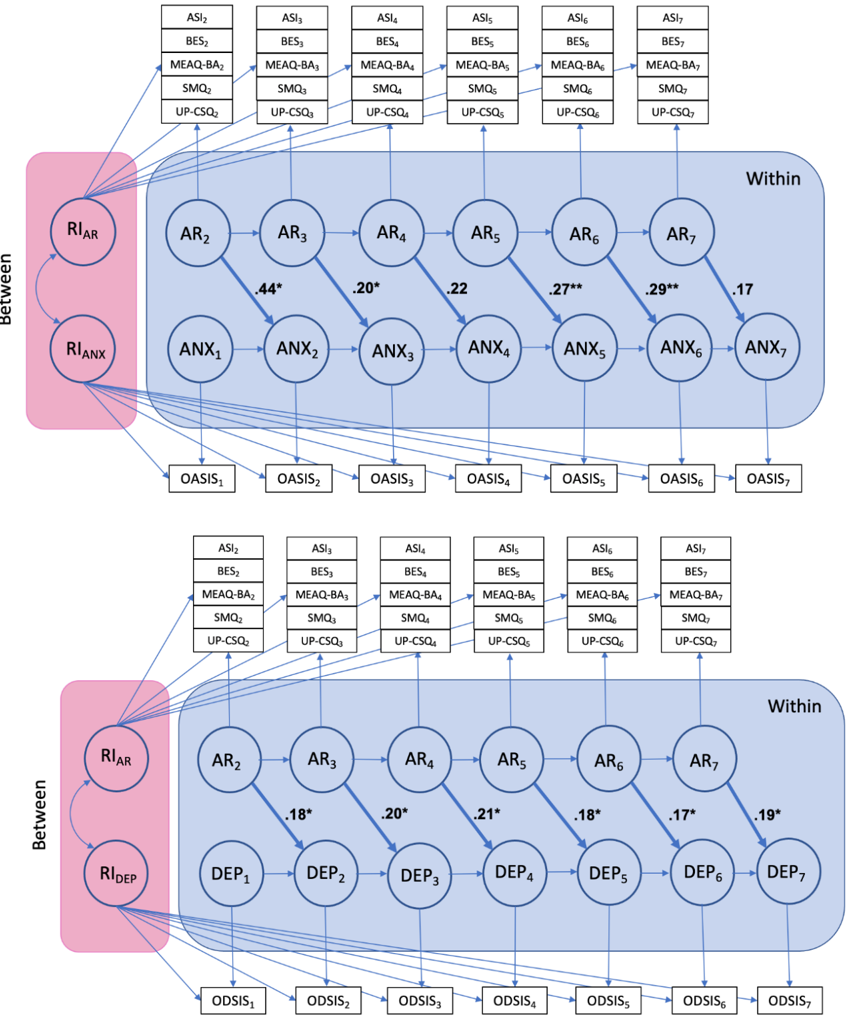
- Within-person reductions in latent aversive reactivity predicted anxiety decreases at five of seven sessions (Bs = .20–.44, ps < .04, except sessions 4 and 7) and depression decreases across all seven sessions (Bs = .18–.20, ps < .03).
Methods
- Secondary analysis of a sequential multiple assignment randomized trial (SMART) of the Unified Protocol; N = 70 treatment-seeking adults (M age = 33.74, 67.1% female, 74.3% white) with DSM-5 anxiety and/or depressive disorders. Participants received five core UP modules in standard or personalized order and were re-randomized after session 5/6 to discontinue after session 6 or continue to session 12.
- Participants completed measures of aversive reactivity, anxiety, and depression no more than 24 hours before each weekly therapy session; primary analyses focused on the first six sessions/weeks 1–7.
- Hierarchical linear modeling tested individual aversive reactivity aspects as predictors of session-to-session symptom change; multilevel exploratory factor analysis tested a latent aversive reactivity factor; random-intercept cross-lagged panel models tested latent aversive reactivity and reciprocal symptom effects.
Limitations
- The paper states that symptoms and aversive reactivity were measured at the same time points, limiting conclusions about temporal precedence; lagged latent aversive reactivity did not significantly predict next-session anxiety or depression.
- The paper states there was no control group, so specificity of aversive reactivity as a UP mechanism cannot be established; only five aversive reactivity measures were used, and total/subscale scores rather than item-level data were modeled.
- The paper states the sample was predominantly white and female, had more anxiety than depression, and had limited participants/assessments, restricting power and generalizability; evident from the text, the first-six-session focus and half of participants discontinuing after session 6 may also constrain interpretation of longer-term session-to-session effects.
Model-written summary. Check it against the paper before relying on it.
Integrity signals
Registry
Cites
Statistics
Figures
Verification
Claims the paper makes
12 Valid · 0 Not valid · 11 Not checked · 70 Own results and interpretations
Every source the paper cites for this claim was checked and supports it.
In the paper
“the degree of change in aspects of aversive reactivity over 6 sessions in the current study was 50-70% as large as that obtained from 12-16 sessions of the UP (Sauer-Zavala et al., 2021)”
§ AVERSIVE REACTIVITY IN THE UNIFIED PROTOCOL 1 Within-Person Changes in Aversive Reactivity Predict Session-to-Session Reductions in Anxiety and Depression in the Unified Protocol > Discussion
What the sources say
- Supportedcites Sauer-Zavala et al., 2021 matched to “Skill Acquisition During Transdiagnostic Treatment With the Unified Protocol” (2021) source
The citation supplies the UP benchmark, not the citing authors’ calculation comparing it with their own six-session study. The Method (Procedure) specifies 12 or 16 UP sessions, and the Results (Observed Change in Skills and Symptoms) report pre-to-post effect sizes for the targeted skills. The source does not itself state the 50–70% comparison. (LLM, conf=0.85)
plain- Asserted: passes — The authors put it forward as true.
- Checkable: passes — It can be checked against evidence.
- Load-bearing: unclear — It is unclear whether the paper’s conclusions depend on it.
- Based: passes — The paper gives a reason why it holds.
- Supported
Every source the paper cites for this claim was checked and supports it.
In the paper
“Reductions in reactions to negative emotions (including fear of emotions and anxiety sensitivity) were significantly related to symptom change in the UP, above and beyond trait negative emotionality (Sauer-Zavala et al., 2012).”
§ AVERSIVE REACTIVITY IN THE UNIFIED PROTOCOL 1 Within-Person Changes in Aversive Reactivity Predict Session-to-Session Reductions in Anxiety and Depression in the Unified Protocol > Within-Person Changes in Aversive Reactivity Predict Session-to-Session Reductions in Anxiety and Depression in the Unified Protocol
What the sources say
- Supportedcites Sauer-Zavala et al., 2012 matched to “The role of negative affectivity and negative reactivity to emotions in predicting outcomes in the unified protocol for the transdiagnostic treatment of emotional disorders” (2012) source
The Results (Tables 3–4) report that reductions in fear of emotions and anxiety sensitivity were related to symptom improvement during the UP after controlling for reductions in negative affect. Together, those two reactivity measures also explained significant additional variance in symptom change beyond negative affect. (LLM, conf=0.93)
plainstates an association- Asserted: passes — The authors put it forward as true.
- Checkable: passes — It can be checked against evidence.
- Load-bearing: passes — The paper’s conclusions depend on it.
- Based: passes — The paper gives a reason why it holds.
- Supported
Every source the paper cites for this claim was checked and supports it.
In the paper
“Given that between-person differences do not necessarily generalize to within-person changes (Fisher et al., 2018), it is important to confirm previous between-person results regarding the structure of aversive reactivity and its associations with symptom change and extend these results to withinperson processes.”
§ AVERSIVE REACTIVITY IN THE UNIFIED PROTOCOL 1 Within-Person Changes in Aversive Reactivity Predict Session-to-Session Reductions in Anxiety and Depression in the Unified Protocol > Within-Person Changes in Aversive Reactivity Predict Session-to-Session Reductions in Anxiety and Depression in the Unified Protocol
What the sources say
- Supportedcites Fisher et al., 2018 matched to “Lack of group-to-individual generalizability is a threat to human subjects research” (2018) source
The opening section states that group-level inferences generalize to individual experience or behavior only for ergodic processes. The Discussion reports that between-person and within-person correlations agreed in four comparisons but disagreed in five, directly supporting the claim's qualification that generalization is not guaranteed. (LLM, conf=0.94)
hedged- Asserted: passes — The authors put it forward as true.
- Checkable: passes — It can be checked against evidence.
- Load-bearing: passes — The paper’s conclusions depend on it.
- Based: passes — The paper gives a reason why it holds.
- Supported
Every source the paper cites for this claim was checked and supports it.
In the paper
“Furthermore, improvements in emotion dysregulation, intolerance of uncertainty, and experiential avoidance predicted reductions in anxiety and depression at post-treatment (Khakpoor et al., 2019)”
§ AVERSIVE REACTIVITY IN THE UNIFIED PROTOCOL 1 Within-Person Changes in Aversive Reactivity Predict Session-to-Session Reductions in Anxiety and Depression in the Unified Protocol > Within-Person Changes in Aversive Reactivity Predict Session-to-Session Reductions in Anxiety and Depression in the Unified Protocol
What the sources say
- Supportedcites Khakpoor et al., 2019 matched to “Reductions in transdiagnostic factors as the potential mechanisms of change in treatment outcomes in the Unified Protocol: A randomized clinical trial” (2019) source
The Results (page not provided) state that the authors ran separate regressions to test how changes in each of the three factors predicted changes in anxiety and depression. The Discussion (page not provided) reports an association between improvement in these factors and reduced symptoms after Unified Protocol treatment. (LLM, conf=0.90)
plainstates a cause- Asserted: passes — The authors put it forward as true.
- Checkable: passes — It can be checked against evidence.
- Load-bearing: passes — The paper’s conclusions depend on it.
- Based: passes — The paper gives a reason why it holds.
- Supported
Every source the paper cites for this claim was checked and supports it.
In the paper
“and reductions in anxiety sensitivity from pre-to post-treatment were associated with lower anxiety at post-treatment and 6-month followup (Boswell et al., 2013).”
§ AVERSIVE REACTIVITY IN THE UNIFIED PROTOCOL 1 Within-Person Changes in Aversive Reactivity Predict Session-to-Session Reductions in Anxiety and Depression in the Unified Protocol > Within-Person Changes in Aversive Reactivity Predict Session-to-Session Reductions in Anxiety and Depression in the Unified Protocol
What the sources say
- Supportedcites Boswell et al., 2013 matched to “Anxiety sensitivity and interoceptive exposure: A transdiagnostic construct and change strategy” (2013) source
The Discussion states that greater reductions in anxiety sensitivity were associated with lower clinical severity at posttreatment and 6-month follow-up. The Results section also reports the association at 6 months after controlling for initial severity. The paper measures severity of the principal anxiety-disorder diagnosis, which the claim paraphrases as anxiety. (LLM, conf=0.93)
plainstates an association- Asserted: passes — The authors put it forward as true.
- Checkable: passes — It can be checked against evidence.
- Load-bearing: passes — The paper’s conclusions depend on it.
- Based: passes — The paper gives a reason why it holds.
- Supported
51 more claims · 2 with their cited sources checked
Create a free account to see all 93 claims and to verify the 2 references still open.
- It may state two separate claims as one. 15
- Probably not a substantial claim. 23
- The quote only partly states this claim. 2
Self-check
Percentages, sums and reported differences re-computed from the paper’s own numbers.
Each contradiction between two passages listed here was confirmed by an independent check.
Rated minor: it would not touch a result — a value no result rests on, a p-value that stays on the same side of the significance level, or a conflict that is clerical, resolved elsewhere in the paper, or outside its own findings.
In the paper
§ AVERSIVE REACTIVITY IN THE UNIFIED PROTOCOL 1 Within-Person Changes in Aversive Reactivity Predict Session-to-Session Reductions in Anxiety and Depression in the Unified Protocol > Current Study
“After six sessions of treatment, participants underwent a secondary randomization process to either discontinue therapy after six sessions or to continue for the full twelve sessions.”
§ AVERSIVE REACTIVITY IN THE UNIFIED PROTOCOL 1 Within-Person Changes in Aversive Reactivity Predict Session-to-Session Reductions in Anxiety and Depression in the Unified Protocol > Study Procedures
“Finally, participants were re-randomized between sessions 5 and 6 to either discontinue treatment after session 6 (n = 35; 50.0%) or continue treatment until session 12 (n = 35; 50.0%).”
Rated minor: it would not touch a result — a value no result rests on, a p-value that stays on the same side of the significance level, or a conflict that is clerical, resolved elsewhere in the paper, or outside its own findings.
In the paper
“Similar proportions of participants had completed some college (n = 15; 24.3%)”
§ AVERSIVE REACTIVITY IN THE UNIFIED PROTOCOL 1 Within-Person Changes in Aversive Reactivity Predict Session-to-Session Reductions in Anxiety and Depression in the Unified Protocol > Method Participants
Reported 24.3 · recomputed 21.428571
Citations
Cites
Diagnostic and Statistical Manual of Mental Disorders
American Psychiatric Association (2013) · doi:10.1176/appi.books.9780890425596 · Cited by 116,369
Hu, L., & Bentler, P. M. (1999) · Structural Equation Modeling A Multidisciplinary Journal · doi:10.1080/10705519909540118 · Cited by 108,788 · cited 1×
“Following Hu and Bentler (1999), the following fit indices indicated excellent model fit: a non-significant chi-squared statistic, RMSEA < .06, CFI and TLI > .95, and SRMR < .08.”
MethodStatistical power analyses using G∗Power 3.1: tests for correlation and regression analyses
Faul, F., Erdfelder, E., Buchner, A., & Lang, A.-G. (2009) · Behavior Research Methods · doi:10.3758/brm.41.4.1149 · Cited by 37,615 · cited 1×
“We had 80% power to detect medium-sized between-person effects ( R 2 ≥ .10; Faul et al., 2009) and small-sized within-person effects ( R 2 ≥ .01; Lafit et al., 2021).”
Backgroundlavaan : An R Package for Structural Equation Modeling
Rosseel, Y. (2012) · Journal of Statistical Software · doi:10.18637/jss.v048.i02 · Cited by 27,955 · cited 3×
“To test our second hypothesis, we conducted a multilevel exploratory factor analysis in Mplus Version 7.0 (Muthén & Muthén, 1998-2012) using maximum likelihood estimation with robust standard errors to explore the between-and within-person factor structure of total scores representing each of the…”
MethodInfluentialContent Analysis: An Introduction to its Methodology.
Shelley, M., & Krippendorff, K. (1984) · Journal of the American Statistical Association · doi:10.2307/2288384 · Cited by 24,312
The REDCap consortium: building an international community of software platform partners
Harris, P. A., Taylor, R., Minor, B. L., Elliott, V., Fernandez, M., O'Neal, L., McLeod, L., Delacqua, G., Delacqua, F., Kirby, J., et al. (2019) · Journal of Biomedical Informatics · doi:10.1016/j.jbi.2019.103208 · Cited by 24,013
The effect of mindfulness based therapy on anxiety and depression: A meta analytic review
Hofmann, S. G., Sawyer, A. T., Witt, A. A., & Oh, D. (2010) · Journal of Consulting and Clinical Psychology · doi:10.1037/a0018555 · Cited by 3,846 · cited 1×
“Lastly, increases in mindfulness were significantly related to reductions in anxiety and depression symptoms (Barnhofer et al., 2009; Hofmann et al., 2010).”
BackgroundAnxiety, sensitivity, anxiety frequency, and the prediction of fearfulness
Reiss, S., Peterson, R. A., Gursky, D. M., & McNally, R. J. (1986) · Behaviour Research and Therapy · doi:10.1016/0005-7967(86)90143-9 · Cited by 3,169 · cited 2×
“The Anxiety Sensitivity Index (ASI; Reiss et al., 1986) is a 16-item self-report survey that assesses an individual ’ s beliefs about the possible negative consequences of anxiety, such as additional anxiety or fear, illness, embarrassment, and loss of control (e.g., “ It scares me when I feel…”
BackgroundThree Extensions of the Random Intercept Cross-Lagged Panel Model
Mulder, J. D., & Hamaker, E. L. (2021) · Structural Equation Modeling: A Multidisciplinary Journal · doi:10.1080/10705511.2020.1784738 · Cited by 1,151 · cited 1×
“Finally, to test our third hypothesis, we fit two random intercept cross-lagged panel models (RI-CLPM; Mulder & Hamaker, 2021) to test the effects of within-person changes in the latent variable of aversive reactivity on anxiety and depressive symptoms using the lavaan package Version 0.6-8…”
MethodInfluentialLack of group-to-individual generalizability is a threat to human subjects research
Fisher, A. J., Medaglia, J. D., & Jeronimus, B. F. (2018) · Proceedings of the National Academy of Sciences · doi:10.1073/pnas.1711978115 · Cited by 1,099 · cited 1×
“Given that between-person differences do not necessarily generalize to within-person changes (Fisher et al., 2018), it is important to confirm previous between-person results regarding the structure of aversive reactivity and its associations with symptom change and extend these results to…”
ResultExpectancy model of fear, anxiety, and panic
Reiss, S. (1991) · Clinical Psychology Review · doi:10.1016/0272-7358(91)90092-9 · Cited by 1,006 · cited 1×
“…physiological sensations associated with emotional experiences (Reiss et al., 1986) and has largely been studied in the context of panic disorder (McNally, 2002; Reiss, 1991), though emerging data suggest this construct confers risk transdiagnostically (Saulnier et al., 2018; Short et al., 2022).”
BackgroundBarlow, D. H., Farchione, T. J., Bullis, J. R., Gallagher, M. W., Murray-Latin, H., Sauer-Zavala, S., Bentley, K. H., Thompson-Hollands, J., Conklin, L. R., Boswell, J. F., et al. (2017) · JAMA Psychiatry · doi:10.1001/jamapsychiatry.2017.2164 · Cited by 853 · cited 4×
“…the core process of aversive reactivity may more reliably and consistently predict session-to-session reductions in anxiety and depression than any single observed aspect of aversive reactivity, providing further evidence to support the functional model of emotional disorders (Barlow et al., 2017).”
BackgroundResultInfluentialSelf-citationThe Nature, Diagnosis, and Treatment of Neuroticism: Back to the Future
Barlow, D. H., Sauer-Zavala, S., Carl, J. R., Bullis, J. R., & Ellard, K. K. (2014) · Clinical Psychological Science · doi:10.1177/2167702613505532 · Cited by 850
Self-citationDevelopment and validation of an Overall Anxiety Severity and Impairment Scale (OASIS)
Norman, S. B., Hami Cissell, S., Means-Christensen, A. J., & Stein, M. B. (2006) · Depression and Anxiety · doi:10.1002/da.20182 · Cited by 770 · cited 1×
“The Overall Anxiety Severity and Impairment Scale (OASIS; Norman et al., 2006) is a five-item self-report questionnaire designed to assess severity and impairment due to anxiety over the prior week (e.g., “ In the past week, how often did you avoid situations, places, objects, or activities because…”
BackgroundAnxiety sensitivity and panic disorder
McNally, R. J. (2002) · Biological Psychiatry · doi:10.1016/s0006-3223(02)01475-0 · Cited by 717 · cited 1×
“…physiological sensations associated with emotional experiences (Reiss et al., 1986) and has largely been studied in the context of panic disorder (McNally, 2002; Reiss, 1991), though emerging data suggest this construct confers risk transdiagnostically (Saulnier et al., 2018; Short et al., 2022).”
BackgroundWang, L. (., & Maxwell, S. E. (2015) · Psychological Methods · doi:10.1037/met0000030 · Cited by 637
Meta-analysis of the relations of anxiety sensitivity to the depressive and anxiety disorders.
Naragon-Gainey, K. (2010) · Psychological Bulletin · doi:10.1037/a0018055 · Cited by 555 · cited 1×
“Indeed, anxiety sensitivity demonstrates correlations of r = .40 – .60 with anxiety disorder symptoms and r = .46 with depressive disorder symptoms (Naragon-Gainey, 2010).”
BackgroundGámez, W., Chmielewski, M., Kotov, R., Ruggero, C., & Watson, D. (2011) · Psychological Assessment · doi:10.1037/a0023242 · Cited by 524 · cited 2×
“The Multidimensional Experiential Avoidance Questionnaire — Behavioral Avoidance Subscale (MEAQ-BA; Gámez et al., 2011) is a 13-item self-report measures designed to assess avoidance of discomfort and distress (e.g., “ I rarely do something if there is a chance that it will upset me ” ) and…”
MethodChadwick, P., Hember, M., Symes, J., Peters, E., Kuipers, E., & Dagnan, D. (2008) · British Journal of Clinical Psychology · doi:10.1348/014466508x314891 · Cited by 517 · cited 1×
“The Southampton Mindfulness Questionnaire (SMQ; Chadwick et al., 2008) is a 16-item self-report measure that assesses mindful awareness of internal thoughts, emotions, and sensations (e.g., “ When I experience distressing thoughts and images, I just try to experience the thoughts or images without…”
BackgroundAn R2statistic for fixed effects in the generalized linear mixed model
Jaeger, B. C., Edwards, L. J., Das, K., & Sen, P. K. (2017) · Journal of Applied Statistics · doi:10.1080/02664763.2016.1193725 · Cited by 399 · cited 1×
“Finally, we used the Glimmix_R2 macro (Jaeger et al., 2017) in SAS to estimate R 2 effect sizes for each model.”
MethodMindfulness-based cognitive therapy as a treatment for chronic depression: A preliminary study
Barnhofer, T., Crane, C., Hargus, E., Amarasinghe, M., Winder, R., & Williams, J. M. G. (2009) · Behaviour Research and Therapy · doi:10.1016/j.brat.2009.01.019 · Cited by 396 · cited 1×
“Lastly, increases in mindfulness were significantly related to reductions in anxiety and depression symptoms (Barnhofer et al., 2009; Hofmann et al., 2010).”
BackgroundDevelopment and validation of the overall depression severity and impairment scale
Bentley, K. H., Gallagher, M. W., Carl, J. R., & Barlow, D. H. (2014) · Psychological Assessment · doi:10.1037/a0036216 · Cited by 365 · cited 1×
“The Overall Depression Severity and Impairment Scale (ODSIS; Bentley et al., 2014) is a five-item self-report questionnaire designed to assess severity and impairment due to depression over the prior week (e.g., “ In the past week, how often did you have difficulty engaging in or being interested…”
BackgroundTolin, D. F., Gilliam, C., Wootton, B. M., Bowe, W., Bragdon, L. B., Davis, E., Hannan, S. E., Steinman, S. A., Worden, B., & Hallion, L. S. (2018) · Assessment · doi:10.1177/1073191116638410 · Cited by 345 · cited 2×
“Two graduate student assessors certified in the Diagnostic Interview for DSM-5 Anxiety, Mood, Obsessive-Compulsive and Related Disorders (Tolin et al., 2018) and masked to participants ’ randomization conditions conducted all diagnostic assessments.”
MethodCarpenter, J. K., Conroy, K., Gomez, A. F., Curren, L. C., & Hofmann, S. G. (2019) · Clinical Psychology Review · doi:10.1016/j.cpr.2019.101785 · Cited by 342 · cited 1×
“Lastly, mindfulness (which functions in opposition to aversive reactivity) has demonstrated negative associations with anxiety and depression (Carpenter et al., 2019), underscoring its role as a transdiagnostic construct.”
BackgroundMcHugh, R. K., Murray, H. W., & Barlow, D. H. (2009) · Behaviour Research and Therapy · doi:10.1016/j.brat.2009.07.005 · Cited by 320 · cited 1×
“…experiential avoidance and distress intolerance have been studied transdiagnostically and are relevant to a wide swath of psychopathology, including both anxiety and depression (Akbari et al., 2022; McHugh et al., 2009; Naragon-Gainey & Watson, 2018; Spinhoven et al., 2014; Spinhoven et al., 2017).”
BackgroundA Longitudinal Study of Experiential Avoidance in Emotional Disorders
Spinhoven, P., Drost, J., de Rooij, M., van Hemert, A. M., & Penninx, B. W. (2014) · Behavior Therapy · doi:10.1016/j.beth.2014.07.001 · Cited by 241 · cited 1×
“…experiential avoidance and distress intolerance have been studied transdiagnostically and are relevant to a wide swath of psychopathology, including both anxiety and depression (Akbari et al., 2022; McHugh et al., 2009; Naragon-Gainey & Watson, 2018; Spinhoven et al., 2014; Spinhoven et al., 2017).”
BackgroundThe unified protocol for transdiagnostic treatment of emotional disorders
Barlow, D. H., Harris, B. A., Eustis, E. H., & Farchione, T. J. (2020) · World Psychiatry · doi:10.1002/wps.20748 · Cited by 236
Anxiety sensitivity and interoceptive exposure: A transdiagnostic construct and change strategy
Boswell, J. F., Farchione, T. J., Sauer-Zavala, S., Murray, H. W., Fortune, M. R., & Barlow, D. H. (2013) · Behavior Therapy · doi:10.1016/j.beth.2013.03.006 · Cited by 232 · cited 1×
“…of uncertainty, and experiential avoidance predicted reductions in anxiety and depression at post-treatment (Khakpoor et al., 2019), and reductions in anxiety sensitivity from pre-to post-treatment were associated with lower anxiety at post-treatment and 6-month follow-up (Boswell et al., 2013).”
BackgroundSelf-citationBullis, J. R., Boettcher, H., Sauer‐Zavala, S., Farchione, T. J., & Barlow, D. H. (2019) · Clinical Psychology: Science and Practice · doi:10.1111/cpsp.12278 · Cited by 216
Self-citationThe Beliefs about Emotions Scale: Validity, reliability and sensitivity to change
Rimes, K. A., & Chalder, T. (2010) · Journal of Psychosomatic Research · doi:10.1016/j.jpsychores.2009.09.014 · Cited by 188 · cited 1×
“The Beliefs about Emotions Scale (BES; Rimes & Chalder, 2010) is a 12-item self-report questionnaire that assesses an individual ’ s beliefs about the unacceptability of experiencing and expressing emotions (e.g., “ It is a sign of weakness if I have miserable thoughts ” ) and corresponds to the UP…”
BackgroundSauer-Zavala, S., Boswell, J. F., Gallagher, M. W., Bentley, K. H., Ametaj, A., & Barlow, D. H. (2012) · Behaviour Research and Therapy · doi:10.1016/j.brat.2012.05.005 · Cited by 177 · cited 1×
“Reductions in reactions to negative emotions (including fear of emotions and anxiety sensitivity) were significantly related to symptom change in the UP, above and beyond trait negative emotionality (Sauer-Zavala et al., 2012).”
BackgroundSelf-citationLafit, G., Adolf, J., Dejonckheere, E., Myin‐Germeys, I., Viechtbauer, W., & Ceulemans, E. (2021) · Advances in Methods and Practices in Psychological Science · doi:10.1177/2515245920978738 · Cited by 173 · cited 1×
“We had 80% power to detect medium-sized between-person effects ( R 2 ≥ .10; Faul et al., 2009) and small-sized within-person effects ( R 2 ≥ .01; Lafit et al., 2021).”
BackgroundAkbari, M., Seydavi, M., Hosseini, Z. S., Krafft, J., & Levin, M. E. (2022) · Journal of Contextual Behavioral Science · doi:10.1016/j.jcbs.2022.03.007 · Cited by 155
Falkenström, F., Solomonov, N., & Rubel, J. A. (2022) · Journal of Consulting and Clinical Psychology · doi:10.1037/ccp0000727 · Cited by 79 · cited 1×
“We used hierarchical linear modeling (HLM) to test our first hypothesis and RI-CLPM in to test our third hypothesis given the specific goals of each hypothesis and to contribute to a more comprehensive understanding of the strengths and limitations of each approach (Falkenström et al., 2022).”
MethodSpinhoven, P., van Hemert, A. M., & Penninx, B. W. J. H. (2017) · Cognitive Therapy and Research · doi:10.1007/s10608-017-9856-7 · Cited by 68 · cited 2×
“Despite that, these findings replicate and extend previous research demonstrating conceptual and empirical overlap among these seemingly disparate aspects of aversive reactivity (Naragon-Gainey & Watson, 2018; Semcho et al., in preparation; Spinhoven et al., 2017).”
BackgroundResultNaragon-Gainey, K., & Watson, D. (2018) · Assessment · doi:10.1177/1073191116659741 · Cited by 67
Sauer-Zavala, S., Cassiello-Robbins, C., Conklin, L. R., Bullis, J. R., Thompson-Hollands, J., & Kennedy, K. A. (2017) · Behavior Modification · doi:10.1177/0145445516673827 · Cited by 54
Self-citationThe Structure of Distress Tolerance and Neighboring Emotion Regulation Abilities
Conway, C. C., Naragon-Gainey, K., & Harris, M. T. (2021) · Assessment · doi:10.1177/1073191120954914 · Cited by 53 · cited 1×
“…various combinations of experiential avoidance, distress tolerance, emotion dysregulation, anxiety sensitivity, worry, rumination, and perfectionism have been shown to load single latent factor (Conway et al., 2021; Naragon-Gainey & Watson, 2018; Spinhoven Psychotherapy Research 761 et al., 2017).”
BackgroundUnified Protocol for Transdiagnostic Treatment of Emotional Disorders: Workbook
Barlow, D. H., Farchione, T. J., Sauer-Zavala, S., Murray Latin, H., Ellard, K. K., Bullis, J. R., Bentley, K. H., Boettcher, H. T., & Cassiello-Robbins, C. (2017) · doi:10.1093/med-psych/9780190686017.001.0001 · Cited by 49
Self-citationIdentifying the presence and timing of discrete mood states prior to therapy
Fisher, A. J., & Bosley, H. G. (2020) · Behaviour Research and Therapy · doi:10.1016/j.brat.2020.103596 · Cited by 44
Southward, M. W., Eberle, J. W., & Neacsiu, A. D. (2022) · Cognitive Behaviour Therapy · doi:10.1080/16506073.2021.1907614 · Cited by 37
Self-citationKhakpoor, S., Mohammadi Bytamar, J., & Saed, O. (2019) · Research in Psychotherapy: Psychopathology, Process and Outcome · doi:10.4081/ripppo.2019.379 · Cited by 34 · cited 1×
“…in emotion dysregulation, intolerance of uncertainty, and experiential avoidance predicted reductions in anxiety and depression at post-treatment (Khakpoor et al., 2019), and reductions in anxiety sensitivity from pre-to post-treatment were associated with lower anxiety at post-treatment and…”
BackgroundSaulnier, K. G., Allan, N. P., Raines, A. M., & Schmidt, N. B. (2018) · Cognitive Behaviour Therapy · doi:10.1080/16506073.2018.1469664 · Cited by 31 · cited 1×
“…physiological sensations associated with emotional experiences (Reiss et al., 1986) and has largely been studied in the context of panic disorder (McNally, 2002; Reiss, 1991), though emerging data suggest this construct confers risk transdiagnostically (Saulnier et al., 2018; Short et al., 2022).”
BackgroundSauer-Zavala, S., Southward, M. W., Stumpp, N. E., Semcho, S. A., Hood, C. O., Garlock, A., & Urs, A. (2022) · Cognitive Behaviour Therapy · doi:10.1080/16506073.2022.2053571 · Cited by 31 · cited 4×
“…is a secondary analysis of a sequential multiple assignment randomized trial (SMART) of the UP in which participants received the five core skill modules in a standard or personalized order and were randomly assigned to discontinue treatment after six or 12 sessions (Sauer-Zavala et al., 2022).”
BackgroundMethodInfluentialSelf-citationDimensions of skill use in the unified protocol: Exploring unique effects on anxiety and depression.
Southward, M. W., & Sauer-Zavala, S. (2022) · Journal of Consulting and Clinical Psychology · doi:10.1037/ccp0000701 · Cited by 27
Self-citationSemcho, S. A., Southward, M. W., Stumpp, N. E., MacLean, D. L., Hood, C. O., Wolitzky-Taylor, K., & Sauer-Zavala, S. (2023) · Journal of Emotion and Psychopathology · doi:10.55913/joep.v1i1.9 · Cited by 26
Self-citationShort, N. A., van Rooij, S. J. H., Murty, V. P., Stevens, J. S., An, X., Ji, Y., McLean, S. A., House, S. L., Beaudoin, F. L., Zeng, D., et al. (2022) · Journal of Psychiatric Research · doi:10.1016/j.jpsychires.2022.09.027 · Cited by 25 · cited 1×
“…physiological sensations associated with emotional experiences (Reiss et al., 1986) and has largely been studied in the context of panic disorder (McNally, 2002; Reiss, 1991), though emerging data suggest this construct confers risk transdiagnostically (Saulnier et al., 2018; Short et al., 2022).”
BackgroundSkill Acquisition During Transdiagnostic Treatment With the Unified Protocol
Sauer-Zavala, S., Rosellini, A. J., Bentley, K. H., Ametaj, A. A., Boswell, J. F., Cassiello-Robbins, C., Wilner Tirpak, J., Farchione, T. J., & Barlow, D. H. (2021) · Behavior Therapy · doi:10.1016/j.beth.2021.03.001 · Cited by 22 · cited 4×
“…suggests that, when the UP modules are presented in isolation, they engage their corresponding form of aversive reactivity (i.e., Mindful Emotion Awareness is associated with increased levels of nonjudgmental, present-focused attention; Cassiello-Robbins et al., 2020; Sauer-Zavala et al., 2021).”
BackgroundInfluentialSelf-citationNegative Emotion Differentiation Predicts Psychotherapy Outcome: Preliminary Findings
Lazarus, G., & Fisher, A. J. (2021) · Frontiers in Psychology · doi:10.3389/fpsyg.2021.689407 · Cited by 21 · cited 1×
“By testing both lag-1 and contemporaneous effects, we hope to help future researchers specify the timescale at which these theorized processes occur (Fisher & Bosley, 2020; Lazarus & Fisher, 2021), since these are currently unknown.”
BackgroundThe dose–effect and good enough level models of change for specific psychological concerns.
Niileksela, C. R., Ghosh, A., & Janis, R. A. (2021) · Journal of Consulting and Clinical Psychology · doi:10.1037/ccp0000635 · Cited by 18
Experimental Manipulations to Test Theory-Driven Mechanisms of Cognitive Behavior Therapy
Southward, M. W., & Sauer-Zavala, S. (2020) · Frontiers in Psychiatry · doi:10.3389/fpsyt.2020.603009 · Cited by 17 · cited 2×
“It is possible that therapists could track patients ’ level of aversive reactivity as an early indicator of treatment response to determine whether patients are “ on track ” to experience symptom relief (Southward & Sauer-Zavala, 2020).”
BackgroundSelf-citationCassiello-Robbins, C. F., Sauer-Zavala, S. E., Brody, L. R., & Barlow, D. H. (2020) · Behavior Therapy · doi:10.1016/j.beth.2019.12.007 · Cited by 16 · cited 1×
“…suggests that, when the UP modules are presented in isolation, they engage their corresponding form of aversive reactivity (i.e., Mindful Emotion Awareness is associated with increased levels of nonjudgmental, present-focused attention; Cassiello-Robbins et al., 2020; Sauer-Zavala et al., 2021).”
BackgroundSelf-citationMechanism engagement as a potential evidence-based approach to personalized treatment termination
Sauer-Zavala, S. E., Southward, M. W., Terrill, D. R., Semcho, S., & Stumpp, N. E. (2023) · Psychotherapy Research · doi:10.1080/10503307.2023.2168574 · Cited by 7 · cited 1×
“Moreover, given that many patients experience early change in aversive reactivity and symptoms, it is possible as few as six sessions may be needed for some individuals; improvement in aversive reactivity could be used to trigger discontinuation decisions (Sauer-Zavala et al., 2023).”
BackgroundSelf-citationSemcho, S., Southward, M. W., Stumpp, N. E., et al. (2022) · doi:10.31219/osf.io/dmtxu · Cited by 4
Self-citation
Research works printed but not linked: 1
- Muthén, L. K., & Muthén, B. O. (1998-2012). Mplus User's Guide. Seventh Edition. Los Angeles, CA: Muthén & Muthén.
Cited by
A Review of Transdiagnostic Mechanisms in Cognitive Behavior Therapy
Southward, M. W., Kushner, M. L., Terrill, D. R., & Sauer-Zavala, S. E. (2024) · Psychiatric Clinics of North America · doi:10.1016/j.psc.2024.02.003 · Cited by 34
Self-citationCroom, H. E., Southward, M. W., & Sauer-Zavala, S. E. (2025) · Behavior Therapy · doi:10.31234/osf.io/4gwy5_v2 · Cited by 2
Self-citation
Metadata
- Authors
- Semcho, S. A., Southward, M. W., Stumpp, N. E., Smith, M. M., Fruhbauerova, M., & Sauer-Zavala, S.
- Affiliations
- University of Kentucky (US)
- Corresponding author
- Semcho, Stephen A.
- ORCID
- Venue
- Psychotherapy Research
- Publisher
- Informa UK Limited
- Published
- 2023-09-13
- Volume
- 34
- Issue
- 6
- Pages
- 760-773
- ISSN
- 1050-3307 (ISSN-L)
- 1468-4381
- OpenAlex
- W4386697946
- Semantic Scholar
- f02ca6e9957eb5891d90f95bb115a71c94453f6b
- Cited by
- 2
- References
- 50
- Citations by year
- 2025: 1 · 2024: 1
- FWCI
- 0.38
- Type
- journal article
- Language
- en
- Open access
- green
- doi.org
- Licence
- cc-by
- Locations
- Psychotherapy Research (publishedVersion)
- PsyArXiv (OSF Preprints) (submittedVersion, cc-by)
- PubMed (publishedVersion)
- Topics
- Social Sciences › Psychology › Experimental and Cognitive Psychology › Anxiety, Depression, Psychometrics, Treatment, Cognitive Processes
- Social Sciences › Psychology › Clinical Psychology › Psychotherapy Techniques and Applications
- Social Sciences › Psychology › Clinical Psychology › Personality Disorders and Psychopathology
- Keywords
- Unified Protocol, anxiety, depression, within-person change, transdiagnostic mechanisms, emotional disorders, emotional acceptance, behavioral avoidance, emotion regulation, psychotherapy outcome
- MeSH terms
- Adult, Anxiety, Clinical Protocols, Depression, Female, Humans, Male, Middle Aged, Outcome Assessment, Health Care, Young Adult
About these checks
Registry, retraction, Cites and statistics results are computed, not judged, with one exception: a printed reference that no index lists is read once by a model before it counts as a citation error. Claims are extracted by a model and kept only when their quote appears verbatim in the text; each cited source is then checked, with a model’s help, for whether it says what the claim relies on. Those verdicts can be wrong — read the claim’s quote and the cited source before relying on one.
The claim verdicts this report counts are experimental: their accuracy is not yet measured.
A language model drew the claims from the paper on 2026-10-12, under version 3 of the claim definition (model deepseek-v4.1-flash, prompt extract-v3).
A second model labelled each claim on 2026-10-12 (model jev-1.13-20260917, definition revision gold-guideline-v0.2).
Cited sources are checked with a language model’s help (gpt-6-sol).
Statistics and arithmetic are recomputed, not judged.
Confidence bands are shown only for fields calibrated on our annotated test set. None is calibrated yet, so no band is shown.
What counts as a claim ›How we measure confidence ›How we check this ›
Are you an author, or do you see a problem with this page? Request a review
Data sources
Bibliographic data: Semantic Scholar, OpenAlex, Crossref.
Contains information from the Semantic Scholar Academic Graph Datasets, made available under the ODC Attribution License (ODC-BY 1.0).
Semantic Scholar’s data is described in: Kinney, R., et al. (2023). The Semantic Scholar Open Data Platform. arXiv:2301.10140.
