

Social anxiety and emotion regulation flexibility: considering emotion intensity and type as contextual factors
Open accessThe DOI matches its Crossref record; 42 of the 42 references it cites were found in a registry or an index.
Abstract
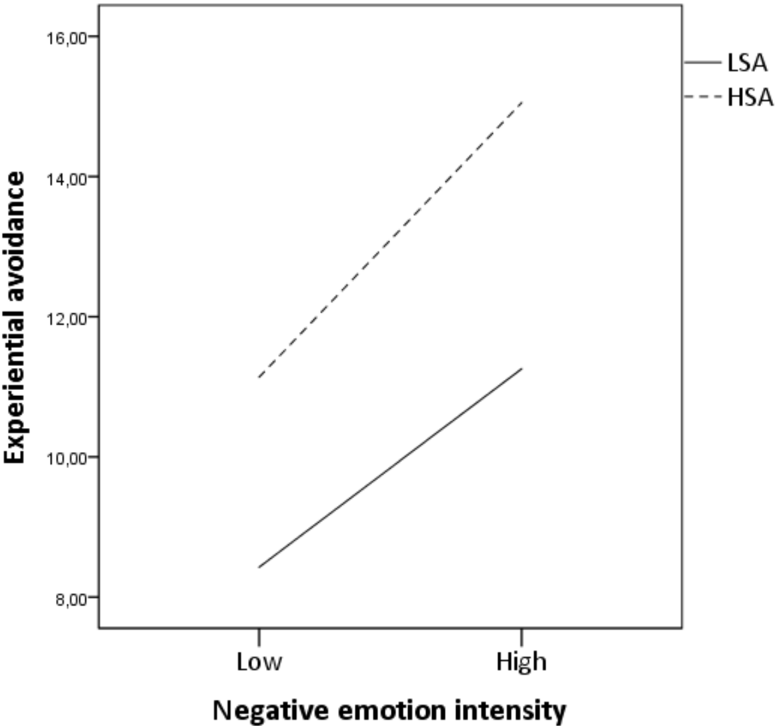
BACKGROUND AND OBJECTIVES: Individuals with social anxiety disorder have often been considered inflexible in their emotion regulation. The aim of this study was to investigate emotion regulation flexibility in socially anxious individuals in response to two contextual factors, namely different levels of emotion intensity and emotion type. METHODS: A daily diary approach was employed, investigating emotion regulation (i.e., experiential avoidance, expressive suppression and cognitive reappraisal) in college students scoring high (N = 62; HSA) and low (N = 52; LSA) on social anxiety. RESULTS: Results revealed that HSAs were found to use more experiential avoidance than LSAs, especially at higher levels of negative intensity. The use of this emotion regulation strategy appeared to be driven by guilt, nervousness, and sadness. There were no between-group differences concerning the other strategies in response to varying levels of emotional intensity. CONCLUSIONS: Together, the results provide evidence for inflexible emotion regulation in HSAs, reflected in an unwillingness to experience negative emotions.
Overview
The claims and statistics of this paper haven’t been checked yet.
Free: it reads the open-access text and checks the first 5 claims that cite a source we can check. Create a free account to check every claim.
Integrity signals
Registry
Cites
Statistics
Figures
Verification
Claims the paper makes
The claims and statistics of this paper haven’t been checked yet.
Free: it reads the open-access text and checks the first 5 claims that cite a source we can check. Create a free account to check every claim.
Claims other papers make about this one
Each is checked against this paper’s own text: does it say what the citing paper says it does?
The cited source says what the claim attributes to it.
In the citing paper
“This study revealed that SA moderated the relationship between emotion intensity and experiential avoidance.”
From Studies of Social Anxiety Using Ambulatory Assessment: Systematic Review (2024) · cites this paper as [38]
The cited source says what the claim attributes to it.
In the citing paper
“Several studies have found that individuals diagnosed with SAD (Kashdan et al., 2013) and with high SAD symptoms (Mahaffey et al., 2013;O'Toole et al., 2017) report greater use of EA compared to healthy controls or individuals with low SAD symptoms.”
From Evaluating Mechanisms: Mapping Weekly Dynamics between Experiential Avoidance and SAD Symptoms (2021) · cites this paper as O'Toole et al., 2017
Self-check
Percentages, sums and reported differences re-computed from the paper’s own numbers.
The self-check needs the paper’s full text.
Citations
Cites
Gross, J. J., & John, O. P. (2003) · Journal of Personality and Social Psychology · doi:10.1037/0022-3514.85.2.348 · Cited by 11,929 · cited 2×
“In contrast, cognitive reappraisal (i.e., thinking differently about a situation in order to alter its emotional impact; Gross, 2014) has been associated with greater well-being (Gross & John, 2003).”
BackgroundMethodAcceptance and commitment therapy: model, processes and outcomes
Hayes, S. C., Luoma, J. B., Bond, F. W., Masuda, A., & Lillis, J. (2006) · Behaviour Research and Therapy · doi:10.1016/j.brat.2005.06.006 · Cited by 6,587
Linear Mixed Models for Longitudinal Data
Verbeke, G. (1997) · Lecture Notes in Statistics · doi:10.1007/978-1-4612-2294-1_3 · Cited by 3,506
Handbook of emotion regulation
(2014) · Choice Reviews Online · doi:10.5860/choice.52-1127 · Cited by 3,280
Psychological flexibility as a fundamental aspect of health
Kashdan, T. B., & Rottenberg, J. (2010) · Clinical Psychology Review · doi:10.1016/j.cpr.2010.03.001 · Cited by 3,054 · cited 2×
“Individuals with social anxiety disorder (SAD) have been described as being inflexible in their emotion regulation in that they habitually engage emotion suppression and avoiding strategies (Goldin, Jazaieri, & Gross, 2014; Kashdan & Rottenberg, 2010).”
BackgroundLinear Mixed Models for Longitudinal Data
Molenberghs, G., & Verbeke, G. (2000) · Springer Series in Statistics · doi:10.1007/978-1-4419-0300-6 · Cited by 2,646
Liebowitz, M. R. (2015) · Modern Trends in Pharmacopsychiatry · doi:10.1159/000414022 · Cited by 2,266
Measuring experiential avoidance: A preliminary test of a working model
Hayes, S. C., Strosahl, K., Wilson, K. G., Bissett, R. T., Pistorello, J., Toarmino, D., Polusny, M. A., Dykstra, T. A., Batten, S. V., Bergan, J., et al. (2004) · The Psychological Record · doi:10.1007/bf03395492 · Cited by 2,140
Webb, T. L., Miles, E., & Sheeran, P. (2012) · Psychological Bulletin · doi:10.1037/a0027600 · Cited by 2,006
Regulatory Flexibility: An Individual Differences Perspective on Coping and Emotion Regulation
Bonanno, G. A., & Burton, C. L. (2013) · Perspectives on Psychological Science · doi:10.1177/1745691613504116 · Cited by 1,676 · cited 4×
“Bonanno and Burton (2013) have reviewed a number of factors that empirically have been found to determine a particular emotion regulation strategy’s effect.”
BackgroundInfluentialEmotion regulation: Conceptual and empirical foundations.
Gross, J. J. (2014) · Cited by 1,092
Barrett, L. F., Gross, J., Christensen, T. C., & Benvenuto, M. (2001) · Cognition & Emotion · doi:10.1080/02699930143000239 · Cited by 1,077
Kashdan, T. B., Barrios, V., Forsyth, J. P., & Steger, M. F. (2006) · Behaviour Research and Therapy · doi:10.1016/j.brat.2005.10.003 · Cited by 994
Emotion Regulation Flexibility
Aldao, A., Sheppes, G., & Gross, J. J. (2015) · Cognitive Therapy and Research · doi:10.1007/s10608-014-9662-4 · Cited by 981 · cited 1×
“A framework has been outlined by Aldao et al. (2015) in which it has been proposed that the adaptiveness of emotion regulation should be evaluated against the person’s short- and long-term goals.”
BackgroundBonanno, G. A., Papa, A., Lalande, K., Westphal, M., & Coifman, K. (2004) · Psychological Science · doi:10.1111/j.0956-7976.2004.00705.x · Cited by 969
FRESCO, D. M., COLES, M. E., HEIMBERG, R. G., LIEBOWITZ, M. R., HAMI, S., STEIN, M. B., & GOETZ, D. (2001) · Psychological Medicine · doi:10.1017/s0033291701004056 · Cited by 874 · cited 1×
“A total of 131 individuals with a maximum score on the self-reported version of Liebowitz Social Anxiety Scale (LSAS; Fresco et al., 2001; Liebowitz, 1987) of 21 (lower quartile), and 130 individuals with a minimum LSAS score of 47 (upper quartile) were invited to participate.”
BackgroundAcceptance and Commitment Therapy as a Unified Model of Behavior Change
Hayes, S. C., Pistorello, J., & Levin, M. E. (2012) · The Counseling Psychologist · doi:10.1177/0011000012460836 · Cited by 718
The Role of Acceptance and Job Control in Mental Health, Job Satisfaction, and Work Performance
Bond, F. W., & Bunce, D. (2003) · Journal of Applied Psychology · doi:10.1037/0021-9010.88.6.1057 · Cited by 711 · cited 2×
“Experiential avoidance was assessed by 7 items (α = .73), factorially derived (Bond & Bunce, 2003) from the Acceptance and Action Questionnaire (AAQ; Hayes et al., 2004).”
BackgroundMethodEmotion regulation choice: A conceptual framework and supporting evidence.
Sheppes, G., Scheibe, S., Suri, G., Radu, P., Blechert, J., & Gross, J. J. (2014) · Journal of Experimental Psychology: General · doi:10.1037/a0030831 · Cited by 674 · cited 2×
“…show a regulatory decision-making pattern; in low-intensity emotional situations healthy individuals were likely to employ reappraisal, whereas in high-intensity negative emotional situations, they more often chose to employ the attention deployment strategy distraction (Sheppes et al., 2014).”
BackgroundTroy, A. S., Shallcross, A. J., & Mauss, I. B. (2013) · Psychological Science · doi:10.1177/0956797613496434 · Cited by 641 · cited 1×
“For instance, Troy, Wilhelm, Shallcross, and Mauss (2010) and Troy, Shallcross, and Mauss (2013) found that reappraisal was associated with less depression among individuals who experienced high levels of uncontrollable stress, but with more depression among individuals who experienced controllable…”
BackgroundGoldin, P. R., Manber, T., Hakimi, S., Canli, T., & Gross, J. J. (2009) · Archives of General Psychiatry · doi:10.1001/archgenpsychiatry.2008.525 · Cited by 486
Kashdan, T. B., Barrett, L. F., & McKnight, P. E. (2015) · Current Directions in Psychological Science · doi:10.1177/0963721414550708 · Cited by 463
Troy, A. S., Wilhelm, F. H., Shallcross, A. J., & Mauss, I. B. (2010) · Emotion · doi:10.1037/a0020262 · Cited by 461
Kashdan, T. B., & Steger, M. F. (2006) · Psychological Science · doi:10.1111/j.1467-9280.2006.01674.x · Cited by 458
Social anxiety spectrum and diminished positive experiences: Theoretical synthesis and meta-analysis
Kashdan, T. B. (2007) · Clinical Psychology Review · doi:10.1016/j.cpr.2006.12.003 · Cited by 419 · cited 1×
“Concerning positive affect, HSAs experienced less positive affect in this study as has been consistently demonstrated in the literature (e.g., Kashdan, 2007; Kashdan, Weeks, & Savostyanova, 2011).”
ResultPsychological Models of Emotion
Scherer, K. R. (2000) · The Neuropsychology Of Emotion · doi:10.1093/oso/9780195114645.003.0006 · Cited by 417
A Practical Guide to Experience-Sampling Procedures
Christensen, T. C., Barrett, L. F., Bliss-Moreau, E., Lebo, K., & Kaschub, C. (2003) · Journal of Happiness Studies · doi:10.1023/a:1023609306024 · Cited by 318
Acceptance and Commitment Therapy for Generalized Social Anxiety Disorder: A Pilot Study
Dalrymple, K. L., & Herbert, J. D. (2007) · Behavior Modification · doi:10.1177/0145445507302037 · Cited by 312 · cited 1×
“A number of treatments do so (e.g., Acceptance and Commitment Therapy: Hayes, Pistorello, & Levin, 2012: Emotion Regulation Therapy: Mennin & Fresco, 2014), and some have already shown promising results in the treatment of SAD (e.g., Dalrymple & Herbert, 2007).”
BackgroundThe Neuropsychology of Emotion.
Cimino, C. R. (2002) · The Journal of Nervous and Mental Disease · doi:10.1097/00005053-200201000-00016 · Cited by 267
Kashdan, T. B., Weeks, J. W., & Savostyanova, A. A. (2011) · Clinical Psychology Review · doi:10.1016/j.cpr.2011.03.012 · Cited by 258
Assessing emotion regulation in social anxiety disorder: the emotion regulation interview
Werner, K. H., Goldin, P. R., Ball, T. M., Heimberg, R. G., & Gross, J. J. (2011) · Journal of Psychopathology and Behavioral Assessment · doi:10.1007/s10862-011-9225-x · Cited by 219 · cited 2×
“feel less self-efficacious in the employment of this strategy (e.g., Goldin, Manber, Hakimi, Canli, & Gross, 2009; O’Toole et al., 2014; Werner et al., 2011).”
BackgroundFarmer, A. S., & Kashdan, T. B. (2012) · Cognitive Behaviour Therapy · doi:10.1080/16506073.2012.666561 · Cited by 192 · cited 1×
“With respect to causality between these variables, it has been found that when people high in social anxiety employ expressive suppression of positive emotions, they report fewer positive social events and less positive emotion on the subsequent day (Farmer & Kashdan, 2012).”
BackgroundKashdan, T. B., Goodman, F. R., Machell, K. A., Kleiman, E. M., Monfort, S. S., Ciarrochi, J., & Nezlek, J. B. (2014) · Emotion · doi:10.1037/a0035935 · Cited by 187 · cited 2×
“Specifically, it has previously been established that experiential avoidance precedes symptoms of social anxiety (Kashdan et al., 2014).”
BackgroundEmotion and evolving treatments for adult psychopathology.
Mennin, D., & Farach, F. (2007) · Clinical Psychology: Science and Practice · doi:10.1111/j.1468-2850.2007.00094.x · Cited by 186 · cited 1×
“The affective sciences are converging in the assumption that emotions are functional in that they are generated in response to motivationally salient stimuli (Gross, 2014; Mennin & Farach, 2007; Scherer, 2000).”
BackgroundSelf-citationDixon-Gordon, K. L., Aldao, A., & De Los Reyes, A. (2015) · Personality and Individual Differences · doi:10.1016/j.paid.2015.06.011 · Cited by 180
Emotion regulation choice: selecting between cognitive regulation strategies to control emotion
Sheppes, G., & Levin, Z. (2013) · Frontiers in Human Neuroscience · doi:10.3389/fnhum.2013.00179 · Cited by 119
Mennin, D. S., & Quintero, J. M. (2017) · Sage eBooks · doi:10.4135/9781483365817.n528 · Cited by 116 · cited 2×
“A number of treatments do so (e.g., Acceptance and Commitment Therapy: Hayes, Pistorello, & Levin, 2012: Emotion Regulation Therapy: Mennin & Fresco, 2014), and some have already shown promising results in the treatment of SAD (e.g., Dalrymple & Herbert, 2007).”
BackgroundSelf-citationSocial anxiety and emotion knowledge: A meta-analysis
O’Toole, M. S., Hougaard, E., & Mennin, D. S. (2012) · Journal of Anxiety Disorders · doi:10.1016/j.janxdis.2012.09.005 · Cited by 114
Self-citationTrait and Daily Emotion Regulation in Social Anxiety Disorder
Blalock, D. V., Kashdan, T. B., & Farmer, A. S. (2016) · Cognitive Therapy and Research · doi:10.1007/s10608-015-9739-8 · Cited by 105
O’Toole, M. S., Jensen, M. B., Fentz, H. N., Zachariae, R., & Hougaard, E. (2014) · Cognitive Therapy and Research · doi:10.1007/s10608-014-9611-2 · Cited by 81 · cited 8×
“O’Toole et al. (2014) tested the validity of the daily measures, the association between trait and daily measures was explored in multilevel models, where the trait version of the measure predicted the daily version of the measure.”
BackgroundMethodInfluentialSelf-citationEmotion Regulation in Social Anxiety Disorder
Goldin, P. R., Jazaieri, H., & Gross, J. J. (2014) · Social Anxiety · doi:10.1016/b978-0-12-394427-6.00017-0 · Cited by 31 · cited 2×
“…to use more experiential avoidance and expressive suppression both at the trait level and on a daily basis (e.g., Blalock, Kashdan, & Farmer, 2016; Goldin et al., 2014; Kashdan & Rottenberg, 2010; Kashdan & Steger, 2006; O’Toole, Jensen, Fentz, Zachariae, & Hougaard, 2014; Werner, Goldin, Ball,…”
BackgroundO'Toole, M. S., Mennin, D. S., Hougaard, E., Zachariae, R., & Rosenberg, N. K. (2015) · Clinical Psychology & Psychotherapy · doi:10.1002/cpp.1926 · Cited by 24
Self-citation
Research works printed but not linked: 1
- 23. Kashdan, T. B., & Rottenberg, J. (2010). Psychological flexibility as a fundamental aspect of health. Clinical Psychology Review, 30, 865-878.
Cited by
Dryman, M. T., & Heimberg, R. G. (2018) · Clinical Psychology Review · doi:10.1016/j.cpr.2018.07.004 · Cited by 554
Psychological flexibility: What we know, what we do not know, and what we think we know
Doorley, J. D., Goodman, F. R., Kelso, K. C., & Kashdan, T. B. (2020) · Social and Personality Psychology Compass · doi:10.1111/spc3.12566 · Cited by 264
Richey, J. A., Brewer, J. A., Sullivan-Toole, H., Strege, M. V., Kim-Spoon, J., White, S. W., & Ollendick, T. H. (2019) · Clinical Psychology Review · doi:10.1016/j.cpr.2019.101756 · Cited by 79
O’Toole, M. S., Renna, M. E., Mennin, D. S., & Fresco, D. M. (2019) · Behavior Therapy · doi:10.1016/j.beth.2018.12.005 · Cited by 66
Self-citationUsing ambulatory assessment to measure dynamic risk processes in affective disorders
Stange, J. P., Kleiman, E. M., Mermelstein, R. J., & Trull, T. J. (2019) · Journal of Affective Disorders · doi:10.1016/j.jad.2019.08.060 · Cited by 44
“(or ―flexibility‖) of emotion regulation strategies, such as the ability to implement a variety of strategies over time, may facilitate adaptive outcomes (Aldao et al., 2015; Bonanno and Burton, 2013; Hollenstein, 2015; Hollenstein et al., 2013; O’Toole et al., 2017; Stange et al., 2017a).”
Background
Metadata
- Authors
- O’Toole, M. S., Zachariae, R., & Mennin, D. S.
- Affiliations
- Aarhus University (DK)
- The Graduate Center, CUNY (US)
- Corresponding author
- O’Toole, Mia S.
- Venue
- Anxiety, Stress, & Coping
- Publisher
- Informa UK Limited
- Published
- 2017-06-30
- Volume
- 30
- Issue
- 6
- Pages
- 716-724
- ISSN
- 1061-5806 (ISSN-L)
- 1477-2205
- OpenAlex
- W2730991380
- Cited by
- 49
- References
- 40
- Citations by year
- 2026: 3 · 2025: 5 · 2024: 5 · 2023: 9 · 2022: 7 · 2021: 7 · 2020: 4 · 2019: 6 · 2018: 3
- FWCI
- 4.63
- Type
- journal article
- Language
- en
- Open access
- green
- pure.au.dk
- Licence
- cc-by-nc-nd
- Locations
- Anxiety Stress & Coping (publishedVersion)
- PubMed (publishedVersion)
- Topics
- Social Sciences › Psychology › Experimental and Cognitive Psychology › Anxiety, Depression, Psychometrics, Treatment, Cognitive Processes
- Social Sciences › Psychology › Clinical Psychology › Child and Adolescent Psychosocial and Emotional Development
- Social Sciences › Psychology › Social Psychology › Emotions and Moral Behavior
- Keywords
- social anxiety, emotion regulation flexibility, experiential avoidance, expressive suppression, cognitive reappraisal, emotional intensity, emotion types, guilt, anxiety, sadness, daily diary, university students
- MeSH terms
- Adolescent, Adult, Anxiety, Denmark, Emotions, Female, Humans, Internal-External Control, Male, Middle Aged, Students, Young Adult
About these checks
Registry, retraction, Cites and statistics results are computed, not judged, with one exception: a printed reference that no index lists is read once by a model before it counts as a citation error. Claims are extracted by a model and kept only when their quote appears verbatim in the text; each cited source is then checked, with a model’s help, for whether it says what the claim relies on. Those verdicts can be wrong — read the claim’s quote and the cited source before relying on one.
Statistics and arithmetic are recomputed, not judged.
Confidence bands are shown only for fields calibrated on our annotated test set. None is calibrated yet, so no band is shown.
What counts as a claim ›How we measure confidence ›How we check this ›
Are you an author, or do you see a problem with this page? Request a review
Data sources
Bibliographic data: Semantic Scholar, OpenAlex, Crossref.
Contains information from the Semantic Scholar Academic Graph Datasets, made available under the ODC Attribution License (ODC-BY 1.0).
Semantic Scholar’s data is described in: Kinney, R., et al. (2023). The Semantic Scholar Open Data Platform. arXiv:2301.10140.
