

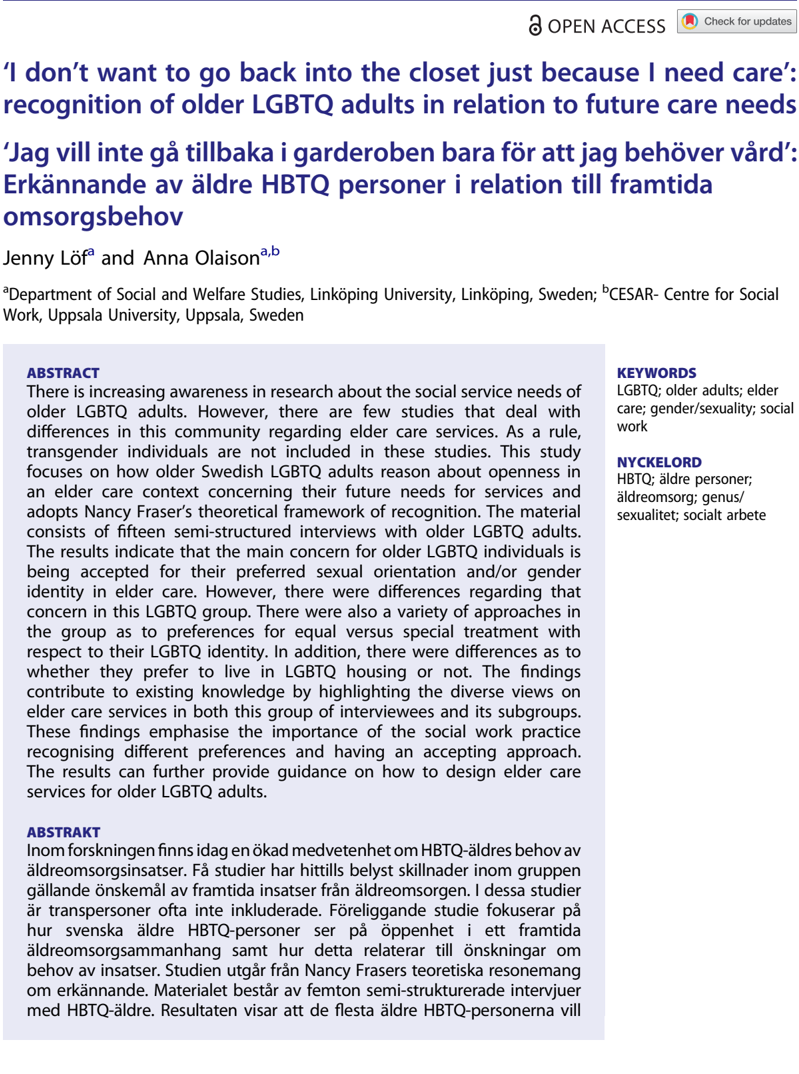
‘I don’t want to go back into the closet just because I need care’: recognition of older LGBTQ adults in relation to future care needs
Open accessThe DOI matches its Crossref record; 39 of the 40 references it cites were found in a registry or an index; 1 of the 31 sources its claims cite were checked for support.
Abstract
There is increasing awareness in research about the social service needs of older LGBTQ adults. However, there are few studies that deal with differences in this community regarding elder care services. As a rule, transgender individuals are not included in these studies. This study focuses on how older Swedish LGBTQ adults reason about openness in an elder care context concerning their future needs for services and adopts Nancy Fraser’s theoretical framework of recognition. The material consists of fifteen semi-structured interviews with older LGBTQ adults. The results indicate that the main concern for older LGBTQ individuals is being accepted for their preferred sexual orientation and/or gender identity in elder care. However, there were differences regarding that concern in this LGBTQ group. There were also a variety of approaches in the group as to preferences for equal versus special treatment with respect to their LGBTQ identity. In addition, there were differences as to whether they prefer to live in LGBTQ housing or not. The findings contribute to existing knowledge by highlighting the diverse views on elder care services in both this group of interviewees and its subgroups. These findings emphasise the importance of the social work practice recognising different preferences and having an accepting approach. The results can further provide guidance on how to design elder care services for older LGBTQ adults.
Overview
CoChat Summary
TL;DR
This qualitative study examines how 15 older LGBTQ adults in Sweden view future elder care through Nancy Fraser’s recognition framework. It finds a shared desire for acceptance, but also differences within the group over openness, equal versus specific treatment, and LGBTQ-specific housing.
Key findings
- All interviewees wanted to be recognised and accepted for their identity in elder care, but differed in how much attention they wanted paid to their LGBTQ identity and how open they wanted to be. Transgender interviewees were often more visible and said they needed to stand up for themselves; older LGB adults stressed being able to talk about their sexuality and not having heterosexuality assumed.
- On treatment preferences, 6 interviewees expressed views favouring attention to LGBTQ-specific qualities/differences, while 7 emphasised equal treatment; in 2 interviews it was not possible to determine a preference.
- On housing, 9 interviewees wanted specialist LGBTQ accommodation, citing belonging, shared experiences and safety; 5 were not interested, including 2 older transgender adults, 2 bisexual/lesbian women and 1 bisexual/gay man. Three interviewees already lived in LGBT senior housing, which some said made it easier to be open.
- In 13 of 15 interviews, interviewees said greater knowledge about LGBTQ issues in elder care was needed to increase understanding and reduce stigma, discrimination and negative attitudes.
Methods
- The empirical data consist of 15 semi-structured interviews with adults aged 65 and older who identify as LGBTQ in Sweden. Interviewees lived at home; 2 had previous experience with elder care services and 3 lived in an LGBT senior housing facility. The sample included 5 bisexual/lesbian women, 5 bisexual/gay men and 5 transgender people, born between 1939 and 1950.
- Recruitment occurred through pensioners’ organisations, LGBTQ organisations, one LGBT senior housing facility, LGBT-certified retirement homes/home care services, a Pride festival, websites and snowball sampling. Interviews lasted from 45 minutes to 2 hours 20 minutes and covered four themes: everyday life and aging, social attitudes and norms, elder care, and social relations and networks.
- Analysis used a thematic approach, with coding in NVivo and peer-debriefing between the authors. The theoretical framework is Nancy Fraser’s status model of recognition, including the concepts of affirmation and transformation.
Limitations
- The paper states that the sample size was relatively small, with only a few representatives from each subgroup, so more material might have revealed clearer patterns; it also states that no individuals identified as transmasculine.
- Evident from the sample description: only 2 of 15 interviewees had previous experience with elder care services, so most accounts concern anticipated future care rather than actual service use.
- Evident from the recruitment description: recruitment through LGBTQ organisations, an LGBT senior housing facility, LGBT-certified services and a Pride festival may overrepresent older LGBTQ adults connected to LGBTQ networks or services.
Model-written summary. Check it against the paper before relying on it.
Integrity signals
Registry
Cites
Statistics
Figures


Verification
Claims the paper makes
1 Valid · 2 Not valid · 26 Not checked · 88 Own results and interpretations
A result the paper reports from its own data — it cites no other source for it, so there is none to check. The quote shows it is in the paper.
In the paper
“At fi rst glance, there do not appear to be any sharp divisions in the LGBTQ group between those who prefer special housing or not.”
hedged- Asserted: passes — The authors put it forward as true.
- Checkable: passes — It can be checked against evidence.
- Load-bearing: unclear — It is unclear whether the paper’s conclusions depend on it.
- Based: passes — The paper gives a reason why it holds.
A result the paper reports from its own data — it cites no other source for it, so there is none to check. The quote shows it is in the paper.
In the paper
“The interviewees also mentioned concrete measures that would promote this welcoming, inclusive environment and encourage individuals to be open.”
plainstates a cause- Asserted: passes — The authors put it forward as true.
- Checkable: passes — It can be checked against evidence.
- Load-bearing: unclear — It is unclear whether the paper’s conclusions depend on it.
- Based: passes — The paper gives a reason why it holds.
A result the paper reports from its own data — it cites no other source for it, so there is none to check. The quote shows it is in the paper.
In the paper
“The common attitude expressed in the interviews is that respecting personal integrity and individuality is important, whether it is a matter of sexuality or gender expression/gender identity, regardless of whether that person wants equal treatment or not.”
plain- Asserted: passes — The authors put it forward as true.
- Checkable: passes — It can be checked against evidence.
- Load-bearing: passes — The paper’s conclusions depend on it.
- Based: passes — The paper gives a reason why it holds.
A result the paper reports from its own data — it cites no other source for it, so there is none to check. The quote shows it is in the paper.
In the paper
“Three of the interviewees currently live in senior housing for LGBT individuals, and it emerged in the interviews that this can make it easier to be open and be one ' s self.”
plainstates a possible cause- Asserted: passes — The authors put it forward as true.
- Checkable: passes — It can be checked against evidence.
- Load-bearing: unclear — It is unclear whether the paper’s conclusions depend on it.
- Based: passes — The paper gives a reason why it holds.
A result the paper reports from its own data — it cites no other source for it, so there is none to check. The quote shows it is in the paper.
In the paper
“Although the interviewees expressed di ff erent views about being open, they either implicitly or more explicitly addressed the connection to heteronormative and gender-binary norms.”
plainstates an association- Asserted: passes — The authors put it forward as true.
- Checkable: passes — It can be checked against evidence.
- Load-bearing: passes — The paper’s conclusions depend on it.
- Based: passes — The paper gives a reason why it holds.
19 more claims
Create a free account to see all 117 claims and to verify the 4 references still open.
- Probably not a substantial claim. 78
- It may state two separate claims as one. 41
- The quote only partly states this claim. 2
Citations
Cites
Using thematic analysis in psychology
Braun, V., & Clarke, V. (2006) · Qualitative Research in Psychology · doi:10.1191/1478088706qp063oa · Cited by 194,414
Meyer, I. H. (2003) · Psychological Bulletin · doi:10.1037/0033-2909.129.5.674 · Cited by 14,736
Determining Validity in Qualitative Inquiry
Creswell, J. W., & Miller, D. L. (2000) · Theory Into Practice · doi:10.1207/s15430421tip3903_2 · Cited by 9,184 · cited 1×
“In the work to evaluate themes, we used peer-debriefing sessions in which both authors interpreted the material individually and then met to compare understandings of the material (Creswell, 2000).”
MethodRedistribution or Recognition?: A Political-Philosophical Exchange
Fraser, N. W., Honneth, A., Golb, J. D., Ingram, J. D., & Wilke, C. (2003) · Cited by 5,126
(2010) · Learning and Teaching at M-Level: A Guide for Student Teachers · doi:10.4135/9781446251607.n8 · Cited by 4,178
Fraser, N. (2000) · New Left Review · doi:10.64590/pup · Cited by 1,298
Social justice in the age of identity politics: redistribution, recognition, participationPreprint
Fraser, N. W. (1998) · RePEc: Research Papers in Economics · Cited by 1,070
Simon, W., & Cecco, J. P. D. (1980) · Journal of Marriage and the Family · doi:10.2307/351847 · Cited by 1,017
Doing Qualitative Research: Praxis of Method
Roth, W.-M. (2005) · BRILL eBooks · doi:10.1163/9789087901219 · Cited by 876
Physical and Mental Health of Transgender Older Adults: An At-Risk and Underserved Population
Fredriksen-Goldsen, K. I., Cook-Daniels, L., Kim, H.-J., Erosheva, E. A., Emlet, C. A., Hoy-Ellis, C. P., Goldsen, J., & Muraco, A. (2014) · The Gerontologist · doi:10.1093/geront/gnt021 · Cited by 582 · cited 1×
“There are also inequalities in the health status of older LGBTQ adults compared to non-LGBTQ adults since there is a greater likelihood that this group has poor health status, with problems such as depression (Fredriksen-Goldsen et al., 2013; Fredriksen-Goldsen et al., 2014).”
BackgroundFredriksen-Goldsen, K. I., Emlet, C. A., Kim, H.-J., Muraco, A., Erosheva, E. A., Goldsen, J., & Hoy-Ellis, C. P. (2013) · The Gerontologist · doi:10.1093/geront/gns123 · Cited by 461
Feminist Politics in the Age of Recognition: A Two-Dimensional Approach to Gender Justice
Fraser, N. (2007) · Studies in Social Justice · doi:10.26522/ssj.v1i1.979 · Cited by 387
The Health and Social Service Needs of Gay and Lesbian Elders and Their Families in Canada
Brotman, S., Ryan, B., & Cormier, R. (2003) · The Gerontologist · doi:10.1093/geront/43.2.192 · Cited by 299 · cited 3×
“and elder care are concerned about having to hide their LGBTQ identity due to a fear of disclosure (Brotman et al., 2003; Gardner, de Vries, & Mockus, 2014; Stein, Beckerman, & Sherman, 2010).”
BackgroundAddis, S., Davies, M., Greene, G., MacBride-Stewart, S., & Shepherd, M. (2009) · Health & Social Care in the Community · doi:10.1111/j.1365-2524.2009.00866.x · Cited by 231
The teller-focused interview: Interviewing as a relational practice
Hydén, M. (2014) · Qualitative Social Work · doi:10.1177/1473325013506247 · Cited by 226
Stein, G. L., Beckerman, N. L., & Sherman, P. A. (2010) · Journal of Gerontological Social Work · doi:10.1080/01634372.2010.496478 · Cited by 195
Awareness of LGBT Aging Issues Among Aging Services Network Providers
Hughes, A. K., Harold, R. D., & Boyer, J. M. (2011) · Journal of Gerontological Social Work · doi:10.1080/01634372.2011.585392 · Cited by 143
Depression Among Transgender Older Adults: General and Minority Stress
Hoy‐Ellis, C. P., & Fredriksen‐Goldsen, K. I. (2017) · American Journal of Community Psychology · doi:10.1002/ajcp.12138 · Cited by 138
Westwood, S. (2016) · Health & Social Care in the Community · doi:10.1111/hsc.12265 · Cited by 99
Lesbian and Gay People's Concerns about Ageing and Accessing Services
Hughes, M. (2009) · Australian Social Work · doi:10.1080/03124070902748878 · Cited by 99
Care staff working with people with dementia: Training, knowledge and confidence
Hughes, J., Bagley, H., Reilly, S., Burns, A., & Challis, D. (2008) · Dementia · doi:10.1177/1471301208091159 · Cited by 94
Hoy-Ellis, C. P., & Fredriksen-Goldsen, K. I. (2016) · Aging & Mental Health · doi:10.1080/13607863.2016.1168362 · Cited by 75
SIMPSON, P., ALMACK, K., & WALTHERY, P. (2018) · Ageing and Society · doi:10.1017/s0144686x1600132x · Cited by 74 · cited 1×
“As Simpson et al. (2016) highlight, the idea of treating everyone the same has some negative consequences since this leads to inequality and exclusion when a heteronormative and CIS-gender norm is assumed.”
BackgroundWILLIS, P., MAEGUSUKU-HEWETT, T., RAITHBY, M., & MILES, P. (2016) · Ageing and Society · doi:10.1017/s0144686x14001147 · Cited by 74
Gardner, A. T., de Vries, B., & Mockus, D. S. (2014) · Journal of Homosexuality · doi:10.1080/00918369.2013.835240 · Cited by 72
Developing Inclusive Health and Social Care Policies for Older LGBT Citizens
Concannon, L. (2007) · British Journal of Social Work · doi:10.1093/bjsw/bcm131 · Cited by 63
A Pilot Study About the Needs of Older Gays and Lesbians: What Social Workers Need to Know
McFarland, P. L., & Sanders, S. (2003) · Journal of Gerontological Social Work · doi:10.1300/j083v40n03_06 · Cited by 59
Older Lesbians and Gays Accessing Health and Aged-Care Services
Hughes, M. (2007) · Australian Social Work · doi:10.1080/03124070701323824 · Cited by 59 · cited 1×
“…the need for elder care providers to be LGBTQ-welcoming, for example, by having staff use inclusive terminology (Simpson, Almack, & Walthery, 2016: Hughes, 2007), demonstrating knowledge about LGBTQ issues (Croghan, Moone, & Olson, 2015; Willis, Maegusuku-Hewett, Raithby, & Miles, 2016) and…”
BackgroundWorking With LGBT Baby Boomers and Older Adults: Factors That Signal a Welcoming Service Environment
Croghan, C. F., Moone, R. P., & Olson, A. M. (2015) · Journal of Gerontological Social Work · doi:10.1080/01634372.2015.1072759 · Cited by 58 · cited 3×
“…terminology (Simpson, Almack, & Walthery, 2016: Hughes, 2007), demonstrating knowledge about LGBTQ issues (Croghan, Moone, & Olson, 2015; Willis, Maegusuku-Hewett, Raithby, & Miles, 2016) and recognising same-sex relationships (McFarland & Sanders, 2003; Croghan et al., 2015; Hughes, 2009).”
BackgroundSullivan, K. M. (2014) · Journal of Gerontological Social Work · doi:10.1080/01634372.2013.867002 · Cited by 56 · cited 3×
“These findings correspond to results from other studies, which highlight the importance of acceptability (see for example McGovern, Brown, & Gasparro, 2016; Sullivan, 2014).”
BackgroundResultInfluentialJenkins Morales, M., King, M. D., Hiler, H., Coopwood, M. S., & Wayland, S. (2014) · Journal of Homosexuality · doi:10.1080/00918369.2013.835239 · Cited by 54
Ward, R., Rivers, I., & Sutherland, M. (2012) · Cited by 53
Visualising conversations between care home staff and residents with dementia
Baker, R., Angus, D. J., Conway, E., Baker, K. S., Gallois, C., Smith, A. M., Wiles, J., & Chenery, H. J. (2013) · Ageing and Society · doi:10.1017/s0144686x13000640 · Cited by 46
Cronin, A., Ward, R., Pugh, S., King, A., & Price, E. (2011) · International Social Work · doi:10.1177/0020872810396261 · Cited by 34
LEYERZAPF, H., VISSE, M., DE BEER, A., & ABMA, T. A. (2018) · Ageing and Society · doi:10.1017/s0144686x16001045 · Cited by 33
Social Work Practice With LGBT Seniors
Gratwick, S., Jihanian, L. J., Holloway, I. W., Sanchez, M., & Sullivan, K. (2014) · Journal of Gerontological Social Work · doi:10.1080/01634372.2014.885475 · Cited by 32
Specifying Long-Term Care Provider Responsiveness to LGBT Older Adults
Jihanian, L. J. (2013) · Journal of Gay & Lesbian Social Services · doi:10.1080/10538720.2013.782834 · Cited by 30 · cited 1×
“Studies highlight the importance of enabling older LGBTQ adults to be open and be themselves in an elder care context (Brotman et al., 2003; Jihanian, 2013).”
BackgroundLessons Learned from an LGBTQ Senior Center: A Bronx Tale
(2016) · doi:10.1080/01634372.2016.1255692 · Cited by 23
Recognition or Redistribution?
Fraser, N. (2004) · Contemporary Political Theory: A Reader · doi:10.4135/9781446215272.n24
Research works printed but not linked: 1
- Fraser, N. (2011). Rättvisans mått : texter om omfördelning, erkännande och representation i en globaliserad värld . Stockholm: Atlas.
Cited by
Lyons, A., Alba, B., Waling, A., Minichiello, V., Hughes, M., Barrett, C., Fredriksen‐Goldsen, K. I., Edmonds, S., & Pepping, C. A. (2020) · Journal of Applied Gerontology · doi:10.1177/0733464820925330 · Cited by 39
Savage, B. K., & Barringer, M. N. (2021) · Sociological Spectrum · doi:10.1080/02732173.2021.2010627 · Cited by 32
Aging Back Into the Closet: Community Planning for Older LGBTQ + Adults
Turesky, M. (2021) · Journal of Planning Literature · doi:10.1177/08854122211051604 · Cited by 24
Weßel, M. (2021) · Medicine Health Care and Philosophy · doi:10.1007/s11019-021-10052-1 · Cited by 22
McMullen‐Roach, S., Kumar, S., Inacio, M. C. S., & Murray, C. M. (2025) · The Gerontologist · doi:10.1093/geront/gnaf048 · Cited by 24
Metadata
- Authors
- Löf, J., & Olaison, A.
- Affiliations
- Linköping University (SE)
- Corresponding author
- Löf, Jenny
- ORCID
- Olaison, Anna
- Venue
- European Journal of Social Work
- Publisher
- Informa UK Limited
- Published
- 2018-10-22
- Volume
- 23
- Issue
- 2
- Pages
- 253-264
- ISSN
- 1369-1457 (ISSN-L)
- 1468-2664
- OpenAlex
- W2898599046
- Semantic Scholar
- 1b1dfdc290e4a0c32f43e921a208bee686552a5a
- Cited by
- 41
- References
- 38
- Citations by year
- 2026: 7 · 2025: 10 · 2024: 3 · 2023: 10 · 2022: 3 · 2021: 5 · 2020: 3
- FWCI
- 2.71
- Type
- journal article
- Language
- en
- Open access
- hybrid
- doi.org
- Licence
- Locations
- European Journal of Social Work (publishedVersion, cc-by-nc-nd)
- DiVA (Linkoping University) (submittedVersion, other-oa)
- KTH Publication Database DiVA (KTH Royal Institute of Technology) (submittedVersion, other-oa)
- NORA - Norwegian Open Research Archives (submittedVersion, cc-by-nc-nd)
- Topics
- Social Sciences › Psychology › Social Psychology › LGBTQ Health, Identity, and Policy
- Social Sciences › Life-span and Life-course Studies › Aging, Elder Care, and Social Issues
- Health Sciences › Medicine › Geriatrics and Gerontology › Geriatric Care and Nursing Homes
- Keywords
- elderly care, recognition theory, Nancy Fraser, transgender older adults, sexual orientation, gender identity, care needs, social work practice
About these checks
Registry, retraction, Cites and statistics results are computed, not judged, with one exception: a printed reference that no index lists is read once by a model before it counts as a citation error. Claims are extracted by a model and kept only when their quote appears verbatim in the text; each cited source is then checked, with a model’s help, for whether it says what the claim relies on. Those verdicts can be wrong — read the claim’s quote and the cited source before relying on one.
The claim verdicts this report counts are experimental: their accuracy is not yet measured.
A language model drew the claims from the paper on 2026-10-11, under version 3 of the claim definition (model deepseek-v4.1-flash, prompt extract-v3).
A second model labelled each claim on 2026-10-11 (model jev-1.13-20260917, definition revision gold-guideline-v0.2).
Statistics and arithmetic are recomputed, not judged.
Confidence bands are shown only for fields calibrated on our annotated test set. None is calibrated yet, so no band is shown.
What counts as a claim ›How we measure confidence ›How we check this ›
Are you an author, or do you see a problem with this page? Request a review
Data sources
Bibliographic data: Semantic Scholar, OpenAlex, Crossref.
Contains information from the Semantic Scholar Academic Graph Datasets, made available under the ODC Attribution License (ODC-BY 1.0).
Semantic Scholar’s data is described in: Kinney, R., et al. (2023). The Semantic Scholar Open Data Platform. arXiv:2301.10140.
