

The Second Cold War: US-China Competition for Centrality in Infrastructure, Digital, Production, and Finance Networks
Open accessThe DOI matches its Crossref record; 168 of the 172 references it cites were found in a registry or an index, and 1 are not checked yet; 10 of the 85 sources its claims cite were checked for support.
Abstract
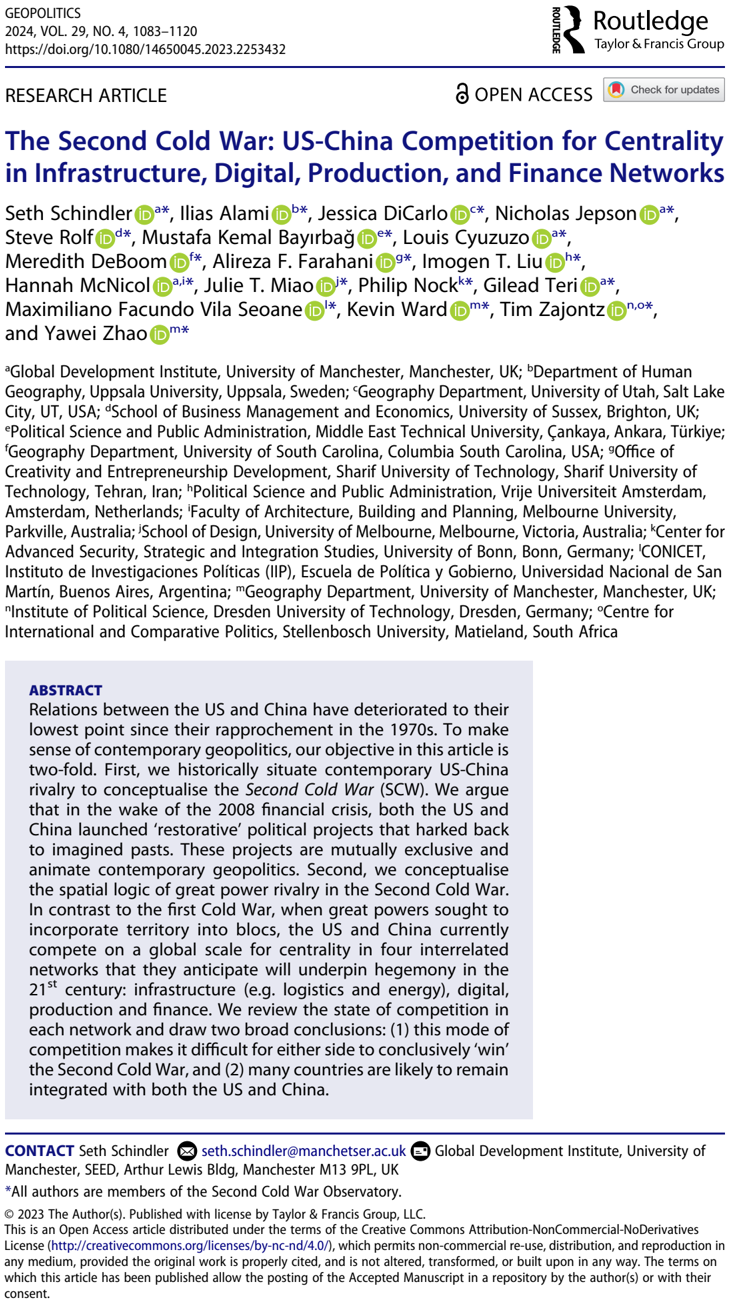
Relations between the US and China have deteriorated to their lowest point since their rapprochement in the 1970s.
Verified 2026-11-25 · 1 reference not checked yet
Overview
CoChat Summary
TL;DR
The article conceptualises contemporary US-China rivalry as a Second Cold War (CWII), a discrete period in a longer challenge to the US-led order, distinguished from the first Cold War by competition for centrality in infrastructure, digital, production, and finance networks rather than territorial blocs. It concludes that this network-based competition makes a conclusive victory difficult for either side and that many countries can remain integrated with both powers.
Key findings
- After the 2008 financial crisis, the US and China launched mutually exclusive “restorative” projects—Xi Jinping’s “national rejuvenation” and Trump’s “Make America Great Again”—which entrenched zero-sum competition; Biden expanded the contest as democracy versus authoritarianism and sought to rally allies through initiatives such as B3W/PGII.
- CWII’s spatial logic is network centrality, not territorial containment: the US and China compete in four interrelated networks—infrastructure, digital, production, and finance—through rule-setting, restructuring networks, or building alternatives (e.g., BRI vs. PGII/DFC, Clean Network Initiative, Made in China 2025 and the Chips and Science Act, renminbi internationalisation and the petroyuan).
- The paper reports that China’s CDB and CHEXIM lent nearly half a trillion dollars internationally between 2008 and 2019, on par with the World Bank; in 2022, 60% of China’s overseas lending portfolio supported debtors in distress, up from 5% in 2010; the US Chips and Science Act provides US$52bn in state support; 2021 grants to MiC2025 firms totalled US$31bn; and the 2022 US-Africa Leaders Summit committed $519mil.
- The authors conclude that neither side is likely to conclusively “win” CWII, and many countries are embracing “omni-alignment,” integrating with both the US and China across different networks; if forced to choose, the world may splinter into rival blocs with parallel networks.
Methods
- Conceptual and historical analysis: the paper reframes the Cold War and CWII as discrete periods in a longer historical sequence whose unifying principle is a sustained challenge to the US-led international order, drawing on critical geopolitical economy and Cold War historiography.
- It reviews the state of competition in four networks—infrastructure, digital, production, and finance—using secondary literature, policy documents, media reports, and illustrative cases rather than original survey or experimental data.
- The main analytical framework is network centrality: it examines strategies such as establishing rules, restructuring networks, and building alternative networks, and assesses implications for third countries’ alignment.
Limitations
- Stated: more research is required to explore the extent to which structural power within networks translates into structural and material power in international relations and the global economy; future research should assess how competition across the four networks—and additional networks such as security and media—is interrelated.
- Stated: the authors call for moving beyond a state-centric approach to explore how CWII manifests in regions, cities, and neighbourhoods, and how those locations shape the geopolitics and geoeconomics of CWII.
- Evident from the text: the article is a conceptual synthesis relying on secondary sources and fast-moving contemporary events, with no systematic dataset or causal identification; the authors also acknowledge that boundaries between the four networks are blurry.
Model-written summary. Check it against the paper before relying on it.
Integrity signals
Registry
Cites
Statistics
Figures


Verification
Claims the paper makes
9 Valid · 2 Not valid · 56 Not checked · 98 Own results and interpretations
The cited sources support only part of this claim — read each source’s verdict below.
In the paper
“In the wake of the economic crisis in 2008, a consensus was forged between new Keynesians and neoliberal hardliners surrounding the merits of state-coordinated infrastructure-led development (Alami, Dixon, and Mawdsley 2021;Schindler and Kanai 2021;Schindler, Alami, and Jepson 2023).”
§ The Second Cold War: US-China Competition for Centrality in Infrastructure, Digital, Production, and Finance Networks > Infrastructure Networks
What the sources say
- Partly supportedcites Alami, Dixon, and Mawdsley 2021 matched to “State Capitalism and the New Global D/development Regime” (2021) sourceExperimental — accuracy not yet measured
The “National Development and Policy Banks” section says the 2008 crisis highlighted a need for countercyclical tools and describes a growing need for state finance of large-scale infrastructure. It does not say that new Keynesians and neoliberal hardliners forged a consensus on infrastructure-led development. Page numbers are unavailable in our copy. (LLM, conf=0.84)
- Not checked — no full text of the sourcecites Schindler and Kanai 2021 matched to “Getting the territory right: infrastructure-led development and the re-emergence of spatial planning strategies” (2021) source
- Not matchedcites Schindler, Alami, and Jepson 2023
An author–year citation the paper’s reference list doesn’t settle. We don’t search these by name.
plainstates a cause- Asserted: passes — The authors put it forward as true.
- Checkable: passes — It can be checked against evidence.
- Load-bearing: unclear — It is unclear whether the paper’s conclusions depend on it.
- Based: passes — The paper gives a reason why it holds.
- Partly supported
Every source the paper cites for this claim was checked and supports it.
In the paper
“Rather than financing new infrastructure projects, Horn et al. (2023, 2) estimate that in 2022 '60% of China's overseas lending portfolio supports debtors in distress, up from just 5% in 2010'.”
§ The Second Cold War: US-China Competition for Centrality in Infrastructure, Digital, Production, and Finance Networks > Infrastructure Networks
What the sources say
- Supportedcites Horn et al. 2023 matched to “China as an International Lender of Last Resort” (2023) source
Appendix I.4 states the quoted figures: as of 2022, 60% of China’s overseas lending portfolio supported debtors in distress, up from 5% in 2010. The Introduction also describes reduced new overseas lending and a rise in bailouts to distressed countries. The appendix cites an earlier Horn et al. work for the figures, but this paper reports them. (LLM, conf=0.94)
hedgedstates an association- Asserted: passes — The authors put it forward as true.
- Checkable: passes — It can be checked against evidence.
- Load-bearing: passes — The paper’s conclusions depend on it.
- Based: passes — The paper gives a reason why it holds.
- Supported
The cited sources support only part of this claim — read each source’s verdict below.
In the paper
“Thus, the US sought to exert influence over Beijing by threatening to restrict its participation in GPNs (Löfflmann 2016).”
§ The Second Cold War: US-China Competition for Centrality in Infrastructure, Digital, Production, and Finance Networks > Production Networks
What the sources say
- Partly supportedcites Löfflmann 2016 matched to “The Pivot between Containment, Engagement, and Restraint: President Obama’s Conflicted Grand Strategy in Asia” (2016) sourceExperimental — accuracy not yet measured
In “The economic pivot” (page unavailable), the paper says China was not part of TPP negotiations and that Beijing feared the agreement was designed to exclude it. That supports the broader idea of US economic pressure, but it does not say the US threatened to restrict China’s participation in global production networks; the same section says the door to Chinese TPP membership remained open. (LLM, conf=0.82)
plainstates a cause- Asserted: passes — The authors put it forward as true.
- Checkable: passes — It can be checked against evidence.
- Load-bearing: unclear — It is unclear whether the paper’s conclusions depend on it.
- Based: passes — The paper gives a reason why it holds.
- Partly supported
The cited sources support only part of this claim — read each source’s verdict below.
In the paper
“In comparison to China's earlier industrial policy, the plan affords the partystate broader scope in allocating resources (McBride and Chatzky 2019) through grants, tax breaks, loans, and direct investments from an expanding array of investment vehicles that increasingly blur the lines between state and private control (e.g.state-managed private equity fund) (Pearson, Rithmire, and Tsai 2022).”
§ The Second Cold War: US-China Competition for Centrality in Infrastructure, Digital, Production, and Finance Networks > Production Networks
What the sources say
- Not matchedcites McBride and Chatzky 2019
An author–year citation the paper’s reference list doesn’t settle. We don’t search these by name.
- Partly supportedcites Pearson, Rithmire, and Tsai 2022 matched to “China's Party-State Capitalism and International Backlash: From Interdependence to Insecurity” (2022) sourceExperimental — accuracy not yet measured
Split into 2 atoms — 1 confirmed, 1 partially supported, 0 disputed, 0 misattributed, 0 unverifiable. Expand the claim to see per-atom verdicts.
plainstates a cause- Asserted: passes — The authors put it forward as true.
- Checkable: passes — It can be checked against evidence.
- Load-bearing: passes — The paper’s conclusions depend on it.
- Based: passes — The paper gives a reason why it holds.
- Not matched
The cited sources support only part of this claim — read each source’s verdict below.
In the paper
“With a post-Covid sovereign debt crisis now mounting, China's distinct lending modalities and preference for case-by-case (even loan-by-loan) negotiations have contributed to a logjam in restructuring efforts for states that have struggled to repay debts -such as Sri Lanka, Zambia and Ethiopia -to a variety of private, bilateral and multilateral creditors (Acker, Brautigam, and Huang 2020; DeBoom”
§ The Second Cold War: US-China Competition for Centrality in Infrastructure, Digital, Production, and Finance Networks > Financial Networks
What the sources say
- Partly supportedcites Acker, Brautigam, and Huang 2020 matched to “Debt Relief with Chinese Characteristics” (2020) sourceExperimental — accuracy not yet measured
Section 4.4 (page not supplied) says Chinese creditors generally restructure loan by loan and seek case-by-case solutions; it also describes separate negotiations with Chinese lenders in Ethiopia. It does not say these practices caused a restructuring logjam in Sri Lanka, Zambia or Ethiopia. For the cases it compares with private creditors, the section says agreements were reached more quickly with China. (LLM, conf=0.86)
- Not matchedcites DeBoom 2020
An author–year citation the paper’s reference list doesn’t settle. We don’t search these by name.
- Not matchedcites Jayasinghe 2022
An author–year citation the paper’s reference list doesn’t settle. We don’t search these by name.
plainstates a cause- Asserted: passes — The authors put it forward as true.
- Checkable: passes — It can be checked against evidence.
- Load-bearing: passes — The paper’s conclusions depend on it.
- Based: passes — The paper gives a reason why it holds.
- Partly supported
82 more claims
Create a free account to see all 165 claims and to verify the 9 references still open.
- It may state two separate claims as one. 60
- Probably not a substantial claim. 31
Self-check
Percentages, sums and reported differences re-computed from the paper’s own numbers.
Each contradiction between two passages listed here was confirmed by an independent check.
Rated minor: it would not touch a result — a value no result rests on, a p-value that stays on the same side of the significance level, or a conflict that is clerical, resolved elsewhere in the paper, or outside its own findings.
In the paper
§ The Second Cold War: US-China Competition for Centrality in Infrastructure, Digital, Production, and Finance Networks > References
“Pompeo, M. R. 2020a. Communist China and the Free World's future.”
§ The Second Cold War: US-China Competition for Centrality in Infrastructure, Digital, Production, and Finance Networks > References
“Accessed January 23, 2006.”
Rated minor: it would not touch a result — a value no result rests on, a p-value that stays on the same side of the significance level, or a conflict that is clerical, resolved elsewhere in the paper, or outside its own findings.
In the paper
§ The Second Cold War: US-China Competition for Centrality in Infrastructure, Digital, Production, and Finance Networks > References
“White House. 2022a. FACT SHEET: CHIPS and Science Act Will Lower Costs, Create Jobs, Strengthen Supply Chains, and Counter China,”
§ The Second Cold War: US-China Competition for Centrality in Infrastructure, Digital, Production, and Finance Networks > References
“January 26, 2023. Accessed January 26, 2023.”
Citations
Cites
(2010) · Intellectum (Universidad de La Sabana) · doi:10.1111/j.1467- · Cited by 16,131
(1996) · Institutional Research Information System University of Turin (University of Turin) · doi:10.1111/j · Cited by 5,486
The tragedy of Great Power politics
(2002) · Choice Reviews Online · doi:10.5860/choice.39-5464 · Cited by 3,594 · cited 1×
“While isolated voices called in vain for the ‘pre-emptive containment’ of China (see Mearsheimer 2001, 397–402), Washington afforded Beijing respect and recognition as a rising power.”
Power and Interdependence: World Politics In Transition
(2017) · The SHAFR Guide Online · doi:10.1163/2468-1733_shafr_sim280020670 · Cited by 3,073
Cultural Backlash: Trump, Brexit, and Authoritarian Populism
Norris, P., & Inglehart, R. (2019) · doi:10.1017/9781108595841 · Cited by 2,986
The territorial trap: The geographical assumptions of international relations theory
Agnew, J. (1994) · Review of International Political Economy · doi:10.1080/09692299408434268 · Cited by 2,549 · cited 1×
“As Agnew (1994, 72) has argued, realist interpretations of global politics ‘came to prominence during the Cold War when, one could claim, their orientations to state territoriality had a certain validity’.”
BackgroundDilemma not Trilemma: The Global Financial Cycle and Monetary Policy Independence
Rey, H. (2015) · National Bureau of Economic Research · doi:10.3386/w21162 · Cited by 2,027 · cited 1×
“Although Chinese lending has contributed to the current sovereign debt crisis, its origins primarily lie in the increased exposure of many world regions to cyclical dollar financing conditions since 2008 (Alami 2019; Rey 2015).”
Weaponized Interdependence: How Global Economic Networks Shape State Coercion
Farrell, H., & Newman, A. L. (2019) · International Security · doi:10.1162/isec_a_00351 · Cited by 1,879 · cited 2×
“State-centric territorial competition has been substantially displaced in significance by an economic globalisation which ‘creates its own set of international structures – through global networks – and thus generates new forms of state power [and conflict]’ (Farrell and Newman 2019, 75).”
Background‘Globalizing’ regional development: a global production networks perspective
Coe, N. M., Hess, M., Yeung, H. W., Dicken, P., & Henderson, J. (2004) · Transactions of the Institute of British Geographers · doi:10.1111/j.0020-2754.2004.00142.x · Cited by 1,439 · cited 1×
“As such, scholars called for cities and regions to proactively engage GPNs to create, add and capture value (Coe et al. 2004).”
BackgroundThe China Shock: Learning from Labor-Market Adjustment to Large Changes in Trade
Autor, D. H., Dorn, D., & Hanson, G. H. (2016) · Annual Review of Economics · doi:10.1146/annurev-economics-080315-015041 · Cited by 1,305 · cited 1×
“Meanwhile, deindustrialisation and the prolonged decline of once-prosperous communities in middle America were increasingly attributed to the ‘China Shock’ (Autor, Dorn, and Hanson 2016).”
Background
Research works printed but not linked: 10
- 12. Agnew, J. 2003. Geopolitics: Re-visioning world politics. London: Routledge.
- 21. Amnesty International. 2006. Undermining freedom of expression in China: The role of Yahoo!, Microsoft and Google. London: Amnesty International.
- 38. Brooks, S. G., and W. C. Wohlforth. 2023. The myth of multipolarity: American power's staying power. Foreign Affairs 102 (3):76-91.
- 42. Campbell, K. M., and E. Ratner. 2018. The China reckoning: How Beijing defied American expectation. Foreign Affairs 97 (2):60-70.
- 82. Gallagher, K. P., and R. Kozul-Wright. 2021. The case for a new Bretton Woods. Cambridge, UK: Polity.
- IMF. 2023a. Geoeconomic fragmentation and the future of multilateralism. Washington, D.C: International Monetary Fund.
- 124. Le Thu, H. 2023. How to survive a great-power competition. Foreign Affairs 102 (3):30-35.
- 166. Roubini, N., and B. Setser. 2005. Will the Bretton Woods 2 regime unravel soon?: The risk of a hard landing in 2005-2006. National Bureau of Economic Research. Proceedings of the Federal Reserve Bank of San Francisco.
- 195. White House. 2020. Executive Order 13959 of November 12, 2020: Addressing the threat from securities investments that finance communist Chinese military companies. Federal Register 85 (222):73185-89.
- 204. Yan, X. 2021. Becoming strong: The new Chinese foreign policy. Foreign Affairs 100 (4):40-47.
Cited by
Items 101–200 of 242
WARD, K. G., & Wiig, A. (2025) · Annals of the American Association of Geographers · doi:10.1080/24694452.2025.2514033 · Cited by 1
Self-citationDiCarlo, J., & Paudel, D. (2025) · Third World Quarterly · doi:10.1080/01436597.2025.2522292 · Cited by 4
“In contrast to the rigid ideological blocs that shaped Cold War alignments, today’s geopo-litical landscape – what some have termed a Second Cold War (Schindler et al. 2024) – is structured by competition across infrastructure, production, finance and digital networks.”
InfluentialSelf-citationOne step forward, two steps back: centring the state in the hybrid logics of US decarbonization
Green, J. (2025) · Environmental Politics · doi:10.1080/09644016.2025.2540683 · Cited by 2
McNicol, H. (2025) · Third World Quarterly · doi:10.1080/01436597.2025.2558078 · Cited by 1
“…development player has become evident in the significant uptake of Chinese spatial, state-led and infrastructure focused policies, such as Special economic Zones (SeZs), by low-income countries along the Belt and Road (BRI) (Alami and Dixon 2020; Schindler et al. 2024; Schindler and Kanai, 2021).”
Self-citationAlves, A. C. (2025) · Third World Quarterly · doi:10.1080/01436597.2025.2580445 · Cited by 2
Situating automated infrastructure: (Dis)continuities, contingencies and spatialities
Lin, W., Adey, P., Harris, T. M., & Brady, D. (2025) · Environment and Planning D Society and Space · doi:10.1177/02637758251397281 · Cited by 1
“The spatial rootedness of digitality is taking on a practical signi fi cance as uneven digital access is reinterpreted from temporary growing pains on the path to global ubiquity to a form of durable national advantage (Schindler et al., 2024; Brady, 2025).”
Abels, J. (2025) · Global Policy · doi:10.1111/1758-5899.70118 · Cited by 1
Artificial Intelligence in Compromised Geographies: Redefining Power and Territorial Challenges
Epasto, S. (2026) · Key challenges in geography · doi:10.1007/978-3-032-05201-8_8 · Cited by 1
Beerepoot, N. (2026) · Globalizations · doi:10.1080/14747731.2025.2599681 · Cited by 3
Modes of state-led globalization: a comparative case on Chinese and Turkish investments in Africa
Yu, C., & Ergenç, C. (2026) · Third World Quarterly · doi:10.1080/01436597.2025.2604290 · Cited by 1
“…recent scholarship argues that they reflect the continued evolution of neoliberalism through crisis (Jessop 2008, 2011). others frame these shifts in terms of geopolitical contestation, pointing to the rise of a new ‘Second Cold War’ between the united States and China (Schindler et al. 2024).”
InfluentialConclusion: W(h)ither Africa–China Relations?
Amoah, L. G. A. (2026) · Springer eBooks · doi:10.1007/978-981-95-4370-0_14 · Cited by 1
AI, Information and Maritime Security: Implications for Global Trade and Geopolitical Competition
Mehmood, Z. H. (2026) · Contributions to international relations · doi:10.1007/978-3-032-13528-5_10 · Cited by 5
Shifting sands and ecological uncertainties: An urban political ecology of dredging in Mombasa
Cyuzuzo, L. (2026) · Environment and Planning E Nature and Space · doi:10.1177/25148486261420090 · Cited by 2
Self-citationThe “World-Systems Theory in the Age of the Belt and Road Initiative (BRI)
Nisar, R. D., & Rahim, T. (2026) · Chinese Journal of International Review · doi:10.1142/s2630531326500034 · Cited by 2
Why Ports Matter to Cities: Understanding the Importance of Logistics‐Led Urbanism
Nikolovski, T., & Wiig, A. (2026) · Geography Compass · doi:10.1111/gec3.70065 · Cited by 1
Schindler, S., Altun, S., & Bayırbağ, M. K. (2026) · Third World Quarterly · doi:10.1080/01436597.2026.2621910 · Cited by 3
“Thus, while the Cold War was essentially a rene-gotiation of the agreements reached at the yalta Conference, the Second Cold War is a rene-gotiation of globalisation, and to this end the US and China compete for control over the transnational networks that underpin interdependence and global economic integration: infr…”
InfluentialSelf-citationWang, J., & Moisio, S. (2026) · Geopolitics · doi:10.1080/14650045.2026.2659596 · Cited by 1
Veselinovič, J., & de Graaff, N. (2026) · Politics and Governance · doi:10.17645/pag.11403 · Cited by 5
“Finally, alliance‐building around competing blocs brought to the fore the issue of political and security dependencies, as is most obviously the case in Trump’s cross‐leveraging of NATO membership in negotiations with the EU and its members (Desmaele, 2023; Foy, 2025; Schindler et al., 2023).”
Abildgaard, M. S., & Gad, U. P. (2026) · Geopolitics · doi:10.1080/14650045.2026.2648553 · Cited by 1
“For example, Greenland’s role in Arctic shipping, telecommunications, and energy systems resonates with the ‘net-worked geopolitics’ described by Schindler et al. (2024) as characteristic of a Second Cold war geared not towards territorial control, but towards influence over networks and their…”
Aoyama, Y., León, L. F. A., & Wang, S.-Y. (2026) · Economic Geography · doi:10.1080/00130095.2026.2687516 · Cited by 3
The Spatial Limits to Weaponizing Interdependence: TSMC in the US–China Chip War
Baines, J., Rolf, S., & Germann, J. (2026) · Economic Geography · doi:10.1080/00130095.2026.2689124 · Cited by 3
“Scholars have explored these geoeconomic dynamics (e.g., Schindler et al. 2024).”
Self-citationRolf, S., Schindler, S., Lim, K. F., & Henderson, J. (2026) · Economic Geography · doi:10.1080/00130095.2026.2692442 · Cited by 4
“…geopolitical and geo-economic turbulence sits what has been termed a Second Cold War between the US and China—a superpower rivalry that has become an increasingly structural and enduring feature of the global political economy over the past decade (Schindler et al. 2024; Schindler and Rolf 2025).”
Self-citationContemporary Geopolitics-cum-Geoeconomics in East Africa: New Scrambles and Omni-alignments
Zajontz, T., & Shangwe, M. J. (2024) · Springer eBooks · doi:10.1007/978-3-031-25399-7_15-2 · Cited by 1
Self-citationBook Forum on Hans Kundnani's Eurowhiteness: Culture, Empire and Race in the European Project
Auer, S., Barša, P., Gagyi, Á., & Kundnani, H. (2024) · Czech Journal of International Relations · doi:10.32422/cjir.1717 · Cited by 1
Veselinovič, J. (2025) · The International Spectator · doi:10.1080/03932729.2025.2495934 · Cited by 1
“…must be understood in the broader context of the EU finding its place in a global landscape increasingly defined by US-PRC ‘strategic competition’ (Schindler et al. 2023), where geoeconomics – here defined as the fact that “beyond military, state-centred forms of ‘hard’ power contentions, today’s…”
Gonzalez-Parias, C. H., Bedoya, J. C. M., Bustamante, P. P., & Muñoz-Muñoz, J. P. (2025) · Revista Científica General José María Córdova · doi:10.21830/19006586.1419 · Cited by 2
Contemporary Geopolitics-cum-Geoeconomics in East Africa: New Scrambles and Omni-alignments
Zajontz, T., & Shangwe, M. J. (2024) · Springer eBooks · doi:10.1007/978-3-031-25399-7_15-1
Self-citationPitts, F. H. (2024) · European Journal of Social Theory · doi:10.1177/13684310241247548
“…powers are party – calls into question both the ascription of terms like ‘imperialism’ as well as the notion that the current context resembles a ‘new’ or ‘second’ version of the realist, rationally calculating Cold War witnessed in the twentieth-century (Achcar, 2023; Schindler et al., 2023).”
Forging New Alliances in the Indo-Pacific Region
Parashar, S. V. C. (2024) · Advances in public policy and administration (APPA) book series · doi:10.4018/979-8-3693-1690-0.ch008
The Trust Deficit. EU Bargaining for Access and Control over Cloud Infrastructures.Preprint
Blancato, F. G., & Carr, M. (2024) · SSRN Electronic Journal · doi:10.2139/ssrn.4843466
Alami, I., & Dixon, A. D. (2024) · Oxford University Press eBooks · doi:10.1093/9780198925224.002.0005
Self-citationAlami, I., & Dixon, A. D. (2024) · Oxford University Press eBooks · doi:10.1093/9780198925224.002.0008
Self-citationAlami, I., & Dixon, A. D. (2024) · Oxford University Press eBooks · doi:10.1093/9780198925224.002.0007
Self-citationState Capitalism Begets State Capitalism: On Combination and Political Multiplicity
Alami, I., & Dixon, A. D. (2024) · Oxford University Press eBooks · doi:10.1093/9780198925224.003.0005 · Cited by 1
Self-citationAlami, I., & Dixon, A. D. (2024) · Oxford University Press eBooks · doi:10.1093/9780198925224.003.0001
Self-citationThe Problématique of State Capitalism
Alami, I., & Dixon, A. D. (2024) · Oxford University Press eBooks · doi:10.1093/9780198925224.003.0003 · Cited by 1
Self-citationAlami, I., & Dixon, A. D. (2024) · Oxford University Press eBooks · doi:10.1093/9780198925224.002.0006
Self-citationConclusion: A Spectre Haunting Capitalism?
Alami, I., & Dixon, A. D. (2024) · Oxford University Press eBooks · doi:10.1093/9780198925224.003.0009
Self-citationLiberal Anxieties and Ideological Adjustment in Global Development
Alami, I., & Dixon, A. D. (2024) · Oxford University Press eBooks · doi:10.1093/9780198925224.003.0008
Self-citationThe Rhetorical Weaponization of the New State Capitalism
Alami, I., & Dixon, A. D. (2024) · Oxford University Press eBooks · doi:10.1093/9780198925224.003.0007
Self-citationPassalacqua, C. C. (2024) · The International Spectator · doi:10.1080/03932729.2024.2401566
“Foreign-sponsored infrastructure plans have become central to the geo-economic competition between the United States (US), the People ’ s Republic of China (PRC) and the European Union (EU) (Gaens and Sinkkonen 2023; Schindler et al .”
Contemporary Geopolitics-cum-Geoeconomics in East Africa: New Scrambles and Omni-alignments
Zajontz, T., & Shangwe, M. J. (2024) · Springer eBooks · doi:10.1007/978-3-031-47227-5_15 · Cited by 1
Self-citationCold War Echoes and Shifting Movements: Russia-West Tensions and International Migration
Saha, P. (2024) · Springer eBooks · doi:10.1007/978-981-99-8001-7_91-1
China-US 5G Competition: Narrow Economic Competition and Broad Security Competition
Zhang, Q. (2025) · Advances in Economics Management and Political Sciences · doi:10.54254/2754-1169/2025.20063
Mamadouh, V., Koch, N. R., Woon, C. Y., et al. (2025) · doi:10.1002/9781119753995.ch1
From Neoliberal Openness to Sovereign Openness: Analysing Imaginaries of European Digital Policies
Münßinger, M., Schröder-Bergen, S., & Glasze, G. (2025) · Geopolitics · doi:10.1080/14650045.2025.2507606 · Cited by 3
US-China geo-political rivalry and India’s geo-cultural outreach to global south
Choudhary, A. (2025) · International Journal of Political Science and Governance · doi:10.33545/26646021.2025.v7.i5b.539
“The U.S. and China are now competing for dominance in four interconnected global networks: infrastructure, digital, production, and finance (Schindler et al ., 2023) [60] .”
Infrastruktura kao sociološki fenomen: ontološke i razvojne dimenzije
Bilić, P. (2025) · Sociologija i prostor · doi:10.5673/sip.62.3.5
Puranen, M. (2025) · Central European Journal of International and Security Studies · doi:10.51870/ujvi8292
Whose head servant? TikTok’s conundrum between digital capitalism and states
Tang, M., & Song, L. (2025) · Chinese Journal of Communication · doi:10.1080/17544750.2025.2528825 · Cited by 2
“Against this backdrop, communication scholars have examined how relations between states play out in respect to information technologies and network infrastructure (Schiller, 2011; Schindler et al., 2024).”
Chung, D.-K., jun-young, K., Chang, Y., et al. (2025) · SSRN Electronic Journal · doi:10.2139/ssrn.5368377
Maçães, B. (2025) · Cambridge University Press eBooks · doi:10.1017/9781009397414.008
Rise of the East: Economic Implications of the Geopolitical Shift
van Niekerk, A. J. (2025) · Springer eBooks · doi:10.1007/978-3-031-93267-0_1
Is Mark Carney turning his back on climate action?
Lange, D. (2025) · doi:10.64628/aam.h4gey4ews
Sulleiman, M., Ahmed, R., Kay, M. G., Manogharan, G. P., & McComb, C. (2025) · Proceedings of the Design Society · doi:10.1017/pds.2025.10214 · Cited by 1
“Beyond traditional conflicts, trade wars can also cause significant global impacts (Schindler et al., 2024; Zhao, 2023).”
Luigi, C. D., Clark, G. L., & Wójcik, D. (2025) · Economic Geography · doi:10.1080/00130095.2025.2543505 · Cited by 2
“…markets (particularly oil) to establish its commodity derivatives as benchmarks and enhance its influence as the issuer of the renminbi (Dalio 2021; Schindler et al. 2024), its wheat futures market remains largely absent, likely due to a combination of factors, including China’s protec-tionist…”
Artificial Intelligence and Cyberspace
Kushnyr, E. (2025) · Advances in computational intelligence and robotics book series · doi:10.4018/979-8-3373-2419-7.ch014 · Cited by 1
The U.S. and China: Policy Approaches to Sanctions and Counter Sanctions
Николаевич, Т. И. (2025) · Vestnik RUDN International Relations · doi:10.22363/2313-0660-2025-25-3-538-552 · Cited by 2
Seoane, M. F. V. (2025) · Latin American Policy · doi:10.1111/lamp.70034
“For example, in the context of increasing rivalry between China and the United States for centrality in numerous networks (Schindler et al. 2023), especially technology ‐ related ones, both superpowers offer other states opportunities for cooperation in science and technology.”
Self-citationTech Cold War: China at the Gate
Türkcan, B., & Mutluer, M. (2025) · Uluslararası sosyal, siyasal ve mali araştırmalar dergisi. · doi:10.70101/ussmad.1660326
Public Debt and Social Inclusion in Africa: Theoretical and Empirical Perspectives
Mutizwa, B., & Pasara, M. T. (2025) · Advances in African economic, social and political development · doi:10.1007/978-3-032-00525-0_10
Murphy, S. P., & McMahon, C. (2025) · Geopolitics · doi:10.1080/14650045.2025.2585304 · Cited by 1
“, which seeks to further consolidate and expand market regulation under the auspices of the strong state (see also Alami and Dixon 2024, Schindler et al. 2023, Alami and Taggart 2024).”
US-China Digital Competition in Africa: The Perspectives of IR Theories
Åberg, J. H. S. (2025) · Studies in digital politics and governance · doi:10.1007/978-3-032-04269-9_11
Steering FinTech: Techno-industrial policy for the data-driven economy in China’s Greater Bay Area
Anguelov, D. (2025) · Environment and Planning A Economy and Space · doi:10.1177/0308518x251394557
“…‘indigenous innovation’ capacities and digital platforms, while enabling it to compete on the global stage through the export of technological networks, standards and goods (Heeks et al., 2024; Schindler et al., 2023), and through the expansion of financial networks abroad (Balmas and Dörry, 2022).”
Bora, S. I. (2025) · Springer eBooks · doi:10.1007/978-981-95-1507-3_6
ABD-Çin Rekabeti Bağlamında Kuşak ve Yol İnisiyatifi ve Denizcilik Sektörü
Hoca, B., & Tutan, M. U. (2025) · Fiscaoeconomia · doi:10.25295/fsecon.1673086
Kirwan, C. G., & Zhiyong, F. (2025) · Elsevier eBooks · doi:10.1016/b978-0-443-23621-1.00001-1
Peruffo, L., Cunha, A. M., & Araripe, T. L. A. (2025) · Springer eBooks · doi:10.1007/978-981-95-1169-3_16
When Trade Turns Strategic: Lessons from Fourteen Trade Wars for U.S.-China Strategic CompetitionPreprint
Neos, N. (2026) · SSRN Electronic Journal · doi:10.2139/ssrn.5805382
Navigating the Turbulent Waters of Strategic Competition to Implement an Inclusive Green Agenda
Martín, R. D., & Economics, R. (2026) · Palgrave studies in Latin American heterodox economics · doi:10.1007/978-3-032-08588-7_5
Pollio, A. (2026) · University of California Press eBooks · doi:10.1525/luminos.262.b
Coda: Thinking Technology Elsewhere, and Otherwise
Pollio, A. (2026) · University of California Press eBooks · doi:10.1525/luminos.262.h
Introduction: The Silicon Savannah’s Beijing Connection
Pollio, A. (2026) · University of California Press eBooks · doi:10.1525/luminos.262.a
Ethnographies of Techno-Optimism
Pollio, A. (2026) · University of California Press eBooks · doi:10.1525/luminos.262.g
Pollio, A. (2026) · University of California Press eBooks · doi:10.1525/luminos.262.e
Pollio, A. (2026) · University of California Press eBooks · doi:10.1525/luminos.262.f
Platforms of Algorithmic Suturing
Pollio, A. (2026) · University of California Press eBooks · doi:10.1525/luminos.262.d
Pollio, A. (2026) · University of California Press eBooks · doi:10.1525/luminos.262.c
The US-China Competition in Southeast Asia from the Perspective of Offensive Realism
Nghi, N. T., & Tu, N. C. (2025) · Strategic Analysis · doi:10.1080/09700161.2025.2604352
“U S-China relations reached their lowest point since the two countries began rapprochement in the 1970s (Schindler et al. 2023).”
Power Asymmetries in BRICS: Serving the Global South or Entrenching Sino‑Russian Interests?
Hadebe, S. P. (2026) · Journal of BRICS Studies · doi:10.36615/xw9mkn74
“Cloud capital also intersects with high-tech sectors like aerospace, biotechnology and clean energy (Schindler et al., 2023).”
Bickhardt, M. (2026) · Capitalism Nature Socialism · doi:10.1080/10455752.2026.2620443
China in Africa: A Sub-imperialist Power?
Amoah, L. G. A. (2026) · Springer eBooks · doi:10.1007/978-981-95-4370-0_2 · Cited by 2
Padma Bridge and Infrastructural Sacredness in Bangladesh
Hou, P. (2025) · South Asia Research · doi:10.1177/02627280261421122
Towards a unified labour value theory of inflation
Hoca, B. (2026) · Economy and Society · doi:10.1080/03085147.2025.2601465
Charting 25 years of labour geographies in JEG
James, A., & MacLeavy, J. (2026) · Journal of Economic Geography · doi:10.1093/jeg/lbag007 · Cited by 1
Surprise, K. (2026) · Environment and Planning E Nature and Space · doi:10.1177/25148486261421780 · Cited by 1
The Consequences of ‘Eastern Opening’: Hungary's FDI Shift to China Under Orbán
Sebők, M., Kozák, S., & Tőrös, Á. (2026) · Europe Asia Studies · doi:10.1080/09668136.2026.2619047
“T HE GROWING GEOPOLITICAL TENSION BETWEEN THE W EST , led by the United States and the European Union, and the East (usually associated with Chinese economic interests) was one of the most critical and widely discussed global economic issues in the early 2020s (Malkin 2022; Schindler et al .”
Saari, L. (2026) · Competition & Change · doi:10.1177/10245294261429545 · Cited by 4
Ruguanxue: A Geopolitical Bricolage
Ma, M. (2026) · Geopolitics · doi:10.1080/14650045.2026.2639583
“As sanctions targeted ‘Chinese tech firms’ and ‘China home-grown tech giants’ (Schindler et al. 2024, 16), many Chinese observers perceived a clear reluctance to accommodate their rise (see Ha and Willnat 2022).”
Between compute and geopolitics: The hyperscale pursuit of global infrastructural power
Hoskins, G. T., & Winseck, D. R. (2026) · Journal of Digital Media & Policy · doi:10.1386/jdmp_00192_1
Webber, S., & Bryant, G. (2026) · Environment and Planning A Economy and Space · doi:10.1177/0308518x261428260
“While the networks and connections contested in this Second Cold War may have shifted, its patterning of social, economic and ecological impact remain familiar.”
InfluentialThe political power of digital multinational companies in an era of geo-technological competition
Dafe, F., & Heldt, E. C. (2026) · Review of International Political Economy · doi:10.1080/09692290.2026.2645101
“Digital technologies are an important element of geopolitical and geo-technological competition as they not only shape the functioning of economic and social structures but also transcend national borders (Schindler et al., 2024).”
Jaknanihan, A. A. (2026) · Australian Journal Of International Affairs · doi:10.1080/10357718.2026.2654403 · Cited by 1
“…of the international economy and supply chains governance is particularly evident in strategic sectors, such as critical minerals, semiconductors, and advanced technology, centred on US–China geoeconomic rivalry (Hauge, Houtzager, and Hörmann 2025; Liu and Lin 2025; Schindler et al .”
Pride and Patriotism: De-Otherness in US and Chinese Media Discourse on Techno-Nationalism
Guo, S. Z., Wang, D., & Xia, C. (2026) · Communication and the Public · doi:10.1177/20570473261440631
Methods of economic statecraft: A typology and an agenda for research
Lindgren, P. Y., & Waage, K. (2026) · European Journal of International Relations · doi:10.1177/13540661261436538 · Cited by 2
Poder nacional y competencia hegemónica en el contexto de la seguridad nacional de México
Arellano, E. O. (2025) · Revista Estrategia Poder y Desarrollo · doi:10.25062/2955-0289.4974
Geopolitical Rivalry and World Trade Law
Roberts, A., Moraes, H. C., Ferguson, V. A., & Lim, D. J. (2026) · Cambridge University Press eBooks · doi:10.1017/9781009490146.017
Meyer, L. (2026) · Contemporary European Politics · doi:10.1002/cep4.70041
The New Cold War: Global and East Asian Dimensions
Streltsov, D. V. (2024) · International Trends / Mezhdunarodnye protsessy · doi:10.46272/it.2024.22.2.77.3
Metadata
- Authors
- Schindler, S., Alami, I., DiCarlo, J., Jepson, N., Rolf, S., Bayırbağ, M. K., Cyuzuzo, L., DeBoom, M., Farahani, A. F., Liu, I. T., McNicol, H., Miao, J. T., Nock, P., Teri, G., Vila Seoane, M. F., Ward, K., Zajontz, T., & Zhao, Y.
- Affiliations
- University of Manchester (GB)
- Uppsala University (SE)
- University of Utah (US)
- University of Sussex (GB)
- Middle East Technical University (TR)
- University of South Carolina (US)
- Sharif University of Technology (IR)
- Vrije Universiteit Amsterdam (NL)
- The University of Melbourne (AU)
- University of Bonn (DE)
- Universidad Nacional de San Martín
- Stellenbosch University (ZA)
- Corresponding author
- Schindler, Seth
- ORCID
- Venue
- Geopolitics
- Publisher
- Informa UK Limited
- Published
- 2023-09-07
- Volume
- 29
- Issue
- 4
- Pages
- 1083-1120
- ISSN
- 1465-0045 (ISSN-L)
- 1557-3028
- OpenAlex
- W4386498142
- Semantic Scholar
- 9bcc499a3ea7e1beb68375b7ac5a4b8ee728c699
- Cited by
- 252
- References
- 158
- Citations by year
- 2026: 108 · 2025: 87 · 2024: 57
- FWCI
- 246.43
- Type
- journal article
- Language
- en
- Open access
- hybrid
- doi.org
- Licence
- Locations
- Geopolitics (publishedVersion, cc-by-nc-nd)
- Research Explorer (The University of Manchester) (publishedVersion, cc-by-nc-nd)
- OpenMETU (Middle East Technical University) (submittedVersion, cc-by-nc-nd)
- Uppsala University Publications (Uppsala University) (submittedVersion, other-oa)
- Figshare (submittedVersion, cc-by-nc-nd)
- VU Research Portal (submittedVersion, other-oa)
- Funders
- University of Manchester
- Topics
- Social Sciences › Political Science and International Relations › COVID-19, Geopolitics, Technology, Migration
- Social Sciences › Political Science and International Relations › International Relations and Foreign Policy
- Social Sciences › Political Science and International Relations › Global Political and Economic Relations
- Keywords
- new Cold War, US-China rivalry, great power competition, centrality, infrastructure networks, digital networks, production networks, financial networks, hegemony, 2008 financial crisis, logistics, energy
About these checks
Registry, retraction, Cites and statistics results are computed, not judged, with one exception: a printed reference that no index lists is read once by a model before it counts as a citation error. Claims are extracted by a model and kept only when their quote appears verbatim in the text; each cited source is then checked, with a model’s help, for whether it says what the claim relies on. Those verdicts can be wrong — read the claim’s quote and the cited source before relying on one.
The claim verdicts this report counts are experimental: their accuracy is not yet measured.
A language model drew the claims from the paper on 2026-09-30, under version 3 of the claim definition (model deepseek-v4.1-flash, prompt extract-v3).
A second model labelled each claim on 2026-09-30 (model jev-1.13-20260917, definition revision gold-guideline-v0.2).
Cited sources are checked with a language model’s help (gpt-6-sol).
Statistics and arithmetic are recomputed, not judged.
Confidence bands are shown only for fields calibrated on our annotated test set. None is calibrated yet, so no band is shown.
What counts as a claim ›How we measure confidence ›How we check this ›
Are you an author, or do you see a problem with this page? Request a review
Data sources
Bibliographic data: Semantic Scholar, OpenAlex, Crossref.
Contains information from the Semantic Scholar Academic Graph Datasets, made available under the ODC Attribution License (ODC-BY 1.0).
Semantic Scholar’s data is described in: Kinney, R., et al. (2023). The Semantic Scholar Open Data Platform. arXiv:2301.10140.
