

The Second Cold War: US-China Competition for Centrality in Infrastructure, Digital, Production, and Finance Networks
Open accessThe DOI matches its Crossref record; 168 of the 172 references it cites were found in a registry or an index, and 1 are not checked yet; 10 of the 85 sources its claims cite were checked for support.
Abstract
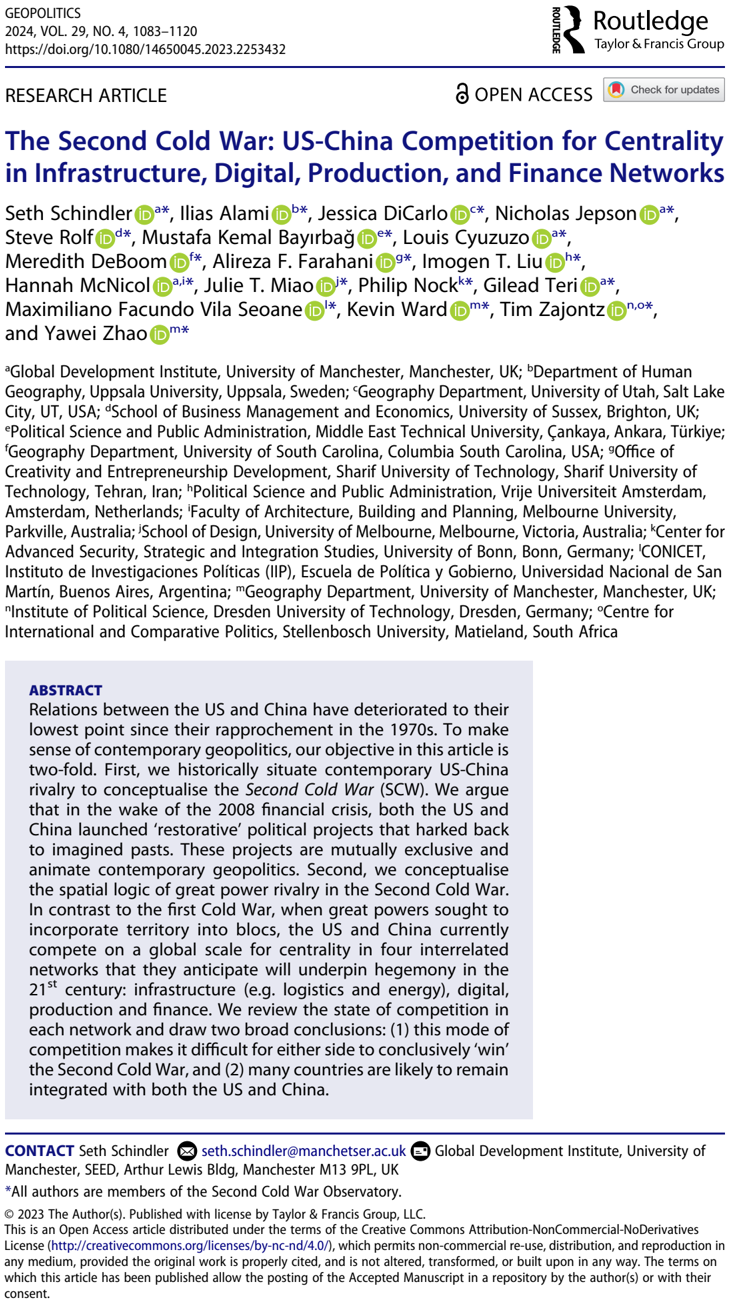
Relations between the US and China have deteriorated to their lowest point since their rapprochement in the 1970s.
Verified 2026-11-25 · 1 reference not checked yet
Overview
CoChat Summary
TL;DR
The article conceptualises contemporary US-China rivalry as a Second Cold War (CWII), a discrete period in a longer challenge to the US-led order, distinguished from the first Cold War by competition for centrality in infrastructure, digital, production, and finance networks rather than territorial blocs. It concludes that this network-based competition makes a conclusive victory difficult for either side and that many countries can remain integrated with both powers.
Key findings
- After the 2008 financial crisis, the US and China launched mutually exclusive “restorative” projects—Xi Jinping’s “national rejuvenation” and Trump’s “Make America Great Again”—which entrenched zero-sum competition; Biden expanded the contest as democracy versus authoritarianism and sought to rally allies through initiatives such as B3W/PGII.
- CWII’s spatial logic is network centrality, not territorial containment: the US and China compete in four interrelated networks—infrastructure, digital, production, and finance—through rule-setting, restructuring networks, or building alternatives (e.g., BRI vs. PGII/DFC, Clean Network Initiative, Made in China 2025 and the Chips and Science Act, renminbi internationalisation and the petroyuan).
- The paper reports that China’s CDB and CHEXIM lent nearly half a trillion dollars internationally between 2008 and 2019, on par with the World Bank; in 2022, 60% of China’s overseas lending portfolio supported debtors in distress, up from 5% in 2010; the US Chips and Science Act provides US$52bn in state support; 2021 grants to MiC2025 firms totalled US$31bn; and the 2022 US-Africa Leaders Summit committed $519mil.
- The authors conclude that neither side is likely to conclusively “win” CWII, and many countries are embracing “omni-alignment,” integrating with both the US and China across different networks; if forced to choose, the world may splinter into rival blocs with parallel networks.
Methods
- Conceptual and historical analysis: the paper reframes the Cold War and CWII as discrete periods in a longer historical sequence whose unifying principle is a sustained challenge to the US-led international order, drawing on critical geopolitical economy and Cold War historiography.
- It reviews the state of competition in four networks—infrastructure, digital, production, and finance—using secondary literature, policy documents, media reports, and illustrative cases rather than original survey or experimental data.
- The main analytical framework is network centrality: it examines strategies such as establishing rules, restructuring networks, and building alternative networks, and assesses implications for third countries’ alignment.
Limitations
- Stated: more research is required to explore the extent to which structural power within networks translates into structural and material power in international relations and the global economy; future research should assess how competition across the four networks—and additional networks such as security and media—is interrelated.
- Stated: the authors call for moving beyond a state-centric approach to explore how CWII manifests in regions, cities, and neighbourhoods, and how those locations shape the geopolitics and geoeconomics of CWII.
- Evident from the text: the article is a conceptual synthesis relying on secondary sources and fast-moving contemporary events, with no systematic dataset or causal identification; the authors also acknowledge that boundaries between the four networks are blurry.
Model-written summary. Check it against the paper before relying on it.
Integrity signals
Registry
Cites
Statistics
Figures


Verification
Claims the paper makes
9 Valid · 2 Not valid · 56 Not checked · 98 Own results and interpretations
The cited sources support only part of this claim — read each source’s verdict below.
In the paper
“In the wake of the economic crisis in 2008, a consensus was forged between new Keynesians and neoliberal hardliners surrounding the merits of state-coordinated infrastructure-led development (Alami, Dixon, and Mawdsley 2021;Schindler and Kanai 2021;Schindler, Alami, and Jepson 2023).”
§ The Second Cold War: US-China Competition for Centrality in Infrastructure, Digital, Production, and Finance Networks > Infrastructure Networks
What the sources say
- Partly supportedcites Alami, Dixon, and Mawdsley 2021 matched to “State Capitalism and the New Global D/development Regime” (2021) sourceExperimental — accuracy not yet measured
The “National Development and Policy Banks” section says the 2008 crisis highlighted a need for countercyclical tools and describes a growing need for state finance of large-scale infrastructure. It does not say that new Keynesians and neoliberal hardliners forged a consensus on infrastructure-led development. Page numbers are unavailable in our copy. (LLM, conf=0.84)
- Not checked — no full text of the sourcecites Schindler and Kanai 2021 matched to “Getting the territory right: infrastructure-led development and the re-emergence of spatial planning strategies” (2021) source
- Not matchedcites Schindler, Alami, and Jepson 2023
An author–year citation the paper’s reference list doesn’t settle. We don’t search these by name.
plainstates a cause- Asserted: passes — The authors put it forward as true.
- Checkable: passes — It can be checked against evidence.
- Load-bearing: unclear — It is unclear whether the paper’s conclusions depend on it.
- Based: passes — The paper gives a reason why it holds.
- Partly supported
Every source the paper cites for this claim was checked and supports it.
In the paper
“Rather than financing new infrastructure projects, Horn et al. (2023, 2) estimate that in 2022 '60% of China's overseas lending portfolio supports debtors in distress, up from just 5% in 2010'.”
§ The Second Cold War: US-China Competition for Centrality in Infrastructure, Digital, Production, and Finance Networks > Infrastructure Networks
What the sources say
- Supportedcites Horn et al. 2023 matched to “China as an International Lender of Last Resort” (2023) source
Appendix I.4 states the quoted figures: as of 2022, 60% of China’s overseas lending portfolio supported debtors in distress, up from 5% in 2010. The Introduction also describes reduced new overseas lending and a rise in bailouts to distressed countries. The appendix cites an earlier Horn et al. work for the figures, but this paper reports them. (LLM, conf=0.94)
hedgedstates an association- Asserted: passes — The authors put it forward as true.
- Checkable: passes — It can be checked against evidence.
- Load-bearing: passes — The paper’s conclusions depend on it.
- Based: passes — The paper gives a reason why it holds.
- Supported
The cited sources support only part of this claim — read each source’s verdict below.
In the paper
“Thus, the US sought to exert influence over Beijing by threatening to restrict its participation in GPNs (Löfflmann 2016).”
§ The Second Cold War: US-China Competition for Centrality in Infrastructure, Digital, Production, and Finance Networks > Production Networks
What the sources say
- Partly supportedcites Löfflmann 2016 matched to “The Pivot between Containment, Engagement, and Restraint: President Obama’s Conflicted Grand Strategy in Asia” (2016) sourceExperimental — accuracy not yet measured
In “The economic pivot” (page unavailable), the paper says China was not part of TPP negotiations and that Beijing feared the agreement was designed to exclude it. That supports the broader idea of US economic pressure, but it does not say the US threatened to restrict China’s participation in global production networks; the same section says the door to Chinese TPP membership remained open. (LLM, conf=0.82)
plainstates a cause- Asserted: passes — The authors put it forward as true.
- Checkable: passes — It can be checked against evidence.
- Load-bearing: unclear — It is unclear whether the paper’s conclusions depend on it.
- Based: passes — The paper gives a reason why it holds.
- Partly supported
The cited sources support only part of this claim — read each source’s verdict below.
In the paper
“In comparison to China's earlier industrial policy, the plan affords the partystate broader scope in allocating resources (McBride and Chatzky 2019) through grants, tax breaks, loans, and direct investments from an expanding array of investment vehicles that increasingly blur the lines between state and private control (e.g.state-managed private equity fund) (Pearson, Rithmire, and Tsai 2022).”
§ The Second Cold War: US-China Competition for Centrality in Infrastructure, Digital, Production, and Finance Networks > Production Networks
What the sources say
- Not matchedcites McBride and Chatzky 2019
An author–year citation the paper’s reference list doesn’t settle. We don’t search these by name.
- Partly supportedcites Pearson, Rithmire, and Tsai 2022 matched to “China's Party-State Capitalism and International Backlash: From Interdependence to Insecurity” (2022) sourceExperimental — accuracy not yet measured
Split into 2 atoms — 1 confirmed, 1 partially supported, 0 disputed, 0 misattributed, 0 unverifiable. Expand the claim to see per-atom verdicts.
plainstates a cause- Asserted: passes — The authors put it forward as true.
- Checkable: passes — It can be checked against evidence.
- Load-bearing: passes — The paper’s conclusions depend on it.
- Based: passes — The paper gives a reason why it holds.
- Not matched
The cited sources support only part of this claim — read each source’s verdict below.
In the paper
“With a post-Covid sovereign debt crisis now mounting, China's distinct lending modalities and preference for case-by-case (even loan-by-loan) negotiations have contributed to a logjam in restructuring efforts for states that have struggled to repay debts -such as Sri Lanka, Zambia and Ethiopia -to a variety of private, bilateral and multilateral creditors (Acker, Brautigam, and Huang 2020; DeBoom”
§ The Second Cold War: US-China Competition for Centrality in Infrastructure, Digital, Production, and Finance Networks > Financial Networks
What the sources say
- Partly supportedcites Acker, Brautigam, and Huang 2020 matched to “Debt Relief with Chinese Characteristics” (2020) sourceExperimental — accuracy not yet measured
Section 4.4 (page not supplied) says Chinese creditors generally restructure loan by loan and seek case-by-case solutions; it also describes separate negotiations with Chinese lenders in Ethiopia. It does not say these practices caused a restructuring logjam in Sri Lanka, Zambia or Ethiopia. For the cases it compares with private creditors, the section says agreements were reached more quickly with China. (LLM, conf=0.86)
- Not matchedcites DeBoom 2020
An author–year citation the paper’s reference list doesn’t settle. We don’t search these by name.
- Not matchedcites Jayasinghe 2022
An author–year citation the paper’s reference list doesn’t settle. We don’t search these by name.
plainstates a cause- Asserted: passes — The authors put it forward as true.
- Checkable: passes — It can be checked against evidence.
- Load-bearing: passes — The paper’s conclusions depend on it.
- Based: passes — The paper gives a reason why it holds.
- Partly supported
82 more claims
Create a free account to see all 165 claims and to verify the 9 references still open.
- It may state two separate claims as one. 60
- Probably not a substantial claim. 31
Self-check
Percentages, sums and reported differences re-computed from the paper’s own numbers.
Each contradiction between two passages listed here was confirmed by an independent check.
Rated minor: it would not touch a result — a value no result rests on, a p-value that stays on the same side of the significance level, or a conflict that is clerical, resolved elsewhere in the paper, or outside its own findings.
In the paper
§ The Second Cold War: US-China Competition for Centrality in Infrastructure, Digital, Production, and Finance Networks > References
“Pompeo, M. R. 2020a. Communist China and the Free World's future.”
§ The Second Cold War: US-China Competition for Centrality in Infrastructure, Digital, Production, and Finance Networks > References
“Accessed January 23, 2006.”
Rated minor: it would not touch a result — a value no result rests on, a p-value that stays on the same side of the significance level, or a conflict that is clerical, resolved elsewhere in the paper, or outside its own findings.
In the paper
§ The Second Cold War: US-China Competition for Centrality in Infrastructure, Digital, Production, and Finance Networks > References
“White House. 2022a. FACT SHEET: CHIPS and Science Act Will Lower Costs, Create Jobs, Strengthen Supply Chains, and Counter China,”
§ The Second Cold War: US-China Competition for Centrality in Infrastructure, Digital, Production, and Finance Networks > References
“January 26, 2023. Accessed January 26, 2023.”
Citations
Cites
(2010) · Intellectum (Universidad de La Sabana) · doi:10.1111/j.1467- · Cited by 16,131
(1996) · Institutional Research Information System University of Turin (University of Turin) · doi:10.1111/j · Cited by 5,486
The tragedy of Great Power politics
(2002) · Choice Reviews Online · doi:10.5860/choice.39-5464 · Cited by 3,594 · cited 1×
“While isolated voices called in vain for the ‘pre-emptive containment’ of China (see Mearsheimer 2001, 397–402), Washington afforded Beijing respect and recognition as a rising power.”
Power and Interdependence: World Politics In Transition
(2017) · The SHAFR Guide Online · doi:10.1163/2468-1733_shafr_sim280020670 · Cited by 3,073
Cultural Backlash: Trump, Brexit, and Authoritarian Populism
Norris, P., & Inglehart, R. (2019) · doi:10.1017/9781108595841 · Cited by 2,986
The territorial trap: The geographical assumptions of international relations theory
Agnew, J. (1994) · Review of International Political Economy · doi:10.1080/09692299408434268 · Cited by 2,549 · cited 1×
“As Agnew (1994, 72) has argued, realist interpretations of global politics ‘came to prominence during the Cold War when, one could claim, their orientations to state territoriality had a certain validity’.”
BackgroundDilemma not Trilemma: The Global Financial Cycle and Monetary Policy Independence
Rey, H. (2015) · National Bureau of Economic Research · doi:10.3386/w21162 · Cited by 2,027 · cited 1×
“Although Chinese lending has contributed to the current sovereign debt crisis, its origins primarily lie in the increased exposure of many world regions to cyclical dollar financing conditions since 2008 (Alami 2019; Rey 2015).”
Weaponized Interdependence: How Global Economic Networks Shape State Coercion
Farrell, H., & Newman, A. L. (2019) · International Security · doi:10.1162/isec_a_00351 · Cited by 1,879 · cited 2×
“State-centric territorial competition has been substantially displaced in significance by an economic globalisation which ‘creates its own set of international structures – through global networks – and thus generates new forms of state power [and conflict]’ (Farrell and Newman 2019, 75).”
Background‘Globalizing’ regional development: a global production networks perspective
Coe, N. M., Hess, M., Yeung, H. W., Dicken, P., & Henderson, J. (2004) · Transactions of the Institute of British Geographers · doi:10.1111/j.0020-2754.2004.00142.x · Cited by 1,439 · cited 1×
“As such, scholars called for cities and regions to proactively engage GPNs to create, add and capture value (Coe et al. 2004).”
BackgroundThe China Shock: Learning from Labor-Market Adjustment to Large Changes in Trade
Autor, D. H., Dorn, D., & Hanson, G. H. (2016) · Annual Review of Economics · doi:10.1146/annurev-economics-080315-015041 · Cited by 1,305 · cited 1×
“Meanwhile, deindustrialisation and the prolonged decline of once-prosperous communities in middle America were increasingly attributed to the ‘China Shock’ (Autor, Dorn, and Hanson 2016).”
Background
Research works printed but not linked: 10
- 12. Agnew, J. 2003. Geopolitics: Re-visioning world politics. London: Routledge.
- 21. Amnesty International. 2006. Undermining freedom of expression in China: The role of Yahoo!, Microsoft and Google. London: Amnesty International.
- 38. Brooks, S. G., and W. C. Wohlforth. 2023. The myth of multipolarity: American power's staying power. Foreign Affairs 102 (3):76-91.
- 42. Campbell, K. M., and E. Ratner. 2018. The China reckoning: How Beijing defied American expectation. Foreign Affairs 97 (2):60-70.
- 82. Gallagher, K. P., and R. Kozul-Wright. 2021. The case for a new Bretton Woods. Cambridge, UK: Polity.
- IMF. 2023a. Geoeconomic fragmentation and the future of multilateralism. Washington, D.C: International Monetary Fund.
- 124. Le Thu, H. 2023. How to survive a great-power competition. Foreign Affairs 102 (3):30-35.
- 166. Roubini, N., and B. Setser. 2005. Will the Bretton Woods 2 regime unravel soon?: The risk of a hard landing in 2005-2006. National Bureau of Economic Research. Proceedings of the Federal Reserve Bank of San Francisco.
- 195. White House. 2020. Executive Order 13959 of November 12, 2020: Addressing the threat from securities investments that finance communist Chinese military companies. Federal Register 85 (222):73185-89.
- 204. Yan, X. 2021. Becoming strong: The new Chinese foreign policy. Foreign Affairs 100 (4):40-47.
Cited by
Items 201–242 of 242
Pearl, M., Tzoumis, K. A., Sergi, B. S., Jarry, M., & Laitinen, I. (2026) · Springer eBooks · doi:10.1007/60490_2026_15 · Cited by 2
Hajoui, Y. E., & BAOUCHARI, N. E. (2026) · Scientific African · doi:10.1016/j.sciaf.2026.e03409
Michel, B., & Dammann, F. (2026) · Digital Geography and Society · doi:10.1016/j.diggeo.2026.100177 · Cited by 1
Knowledge regulation and US centrality in the semiconductor production network
Xu, Y. (2026) · New Political Economy · doi:10.1080/13563467.2026.2673550
van Apeldoorn, B., de Graaff, N., & Veselinovič, J. (2026) · Cambridge Review of International Affairs · doi:10.1080/09557571.2026.2663381
Yoon, H.-Y., & Choe, H. (2026) · Asian Journal of Technology Innovation · doi:10.1080/19761597.2026.2678352
Mundane Geopolitics, Strategic (De)Coupling, and Chinese Infrastructure Investment in Europe
Mohan, G., Chen, W., Katsinas, P., & Schaefer, F. (2026) · Economic Geography · doi:10.1080/00130095.2026.2666417
Biyik, O. (2026) · SSRN Electronic Journal · doi:10.2139/ssrn.6838158
E-commerce as a battlefield in the US–China tech race: Effects on the global workplace in Brazil
Nowak, J., Fares, T. M., & Festi, R. C. (2026) · Journal of Industrial Relations · doi:10.1177/00221856261454712
Abels, J., Bieling, H., Haas, T., et al. (2026) · PROKLA Zeitschrift für kritische Sozialwissenschaft · doi:10.32387/prokla.v56i223.2244
Metintaş, M., & Köstem, S. (2026) · Globalizations · doi:10.1080/14747731.2026.2675138
China and the “Asia-Pacific Century” in International Politics: An Introduction
Üngör, Ç. (2026) · Uluslararası İlişkiler Dergisi · doi:10.33458/uidergisi.1943778
An Introduction to Workarounding: A New Strategy for Navigating Geopolitical Competition
Mahrenbach, L. C., Mayer, M., Afterman, G., & Janardhan, N. (2026) · Springer eBooks · doi:10.1007/978-981-95-7629-6_1
Global environmental governance after liberal environmentalism
Taggart, J., Jennifer A. Clapp (University of Waterloo), Dauvergne, P., & Ralston, R. (2026) · Review of International Political Economy · doi:10.1080/09692290.2026.2685030 · Cited by 3
War of the (digital) worlds: Rival political economic regimes for platform governance
Monlezun, D. J. (2026) · Elsevier eBooks · doi:10.1016/b978-0-443-45505-6.00007-4
Baig, S., Balushi, M. A. A., & Shidhani, R. A. (2026) · Third World Quarterly · doi:10.1080/01436597.2026.2685312
U.S.-China digital rivalry and the struggle to shape the world's next order
Seyidbayli, T. (2026) · Society Register · doi:10.14746/sr.50620
Maiza-Larrarte, A., Gil‐Alana, L. A., & Claudio‐Quiroga, G. (2026) · Journal of Industrial and Business Economics · doi:10.1007/s40812-026-00414-2
Klimentov, V. A., Leoni, Z., Winkler, S. C., et al. (2026) · Geopolitics · doi:10.1080/14650045.2026.2689601
Fang, C. (2026) · Review of International Political Economy · doi:10.1080/09692290.2026.2692438
A critical approach to techno-nationalism in the ‘New Cold War’: the case of Taiwan
Hsu, S.-Y. (2026) · Globalizations · doi:10.1080/14747731.2026.2694267
Batrancea, L. M., Balcı, M. A., Akgüller, Ö., & Gómez, F. D. J. B. (2026) · Economic Change and Restructuring · doi:10.1007/s10644-026-10035-3
“In addition, cross-country studies often treat Türkiye as part of a broader emerging market aggre - gate, thereby limiting the ability to capture country-specific features and detailed analysis tailored to the Turkish context (Mishra et al. 2023 ; Schindler et al. 2024).”
Strategic trade policy tools as weapons in the geopolitical conflict among great powers
Konrad, K. A. (2026) · Economic Modelling · doi:10.1016/j.econmod.2026.107769
Bashfield, S. M. (2026) · Cambridge University Press eBooks · doi:10.1017/9781009651110 · Cited by 2
Bieling, H., Flemmer, R., Abels, J., & Futterer, A. (2026) · International Political Sociology · doi:10.1093/ips/olag032
Sujana, R. I., & Hosen, M. I. (2026) · Research Square · doi:10.21203/rs.3.rs-10404391/v1
Hyperscalers, Geopolitics, and Reshaping the ‘Body’ of Global Internet Infrastructure
Hoskins, G. T., & Winseck, D. R. (2026) · International political economy series · doi:10.1007/978-3-032-09279-3_5
Quttainah, M. A. (2026) · Frontiers in Political Science · doi:10.3389/fpos.2026.1895147
Wu, F. (2026) · Elsevier eBooks · doi:10.1016/b978-0-443-44207-0.00026-2
Audiences, contexts, and cues: explaining divergent public perceptions of China in Central Asia
Neafie, J., Maracchione, F., McGarry, C., & Aibassova, A. (2026) · Post-Soviet Affairs · doi:10.1080/1060586x.2026.2715664 · Cited by 1
Indonesia's Search for Network Centrality in the Indo‐Pacific
Koga, K., & Lim, K. H. C. (2026) · Global Policy · doi:10.1111/1758-5899.70210
Martini, M., & Robertson, S. L. (2026) · European Educational Research Journal · doi:10.1177/14749041261473066
Robertson, J. (2026) · New Political Economy · doi:10.1080/13563467.2026.2716631
Ehlke, R. (2026) · Finance and Space · doi:10.1080/2833115x.2026.2716652
Risk or opportunity? USA–China tensions and the shift in foreign direct investment patterns
Farooq, U., Subhani, B. H., Tabash, M. I., et al. (2026) · International journal of organizational analysis · doi:10.1108/ijoa-01-2026-6488
The petrochemical pivot: geostrategic globalization and the future of oil and gas
Alabdulhadi, F., Andreasson, S., & Taggart, J. (2026) · Review of International Political Economy · doi:10.1080/09692290.2026.2732087
Introduction: transnational infrastructures in geoeconomic competition
Abels, J., Bieling, H., & Ruck, J. (2026) · Globalizations · doi:10.1080/14747731.2026.2728889 · Cited by 4
The power to price: pricing regimes and governance of the cobalt global production network
Wojewska, A. N. (2026) · Journal of Economic Geography · doi:10.1093/jeg/lbag063
The Trajectory of Geoeconomics: From Post–Cold War Emergence to Contemporary Resurgence
Altunkaya, E. (2026) · Politik Ekonomik Kuram · doi:10.30586/pek.1957847
Global Finance in Transition: Competing Financial Centers
Ganić, M. (2026) · Springer eBooks · doi:10.1007/978-3-032-28906-3_2
Hickey, S., Mohan, G., Abdulai, A., Asante, K. P., Izama, A., & Tyce, M. (2026) · Review of International Political Economy · doi:10.1080/09692290.2026.2734141
Metadata
- Authors
- Schindler, S., Alami, I., DiCarlo, J., Jepson, N., Rolf, S., Bayırbağ, M. K., Cyuzuzo, L., DeBoom, M., Farahani, A. F., Liu, I. T., McNicol, H., Miao, J. T., Nock, P., Teri, G., Vila Seoane, M. F., Ward, K., Zajontz, T., & Zhao, Y.
- Affiliations
- University of Manchester (GB)
- Uppsala University (SE)
- University of Utah (US)
- University of Sussex (GB)
- Middle East Technical University (TR)
- University of South Carolina (US)
- Sharif University of Technology (IR)
- Vrije Universiteit Amsterdam (NL)
- The University of Melbourne (AU)
- University of Bonn (DE)
- Universidad Nacional de San Martín
- Stellenbosch University (ZA)
- Corresponding author
- Schindler, Seth
- ORCID
- Venue
- Geopolitics
- Publisher
- Informa UK Limited
- Published
- 2023-09-07
- Volume
- 29
- Issue
- 4
- Pages
- 1083-1120
- ISSN
- 1465-0045 (ISSN-L)
- 1557-3028
- OpenAlex
- W4386498142
- Semantic Scholar
- 9bcc499a3ea7e1beb68375b7ac5a4b8ee728c699
- Cited by
- 252
- References
- 158
- Citations by year
- 2026: 108 · 2025: 87 · 2024: 57
- FWCI
- 246.43
- Type
- journal article
- Language
- en
- Open access
- hybrid
- doi.org
- Licence
- Locations
- Geopolitics (publishedVersion, cc-by-nc-nd)
- Research Explorer (The University of Manchester) (publishedVersion, cc-by-nc-nd)
- OpenMETU (Middle East Technical University) (submittedVersion, cc-by-nc-nd)
- Uppsala University Publications (Uppsala University) (submittedVersion, other-oa)
- Figshare (submittedVersion, cc-by-nc-nd)
- VU Research Portal (submittedVersion, other-oa)
- Funders
- University of Manchester
- Topics
- Social Sciences › Political Science and International Relations › COVID-19, Geopolitics, Technology, Migration
- Social Sciences › Political Science and International Relations › International Relations and Foreign Policy
- Social Sciences › Political Science and International Relations › Global Political and Economic Relations
- Keywords
- new Cold War, US-China rivalry, great power competition, centrality, infrastructure networks, digital networks, production networks, financial networks, hegemony, 2008 financial crisis, logistics, energy
About these checks
Registry, retraction, Cites and statistics results are computed, not judged, with one exception: a printed reference that no index lists is read once by a model before it counts as a citation error. Claims are extracted by a model and kept only when their quote appears verbatim in the text; each cited source is then checked, with a model’s help, for whether it says what the claim relies on. Those verdicts can be wrong — read the claim’s quote and the cited source before relying on one.
The claim verdicts this report counts are experimental: their accuracy is not yet measured.
A language model drew the claims from the paper on 2026-09-30, under version 3 of the claim definition (model deepseek-v4.1-flash, prompt extract-v3).
A second model labelled each claim on 2026-09-30 (model jev-1.13-20260917, definition revision gold-guideline-v0.2).
Cited sources are checked with a language model’s help (gpt-6-sol).
Statistics and arithmetic are recomputed, not judged.
Confidence bands are shown only for fields calibrated on our annotated test set. None is calibrated yet, so no band is shown.
What counts as a claim ›How we measure confidence ›How we check this ›
Are you an author, or do you see a problem with this page? Request a review
Data sources
Bibliographic data: Semantic Scholar, OpenAlex, Crossref.
Contains information from the Semantic Scholar Academic Graph Datasets, made available under the ODC Attribution License (ODC-BY 1.0).
Semantic Scholar’s data is described in: Kinney, R., et al. (2023). The Semantic Scholar Open Data Platform. arXiv:2301.10140.
