

The Second Cold War: US-China Competition for Centrality in Infrastructure, Digital, Production, and Finance Networks
Open accessThe DOI matches its Crossref record; 168 of the 172 references it cites were found in a registry or an index, and 1 are not checked yet; 10 of the 85 sources its claims cite were checked for support.
Abstract
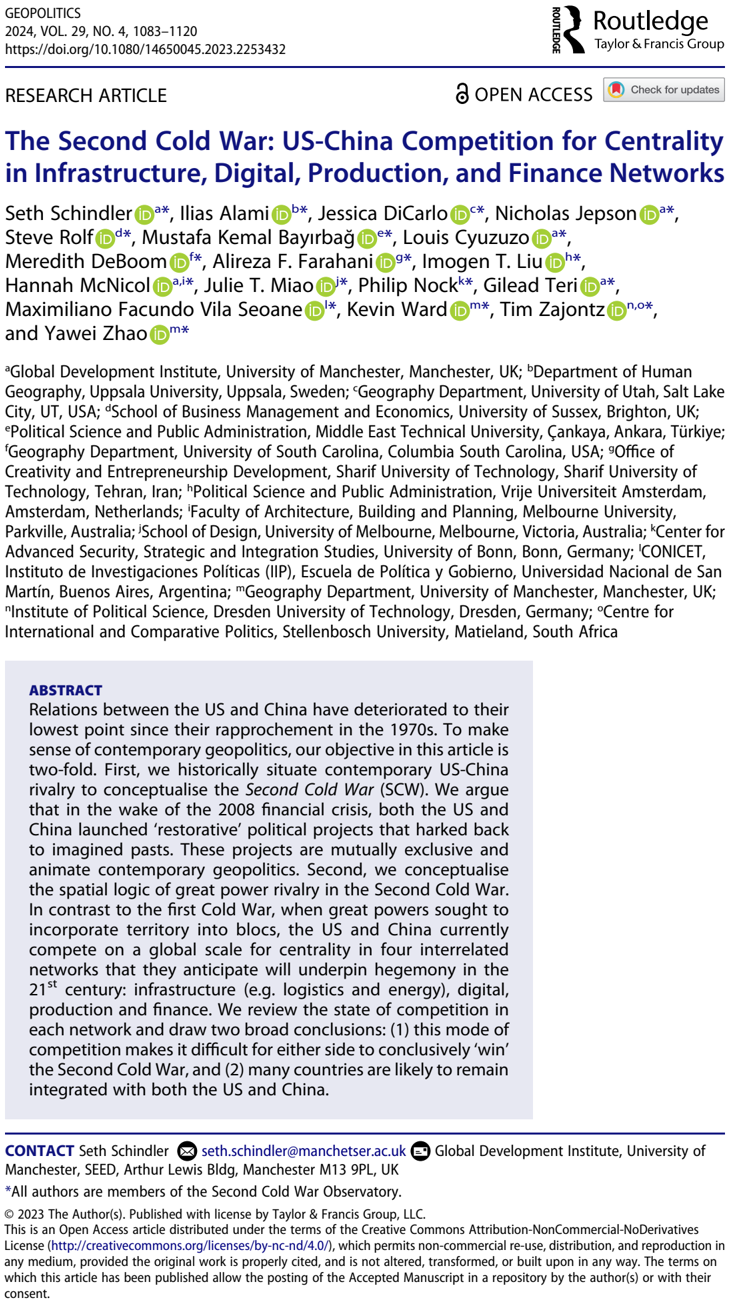
Relations between the US and China have deteriorated to their lowest point since their rapprochement in the 1970s.
Verified 2026-11-25 · 1 reference not checked yet
Overview
CoChat Summary
TL;DR
The article conceptualises contemporary US-China rivalry as a Second Cold War (CWII), a discrete period in a longer challenge to the US-led order, distinguished from the first Cold War by competition for centrality in infrastructure, digital, production, and finance networks rather than territorial blocs. It concludes that this network-based competition makes a conclusive victory difficult for either side and that many countries can remain integrated with both powers.
Key findings
- After the 2008 financial crisis, the US and China launched mutually exclusive “restorative” projects—Xi Jinping’s “national rejuvenation” and Trump’s “Make America Great Again”—which entrenched zero-sum competition; Biden expanded the contest as democracy versus authoritarianism and sought to rally allies through initiatives such as B3W/PGII.
- CWII’s spatial logic is network centrality, not territorial containment: the US and China compete in four interrelated networks—infrastructure, digital, production, and finance—through rule-setting, restructuring networks, or building alternatives (e.g., BRI vs. PGII/DFC, Clean Network Initiative, Made in China 2025 and the Chips and Science Act, renminbi internationalisation and the petroyuan).
- The paper reports that China’s CDB and CHEXIM lent nearly half a trillion dollars internationally between 2008 and 2019, on par with the World Bank; in 2022, 60% of China’s overseas lending portfolio supported debtors in distress, up from 5% in 2010; the US Chips and Science Act provides US$52bn in state support; 2021 grants to MiC2025 firms totalled US$31bn; and the 2022 US-Africa Leaders Summit committed $519mil.
- The authors conclude that neither side is likely to conclusively “win” CWII, and many countries are embracing “omni-alignment,” integrating with both the US and China across different networks; if forced to choose, the world may splinter into rival blocs with parallel networks.
Methods
- Conceptual and historical analysis: the paper reframes the Cold War and CWII as discrete periods in a longer historical sequence whose unifying principle is a sustained challenge to the US-led international order, drawing on critical geopolitical economy and Cold War historiography.
- It reviews the state of competition in four networks—infrastructure, digital, production, and finance—using secondary literature, policy documents, media reports, and illustrative cases rather than original survey or experimental data.
- The main analytical framework is network centrality: it examines strategies such as establishing rules, restructuring networks, and building alternative networks, and assesses implications for third countries’ alignment.
Limitations
- Stated: more research is required to explore the extent to which structural power within networks translates into structural and material power in international relations and the global economy; future research should assess how competition across the four networks—and additional networks such as security and media—is interrelated.
- Stated: the authors call for moving beyond a state-centric approach to explore how CWII manifests in regions, cities, and neighbourhoods, and how those locations shape the geopolitics and geoeconomics of CWII.
- Evident from the text: the article is a conceptual synthesis relying on secondary sources and fast-moving contemporary events, with no systematic dataset or causal identification; the authors also acknowledge that boundaries between the four networks are blurry.
Model-written summary. Check it against the paper before relying on it.
Integrity signals
Registry
Cites
Statistics
Figures


Verification
Claims the paper makes
9 Valid · 2 Not valid · 56 Not checked · 98 Own results and interpretations
The cited sources support only part of this claim — read each source’s verdict below.
In the paper
“In the wake of the economic crisis in 2008, a consensus was forged between new Keynesians and neoliberal hardliners surrounding the merits of state-coordinated infrastructure-led development (Alami, Dixon, and Mawdsley 2021;Schindler and Kanai 2021;Schindler, Alami, and Jepson 2023).”
§ The Second Cold War: US-China Competition for Centrality in Infrastructure, Digital, Production, and Finance Networks > Infrastructure Networks
What the sources say
- Partly supportedcites Alami, Dixon, and Mawdsley 2021 matched to “State Capitalism and the New Global D/development Regime” (2021) sourceExperimental — accuracy not yet measured
The “National Development and Policy Banks” section says the 2008 crisis highlighted a need for countercyclical tools and describes a growing need for state finance of large-scale infrastructure. It does not say that new Keynesians and neoliberal hardliners forged a consensus on infrastructure-led development. Page numbers are unavailable in our copy. (LLM, conf=0.84)
- Not checked — no full text of the sourcecites Schindler and Kanai 2021 matched to “Getting the territory right: infrastructure-led development and the re-emergence of spatial planning strategies” (2021) source
- Not matchedcites Schindler, Alami, and Jepson 2023
An author–year citation the paper’s reference list doesn’t settle. We don’t search these by name.
plainstates a cause- Asserted: passes — The authors put it forward as true.
- Checkable: passes — It can be checked against evidence.
- Load-bearing: unclear — It is unclear whether the paper’s conclusions depend on it.
- Based: passes — The paper gives a reason why it holds.
- Partly supported
Every source the paper cites for this claim was checked and supports it.
In the paper
“Rather than financing new infrastructure projects, Horn et al. (2023, 2) estimate that in 2022 '60% of China's overseas lending portfolio supports debtors in distress, up from just 5% in 2010'.”
§ The Second Cold War: US-China Competition for Centrality in Infrastructure, Digital, Production, and Finance Networks > Infrastructure Networks
What the sources say
- Supportedcites Horn et al. 2023 matched to “China as an International Lender of Last Resort” (2023) source
Appendix I.4 states the quoted figures: as of 2022, 60% of China’s overseas lending portfolio supported debtors in distress, up from 5% in 2010. The Introduction also describes reduced new overseas lending and a rise in bailouts to distressed countries. The appendix cites an earlier Horn et al. work for the figures, but this paper reports them. (LLM, conf=0.94)
hedgedstates an association- Asserted: passes — The authors put it forward as true.
- Checkable: passes — It can be checked against evidence.
- Load-bearing: passes — The paper’s conclusions depend on it.
- Based: passes — The paper gives a reason why it holds.
- Supported
The cited sources support only part of this claim — read each source’s verdict below.
In the paper
“Thus, the US sought to exert influence over Beijing by threatening to restrict its participation in GPNs (Löfflmann 2016).”
§ The Second Cold War: US-China Competition for Centrality in Infrastructure, Digital, Production, and Finance Networks > Production Networks
What the sources say
- Partly supportedcites Löfflmann 2016 matched to “The Pivot between Containment, Engagement, and Restraint: President Obama’s Conflicted Grand Strategy in Asia” (2016) sourceExperimental — accuracy not yet measured
In “The economic pivot” (page unavailable), the paper says China was not part of TPP negotiations and that Beijing feared the agreement was designed to exclude it. That supports the broader idea of US economic pressure, but it does not say the US threatened to restrict China’s participation in global production networks; the same section says the door to Chinese TPP membership remained open. (LLM, conf=0.82)
plainstates a cause- Asserted: passes — The authors put it forward as true.
- Checkable: passes — It can be checked against evidence.
- Load-bearing: unclear — It is unclear whether the paper’s conclusions depend on it.
- Based: passes — The paper gives a reason why it holds.
- Partly supported
The cited sources support only part of this claim — read each source’s verdict below.
In the paper
“In comparison to China's earlier industrial policy, the plan affords the partystate broader scope in allocating resources (McBride and Chatzky 2019) through grants, tax breaks, loans, and direct investments from an expanding array of investment vehicles that increasingly blur the lines between state and private control (e.g.state-managed private equity fund) (Pearson, Rithmire, and Tsai 2022).”
§ The Second Cold War: US-China Competition for Centrality in Infrastructure, Digital, Production, and Finance Networks > Production Networks
What the sources say
- Not matchedcites McBride and Chatzky 2019
An author–year citation the paper’s reference list doesn’t settle. We don’t search these by name.
- Partly supportedcites Pearson, Rithmire, and Tsai 2022 matched to “China's Party-State Capitalism and International Backlash: From Interdependence to Insecurity” (2022) sourceExperimental — accuracy not yet measured
Split into 2 atoms — 1 confirmed, 1 partially supported, 0 disputed, 0 misattributed, 0 unverifiable. Expand the claim to see per-atom verdicts.
plainstates a cause- Asserted: passes — The authors put it forward as true.
- Checkable: passes — It can be checked against evidence.
- Load-bearing: passes — The paper’s conclusions depend on it.
- Based: passes — The paper gives a reason why it holds.
- Not matched
The cited sources support only part of this claim — read each source’s verdict below.
In the paper
“With a post-Covid sovereign debt crisis now mounting, China's distinct lending modalities and preference for case-by-case (even loan-by-loan) negotiations have contributed to a logjam in restructuring efforts for states that have struggled to repay debts -such as Sri Lanka, Zambia and Ethiopia -to a variety of private, bilateral and multilateral creditors (Acker, Brautigam, and Huang 2020; DeBoom”
§ The Second Cold War: US-China Competition for Centrality in Infrastructure, Digital, Production, and Finance Networks > Financial Networks
What the sources say
- Partly supportedcites Acker, Brautigam, and Huang 2020 matched to “Debt Relief with Chinese Characteristics” (2020) sourceExperimental — accuracy not yet measured
Section 4.4 (page not supplied) says Chinese creditors generally restructure loan by loan and seek case-by-case solutions; it also describes separate negotiations with Chinese lenders in Ethiopia. It does not say these practices caused a restructuring logjam in Sri Lanka, Zambia or Ethiopia. For the cases it compares with private creditors, the section says agreements were reached more quickly with China. (LLM, conf=0.86)
- Not matchedcites DeBoom 2020
An author–year citation the paper’s reference list doesn’t settle. We don’t search these by name.
- Not matchedcites Jayasinghe 2022
An author–year citation the paper’s reference list doesn’t settle. We don’t search these by name.
plainstates a cause- Asserted: passes — The authors put it forward as true.
- Checkable: passes — It can be checked against evidence.
- Load-bearing: passes — The paper’s conclusions depend on it.
- Based: passes — The paper gives a reason why it holds.
- Partly supported
82 more claims
Create a free account to see all 165 claims and to verify the 9 references still open.
- It may state two separate claims as one. 60
- Probably not a substantial claim. 31
Self-check
Percentages, sums and reported differences re-computed from the paper’s own numbers.
Each contradiction between two passages listed here was confirmed by an independent check.
Rated minor: it would not touch a result — a value no result rests on, a p-value that stays on the same side of the significance level, or a conflict that is clerical, resolved elsewhere in the paper, or outside its own findings.
In the paper
§ The Second Cold War: US-China Competition for Centrality in Infrastructure, Digital, Production, and Finance Networks > References
“Pompeo, M. R. 2020a. Communist China and the Free World's future.”
§ The Second Cold War: US-China Competition for Centrality in Infrastructure, Digital, Production, and Finance Networks > References
“Accessed January 23, 2006.”
Rated minor: it would not touch a result — a value no result rests on, a p-value that stays on the same side of the significance level, or a conflict that is clerical, resolved elsewhere in the paper, or outside its own findings.
In the paper
§ The Second Cold War: US-China Competition for Centrality in Infrastructure, Digital, Production, and Finance Networks > References
“White House. 2022a. FACT SHEET: CHIPS and Science Act Will Lower Costs, Create Jobs, Strengthen Supply Chains, and Counter China,”
§ The Second Cold War: US-China Competition for Centrality in Infrastructure, Digital, Production, and Finance Networks > References
“January 26, 2023. Accessed January 26, 2023.”
Citations
Cites
(2010) · Intellectum (Universidad de La Sabana) · doi:10.1111/j.1467- · Cited by 16,131
(1996) · Institutional Research Information System University of Turin (University of Turin) · doi:10.1111/j · Cited by 5,486
The tragedy of Great Power politics
(2002) · Choice Reviews Online · doi:10.5860/choice.39-5464 · Cited by 3,594 · cited 1×
“While isolated voices called in vain for the ‘pre-emptive containment’ of China (see Mearsheimer 2001, 397–402), Washington afforded Beijing respect and recognition as a rising power.”
Power and Interdependence: World Politics In Transition
(2017) · The SHAFR Guide Online · doi:10.1163/2468-1733_shafr_sim280020670 · Cited by 3,073
Cultural Backlash: Trump, Brexit, and Authoritarian Populism
Norris, P., & Inglehart, R. (2019) · doi:10.1017/9781108595841 · Cited by 2,986
The territorial trap: The geographical assumptions of international relations theory
Agnew, J. (1994) · Review of International Political Economy · doi:10.1080/09692299408434268 · Cited by 2,549 · cited 1×
“As Agnew (1994, 72) has argued, realist interpretations of global politics ‘came to prominence during the Cold War when, one could claim, their orientations to state territoriality had a certain validity’.”
BackgroundDilemma not Trilemma: The Global Financial Cycle and Monetary Policy Independence
Rey, H. (2015) · National Bureau of Economic Research · doi:10.3386/w21162 · Cited by 2,027 · cited 1×
“Although Chinese lending has contributed to the current sovereign debt crisis, its origins primarily lie in the increased exposure of many world regions to cyclical dollar financing conditions since 2008 (Alami 2019; Rey 2015).”
Weaponized Interdependence: How Global Economic Networks Shape State Coercion
Farrell, H., & Newman, A. L. (2019) · International Security · doi:10.1162/isec_a_00351 · Cited by 1,879 · cited 2×
“State-centric territorial competition has been substantially displaced in significance by an economic globalisation which ‘creates its own set of international structures – through global networks – and thus generates new forms of state power [and conflict]’ (Farrell and Newman 2019, 75).”
Background‘Globalizing’ regional development: a global production networks perspective
Coe, N. M., Hess, M., Yeung, H. W., Dicken, P., & Henderson, J. (2004) · Transactions of the Institute of British Geographers · doi:10.1111/j.0020-2754.2004.00142.x · Cited by 1,439 · cited 1×
“As such, scholars called for cities and regions to proactively engage GPNs to create, add and capture value (Coe et al. 2004).”
BackgroundThe China Shock: Learning from Labor-Market Adjustment to Large Changes in Trade
Autor, D. H., Dorn, D., & Hanson, G. H. (2016) · Annual Review of Economics · doi:10.1146/annurev-economics-080315-015041 · Cited by 1,305 · cited 1×
“Meanwhile, deindustrialisation and the prolonged decline of once-prosperous communities in middle America were increasingly attributed to the ‘China Shock’ (Autor, Dorn, and Hanson 2016).”
BackgroundTheorizing Sociospatial Relations
Jessop, B., Brenner, N., & Jones, M. (2008) · Environment and Planning D: Society and Space · doi:10.1068/d9107 · Cited by 1,252 · cited 3×
“…logic of geopolitical rivalry during the Cold War encouraged bordering, bounding, and enclosing space to constitute a ‘territorial outside’ (see Jessop, Brenner, and Jones 2008, 393), which reflected profound ‘ideological antagonism, not just as foreign orientation but pervading all structures…”
BackgroundInfluentialCrashed: how a decade of financial crises changed the world
Subacchi, P. (2019) · International Affairs · doi:10.1093/ia/iiz128 · Cited by 1,050
‘Spatial’ relationships? Towards a reconceptualization of embedded ness
Hess, M. (2004) · Progress in Human Geography · doi:10.1191/0309132504ph479oa · Cited by 998 · cited 1×
“In this context, Hess (2004) argued that regions at risk of experiencing disinvestment and deindustrialisation needed to embed GPNs in local socio-economic structures.”
BackgroundLiberal Leviathan: The Origins, Crisis, and Transformation of the American World Order
IKENBERRY, G. J. (2011) · Princeton University Press eBooks · doi:10.2307/j.ctt7rjt2 · Cited by 854
Rodrik, D. (2006) · Journal of Economic Literature · doi:10.1257/jel.44.4.973 · Cited by 822 · cited 1×
“In the years preceding the 2008 financial crash, discontent with the Washington Consensus was widespread, from Latin American capitals to the corridors of power in the World Bank itself (Grugel and Riggirozzi 2012; Rodrik 2006).”
BackgroundGlobal Production Networks: Theorizing Economic Development in an Interconnected World
Coe, N. M., & Yeung, H. W.-C. (2015) · Oxford University Press eBooks · doi:10.1093/acprof:oso/9780198703907.001.0001 · Cited by 721 · cited 1×
“…complexity of the international division of labour, and development at the technology and productivity frontier, the world economy has become increasingly organised as a set of highly structured networks spanning territorial borders (e.g., Coe and Yeung 2015; Gjesvik 2023; Haberly and Wójcik 2022).”
BackgroundThe Global Cold War: Third World Interventions and the Making of Our Times
(2017) · The SHAFR Guide Online · doi:10.1163/2468-1733_shafr_sim250030076 · Cited by 712
An Essay on the Revived Bretton Woods System
Dooley, M., Folkerts-Landau, D., & Garber, P. (2003) · National Bureau of Economic Research · doi:10.3386/w9971 · Cited by 711 · cited 1×
“Roubini and Setser (2005; see Dooley, Folkerts-Landau, and Garber 2003) refer to this as Bretton Woods 2.0 because it underpinned monetary stability worldwide, but they anticipated its collapse.”
BackgroundInfluentialDeng Xiaoping and the Transformation of China
Vogel, E. F. (2011) · doi:10.4159/harvard.9780674062832 · Cited by 684 · cited 2×
“…with novel economic strategies, Beijing maintained the objectives that had guided the CCP and underpinned its legitimacy since 1949 – namely, the pursuit of territorial sovereignty, international influence, wealth and power (Brazinsky 2017; Meisner 1999; Schell and Delury 2013; Vogel 2011).”
BackgroundMacFarquhar, R. (1966) · Foreign Affairs · doi:10.2307/20039217 · Cited by 608
Integrating China into the Global Economy
Pye, L. W., & Lardy, N. R. (2002) · Foreign Affairs · doi:10.2307/20033216 · Cited by 585 · cited 2×
“…a new round of global trade liberal-isation’, and ‘the implications of rising living standards [in China] based on an increasingly market-oriented economy are overwhelmingly favourable to our long-term interest in the development of a more pluralistic political system in China’ (Lardy 2001, 164).”
Capital Accumulation, Private Property, and Rising Inequality in China, 1978–2015
Piketty, T., Yang, L., & Zucman, G. (2019) · American Economic Review · doi:10.1257/aer.20170973 · Cited by 585 · cited 1×
“The institutionalisation of politics and sustained economic growth was, however, accompanied by increased inequality, corruption on a grand scale and widespread discontent in the countryside (Ang 2020; Chen 2020; Piketty, Yang, and Zucman 2019).”
The Stack: On Software and Sovereignty
Bratton, B. H. (2016) · doi:10.7551/mitpress/9780262029575.001.0001 · Cited by 574
Westward ho-the China dream and ‘one belt, one road’: Chinese foreign policy under Xi Jinping
FERDINAND, P. (2016) · International Affairs · doi:10.1111/1468-2346.12660 · Cited by 565 · cited 1×
“Since coming to power in 2012, Xi Jinping has embraced the notion of the ‘Chinese Dream’, which purportedly builds on the CCP’s past achievements and is presented as the logical next step in the Chinese civilisation’s destiny (Carrai 2021; Ferdinand 2016).”
BackgroundThe making of global capitalism: the political economy of American empire
(2013) · Choice Reviews Online · doi:10.5860/choice.50-3967 · Cited by 532
Mao's China and After: A History of the People's Republic.
Chamberlain, H. B., & Meisner, M. (1987) · Pacific Affairs · doi:10.2307/2758836 · Cited by 508 · cited 2×
“…with novel economic strategies, Beijing maintained the objectives that had guided the CCP and underpinned its legitimacy since 1949 – namely, the pursuit of territorial sovereignty, international influence, wealth and power (Brazinsky 2017; Meisner 1999; Schell and Delury 2013; Vogel 2011).”
Post‐neoliberalism in Latin America: Rebuilding and Reclaiming the State after Crisis
Grugel, J., & Riggirozzi, P. (2012) · Development and Change · doi:10.1111/j.1467-7660.2011.01746.x · Cited by 475 · cited 1×
“In the years preceding the 2008 financial crash, discontent with the Washington Consensus was widespread, from Latin American capitals to the corridors of power in the World Bank itself (Grugel and Riggirozzi 2012; Rodrik 2006).”
BackgroundGlobal Value Chains and Development: Redefining the Contours of 21st Century Capitalism
Gereffi, G. (2018) · doi:10.1017/9781108559423 · Cited by 452 · cited 1×
“…(Keohane and Nye 1977; Sargent 2015), and this has become a defining feature of our epoch of dense trade in parts and components, vast transnational, financial and digital flows, and networked infrastructures (see respectively Davis and Kim 2015; Gereffi 2018; Kokas 2022; Schindler and Kanai 2021).”
BackgroundGeopolitics: Revisioning World Politics
Hyndman, J. (2004) · Political Geography · doi:10.1016/j.polgeo.2004.04.001 · Cited by 441
Financialization of the Economy
Davis, G. F., & Kim, S. (2015) · Annual Review of Sociology · doi:10.1146/annurev-soc-073014-112402 · Cited by 439 · cited 1×
“…(Keohane and Nye 1977; Sargent 2015), and this has become a defining feature of our epoch of dense trade in parts and components, vast transnational, financial and digital flows, and networked infrastructures (see respectively Davis and Kim 2015; Gereffi 2018; Kokas 2022; Schindler and Kanai 2021).”
BackgroundIntellectual Monopoly in Global Value ChainsPreprint
Durand, C., & Milberg, W. S. (2018) · HAL · Cited by 425
The Global Cold War: Third World Interventions and the Making of Our Times
Brands, H. W. (2006) · Journal of American History · doi:10.2307/4486537 · Cited by 420 · cited 2×
“…Cold War became a three-way contest from the late 1950s until Sino-US rapprochement, and, to a large extent, this three-way rivalry played out in what was then termed the ‘Third World’ with devastating human costs (Brazinsky 2017; Chamberlin 2019; Fewsmith 2021; Friedman 2015, 2021; Westad 2007).”
Introduction: Turbulent Circulation: Building a Critical Engagement with Logistics
Chua, C., Danyluk, M., Cowen, D., & Khalili, L. (2018) · Environment and Planning D: Society and Space · doi:10.1177/0263775818783101 · Cited by 397 · cited 1×
“…circulation of information, exert control over the wider division of labour, establish standards and exclude competitors (or ensure they remain in a subordinate position), and capture value within production networks (Baglioni, Campling, and Hanlon 2021; Chua et al. 2018; Durand and Milberg 2020).”
BackgroundGreat Games, Local Rules: The New Great Power Contest in Central Asia
Cooley, A. (2012) · Oxford University Press eBooks · doi:10.1093/acprof:oso/9780199929825.001.0001 · Cited by 362
Exit from Hegemony: The Unraveling of the American Global Order
Cooley, A., & Nexon, D. (2020) · doi:10.1093/oso/9780190916473.001.0001 · Cited by 354
Schindler, S., & Kanai, J. M. (2021) · Regional Studies · doi:10.1080/00343404.2019.1661984 · Cited by 346 · cited 2×
“In the wake of the economic crisis in 2008, a consensus was forged between new Keynesians and neoliberal hardliners surrounding the merits of state-coordinated infrastructure-led development (Alami, Dixon, and Mawdsley 2021; Schindler and Kanai 2021; Schindler, Alami, and Jepson 2023).”
BackgroundSelf-citationAfter Geopolitics? From the Geopolitical Social to Geoeconomics
Cowen, D., & Smith, N. (2009) · Antipode · doi:10.1111/j.1467-8330.2008.00654.x · Cited by 331 · cited 1×
“We situate our approach within a tradition of critical geopolitical economy scholarship attentive to the relationship between geopolitics and capitalist development (e.g., Cowen and Smith 2009; Csurgai 2018; Glassman 2018; Hart 2010; Jayasuriya 2021).”
MethodGeo-Economic Fragmentation and the Future of Multilateralism
Aiyar, S., Ilyina, A., Chen, J., Kangur, A., Trevino, J., Ebeke, C., Gudmundsson, T., Soderberg, G., Schulze, T., Kunaratskul, T., et al. (2023) · Staff Discussion Notes · doi:10.5089/9798400229046.006 · Cited by 327
Hegemony: the new shape of global power
(2005) · Choice Reviews Online · doi:10.5860/choice.43-2278 · Cited by 317 · cited 1×
“…alike as a system of ‘rigidly defined territorial units in which each state can gain power only at the expense of others and each has total control over its own territory’, within which the ‘national economy was still seen as the basic building block of the world economy’ (Agnew 2005, 43–4; 124).”
Mecca of Revolution: Algeria, Decolonization, and the Third World Order
Byrne, J. J. (2016) · Oxford University Press eBooks · doi:10.1093/acprof:oso/9780199899142.001.0001 · Cited by 317 · cited 1×
“…(Galway 2022) and in Africa alone ‘[i]nsurgents from Algeria, Angola, Botswana, Cameroon, both Congos, Guinea, Kenya, Malawi, Mozambique, Niger, Nigeria and South Africa all received training from China’ (Brazinsky 2017; Byrne 2016; Fewsmith 2021; Friedman 2015; Rothwell 2021, 2487–2488; 2012).”
BackgroundGaddis, J. L. (2005) · doi:10.1093/oso/9780195174489.001.0001 · Cited by 317
Shutdown: How Covid Shook the World's Economy
Fredona, R. (2022) · Business History Review · doi:10.1017/s0007680522000289 · Cited by 303
Flint, C., & Zhu, C. (2019) · Geoforum · doi:10.1016/j.geoforum.2018.12.008 · Cited by 289 · cited 1×
“These paradigm shifts in the material substratum of the global political economy have come to underlie a new ‘geopolitics of connectivity’ (Flint and Zhu 2019; Leonard 2021).”
BackgroundArmageddon Averted: The Soviet Collapse
Legvold, R., Kotkin, S., & McFaul, M. (2002) · Foreign Affairs · doi:10.2307/20033049 · Cited by 280
The China Shock: Learning from Labor Market Adjustment to Large Changes in Trade
Autor, D., Dorn, D., & Hanson, G. (2016) · National Bureau of Economic Research · doi:10.3386/w21906 · Cited by 270
Wealth and Power: China's Long March to the Twenty-first Century
Schell, O., & Delury, J. (2013) · Cited by 269
Toward a Geoeconomic Order in International Trade and Investment
Roberts, A., Choer Moraes, H., & Ferguson, V. (2019) · Journal of International Economic Law · doi:10.1093/jiel/jgz036 · Cited by 269 · cited 1×
“…‘weaponised interdependence’ has shown how the interconnectedness of economic networks poses security risks and can increase dependency on foreign states for critical commodities, technologies or raw materials (Farrell and Newman 2019; Gertz and Evers 2020; Roberts, Moraes, and Ferguson 2019, 659).”
BackgroundCrashed: How a Decade of Financial Crises Changed the World
Tooze, J. (2018) · Cited by 268
Chen, J. (2001) · Project Muse (Johns Hopkins University) · Cited by 251
Horn, S., Reinhart, C. M., & Trebesch, C. (2021) · Journal of International Economics · doi:10.1016/j.jinteco.2021.103539 · Cited by 241
The long peace, the end of the cold war, and the failure of realism
Lebow, R. N. (1994) · International Organization · doi:10.1017/s0020818300028186 · Cited by 240 · cited 1×
“These approaches are, moreover, overwhelmingly neorealist in outlook, and emphasise the high geopolitics of grand strategy and balance-of-power considerations in the international system over economic and domestic considerations (Cumings 1993; Halliday 2010; Lebow 1994).”
How China Escaped Shock Therapy: The Market Reform Debate
Weber, I. M. (2021) · Routledge eBooks · doi:10.4324/9780429490125 · Cited by 235 · cited 1×
“Deng Xiaoping outma-noeuvred Hua Guofeng to lead the CCP, and he presided over cautious ‘experimentalist marketisation’ (Vogel 2011; Weber 2021).”
BackgroundChina's Gilded Age: The Paradox of Economic Boom and Vast Corruption
Ang, Y. Y. (2020) · Cambridge University Press eBooks · doi:10.1017/9781108778350 · Cited by 222 · cited 1×
“The institutionalisation of politics and sustained economic growth was, however, accompanied by increased inequality, corruption on a grand scale and widespread discontent in the countryside (Ang 2020; Chen 2020; Piketty, Yang, and Zucman 2019).”
BackgroundRed Globalization: The Political Economy of the Soviet Cold War from Stalin to Khrushchev
Sanchez-Sibony, O. (2014) · Cambridge University Press eBooks · doi:10.1017/cbo9781139628778 · Cited by 219
(2010) · Choice Reviews Online · doi:10.5860/choice.47-3323 · Cited by 216 · cited 1×
“In addition to development aid such as the TAZARA railway (Monson 2009), Beijing engaged in ‘revolutionary evangelism’ (Galway 2022) and in Africa alone ‘[i]nsurgents from Algeria, Angola, Botswana, Cameroon, both Congos, Guinea, Kenya, Malawi, Mozambique, Niger, Nigeria and South Africa all…”
State Capitalism and the New Global D/development Regime
Alami, I., Dixon, A. D., & Mawdsley, E. (2021) · Antipode · doi:10.1111/anti.12725 · Cited by 195 · cited 1×
“In the wake of the economic crisis in 2008, a consensus was forged between new Keynesians and neoliberal hardliners surrounding the merits of state-coordinated infrastructure-led development (Alami, Dixon, and Mawdsley 2021; Schindler and Kanai 2021; Schindler, Alami, and Jepson 2023).”
BackgroundSelf-citationThe Sino-Soviet split: Cold War in the communist world
Shiwen, W. (2009) · Cold War History · doi:10.1080/14682740903268586 · Cited by 183 · cited 1×
“Given the intractability of the Sino-Soviet split (Lüthi 2008), the Cold War became a three-way contest from the late 1950s until Sino-US rapprochement, and, to a large extent, this three-way rivalry played out in what was then termed the ‘Third World’ with devastating human costs (Brazinsky 2017;…”
For the soul of mankind: the United States, the Soviet Union, and the Cold War
(2008) · Choice Reviews Online · doi:10.5860/choice.45-3923 · Cited by 182
Schindler, S., Alami, I., & Jepson, N. (2022) · New Political Economy · doi:10.1080/13563467.2022.2091534 · Cited by 180
Self-citationShadow Cold War: The Sino-Soviet Competition for the Third World
Friedman, J. (2015) · University of North Carolina Press eBooks · doi:10.5149/northcarolina/9781469623764.001.0001 · Cited by 176 · cited 2×
“…Cold War became a three-way contest from the late 1950s until Sino-US rapprochement, and, to a large extent, this three-way rivalry played out in what was then termed the ‘Third World’ with devastating human costs (Brazinsky 2017; Chamberlin 2019; Fewsmith 2021; Friedman 2015, 2021; Westad 2007).”
BackgroundHegemony Studies 3.0: The Dynamics of Hegemonic Orders
Ikenberry, G. J., & Nexon, D. H. (2019) · Security Studies · doi:10.1080/09636412.2019.1604981 · Cited by 174
Coordinated Credit Spaces: The Globalization of Chinese Development Finance
Chin, G. T., & Gallagher, K. P. (2019) · Development and Change · doi:10.1111/dech.12470 · Cited by 173 · cited 3×
“…such as the BRICS’ New Development Bank and the Asian Infrastructure Investment Bank grow more significant, they remain minor players compared to bilateral lending from China’s two main policy banks, the China Development Bank (CDB) and Chinese Export-Import Bank (CHEXIM) (Chin and Gallagher 2019).”
BackgroundUneven and combined state capitalism
Alami, I., & Dixon, A. D. (2023) · Environment and Planning A: Economy and Space · doi:10.1177/0308518x211037688 · Cited by 170
Self-citationThe US–China rivalry and the emergence of state platform capitalism
Rolf, S., & Schindler, S. (2023) · Environment and Planning A: Economy and Space · doi:10.1177/0308518x221146545 · Cited by 167 · cited 3×
“Washington and Beijing have sought to instrumentalise their domestic platforms in pursuit of geoeconomic and geopolitical objectives (Rolf and Schindler 2023).”
InfluentialSelf-citationThe new cold war and the rise of the 21st‐century infrastructure state
Schindler, S., DiCarlo, J., & Paudel, D. (2022) · Transactions of the Institute of British Geographers · doi:10.1111/tran.12480 · Cited by 165
Self-citationD/developments after the Meltdown
Hart, G. (2010) · Antipode · doi:10.1111/j.1467-8330.2009.00719.x · Cited by 163 · cited 1×
“We situate our approach within a tradition of critical geopolitical economy scholarship attentive to the relationship between geopolitics and capitalist development (e.g., Cowen and Smith 2009; Csurgai 2018; Glassman 2018; Hart 2010; Jayasuriya 2021).”
MethodGeoeconomic Competition: Will State Capitalism Win?
Gertz, G., & Evers, M. M. (2020) · The Washington Quarterly · doi:10.1080/0163660x.2020.1770962 · Cited by 151 · cited 1×
“…‘weaponised interdependence’ has shown how the interconnectedness of economic networks poses security risks and can increase dependency on foreign states for critical commodities, technologies or raw materials (Farrell and Newman 2019; Gertz and Evers 2020; Roberts, Moraes, and Ferguson 2019, 659).”
The strange geographies of the ‘new’ state capitalism
Alami, I., & Dixon, A. D. (2020) · Political Geography · doi:10.1016/j.polgeo.2020.102237 · Cited by 140 · cited 1×
“This reactivated geopolitical grand narratives from the Cold War (see Alami and Dixon 2020), amplifying the chorus of voices articulating a simple narrative of competition between two easily identifiable protagonists – (Western) democratic free-market capitalism and its deviant ‘other’ in the form…”
BackgroundSelf-citationNew Bottles for New Wine: A Pericentric Framework for the Study of the Cold War
Smith, T. (2000) · Diplomatic History · doi:10.1111/0145-2096.00237 · Cited by 128 · cited 1×
“…that (1) was peri-centric in nature, (2) exhibited variegated local manifestations and (3) fostered a host of horizontal relationships that frequently enabled middle powers and smaller states to exercise agency (Smith 2000; Westad 2007; Romero 2014; Lüthi 2020; see Schindler and DiCarlo 2022a).”
BackgroundChina's Party-State Capitalism and International Backlash: From Interdependence to Insecurity
Pearson, M. M., Rithmire, M., & Tsai, K. S. (2022) · International Security · doi:10.1162/isec_a_00447 · Cited by 125 · cited 1×
“…in allocating resources (McBride and Chatzky 2019) through grants, tax breaks, loans, and direct investments from an expanding array of investment vehicles that increasingly blur the lines between state and private control (e.g. state-managed private equity fund) (Pearson, Rithmire, and Tsai 2022).”
BackgroundSticky Power: Global Financial Networks in the World Economy
Haberly, D., & Wójcik, D. (2022) · doi:10.1093/oso/9780198870982.001.0001 · Cited by 122
Sargent, D. J. (2014) · Oxford University Press eBooks · doi:10.1093/acprof:oso/9780195395471.001.0001 · Cited by 122
For the Soul of Mankind: The United States, the Soviet Union, and the Cold War
Lake, A. (2017) · The SHAFR Guide Online · doi:10.1163/2468-1733_shafr_sim250030052 · Cited by 119
Mecca of Revolution: Algeria, Decolonization, and the Third World Order
Byrne, J. J. (2017) · The SHAFR Guide Online · doi:10.1163/2468-1733_shafr_sim220070001 · Cited by 116
Private infrastructure in weaponized interdependence
Gjesvik, L. (2022) · Review of International Political Economy · doi:10.1080/09692290.2022.2069145 · Cited by 109
The Advance of the State in Contemporary China: State-Market Relations in the Reform Era
Eaton, S. (2015) · Cambridge University Press eBooks · doi:10.1017/cbo9781316402191 · Cited by 108 · cited 1×
“Moreover, economic liberalisation (such as the privatisation of state-owned enterprises) remained confined to sectors deemed non-strategic (Eaton 2016).”
Global Development: A Cold War History
Logvinenko, I. O. (2020) · Political Science Quarterly · doi:10.1002/polq.13115 · Cited by 99
Debt, distress, dispossession: towards a critical political economy of Africa’s financial dependency
Zajontz, T. (2021) · Review of African Political Economy · doi:10.1080/03056244.2021.1950669 · Cited by 97
Self-citationDebt Relief with Chinese Characteristics
Acker, K., Brautigam, D., & Huang, Y. (2020) · doi:10.2139/ssrn.3745021 · Cited by 95 · cited 1×
“…efforts for states that have struggled to repay debts – such as Sri Lanka, Zambia and Ethiopia – to a variety of private, bilateral and multilateral creditors (Acker, Brautigam, and Huang 2020; DeBoom 2020; Jayasinghe 2022; Jepson 2023; Narins and Agnew 2022; Savage 2022; Zajontz 2022).”
BackgroundCold War historiography at the crossroads
Romero, F. (2014) · Cold War History · doi:10.1080/14682745.2014.950249 · Cited by 89 · cited 1×
“…that (1) was peri-centric in nature, (2) exhibited variegated local manifestations and (3) fostered a host of horizontal relationships that frequently enabled middle powers and smaller states to exercise agency (Smith 2000; Westad 2007; Romero 2014; Lüthi 2020; see Schindler and DiCarlo 2022a).”
Background“The persistent myth of lost hegemony,” revisited: structural power as a complex network phenomenon
Winecoff, W. K. (2020) · European Journal of International Relations · doi:10.1177/1354066120952876 · Cited by 89 · cited 3×
“…capital, commodities, money, labour power, knowledge, data, technical standards and the like has always been a strategy of geopolitical power projection, but these tasks have taken on a strategic urgency given the network-based structure of the contemporary world capitalist economy (Winecoff 2020).”
BackgroundInfluentialChinese Political Nostalgia and Xi Jinping's Dream of Great Rejuvenation
Carrai, M. A. (2020) · International Journal of Asian Studies · doi:10.1017/s1479591420000406 · Cited by 88 · cited 1×
“Since coming to power in 2012, Xi Jinping has embraced the notion of the ‘Chinese Dream’, which purportedly builds on the CCP’s past achievements and is presented as the logical next step in the Chinese civilisation’s destiny (Carrai 2021; Ferdinand 2016).”
Petry, J. (2021) · Competition & Change · doi:10.1177/1024529420964723 · Cited by 87
Trafficking Data: How China Is Winning the Battle for Digital Sovereignty
Kokas, A. (2022) · doi:10.1093/oso/9780197620502.001.0001 · Cited by 86
Geopolitics and the ‘New’ State Capitalism
Alami, I., Dixon, A. D., Gonzalez-Vicente, R., Babic, M., Lee, S.-O., Medby, I. A., & Graaff, N. D. (2022) · Geopolitics · doi:10.1080/14650045.2021.1924943 · Cited by 83
Self-citationGovernance in a Global Economy
Kahler, M. 1., & Lake, D. A. 1. (2004) · Princeton University Press eBooks · doi:10.1515/9780691234687 · Cited by 80
For the Soul of Mankind: The United States, the Soviet Union, and the Cold War
Leffler, M. P. (2007) · doi:10.1163/2468-1733_shafr_sim140050077 · Cited by 78
The Increasing Importance of Geoeconomics in Power Rivalries in the Twenty-First Century
Csurgai, G. (2017) · Geopolitics · doi:10.1080/14650045.2017.1359547 · Cited by 75 · cited 1×
“We situate our approach within a tradition of critical geopolitical economy scholarship attentive to the relationship between geopolitics and capitalist development (e.g., Cowen and Smith 2009; Csurgai 2018; Glassman 2018; Hart 2010; Jayasuriya 2021).”
MethodClash of Empires: From 'Chimerica' to the 'New Cold War'
Hung, H.-F. (2022) · doi:10.1017/9781108895897 · Cited by 75 · cited 4×
“In many regions, American and Chinese interests were compatible if not complementary (Cooley 2012), and the coupling of their economies proceeded apace in the 1990s as ‘Wall Street took control of [America’s] China policy’ (Hung 2020).”
BackgroundInfluentialShutdown how Covid shook the world's economy
Tooze, J. A. (2021) · Cited by 74
China as an International Lender of Last Resort
Horn, S., Parks, B., Reinhart, C., & Trebesch, C. (2023) · doi:10.3386/w31105 · Cited by 73
Glassman, J. (2018) · BRILL eBooks · doi:10.1163/9789004377523 · Cited by 70 · cited 1×
“We situate our approach within a tradition of critical geopolitical economy scholarship attentive to the relationship between geopolitics and capitalist development (e.g., Cowen and Smith 2009; Csurgai 2018; Glassman 2018; Hart 2010; Jayasuriya 2021).”
MethodBrazinsky, G. A. (2017) · University of North Carolina Press eBooks · doi:10.5149/northcarolina/9781469631707.001.0001 · Cited by 64
Petry, J. (2023) · European Journal of International Relations · doi:10.1177/13540661221126615 · Cited by 64
A novel pathway to power? Contestation and adaptation in China's internationalization of the RMB
McNally, C. A., & Gruin, J. (2017) · Review of International Political Economy · doi:10.1080/09692290.2017.1319400 · Cited by 61 · cited 1×
“China’s reluctance to fully liberalise its capital account has long seemed to rule out prospects for the renminbi as a dollar rival (McNally and Gruin 2017).”
BackgroundLüthi, L. M. (2020) · Cambridge University Press eBooks · doi:10.1017/9781108289825 · Cited by 61
China’s Contingencies: Critical Geopolitics, Chinese Exceptionalism and the Uses of History
Woon, C. Y. (2017) · Geopolitics · doi:10.1080/14650045.2017.1302429 · Cited by 59 · cited 1×
“Deeply rooted in the US and China is a steadfast belief in the exceptionalism of their respective societies (Löfflmann 2015; Woon 2018).”
BackgroundNot one inch: America, Russia, and the making of post-Cold War stalemate
Papageorgiou, M. M. (2022) · International Affairs · doi:10.1093/ia/iiac089 · Cited by 59 · cited 1×
“The US became the sole global superpower and, throughout the 1990s, augmented the international institutions that underpinned its hegemony (Ikenberrry 2011; Sarotte 2021).”
Winning the Third World: Sino-American Rivalry during the Cold War
Brazinsky, G. A. (2017) · The SHAFR Guide Online · doi:10.1163/2468-1733_shafr_sim140160076 · Cited by 58
Capital, the State, and War: Class Conflict and Geopolitics in the Thirty Years' Crisis, 1914-1945
Anievas, A. (2014) · doi:10.3998/mpub.6487271 · Cited by 57 · cited 1×
“…many ways, Overy (2021, x) maintains that ‘little is to be gained by separating the two giant conflicts’ because they are both chapters in a longer history of the unravel-ling of empires (first Ottoman, Habsburg Romanov, Qing and Qajar, and subsequently British and French) (also see Anievas 2014).”
BackgroundIntegrating China into the Global Economy
Lardy, N. R. (2018) · Project Muse (Johns Hopkins University) · Cited by 56
Brzezinski, Z. (1997) · Virtual Defense Library (Ministerio de Defensa) · Cited by 54
Globalisation, uneven development and the North–South ‘big switch’
Horner, R., Schindler, S., Haberly, D., & Aoyama, Y. (2018) · Cambridge Journal of Regions, Economy and Society · doi:10.1093/cjres/rsx026 · Cited by 52 · cited 1×
“In 1994 Bill Clinton formally delinked human rights issues in China from US trade policy, and American economists lobbied for China’s accession to the World Trade Organization (Horner et al. 2018).”
BackgroundSelf-citationLeading from Behind – American Exceptionalism and President Obama’s Post-American Vision of Hegemony
Löfflmann, G. (2015) · Geopolitics · doi:10.1080/14650045.2015.1017633 · Cited by 51 · cited 1×
“Deeply rooted in the US and China is a steadfast belief in the exceptionalism of their respective societies (Löfflmann 2015; Woon 2018).”
BackgroundBeyond rentiership: Standardisation, intangibles and value capture in global production
Baglioni, E., Campling, L., & Hanlon, G. (2023) · Environment and Planning A: Economy and Space · doi:10.1177/0308518x21997835 · Cited by 51 · cited 1×
“…circulation of information, exert control over the wider division of labour, establish standards and exclude competitors (or ensure they remain in a subordinate position), and capture value within production networks (Baglioni, Campling, and Hanlon 2021; Chua et al. 2018; Durand and Milberg 2020).”
Money Power and Financial Capital in Emerging Markets: Facing the Liquidity Tsunami
Alami, I. (2019) · Routledge eBooks · doi:10.4324/9780429297106 · Cited by 50 · cited 1×
“Although Chinese lending has contributed to the current sovereign debt crisis, its origins primarily lie in the increased exposure of many world regions to cyclical dollar financing conditions since 2008 (Alami 2019; Rey 2015).”
BackgroundSelf-citationWhat does the state do in China’s state-led infrastructure financialisation?
Liu, I. T., & Dixon, A. D. (2022) · Journal of Economic Geography · doi:10.1093/jeg/lbac009 · Cited by 49 · cited 1×
“Policy bank loans have nevertheless been available to any state prepared to meet Chinese conditions – generally, recognition of Beijing’s stance on Taipei and willingness to accept a majority of Chinese contractors in tied financing arrangements (Liu and Dixon 2022).”
BackgroundSelf-citationLöfflmann, G. (2016) · Asian Security · doi:10.1080/14799855.2016.1190338 · Cited by 47 · cited 16×
“Examples include semiconductors, telecoms hardware and electric vehicles, as well as GPNs that incorporate artificial intelligence and biotechnology.”
BackgroundInfluentialIntellectual monopoly in global value chains
Durand, C., & Milberg, W. (2020) · Review of International Political Economy · doi:10.1080/09692290.2019.1660703 · Cited by 45 · cited 1×
“…circulation of information, exert control over the wider division of labour, establish standards and exclude competitors (or ensure they remain in a subordinate position), and capture value within production networks (Baglioni, Campling, and Hanlon 2021; Chua et al. 2018; Durand and Milberg 2020).”
BackgroundFewsmith, J. (2021) · Cambridge University Press eBooks · doi:10.1017/9781108923859 · Cited by 44 · cited 3×
“Proponents of the view that engaging China would facilitate its gradual liberalisation overlooked these facts, yet they felt vindicated in the mid-2000s when opaque elite politics were increasingly institutiona-lised, and the rule of law strengthened (Fewsmith 2021, 86).”
BackgroundPeasant protests over land seizures in rural China
Chen, C.-J. J. (2020) · The Journal of Peasant Studies · doi:10.1080/03066150.2020.1824182 · Cited by 42
China as an International Lender of Last ResortPreprint
Horn, S., Parks, B., Reinhart, C., & Trebesch, C. (2023) · SSRN Electronic Journal · doi:10.2139/ssrn.4413842 · Cited by 42
A Certain Idea of Science: How International Relations Theory Avoids the New Cold War History
Wohlforth, W. C. (1999) · Journal of Cold War Studies · doi:10.1162/15203979952559513 · Cited by 39
The digital Silk Road: China's quest to wire the world and win the future
Chuanying, L. (2023) · International Affairs · doi:10.1093/ia/iiad079 · Cited by 39 · cited 1×
“The US-China Economic and Security Review Commission took notice in 2020, 10 and a researcher based at the Center for Strategic and International Studies asserted that the US and China were locked in a ‘network war’ (Hillman 2021).”
The Triumph of Broken Promises: The End of the Cold War and the Rise of Neoliberalism
Vials, C. (2024) · Journal of American History · doi:10.1093/jahist/jaad431 · Cited by 39 · cited 1×
“…imaginaries underplayed intra-bloc transnational trade as well as the importance of Eurodollar loans to East Bloc countries in the 1970s (Bartel 2022; Sanchez-Sibony 2014), it captured the extent to which national economies remained coordinated and territorially contained, at least in…”
The Cold War as a historical period: an interpretive essay
Duara, P. (2011) · Journal of Global History · doi:10.1017/s1740022811000416 · Cited by 38 · cited 9×
“Meanwhile, Mao began to rank encirclement by the USSR as a greater threat than US imperialism, which explains his responsiveness to Kissinger’s overtures.”
InfluentialInnovate to Dominate: The Rise of the Chinese Techno-Security State
Behera, L. K. (2023) · Strategic Analysis · doi:10.1080/09700161.2023.2176060 · Cited by 36
China's New Red Guards: The Return of Radicalism and the Rebirth of Mao Zedong
Blanchette, J. (2019) · Cited by 35
Flint, C. D., & Waddoups, M. (2019) · Geopolitics · doi:10.1080/14650045.2019.1659781 · Cited by 34 · cited 1×
“We argue that in comparison to the unipolar era, CWII affords countries in the Global South more space to implement independent development policy, and ultimately the actions of third countries reverberate and shape great power rivalry (Flint and Waddoups 2021; Schindler and DiCarlo 2022b).”
ResultSchindler, S., & Kanai, J. M. (2021) · Planning Regional Futures · doi:10.4324/9781003147008-5 · Cited by 34
Self-citation"Revising Postrevisionism," or, The Poverty of Theory in Diplomatic History
Cumings, B. (1993) · Diplomatic History · doi:10.1111/j.1467-7709.1993.tb00599.x · Cited by 32 · cited 1×
“These approaches are, moreover, overwhelmingly neorealist in outlook, and emphasise the high geopolitics of grand strategy and balance-of-power considerations in the international system over economic and domestic considerations (Cumings 1993; Halliday 2010; Lebow 1994).”
BackgroundThe Gulf’s shifting geoeconomy and China’s structural power: From the petrodollar to the petroyuan?
Alshareef, S. (2022) · Competition & Change · doi:10.1177/10245294221095222 · Cited by 32 · cited 1×
“This ‘petroyuan’ contract has become the third largest oil futures market, even if it still lags significantly behind the West Texas International and Brent benchmarks (Alshareef 2022).”
BackgroundSchindler, S., & DiCarlo, J. (2022) · Area · doi:10.1111/area.12812 · Cited by 31 · cited 2×
“We argue that in comparison to the unipolar era, CWII affords countries in the Global South more space to implement independent development policy, and ultimately the actions of third countries reverberate and shape great power rivalry (Flint and Waddoups 2021; Schindler and DiCarlo 2022b).”
BackgroundResultSelf-citationMACFARQUHAR, R., & SCHOENHALS, M. (2009) · doi:10.2307/j.ctvk12s4j · Cited by 31
China's Dream: The Culture of Chinese Communism and the Secret Sources of its Power
Brown, K. (2018) · Research Portal (King's College London) · Cited by 27
The Last Empire: The Final Days of the Soviet Union
Cox, M. (2015) · Cold War History · doi:10.1080/14682745.2015.1018480 · Cited by 26 · cited 1×
“In Washington, the break-up of the USSR was hailed as a victory that vindicated its four-decade strategy to contain communism (Kotkin 2008; Plokhy 2014, 328).”
Narins, T. P., & Agnew, J. A. (2021) · Human Geography · doi:10.1177/19427786211045404 · Cited by 25 · cited 1×
“…efforts for states that have struggled to repay debts – such as Sri Lanka, Zambia and Ethiopia – to a variety of private, bilateral and multilateral creditors (Acker, Brautigam, and Huang 2020; DeBoom 2020; Jayasinghe 2022; Jepson 2023; Narins and Agnew 2022; Savage 2022; Zajontz 2022).”
BackgroundDeBoom, M. J. (2019) · Area Development and Policy · doi:10.1080/23792949.2019.1703556 · Cited by 24 · cited 1×
“…efforts for states that have struggled to repay debts – such as Sri Lanka, Zambia and Ethiopia – to a variety of private, bilateral and multilateral creditors (Acker, Brautigam, and Huang 2020; DeBoom 2020; Jayasinghe 2022; Jepson 2023; Narins and Agnew 2022; Savage 2022; Zajontz 2022).”
BackgroundSelf-citationThe Triumph of Broken Promises: The End of the Cold War and the Rise of Neoliberalism
Bartel, F. (2022) · Harvard University Press eBooks · doi:10.2307/j.ctv2phpr5w · Cited by 24
From ‘debt diplomacy’ to donorship? China’s changing role in global development
Carmody, P., Zajontz, T., & Reboredo, R. (2022) · Global Political Economy · doi:10.1332/uzhw7185 · Cited by 23
Self-citationThe Cold War and the international political economy in the 1970s
Sargent, D. (2013) · Cold War History · doi:10.1080/14682745.2013.789693 · Cited by 20 · cited 1×
“This was largely overlooked by mainstream accounts, and it has been upended by the emergence of globalised manufacturing, finance, and technology networks and data flows (Kahler and Lake 2003; Sargent 2013).”
BackgroundData access and regime competition: A case study of car data sharing in China
Martens, B., & Zhao, B. (2021) · Big Data & Society · doi:10.1177/20539517211046374 · Cited by 20 · cited 1×
“In return, platforms are subordinated to the party-state in the process of ‘military-civil fusion’ (Kania and Laskai 2021), and they are expected to support Beijing’s economic statecraft (e.g., Bloomberg 2021; Martens and Zhao 2021).”
BackgroundBreslin, S. G. (2021) · Policy Press eBooks · doi:10.1332/policypress/9781529215809.001.0001 · Cited by 19
Dodds, K. J. (2003) · doi:10.1002/9780470998946.ch14 · Cited by 18 · cited 1×
“In this context of tightly bounded and territorialised national economies engaged in zero-sum power politics, geopolitical practice revolved significantly around (more or less successful) interventions to secure elite compliance in the face of popular opposition (Dodds 2003).”
The Emergence of Global Maoism
Galway, M. (2022) · Cornell University Press eBooks · doi:10.1515/9781501761836 · Cited by 17 · cited 1×
“In addition to development aid such as the TAZARA railway (Monson 2009), Beijing engaged in ‘revolutionary evangelism’ (Galway 2022) and in Africa alone ‘[i]nsurgents from Algeria, Angola, Botswana, Cameroon, both Congos, Guinea, Kenya, Malawi, Mozambique, Niger, Nigeria and South Africa all…”
BackgroundGlobal Development: A Cold War History
Lorenzini, S. (2019) · Institutional Research Information System (Università degli Studi di Trento) · doi:10.1515/9780691185569 · Cited by 17
The Rise of the Infrastructure State
(2022) · Policy Press eBooks · doi:10.1332/policypress/9781529220773.001.0001 · Cited by 15
The Age of Unpeace : How Connectivity Causes Conflict
Leonard, M. (2021) · Cited by 15
Sovereign ESG Bond Issuance: A Guidance Note for Sovereign Debt Managers
Lindner, P. J., & Chung, K. (2023) · IMF Working Paper · doi:10.5089/9798400235047.001 · Cited by 14
Friedman, J. S. (2021) · Harvard University Press eBooks · doi:10.4159/9780674269743 · Cited by 13
The Cold War analogy’s misrepresentation of the essence of US–China strategic competition
Ji-wu, Y. (2020) · China International Strategy Review · doi:10.1007/s42533-020-00058-4 · Cited by 12 · cited 1×
“Echoing this position, Christensen (2021) called the notion of a ‘new Cold War’ a ‘false analogy’ (see Yin 2020).”
BackgroundD/Developments after the Meltdown
Hart, G. (2010) · doi:10.1002/9781444397352.ch6 · Cited by 12
Beyond geopolitical fetishism: a geopolitical economy research agenda
Jayasuriya, K. (2021) · Australian Journal Of International Affairs · doi:10.1080/10357718.2021.1992144 · Cited by 11 · cited 1×
“We situate our approach within a tradition of critical geopolitical economy scholarship attentive to the relationship between geopolitics and capitalist development (e.g., Cowen and Smith 2009; Csurgai 2018; Glassman 2018; Hart 2010; Jayasuriya 2021).”
MethodThe Cold War’s Killing Fields: Rethinking the Long Peace
Chamberlin, P. T. (2017) · The SHAFR Guide Online · doi:10.1163/2468-1733_shafr_sim140050053 · Cited by 11
Not One Inch: America, Russia, and the Making of Post-Cold War Stalemate
Sarotte, M. E. (2021) · Cited by 10
Open Door Expansionism Reconsidered: The World War II Experience
Eckes, A. E. (1973) · Journal of American History · doi:10.2307/1918368 · Cited by 8 · cited 1×
“Similarly, the Cold War and contemporary US-China rivalry are periods in a longer process of world-historical significance in which the post-WWII ‘Open Door’ US-led international order is challenged (see Eckes 1973).”
BackgroundT. Cheney, C. (2021) · Research Handbook on the Belt and Road Initiative · doi:10.4337/9781789908718.00016 · Cited by 7 · cited 1×
“In 2015 Beijing launched the Digital Silk Road, which was designed to augment its national digital champions and support their efforts to expand abroad (Cheney 2021).”
Twilight Struggle: What the Cold War Teaches Us about Great-Power Rivalry Today
Brakel, A. (2022) · Israel Journal of Foreign Affairs · doi:10.1080/23739770.2022.2165354 · Cited by 7
Lorenzini, S. (2019) · doi:10.2307/j.ctvdf0kdq · Cited by 6
The Cold War: Lessons and Legacies
Halliday, F. (2009) · Government and Opposition · doi:10.1111/j.1477-7053.2009.01302.x · Cited by 5 · cited 1×
“These approaches are, moreover, overwhelmingly neorealist in outlook, and emphasise the high geopolitics of grand strategy and balance-of-power considerations in the international system over economic and domestic considerations (Cumings 1993; Halliday 2010; Lebow 1994).”
BackgroundThe Triumph of Broken Promises : The End of the Cold War and the Rise of Neoliberalism
Bartel, F. (2022) · Cited by 5
The Twilight Struggle What the Cold War teaches us about Great-Power Rivalry today
Brands, H. (2022) · Cited by 4
(2016) · Foreign Affairs · Cited by 3
Khong, Y. F. (2022) · International Affairs · doi:10.1093/ia/iiac192 · Cited by 3 · cited 1×
“Despite ongoing debate over terminology, the ‘new Cold War' analogy seems destined to be mobilised by US foreign policy elites as a means of conceptua-lising rivalry with China (Khong 2022).”
BackgroundArgentina and the Spatial Politics of Extractive Infrastructures under US–China Tensions
Saguier, M. I., & Seoane, M. F. V. (2022) · Policy Press eBooks · doi:10.1332/policypress/9781529220773.003.0011 · Cited by 3
Self-citationOrtmann, S. (2020) · Edward Elgar Publishing eBooks · doi:10.4337/9781788978057.00042 · Cited by 2
The Road Is Tortuous: The Chinese Revolution and the End of the Global Sixties
Rothwell, M. (2021) · Izquierdas · doi:10.4067/s0718-50492021000100219 · Cited by 2 · cited 1×
“…(Galway 2022) and in Africa alone ‘[i]nsurgents from Algeria, Angola, Botswana, Cameroon, both Congos, Guinea, Kenya, Malawi, Mozambique, Niger, Nigeria and South Africa all received training from China’ (Brazinsky 2017; Byrne 2016; Fewsmith 2021; Friedman 2015; Rothwell 2021, 2487–2488; 2012).”
Regional Economic Outlook, Asia and Pacific, October 2023
Dept, I. M. F. A. A. P. (2023) · International Monetary Fund eBooks · doi:10.5089/9798400253591.086 · Cited by 2
Hanieh, A. (2018) · doi:10.1017/9781108614443 · Cited by 1 · cited 1×
“15 However, this petrodollar system may begin to unravel as the US is no longer directly reliant on West Asian oil, and China is now the main importer from the region (Hanieh 2018).”
BackgroundCanadian Political Economy andthe Making of Global Capitalism
Panitch, L., & Gindin, S. (2013) · Studies in Political Economy · doi:10.1080/19187033.2013.11674978
From the Drums of War to the Drums of Development
Glassman, J. (2018) · Drums of War, Drums of Development: The Formation of a Pacific Ruling Class and Industrial Transformation in East and Southeast Asia, 1945-1980 · doi:10.1163/9789004377523_002
Cheung, T. M. (2022) · Cornell University Press eBooks · doi:10.7591/cornell/9781501764349.001.0001
(2021)
(2022) · Project Muse (Johns Hopkins University)
Brands, H., & Gaddis, J. L. (2022) · Rossiya v globalnoi politike · doi:10.31278/1810-6439-2022-20-1-150-165
Innovate to Dominate: The Rise of the Chinese Techno-Security State
Cheung, T. M. (2022) · doi:10.1515/9781501764356
Global Development: A Cold War History
Lorenzini, S. (2019) · doi:10.23943/princeton/9780691180151.001.0001
The revived Bretton Woods system
Dooley, M. P., Folkerts‐Landau, D., & Garber, P. (2004) · International Journal of Finance & Economics · doi:10.1002/ijfe.250
Research works printed but not linked: 10
- 12. Agnew, J. 2003. Geopolitics: Re-visioning world politics. London: Routledge.
- 21. Amnesty International. 2006. Undermining freedom of expression in China: The role of Yahoo!, Microsoft and Google. London: Amnesty International.
- 38. Brooks, S. G., and W. C. Wohlforth. 2023. The myth of multipolarity: American power's staying power. Foreign Affairs 102 (3):76-91.
- 42. Campbell, K. M., and E. Ratner. 2018. The China reckoning: How Beijing defied American expectation. Foreign Affairs 97 (2):60-70.
- 82. Gallagher, K. P., and R. Kozul-Wright. 2021. The case for a new Bretton Woods. Cambridge, UK: Polity.
- IMF. 2023a. Geoeconomic fragmentation and the future of multilateralism. Washington, D.C: International Monetary Fund.
- 124. Le Thu, H. 2023. How to survive a great-power competition. Foreign Affairs 102 (3):30-35.
- 166. Roubini, N., and B. Setser. 2005. Will the Bretton Woods 2 regime unravel soon?: The risk of a hard landing in 2005-2006. National Bureau of Economic Research. Proceedings of the Federal Reserve Bank of San Francisco.
- 195. White House. 2020. Executive Order 13959 of November 12, 2020: Addressing the threat from securities investments that finance communist Chinese military companies. Federal Register 85 (222):73185-89.
- 204. Yan, X. 2021. Becoming strong: The new Chinese foreign policy. Foreign Affairs 100 (4):40-47.
Cited by
The Spectre of State Capitalism
Alami, I., & Dixon, A. D. (2024) · doi:10.1093/9780198925224.001.0001 · Cited by 181
Self-citationGeostrategic globalization: US–China rivalry, corporate strategy, and the new global economy
Schindler, S., & Rolf, S. (2024) · Globalizations · doi:10.1080/14747731.2024.2434306 · Cited by 61
“The Biden administration systematically expanded Trump’s haphazard initiatives (see Table 1) (Schindler et al., 2024).”
Self-citationQuo vadis neoliberalism in an age of resurgent state capitalism?
Alami, I., Taggart, J., Whiteside, H., González-Vicente, R., Liu, I. T., & Rolf, S. (2024) · Finance and Space · doi:10.1080/2833115x.2024.2392736 · Cited by 36
Self-citationPetry, J. (2024) · Finance and Space · doi:10.1080/2833115x.2023.2296439 · Cited by 40
Driving Change in Troubling Times: Security, Risk and the State in Global Production Networks
Heß, M., & Horner, R. (2024) · ZFW – Advances in Economic Geography · doi:10.1515/zfw-2024-0085 · Cited by 36
Metadata
- Authors
- Schindler, S., Alami, I., DiCarlo, J., Jepson, N., Rolf, S., Bayırbağ, M. K., Cyuzuzo, L., DeBoom, M., Farahani, A. F., Liu, I. T., McNicol, H., Miao, J. T., Nock, P., Teri, G., Vila Seoane, M. F., Ward, K., Zajontz, T., & Zhao, Y.
- Affiliations
- University of Manchester (GB)
- Uppsala University (SE)
- University of Utah (US)
- University of Sussex (GB)
- Middle East Technical University (TR)
- University of South Carolina (US)
- Sharif University of Technology (IR)
- Vrije Universiteit Amsterdam (NL)
- The University of Melbourne (AU)
- University of Bonn (DE)
- Universidad Nacional de San Martín
- Stellenbosch University (ZA)
- Corresponding author
- Schindler, Seth
- ORCID
- Venue
- Geopolitics
- Publisher
- Informa UK Limited
- Published
- 2023-09-07
- Volume
- 29
- Issue
- 4
- Pages
- 1083-1120
- ISSN
- 1465-0045 (ISSN-L)
- 1557-3028
- OpenAlex
- W4386498142
- Cited by
- 252
- References
- 158
- Citations by year
- 2026: 108 · 2025: 87 · 2024: 57
- FWCI
- 246.43
- Type
- journal article
- Language
- en
- Open access
- hybrid
- doi.org
- Licence
- Locations
- Geopolitics (publishedVersion, cc-by-nc-nd)
- Research Explorer (The University of Manchester) (publishedVersion, cc-by-nc-nd)
- OpenMETU (Middle East Technical University) (submittedVersion, cc-by-nc-nd)
- Uppsala University Publications (Uppsala University) (submittedVersion, other-oa)
- Figshare (submittedVersion, cc-by-nc-nd)
- VU Research Portal (submittedVersion, other-oa)
- Funders
- University of Manchester
- Topics
- Social Sciences › Political Science and International Relations › COVID-19, Geopolitics, Technology, Migration
- Social Sciences › Political Science and International Relations › International Relations and Foreign Policy
- Social Sciences › Political Science and International Relations › Global Political and Economic Relations
- Keywords
- new Cold War, US-China rivalry, great power competition, centrality, infrastructure networks, digital networks, production networks, financial networks, hegemony, 2008 financial crisis, logistics, energy
About these checks
Registry, retraction, Cites and statistics results are computed, not judged, with one exception: a printed reference that no index lists is read once by a model before it counts as a citation error. Claims are extracted by a model and kept only when their quote appears verbatim in the text; each cited source is then checked, with a model’s help, for whether it says what the claim relies on. Those verdicts can be wrong — read the claim’s quote and the cited source before relying on one.
The claim verdicts this report counts are experimental: their accuracy is not yet measured.
A language model drew the claims from the paper on 2026-09-30, under version 3 of the claim definition (model deepseek-v4.1-flash, prompt extract-v3).
A second model labelled each claim on 2026-09-30 (model jev-1.13-20260917, definition revision gold-guideline-v0.2).
Cited sources are checked with a language model’s help (gpt-6-sol).
Statistics and arithmetic are recomputed, not judged.
Confidence bands are shown only for fields calibrated on our annotated test set. None is calibrated yet, so no band is shown.
What counts as a claim ›How we measure confidence ›How we check this ›
Are you an author, or do you see a problem with this page? Request a review
Data sources
Bibliographic data: Semantic Scholar, OpenAlex, Crossref.
Contains information from the Semantic Scholar Academic Graph Datasets, made available under the ODC Attribution License (ODC-BY 1.0).
Semantic Scholar’s data is described in: Kinney, R., et al. (2023). The Semantic Scholar Open Data Platform. arXiv:2301.10140.
