

The DOI matches its Crossref record; 34 of the 34 references it cites were found in a registry or an index; 8 of the 27 sources its claims cite were checked for support.
Machine learning estimation of off-trail pedestrian travel rates using LiDAR-derived slope, vegetation, and surface roughness
Open accessAbstract
Multiple landscape factors, including slope, vegetation density, and surface roughness, work together to affect pedestrian travel rates in off-path environments. Most previous pedestrian travel rate models have only quantified the effects of these factors at relatively coarse spatiotemporal resolutions, ignoring the fine-scaled information contained within LiDAR data and instantaneous travel trajectories. Previous studies have also relied on parametric function fitting to model off-path travel rates. This paper presents the first known examination of instantaneous travel rates using random forests—a machine learning algorithm well-suited to the presence of non-linear relationships and the ability to robustly evaluate variable importance. Principal components of airborne LiDAR-derived slope, vegetation density, and surface roughness were used as predictor variables in a random forest model. The model explained over 77% of the variance in observed travel rates from an independent test dataset (R² = 0.778). An analysis of permutation importance indicated that LiDAR-derived slope was the most important predictor of travel rate, followed by vegetation density, then surface roughness. Examining the importance of slope, vegetation density, and surface roughness together provides new insight beyond their individual effects, revealing how these landscape factors interact to shape pedestrian travel rates. While slope is the most important single predictor, our results show that vegetation density and surface roughness exert distinct and nonlinear influences that become clearer only when evaluated jointly. Notably, vegetation density reduces travel rate more sharply than surface roughness, and high vegetation density remains strongly limiting even when roughness is low, whereas the reverse is not true. These combined effects also exceed the explanatory power of individual median speed, underscoring the importance of environmental conditions over individual-level differences in exertion or fitness. Potential applications of this work include modeling instantaneous travel rates for wildland firefighter safety, search and rescue, and migration applications.
Overview
AI snapshot
Written from the paper’s full text.
TL;DR
This paper models instantaneous off-trail pedestrian travel rates using a random forest with LiDAR-derived slope, vegetation density, and surface roughness, plus individual median travel rate. The model explained 77.8% of variance in independent test data, with slope the most important predictor, followed by vegetation density, surface roughness, and median travel rate.
Key findings
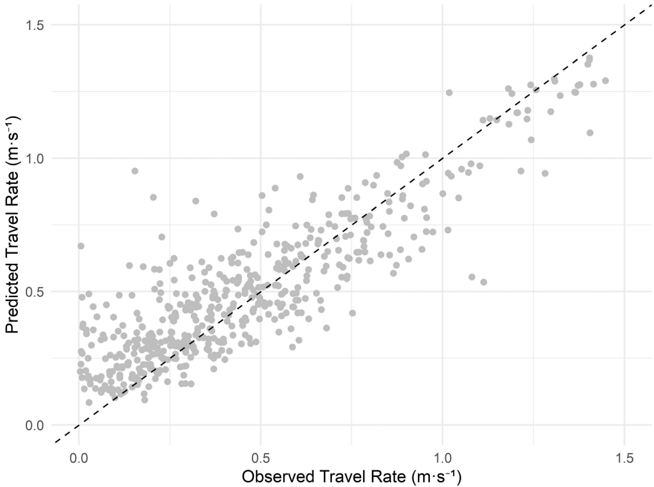
- The random forest explained over 77% of variance in observed instantaneous travel rates on independent test data (R² = 0.778), with RMSE = 0.160 m/s, MAE = 0.119 m/s, nRMSE = 0.350, and nMAE = 0.261.
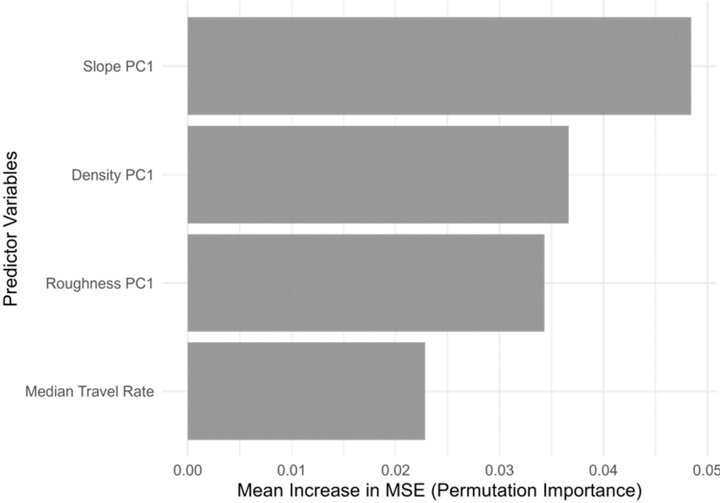
- Permutation importance ranked LiDAR-derived slope PC1 as the most important predictor, followed by vegetation density, then surface roughness, then individual median travel rate.
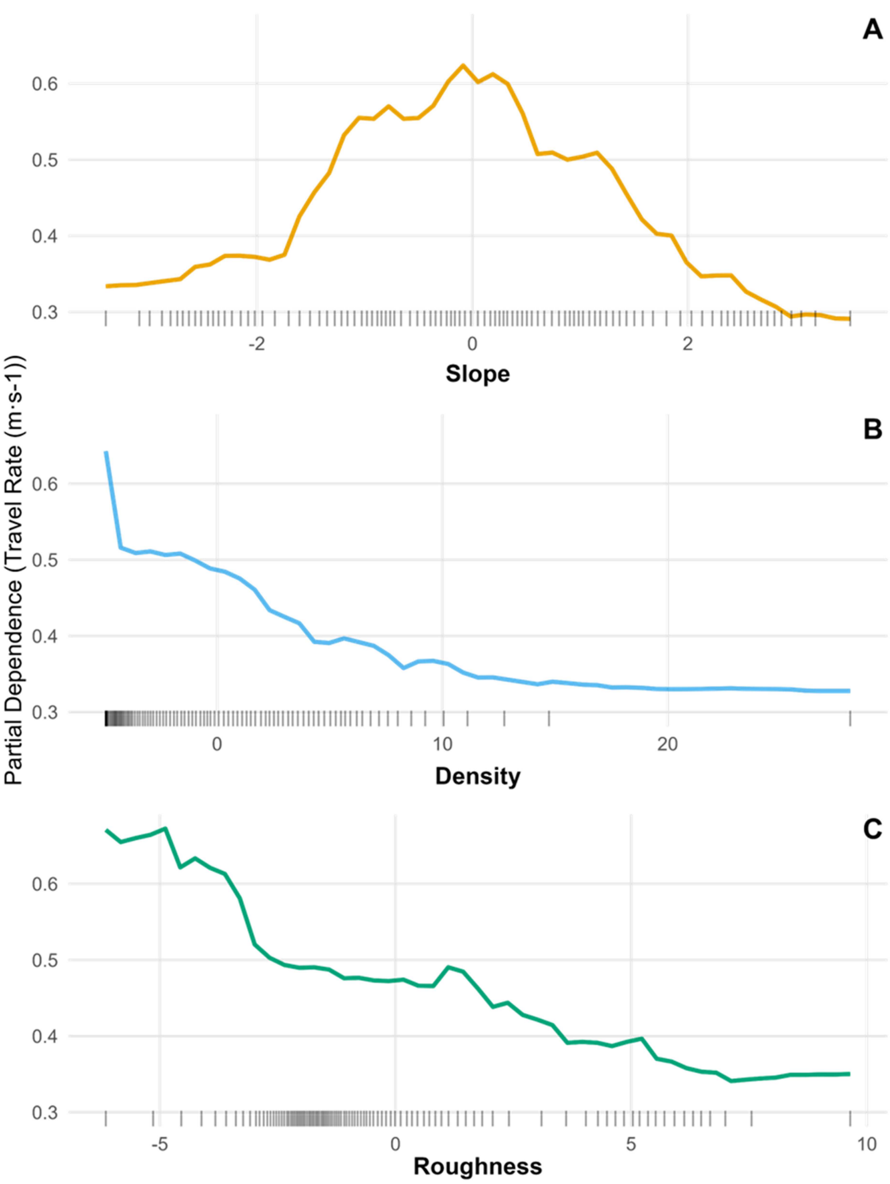
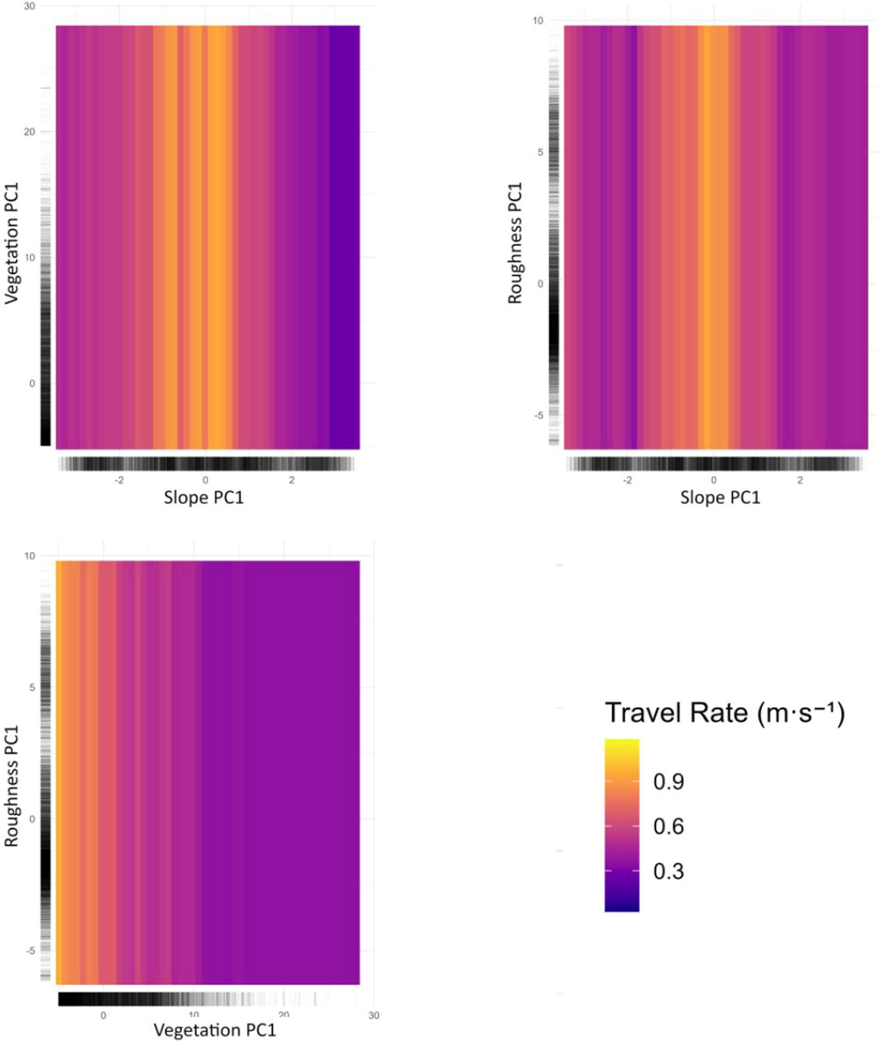
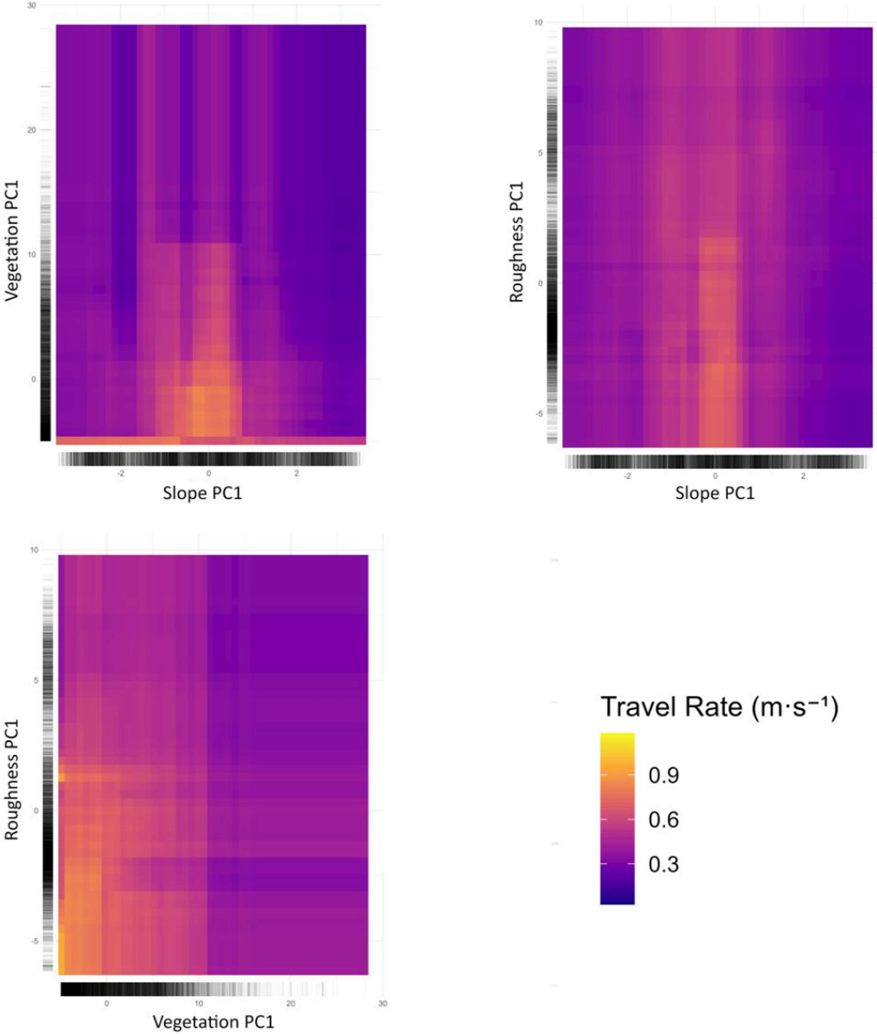
- Partial dependence showed slope–travel rate patterns resembling asymmetrical Lorentz functions, vegetation density reducing travel rate nonlinearly with rapid initial decreases, and surface roughness reducing travel rate more linearly.
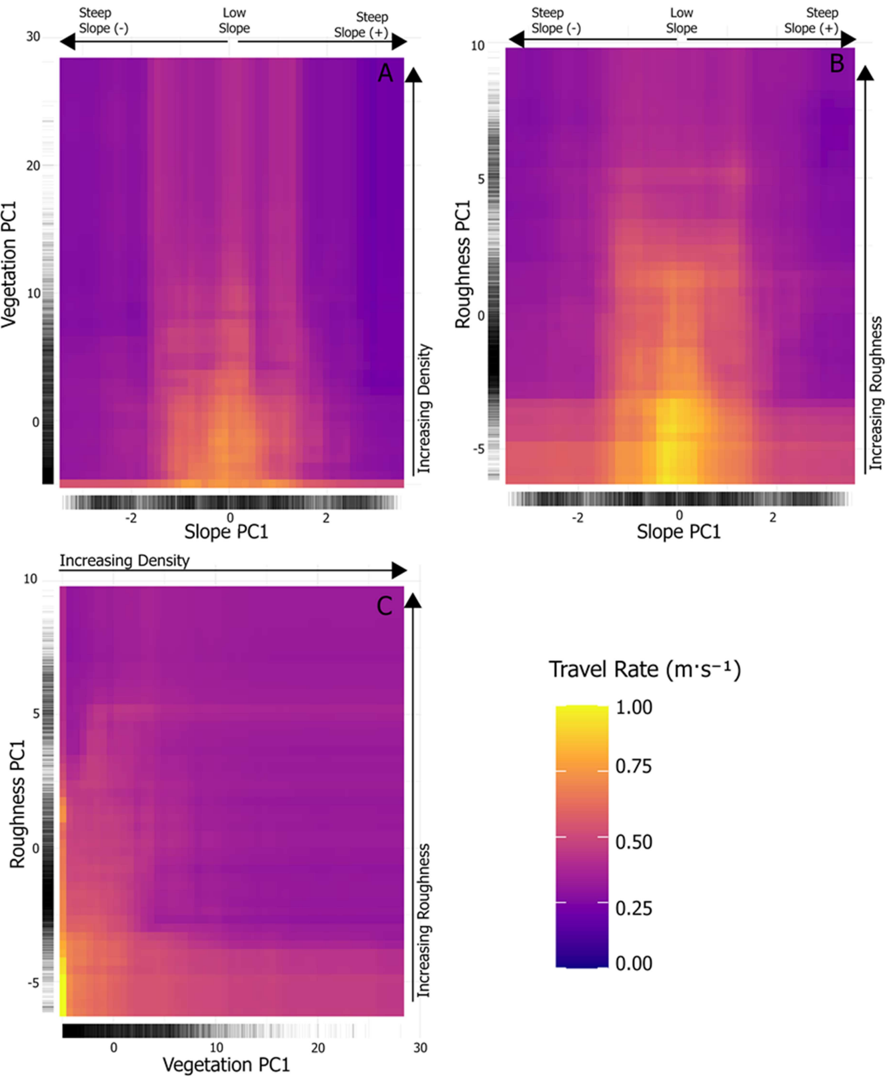
- Bivariate partial dependence indicated vegetation density reduces travel rate more sharply than surface roughness; high vegetation density strongly limits travel rate even when roughness is low, whereas high roughness does not do the same when vegetation density is low. A model excluding median travel rate still explained over 65% of variance.
Methods
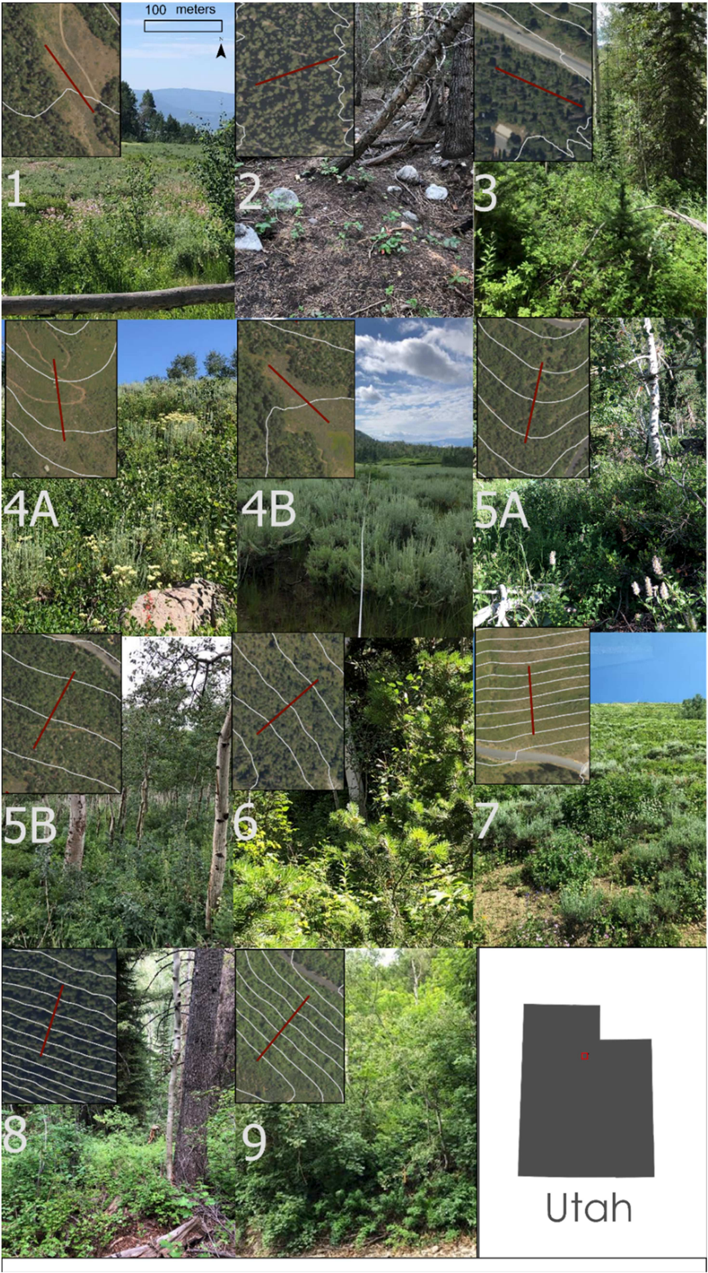
- Nine volunteers walked eleven 100 m transects in the Central Wasatch Mountains, Utah, in both upslope and downslope directions, yielding 74 tracks; airborne LiDAR from USGS 3DEP (2018–2020, 12–16 pulses/m²) was used to derive landscape metrics.
- Instantaneous travel rates were sampled every five seconds, producing 42,007 data points (29,405 training, 12,602 testing); predictors were PC1s for slope, vegetation density, and surface roughness, plus each individual’s median travel rate.
- A random forest was tuned via grid search and evaluated with R², RMSE, and MAE; permutation importance and partial dependence were used to assess predictors, and XGBoost and LightGBM were fit for comparison.
Limitations
- Stated: only nine participants were included, with substantial variation in travel rates; the authors call for a larger, more diverse sample. The five-second sampling meant slower participants generated more data points, though balancing reduced performance only slightly (R² from 0.778 to 0.763; nRMSE from 0.350 to 0.362).
- Stated: participants travelled only about 200 m per transect, so estimated rates may be higher than over longer distances where fatigue matters; weather effects were not tested, and experiments occurred in favourable conditions.
- Evident: the study is limited to one mountain region and a small volunteer pool, which constrains broad transferability; ALS data were collected three to five years before field experiments, though the authors checked for no substantial land cover change.
Model-written summary. Check it against the paper before relying on it.
Integrity signals
Registry
Cites
Statistics
Figures





Verification
Claims the paper makes
35 Own result · 24 Own method · 21 Own interpretation · 6 Not checked yet · 5 No basis given · 3 Supported · 3 Supported so far · 2 Sources not found · 2 No full text of the sources · 1 Partly supported · accuracy not yet measured
Every source the paper cites for this claim was checked and supports it.
In the paper
“Additionally, they found that vegetation at a height of between 0.85 and 1.20 metres impacted travel rate the most.”
§ Machine learning estimation of off-trail pedestrian travel rates using LiDAR-derived slope, vegetation, and surface roughness > Introduction
What the sources say
- Supportedcites Campbell, Cutler, and Dennison 2024 source
In Results and discussion, the authors report that the 0.85–1.20 m vegetation-density range best explained travel rates among the height ranges tested. They also note that several other ranges had nearly comparable predictive performance. (LLM, conf=0.88)
plaindirect- Asserted: passes — The authors put it forward as true.
- Checkable: passes — It can be checked against evidence.
- Load-bearing: unclear — It is unclear whether the paper’s conclusions depend on it.
- Based: passes — The paper gives a reason why it holds.
- Supported
Every source the paper cites for this claim was checked and supports it.
In the paper
“Vegetation density partial dependence in Figure 9B confirms a non-linear relationship between vegetation density and travel rate previously posited by Campbell, Cutler, and Dennison (2024).”
§ Machine learning estimation of off-trail pedestrian travel rates using LiDAR-derived slope, vegetation, and surface roughness > Discussion
What the sources say
- Supportedcites Campbell, Cutler, and Dennison (2024) source
In Results and discussion, “STRIDE model performance” (page unavailable), Eq. (1) places vegetation density in the denominator of the travel-rate function, making its modeled relationship with travel rate nonlinear. The section also says that denser vegetation contributes to lower travel rates. Figure 9B is the citing paper’s own analysis, not a result attributed to Campbell et al. (LLM, conf=0.91)
boostedcorrelational- Asserted: passes — The authors put it forward as true.
- Checkable: passes — It can be checked against evidence.
- Load-bearing: unclear — It is unclear whether the paper’s conclusions depend on it.
- Based: passes — The paper gives a reason why it holds.
- Supported
A result the paper reports from its own data — it cites no other source for it, so there is none to check. The quote shows it is in the paper.
In the paper
“The model explained over 77% of the variance in observed travel rates from an independent test dataset (R² = 0.778).”
§ Machine learning estimation of off-trail pedestrian travel rates using LiDAR-derived slope, vegetation, and surface roughness > Abstract
plaincorrelational- Asserted: passes — The authors put it forward as true.
- Checkable: passes — It can be checked against evidence.
- Load-bearing: passes — The paper’s conclusions depend on it.
- Based: passes — The paper gives a reason why it holds.
A result the paper reports from its own data — it cites no other source for it, so there is none to check. The quote shows it is in the paper.
In the paper
“While slope is the most important single predictor, our results show that vegetation density and surface roughness exert distinct and nonlinear influences that become clearer only when evaluated jointly.”
§ Machine learning estimation of off-trail pedestrian travel rates using LiDAR-derived slope, vegetation, and surface roughness > Abstract
boosteddirect- Asserted: passes — The authors put it forward as true.
- Checkable: passes — It can be checked against evidence.
- Load-bearing: passes — The paper’s conclusions depend on it.
- Based: passes — The paper gives a reason why it holds.
- Rests on an assumption: The nine volunteer participants from the University of Utah are representative of off-path pedestrians in general.
- Rests on an assumption: The eleven transects are representative of the wider range of off-path landscapes to which the findings are claimed to apply.
The paper states this without a source or data behind it here, so there is nothing to check it against. The quote shows it is in the paper.
In the paper
“This study resulted in novel random forest models that predict instantaneous, off-path travel rates.”
§ Machine learning estimation of off-trail pedestrian travel rates using LiDAR-derived slope, vegetation, and surface roughness > Conclusion
plain- Asserted: passes — The authors put it forward as true.
- Checkable: passes — It can be checked against evidence.
- Load-bearing: passes — The paper’s conclusions depend on it.
- Based: passes — The paper gives a reason why it holds.
A result the paper reports from its own data — it cites no other source for it, so there is none to check. The quote shows it is in the paper.
In the paper
“Despite the small number of participants, a random forest model excluding the median travel rate per person predictor still explained over 65% of the variance in observed instantaneous travel rates, suggesting that landscape factors affect movement more than individual-level fitness, experience, or physiology.”
§ Machine learning estimation of off-trail pedestrian travel rates using LiDAR-derived slope, vegetation, and surface roughness > Discussion
plaincorrelationaln = 9- Asserted: passes — The authors put it forward as true.
- Checkable: passes — It can be checked against evidence.
- Load-bearing: passes — The paper’s conclusions depend on it.
- Based: passes — The paper gives a reason why it holds.
A result the paper reports from its own data — it cites no other source for it, so there is none to check. The quote shows it is in the paper.
In the paper
“The resulting normalised RMSE represented 35% of the mean observed value, while the normalised MAE indicated an absolute prediction error of 26.1%.”
§ Machine learning estimation of off-trail pedestrian travel rates using LiDAR-derived slope, vegetation, and surface roughness > Results
plain- Asserted: passes — The authors put it forward as true.
- Checkable: passes — It can be checked against evidence.
- Load-bearing: passes — The paper’s conclusions depend on it.
- Based: passes — The paper gives a reason why it holds.
A result the paper reports from its own data — it cites no other source for it, so there is none to check. The quote shows it is in the paper.
In the paper
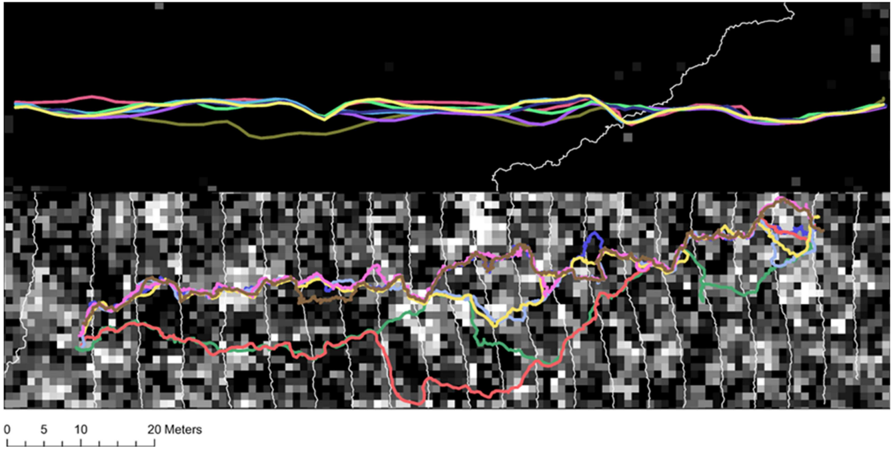
“The data collected by this experiment provided insights into the variety of paths individuals choose when moving through the same landscape.”
§ Machine learning estimation of off-trail pedestrian travel rates using LiDAR-derived slope, vegetation, and surface roughness > Discussion
plain- Asserted: passes — The authors put it forward as true.
- Checkable: passes — It can be checked against evidence.
- Load-bearing: unclear — It is unclear whether the paper’s conclusions depend on it.
- Based: passes — The paper gives a reason why it holds.
A result the paper reports from its own data — it cites no other source for it, so there is none to check. The quote shows it is in the paper.
In the paper
“Additionally, bivariate partial dependence reveals that high vegetation density substantially impedes travel rate, even when surface roughness is low.”
§ Machine learning estimation of off-trail pedestrian travel rates using LiDAR-derived slope, vegetation, and surface roughness > Results
plaindirect- Asserted: passes — The authors put it forward as true.
- Checkable: passes — It can be checked against evidence.
- Load-bearing: passes — The paper’s conclusions depend on it.
- Based: passes — The paper gives a reason why it holds.
A result the paper reports from its own data — it cites no other source for it, so there is none to check. The quote shows it is in the paper.
In the paper
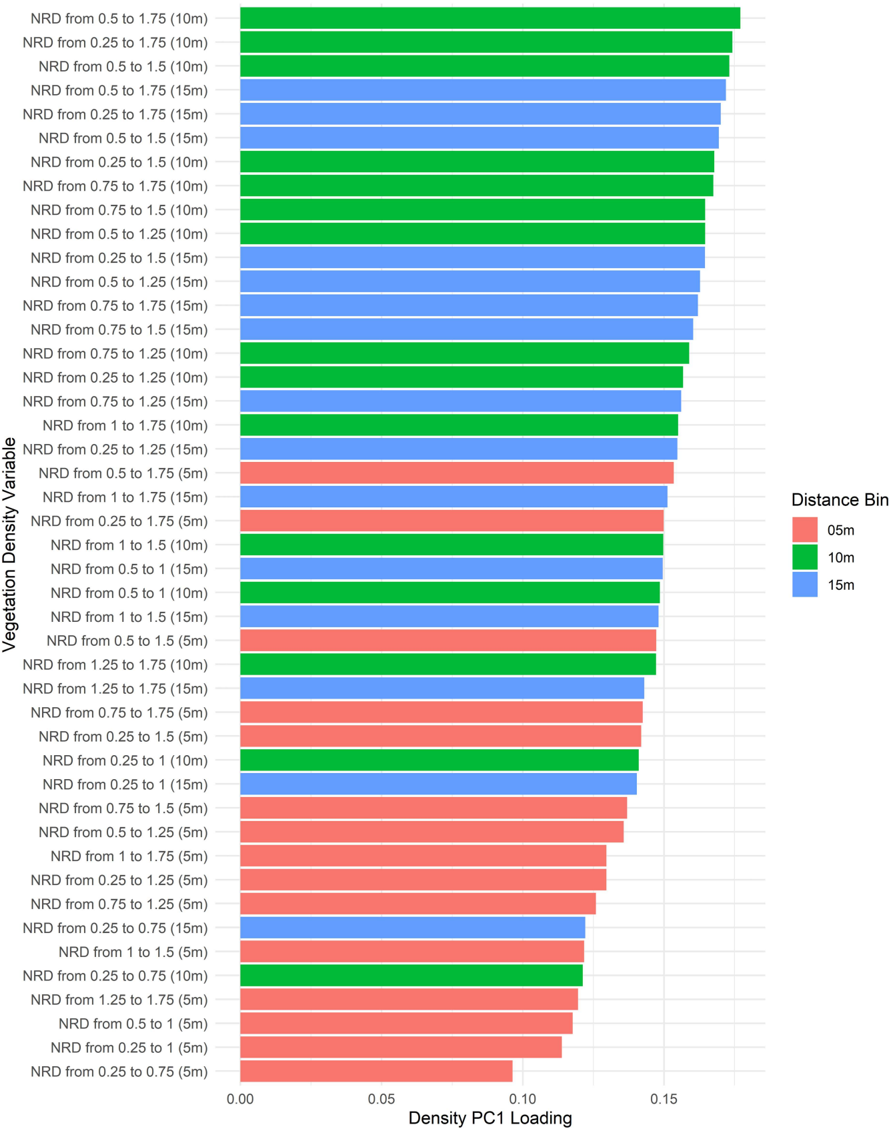
“The PC1 loadings for vegetation density indicated that 10-and 15metre vegetation variables had higher weightings than 5-metre variables (Figure 6).”
§ Machine learning estimation of off-trail pedestrian travel rates using LiDAR-derived slope, vegetation, and surface roughness > Results
hedgedcorrelational- Asserted: passes — The authors put it forward as true.
- Checkable: passes — It can be checked against evidence.
- Load-bearing: unclear — It is unclear whether the paper’s conclusions depend on it.
- Based: passes — The paper gives a reason why it holds.
A result the paper reports from its own data — it cites no other source for it, so there is none to check. The quote shows it is in the paper.
In the paper
“However, using a balanced dataset, where each individual contributed the same number of points, capped by the fastest person's maximum, resulted in only a small drop in performance.”
§ Machine learning estimation of off-trail pedestrian travel rates using LiDAR-derived slope, vegetation, and surface roughness > Discussion
plaindirect- Asserted: passes — The authors put it forward as true.
- Checkable: passes — It can be checked against evidence.
- Load-bearing: unclear — It is unclear whether the paper’s conclusions depend on it.
- Based: passes — The paper gives a reason why it holds.
A result the paper reports from its own data — it cites no other source for it, so there is none to check. The quote shows it is in the paper.
In the paper
“Random forest modelling revealed that slope, vegetation density, surface roughness, and median travel rate can be used together to predict instantaneous travel rates with relatively high explanatory power and low predictive error (Table 2).”
§ Machine learning estimation of off-trail pedestrian travel rates using LiDAR-derived slope, vegetation, and surface roughness > Results
plaincorrelational- Asserted: passes — The authors put it forward as true.
- Checkable: passes — It can be checked against evidence.
- Load-bearing: passes — The paper’s conclusions depend on it.
- Based: passes — The paper gives a reason why it holds.
A result the paper reports from its own data — it cites no other source for it, so there is none to check. The quote shows it is in the paper.
In the paper
“Over 77% of the variance in travel rate was explained by the predictor variables in the test data.”
- Also stated in: § Discussion · boosted
“Our random forest model explained over 77% of the variance in observed travel rate, indicating strong predictive performance.”
§ Machine learning estimation of off-trail pedestrian travel rates using LiDAR-derived slope, vegetation, and surface roughness > Results
boostedcorrelational- Asserted: passes — The authors put it forward as true.
- Checkable: passes — It can be checked against evidence.
- Load-bearing: passes — The paper’s conclusions depend on it.
- Based: passes — The paper gives a reason why it holds.
- Also stated in: § Discussion · boosted
A result the paper reports from its own data — it cites no other source for it, so there is none to check. The quote shows it is in the paper.
In the paper
“The additional PCs were all ranked as less important than the 3 PC1 and the median travel rate variables and thus, for the sake of parsimony, the final model we have presented only describes the model built with the three PC1s.”
§ Machine learning estimation of off-trail pedestrian travel rates using LiDAR-derived slope, vegetation, and surface roughness > Principal component analysis
plain- Asserted: passes — The authors put it forward as true.
- Checkable: passes — It can be checked against evidence.
- Load-bearing: passes — The paper’s conclusions depend on it.
- Based: passes — The paper gives a reason why it holds.
A result the paper reports from its own data — it cites no other source for it, so there is none to check. The quote shows it is in the paper.
In the paper
“Despite the presence of several near-zero values in the test data, the model did not produce predictions below 0.1 m/s (Figure 4).”
§ Machine learning estimation of off-trail pedestrian travel rates using LiDAR-derived slope, vegetation, and surface roughness > Results
plain- Asserted: passes — The authors put it forward as true.
- Checkable: passes — It can be checked against evidence.
- Load-bearing: unclear — It is unclear whether the paper’s conclusions depend on it.
- Based: passes — The paper gives a reason why it holds.
A result the paper reports from its own data — it cites no other source for it, so there is none to check. The quote shows it is in the paper.
In the paper
“These three landscape factors were followed by the median travel rate.”
§ Machine learning estimation of off-trail pedestrian travel rates using LiDAR-derived slope, vegetation, and surface roughness > Results
plaincorrelational- Asserted: passes — The authors put it forward as true.
- Checkable: passes — It can be checked against evidence.
- Load-bearing: unclear — It is unclear whether the paper’s conclusions depend on it.
- Based: passes — The paper gives a reason why it holds.
A result the paper reports from its own data — it cites no other source for it, so there is none to check. The quote shows it is in the paper.
In the paper
“We found minimal performance gains when PC were increased to explain over 95% or more of the variance; R² improved by 0.05 and nRMSE improved by only 0.003.”
§ Machine learning estimation of off-trail pedestrian travel rates using LiDAR-derived slope, vegetation, and surface roughness > Principal component analysis
plain- Asserted: passes — The authors put it forward as true.
- Checkable: passes — It can be checked against evidence.
- Load-bearing: passes — The paper’s conclusions depend on it.
- Based: passes — The paper gives a reason why it holds.
A result the paper reports from its own data — it cites no other source for it, so there is none to check. The quote shows it is in the paper.
In the paper
“The performance differences among all models were minimal, within approximately one percent, indicating that the choice of algorithm had relatively little influence on predictive accuracy for this dataset (Table 3).”
§ Machine learning estimation of off-trail pedestrian travel rates using LiDAR-derived slope, vegetation, and surface roughness > Discussion
hedged- Asserted: passes — The authors put it forward as true.
- Checkable: passes — It can be checked against evidence.
- Load-bearing: unclear — It is unclear whether the paper’s conclusions depend on it.
- Based: passes — The paper gives a reason why it holds.
A result the paper reports from its own data — it cites no other source for it, so there is none to check. The quote shows it is in the paper.
In the paper
“However, when comparing the effects of vegetation density and surface roughness with slope, it becomes evident that a slight increase in vegetation density reduces travel rate more sharply than a comparable increase in surface roughness (Figures 9A & 9B).”
§ Machine learning estimation of off-trail pedestrian travel rates using LiDAR-derived slope, vegetation, and surface roughness > Results
plaindirect- Asserted: passes — The authors put it forward as true.
- Checkable: passes — It can be checked against evidence.
- Load-bearing: unclear — It is unclear whether the paper’s conclusions depend on it.
- Based: passes — The paper gives a reason why it holds.
In the paper
“Partial dependence further confirmed that the relationship between slope and travel rate is”
§ Machine learning estimation of off-trail pedestrian travel rates using LiDAR-derived slope, vegetation, and surface roughness > Discussion
What the sources say
- Not matchedcites Tobler (1993)
Couldn’t be matched to a paper in Crossref, so it can’t be checked.
boostedcorrelational- Asserted: passes — The authors put it forward as true.
- Checkable: passes — It can be checked against evidence.
- Load-bearing: unclear — It is unclear whether the paper’s conclusions depend on it.
- Based: passes — The paper gives a reason why it holds.
- Not matched
A result the paper reports from its own data — it cites no other source for it, so there is none to check. The quote shows it is in the paper.
In the paper
“Vegetation density follows the general pattern of increased vegetation density resulting in decreased travel rates (Figure 8B).”
§ Machine learning estimation of off-trail pedestrian travel rates using LiDAR-derived slope, vegetation, and surface roughness > Results
hedgeddirect- Asserted: passes — The authors put it forward as true.
- Checkable: passes — It can be checked against evidence.
- Load-bearing: passes — The paper’s conclusions depend on it.
- Based: passes — The paper gives a reason why it holds.
A result the paper reports from its own data — it cites no other source for it, so there is none to check. The quote shows it is in the paper.
In the paper
“The resulting normalised RMSE represented 35% of the mean observed value, while the normalised MAE indicated an absolute prediction error of 26.1%.”
§ Machine learning estimation of off-trail pedestrian travel rates using LiDAR-derived slope, vegetation, and surface roughness > Results
plain- Asserted: passes — The authors put it forward as true.
- Checkable: passes — It can be checked against evidence.
- Load-bearing: unclear — It is unclear whether the paper’s conclusions depend on it.
- Based: passes — The paper gives a reason why it holds.
A result the paper reports from its own data — it cites no other source for it, so there is none to check. The quote shows it is in the paper.
In the paper
“In contrast, high surface roughness does not produce a similarly strong effect when vegetation density is low (Figure 9C).”
§ Machine learning estimation of off-trail pedestrian travel rates using LiDAR-derived slope, vegetation, and surface roughness > Results
plain- Asserted: passes — The authors put it forward as true.
- Checkable: passes — It can be checked against evidence.
- Load-bearing: unclear — It is unclear whether the paper’s conclusions depend on it.
- Based: passes — The paper gives a reason why it holds.
A result the paper reports from its own data — it cites no other source for it, so there is none to check. The quote shows it is in the paper.
In the paper
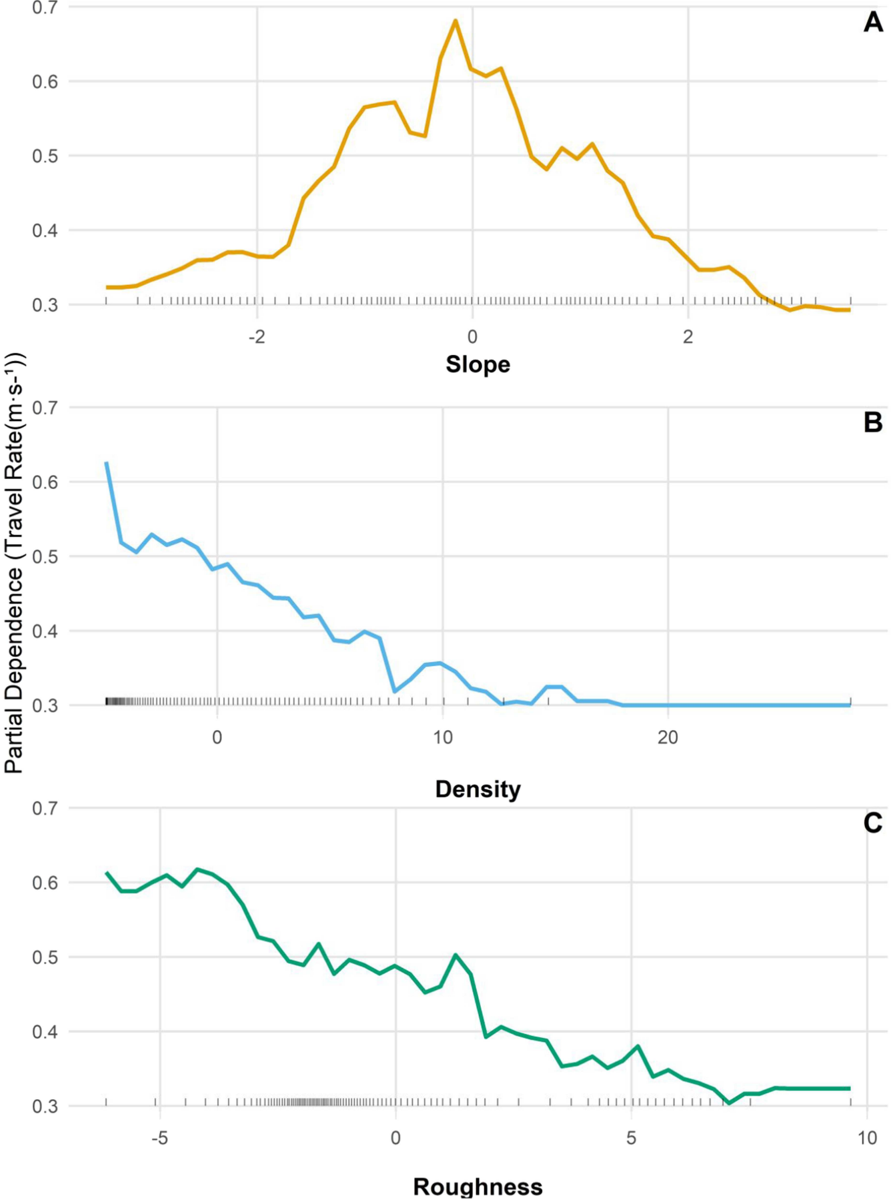
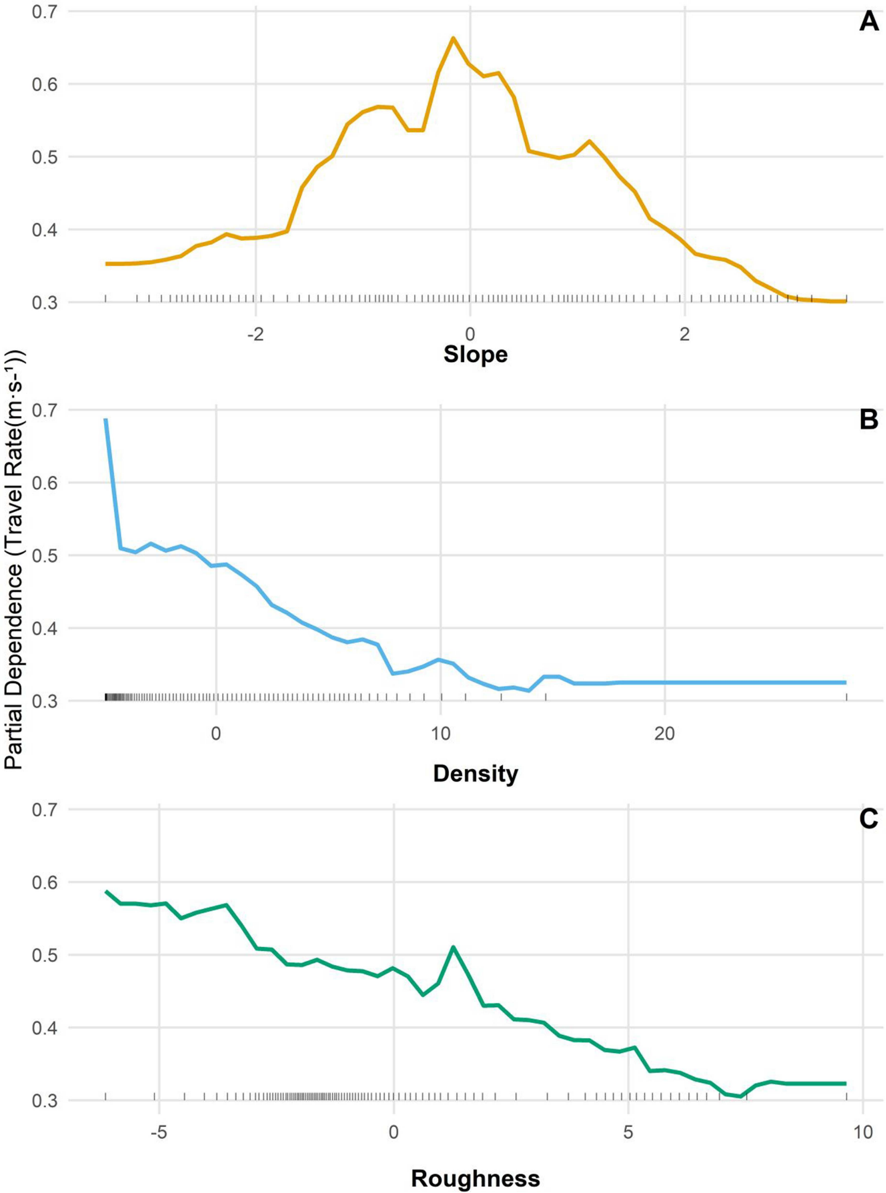
“An analysis of partial dependence among the comparison models shown in Figures A1-A4 also yielded similar results to the main random forest model.”
§ Machine learning estimation of off-trail pedestrian travel rates using LiDAR-derived slope, vegetation, and surface roughness > Discussion
plain- Asserted: passes — The authors put it forward as true.
- Checkable: passes — It can be checked against evidence.
- Load-bearing: unclear — It is unclear whether the paper’s conclusions depend on it.
- Based: passes — The paper gives a reason why it holds.
A result the paper reports from its own data — it cites no other source for it, so there is none to check. The quote shows it is in the paper.
In the paper
“Slope PC1 was as the most influential predictor of travel rate, with a higher importance compared to vegetation density and surface roughness (Figure 5).”
- Also stated in: § Discussion · plain
“Slope was found to be the most important variable in predicting instantaneous travel rate, and this study, like many previous slope-based studies, found that steeper slopes result in decreased travel rates (Tobler 1993;Rees 2004;Sullivan et al. 2020).”
§ Machine learning estimation of off-trail pedestrian travel rates using LiDAR-derived slope, vegetation, and surface roughness > Results
plaincorrelational- Asserted: passes — The authors put it forward as true.
- Checkable: passes — It can be checked against evidence.
- Load-bearing: passes — The paper’s conclusions depend on it.
- Based: passes — The paper gives a reason why it holds.
- Also stated in: § Discussion · plain
A conclusion the paper draws from its own results — it cites no other source for it, so there is none to check. The quote shows it is in the paper.
In the paper
“This paper presents the first known examination of instantaneous travel rates using random forests-a machine learning algorithm well-suited to the presence of non-linear relationships and the ability to robustly evaluate variable importance.”
- Also stated in: § Introduction · hedged
“To our knowledge, this is the first study to apply random forests to modelling pedestrian travel rates, providing new abilities to capture complex relationships between predictor variables and travel rates.”
§ Machine learning estimation of off-trail pedestrian travel rates using LiDAR-derived slope, vegetation, and surface roughness > Abstract
hedged- Asserted: passes — The authors put it forward as true.
- Checkable: passes — It can be checked against evidence.
- Load-bearing: passes — The paper’s conclusions depend on it.
- Based: passes — The paper gives a reason why it holds.
- Also stated in: § Introduction · hedged
The paper states this without a source or data behind it here, so there is nothing to check it against. The quote shows it is in the paper.
In the paper
“Previous studies have also relied on parametric function fitting to model off-path travel rates.”
- Also stated in: § Introduction · hedged
“Additionally, most previous travel rate studies have attempted to fit travel rates to mathematical functions (e.g.bi-exponential, Gaussian, or Lorentz) using regression, rather than using more advanced machine learning techniques to quantify relationships between predictor variables and travel rates.”
§ Machine learning estimation of off-trail pedestrian travel rates using LiDAR-derived slope, vegetation, and surface roughness > Abstract
plain- Asserted: passes — The authors put it forward as true.
- Checkable: passes — It can be checked against evidence.
- Load-bearing: passes — The paper’s conclusions depend on it.
- Based: passes — The paper gives a reason why it holds.
- Also stated in: § Introduction · hedged
A conclusion the paper draws from its own results — it cites no other source for it, so there is none to check. The quote shows it is in the paper.
In the paper
“Examining the importance of slope, vegetation density, and surface roughness together provides new insight beyond their individual effects, revealing how these landscape factors interact to shape pedestrian travel rates.”
§ Machine learning estimation of off-trail pedestrian travel rates using LiDAR-derived slope, vegetation, and surface roughness > Abstract
plaincorrelational- Asserted: passes — The authors put it forward as true.
- Checkable: passes — It can be checked against evidence.
- Load-bearing: passes — The paper’s conclusions depend on it.
- Based: passes — The paper gives a reason why it holds.
- Rests on an assumption: The nine volunteer participants from the University of Utah are representative of off-path pedestrians in general.
- Rests on an assumption: The eleven transects are representative of the wider range of off-path landscapes to which the findings are claimed to apply.
The paper states this without a source or data behind it here, so there is nothing to check it against. The quote shows it is in the paper.
In the paper
“Most previous pedestrian travel rate models have only quantified the effects of these factors at relatively coarse spatiotemporal resolutions, ignoring the fine-scaled information contained within LiDAR data and instantaneous travel trajectories.”
- Also stated in: § Introduction · plain
“Previous studies have most commonly modelled travel rates over longer distances and times, and have not utilised the finer spatiotemporal scale information available in instantaneous travel rates.”
§ Machine learning estimation of off-trail pedestrian travel rates using LiDAR-derived slope, vegetation, and surface roughness > Abstract
plain- Asserted: passes — The authors put it forward as true.
- Checkable: passes — It can be checked against evidence.
- Load-bearing: passes — The paper’s conclusions depend on it.
- Based: passes — The paper gives a reason why it holds.
- Also stated in: § Introduction · plain
A conclusion the paper draws from its own results — it cites no other source for it, so there is none to check. The quote shows it is in the paper.
In the paper
“Despite the small number of participants, a random forest model excluding the median travel rate per person predictor still explained over 65% of the variance in observed instantaneous travel rates, suggesting that landscape factors affect movement more than individual-level fitness, experience, or physiology.”
§ Machine learning estimation of off-trail pedestrian travel rates using LiDAR-derived slope, vegetation, and surface roughness > Discussion
hedgedcorrelationaln = 9- Asserted: passes — The authors put it forward as true.
- Checkable: passes — It can be checked against evidence.
- Load-bearing: passes — The paper’s conclusions depend on it.
- Based: passes — The paper gives a reason why it holds.
A conclusion the paper draws from its own results — it cites no other source for it, so there is none to check. The quote shows it is in the paper.
In the paper
“Our random forest model explained over 77% of the variance in observed travel rate, indicating strong predictive performance.”
§ Machine learning estimation of off-trail pedestrian travel rates using LiDAR-derived slope, vegetation, and surface roughness > Discussion
hedgedcorrelational- Asserted: passes — The authors put it forward as true.
- Checkable: passes — It can be checked against evidence.
- Load-bearing: passes — The paper’s conclusions depend on it.
- Based: passes — The paper gives a reason why it holds.
A conclusion the paper draws from its own results — it cites no other source for it, so there is none to check. The quote shows it is in the paper.
In the paper
“Variation in individual paths suggests that individuals do not always choose the optimal path through a landscape (Figure 3).”
§ Machine learning estimation of off-trail pedestrian travel rates using LiDAR-derived slope, vegetation, and surface roughness > Discussion
hedged- Asserted: passes — The authors put it forward as true.
- Checkable: passes — It can be checked against evidence.
- Load-bearing: unclear — It is unclear whether the paper’s conclusions depend on it.
- Based: passes — The paper gives a reason why it holds.
A conclusion the paper draws from its own results — it cites no other source for it, so there is none to check. The quote shows it is in the paper.
In the paper
“While previous firefighter studies noted that different fuel types (which imply varying vegetation characteristics) affected travel difficulty, our study offers a more quantifiable approach using continuous vegetation density measures (Alexander, Baxter, and Dakin 2005).”
§ Machine learning estimation of off-trail pedestrian travel rates using LiDAR-derived slope, vegetation, and surface roughness > Discussion
plain- Asserted: passes — The authors put it forward as true.
- Checkable: passes — It can be checked against evidence.
- Load-bearing: passes — The paper’s conclusions depend on it.
- Based: passes — The paper gives a reason why it holds.
The paper states this without a source or data behind it here, so there is nothing to check it against. The quote shows it is in the paper.
In the paper
“Unlike net travel rate, which represents the average speed over an entire route or longer time interval, instantaneous rate reveals the dynamic variability that traditional net travel rate-based models often oversimplify.”
§ Machine learning estimation of off-trail pedestrian travel rates using LiDAR-derived slope, vegetation, and surface roughness > Introduction
plaindirect- Asserted: passes — The authors put it forward as true.
- Checkable: passes — It can be checked against evidence.
- Load-bearing: passes — The paper’s conclusions depend on it.
- Based: passes — The paper gives a reason why it holds.
A conclusion the paper draws from its own results — it cites no other source for it, so there is none to check. The quote shows it is in the paper.
In the paper
“Vegetation densities within wider height ranges were most important.”
§ Machine learning estimation of off-trail pedestrian travel rates using LiDAR-derived slope, vegetation, and surface roughness > Results
plaincorrelational- Asserted: passes — The authors put it forward as true.
- Checkable: passes — It can be checked against evidence.
- Load-bearing: unclear — It is unclear whether the paper’s conclusions depend on it.
- Based: passes — The paper gives a reason why it holds.
The paper states this without a source or data behind it here, so there is nothing to check it against. The quote shows it is in the paper.
In the paper
“Because of the wide variety of structural conditions that may exist within categorical land cover types, the use of LiDAR-based measurements in travel rate models improves accuracy by capturing fine-scale variation in vegetation density and distribution along a continuous spectrum.”
§ Machine learning estimation of off-trail pedestrian travel rates using LiDAR-derived slope, vegetation, and surface roughness > Introduction
plaindirect- Asserted: passes — The authors put it forward as true.
- Checkable: passes — It can be checked against evidence.
- Load-bearing: passes — The paper’s conclusions depend on it.
- Based: passes — The paper gives a reason why it holds.
In the paper
“Campbell, Cutler, and Dennison (2024) used LiDAR-based measurements of slope, vegetation density, and surface roughness to model net travel rate in both on-and off-path environments.They found that these three variables could explain the variation in travel rate across diverse landscapes.”
§ Machine learning estimation of off-trail pedestrian travel rates using LiDAR-derived slope, vegetation, and surface roughness > Introduction
What the sources say
- Not checked yetcites Campbell, Cutler, and Dennison 2024 source
plaincorrelational- Asserted: passes — The authors put it forward as true.
- Checkable: passes — It can be checked against evidence.
- Load-bearing: passes — The paper’s conclusions depend on it.
- Based: passes — The paper gives a reason why it holds.
None of the sources cited for this claim have been checked yet.
In the paper
“The effects of vegetation density and surface roughness on travel rate are less established than those of slope, although there are off-path travel rate models that have incorporated vegetation density or landcover type to improve travel rate estimations (Tobler 1993;Alexander, Baxter, and Dakin 2005;Campbell, Dennison, and Butler 2017;Irmischer and Clarke 2018).”
§ Machine learning estimation of off-trail pedestrian travel rates using LiDAR-derived slope, vegetation, and surface roughness > Introduction
What the sources say
- Not matchedcites Tobler 1993
Couldn’t be matched to a paper in Crossref, so it can’t be checked.
- Not matchedcites Alexander, Baxter, and Dakin 2005
Couldn’t be matched to a paper in Crossref, so it can’t be checked.
- Not checked — no full text of the sourcecites Campbell, Dennison, and Butler 2017 source
plain- Asserted: passes — The authors put it forward as true.
- Checkable: passes — It can be checked against evidence.
- Load-bearing: passes — The paper’s conclusions depend on it.
- Based: passes — The paper gives a reason why it holds.
- Not matched
A conclusion the paper draws from its own results — it cites no other source for it, so there is none to check. The quote shows it is in the paper.
In the paper
“Our results underscore the importance of surface roughness and vegetation structure in shaping human mobility patterns.”
§ Machine learning estimation of off-trail pedestrian travel rates using LiDAR-derived slope, vegetation, and surface roughness > Conclusion
plaindirect- Asserted: passes — The authors put it forward as true.
- Checkable: passes — It can be checked against evidence.
- Load-bearing: passes — The paper’s conclusions depend on it.
- Based: passes — The paper gives a reason why it holds.
A conclusion the paper draws from its own results — it cites no other source for it, so there is none to check. The quote shows it is in the paper.
In the paper
“Together, these interactions underscore that vegetation structure plays a particularly strong role in shaping off-path travel rates, often amplifying or overriding the effects of other terrain characteristics.”
§ Machine learning estimation of off-trail pedestrian travel rates using LiDAR-derived slope, vegetation, and surface roughness > Discussion
boosteddirect- Asserted: passes — The authors put it forward as true.
- Checkable: passes — It can be checked against evidence.
- Load-bearing: passes — The paper’s conclusions depend on it.
- Based: passes — The paper gives a reason why it holds.
None of the sources cited for this claim have been checked yet.
In the paper
“Most previous studies that have explored the relationship between vegetation and travel rates have used categorical vegetation or landcover types (Alexander, Baxter, and Dakin 2005;Irmischer and Clarke 2018).”
§ Machine learning estimation of off-trail pedestrian travel rates using LiDAR-derived slope, vegetation, and surface roughness > Introduction
What the sources say
- Not matchedcites Alexander, Baxter, and Dakin 2005
Couldn’t be matched to a paper in Crossref, so it can’t be checked.
- Not checked yetcites Irmischer and Clarke 2018 source
plain- Asserted: passes — The authors put it forward as true.
- Checkable: passes — It can be checked against evidence.
- Load-bearing: passes — The paper’s conclusions depend on it.
- Based: passes — The paper gives a reason why it holds.
- Not matched
What the paper did — it cites no source for this, so there is none to check. The quote shows it is in the paper.
In the paper
“One approach to controlling for these individuallevel differences would be to include the individual as a categorical predictor variable.However, doing so would limit the applicability of the model to the limited pool of study subjects.”
§ Machine learning estimation of off-trail pedestrian travel rates using LiDAR-derived slope, vegetation, and surface roughness > Median travel rate
hedgeddirect- Asserted: passes — The authors put it forward as true.
- Checkable: passes — It can be checked against evidence.
- Load-bearing: passes — The paper’s conclusions depend on it.
- Based: passes — The paper gives a reason why it holds.
What the paper did — it cites no source for this, so there is none to check. The quote shows it is in the paper.
In the paper
“This introduces a potential bias in the model, skewing it toward the behaviour of slower-moving participants.”
§ Machine learning estimation of off-trail pedestrian travel rates using LiDAR-derived slope, vegetation, and surface roughness > Discussion
hedgedconditional- Asserted: passes — The authors put it forward as true.
- Checkable: passes — It can be checked against evidence.
- Load-bearing: unclear — It is unclear whether the paper’s conclusions depend on it.
- Based: passes — The paper gives a reason why it holds.
None of the sources cited for this claim have been checked yet.
In the paper
“Surface roughness is the microtopography of the ground (Brubaker et al. 2013;Richmond, Potter, and Santee 2015) and works together with slope and vegetation density to impact travel rate, as uneven surfaces can cause difficulty when walking.”
§ Machine learning estimation of off-trail pedestrian travel rates using LiDAR-derived slope, vegetation, and surface roughness > Introduction
What the sources say
- Not checked yetcites Brubaker et al. 2013 source
Checked before — its earlier verdict is held back until a new check runs.
- Not matchedcites Richmond, Potter, and Santee 2015
Couldn’t be matched to a paper in Crossref, so it can’t be checked.
plaindirect- Asserted: passes — The authors put it forward as true.
- Checkable: passes — It can be checked against evidence.
- Load-bearing: passes — The paper’s conclusions depend on it.
- Based: passes — The paper gives a reason why it holds.
- Not checked yet
A conclusion the paper draws from its own results — it cites no other source for it, so there is none to check. The quote shows it is in the paper.
In the paper
“Unlike previous travel rate models, which often relied on mean variables aggregated across entire trajectories and longer time frames, this approach captures fine-scale variability in landscape conditions and walking speed.”
§ Machine learning estimation of off-trail pedestrian travel rates using LiDAR-derived slope, vegetation, and surface roughness > Introduction
plain- Asserted: passes — The authors put it forward as true.
- Checkable: passes — It can be checked against evidence.
- Load-bearing: passes — The paper’s conclusions depend on it.
- Based: passes — The paper gives a reason why it holds.
What the paper did — it cites no source for this, so there is none to check. The quote shows it is in the paper.
In the paper
“The participants' trajectories were georeferenced using the GPS coordinates of the LiDAR reflectors that were collected using a Trimble R2 GNSS received with RTX FieldPoint correction, providing decimetre-level positional accuracy.”
§ Machine learning estimation of off-trail pedestrian travel rates using LiDAR-derived slope, vegetation, and surface roughness > Participant data
plainn = 9- Asserted: passes — The authors put it forward as true.
- Checkable: passes — It can be checked against evidence.
- Load-bearing: passes — The paper’s conclusions depend on it.
- Based: passes — The paper gives a reason why it holds.
- Probably not a substantial claim. 29
- It may state two separate claims as one. 34
The sources with a verdict support this claim; the rest weren’t checked yet, have no full text we could read, or their verdicts aren’t rated yet.
In the paper
“While less important to the model's prediction than the landscape variables, the importance of median travel rate as a variable in our model highlights the inherent variability between individuals, which is also acknowledged in other studies on navigation speed and pedestrian behaviour (Irmischer and Clarke 2018;Prisner and Sui 2023).”
§ Machine learning estimation of off-trail pedestrian travel rates using LiDAR-derived slope, vegetation, and surface roughness > Discussion
What the sources say
- Supportedcites Irmischer and Clarke 2018 source
The Discussion (lines 407–415) says the reported velocities average across subjects and acknowledges likely large differences in navigation speed across groups, with other factors increasing variation. The Conclusion (around line 530) also notes variance in human behavior. The median-travel-rate variable belongs to the citing authors’ model, not to the claim attributed to this source. (LLM, conf=0.88)
- Not checked — no full text of the sourcecites Prisner and Sui 2023 source
plaincorrelationaln = 9- Asserted: passes — The authors put it forward as true.
- Checkable: passes — It can be checked against evidence.
- Load-bearing: fails — The paper’s conclusions may not depend on it.
- Based: passes — The paper gives a reason why it holds.
Probably not a substantial claim. The paper’s conclusions may not depend on it. It may state two separate claims as one.
- Supported
The sources with a verdict support this claim; the rest weren’t checked yet, have no full text we could read, or their verdicts aren’t rated yet.
In the paper
“Slope had the highest variable importance and based on partial dependence the pattern between slope and travel rates in this dataset closely resembles the asymmetrical Lorentz functions used to predict travel rate in previous studies (Campbell et al., 2022;Sullivan et al. 2020) (Figure 8A).”
§ Machine learning estimation of off-trail pedestrian travel rates using LiDAR-derived slope, vegetation, and surface roughness > Results
What the sources say
- Not checked — no full text of the sourcecites Campbell et al., 2022 source
- Supportedcites Sullivan et al. 2020 source
Section 2.3 (Analysis) gives a Lorentz function for predicting travel rate from slope and explains that its slope-dependent term accounts for the asymmetry between uphill and downhill travel. Sullivan et al. therefore supports the cited reference to a previous asymmetrical Lorentz travel-rate function; the citing paper's variable-importance and partial-dependence results describe its own dataset, not Sullivan et al.'s. (LLM, conf=0.91)
plaincorrelational- Asserted: passes — The authors put it forward as true.
- Checkable: passes — It can be checked against evidence.
- Load-bearing: passes — The paper’s conclusions depend on it.
- Based: passes — The paper gives a reason why it holds.
It may state two separate claims as one.
Every source the paper cites for this claim was checked and supports it.
In the paper
“Studies that have used machine learning to model travel rate have either not included a vegetation measure or used a very generalised vegetation measure (Wood et al. 2023;Asako et al. 2024).”
§ Machine learning estimation of off-trail pedestrian travel rates using LiDAR-derived slope, vegetation, and surface roughness > Introduction
What the sources say
- Supportedcites Wood et al. 2023 source
The Materials and methods sections describe a data-driven walking-speed model that classifies terrain obstruction as light or heavy using a single 10 cm height cutoff. The Discussion calls this obstruction measure “relatively crude,” supporting the claim that Wood et al. used a very generalised vegetation measure. (LLM, conf=0.90)
- Supportedcites Asako et al. 2024 source
Section 4.2 (Spatio-Temporal Component; page not provided) lists the inputs to Asako et al.’s deep-learning travel-time model; none is a vegetation measure. The Wood’s Hiking Model comparison also says the data needed to calculate obstruction level were unavailable, so the authors used the same parameters regardless of obstruction level. This supports the claim as applied to Asako et al.’s study, not as a finding about all machine-learning studies. (LLM, conf=0.91)
plain- Asserted: passes — The authors put it forward as true.
- Checkable: passes — It can be checked against evidence.
- Load-bearing: passes — The paper’s conclusions depend on it.
- Based: passes — The paper gives a reason why it holds.
It may state two separate claims as one.
- Supported
The cited sources support only part of this claim — read each source’s verdict below.
In the paper
“Additionally, weather-related variables such as temperature, humidity, and wind can have a significant effect on travel rates (Obuchi et al. 2021).”
§ Machine learning estimation of off-trail pedestrian travel rates using LiDAR-derived slope, vegetation, and surface roughness > Discussion
What the sources say
- Partly supportedcites Obuchi et al. 2021 sourceExperimental — accuracy not yet measured
The Results (Table 2) report statistically significant correlations between walking speed and both temperature and humidity. The Methods list the meteorological variables measured but do not include wind, and the study addresses walking speed rather than travel rates generally. The reported correlations also do not establish that those variables caused the changes in speed. (LLM, conf=0.88)
plainconditional- Asserted: passes — The authors put it forward as true.
- Checkable: passes — It can be checked against evidence.
- Load-bearing: fails — The paper’s conclusions may not depend on it.
- Based: passes — The paper gives a reason why it holds.
Probably not a substantial claim. The paper’s conclusions may not depend on it.
- Partly supported
The sources with a verdict support this claim; the rest weren’t checked yet, have no full text we could read, or their verdicts aren’t rated yet.
In the paper
“Recent work highlights that pedestrian movement is highly sensitive to local landscape conditions, and that assuming uniform effects across individuals or terrain can lead to prediction errors (Campbell et al. 2019;Campbell, Cutler, and Dennison 2024).”
§ Machine learning estimation of off-trail pedestrian travel rates using LiDAR-derived slope, vegetation, and surface roughness > Introduction
What the sources say
- Not checked — no full text of the sourcecites Campbell et al. 2019 source
- Supportedcites Campbell, Cutler, and Dennison 2024 source
The Introduction explains that slope, vegetation, and surface roughness affect walking rates and that broad, fixed terrain multipliers do not capture the diversity of off-path conditions. In Results and discussion > STRIDE model performance (page unavailable), the authors report prediction error and suggest that differences in participants’ fitness may contribute to unexplained variation. Together, these passages support the claim’s caution about treating terrain or pedestrians as uniform. (LLM, conf=0.88)
plaindirect- Asserted: passes — The authors put it forward as true.
- Checkable: passes — It can be checked against evidence.
- Load-bearing: passes — The paper’s conclusions depend on it.
- Based: passes — The paper gives a reason why it holds.
It may state two separate claims as one.
A result the paper reports from its own data — it cites no other source for it, so there is none to check. The quote shows it is in the paper.
In the paper
“An analysis of permutation importance indicated that LiDAR-derived slope was the most important predictor of travel rate, followed by vegetation density, then surface roughness.”
§ Machine learning estimation of off-trail pedestrian travel rates using LiDAR-derived slope, vegetation, and surface roughness > Abstract
hedgedcorrelational- Asserted: passes — The authors put it forward as true.
- Checkable: passes — It can be checked against evidence.
- Load-bearing: passes — The paper’s conclusions depend on it.
- Based: passes — The paper gives a reason why it holds.
It may state two separate claims as one.
A result the paper reports from its own data — it cites no other source for it, so there is none to check. The quote shows it is in the paper.
In the paper
“Notably, vegetation density reduces travel rate more sharply than surface roughness, and high vegetation density remains strongly limiting even when roughness is low, whereas the reverse is not true.”
§ Machine learning estimation of off-trail pedestrian travel rates using LiDAR-derived slope, vegetation, and surface roughness > Abstract
boosteddirect- Asserted: passes — The authors put it forward as true.
- Checkable: passes — It can be checked against evidence.
- Load-bearing: passes — The paper’s conclusions depend on it.
- Based: passes — The paper gives a reason why it holds.
It may state two separate claims as one.
- Rests on an assumption: The nine volunteer participants from the University of Utah are representative of off-path pedestrians in general.
- Rests on an assumption: The eleven transects are representative of the wider range of off-path landscapes to which the findings are claimed to apply.
A result the paper reports from its own data — it cites no other source for it, so there is none to check. The quote shows it is in the paper.
In the paper
“Travel rate also decreases as surface roughness increases, but in a more linear fashion compared to vegetation density (Figure 8C).”
§ Machine learning estimation of off-trail pedestrian travel rates using LiDAR-derived slope, vegetation, and surface roughness > Results
plaindirect- Asserted: passes — The authors put it forward as true.
- Checkable: passes — It can be checked against evidence.
- Load-bearing: unclear — It is unclear whether the paper’s conclusions depend on it.
- Based: passes — The paper gives a reason why it holds.
It may state two separate claims as one.
A result the paper reports from its own data — it cites no other source for it, so there is none to check. The quote shows it is in the paper.
In the paper
“These combined effects also exceed the explanatory power of individual median speed, underscoring the importance of environmental conditions over individual-level differences in exertion or fitness.”
§ Machine learning estimation of off-trail pedestrian travel rates using LiDAR-derived slope, vegetation, and surface roughness > Abstract
plaindirect- Asserted: passes — The authors put it forward as true.
- Checkable: passes — It can be checked against evidence.
- Load-bearing: passes — The paper’s conclusions depend on it.
- Based: passes — The paper gives a reason why it holds.
It may state two separate claims as one.
- Rests on an assumption: The nine volunteer participants from the University of Utah are representative of off-path pedestrians in general.
- Rests on an assumption: The eleven transects are representative of the wider range of off-path landscapes to which the findings are claimed to apply.
- Rests on an assumption: The median travel rate across all experimental transects adequately captures individual-level differences in exertion or fitness.
A result the paper reports from its own data — it cites no other source for it, so there is none to check. The quote shows it is in the paper.
In the paper
“The bivariate patterns further indicate that dense vegetation consistently constrains movement, even on relatively smooth terrain, while high roughness alone does not impose the same degree of limitation when vegetation is sparse.”
§ Machine learning estimation of off-trail pedestrian travel rates using LiDAR-derived slope, vegetation, and surface roughness > Discussion
hedgeddirect- Asserted: passes — The authors put it forward as true.
- Checkable: passes — It can be checked against evidence.
- Load-bearing: passes — The paper’s conclusions depend on it.
- Based: passes — The paper gives a reason why it holds.
It may state two separate claims as one.
A result the paper reports from its own data — it cites no other source for it, so there is none to check. The quote shows it is in the paper.
In the paper
“Travel rate decreases rapidly with the initial increase in density and then continues to slow more gradually.”
§ Machine learning estimation of off-trail pedestrian travel rates using LiDAR-derived slope, vegetation, and surface roughness > Results
plaindirect- Asserted: passes — The authors put it forward as true.
- Checkable: passes — It can be checked against evidence.
- Load-bearing: unclear — It is unclear whether the paper’s conclusions depend on it.
- Based: passes — The paper gives a reason why it holds.
It may state two separate claims as one.
A result the paper reports from its own data — it cites no other source for it, so there is none to check. The quote shows it is in the paper.
In the paper
“PC1 for slope explained 99% of the variance, vegetation density explained 55% of the variance, and PC1 for surface roughness explained 80% of the variance.”
§ Machine learning estimation of off-trail pedestrian travel rates using LiDAR-derived slope, vegetation, and surface roughness > Principal component analysis
plaincorrelational- Asserted: passes — The authors put it forward as true.
- Checkable: passes — It can be checked against evidence.
- Load-bearing: passes — The paper’s conclusions depend on it.
- Based: passes — The paper gives a reason why it holds.
It may state two separate claims as one.
A result the paper reports from its own data — it cites no other source for it, so there is none to check. The quote shows it is in the paper.
In the paper
“While vegetation density and surface roughness PC1s contributed less overall, their importance values were similar in magnitude, with vegetation density being slightly more important for predicting travel rate.”
§ Machine learning estimation of off-trail pedestrian travel rates using LiDAR-derived slope, vegetation, and surface roughness > Results
plaincorrelational- Asserted: passes — The authors put it forward as true.
- Checkable: passes — It can be checked against evidence.
- Load-bearing: unclear — It is unclear whether the paper’s conclusions depend on it.
- Based: passes — The paper gives a reason why it holds.
It may state two separate claims as one.
A result the paper reports from its own data — it cites no other source for it, so there is none to check. The quote shows it is in the paper.
In the paper
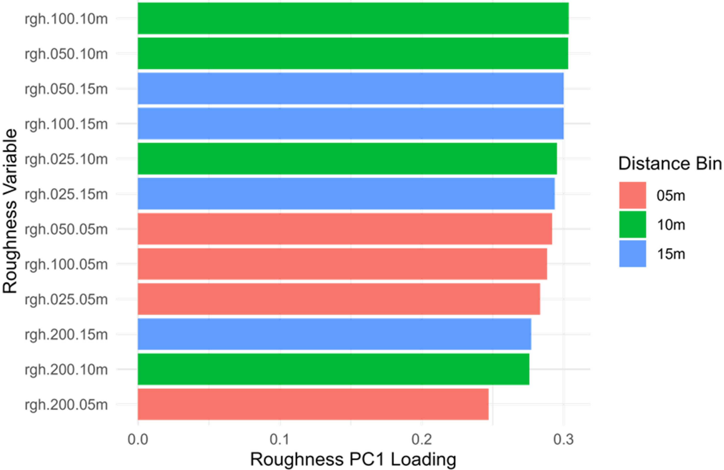
“The PC1 loadings for slope across the 0-5, 5-10, and 10-15 metre segments were nearly identical, indicating that each segment contributed equally to the variance captured by PC1.”
§ Machine learning estimation of off-trail pedestrian travel rates using LiDAR-derived slope, vegetation, and surface roughness > Results
hedged- Asserted: passes — The authors put it forward as true.
- Checkable: passes — It can be checked against evidence.
- Load-bearing: unclear — It is unclear whether the paper’s conclusions depend on it.
- Based: passes — The paper gives a reason why it holds.
It may state two separate claims as one.
A result the paper reports from its own data — it cites no other source for it, so there is none to check. The quote shows it is in the paper.
In the paper
“Although slope is the main driver of movement, the joint PDPs show that vegetation density and surface roughness influence travel rates in different ways when evaluated together with slope.”
§ Machine learning estimation of off-trail pedestrian travel rates using LiDAR-derived slope, vegetation, and surface roughness > Discussion
plaindirect- Asserted: passes — The authors put it forward as true.
- Checkable: passes — It can be checked against evidence.
- Load-bearing: passes — The paper’s conclusions depend on it.
- Based: passes — The paper gives a reason why it holds.
It may state two separate claims as one.
A result the paper reports from its own data — it cites no other source for it, so there is none to check. The quote shows it is in the paper.
In the paper
“The R² fell slightly from 0.778 to 0.763, and the nRMSE rose from 0.350 to 0.362.”
§ Machine learning estimation of off-trail pedestrian travel rates using LiDAR-derived slope, vegetation, and surface roughness > Discussion
plaindirect- Asserted: passes — The authors put it forward as true.
- Checkable: passes — It can be checked against evidence.
- Load-bearing: unclear — It is unclear whether the paper’s conclusions depend on it.
- Based: passes — The paper gives a reason why it holds.
It may state two separate claims as one.
In the paper
“Lower observed travel rates tended to be overpredicted by the model, while higher rates were consistently underpredicted as is common with random forests (Zhang and Lu 2011).”
§ Machine learning estimation of off-trail pedestrian travel rates using LiDAR-derived slope, vegetation, and surface roughness > Results
What the sources say
- Not checked — no full text of the sourcecites Zhang and Lu 2011 source
plaincorrelational- Asserted: passes — The authors put it forward as true.
- Checkable: passes — It can be checked against evidence.
- Load-bearing: unclear — It is unclear whether the paper’s conclusions depend on it.
- Based: passes — The paper gives a reason why it holds.
It may state two separate claims as one.
A result the paper reports from its own data — it cites no other source for it, so there is none to check. The quote shows it is in the paper.
In the paper
“The mean travel rate for the entire dataset was 0.481 m/s and the maximum was 1.589 m/s with a standard deviation of 0.481 m/s.”
§ Machine learning estimation of off-trail pedestrian travel rates using LiDAR-derived slope, vegetation, and surface roughness > Path geometry and travel rate
plain- Asserted: passes — The authors put it forward as true.
- Checkable: passes — It can be checked against evidence.
- Load-bearing: unclear — It is unclear whether the paper’s conclusions depend on it.
- Based: passes — The paper gives a reason why it holds.
It may state two separate claims as one.
A result the paper reports from its own data — it cites no other source for it, so there is none to check. The quote shows it is in the paper.
In the paper
“Slope-dependent travel rate was highest on flatter slopes and became much slower at steeper positive and negative slopes, with the travel rate slowing slightly faster on uphill slopes (positive slope values) than downhill slopes (negative slope values).”
- Also stated in: § Discussion · plain
“Slope was found to be the most important variable in predicting instantaneous travel rate, and this study, like many previous slope-based studies, found that steeper slopes result in decreased travel rates (Tobler 1993;Rees 2004;Sullivan et al. 2020).”
§ Machine learning estimation of off-trail pedestrian travel rates using LiDAR-derived slope, vegetation, and surface roughness > Results
plaincorrelational- Asserted: passes — The authors put it forward as true.
- Checkable: passes — It can be checked against evidence.
- Load-bearing: passes — The paper’s conclusions depend on it.
- Based: passes — The paper gives a reason why it holds.
It may state two separate claims as one.
- Also stated in: § Discussion · plain
A result the paper reports from its own data — it cites no other source for it, so there is none to check. The quote shows it is in the paper.
In the paper
“Even small increases in vegetation density produce disproportionately large reductions in travel rate, whereas comparable increases in surface roughness have a more modest effect.”
§ Machine learning estimation of off-trail pedestrian travel rates using LiDAR-derived slope, vegetation, and surface roughness > Discussion
plaindirect- Asserted: passes — The authors put it forward as true.
- Checkable: passes — It can be checked against evidence.
- Load-bearing: passes — The paper’s conclusions depend on it.
- Based: passes — The paper gives a reason why it holds.
It may state two separate claims as one.
In the paper
“Multiple landscape factors, including slope, vegetation density, and surface roughness, work together to affect pedestrian travel rates in off-path environments.”
- Also stated in: § Introduction · plain
“In off-path environments, vegetation density and the roughness of the ground surface also play a role in determining travel rate (Campbell, Cutler, and Dennison 2024).”
§ Machine learning estimation of off-trail pedestrian travel rates using LiDAR-derived slope, vegetation, and surface roughness > Abstract
What the sources say
- Not checked yetcites Campbell, Cutler, and Dennison 2024 source
plaindirect- Asserted: passes — The authors put it forward as true.
- Checkable: passes — It can be checked against evidence.
- Load-bearing: passes — The paper’s conclusions depend on it.
- Based: passes — The paper gives a reason why it holds.
It may state two separate claims as one.
- Also stated in: § Introduction · plain
What the paper did — it cites no source for this, so there is none to check. The quote shows it is in the paper.
In the paper
“We did not test for the effects of weather on travel rates, though it should be noted that our field experiments took place in favourable conditions (no precipitation, warm, low humidity).”
§ Machine learning estimation of off-trail pedestrian travel rates using LiDAR-derived slope, vegetation, and surface roughness > Discussion
plain- Asserted: passes — The authors put it forward as true.
- Checkable: passes — It can be checked against evidence.
- Load-bearing: fails — The paper’s conclusions may not depend on it.
- Based: passes — The paper gives a reason why it holds.
Probably not a substantial claim. The paper’s conclusions may not depend on it. It may state two separate claims as one.
What the paper did — it cites no source for this, so there is none to check. The quote shows it is in the paper.
In the paper
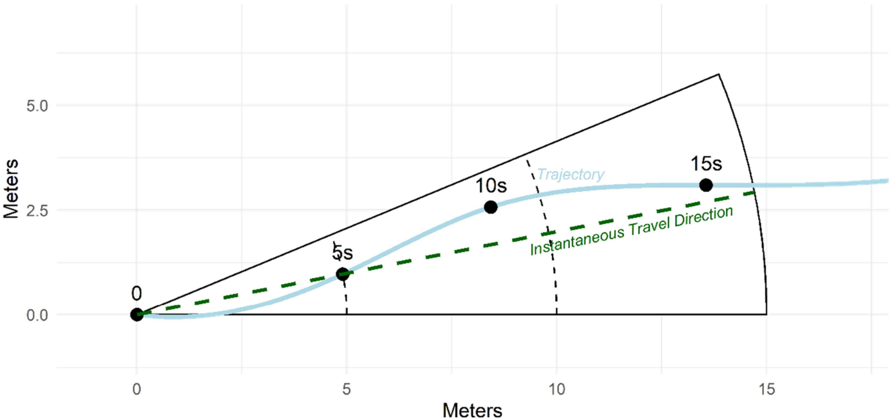
“A wedge was chosen over other polygon shapes or a straight line because the wedge shape incorporates the increasing route selection possibilities an individual has as the distance from their current location increases.”
§ Machine learning estimation of off-trail pedestrian travel rates using LiDAR-derived slope, vegetation, and surface roughness > Path geometry and travel rate
plaindirect- Asserted: passes — The authors put it forward as true.
- Checkable: passes — It can be checked against evidence.
- Load-bearing: passes — The paper’s conclusions depend on it.
- Based: passes — The paper gives a reason why it holds.
Probably not a substantial claim.
A conclusion the paper draws from its own results — it cites no other source for it, so there is none to check. The quote shows it is in the paper.
In the paper
“The knowledge gained from these models may be applicable to future models in wildland firefighter safety, search and rescue, migration, military troop movements, and personal recreation.”
§ Machine learning estimation of off-trail pedestrian travel rates using LiDAR-derived slope, vegetation, and surface roughness > Conclusion
hedged- Asserted: passes — The authors put it forward as true.
- Checkable: fails — It may be too vague to check against evidence.
- Load-bearing: fails — The paper’s conclusions may not depend on it.
- Based: fails — The paper may give no reason why it holds.
Probably not a substantial claim. It may be too vague to check against evidence. The paper’s conclusions may not depend on it. The paper may give no reason why it holds.
A conclusion the paper draws from its own results — it cites no other source for it, so there is none to check. The quote shows it is in the paper.
In the paper
“This suggests that slope values across these spatial intervals were highly correlated and exhibited similar distributions, resulting in minimal differentiation among them.”
§ Machine learning estimation of off-trail pedestrian travel rates using LiDAR-derived slope, vegetation, and surface roughness > Results
hedgedcorrelational- Asserted: passes — The authors put it forward as true.
- Checkable: passes — It can be checked against evidence.
- Load-bearing: unclear — It is unclear whether the paper’s conclusions depend on it.
- Based: passes — The paper gives a reason why it holds.
It may state two separate claims as one.
In the paper
“While previous firefighter studies noted that different fuel types (which imply varying vegetation characteristics) affected travel difficulty, our study offers a more quantifiable approach using continuous vegetation density measures (Alexander, Baxter, and Dakin 2005).”
§ Machine learning estimation of off-trail pedestrian travel rates using LiDAR-derived slope, vegetation, and surface roughness > Discussion
What the sources say
- Not matchedcites Alexander, Baxter, and Dakin 2005
Couldn’t be matched to a paper in Crossref, so it can’t be checked.
plaindirect- Asserted: passes — The authors put it forward as true.
- Checkable: passes — It can be checked against evidence.
- Load-bearing: fails — The paper’s conclusions may not depend on it.
- Based: passes — The paper gives a reason why it holds.
Probably not a substantial claim. The paper’s conclusions may not depend on it.
- Not matched
What the paper did — it cites no source for this, so there is none to check. The quote shows it is in the paper.
In the paper
“Each wedge created at a point was divided into three 5-metre segments: (1) 0-5 m, (2) 5-10 m, and (3) 10-15 m (Figure 2).This segmentation allowed for capturing landscape variability at different distances from the individual.”
§ Machine learning estimation of off-trail pedestrian travel rates using LiDAR-derived slope, vegetation, and surface roughness > Path geometry and travel rate
plain- Asserted: passes — The authors put it forward as true.
- Checkable: passes — It can be checked against evidence.
- Load-bearing: passes — The paper’s conclusions depend on it.
- Based: passes — The paper gives a reason why it holds.
Probably not a substantial claim.
A conclusion the paper draws from its own results — it cites no other source for it, so there is none to check. The quote shows it is in the paper.
In the paper
“Modelling instantaneous travel rate allows for more precise predictions of how vegetation density, slope, and surface roughness impact individuals as they take different routes through the same environment.”
§ Machine learning estimation of off-trail pedestrian travel rates using LiDAR-derived slope, vegetation, and surface roughness > Discussion
plaincorrelational- Asserted: passes — The authors put it forward as true.
- Checkable: passes — It can be checked against evidence.
- Load-bearing: passes — The paper’s conclusions depend on it.
- Based: passes — The paper gives a reason why it holds.
Probably not a substantial claim.
What the paper did — it cites no source for this, so there is none to check. The quote shows it is in the paper.
In the paper
“This function returns a normalised value that aims to capture the proportion of LiDAR pulse energy intercepted by vegetation within a height range of interest, serving as a proxy for vegetation density (Figure 3).”
§ Machine learning estimation of off-trail pedestrian travel rates using LiDAR-derived slope, vegetation, and surface roughness > Vegetation density
plaincorrelational- Asserted: passes — The authors put it forward as true.
- Checkable: passes — It can be checked against evidence.
- Load-bearing: passes — The paper’s conclusions depend on it.
- Based: passes — The paper gives a reason why it holds.
Probably not a substantial claim.
What the paper did — it cites no source for this, so there is none to check. The quote shows it is in the paper.
In the paper
“MLS point cloud and trajectory georeferencing was completed in the software CloudCompare with a root mean squared positional error between GPS and point cloud data of less than 0.5m for all trajectories.”
§ Machine learning estimation of off-trail pedestrian travel rates using LiDAR-derived slope, vegetation, and surface roughness > Participant data
plain- Asserted: passes — The authors put it forward as true.
- Checkable: passes — It can be checked against evidence.
- Load-bearing: fails — The paper’s conclusions may not depend on it.
- Based: passes — The paper gives a reason why it holds.
Probably not a substantial claim. The paper’s conclusions may not depend on it.
In the paper
“For example, Campbell, Dennison, and Butler (2017) assumed that vegetation density has linear relationship with travel rate.”
§ Machine learning estimation of off-trail pedestrian travel rates using LiDAR-derived slope, vegetation, and surface roughness > Discussion
What the sources say
- Not checked — no full text of the sourcecites Campbell, Dennison, and Butler (2017) source
plaincorrelational- Asserted: passes — The authors put it forward as true.
- Checkable: passes — It can be checked against evidence.
- Load-bearing: fails — The paper’s conclusions may not depend on it.
- Based: passes — The paper gives a reason why it holds.
Probably not a substantial claim. The paper’s conclusions may not depend on it.
What the paper did — it cites no source for this, so there is none to check. The quote shows it is in the paper.
In the paper
“By transforming the original variables into a smaller number of uncorrelated components, PCA allowed us to capture the dominant patterns of variance in the data and determine the relative importance of slope, vegetation density, and surface roughness factors in determining instantaneous travel rate.”
§ Machine learning estimation of off-trail pedestrian travel rates using LiDAR-derived slope, vegetation, and surface roughness > Principal component analysis
plaincorrelational- Asserted: passes — The authors put it forward as true.
- Checkable: passes — It can be checked against evidence.
- Load-bearing: passes — The paper’s conclusions depend on it.
- Based: passes — The paper gives a reason why it holds.
It may state two separate claims as one.
What the paper did — it cites no source for this, so there is none to check. The quote shows it is in the paper.
In the paper
“We could not control for the fact that individuals walk with different average rates-we asked that study subjects walk at a pace that was comfortable to them.”
§ Machine learning estimation of off-trail pedestrian travel rates using LiDAR-derived slope, vegetation, and surface roughness > Median travel rate
plain- Asserted: passes — The authors put it forward as true.
- Checkable: passes — It can be checked against evidence.
- Load-bearing: passes — The paper’s conclusions depend on it.
- Based: passes — The paper gives a reason why it holds.
It may state two separate claims as one.
What the paper did — it cites no source for this, so there is none to check. The quote shows it is in the paper.
In the paper
“The dataset was filtered to include one point per five seconds, meaning individuals who moved more slowly generated more data points than those who moved quickly.”
§ Machine learning estimation of off-trail pedestrian travel rates using LiDAR-derived slope, vegetation, and surface roughness > Discussion
plaindirect- Asserted: passes — The authors put it forward as true.
- Checkable: passes — It can be checked against evidence.
- Load-bearing: passes — The paper’s conclusions depend on it.
- Based: passes — The paper gives a reason why it holds.
It may state two separate claims as one.
What the paper did — it cites no source for this, so there is none to check. The quote shows it is in the paper.
In the paper
“This approach captures the directional variation in terrain steepness surrounding each point, allowing for a more spatially explicit representation of local topography.”
§ Machine learning estimation of off-trail pedestrian travel rates using LiDAR-derived slope, vegetation, and surface roughness > Slope
plaindirect- Asserted: passes — The authors put it forward as true.
- Checkable: passes — It can be checked against evidence.
- Load-bearing: fails — The paper’s conclusions may not depend on it.
- Based: passes — The paper gives a reason why it holds.
Probably not a substantial claim. The paper’s conclusions may not depend on it.
A conclusion the paper draws from its own results — it cites no other source for it, so there is none to check. The quote shows it is in the paper.
In the paper
“The patterns in scale-based loadings may be attributable to the fact that the 0-5m wedge segment was relatively smaller in area, limiting the amount of data contributing to the representation of landscape factors.”
§ Machine learning estimation of off-trail pedestrian travel rates using LiDAR-derived slope, vegetation, and surface roughness > Results
hedgedconditional- Asserted: passes — The authors put it forward as true.
- Checkable: passes — It can be checked against evidence.
- Load-bearing: fails — The paper’s conclusions may not depend on it.
- Based: passes — The paper gives a reason why it holds.
Probably not a substantial claim. The paper’s conclusions may not depend on it.
What the paper did — it cites no source for this, so there is none to check. The quote shows it is in the paper.
In the paper
“To avoid overfitting, we relied on a relatively coarse grid and emphasised parameters that control tree depth and sampling variability rather than aggressively optimising for marginal gains.”
§ Machine learning estimation of off-trail pedestrian travel rates using LiDAR-derived slope, vegetation, and surface roughness > Random forest model
plaindirect- Asserted: passes — The authors put it forward as true.
- Checkable: passes — It can be checked against evidence.
- Load-bearing: fails — The paper’s conclusions may not depend on it.
- Based: passes — The paper gives a reason why it holds.
Probably not a substantial claim. The paper’s conclusions may not depend on it. It may state two separate claims as one.
None of the sources cited for this claim have been checked yet.
In the paper
“These slopecontrolled models estimate travel rates solely as a function of slope, which is most appropriate for on-path travel (i.e. on a road or trail) where vegetation density and surface roughness are low.”
§ Machine learning estimation of off-trail pedestrian travel rates using LiDAR-derived slope, vegetation, and surface roughness > Introduction
What the sources say
plaindirect- Asserted: passes — The authors put it forward as true.
- Checkable: passes — It can be checked against evidence.
- Load-bearing: passes — The paper’s conclusions depend on it.
- Based: passes — The paper gives a reason why it holds.
It may state two separate claims as one.
What the paper did — it cites no source for this, so there is none to check. The quote shows it is in the paper.
In the paper
“These scales were selected to capture a variety of terrain features, ranging from small obstacles such as rocks and roots to broader surface variations across the landscape.”
§ Machine learning estimation of off-trail pedestrian travel rates using LiDAR-derived slope, vegetation, and surface roughness > Surface roughness
plain- Asserted: passes — The authors put it forward as true.
- Checkable: passes — It can be checked against evidence.
- Load-bearing: fails — The paper’s conclusions may not depend on it.
- Based: passes — The paper gives a reason why it holds.
Probably not a substantial claim. The paper’s conclusions may not depend on it.
A conclusion the paper draws from its own results — it cites no other source for it, so there is none to check. The quote shows it is in the paper.
In the paper
“The model results from this study provide insights into the driving factors influencing instantaneous travel rates.”
§ Machine learning estimation of off-trail pedestrian travel rates using LiDAR-derived slope, vegetation, and surface roughness > Conclusion
plaincorrelational- Asserted: passes — The authors put it forward as true.
- Checkable: fails — It may be too vague to check against evidence.
- Load-bearing: passes — The paper’s conclusions depend on it.
- Based: passes — The paper gives a reason why it holds.
Probably not a substantial claim. It may be too vague to check against evidence.
A conclusion the paper draws from its own results — it cites no other source for it, so there is none to check. The quote shows it is in the paper.
In the paper
“Additionally, since participants only travelled approximately 200 metres on each transect, the estimated travel rates may be slightly higher than would be expected over longer distances, where fatigue and sustained effort become more significant factors.”
§ Machine learning estimation of off-trail pedestrian travel rates using LiDAR-derived slope, vegetation, and surface roughness > Discussion
hedgedconditional- Asserted: passes — The authors put it forward as true.
- Checkable: passes — It can be checked against evidence.
- Load-bearing: fails — The paper’s conclusions may not depend on it.
- Based: passes — The paper gives a reason why it holds.
Probably not a substantial claim. The paper’s conclusions may not depend on it.
What the paper did — it cites no source for this, so there is none to check. The quote shows it is in the paper.
In the paper
“Model performance was evaluated using independent testing data, based on the coefficient of determination (R²), root mean square error (RMSE), and mean absolute error (MAE).”
§ Machine learning estimation of off-trail pedestrian travel rates using LiDAR-derived slope, vegetation, and surface roughness > Random forest model
plain- Asserted: passes — The authors put it forward as true.
- Checkable: passes — It can be checked against evidence.
- Load-bearing: passes — The paper’s conclusions depend on it.
- Based: passes — The paper gives a reason why it holds.
Probably not a substantial claim.
What the paper did — it cites no source for this, so there is none to check. The quote shows it is in the paper.
In the paper
“Prior to the start of the field experiment, approval from the University of Utah's Internal Review Board (IRB) was given for this study (approval number IRB_00145438).”
§ Machine learning estimation of off-trail pedestrian travel rates using LiDAR-derived slope, vegetation, and surface roughness > Participant data
plain- Asserted: passes — The authors put it forward as true.
- Checkable: passes — It can be checked against evidence.
- Load-bearing: fails — The paper’s conclusions may not depend on it.
- Based: passes — The paper gives a reason why it holds.
Probably not a substantial claim. The paper’s conclusions may not depend on it.
What the paper did — it cites no source for this, so there is none to check. The quote shows it is in the paper.
In the paper
“Participants were all over the age of 18 and gave informed written consent for the collection and use of the data created for this study.”
§ Machine learning estimation of off-trail pedestrian travel rates using LiDAR-derived slope, vegetation, and surface roughness > Participant data
plainn = 9- Asserted: passes — The authors put it forward as true.
- Checkable: passes — It can be checked against evidence.
- Load-bearing: fails — The paper’s conclusions may not depend on it.
- Based: passes — The paper gives a reason why it holds.
Probably not a substantial claim. The paper’s conclusions may not depend on it. It may state two separate claims as one.
What the paper did — it cites no source for this, so there is none to check. The quote shows it is in the paper.
In the paper
“Before training our random forest model, the data for each individual track was split into 70% training and 30% testing sets.Specifically, the middle 30% of points along each track were used for testing, while the outer 70% at both the beginning and end were reserved for training.This was done to reduce the effects of spatial and temporal autocorrelation on model performance assessment.”
§ Machine learning estimation of off-trail pedestrian travel rates using LiDAR-derived slope, vegetation, and surface roughness > Random forest model
plaindirect- Asserted: passes — The authors put it forward as true.
- Checkable: passes — It can be checked against evidence.
- Load-bearing: passes — The paper’s conclusions depend on it.
- Based: passes — The paper gives a reason why it holds.
Probably not a substantial claim. It may state two separate claims as one.
A conclusion the paper draws from its own results — it cites no other source for it, so there is none to check. The quote shows it is in the paper.
In the paper
“By integrating LiDAR-derived terrain metrics with fine-scale trajectory data, this study offers a replicable framework for modelling travel rates in complex landscapes.”
§ Machine learning estimation of off-trail pedestrian travel rates using LiDAR-derived slope, vegetation, and surface roughness > Conclusion
plain- Asserted: passes — The authors put it forward as true.
- Checkable: passes — It can be checked against evidence.
- Load-bearing: passes — The paper’s conclusions depend on it.
- Based: passes — The paper gives a reason why it holds.
Probably not a substantial claim.
What the paper did — it cites no source for this, so there is none to check. The quote shows it is in the paper.
In the paper
“The tracks were filtered to one point per five seconds from the original approximately 20 data points per second.We divided up each trajectory into five second intervals, and retained the first point from each interval.This was done to minimise noise in the data set while still capturing a fine-level of instantaneous travel rate spatiotemporal precision.”
§ Machine learning estimation of off-trail pedestrian travel rates using LiDAR-derived slope, vegetation, and surface roughness > Path geometry and travel rate
plaindirectn = 74- Asserted: passes — The authors put it forward as true.
- Checkable: passes — It can be checked against evidence.
- Load-bearing: passes — The paper’s conclusions depend on it.
- Based: passes — The paper gives a reason why it holds.
Probably not a substantial claim.
A conclusion the paper draws from its own results — it cites no other source for it, so there is none to check. The quote shows it is in the paper.
In the paper
“Despite the limitations of this study, the machine learning models we created provide new insight into instantaneous travel rates in off-path environments.”
§ Machine learning estimation of off-trail pedestrian travel rates using LiDAR-derived slope, vegetation, and surface roughness > Discussion
plain- Asserted: passes — The authors put it forward as true.
- Checkable: fails — It may be too vague to check against evidence.
- Load-bearing: passes — The paper’s conclusions depend on it.
- Based: passes — The paper gives a reason why it holds.
Probably not a substantial claim. It may be too vague to check against evidence.
A conclusion the paper draws from its own results — it cites no other source for it, so there is none to check. The quote shows it is in the paper.
In the paper
“The use of instantaneous travel rates, rather than total average speeds, allows for more precise modelling of landscape impacts on off-path travel.”
§ Machine learning estimation of off-trail pedestrian travel rates using LiDAR-derived slope, vegetation, and surface roughness > Conclusion
plaindirect- Asserted: passes — The authors put it forward as true.
- Checkable: passes — It can be checked against evidence.
- Load-bearing: passes — The paper’s conclusions depend on it.
- Based: fails — The paper may give no reason why it holds.
Probably not a substantial claim. The paper may give no reason why it holds.
A conclusion the paper draws from its own results — it cites no other source for it, so there is none to check. The quote shows it is in the paper.
In the paper
“This consistency suggests that the underlying signal is strong and that model performance is robust across a range of tree-based methods.”
§ Machine learning estimation of off-trail pedestrian travel rates using LiDAR-derived slope, vegetation, and surface roughness > Discussion
hedgedcorrelational- Asserted: passes — The authors put it forward as true.
- Checkable: passes — It can be checked against evidence.
- Load-bearing: unclear — It is unclear whether the paper’s conclusions depend on it.
- Based: passes — The paper gives a reason why it holds.
It may state two separate claims as one.
What the paper did — it cites no source for this, so there is none to check. The quote shows it is in the paper.
In the paper
“Only nine individuals participated in this study, and there was substantial variation in their travel rates.”
§ Machine learning estimation of off-trail pedestrian travel rates using LiDAR-derived slope, vegetation, and surface roughness > Discussion
plainn = 9- Asserted: passes — The authors put it forward as true.
- Checkable: passes — It can be checked against evidence.
- Load-bearing: passes — The paper’s conclusions depend on it.
- Based: passes — The paper gives a reason why it holds.
It may state two separate claims as one.
A conclusion the paper draws from its own results — it cites no other source for it, so there is none to check. The quote shows it is in the paper.
In the paper
“These findings indicate that environmental factors are more predictive of travel rate than the identity or attributes of the individuals walking the transects, with slope being the single most important factor.”
§ Machine learning estimation of off-trail pedestrian travel rates using LiDAR-derived slope, vegetation, and surface roughness > Results
hedgedcorrelational- Asserted: passes — The authors put it forward as true.
- Checkable: passes — It can be checked against evidence.
- Load-bearing: passes — The paper’s conclusions depend on it.
- Based: passes — The paper gives a reason why it holds.
It may state two separate claims as one.
What the paper did — it cites no source for this, so there is none to check. The quote shows it is in the paper.
In the paper
“Using a five-second interval helped smooth short-term fluctuations and reduce noise in the path taken.”
§ Machine learning estimation of off-trail pedestrian travel rates using LiDAR-derived slope, vegetation, and surface roughness > Path geometry and travel rate
plaindirect- Asserted: passes — The authors put it forward as true.
- Checkable: passes — It can be checked against evidence.
- Load-bearing: fails — The paper’s conclusions may not depend on it.
- Based: passes — The paper gives a reason why it holds.
Probably not a substantial claim. The paper’s conclusions may not depend on it. It may state two separate claims as one.
What the paper did — it cites no source for this, so there is none to check. The quote shows it is in the paper.
In the paper
“The MLS instrument provided precise positioning of each participant's track relative to pairs of reflective georeferencing targets placed at each end of the transect.”
§ Machine learning estimation of off-trail pedestrian travel rates using LiDAR-derived slope, vegetation, and surface roughness > Participant data
plaindirectn = 9- Asserted: passes — The authors put it forward as true.
- Checkable: passes — It can be checked against evidence.
- Load-bearing: passes — The paper’s conclusions depend on it.
- Based: passes — The paper gives a reason why it holds.
Probably not a substantial claim.
What the paper did — it cites no source for this, so there is none to check. The quote shows it is in the paper.
In the paper
“This plot allowed us to identify stable regions of good performance rather than a single extreme optimum, ensuring that the final hyperparameter selection reflected robust trends rather than noise.”
§ Machine learning estimation of off-trail pedestrian travel rates using LiDAR-derived slope, vegetation, and surface roughness > Random forest model
plaindirect- Asserted: passes — The authors put it forward as true.
- Checkable: passes — It can be checked against evidence.
- Load-bearing: fails — The paper’s conclusions may not depend on it.
- Based: passes — The paper gives a reason why it holds.
Probably not a substantial claim. The paper’s conclusions may not depend on it. It may state two separate claims as one.
What the paper did — it cites no source for this, so there is none to check. The quote shows it is in the paper.
In the paper
“Transects were evaluated on the ground to ensure that no substantial land cover changes had occurred between ALS acquisition and travel rate data collection.”
§ Machine learning estimation of off-trail pedestrian travel rates using LiDAR-derived slope, vegetation, and surface roughness > Airborne LiDAR data
plain- Asserted: passes — The authors put it forward as true.
- Checkable: passes — It can be checked against evidence.
- Load-bearing: passes — The paper’s conclusions depend on it.
- Based: passes — The paper gives a reason why it holds.
Probably not a substantial claim.
The paper relies on this without support.
The nine volunteer participants from the University of Utah are representative of off-path pedestrians in general.
“Nine individuals of various ages, genders, and athletic abilities walked eleven transects wearing an Emesent Hovermap mobile laser scanner (MLS) mounted on a backpack.Participants were recruited volunteers from the University of Utah.”
The paper relies on this without support.
The eleven transects are representative of the wider range of off-path landscapes to which the findings are claimed to apply.
“The wide range of vegetation densities, vegetation types, and degrees of slope were chosen to make the findings of the study applicable to a wider range of landscapes than past efforts that have been focused on more ecologically narrow settings.”
The paper relies on this without support.
The median travel rate across all experimental transects adequately captures individual-level differences in exertion or fitness.
“Instead, to build a more broadly applicable model, we opted to include the individuals' median travel rates across all experimental transects as a predictor variable.”
The paper relies on this without support.
In most landscapes, slope, vegetation density, and surface roughness interact to determine travel rate rather than acting in isolation.
“In most landscapes, these variables interact to determine travel rate rather than acting in isolation.”
Self-check
Percentages, sums and reported differences re-computed from the paper’s own numbers.
Each contradiction between two passages listed here was confirmed by an independent check.
Rated minor: it would not touch a result — a value no result rests on, a p-value that stays on the same side of the significance level, or a conflict that is clerical, resolved elsewhere in the paper, or outside its own findings.
In the paper
“Every combination of the minimum and maximum heights with a height range of at least 0.5m was used.This provided a total of 37 NRD-based vegetation density variables.”
§ Machine learning estimation of off-trail pedestrian travel rates using LiDAR-derived slope, vegetation, and surface roughness > Vegetation density
Reported 37 · recomputed 15
Rated minor: it would not touch a result — a value no result rests on, a p-value that stays on the same side of the significance level, or a conflict that is clerical, resolved elsewhere in the paper, or outside its own findings.
In the paper
§ Machine learning estimation of off-trail pedestrian travel rates using LiDAR-derived slope, vegetation, and surface roughness > Conclusion
“Figure 1.Maps and photos of the nine transects in the Wasatch Mountains.”
§ Machine learning estimation of off-trail pedestrian travel rates using LiDAR-derived slope, vegetation, and surface roughness > Conclusion
“Each map contains the red 100-metre transect for each of the eleven transects”
Citations
Cites
XGBoost: A Scalable Tree Boosting System
Chen, T., & Guestrin, C. (2016) · Proceedings of the 22nd ACM SIGKDD International Conference on Knowledge Discovery and Data Mining · doi:10.1145/2939672.2939785 · Cited by 54,569
Bias-corrected random forests in regression
Zhang, G., & Lu, Y. (2012) · Journal of Applied Statistics · doi:10.1080/02664763.2011.578621 · Cited by 196
Least-cost paths in mountainous terrain
Rees, W. G. (2004) · Computers & Geosciences · doi:10.1016/j.cageo.2003.11.001 · Cited by 156
Detection of sub-canopy forest structure using airborne LiDAR
Jarron, L. R., Coops, N. C., MacKenzie, W. H., Tompalski, P., & Dykstra, P. (2020) · Remote Sensing of Environment · doi:10.1016/j.rse.2020.111770 · Cited by 130
Using crowdsourced fitness tracker data to model the relationship between slope and travel rates
Campbell, M. J., Dennison, P. E., Butler, B. W., & Page, W. G. (2019) · Applied Geography · doi:10.1016/j.apgeog.2019.03.008 · Cited by 87
Self-citationMeasuring and modeling the speed of human navigation
Irmischer, I. J., & Clarke, K. C. (2018) · Cartography and Geographic Information Science · doi:10.1080/15230406.2017.1292150 · Cited by 62
An analysis of probability of area techniques for missing persons in Yosemite National Park
Doherty, P. J., Guo, Q., Doke, J., & Ferguson, D. (2014) · Applied Geography · doi:10.1016/j.apgeog.2013.11.001 · Cited by 60
The Use of LiDAR Terrain Data in Characterizing Surface Roughness and Microtopography
Brubaker, K. M., Myers, W. L., Drohan, P. J., Miller, D. A., & Boyer, E. W. (2013) · Applied and Environmental Soil Science · doi:10.1155/2013/891534 · Cited by 58
Beyond tobler’s hiking function
Goodchild, M. F. (2020) · Geographical Analysis · doi:10.1111/gean.12253 · Cited by 57
Estimated travel time for walking trails in natural areas
Márquez-Pérez, J., Vallejo-Villalta, I., & Álvarez-Francoso, J. I. (2017) · Geografisk Tidsskrift-Danish Journal of Geography · doi:10.1080/00167223.2017.1316212 · Cited by 56
Research works printed but not linked: 5
- Alexander, M. E., G. J. Baxter, and G. R. Dakin. 2005. “Travel Rates of Alberta Wildland Firefighters Using Escape Routes.” In Proceedings of the Eighth International Wildland Fire Safety Summit B.W. Butler and M. E. Alexander, eds. 1–12. International Association of Wildland Fire.
- Jensen, D. E. 2003. “Geoglyphs and GIS: Modeling Transhumance in Northern Chile.” In The digital heritage of archaeology,M. Doerr and S. Apostolis, eds. 6. Heraklion.
- Ke, G., Q. Meng, T. Finley, T. Wang, W. Chen, W. Ma, Q. Ye, and T.-Y. Liu. 2017. “LightGBM: A Highly Efficient Gradient Boosting Decision Tree.” In Advances in Neural Information Processing Systems 30: 1–9.
- Mink, P. B., M. J. Ripy, K. Bailey, H. B. Box, and T. Grossardt. 2009. Predictive Archaeological Modeling Using GIS-based Fuzzy Set Estimation In Transportation Research Board Annual Meeting11–15, Washington: ESRI International.
- Rogers, S. R., C. Collet, and R. Lugon. 2014. “Least Cost Path Analysis for Predicting Glacial Archaeological Site Potential in Central Europe.” In Across Space and Time: Papers from the 41st Conference on Computer Applications and Quantitative Methods in Archaeology Perth, 25–28 March 2013,Traviglia, A., ed. 261–275. Amsterdam University Press.
Cited by
Still being checked.
Metadata
- Authors
- Cutler, S. L., Campbell, M. J., Brewer, S. C., & Dennison, P. E.
- Affiliations
- University of Utah (US)
- School of Environment, Society & Sustainability, University of Utah
- Corresponding author
- Cutler, Sierra L.
- Venue
- GIScience & Remote Sensing
- Publisher
- Informa UK Limited
- Published
- 2026-02-09
- Volume
- 63
- Issue
- 1
- ISSN
- 1548-1603 (ISSN-L)
- 1943-7226
- OpenAlex
- W7128507901
- Cited by
- 0
- References
- 33
- FWCI
- 0.00
- Type
- journal article
- Language
- en
- Open access
- gold
- doi.org
- Licence
- Locations
- GIScience & Remote Sensing (publishedVersion, cc-by)
- DOAJ (DOAJ: Directory of Open Access Journals) (submittedVersion, cc-by-sa)
- Funders
- US forest service (21-CS-11221636-120)
- National Science Foundation United States (2117865)
- Topics
- Social Sciences › Safety Research › Evacuation and Crowd Dynamics
- Social Sciences › Transportation › Urban Transport and Accessibility
- Physical Sciences › Engineering › Safety, Risk, Reliability and Quality › Traffic and Road Safety
- Keywords
- airborne laser scanning, slope, vegetation density, surface roughness, random forest, permutation importance, landscape factors, search and rescue, wildlife migration
About these checks
Registry, retraction, Cites and statistics results are computed, not judged, with one exception: a printed reference that no index lists is read once by a model before it counts as a citation error. Claims are extracted by a model and kept only when their quote appears verbatim in the text; each cited source is then checked, with a model’s help, for whether it says what the claim relies on. Those verdicts can be wrong — read the claim’s quote and the cited source before relying on one.
A language model drew the claims from the paper on 2026-11-10, under version 3 of the claim definition (model deepseek-v4.1-flash, prompt extract-v3).
A second model labelled each claim on 2026-11-10 (model jev-1.13-20260917, definition revision gold-guideline-v0.2).
Cited sources are checked with a language model’s help (gpt-6-sol).
Statistics and arithmetic are recomputed, not judged.
Confidence bands are shown only for fields calibrated on our annotated test set. None is calibrated yet, so no band is shown.
What counts as a claim ›How we measure confidence ›How we check this ›
Are you an author, or do you see a problem with this page? Request a review
