

An Overview of Corporate Sustainability Reporting Legislation in the European Union
Open accessThe DOI matches its Crossref record; 44 of the 44 references it cites were found in a registry or an index; 1 of the 71 sources its claims cite were checked for support.
Abstract
In recent years, sustainability disclosure has increasingly become mandatory in many countries. The European Union (EU) is at the forefront of this change by adopting legislation that governs disclosure of companies’ sustainability aspects (Corporate Sustainability Reporting Directive), the sustainability of economic activities (Taxonomy Regulation), the sustainability of financial products (Sustainable Finance Disclosure Regulation), and the environmental, social and governance risks of credit institutions.
Overview
CoChat Summary
TL;DR
This article provides a structured overview and comparison of the EU’s main corporate sustainability reporting mandates—NFRD, CSRD, Taxonomy Regulation, SFDR, and Pillar 3 ESG risk disclosures—and three major reporting standards: GRI, ESRS, and IFRS Sustainability Disclosure Standards. It highlights their interconnections, differing materiality concepts, scopes, timelines, and implications for practitioners and researchers as of December 2023.
Key findings
- EU sustainability disclosure is organized around five mandates: the NFRD (applicable from financial year 2017), the CSRD (superseding the NFRD from financial year 2024), the Taxonomy Regulation (climate objectives from financial year 2021, other environmental objectives from financial year 2023), the SFDR (first disclosure requirements effective March 2021), and CRR II Pillar 3 ESG risk disclosures (first application for financial year 2022). The CSRD substantially expands scope from approximately 11,700 companies under the NFRD to about 50,000 companies.
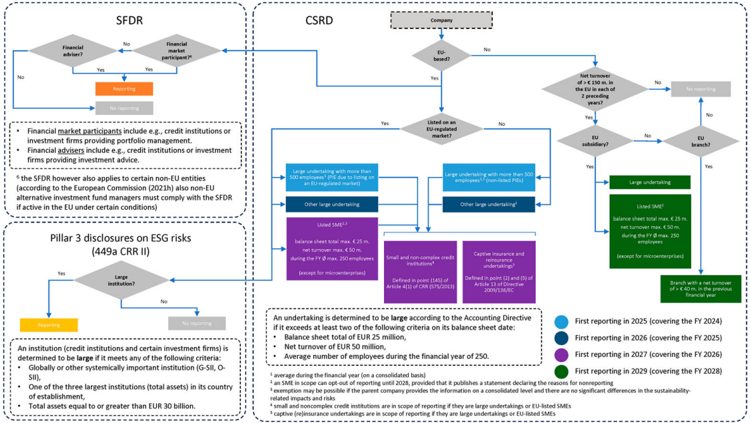
- The CSRD introduces double materiality, ESRS reporting in the management report, limited assurance, and digital tagging, with phased first reporting in 2025 for financial year 2024 by companies already subject to the NFRD, 2026 for other large companies, and 2027 for listed SMEs, small and noncomplex credit institutions, and captive (re)insurance undertakings, with an opt-out for another two years. From financial year 2028, EU branches and subsidiaries of non-EU undertakings are also subject if the non-EU undertaking has EU net turnover of EUR 150 million for each of the last two consecutive years and either a large or listed EU subsidiary or an EU branch with net turnover of at least EUR 40 million.
- The three standards differ in focus and materiality: the GRI Standards focus exclusively on impact materiality and broad stakeholders; the ESRS apply double materiality and broad stakeholder focus; the IFRS Sustainability Disclosure Standards focus on financial materiality and investors, with IFRS S1 and S2 primarily covering climate-related information. In 2022, 78 percent of the 250 largest global companies and 68 percent of the largest 100 companies across 58 countries reported in accordance with the GRI Standards.
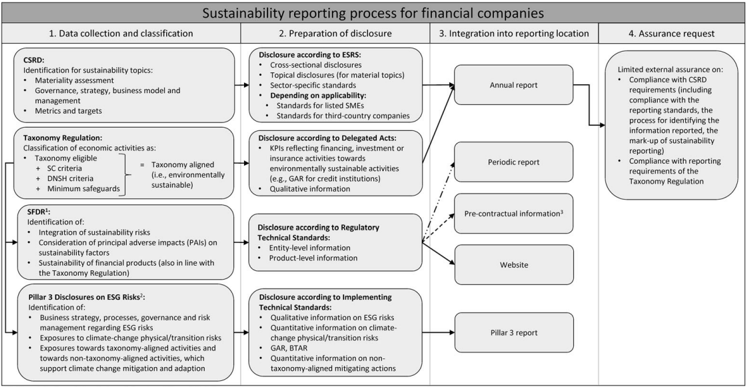
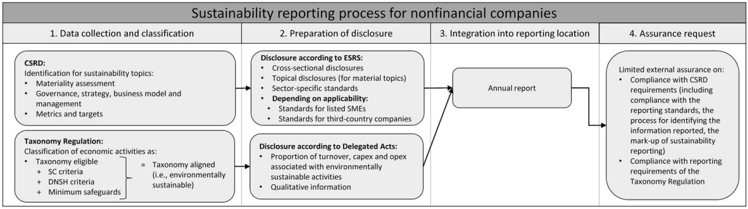
- The Taxonomy Regulation classifies environmentally sustainable economic activities around six environmental objectives and requires nonfinancial companies to disclose the proportion of turnover, capex, and opex associated with environmentally sustainable activities. The SFDR targets financial market participants and financial advisers, while Pillar 3 ESG risk disclosures target large listed credit institutions and certain investment firms, with phased disclosures including financed GHG emissions by end of June 2024, GAR by end of December 2023, and BTAR by December 2024.
Methods
- Design: descriptive legal and standard-setting overview with systematic comparison, not an empirical study. It reviews theory and literature on mandatory sustainability disclosure and compares key characteristics such as scope, objectives, materiality, disclosure requirements, legal character, location of information, and timeline.
- Data or sample: EU legislation and delegated/implementing acts—NFRD, CSRD, Taxonomy Regulation, SFDR, and CRR II Pillar 3—plus the GRI Standards, ESRS, and IFRS Sustainability Disclosure Standards, using secondary sources and official documents. The overview is provided at the time of writing, December 2023.
- Main analysis: qualitative comparison tables and critical reflection; no statistical analysis or empirical testing.
Limitations
- Stated in the paper: the highly dynamic nature of sustainability reporting legislation limits coverage to mandates implemented by the publication date; the article focuses only on EU legislation and the most important sustainability reporting standards; it does not discuss all voluntary frameworks, standards, and initiatives or how they may interact with mandatory schemes. The authors note an openly accessible website provides an updated register to help address the dynamism.
- Evident from the text: as of December 2023, several implementing elements were not yet available—sector-specific ESRS, proportionate ESRS for listed SMEs, standards for non-EU companies, the basis for equivalence, assurance standards and responsibility sharing, and the IASB management commentary revision—so some comparisons and implications are provisional.
- Evident from the text: the article is descriptive and does not provide empirical evidence on the consequences of the mandates; the authors note that large-scale empirical evidence on mandatory sustainability reporting is currently scant.
Model-written summary. Check it against the paper before relying on it.
Integrity signals
Registry
Cites
Statistics
Figures


Verification
Claims the paper makes
1 Valid · 9 Not valid · 72 Not checked · 89 Own results and interpretations
In the paper
“This table provides an overview of the requirements under the NFRD (baseline) and differences of the EU-27 (plus UK) member states in their national transpositions based on CSR Europe and GRI (2017) and our own analyses.”
§ An Overview of Corporate Sustainability Reporting Legislation in the European Union > 6. Conclusion
What the sources say
- Not matchedcites CSR Europe and GRI (2017)
An author–year citation the paper’s reference list doesn’t settle. We don’t search these by name.
plain- Asserted: passes — The authors put it forward as true.
- Checkable: passes — It can be checked against evidence.
- Load-bearing: passes — The paper’s conclusions depend on it.
- Based: passes — The paper gives a reason why it holds.
- Not matched
In the paper
“In addition, the ESRS are also aligned to meet certain data requirements for disclosures under Pillar 3 and under the SFDR (see Appendix B of ESRS 2).”
§ An Overview of Corporate Sustainability Reporting Legislation in the European Union > 3.6.1. Comparison
What the sources say
- Not matchedcites Appendix B of ESRS 2
This doesn’t read as a citation we can look up.
plainstates an association- Asserted: passes — The authors put it forward as true.
- Checkable: passes — It can be checked against evidence.
- Load-bearing: unclear — It is unclear whether the paper’s conclusions depend on it.
- Based: passes — The paper gives a reason why it holds.
- Not matched
A conclusion the paper draws from its own results — it cites no other source for it, so there is none to check. The quote shows it is in the paper.
In the paper
“Moreover, reporting requirements differ significantly for financial and nonfinancial companies.”
§ An Overview of Corporate Sustainability Reporting Legislation in the European Union > 3.6.1. Comparison
plainstates an association- Asserted: passes — The authors put it forward as true.
- Checkable: passes — It can be checked against evidence.
- Load-bearing: unclear — It is unclear whether the paper’s conclusions depend on it.
- Based: passes — The paper gives a reason why it holds.
In the paper
“Regarding Article-9 investment products, disclosure is required on how the objective is to be met.32”
§ An Overview of Corporate Sustainability Reporting Legislation in the European Union > 3.4. Sustainable Finance Disclosure Regulation (SFDR)
What the sources say
- Not matchedcites Article 9
This doesn’t read as a citation we can look up.
plain- Asserted: passes — The authors put it forward as true.
- Checkable: passes — It can be checked against evidence.
- Load-bearing: unclear — It is unclear whether the paper’s conclusions depend on it.
- Based: passes — The paper gives a reason why it holds.
- Not matched
A statement the paper makes itself — it cites no source for it, so there is none to check. The quote shows it is in the paper.
In the paper
“In particular, the ESRS are required to align with the Taxonomy Regulation (CSRD, Recital 38), and specific disclosure requirements under the SFDR and Pillar 3 directly build on classifications according to the Taxonomy Regulation.”
§ An Overview of Corporate Sustainability Reporting Legislation in the European Union > 3.6.1. Comparison
plainstates a cause- Asserted: passes — The authors put it forward as true.
- Checkable: passes — It can be checked against evidence.
- Load-bearing: unclear — It is unclear whether the paper’s conclusions depend on it.
- Based: passes — The paper gives a reason why it holds.
34 more claims
Create a free account to see all 171 claims and every source verdict.
- Probably not a substantial claim. 104
- It may state two separate claims as one. 67
Citations
Cites
Managing Legitimacy: Strategic and Institutional Approaches
Suchman, M. C. (1995) · The Academy of Management Review · doi:10.2307/258788 · Cited by 19,903 · cited 1×
“Legitimacy can be de fi ned as a ‘ generalized perception or assumption that the actions of an entity are desirable, proper, or appropriate within some socially constructed system of norms, values, beliefs, and de fi nitions ’ (Suchman, 1995, p. 574).”
Healy, P. M., & Palepu, K. G. (2001) · Journal of Accounting and Economics · doi:10.1016/s0165-4101(01)00018-0 · Cited by 8,097 · cited 2×
“Additional capital-market effects associated with voluntary disclosures include lower costs of capital and higher coverage by fi nancial analysts (Healy & Palepu, 2001).”
Verrecchia, R. E. (1983) · Journal of Accounting and Economics · doi:10.1016/0165-4101(83)90011-3 · Cited by 3,481
The financial reporting environment: Review of the recent literature
Beyer, A., Cohen, D. A., Lys, T. Z., & Walther, B. R. (2010) · Journal of Accounting and Economics · doi:10.1016/j.jacceco.2010.10.003 · Cited by 2,609
Healy, P. M., & Palepu, K. (2001) · SSRN Electronic Journal · doi:10.2139/ssrn.258514 · Cited by 2,097
The role of environmental disclosures as tools of legitimacy: A research note
Cho, C. H., & Patten, D. M. (2007) · Accounting, Organizations and Society · doi:10.1016/j.aos.2006.09.009 · Cited by 2,069 · cited 1×
“…evidence suggests that companies with poor sustainability performance provide positive sustainability disclosure to in fl uence public perceptions of their underlying sustainability performance (e.g. Cho et al., 2010; Cho et al., 2012; Cho & Patten, 2007; Hummel & Schlick, 2016; Patten, 2002).”
Mandatory CSR and sustainability reporting: economic analysis and literature review
Christensen, H. B., Hail, L., & Leuz, C. (2021) · Review of Accounting Studies · doi:10.1007/s11142-021-09609-5 · Cited by 1,923 · cited 6×
“We develop the future research agenda with recent literature reviews on the consequences of sustainability reporting mandates (Christensen et al., 2021; Haji et al., 2023), a recent discussion of the developments in sustainability reporting (Baboukardos et al., 2023; Stolowy & Paugam, 2023), and…”
InfluentialLEUZ, C., & WYSOCKI, P. D. (2016) · Journal of Accounting Research · doi:10.1111/1475-679x.12115 · Cited by 1,760
The relevance of the value-relevance literature for financial accounting standard setting
Holthausen, R. W., & Watts, R. L. (2001) · Journal of Accounting and Economics · doi:10.1016/s0165-4101(01)00029-5 · Cited by 1,742 · cited 1×
“Valuable reviews of this literature are provided, for instance, by Healy and Palepu (2001), Holthausen and Watts (2001), Beyer et al. (2010), Berger (2011), and Leuz and Wysocki (2016).”
The Means and End of Greenwash
Lyon, T. P., & Montgomery, A. W. (2015) · Organization & Environment · doi:10.1177/1086026615575332 · Cited by 1,636 · cited 1×
“Researchers could utilize the Taxonomy Regulation ’ s classi fi cation scheme to detect green-washing (Kim & Lyon, 2015; Lyon & Montgomery, 2015) and potentially manipulative reporting.”
Research works printed but not linked: 3
- 18. EBA, EIOPA & ESMA. (2023a). Joint consultation paper. Review of SFDR delegated regulation regarding PAI and financial product disclosures. Draft regulatory technical standards with regard to the content, methodologies and presentation of sustainability disclosures pursuant to Article 2a(3), 4(6), 4(7), 8(3), 8(4), 9(5), 9(6), 10(2), 11(4) and 11(5) of regulation (EU) 2019/2088. JC 2023 09. https://www.esma.europa.eu/sites/default/files/2023-04/JC_ 2023_09_Joint_consultation_paper_on_review_of_SFDR_Delegated_Regulation.pdf
- European Commission. (2020). Remarks by Executive Vice-President Dombrovskis at the conference on implementing the European Green Deal: Financing the transition. https://ec.europa.eu/commission/presscorner/detail/en/SPEECH_20_139
- 26. European Commission. (2020). Remarks by Executive Vice-President Dombrovskis at the conference on implementing the European Green Deal: Financing the transition. https://ec.europa.eu/commission/presscorner/detail/en/SPEECH_20_139 European Commission. (2021a). Commission delegated regulation (EU) 2021/2178 of 6 July 2021 supplementing regu- lation (EU) 2020/852 of the European Parliament and of the Council by specifying the content and presentation of information to be disclosed by undertakings subject to Articles 19a or 29a of Directive 2013/34/EU concerning environmentally sustainable economic activities, and specifying the methodology to comply with that disclosure obligation. https://eur-lex.europa.eu/legal-content/EN/TXT/?uri=CELEX:32021R2178 European Commission. (2021b). Commission delegated regulation (EU) 2021/2139 of 4 June 2021 supplementing regu- lation (EU) 2020/852 of the European Parliament and of the Council by establishing the technical screening criteria for determining the conditions under which an economic activity qualifies as contributing substantially to climate change mitigation or climate change adaptation and for determining whether that economic activity causes no sig- nificant harm to any of the other environmental objectives. https://eur-lex.europa.eu/legal-content/EN/TXT/?uri= CELEX:32021R2139 European Commission. (2021c). Fitness check on the EU framework for public reporting by companies. SWD(2021) 81
Cited by
Dragomir, V. D., Dumitru, M., Chersan, I.-C., Gorgan, C., & Păunescu, M. (2024) · Accounting in Europe · doi:10.1080/17449480.2024.2339264 · Cited by 137
“All the requirements of the ESRS are subject to the double materiality assessment (Hummel & Jobst, 2024).”
Consequences of sustainability reporting mandates: evidence from the EU taxonomy regulation
Hummel, K., & Bauernhofer, K. (2024) · Accounting Forum · doi:10.1080/01559982.2024.2301854 · Cited by 109
Self-citationNicolò, G., Zampone, G., Sannino, G., & Polcini, P. T. (2025) · Business Strategy and the Environment · doi:10.1002/bse.70054 · Cited by 100
ESG controversies and insolvency risk: evidence from the insurance industry
Giráldez, P., Moreno, I., Pérez‐Calero, L., & Guerrero‐Villegas, J. (2024) · Management Decision · doi:10.1108/md-10-2023-2002 · Cited by 66
Are listed SMEs ready for the corporate sustainability reporting directive? Evidence from Italy
Pizzi, S., & Coronella, L. (2024) · Business Ethics the Environment & Responsibility · doi:10.1111/beer.12736 · Cited by 69
Nicolò, G., Bryl, Ł., & Ferullo, D. V. (2025) · Business Strategy and the Environment · doi:10.1002/bse.4304 · Cited by 44
Regulating Sustainability Reporting in Europe: De Jure Harmonisation or De Facto Standardisation?
Pizzi, S., Venturelli, A., & Caputo, F. (2024) · Accounting in Europe · doi:10.1080/17449480.2024.2330976 · Cited by 58
“In this context, the active involvement of the GRI within the projects launched by the EFRAG will be relevant for the development of a set of common taxonomies able to enhance the comparability between reports prepared in accordance with different rules and principles (Hummel & Jobst, 2024).”
Sustainability Performance Reporting
Rusu, T. M., Odagiu, A. C. M., Pop, H., & Paulette, L. (2024) · Sustainability · doi:10.3390/su16198538 · Cited by 34
Sharaf-Addin, H. H. (2024) · Environmental and Sustainability Indicators · doi:10.1016/j.indic.2024.100516 · Cited by 61
From sustainability to financial performance: the role of SDG disclosure
Beretta, V., Demartini, C., & Trucco, S. (2024) · Measuring Business Excellence · doi:10.1108/mbe-05-2024-0054 · Cited by 59
The effect of ESG disclosure on firm value in the European context
Mahmood, A., Mehmood, A., Terzani, S., Luca, F. D., & Djajadikerta, H. G. (2025) · Management Decision · doi:10.1108/md-10-2024-2480 · Cited by 78
Al‐Hajaya, K., Almahameed, E. A., Sawan, N., Altarawneh, M. S., Eltweri, A. A., & Salem, R. I. A. (2025) · Business Strategy and the Environment · doi:10.1002/bse.4297 · Cited by 39
Xhindole, C., Tarquinio, L., & Sierra‐García, L. (2025) · Journal of Accounting & Organizational Change · doi:10.1108/jaoc-05-2024-0172 · Cited by 36
Carungu, J., Pietra, R. D., Molinari, M., & Nicolò, G. (2025) · Accounting Auditing & Accountability Journal · doi:10.1108/aaaj-06-2024-7142 · Cited by 44
Fernández‐Miguel, A., García‐Muiña, F. E., Ortíz-Marcos, S., Jiménez, M., del Hoyo, A. P. F., & Settembre‐Blundo, D. (2025) · Future Internet · doi:10.3390/fi17090430 · Cited by 30
“In this context, firms must integrate sustainability into their strategic decision-making processes, leveraging technologies and circular practices to meet stakeholder expectations for transparency and accountability [57].”
Raimo, N., L’Abate, V., Sica, D., & Vitolla, F. (2025) · Management Decision · doi:10.1108/md-10-2024-2408 · Cited by 57
Villacampa-Porta, J., Vaca, M. C., & Garrido‐Merchán, E. C. (2025) · Environmental Sciences Europe · doi:10.1186/s12302-025-01067-z · Cited by 37
“ESRS (E1) is the specific climate-related ESRS [5].”
InfluentialSharma, R. (2025) · Sustainability Accounting Management and Policy Journal · doi:10.1108/sampj-01-2025-0091 · Cited by 73
Haladu, A., Bin‐Nashwan, S. A., Yusuf, A., & Yaro, N. A. (2024) · World Development Perspectives · doi:10.1016/j.wdp.2024.100655 · Cited by 26
Bohn, L., Macagnan, C. B., & Kronbauer, C. A. (2024) · Meditari Accountancy Research · doi:10.1108/medar-11-2023-2235 · Cited by 29
A Systematic Review of the Effects of Mandatory Corporate Sustainability Reporting
Papafloratos, T., & Pantazi, T. (2025) · Sustainability · doi:10.3390/su17125336 · Cited by 60
Dictionary-based assessment of European Sustainability Reporting Standard (ESRS) disclosure topics
Suta, A., Molnár, P., Limbach, Z., & Tóth, Á. (2025) · Discover Sustainability · doi:10.1007/s43621-025-00930-6 · Cited by 32
“Hummel and Jobst [19] provided a comprehensive overview of sustainability disclosure legislation and standards in the EU, aiding decision-makers and researchers.”
Cantero-Sáiz, M., Azofra, S. S., Olmo, B. T., & Bringas-Fernández, V. (2025) · Green Finance · doi:10.3934/gf.2025011 · Cited by 32
The status, threats and conservation of Critically Endangered species
Lacher, T. E., Butchart, S. H. M., Gumbs, R., Long, B., López‐Gallego, C., Raimondo, D. C., Simkins, A. T., Sunarto, S., & Hoffmann, M. (2025) · Nature Reviews Biodiversity · doi:10.1038/s44358-025-00059-4 · Cited by 31
“…as Target 15 of the GBF (which calls on governments to encourage and enable businesses to reduce negative impacts on biodiversity and increase positive impacts 119 ), the Taskforce on Nature-related Financial Disclosures, and the European Union’s Corporate Sustainability Reporting Directive 120 .”
Carungu, J., Dimes, R., & Molinari, M. (2025) · Management Decision · doi:10.1108/md-10-2024-2463 · Cited by 25
Institutional Investors and the Fight Against Climate Change
Kolasa, T., & Sautner, Z. (2024) · Corporate Governance An International Review · doi:10.1111/corg.12620 · Cited by 40
ІМПЛЕМЕНТАЦІЯ ЄВРОПЕЙСЬКИХ СТАНДАРТІВ ЗВІТНОСТІ ПРО СТАЛИЙ РОЗВИТОК
Безверхий, К. В. (2024) · Foreign Trade Economics Finance Law · doi:10.31617/3.2024(133)08 · Cited by 15
Brescia, V., Degregori, G., Chmet, F., & Secinaro, S. F. (2025) · Business Strategy and the Environment · doi:10.1002/bse.70170 · Cited by 27
Arena, M., AZZONE, G. F., Piantoni, G., Fatis, B. I. T. D., & Wang, M. (2025) · Corporate Social Responsibility and Environmental Management · doi:10.1002/csr.3241 · Cited by 36
Hao, N., & Dragomir, V. D. (2025) · Sustainability · doi:10.3390/su17083646 · Cited by 25
Environmental controversies, environmental fines and firms’ default risk
Cosma, S., Rimo, G., & Schwizer, P. (2025) · Research in International Business and Finance · doi:10.1016/j.ribaf.2025.102910 · Cited by 22
Sustainability Performance and Its Impact on Financial Distress Risk—Evidence From STOXX Europe 600
Seefloth, M., Siedler, F., Kayser, C., Retsch, B. T., & Zülch, H. (2025) · Business Strategy and the Environment · doi:10.1002/bse.4263 · Cited by 15
AI-Enabled ESG Compliance Audit for Stakeholders
Alotaibi, E. M., & Alwathnani, A. M. (2025) · Sustainability · doi:10.3390/su17219513 · Cited by 20
Reporting for change: does the adoption of double materiality influence ESG risk management?
Panfilo, S., Scarpa, F., & Canestraro, N. (2025) · Management Decision · doi:10.1108/md-10-2024-2436 · Cited by 25
Bataleblu, A. A., Rauch, E., Cochran, D. S., & Matt, D. T. (2024) · Lecture notes in mechanical engineering · doi:10.1007/978-3-031-56474-1_18 · Cited by 16
Deng, Z., Sumbal, Li, L., & Khaskheli, M. B. (2026) · Sustainability · doi:10.3390/su18052523 · Cited by 13
Vijaya, A., Qadri, F. D., Angreani, L. S., & Wicaksono, H. (2025) · Journal of Innovation & Knowledge · doi:10.1016/j.jik.2025.100924 · Cited by 20
Ahmad, F., Boumaiza, A., Yazıcı, M., Taşaltın, N., & Özmen, S. (2025) · Sustainable Development · doi:10.1002/sd.70373 · Cited by 15
Toward an Experimental Common Framework for Measuring Double Materiality in Companies
Bux, C., Geatti, P., Sebastiani, S., Chicca, A. D., Giungato, P., Tarabella, A., & Tricase, C. (2025) · Sustainability · doi:10.3390/su17146518 · Cited by 10
Damiano, R., & Valenza, G. (2025) · Management Decision · doi:10.1108/md-10-2024-2360 · Cited by 38
Demartini, C., Trucco, S., & Beretta, V. (2025) · Business Strategy and the Environment · doi:10.1002/bse.70287 · Cited by 12
Pu, T. (2025) · Humanities and Social Sciences Communications · doi:10.1057/s41599-025-05773-0 · Cited by 24
“Similar momentum is evident worldwide: the European Union ’ s Corpo-rate Sustainability Reporting Directive requires standardized ESG disclosures (Hummel & Jobst, 2024); the U.S. Securities and Exchange Commission has proposed climate risk reporting rules (Securities and Exchange Commission, 2022);…”
Accounting regulation in the European Union
Labro, E., & Pierk, J. (2025) · Review of Accounting Studies · doi:10.1007/s11142-025-09909-0 · Cited by 28
Ahmad, K., Marchesano, M. G., Popolo, V., Revetria, R., & Rozhok, A. P. (2025) · Sustainability · doi:10.3390/su17114772 · Cited by 15
“Applicable to large enterprises and Small and Medium-sized Enterprises (SMEs), these standards align closely with the EU’s objective of becoming climate-neutral by 2050 [14].”
Discerning the state of the art in Italy of voluntary disclosure on biodiversity and endemic species
Solimene, S., Coluccia, D., Fontana, S., Gulluscio, C., Bernardo, A., & Carnegie, G. D. (2024) · Meditari Accountancy Research · doi:10.1108/medar-04-2024-2450 · Cited by 12
CSRD as a Paradigm Shift in Sustainability Reporting: From Voluntary Practice to Legal Requirement
Mangiuc, D. M., & Kagitci, M. (2025) · Amfiteatru Economic · doi:10.24818/ea/2025/70/1193 · Cited by 27
“However, they differ significantly in the extent to which they operationalize digitalization as an essential mechanism for achieving sustainability goals (Hummel and Jobst, 2024).”
Too Much of a Good Thing? Navigating the Abundance of E&S Metrics in Ports’ Sustainability
Oswald, F., Alavi-Borazjani, S. A., Adams, M., & Alves, F. L. (2025) · Sustainability · doi:10.3390/su17104743 · Cited by 8
Devi, R., Firoz, M., & Saravanan, R. (2024) · Sustainability Accounting Management and Policy Journal · doi:10.1108/sampj-10-2023-0786 · Cited by 16
Stakeholders’ perceptions on ESG reporting: On the case of Czechia and Estonia
Strouhal, J., Horák, J., Resik, A., et al. (2025) · JOURNAL OF INTERNATIONAL STUDIES · doi:10.14254/2071-8330.2025/18-2/4 · Cited by 8
Mohammadrezaei, M., Marques, J. C., & Huq, A. M. (2025) · SSRN Electronic Journal · doi:10.2139/ssrn.5071032 · Cited by 9
Laborda, J., & Pérez, J. (2025) · Corporate Social Responsibility and Environmental Management · doi:10.1002/csr.70248 · Cited by 8
Regulating EU Sustainability Reporting: Learning from Failure and Success
Monciardini, D. (2025) · Cambridge University Press eBooks · doi:10.1017/9781009737104 · Cited by 9
Shareholder wealth effects of corporate sustainability reporting regulations
Boungou, W., & Dufau, B. (2025) · Finance research letters · doi:10.1016/j.frl.2025.107404 · Cited by 15
Damiano, R., & Valenza, G. (2025) · Business Strategy and the Environment · doi:10.1002/bse.70016 · Cited by 9
CSR disclosure quantity to CSR disclosure quality – in pursuit of a disclosure quality index
Hameed, F., Wilmshurst, T., & Horner, C. (2024) · Pacific Accounting Review · doi:10.1108/par-11-2023-0161 · Cited by 6
Kocamış, T. U., Kazan, G., & Güngör, A. (2025) · Corporate Governance and Sustainability Review · doi:10.22495/cgsrv10i1p2 · Cited by 8
“The increased emphasis on sustainability, particularly in investment and credit ratings, has encouraged companies to adopt such practices voluntarily (Hummel & Jobst, 2024).”
Nobes, C. W. (2025) · Accounting and Business Research · doi:10.1080/00014788.2025.2579303 · Cited by 24
Gao, Y., Omenihu, C. M., Brahma, S., et al. (2025) · Administrative Sciences · doi:10.3390/admsci15090352 · Cited by 5
“While these initiatives enhance transparency and long-term sustainability, numerous organizations encounter short-term financial pressure stemming from increased compliance expenses and administrative responsibilities (Hummel & Jobst, 2024).”
Double materiality and sustainability reporting: a qualitative study in a developing country
Suhardjo, I., Akroyd, C., Rudyanto, A., & Suparman, M. (2025) · Meditari Accountancy Research · doi:10.1108/medar-11-2024-2738 · Cited by 18
Reshaping the Digital Economy with Big Data: A Meta-Analysis of Trends and Technological Evolution
Căpuşneanu, S., Barbu, C. M., Solomon, A.-G., & Rakoș, I.-S. (2025) · Electronics · doi:10.3390/electronics14132709 · Cited by 16
Pizzi, S., & Caputo, F. (2025) · Management Decision · doi:10.1108/md-10-2024-2222 · Cited by 7
Mensah, C., Azila-Gbettor, E. M., Novieto, D. T., Coffie, G. H., & Adzivor, E. K. (2025) · Research in Hospitality Management · doi:10.1080/22243534.2025.2483753 · Cited by 7
Reflections on Sustainability Reporting Regulation From a Northern European Perspective
Mäkelä, H. (2025) · Social and Environmental Accountability Journal · doi:10.1080/0969160x.2025.2533121 · Cited by 6
An exploratory study of the demand side of firms' non-financial information
Mittelbach-Hörmanseder, S., & Barrantes, E. (2025) · Accounting Auditing & Accountability Journal · doi:10.1108/aaaj-02-2021-5138 · Cited by 5
Zanin, L. (2025) · Economics Letters · doi:10.1016/j.econlet.2025.112188 · Cited by 5
Matacera, A., Tola, F., Tarantino, M., Gianvincenzi, M., & Mosconi, E. M. (2024) · Journal of Lifestyle and SDGs Review · doi:10.47172/2965-730x.sdgsreview.v5.n02.pe01918 · Cited by 6
“Compared to the NFRD, (Hummel & Jobst, 2024) subject to the NFRD will have to include data from the financial year 2024 in their first report, thus starting a process that will reach the financial year 2028, where EU branches and subsidiaries of non-EU companies will also have to comply with the…”
InfluentialHinojo-Pérez, J. J., Valdés-Martínez, J., Juan-Fernández, B., et al. (2024) · Processes · doi:10.3390/pr12122698 · Cited by 5
Digitalizing Sustainability: Product Carbon Footprint with Green Digital Twins
Balduf, F., Müller‐Zhang, Z., Treichel, T., et al. (2024) · doi:10.1109/etfa61755.2024.10711042 · Cited by 5
“[15] Use Case 2: Production Process Optimization for Energy Efficiency Use Case 2 targets energy efficiency enhancements within manufacturing processes through the analysis and optimization of energy use, leveraging GDT.”
MethodAccounting Regulation in the European UnionPreprint
Labro, E., & Pierk, J. (2023) · SSRN Electronic Journal · doi:10.2139/ssrn.4663683 · Cited by 5
The influence of global sustainability reporting standards on the discourse within the EU
Carungu, J., Dimes, R., & Molinari, M. (2025) · Sustainability Accounting Management and Policy Journal · doi:10.1108/sampj-12-2024-1378 · Cited by 4
Nicolò, G., Raimo, N., Rella, A., & Vitolla, F. (2025) · VINE Journal of Information and Knowledge Management Systems · doi:10.1108/vjikms-03-2025-0124 · Cited by 15
Papafloratos, T., & Fragidis, G. (2025) · Standards · doi:10.3390/standards5020012 · Cited by 13
“…Corporate Sustainability Reporting Directive (CSRD), which was accompanied by its own sustainability reporting standards, namely the European Sustainability Reporting Standards (ESRSs), brought the conversation about streamlining sustainability reporting standards once again to the forefront [28].”
Using Sustainability Impact Scores for Software Architecture Evaluation
Fatima, I., Lago, P., Andrikopoulos, V., & van der Waaij, B. (2025) · IEEE International Conference on Software Architecture Companion (ICSA-C) · doi:10.1109/icsa-c65153.2025.00017 · Cited by 5
“However, sustainability, that is a multidimensional concern, is complex to quantify [17].”
Sustainability reporting and transitory environmental sustainability risks in manufacturing
Schneider, D., Schüler, A., Woerle, M., Schneider, D., Eisold, N., & Reinhart, G. (2025) · International Journal of Sustainable Engineering · doi:10.1080/19397038.2025.2461565 · Cited by 6
“…SMEs that, even when not directly under the CSRD, must comply due to their roles as suppliers to larger entities or due to their reliance on financing, where transparency in sustainability practices is increasingly demanded (Allgeier and Feldmann 2023; Hummel and Jobst 2024; Oliver Yébenes 2024).”
Doctoral Students as Carbon Accountants: Calculating Carbon Costs of a PhD in NeurosciencePreprint
Smith, W. V., Bebbington, A., Sircar, R., & Pulver, S. R. (2025) · bioRxiv (Cold Spring Harbor Laboratory) · doi:10.1101/2025.01.20.633775 · Cited by 4
Legenzova, R., & Raudonienė, D. (2025) · Journal of Governance and Regulation · doi:10.22495/jgrv14i1art13 · Cited by 4
“It will bring a large amount of sustainability-related data enabling new research perspectives incorporating not only large but also smaller companies (Hummel & Jobst, 2024).”
Corporate Sustainability Reporting Directive (CSRD) and Gender Equality: A Foucauldian Perspective
Lombardi, R., & Schimperna, M. (2025) · SIDREA series in accounting and business administration · doi:10.1007/978-3-031-78999-1_6 · Cited by 4
Sustainability Disclosure Regulation and Loan Costs: Insights from Syndicated LoansPreprint
Hummel, K., & Jobst, D. (2025) · SSRN Electronic Journal · doi:10.2139/ssrn.4641046 · Cited by 4
Self-citationThe problem of knowledge in the Anthropocene
Durand, C. (2026) · Globalizations · doi:10.1080/14747731.2025.2601919 · Cited by 4
“Ongoing changes in corporate reporting legislation in the European Union aim to provide more robust disclosure (Hummel & Jobst, 2024).”
Pacelli, V., & Ekinci, S. (2026) · Corporate Social Responsibility and Environmental Management · doi:10.1002/csr.70813 · Cited by 5
Tablada, N. G., Korca, B., & Schiemann, F. (2026) · Accounting in Europe · doi:10.1080/17449480.2026.2684325 · Cited by 5
Gürel, B., Balcı, N., & Okur, M. R. (2026) · Corporate Social Responsibility and Environmental Management · doi:10.1002/csr.70575 · Cited by 6
Thanasi-Boçe, M., Dsouza, S., & Hoxha, J. (2026) · Business Strategy & Development · doi:10.1002/bsd2.70295 · Cited by 4
Ayodele, F. O., Ayodele, B. V., OLADELE, T. O., et al. (2026) · Environments · doi:10.3390/environments13020115 · Cited by 3
Sustainability reporting regulations at the crossroads. A critical note on the EU Omnibus
Velte, P. (2026) · Critical Perspectives on International Business · doi:10.1108/cpoib-06-2025-0142 · Cited by 10
The Role of National Culture in ESG Risk Management: Empirical Evidence From STOXX Europe 600
Tonelli, A., Barbera, G. L., Fiandrino, S., & Busso, D. (2026) · Corporate Social Responsibility and Environmental Management · doi:10.1002/csr.70447 · Cited by 5
Zhou, W., Cheng, J., Yang, H., Zhang, R., & Xie, H. (2026) · Sustainability · doi:10.3390/su18010477 · Cited by 3
“For instance, the European Union’s Corporate Sustainability Reporting Directive requires more than 50,000 large enterprises to disclose the substantive impacts of their business activities on the environment and society [2].”
Uddin, M. M., Khan, M. M. I., Islam, M. T., & Babu, M. A. (2025) · Cleaner Waste Systems · doi:10.1016/j.clwas.2025.100456 · Cited by 11
Cannizzaro, B. V., Damiano, R., & Ruisi, M. (2025) · Journal of Management & Governance · doi:10.1007/s10997-025-09766-8 · Cited by 4
“First, as the European Union has strong sustainability reporting legislation (Hummel & Jobst, 2024) that may influence firms’ behaviour towards disclosure, we controlled for European Membership (EUM), introducing a dummy variable representing the membership in the EU of firms.”
Toward a Business‐Oriented Concept of Natural Capital and Its Measurement in Organizations
Amicarelli, V., Bux, C., Chicca, A. D., Giungato, P., Tarabella, A., & Tricase, C. (2025) · Business Strategy and the Environment · doi:10.1002/bse.70310 · Cited by 6
Corporate Environmental Responsibility, Environmental Policy Stringency and Debt Cost in Europe
Sánchez, F. J. G., Martín, G. R., Sáez, P. L., & Martín, A. R. (2025) · Corporate Social Responsibility and Environmental Management · doi:10.1002/csr.70220 · Cited by 6
Evaluation of Corporate Sustainability Disclosure Practices in Listed Companies of the Baltic States
Jokūbauskas, P. Č., & Šalienė, A. (2025) · Buhalterinės apskaitos teorija ir praktika · doi:10.15388/batp.2025.6 · Cited by 4
Climate Injustices Have Multiplied over Time: The Need for Climate System Justice
Gupta, J., Chen, Y., McDonnell, C., Heras, A., Herzog-Hawelka, J., de Morrée, F., & Asencio, O. M. (2025) · Progress in Development Studies · doi:10.1177/14649934251360854 · Cited by 6
Dubcová, G., Велинов, Е., & Kosikova, M. (2025) · Financial Internet Quarterly · doi:10.2478/fiqf-2025-0013 · Cited by 5
Mardenli, A., Sträter, K. F., Herrmann, C., & Sackmann, D. (2025) · Cleaner Logistics and Supply Chain · doi:10.1016/j.clscn.2025.100239 · Cited by 7
Houfi, M. A., & Farhat, C. (2025) · Environment Development and Sustainability · doi:10.1007/s10668-025-06337-7 · Cited by 7
“Additionally, divergent requirements such as the EU Taxonomy and SFDR create difficulties for international financial actors in terms of compliance and transparency (Gebhardt et al., 2024; Hummel & Jobst, 2024).”
Fedele, M., Principale, S., Formisano, V., & Lombardi, R. (2025) · Management Decision · doi:10.1108/md-10-2024-2476 · Cited by 13
History of sustainable finance regulation: the European Odyssey
Fuster-Navarro, C., Alfonso, L. P., & Renau, M. P. (2025) · Journal of Financial Regulation and Compliance · doi:10.1108/jfrc-11-2024-0226 · Cited by 5
Abdullah, A., Omhand, K., & Islam, M. A. (2026) · Business Strategy and the Environment · doi:10.1002/bse.71173 · Cited by 3
Metadata
- Authors
- Hummel, K., & Jobst, D.
- Affiliations
- Vienna University of Economics and Business (AT)
- Corresponding author
- Hummel, Katrin
- ORCID
- Hummel, Katrin
- Venue
- Accounting in Europe
- Publisher
- Informa UK Limited
- Published
- 2024-02-09
- Volume
- 21
- Issue
- 3
- Pages
- 320-355
- ISSN
- 1744-9480 (ISSN-L)
- 1744-9499
- OpenAlex
- W4391722482
- Semantic Scholar
- 31526fc594886dfe8fbbe4c1661b4cef1c8b5abd
- Cited by
- 315
- References
- 39
- Citations by year
- 2026: 144 · 2025: 131 · 2024: 33
- FWCI
- 103.40
- Type
- journal article
- Language
- en
- Open access
- hybrid
- doi.org
- Licence
- Locations
- Accounting in Europe (publishedVersion, cc-by-nc-nd)
- SSRN Electronic Journal (acceptedVersion)
- WU Research (publishedVersion, cc-by-nc-nd)
- RePEc: Research Papers in Economics (submittedVersion)
- WU Research (submittedVersion)
- Funders
- University of Bristol
- Topics
- Social Sciences › Business, Management and Accounting › Strategy and Management › Corporate Social Responsibility Reporting
- Social Sciences › Business, Management and Accounting › Strategy and Management › Governance, Compliance, and Sustainability
- Social Sciences › Economics, Econometrics and Finance › Finance › Sustainable Finance and Green Bonds
- Keywords
- corporate sustainability reporting, Corporate Sustainability Reporting Directive, EU Taxonomy Regulation, Sustainable Finance Disclosure Regulation, credit institutions, ISSB, sustainability reporting standards, European Union regulation, disclosure requirements
About these checks
Registry, retraction, Cites and statistics results are computed, not judged, with one exception: a printed reference that no index lists is read once by a model before it counts as a citation error. Claims are extracted by a model and kept only when their quote appears verbatim in the text; each cited source is then checked, with a model’s help, for whether it says what the claim relies on. Those verdicts can be wrong — read the claim’s quote and the cited source before relying on one.
The claim verdicts this report counts are experimental: their accuracy is not yet measured.
A language model drew the claims from the paper on 2026-09-28, under version 3 of the claim definition (prompt extract-v3).
A second model labelled each claim on 2026-09-28 (model jev-1.13-20260917, definition revision gold-guideline-v0.2).
Statistics and arithmetic are recomputed, not judged.
Confidence bands are shown only for fields calibrated on our annotated test set. None is calibrated yet, so no band is shown.
What counts as a claim ›How we measure confidence ›How we check this ›
Are you an author, or do you see a problem with this page? Request a review
Data sources
Bibliographic data: Semantic Scholar, OpenAlex, Crossref.
Contains information from the Semantic Scholar Academic Graph Datasets, made available under the ODC Attribution License (ODC-BY 1.0).
Semantic Scholar’s data is described in: Kinney, R., et al. (2023). The Semantic Scholar Open Data Platform. arXiv:2301.10140.
