

An Overview of Corporate Sustainability Reporting Legislation in the European Union
Open accessThe DOI matches its Crossref record; 44 of the 44 references it cites were found in a registry or an index; 1 of the 71 sources its claims cite were checked for support.
Abstract
In recent years, sustainability disclosure has increasingly become mandatory in many countries. The European Union (EU) is at the forefront of this change by adopting legislation that governs disclosure of companies’ sustainability aspects (Corporate Sustainability Reporting Directive), the sustainability of economic activities (Taxonomy Regulation), the sustainability of financial products (Sustainable Finance Disclosure Regulation), and the environmental, social and governance risks of credit institutions.
Overview
CoChat Summary
TL;DR
This article provides a structured overview and comparison of the EU’s main corporate sustainability reporting mandates—NFRD, CSRD, Taxonomy Regulation, SFDR, and Pillar 3 ESG risk disclosures—and three major reporting standards: GRI, ESRS, and IFRS Sustainability Disclosure Standards. It highlights their interconnections, differing materiality concepts, scopes, timelines, and implications for practitioners and researchers as of December 2023.
Key findings
- EU sustainability disclosure is organized around five mandates: the NFRD (applicable from financial year 2017), the CSRD (superseding the NFRD from financial year 2024), the Taxonomy Regulation (climate objectives from financial year 2021, other environmental objectives from financial year 2023), the SFDR (first disclosure requirements effective March 2021), and CRR II Pillar 3 ESG risk disclosures (first application for financial year 2022). The CSRD substantially expands scope from approximately 11,700 companies under the NFRD to about 50,000 companies.
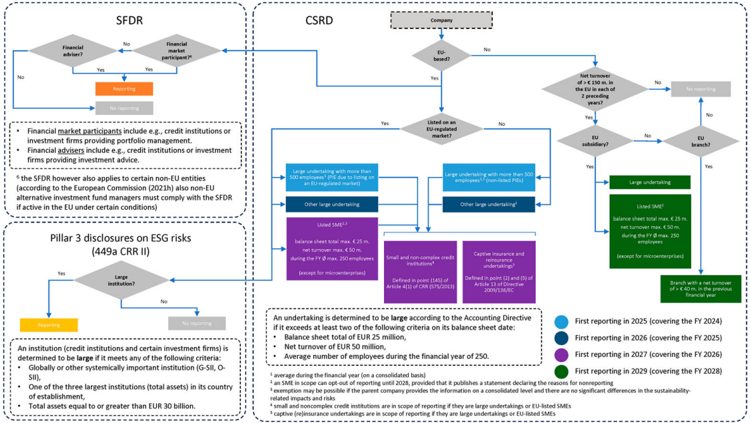
- The CSRD introduces double materiality, ESRS reporting in the management report, limited assurance, and digital tagging, with phased first reporting in 2025 for financial year 2024 by companies already subject to the NFRD, 2026 for other large companies, and 2027 for listed SMEs, small and noncomplex credit institutions, and captive (re)insurance undertakings, with an opt-out for another two years. From financial year 2028, EU branches and subsidiaries of non-EU undertakings are also subject if the non-EU undertaking has EU net turnover of EUR 150 million for each of the last two consecutive years and either a large or listed EU subsidiary or an EU branch with net turnover of at least EUR 40 million.
- The three standards differ in focus and materiality: the GRI Standards focus exclusively on impact materiality and broad stakeholders; the ESRS apply double materiality and broad stakeholder focus; the IFRS Sustainability Disclosure Standards focus on financial materiality and investors, with IFRS S1 and S2 primarily covering climate-related information. In 2022, 78 percent of the 250 largest global companies and 68 percent of the largest 100 companies across 58 countries reported in accordance with the GRI Standards.
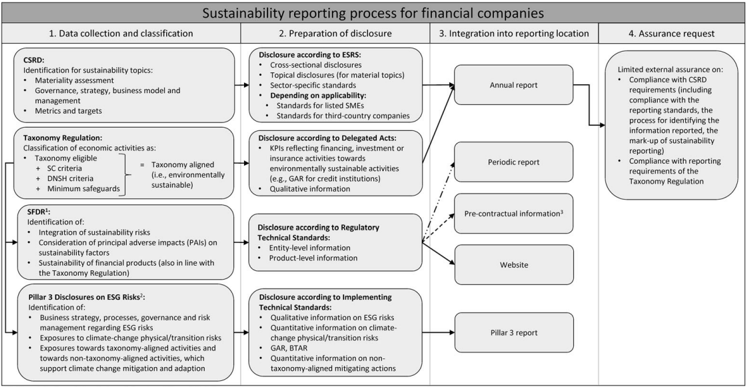
- The Taxonomy Regulation classifies environmentally sustainable economic activities around six environmental objectives and requires nonfinancial companies to disclose the proportion of turnover, capex, and opex associated with environmentally sustainable activities. The SFDR targets financial market participants and financial advisers, while Pillar 3 ESG risk disclosures target large listed credit institutions and certain investment firms, with phased disclosures including financed GHG emissions by end of June 2024, GAR by end of December 2023, and BTAR by December 2024.
Methods
- Design: descriptive legal and standard-setting overview with systematic comparison, not an empirical study. It reviews theory and literature on mandatory sustainability disclosure and compares key characteristics such as scope, objectives, materiality, disclosure requirements, legal character, location of information, and timeline.
- Data or sample: EU legislation and delegated/implementing acts—NFRD, CSRD, Taxonomy Regulation, SFDR, and CRR II Pillar 3—plus the GRI Standards, ESRS, and IFRS Sustainability Disclosure Standards, using secondary sources and official documents. The overview is provided at the time of writing, December 2023.
- Main analysis: qualitative comparison tables and critical reflection; no statistical analysis or empirical testing.
Limitations
- Stated in the paper: the highly dynamic nature of sustainability reporting legislation limits coverage to mandates implemented by the publication date; the article focuses only on EU legislation and the most important sustainability reporting standards; it does not discuss all voluntary frameworks, standards, and initiatives or how they may interact with mandatory schemes. The authors note an openly accessible website provides an updated register to help address the dynamism.
- Evident from the text: as of December 2023, several implementing elements were not yet available—sector-specific ESRS, proportionate ESRS for listed SMEs, standards for non-EU companies, the basis for equivalence, assurance standards and responsibility sharing, and the IASB management commentary revision—so some comparisons and implications are provisional.
- Evident from the text: the article is descriptive and does not provide empirical evidence on the consequences of the mandates; the authors note that large-scale empirical evidence on mandatory sustainability reporting is currently scant.
Model-written summary. Check it against the paper before relying on it.
Integrity signals
Registry
Cites
Statistics
Figures


Verification
Claims the paper makes
1 Valid · 9 Not valid · 72 Not checked · 89 Own results and interpretations
In the paper
“This table provides an overview of the requirements under the NFRD (baseline) and differences of the EU-27 (plus UK) member states in their national transpositions based on CSR Europe and GRI (2017) and our own analyses.”
§ An Overview of Corporate Sustainability Reporting Legislation in the European Union > 6. Conclusion
What the sources say
- Not matchedcites CSR Europe and GRI (2017)
An author–year citation the paper’s reference list doesn’t settle. We don’t search these by name.
plain- Asserted: passes — The authors put it forward as true.
- Checkable: passes — It can be checked against evidence.
- Load-bearing: passes — The paper’s conclusions depend on it.
- Based: passes — The paper gives a reason why it holds.
- Not matched
In the paper
“In addition, the ESRS are also aligned to meet certain data requirements for disclosures under Pillar 3 and under the SFDR (see Appendix B of ESRS 2).”
§ An Overview of Corporate Sustainability Reporting Legislation in the European Union > 3.6.1. Comparison
What the sources say
- Not matchedcites Appendix B of ESRS 2
This doesn’t read as a citation we can look up.
plainstates an association- Asserted: passes — The authors put it forward as true.
- Checkable: passes — It can be checked against evidence.
- Load-bearing: unclear — It is unclear whether the paper’s conclusions depend on it.
- Based: passes — The paper gives a reason why it holds.
- Not matched
A conclusion the paper draws from its own results — it cites no other source for it, so there is none to check. The quote shows it is in the paper.
In the paper
“Moreover, reporting requirements differ significantly for financial and nonfinancial companies.”
§ An Overview of Corporate Sustainability Reporting Legislation in the European Union > 3.6.1. Comparison
plainstates an association- Asserted: passes — The authors put it forward as true.
- Checkable: passes — It can be checked against evidence.
- Load-bearing: unclear — It is unclear whether the paper’s conclusions depend on it.
- Based: passes — The paper gives a reason why it holds.
In the paper
“Regarding Article-9 investment products, disclosure is required on how the objective is to be met.32”
§ An Overview of Corporate Sustainability Reporting Legislation in the European Union > 3.4. Sustainable Finance Disclosure Regulation (SFDR)
What the sources say
- Not matchedcites Article 9
This doesn’t read as a citation we can look up.
plain- Asserted: passes — The authors put it forward as true.
- Checkable: passes — It can be checked against evidence.
- Load-bearing: unclear — It is unclear whether the paper’s conclusions depend on it.
- Based: passes — The paper gives a reason why it holds.
- Not matched
A statement the paper makes itself — it cites no source for it, so there is none to check. The quote shows it is in the paper.
In the paper
“In particular, the ESRS are required to align with the Taxonomy Regulation (CSRD, Recital 38), and specific disclosure requirements under the SFDR and Pillar 3 directly build on classifications according to the Taxonomy Regulation.”
§ An Overview of Corporate Sustainability Reporting Legislation in the European Union > 3.6.1. Comparison
plainstates a cause- Asserted: passes — The authors put it forward as true.
- Checkable: passes — It can be checked against evidence.
- Load-bearing: unclear — It is unclear whether the paper’s conclusions depend on it.
- Based: passes — The paper gives a reason why it holds.
34 more claims
Create a free account to see all 171 claims and every source verdict.
- Probably not a substantial claim. 104
- It may state two separate claims as one. 67
Citations
Cites
Managing Legitimacy: Strategic and Institutional Approaches
Suchman, M. C. (1995) · The Academy of Management Review · doi:10.2307/258788 · Cited by 19,903 · cited 1×
“Legitimacy can be de fi ned as a ‘ generalized perception or assumption that the actions of an entity are desirable, proper, or appropriate within some socially constructed system of norms, values, beliefs, and de fi nitions ’ (Suchman, 1995, p. 574).”
Healy, P. M., & Palepu, K. G. (2001) · Journal of Accounting and Economics · doi:10.1016/s0165-4101(01)00018-0 · Cited by 8,097 · cited 2×
“Additional capital-market effects associated with voluntary disclosures include lower costs of capital and higher coverage by fi nancial analysts (Healy & Palepu, 2001).”
Verrecchia, R. E. (1983) · Journal of Accounting and Economics · doi:10.1016/0165-4101(83)90011-3 · Cited by 3,481
The financial reporting environment: Review of the recent literature
Beyer, A., Cohen, D. A., Lys, T. Z., & Walther, B. R. (2010) · Journal of Accounting and Economics · doi:10.1016/j.jacceco.2010.10.003 · Cited by 2,609
Healy, P. M., & Palepu, K. (2001) · SSRN Electronic Journal · doi:10.2139/ssrn.258514 · Cited by 2,097
The role of environmental disclosures as tools of legitimacy: A research note
Cho, C. H., & Patten, D. M. (2007) · Accounting, Organizations and Society · doi:10.1016/j.aos.2006.09.009 · Cited by 2,069 · cited 1×
“…evidence suggests that companies with poor sustainability performance provide positive sustainability disclosure to in fl uence public perceptions of their underlying sustainability performance (e.g. Cho et al., 2010; Cho et al., 2012; Cho & Patten, 2007; Hummel & Schlick, 2016; Patten, 2002).”
Mandatory CSR and sustainability reporting: economic analysis and literature review
Christensen, H. B., Hail, L., & Leuz, C. (2021) · Review of Accounting Studies · doi:10.1007/s11142-021-09609-5 · Cited by 1,923 · cited 6×
“We develop the future research agenda with recent literature reviews on the consequences of sustainability reporting mandates (Christensen et al., 2021; Haji et al., 2023), a recent discussion of the developments in sustainability reporting (Baboukardos et al., 2023; Stolowy & Paugam, 2023), and…”
InfluentialLEUZ, C., & WYSOCKI, P. D. (2016) · Journal of Accounting Research · doi:10.1111/1475-679x.12115 · Cited by 1,760
The relevance of the value-relevance literature for financial accounting standard setting
Holthausen, R. W., & Watts, R. L. (2001) · Journal of Accounting and Economics · doi:10.1016/s0165-4101(01)00029-5 · Cited by 1,742 · cited 1×
“Valuable reviews of this literature are provided, for instance, by Healy and Palepu (2001), Holthausen and Watts (2001), Beyer et al. (2010), Berger (2011), and Leuz and Wysocki (2016).”
The Means and End of Greenwash
Lyon, T. P., & Montgomery, A. W. (2015) · Organization & Environment · doi:10.1177/1086026615575332 · Cited by 1,636 · cited 1×
“Researchers could utilize the Taxonomy Regulation ’ s classi fi cation scheme to detect green-washing (Kim & Lyon, 2015; Lyon & Montgomery, 2015) and potentially manipulative reporting.”
The relation between environmental performance and environmental disclosure: a research note
Patten, D. M. (2002) · Accounting, Organizations and Society · doi:10.1016/s0361-3682(02)00028-4 · Cited by 1,484 · cited 1×
“…evidence suggests that companies with poor sustainability performance provide positive sustainability disclosure to in fl uence public perceptions of their underlying sustainability performance (e.g. Cho et al., 2010; Cho et al., 2012; Cho & Patten, 2007; Hummel & Schlick, 2016; Patten, 2002).”
O’Donovan, G. (2002) · Accounting, Auditing & Accountability Journal · doi:10.1108/09513570210435870 · Cited by 1,450
Greenwash vs. Brownwash: Exaggeration and Undue Modesty in Corporate Sustainability Disclosure
Kim, E.-H., & Lyon, T. P. (2015) · Organization Science · doi:10.1287/orsc.2014.0949 · Cited by 932 · cited 1×
“Researchers could utilize the Taxonomy Regulation ’ s classi fi cation scheme to detect green-washing (Kim & Lyon, 2015; Lyon & Montgomery, 2015) and potentially manipulative reporting.”
The language of US corporate environmental disclosure
Cho, C. H., Roberts, R. W., & Patten, D. M. (2010) · Accounting, Organizations and Society · doi:10.1016/j.aos.2009.10.002 · Cited by 836 · cited 1×
“…evidence suggests that companies with poor sustainability performance provide positive sustainability disclosure to in fl uence public perceptions of their underlying sustainability performance (e.g. Cho et al., 2010; Cho et al., 2012; Cho & Patten, 2007; Hummel & Schlick, 2016; Patten, 2002).”
Hummel, K., & Schlick, C. (2016) · Journal of Accounting and Public Policy · doi:10.1016/j.jaccpubpol.2016.06.001 · Cited by 690 · cited 1×
“…evidence suggests that companies with poor sustainability performance provide positive sustainability disclosure to in fl uence public perceptions of their underlying sustainability performance (e.g. Cho et al., 2010; Cho et al., 2012; Cho & Patten, 2007; Hummel & Schlick, 2016; Patten, 2002).”
Self-citationGray, R. (2006) · Accounting, Auditing & Accountability Journal · doi:10.1108/09513570610709872 · Cited by 689 · cited 1×
“In that context, researchers assert that the disclosure of sustainability information is often ‘ partial, and, mostly, fairly trivial ’ (Cho et al., 2015; Gray, 2006, p. 803).”
Do actions speak louder than words? An empirical investigation of corporate environmental reputation
Cho, C. H., Guidry, R. P., Hageman, A. M., & Patten, D. M. (2012) · Accounting, Organizations and Society · doi:10.1016/j.aos.2011.12.001 · Cited by 652 · cited 1×
“…evidence suggests that companies with poor sustainability performance provide positive sustainability disclosure to in fl uence public perceptions of their underlying sustainability performance (e.g. Cho et al., 2010; Cho et al., 2012; Cho & Patten, 2007; Hummel & Schlick, 2016; Patten, 2002).”
Leuz, C., & Wysocki, P. D. (2015) · SSRN Electronic Journal · doi:10.2139/ssrn.2733831 · Cited by 580
The Relevance of the Value Relevance Literature for Financial Accounting Standard Setting
Holthausen, R. W., & Watts, R. L. (2000) · SSRN Electronic Journal · doi:10.2139/ssrn.228950 · Cited by 533
Forcing Firms to Talk: Financial Disclosure Regulation and Externalities
Admati, A. R., & Pfleiderer, P. (2000) · Review of Financial Studies · doi:10.1093/rfs/13.3.479 · Cited by 515
CSR disclosure: the more things change…?
Cho, C. H., Michelon, G., Patten, D. M., & Roberts, R. W. (2015) · Accounting, Auditing & Accountability Journal · doi:10.1108/aaaj-12-2013-1549 · Cited by 413 · cited 1×
“In that context, researchers assert that the disclosure of sustainability information is often ‘ partial, and, mostly, fairly trivial ’ (Cho et al., 2015; Gray, 2006, p. 803).”
La Torre, M., Sabelfeld, S., Blomkvist, M., Tarquinio, L., & Dumay, J. (2018) · Meditari Accountancy Research · doi:10.1108/medar-02-2018-0290 · Cited by 294
Sustainability Reporting: A Financial Reporting Perspective
Wagenhofer, A. (2023) · Accounting in Europe · doi:10.1080/17449480.2023.2218398 · Cited by 264 · cited 1×
“Here, a particular challenge for future research could be to aggregate the immense amounts of data into measures of sustainability (Wagenhofer, 2023) that enable high-level cross-sectional and intertemporal comparison.”
Corporate social responsibility assurance and reporting quality: Evidence from restatements
Ballou, B., Chen, P.-C., Grenier, J. H., & Heitger, D. L. (2018) · Journal of Accounting and Public Policy · doi:10.1016/j.jaccpubpol.2018.02.001 · Cited by 211 · cited 1×
“7 Assurance also plays an important role because it can increase the quality and reliability of the information disclosed (Ballou et al., 2018; Maroun, 2019).”
Inchausti, B. G., & Luque‐Vílchez, M. (2022) · Sustainability Accounting Management and Policy Journal · doi:10.1108/sampj-06-2021-0222 · Cited by 206
Does external assurance contribute to higher quality integrated reports?
Maroun, W. (2019) · Journal of Accounting and Public Policy · doi:10.1016/j.jaccpubpol.2019.06.002 · Cited by 203 · cited 1×
“7 Assurance also plays an important role because it can increase the quality and reliability of the information disclosed (Ballou et al., 2018; Maroun, 2019).”
Berger, P. G. (2011) · Journal of Accounting and Economics · doi:10.1016/j.jacceco.2011.01.001 · Cited by 186 · cited 1×
“Valuable reviews of this literature are provided, for instance, by Healy and Palepu (2001), Holthausen and Watts (2001), Beyer et al. (2010), Berger (2011), and Leuz and Wysocki (2016).”
Sustainability Accounting and Accountability
Laine, M., Tregidga, H., & Unerman, J. (2021) · Routledge eBooks · doi:10.4324/9781003185611 · Cited by 184
Mittelbach-Hörmanseder, S., Hummel, K., & Rammerstorfer, M. (2020) · European Accounting Review · doi:10.1080/09638180.2020.1763818 · Cited by 166
Self-citationDiscretionary compliance with mandatory environmental disclosures: Evidence from SEC filings
Peters, G. F., & Romi, A. M. (2013) · Journal of Accounting and Public Policy · doi:10.1016/j.jaccpubpol.2013.04.004 · Cited by 158 · cited 1×
“…compliance thus depends on these costs, which are determined by the speci fi cation of the legislation, in particular how precisely the reporting requirements are outlined, the magnitude of potential sanctions for noncompliance, and the likelihood of detection and enforcement (Peters & Romi, 2013).”
Consequences of CSR reporting regulations worldwide: a review and research agenda
Haji, A. A., Coram, P., & Troshani, I. (2023) · Accounting, Auditing & Accountability Journal · doi:10.1108/aaaj-05-2020-4571 · Cited by 125 · cited 2×
“…the future research agenda with recent literature reviews on the consequences of sustainability reporting mandates (Christensen et al., 2021; Haji et al., 2023), a recent discussion of the developments in sustainability reporting (Baboukardos et al., 2023; Stolowy & Paugam, 2023), and our…”
Adams, C. A., & Mueller, F. U. (2022) · Sustainability Accounting Management and Policy Journal · doi:10.1108/sampj-10-2021-0436 · Cited by 118 · cited 2×
“…paper on sustainability reporting in September 2020 was the starting point for a critical debate among accounting scholars on the optimal path towards sustainability standard setting (Adams, 2021; Adams & Mueller, 2022; Cho et al., 2022; Laine & Michelon, 2020; Professors of Accounting, 2020).”
Consequences of sustainability reporting mandates: evidence from the EU taxonomy regulation
Hummel, K., & Bauernhofer, K. (2024) · Accounting Forum · doi:10.1080/01559982.2024.2301854 · Cited by 109 · cited 1×
“Recently, Hummel and Bauernhofer (2024) concluded that complex and detailed reporting requirements in combination with a tight implementation period result in a reporting response in the fi rst implementation years they describe as an ‘ endeavor to comply ’ ; companies aim to comply with reporting…”
Self-citationSustainability Reporting: Is Convergence Possible?
Stolowy, H., & Paugam, L. (2023) · Accounting in Europe · doi:10.1080/17449480.2023.2189016 · Cited by 91 · cited 3×
“Further research can therefore investigate how these changes translate into more comparable or converging (Korca et al., 2023; Stolowy & Paugam, 2023) disclosure.”
Cremasco, C., & Boni, L. (2024) · Journal of Sustainable Finance & Investment · doi:10.1080/20430795.2022.2124838 · Cited by 88 · cited 1×
“Cremasco and Boni (2022) found evidence that investment funds exhibit a degree of fuz-ziness in their category memberships, suggesting loose boundaries and a potential need for adapting the SFDR to better ful fi ll its aim.”
Hombach, K., & Sellhorn, T. (2018) · Schmalenbach Business Review · doi:10.1007/s41464-018-0065-z · Cited by 59
Disentangling the concept of comparability in sustainability reporting
Korca, B., Costa, E., & Bouten, L. (2023) · Sustainability Accounting Management and Policy Journal · doi:10.1108/sampj-05-2022-0284 · Cited by 59 · cited 1×
“Further research can therefore investigate how these changes translate into more comparable or converging (Korca et al., 2023; Stolowy & Paugam, 2023) disclosure.”
The multiverse of non-financial reporting regulation
Baboukardos, D., Gaia, S., Lassou, P., & Soobaroyen, T. (2023) · Accounting Forum · doi:10.1080/01559982.2023.2204786 · Cited by 57 · cited 2×
“Consistent with Stolowy and Paugam (2023) and Baboukardos et al. (2023), we therefore remain skeptical whether interoperability between the standards will eventually be achieved.”
The Future of Corporate Reporting
Cho, C. H., Kajüter, P., & Stacchezzini, R. (2022) · Accounting in Europe · doi:10.1080/17449480.2022.2033804 · Cited by 33 · cited 4×
“…paper on sustainability reporting in September 2020 was the starting point for a critical debate among accounting scholars on the optimal path towards sustainability standard setting (Adams, 2021; Adams & Mueller, 2022; Cho et al., 2022; Laine & Michelon, 2020; Professors of Accounting, 2020).”
InfluentialPesci, C., Vola, P., & Gelmini, L. (2023) · Sustainability Accounting Management and Policy Journal · doi:10.1108/sampj-05-2022-0287 · Cited by 33 · cited 1×
“Moreover, future research could also analyze how the role and relevance of voluntary standard-setters change in an evolving shift towards mandatory standard application and as major players of accounting stan-dard-setting enter the fi eld (Pesci et al., 2023).”
4 Embracing the New Age of Materiality: Harnessing the Pace of Change in ESG
Brown, K., Eltobgy, M., Beal, D., Chau, V., Eccles, R. G., Shandal, V., Tauber, L., Woods, W., & Young, D. (2023) · De Gruyter eBooks · doi:10.1515/9783111295268-005 · Cited by 21
Environmental Disclosure as Legitimation: Is It in the Public Interest?
Patten, D. M. (2013) · Springer eBooks · doi:10.1007/978-94-007-7082-9_10 · Cited by 20 · cited 3×
“Therefore, according to both theories, sustainability reporting mandates can lift the quantity and/or quality of sustainability information (Christensen et al., 2021; Jeffrey & Perkins, 2014; Patten, 2014).”
Jeffrey, C. G., & Perkins, J. D. (2013) · doi:10.1007/978-94-007-7082-9_9 · Cited by 9 · cited 1×
“Therefore, according to both theories, sustainability reporting mandates can lift the quantity and/or quality of sustainability information (Christensen et al., 2021; Jeffrey & Perkins, 2014; Patten, 2014).”
Laine, M., Tregidga, H., & Unerman, J. (2021) · Sustainability Accounting and Accountability · doi:10.4324/9781003185611-7
Research works printed but not linked: 3
- 18. EBA, EIOPA & ESMA. (2023a). Joint consultation paper. Review of SFDR delegated regulation regarding PAI and financial product disclosures. Draft regulatory technical standards with regard to the content, methodologies and presentation of sustainability disclosures pursuant to Article 2a(3), 4(6), 4(7), 8(3), 8(4), 9(5), 9(6), 10(2), 11(4) and 11(5) of regulation (EU) 2019/2088. JC 2023 09. https://www.esma.europa.eu/sites/default/files/2023-04/JC_ 2023_09_Joint_consultation_paper_on_review_of_SFDR_Delegated_Regulation.pdf
- European Commission. (2020). Remarks by Executive Vice-President Dombrovskis at the conference on implementing the European Green Deal: Financing the transition. https://ec.europa.eu/commission/presscorner/detail/en/SPEECH_20_139
- 26. European Commission. (2020). Remarks by Executive Vice-President Dombrovskis at the conference on implementing the European Green Deal: Financing the transition. https://ec.europa.eu/commission/presscorner/detail/en/SPEECH_20_139 European Commission. (2021a). Commission delegated regulation (EU) 2021/2178 of 6 July 2021 supplementing regu- lation (EU) 2020/852 of the European Parliament and of the Council by specifying the content and presentation of information to be disclosed by undertakings subject to Articles 19a or 29a of Directive 2013/34/EU concerning environmentally sustainable economic activities, and specifying the methodology to comply with that disclosure obligation. https://eur-lex.europa.eu/legal-content/EN/TXT/?uri=CELEX:32021R2178 European Commission. (2021b). Commission delegated regulation (EU) 2021/2139 of 4 June 2021 supplementing regu- lation (EU) 2020/852 of the European Parliament and of the Council by establishing the technical screening criteria for determining the conditions under which an economic activity qualifies as contributing substantially to climate change mitigation or climate change adaptation and for determining whether that economic activity causes no sig- nificant harm to any of the other environmental objectives. https://eur-lex.europa.eu/legal-content/EN/TXT/?uri= CELEX:32021R2139 European Commission. (2021c). Fitness check on the EU framework for public reporting by companies. SWD(2021) 81
Cited by
Dragomir, V. D., Dumitru, M., Chersan, I.-C., Gorgan, C., & Păunescu, M. (2024) · Accounting in Europe · doi:10.1080/17449480.2024.2339264 · Cited by 135
“All the requirements of the ESRS are subject to the double materiality assessment (Hummel & Jobst, 2024).”
Consequences of sustainability reporting mandates: evidence from the EU taxonomy regulation
Hummel, K., & Bauernhofer, K. (2024) · Accounting Forum · doi:10.1080/01559982.2024.2301854 · Cited by 109
Self-citationNicolò, G., Zampone, G., Sannino, G., & Polcini, P. T. (2025) · Business Strategy and the Environment · doi:10.1002/bse.70054 · Cited by 100
ESG controversies and insolvency risk: evidence from the insurance industry
Giráldez, P., Moreno, I., Pérez‐Calero, L., & Guerrero‐Villegas, J. (2024) · Management Decision · doi:10.1108/md-10-2023-2002 · Cited by 65
Are listed SMEs ready for the corporate sustainability reporting directive? Evidence from Italy
Pizzi, S., & Coronella, L. (2024) · Business Ethics the Environment & Responsibility · doi:10.1111/beer.12736 · Cited by 69
Metadata
- Authors
- Hummel, K., & Jobst, D.
- Affiliations
- Vienna University of Economics and Business (AT)
- Corresponding author
- Hummel, Katrin
- ORCID
- Hummel, Katrin
- Venue
- Accounting in Europe
- Publisher
- Informa UK Limited
- Published
- 2024-02-09
- Volume
- 21
- Issue
- 3
- Pages
- 320-355
- ISSN
- 1744-9480 (ISSN-L)
- 1744-9499
- OpenAlex
- W4391722482
- Cited by
- 315
- References
- 39
- Citations by year
- 2026: 144 · 2025: 131 · 2024: 33
- FWCI
- 103.40
- Type
- journal article
- Language
- en
- Open access
- hybrid
- doi.org
- Licence
- Locations
- Accounting in Europe (publishedVersion, cc-by-nc-nd)
- SSRN Electronic Journal (acceptedVersion)
- WU Research (publishedVersion, cc-by-nc-nd)
- RePEc: Research Papers in Economics (submittedVersion)
- WU Research (submittedVersion)
- Funders
- University of Bristol
- Topics
- Social Sciences › Business, Management and Accounting › Strategy and Management › Corporate Social Responsibility Reporting
- Social Sciences › Business, Management and Accounting › Strategy and Management › Governance, Compliance, and Sustainability
- Social Sciences › Economics, Econometrics and Finance › Finance › Sustainable Finance and Green Bonds
- Keywords
- corporate sustainability reporting, Corporate Sustainability Reporting Directive, EU Taxonomy Regulation, Sustainable Finance Disclosure Regulation, credit institutions, ISSB, sustainability reporting standards, European Union regulation, disclosure requirements
About these checks
Registry, retraction, Cites and statistics results are computed, not judged, with one exception: a printed reference that no index lists is read once by a model before it counts as a citation error. Claims are extracted by a model and kept only when their quote appears verbatim in the text; each cited source is then checked, with a model’s help, for whether it says what the claim relies on. Those verdicts can be wrong — read the claim’s quote and the cited source before relying on one.
The claim verdicts this report counts are experimental: their accuracy is not yet measured.
A language model drew the claims from the paper on 2026-09-28, under version 3 of the claim definition (prompt extract-v3).
A second model labelled each claim on 2026-09-28 (model jev-1.13-20260917, definition revision gold-guideline-v0.2).
Statistics and arithmetic are recomputed, not judged.
Confidence bands are shown only for fields calibrated on our annotated test set. None is calibrated yet, so no band is shown.
What counts as a claim ›How we measure confidence ›How we check this ›
Are you an author, or do you see a problem with this page? Request a review
Data sources
Bibliographic data: Semantic Scholar, OpenAlex, Crossref.
Contains information from the Semantic Scholar Academic Graph Datasets, made available under the ODC Attribution License (ODC-BY 1.0).
Semantic Scholar’s data is described in: Kinney, R., et al. (2023). The Semantic Scholar Open Data Platform. arXiv:2301.10140.
