

Antibody-mediated phagocytosis contributes to the anti-tumor activity of the therapeutic antibody daratumumab in lymphoma and multiple myeloma
Open accessThe DOI matches its Crossref record; 48 of the 48 references it cites were found in a registry or an index.
Abstract
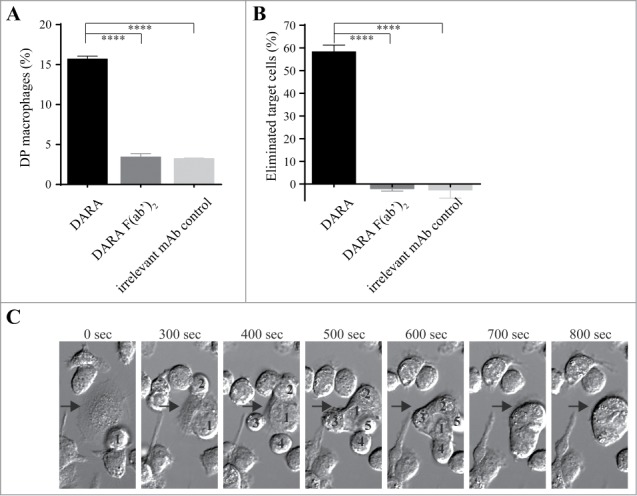
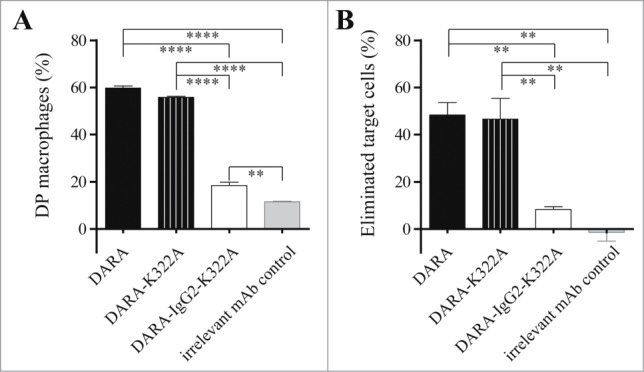
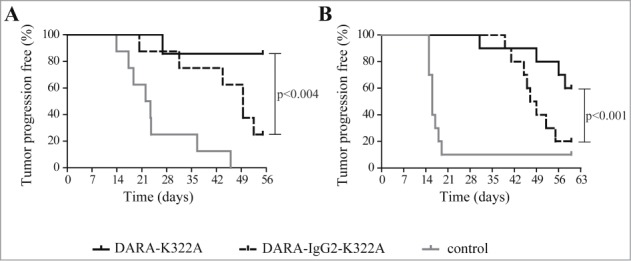
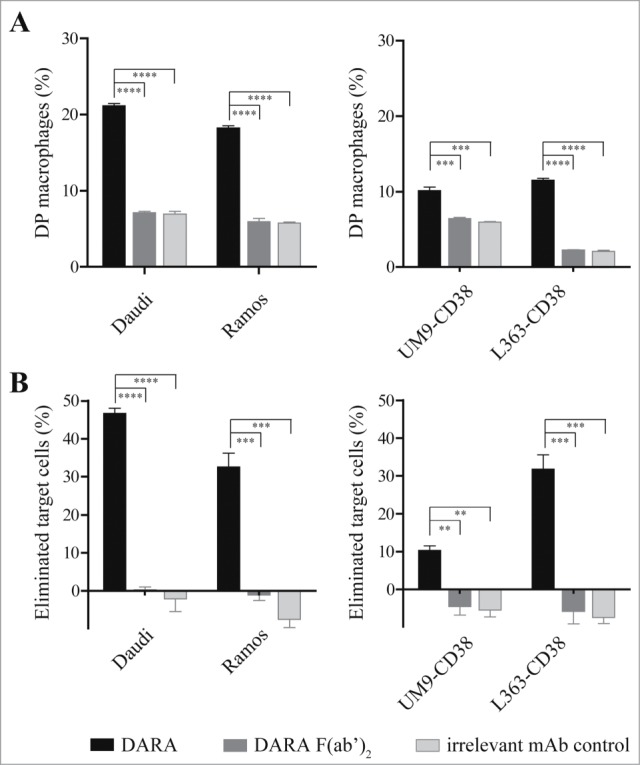
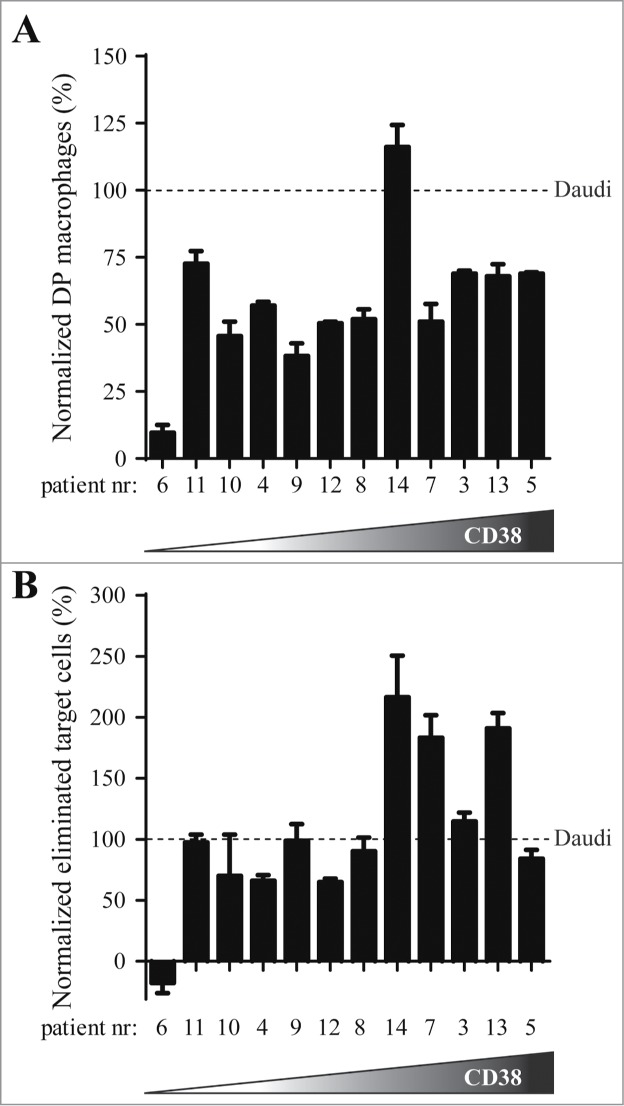
Daratumumab (DARA) is a human CD38-specific IgG1 antibody that is in clinical development for the treatment of multiple myeloma (MM). The potential for IgG1 antibodies to induce macrophage-mediated phagocytosis, in combination with the known presence of macrophages in the tumor microenvironment in MM and other hematological tumors, led us to investigate the contribution of antibody-dependent, macrophage-mediated phagocytosis to DARA's mechanism of action. Live cell imaging revealed that DARA efficiently induced macrophage-mediated phagocytosis, in which individual macrophages rapidly and sequentially engulfed multiple tumor cells. DARA-dependent phagocytosis by mouse and human macrophages was also observed in an in vitro flow cytometry assay, using a range of MM and Burkitt's lymphoma cell lines. Phagocytosis contributed to DARA's anti-tumor activity in vivo, in both a subcutaneous and an intravenous leukemic xenograft mouse model. Finally, DARA was shown to induce macrophage-mediated phagocytosis of MM cells isolated from 11 of 12 MM patients that showed variable levels of CD38 expression. In summary, we demonstrate that phagocytosis is a fast, potent and clinically relevant mechanism of action that may contribute to the therapeutic activity of DARA in multiple myeloma and potentially other hematological tumors.
Overview
The claims and statistics of this paper haven’t been checked yet.
Free: it reads the open-access text and checks the first 5 claims that cite a source we can check. Create a free account to check every claim.
Integrity signals
Registry
Cites
Statistics
Figures
Verification
Claims the paper makes
The claims and statistics of this paper haven’t been checked yet.
Free: it reads the open-access text and checks the first 5 claims that cite a source we can check. Create a free account to check every claim.
Claims other papers make about this one
Each is checked against this paper’s own text: does it say what the citing paper says it does?
The source backs part of the claim, not all of it — or backs it for a different population, condition or comparison.
In the citing paper
“Daratumumab is an IgG1 monoclonal antibody that targeting CD38 and induces cell death through complement-dependent cytotoxicity (CDC), antibody-dependent cellular cytotoxicity (ADCC), antibody-dependent cellular phagocytosis (ADCP), and regulation of CD38 enzyme activity [157, 158].”
From Multiple myeloma: signaling pathways and targeted therapy (2024) · cites this paper as [158]
Experimental — accuracy not yet measured
Self-check
Percentages, sums and reported differences re-computed from the paper’s own numbers.
The self-check needs the paper’s full text.
Citations
Cites
CD47 Is Upregulated on Circulating Hematopoietic Stem Cells and Leukemia Cells to Avoid Phagocytosis
Jaiswal, S., Jamieson, C. H. M., Pang, W. W., Park, C. Y., Chao, M. P., Majeti, R., Traver, D., van Rooijen, N., & Weissman, I. L. (2009) · Cell · doi:10.1016/j.cell.2009.05.046 · Cited by 1,581
Efficient Neutralization of Primary Isolates of HIV-1 by a Recombinant Human Monoclonal Antibody
Burton, D. R., Pyati, J., Koduri, R., Sharp, S. J., Thornton, G. B., Parren, P. W. H. I., Sawyer, L. S. W., Hendry, R. M., Dunlop, N., Nara, P. L., et al. (1994) · Science · doi:10.1126/science.7973652 · Cited by 1,100
Self-citationChao, M. P., Alizadeh, A. A., Tang, C., Myklebust, J. H., Varghese, B., Gill, S., Jan, M., Cha, A. C., Chan, C. K., Tan, B. T., et al. (2010) · Cell · doi:10.1016/j.cell.2010.07.044 · Cited by 1,087 · cited 1×
“Anti-CD47 mAb has been shown to synergize with rituximab in the treatment of non-Hodgkin lymphoma.(41) Moreover, targeting the CD47-SIRP a axis has now been shown to increase efficacy of several therapeutic antibodies.”
Backgroundde Weers, M., Tai, Y.-T., van der Veer, M. S., Bakker, J. M., Vink, T., Jacobs, D. C. H., Oomen, L. A., Peipp, M., Valerius, T., Slootstra, J. W., et al. (2011) · The Journal of Immunology · doi:10.4049/jimmunol.1003032 · Cited by 1,037 · cited 2×
“Antibodies Human IgG1 CD38 mAb DARA was generated by immunization in a HuMAb mouse and produced as recombinant protein as described previously.(12) DARA F(ab’)2 fragments were prepared via pepsin digestion (Sigma-Aldrich, P7012).”
BackgroundMethodSelf-citationRole of tumor-associated macrophages in tumor progression and invasion
Mantovani, A., Schioppa, T., Porta, C., Allavena, P., & Sica, A. (2006) · Cancer and Metastasis Reviews · doi:10.1007/s10555-006-9001-7 · Cited by 888
Chao, M. P., Jaiswal, S., Weissman-Tsukamoto, R., Alizadeh, A. A., Gentles, A. J., Volkmer, J., Weiskopf, K., Willingham, S. B., Raveh, T., Park, C. Y., et al. (2010) · Science Translational Medicine · doi:10.1126/scitranslmed.3001375 · Cited by 776 · cited 1×
“CD47 is described to be upregulated on leukemic cells to avoid phagocytosis,(26) which can be counterbalanced by the expression of calreticulin that gives a pro-phagocytic signal upon receptor binding.(27,28) Human CD47 is not able to bind to mouse SIRPa,(29,30) and therefore CD47 cannot account for the difference in…”
BackgroundUchida, J., Hamaguchi, Y., Oliver, J. A., Ravetch, J. V., Poe, J. C., Haas, K. M., & Tedder, T. F. (2004) · The Journal of Experimental Medicine · doi:10.1084/jem.20040119 · Cited by 642 · cited 1×
“By using mouse strains deficient in specific leukocyte subpopulations or by depleting specific effector cell subsets, mw were shown to represent the main effector cells in the anti-tumor activity of CD20-targeting monoclonal Ab (mAb) in vivo.(6,7) Furthermore, for SGN-30 (chimeric IgG1 CD30 mAb), SGN-40 (humanized IgG…”
BackgroundMechanism of action of immunomodulatory drugs (IMiDS) in multiple myeloma
Quach, H., Ritchie, D., Stewart, A. K., Neeson, P., Harrison, S., Smyth, M. J., & Prince, H. M. (2010) · Leukemia · doi:10.1038/leu.2009.236 · Cited by 600 · cited 3×
“However, we previously showed that monocytes and NK-cells from peripheral blood mononuclear cells of a healthy donor were not killed by DARA.34 For MM patient therapy, the current focus is on combination therapy of mAb with immunomodulatory drugs (IMiDs).37,38 IMiDs currently used, e.g., lenalidomide and pomalidomide,…”
BackgroundThe binding site for C1q on IgG
Duncan, A. R., & Winter, G. (1988) · Nature · doi:10.1038/332738a0 · Cited by 569
Polymorphism in Sirpa modulates engraftment of human hematopoietic stem cells
Takenaka, K., Prasolava, T. K., Wang, J. C. Y., Mortin-Toth, S. M., Khalouei, S., Gan, O. I., Dick, J. E., & Danska, J. S. (2007) · Nature Immunology · doi:10.1038/ni1527 · Cited by 509
Cited by
Items 401–500 of 534
Bapatla, A., Kaul, A., Dhalla, P. S., Armenta-Quiroga, A. S., Khalid, R., Garcia, J., & Khan, S. (2021) · Cureus · doi:10.7759/cureus.15440 · Cited by 6
“The efficacy and quick action of macrophage-induced phagocytosis is demonstrated by time-lapse imaging microscopy [10].”
BackgroundCellular immunity in the era of modern multiple myeloma therapy
Liu, Z., Zhao, X., Shen, H., Liu, X., Xu, X., & Fu, R. (2023) · International Journal of Cancer · doi:10.1002/ijc.34609 · Cited by 5
Huang, Z.-Y., Jin, X.-Q., Liang, Q., Zhang, D.-Y., Han, H., & Wang, Z. (2023) · Medicine · doi:10.1097/md.0000000000035319 · Cited by 9
Díaz-Tejedor, A., Rodríguez‐Ubreva, J., Ciudad, L., Lorenzo-Mohamed, M., González-Rodríguez, M., Castellanos, B., Sotolongo-Ravelo, J., San‐Segundo, L., Corchete, L. A., González-Méndez, L., et al. (2024) · International Journal of Molecular Sciences · doi:10.3390/ijms25094718 · Cited by 4
“Daratumumab exerts its anti-myeloma effect through immune-mediated mechanisms (e.g., antibody-dependent cellular cytotoxicity (ADCC), complement-mediated cytotoxicity (CDC) and antibody-dependent cellular phagocytosis (ADCP)) [13,14].”
BackgroundFoster, L. H., Anderson, L. D., Chung, A., Chaulagain, C. P., Pettijohn, E. M., Cowan, A. J., Costello, C. L., Larson, S., Sborov, D. W., Shain, K. H., et al. (2025) · Blood Cancer Journal · doi:10.1038/s41408-025-01355-0 · Cited by 4
Antibody-dependent cellular phagocytosis in cancer immunotherapy: research and perspectives
Gu, Q., Li, S., Hou, S., Liu, J., Zhang, X., Xi, Y., Chen, H., Liu, S., Chu, M., & Yang, M. (2026) · Journal of Translational Medicine · doi:10.1186/s12967-026-08020-5 · Cited by 4
“Anti-CD38 mAbs were shown to effectively treat Daudi-luciferase tumor and leukemic severe combined immunodeficiency (SCID)-beige xenograft models [30].”
Horenstein, A. L., Frerichs, K. A., Faini, A. C., van de Donk, N. W. C. J., & Malavasi, F. (2026) · Frontiers in Immunology · doi:10.3389/fimmu.2026.1769281 · Cited by 4
Maraglino, A. M. E., Sammassimo, S., Lolli, G., Clemente, A., Tabanelli, V., Pastano, R., & Derenzini, E. (2025) · Annals of Hematology · doi:10.1007/s00277-025-06474-z · Cited by 4
“…of daratumumab is not clear and it might be similar to that in multiple myelomas: after ligation with the CD38 molecule, daratumumab inhibits tumor cell growth through complement-dependent cytotoxicity (CDC) and antibody-dependent cellular cytotoxicity (ADCC) and induces cell apoptosis [ 12].”
Deligne, C., & Gros, L. (2019) · médecine/sciences · doi:10.1051/medsci/2019194 · Cited by 7
Fu, W., Bang, S., Huang, H., Kım, K., Li, W., An, G., Lee, J., Cai, Z., Jin, J., Wang, Y., et al. (2025) · Annals of Hematology · doi:10.1007/s00277-025-06303-3 · Cited by 4
Mele, G., Cascavilla, N., Renzo, N. D., Guarini, A., Mazza, P., Melillo, L. M. A., Pavone, V., Tarantini, G., Curci, P., Falcone, A. P., et al. (2022) · Annals of Hematology · doi:10.1007/s00277-022-04857-0 · Cited by 4
Current and emerging pharmacotherapy for the treatment of childhood acute myeloid leukemia
Cuglievan, B., McCall, D. C., Robusto, L., Mireles, M. E., & Gettys, S. C. (2022) · Expert Opinion on Pharmacotherapy · doi:10.1080/14656566.2022.2145186 · Cited by 4
“CD38 has been targeted with monoclonal antibodies, namely isatuximab [79] and daratumumab [80].”
BackgroundShimazu, Y., Kanda, J., Kaneko, H., Imada, K., Yamamura, R., Kosugi, S., Shimura, Y., Ito, T., Fuchida, S., Uchiyama, H., et al. (2022) · Therapeutic Advances in Hematology · doi:10.1177/20406207221142487 · Cited by 4
Esposito, P. B., Picciotto, D., Costigliolo, F., Russo, E., Macciò, L., Cenacchi, G., Cagnetta, A., Cea, M., Lemoli, R. M., & Viazzi, F. C. (2023) · Frontiers in Medicine · doi:10.3389/fmed.2023.1266172 · Cited by 4
“The binding of daratumumab with CD38 induces cell death through different Fc-mediated mechanisms: apoptosis, phagocytosis, and antibodyas well as complement-dependent cytotoxicity (27).”
BackgroundAlegre, A. M., de la Rubia, J., Sureda, A. M., Rodríguez, C. E., Suárez, A., Blanchard, M. J., Bargay, J., Rodríguez‐Otero, P., Insunza, A., Palomera, L., et al. (2020) · HemaSphere · doi:10.1097/hs9.0000000000000380 · Cited by 4
An evaluation of subcutaneous daratumumab for the treatment of multiple myeloma
Paul, B. A., Atrash, S., Bhutani, M., Voorhees, P. M., Hamadeh, I. S., & Usmani, S. Z. (2020) · Expert Review of Hematology · doi:10.1080/17474086.2020.1795829 · Cited by 4
Innate and adaptive immunity in cancer
Doshi, A. S., & Asrani, K. H. (2021) · Elsevier eBooks · doi:10.1016/b978-0-12-823397-9.00025-9 · Cited by 4
Klein, C. (2018) · MDPI eBooks · doi:10.3390/books978-3-03842-876-3 · Cited by 5
Quantification of serum daratumumab in multiple myeloma patients by LC-MS/MS, comparison with ELISA
Li, W., Tian, Z., Xiong, Y., Xu, H., Huang, F., Yu, J., & Diao, X. (2024) · Journal of Pharmaceutical and Biomedical Analysis · doi:10.1016/j.jpba.2024.116627 · Cited by 3
Huang, X., Zhou, J., Qian, Y., He, J., Yang, L., Wang, Z., Wei, D., Li, M., Ma, W., & Lang, H. (2025) · Systematic Reviews · doi:10.1186/s13643-025-02804-4 · Cited by 3
“Daratumumab is believed to act as an antimyeloma agent through complement-dependent cytotoxicity, anti-body-dependent cell-mediated cytotoxicity, antibody-dependent cellular phagocytosis, induction of apoptosis, and modulation of CD38 enzyme activities [3, 45].”
Bahlis, N. J., Zonder, J. A., Karlin, L., Plesner, T., París, L., Wróbel, T., Hungria, V., Besemer, B., Crusoé, E., Silkjær, T., et al. (2025) · Leukemia & lymphoma/Leukemia and lymphoma · doi:10.1080/10428194.2025.2561117 · Cited by 3
“Daratumumab is a human IgG1 kappa monoclonal antibody targeting CD38 with direct on-tumor [1–4] and immunomodulatory [5–7] mechanisms of action, demonstrating greater cytotoxicity toward multiple myeloma (MM) cells ex vivo compared with analogs of other CD38 antibodies [8].”
Subcutaneous delivery of daratumumab in Japanese patients with relapsed/refractory multiple myeloma
Shibayama, H., Matsumoto, M., Kosugi, H., Shibayama, K., Yamazaki, H., & Iida, S. (2020) · International Journal of Hematology · doi:10.1007/s12185-020-02985-9 · Cited by 3
Monoclonal antibody-based therapies for Waldenström's macroglobulinemia
Fotiou, D., Theodorakakou, F., & Kastritis, E. (2022) · Leukemia Research Reports · doi:10.1016/j.lrr.2022.100324 · Cited by 3
CD38 regulates chronic lymphocytic leukemia proliferation via CD45 phosphatase activity
Imbery, J. F., Wiik, C., Heinzelbecker, J., Jebsen, J. K., Dobbing, M. K., Bottini, N., Stanford, S. M., Munthe, L. A., Tjønnfjord, G. E., Tveita, A. A., et al. (2024) · Molecular Therapy Oncology · doi:10.1016/j.omton.2024.200841 · Cited by 4
“49,50 Although we observed that DARA blocked binding of the CD38 fl ow cytometry antibody, a robust effect was already observable at a low DARA concentration where binding of our CD38 fl ow antibody was not inhibited.”
Response to daratumumab-retreatment in patients with multiple myeloma
Souren, L., Ihorst, G., Greil, C., Engelhardt, M. M., & Wäsch, R. (2024) · Annals of Hematology · doi:10.1007/s00277-024-05991-7 · Cited by 3
Chari, A., Munder, M., Weisel, K. C., Jenner, M. W., Bygrave, C., Petrucci, M. T., Boccadoro, M., Cavo, M., van de Donk, N. W. C. J., Turgut, M., et al. (2021) · Advances in Therapy · doi:10.1007/s12325-020-01601-w · Cited by 3
Attardi, E., Pilerci, S., Attucci, I., Buzzichelli, A., Messeri, M., Staderini, M., Vannucchi, A. M., & Antonioli, E. (2021) · Clinical Lymphoma Myeloma & Leukemia · doi:10.1016/j.clml.2021.06.018 · Cited by 3
Dumbravă, M., Galardy, P. J., Feldman, A. L., Kuhn, A. K., Khan, S. P., Ferdjallah, A., & Kohorst, M. A. (2023) · Journal of Pediatric Hematology/Oncology · doi:10.1097/mph.0000000000002629 · Cited by 3
Li, X., Dosne, A., Pérez‐Ruixo, C., & Ruixo, J. J. P. (2023) · Clinical Pharmacokinetics · doi:10.1007/s40262-023-01232-8 · Cited by 3
Risk of Severe Infections Secondary to the Use of Targeted Therapies in Hematological Malignancies
Andreescu, M. (2024) · Cureus · doi:10.7759/cureus.52050 · Cited by 4
“Daratumumab, an anti-CD38 antibody, has demonstrated efficacy in MM by inducing Fc-mediated cell lysis by cell-mediated toxicity and complement activation [77].”
BackgroundTso, A. C. Y., Wang, S. S. Y., Gallardo, C. A., Christopher, D., & Ong, K. H. (2024) · Clinical Hematology International · doi:10.46989/001c.92085 · Cited by 3
A Rare Case of Daratumumab-Associated Encephalopathy in Multiple Myeloma
Xiang, J., Hong, Z., Zhang, Y., Chen, J., Shen, J., & Zhu, N. (2024) · Immunotherapy · doi:10.2217/imt-2023-0321 · Cited by 3
Wang, J., Lv, J.-T., Xiao, D., Liu, J., Du, J., & Zhong, L. (2024) · Frontiers in Medicine · doi:10.3389/fmed.2024.1462199 · Cited by 3
Antibody based immunotherapy for multiple myeloma: it’s about time
Sher, T., & Gertz, M. A. (2015) · Leukemia & lymphoma/Leukemia and lymphoma · doi:10.3109/10428194.2015.1092530 · Cited by 3
Smith, M. R. (1939) · INFM-OAR (INFN Catania) · doi:10.5281/zenodo.26523 · Cited by 5
Daratumumab therapy for relapsed or refractory multiple myeloma: a single-center retrospective study
Sunami, K., Murakami, H., Tagashira, H., Ueda, H., Moriyama, T., Ishikawa, T., Yoshioka, T., & Makita, M. (2020) · International Journal of Clinical Oncology · doi:10.1007/s10147-020-01754-2 · Cited by 3
Innovations in treatment and response evaluation in multiple myeloma
Wester, R., & Sonneveld, P. (2016) · Haematologica · doi:10.3324/haematol.2016.142737 · Cited by 3
“It induces cell killing by multiple mechanisms: complementdependent cytotoxicity, antibody-dependent cellular cytotoxicity and antibody-dependent cellular phagocytosis through activation of complement proteins, natural killer cells, and macrophages, respectively.(27,28) A phase I/II study in heavily pre-treated patien…”
BackgroundIn vivo metabolomics identifies CD38 as an emergent vulnerability in LKB1 -mutant lung cancerPreprint
Deng, J., Peng, D. H., Fenyö, D., Yuan, H., Lopez, A., Levin, D. S., Meynardie, M., Quinteros, M., Ranieri, M., Sahu, S., et al. (2023) · bioRxiv (Cold Spring Harbor Laboratory) · doi:10.1101/2023.04.18.537350 · Cited by 4
“Daratumumab is the first approved antibody against CD38, which is a fully human IgG1-κ monoclonal antibody that kills MM cells through multiple mechanisms, including antibody-dependent cellular cytotoxicity (ADCC) via binding to Fcγ receptors (FcγR) (38-40).”
BackgroundKotemul, K., Pata, S., Laopajon, W., Kasinrerk, W., & Takheaw, N. (2024) · Journal of Associated Medical Sciences · doi:10.12982/jams.2024.047 · Cited by 2
Rodríguez‐Otero, P., Voorhees, P. M., Boccadoro, M., Laubach, J. P., Einsele, H., Sborov, D. W., Dimopoulos, M. A., Broijl, A., Mina, R., Spencer, A. G., et al. (2025) · Clinical Lymphoma Myeloma & Leukemia · doi:10.1016/j.clml.2025.04.007 · Cited by 2
Daratumumab for CD20 − CD38 + Relapsed/Refractory Diffuse Large B‐Cell Lymphoma
Hong, Z., Hong, Z., Ma, Y., Yin, Q., Liu, M., Huang, W., Zhou, K., Li, D., Li, T., & Zheng, M. (2025) · Journal of Cellular and Molecular Medicine · doi:10.1111/jcmm.70875 · Cited by 2
Li, X., Wang, H., Li, Y., Zhou, J. W., Yang, N., Wei, X., Cai, X., Xiao, Z., Du, J., & Zeng, H. (2025) · BMC Cancer · doi:10.1186/s12885-025-15250-1 · Cited by 2
“Daratumumab (Dara) is a humanized IgG-κ monoclonal antibody that targets CD38 [15], with mechanisms that include direct anti-tumor effects [16] and immunomodulatory functions [17, 18].”
Allo-defensive, multiplex base-edited, anti-CD38 CAR T cells for ‘off-the-shelf’ immunotherapy
Preece, R., Gough, O., Joshi, A., Kadirkamanathan, R., Cudworth, E., Kallon, D., Georgiadis, C., & Qasim, W. (2025) · Haematologica · doi:10.3324/haematol.2025.289016 · Cited by 3
Advancing immunotherapy via multiple immune cells co-engagement
Li, H., Zhang, Y., Wei, Q., Sun, Q., Lin, F., & Chen, P. R. (2026) · Frontiers in Immunology · doi:10.3389/fimmu.2026.1783276 · Cited by 3
“Myeloid lineages possess the distinct versatility to execute tumor clearance via antibody-dependent cellular phagocytosis (ADCP) and to orchestrate adaptive immunity through antigen presentation (56, 57).”
Ocio, E. M., Parmar, G., Mateos, M., Leleu, X. P., Buck, T. T., Tan, C. R., Curry, N. C., Ling, S., Quach, H., Mai, E. K., et al. (2026) · Expert Opinion on Drug Delivery · doi:10.1080/17425247.2026.2659263 · Cited by 2
Kim, Y., Kang, I., Kang, B. H., Park, W. H., Kim, C. W., Kim, H.-J., La, J., Kwon, M. S., Park, S. H., Im, S. H., et al. (2026) · Science Immunology · doi:10.1126/sciimmunol.adz2494 · Cited by 3
DARATUMUMAB FOR THE TREATMENT OF MULTIPLE MYELOMA
Рыжко, В. В., & Канаева, М. Л. (2017) · Meditsinskiy sovet = Medical Council · doi:10.21518/2079-701x-2017-14-94-102 · Cited by 2
Rola daratumumabu w leczeniu chorych na nawrotowego i opornego szpiczaka plazmocytowego
Salomon‐Perzyński, A., & Jamroziak, K. (2018) · Hematologia · doi:10.5603/hem.2017.0037 · Cited by 2
Skvortsova, N. V., Vorontsova, E. V., Нечунаева, И. Н., Voropaeva, E. N., Kovynev, I. B., & Pospelova, T. I. (2023) · JOURNAL of SIBERIAN MEDICAL SCIENCES · doi:10.31549/2542-1174-2023-7-2-90-113 · Cited by 2
Efficacy of daratumumab in newly diagnosed multiple myeloma patients with 1q21 gain
Iriuchishima, H., Saito, A., Mihara, M., Terasaki, Y., Matsumoto, A., Isoda, A., Furukawa, Y., & Matsumoto, M. (2024) · International Journal of Hematology · doi:10.1007/s12185-024-03760-w · Cited by 2
“Daratumumab has various mechanisms of anti-tumor effects, including complement-dependent cytotoxicity (CDC), antibody-dependent cell-mediated cytotoxicity (ADCC), and antibody-dependent cellular phagocytosis (ADCP) via antibody binding to activated Fcγ receptors on immune effector cells [27, 28].”
Xie, D., & Zhang, P.-F. (2025) · BMJ Open · doi:10.1136/bmjopen-2023-076914 · Cited by 2
The therapeutic role of natural killer cells in multiple myeloma
Mohyuddin, G. R., & Qazilbash, M. H. (2019) · Advances in Cell and Gene Therapy · doi:10.1002/acg2.49 · Cited by 2
Optimizing the Outcome of Anti-Myeloma Treatment with Daratumumab
Plesner, T. (2021) · Journal of Clinical Medicine · doi:10.3390/jcm10051002 · Cited by 2
“This observation has fostered the assumption that high expression of CD38 is beneficial for the response to Daratumumab although the authors of the original publication pointed out, that obtaining long-term disease control with Daratumumab may differ in requirements from the rapid initial response that most likely is…”
BackgroundInfluentialEmerging and current treatment combinations for transplant-ineligible multiple myeloma patients
Tacchetti, P., Rocchi, S., Barbato, S., Zamagni, E., Pantani, L., Mancuso, K., Rizzello, I., & Cavo, M. (2021) · Expert Review of Hematology · doi:10.1080/17474086.2021.1983426 · Cited by 2
Gopal, V., & Dubashi, B. (2020) · Indian Journal of Medical and Paediatric Oncology · doi:10.4103/ijmpo.ijmpo_263_19 · Cited by 2
Hungria, V., Moura, F. L., Costa, A., Ribeiro, E. F. O., Soares, P., Lima, J. S., Ricci, L. A., Arrais-Rodrigues, C., Nucci, F. M., Lima, M. D. M., et al. (2025) · Annals of Hematology · doi:10.1007/s00277-025-06365-3 · Cited by 1
Yang, L., Han, J., Ma, W., Zhang, R., & Zhou, S. (2025) · Clinical Proteomics · doi:10.1186/s12014-025-09553-5 · Cited by 1
“Overdijk et al. [8]. put forward that ADCP contributes to the anti-tumor activity of therapeutic antibodies in lymphoma and multiple myeloma.”
Zhang, Q., & Wang, X. (2026) · Cancers · doi:10.3390/cancers18091358 · Cited by 1
“Tumor cells can express complement regulatory proteins such as CD55 and CD59 that suppress CDC activity, and even antibodies with strong C1q-binding capacity, such as daratumumab, may thus exhibit limited CDC activity, suggesting that complement evasion can influence therapeutic efficacy [78].”
Bahlis, N. J., Facon, T. T. F., San-Miguel, J., Usmani, S. Z., Dimopoulos, M. A., Moreau, P., Zweegman, S., Perrot, A., Manier, S., Chari, A., et al. (2026) · Blood Advances · doi:10.1182/bloodadvances.2025019323 · Cited by 1
Miyazawa, Y., Kanaya, S., Takei, H., Kobayashi, N., Osaki, Y., Ogawa, Y., Yokohama, A., Saitoh, T., & Handa, H. (2026) · International Journal of Hematology · doi:10.1007/s12185-026-04225-y · Cited by 1
“…to induce targeted killing of CD38-expressing tumor cells through multiple mechanisms, including comple- ment-and antibody-dependent cell-mediated cytotoxicity, antibody-dependent cellular phagocytosis, apoptosis [12, 13], and, to a lesser extent, inhibition of CD38 enzymatic activity [14].”
Gao, J., Pei, Y., Wei, L., Yang, B., & Yang, H. U. I. (2026) · Frontiers in Immunology · doi:10.3389/fimmu.2026.1844062 · Cited by 1
“…CD38 has emerged as a promising therapeutic target for refractory PMN. Daratumumab is an IgG1-k monoclonal antibody that induces target cell apoptosis through multiple mechanisms, including CDC, ADCC, antibody-dependent cellular phagocytosis and direct apoptotic signaling (69, 123, 124).”
Next-generation immune cell engagers for B cell depletion in autoimmune diseases
Fu, Y., Robert, B., Bitoun, S., Martineau, P., Konig, M. F., Avouac, J., Tsokos, G. C., Ye, S., & Scherlinger, M. (2026) · Nature Reviews Drug Discovery · doi:10.1038/s41573-026-01534-z · Cited by 1
Petričević, B., Hilbe, W., & Zojer, N. (2017) · memo - Magazine of European Medical Oncology · doi:10.1007/s12254-017-0342-4 · Cited by 1
Daratumumab: Dawn of a New Paradigm in Multiple Myeloma?
Kalis, J. A. (2017) · Journal of the Advanced Practitioner in Oncology · doi:10.6004/jadpro.2017.8.1.7 · Cited by 2
New Possibilities of Treatment for Relapsed/Refractory Multiple Myeloma: A Literature Review
Votyakova, O. M. (2017) · Clinical oncohematology · doi:10.21320/2500-2139-2017-10-4-425-434 · Cited by 1
Utilisation du daratumumab dans le myélome multiple
Croizier, C., & Bailly, S. (2018) · Bulletin du Cancer · doi:10.1016/j.bulcan.2018.09.003 · Cited by 1
In Vitro Assays for Assessing Potential Adverse Effects of Cancer Immunotherapeutics
Li, J., Mitra, M. S., & Rao, G. K. (2020) · Methods in pharmacology and toxicology · doi:10.1007/978-1-0716-0171-6_12 · Cited by 1
Cross Fire: Daratumumab-Based Therapies Are Standard of Care in Newly Diagnosed Multiple Myeloma
Korde, N., & Usmani, S. Z. (2021) · Hematology/Oncology and Stem Cell Therapy · doi:10.1016/j.hemonc.2021.07.001 · Cited by 1
CLEC5a-directed bispecific antibody for effective cellular phagocytosis
Kedage, V., Ellerman, D. A., Fei, M., Liang, W., Zhang, G., Cheng, E., Zhang, J., Chen, Y., Huang, H., Lee, W. P., et al. (2022) · mAbs · doi:10.1080/19420862.2022.2040083 · Cited by 1
NEGATIVE INDIRECT ANTIGLOBULIN TEST EARLY AFTER ADMINISTRATION OF DARATUMUMAB: REPORT OF TWO CASES
Kojima, N., Hatayama, Y., Nakada, Y., Hamada, E., Matsumoto, S., Nogami, S., Fukuda, T., & Motokura, T. (2020) · Japanese Journal of Transfusion and Cell Therapy · doi:10.3925/jjtc.66.649 · Cited by 1
Is There a Role for Daratumumab Retreatment in Patients with Relapsed/Refractory Multiple Myeloma?
Galušić, D., Krečak, I., Blaslov, V., Anđela, K. O., Valković, T., & Bašić‐Kinda, S. (2025) · Biomedicines · doi:10.3390/biomedicines13010207 · Cited by 1
Discovery, Development, and Mechanisms of Action of the Human CD38 Antibody Daratumumab
Janmaat, M. L., van de Donk, N. W. C. J., van Bueren, J. J. L., Ahmadi, T., Sasser, A. K., Jansson, R. K., Lokhorst, H. M., & Parren, P. W. H. I. (2018) · Wiley eBooks · doi:10.1002/9783527808694.ch7 · Cited by 2
Self-citationRôle de la molécule APRIL dans le développement des hémopathies malignes B
Manfroi, B. (2017) · theses.fr (ABES) · doi:10.70675/da3cf251z26e8z4c94z8c42z22a8bda0cec3
“Cet anticorps possède une activité anti-tumorale directe en induisant la mort des cellules tumorales grâce des mécanismes de CDC et d’ADCC (de Weers et al., 2011; Overdijk et al., 2015).”
BackgroundMonoclonal Antibodies for Waldenström Macroglobulinemia
Domínguez, A., Kastritis, E., & Castillo, J. J. (2018) · Hematology/Oncology Clinics of North America · doi:10.1016/j.hoc.2018.05.010 · Cited by 1
Brilhante, D., Chabert, T., Brites, A., Nascimento, F., Rodrigues, M. J., Duran, J. A., Barroso, S., Jaime, R., & Esesumaga, A. M. (2018) · International Journal of Blood Transfusion and Immunohematology · doi:10.5348/100037z02db2018ra
iMALDI as a tool to improve patient stratification for targeted cancer therapies
Popp, R. (2018) · UVic’s Research and Learning Repository (University of Victoria)
Natural killer cells, multiple myeloma, and daratumumab : a love-hate relationship
Chrobok, M. (2019) · Figshare
Monoclonal Antibodies in Cancer
Barth, J. (2019) · Springer eBooks · doi:10.1007/978-3-030-00710-2_23
Gao, S., Zhang, C., Li, J., Yan, H., Zhang, B., Hu, Y., & Sun, C. (2019) · PubMed Central · doi:10.3760/cma.j.issn.0253-2727.2019.04.015
Sequence matters: elotuzumab more effective if used before daratumumab
Pearse, R. N. (2019) · Leukemia & lymphoma/Leukemia and lymphoma · doi:10.1080/10428194.2019.1703972
Combining Daratumumab With Backbone Antimyeloma Agents
O’Donnell, E., & Raje, N. S. (2016) · The Hematologist · doi:10.1182/hem.v13.6.6753
Zhang, P.-F., Zhang, M., Wu, Q., & Li, Q. (2020) · Leukemia Research · doi:10.1016/j.leukres.2020.106444
RetractedDima, D., Hu, X., Dower, J., Zhang, D., Comenzo, R. L., & Varga, C. (2021) · Research Square · doi:10.21203/rs.3.rs-597058/v1
Daratumumab for Immunoglobulin Light Chain Amyloidosis
Theodorakakou, F., Dimopoulos, M. A., & Kastritis, E. (2021) · touchREVIEWS in Oncology & Haematology · doi:10.17925/ohr.2021.17.2.79
“Binding of the Fc domain to the CD38 epitope on clonal plasma cells promotes the activation of natural killer cells, which results in degranulation of cytotoxic cytokines and lysis of tumour cells by ADCC,(21) and the activation of other effector cells (macrophages and monocytes), which leads to phagocytosis (ADCP).(2…”
BackgroundHua, V. M. (2021) · Resistance to targeted anti-cancer therapeutics · doi:10.1007/978-3-030-73440-4_5
Antibody Therapies for Multiple Myeloma
Kanellias, N., Gavriatopoulou, M., & Terpos, E. (2021) · IntechOpen eBooks · doi:10.5772/intechopen.98656
Doshi, A. S. (2021) · Digital Repository Service (Northeastern University) · doi:10.17760/d20416548 · Cited by 1
Dent, M. (2021) · ThinkIR: The University of Louisville's Institutional Repository (University of Louisville) · doi:10.18297/etd/3789
Xing, L., Wang, S., Liu, J., Yu, T., Chen, H., Wen, K., Li, Y., Lin, L., Hsieh, P. A., Cho, S., et al. (2023) · doi:10.1158/1078-0432.22481021
Xing, L., Wang, S., Liu, J., Yu, T., Chen, H., Wen, K., Li, Y., Lin, L., Hsieh, P. A., Cho, S., et al. (2023) · doi:10.1158/1078-0432.c.6530600.v1
Data from The IKZF1–IRF4/IRF5 Axis Controls Polarization of Myeloma-Associated Macrophages
Mougiakakos, D., Bach, C., Böttcher, M., Beier, F., Röhner, L., Stoll, A., Rehli, M., Gebhard, C., Lischer, C., Eberhardt, M., et al. (2023) · doi:10.1158/2326-6066.c.6550200
Daratumumab for the treatment of multiple myeloma
Iversen, K. F., & Plesner, T. (2023) · Srpski medicinski casopis Lekarske komore · doi:10.5937/smclk4-47645
“These modes of action may be impaired by a low level of expression of CD38, which may occur with time as treatment with daratumumab reduces the expression of CD38 by myeloma cells [22,23].”
BackgroundAntibody-Based Biotherapeutics in Cancer
Barth, J. (2024) · Springer eBooks · doi:10.1007/978-3-031-30023-3_23
Elver, Ö., Aslan, N. A., Erol, V., Kendir, İ. C., & Güler, N. (2024) · Pamukkale Medical Journal · doi:10.31362/patd.1427969
Natural Killer (NK) and Innate Lymphoid Cell responses to autologous and allogeneic tumors
Thaller, A. (2023) · theses.fr (ABES) · doi:10.70675/2b1b5377z266fz484bzaaf8z6358f3c1c53c
Moustafa, D. A., Shafei, L., Sulaiman, R., Yassin, M. A., Abushanab, D., Algarabli, Y., & Al‐Badriyeh, D. (2024) · Journal of Oncology Pharmacy Practice · doi:10.1177/10781552241290452
“16 Dara has shown promising results when added to conventional induction regimens or when used to treat refractory MM. Dara showed improved progression-free survival when added to pomalidomide and dexamethasone (DPd) or added to car fi lzomib and dexamethasone (KdD), according to the APOLLO and…”
Cui, Y., Luo, Y., Li, J., Yuan, L., Wang, Z., Li, R., & Peng, H. (2026) · Frontiers in Immunology · doi:10.3389/fimmu.2026.1960805
Sayyaparaju, M. V. (2024) · Open Journal of Clinical and Medical Case Reports · doi:10.52768/2379-1039/2291
Chen, J., He, J., Xu, X., Sun, H., & Zhang, J. (2025) · PLoS ONE · doi:10.1371/journal.pone.0333916
Metadata
- Authors
- Overdijk, M. B., Verploegen, S., Bögels, M., van Egmond, M., van Bueren, J. J. L., Mutis, T., Groen, R. W., Breij, E., Martens, A. C., Bleeker, W. K., & Parren, P. W.
- Affiliations
- Genmab (United States) (US)
- Amsterdam UMC Location Vrije Universiteit Amsterdam (NL)
- University Medical Center Utrecht (NL)
- University of Southern Denmark (DK)
- Corresponding author
- Parren, Paul WHI
- ORCID
- Venue
- mAbs
- Publisher
- Informa UK Limited
- Published
- 2015-03-04
- Volume
- 7
- Issue
- 2
- Pages
- 311-320
- ISSN
- 1942-0862 (ISSN-L)
- 1942-0870
- PMC
- PMC4622648
- OpenAlex
- W1585625390
- Cited by
- 521
- References
- 48
- Citations by year
- 2026: 28 · 2025: 32 · 2024: 38 · 2023: 49 · 2022: 50 · 2021: 65 · 2020: 76 · 2019: 51 · 2018: 43 · 2017: 42 · 2016: 36 · 2015: 8
- FWCI
- 33.75
- Type
- journal article
- Language
- en
- Open access
- gold
- doi.org
- Licence
- cc-by
- Locations
- mAbs (publishedVersion, cc-by)
- PubMed Central (publishedVersion, cc-by)
- PubMed (publishedVersion)
- Amsterdam UMC (VU Amsterdam) - Institutional Repository (publishedVersion)
- Pure Amsterdam UMC (submittedVersion, other-oa)
- Data Archiving and Networked Services (DANS) (submittedVersion)
- Leiden Repository (Leiden University) (submittedVersion)
- University of Southern Denmark Research Portal (University of Southern Denmark) (submittedVersion)
- Topics
- Health Sciences › Medicine › Hematology › Multiple Myeloma Research and Treatments
- Life Sciences › Immunology and Microbiology › Immunology › Monoclonal and Polyclonal Antibodies Research
- Life Sciences › Immunology and Microbiology › Immunology › Phagocytosis and Immune Regulation
- Keywords
- daratumumab, antibody-mediated phagocytosis, macrophage phagocytosis, CD38, multiple myeloma, Burkitt lymphoma, tumor microenvironment, anticancer activity, CD38 expression
- MeSH terms
- Animals, Antibodies, Monoclonal, Antibodies, Neoplasm, Humans, Lymphoma, Macrophages, Multiple Myeloma, Xenograft Model Antitumor Assays, Cell Line, Tumor, Mice, Cytophagocytosis
About these checks
Registry, retraction, Cites and statistics results are computed, not judged, with one exception: a printed reference that no index lists is read once by a model before it counts as a citation error. Claims are extracted by a model and kept only when their quote appears verbatim in the text; each cited source is then checked, with a model’s help, for whether it says what the claim relies on. Those verdicts can be wrong — read the claim’s quote and the cited source before relying on one.
Statistics and arithmetic are recomputed, not judged.
Confidence bands are shown only for fields calibrated on our annotated test set. None is calibrated yet, so no band is shown.
What counts as a claim ›How we measure confidence ›How we check this ›
Are you an author, or do you see a problem with this page? Request a review
Data sources
Bibliographic data: Semantic Scholar, OpenAlex, Crossref.
Contains information from the Semantic Scholar Academic Graph Datasets, made available under the ODC Attribution License (ODC-BY 1.0).
Semantic Scholar’s data is described in: Kinney, R., et al. (2023). The Semantic Scholar Open Data Platform. arXiv:2301.10140.
