

The DOI matches its Crossref record; 208 of the 208 references it cites were found in a registry or an index.
Microbiota-derived metabolites as drivers of gut–brain communication
Open accessAbstract
Alterations in the gut microbiota composition have been associated with a range of neurodevelopmental, neurodegenerative, and neuropsychiatric disorders. The gut microbes transform and metabolize dietary- and host-derived molecules generating a diverse group of metabolites with local and systemic effects. The bi-directional communication between brain and the microbes residing in the gut, the so-called gut–brain axis, consists of a network of immunological, neuronal, and endocrine signaling pathways. Although the full variety of mechanisms of the gut–brain crosstalk is yet to be established, the existing data demonstrates that a single metabolite or its derivatives are likely among the key inductors within the gut–brain axis communication. However, more research is needed to understand the molecular mechanisms underlying how gut microbiota associated metabolites alter brain functions, and to examine if different interventional approaches targeting the gut microbiota could be used in prevention and treatment of neurological disorders, as reviewed herein.Abbreviations:4-EPS 4-ethylphenylsulfate; 5-AVA(B) 5-aminovaleric acid (betaine); Aβ Amyloid beta protein; AhR Aryl hydrocarbon receptor; ASD Autism spectrum disorder; BBB Blood–brain barrier; BDNF Brain-derived neurotrophic factor; CNS Central nervous system; GABA ɣ-aminobutyric acid; GF Germ-free; MIA Maternal immune activation; SCFA Short-chain fatty acid; 3M-4-TMAB 3-methyl-4-(trimethylammonio)butanoate; 4-TMAP 4-(trimethylammonio)pentanoate; TMA(O) Trimethylamine(-N-oxide); TUDCA Tauroursodeoxycholic acid; ZO Zonula occludens proteins
Overview
The claims and statistics of this paper haven’t been checked yet.
Run the check — free, no account needed. It reads the open-access text and checks the sources it cites.
Integrity signals
Registry
Cites
Statistics
Figures
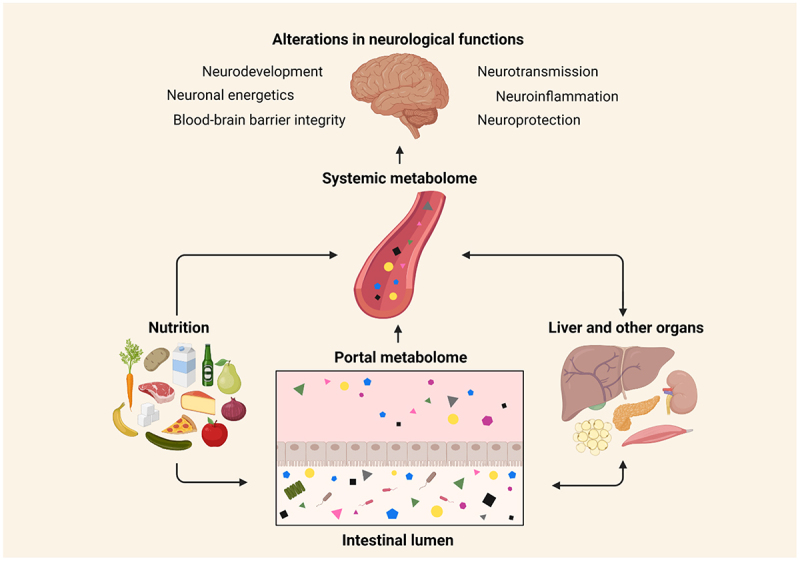
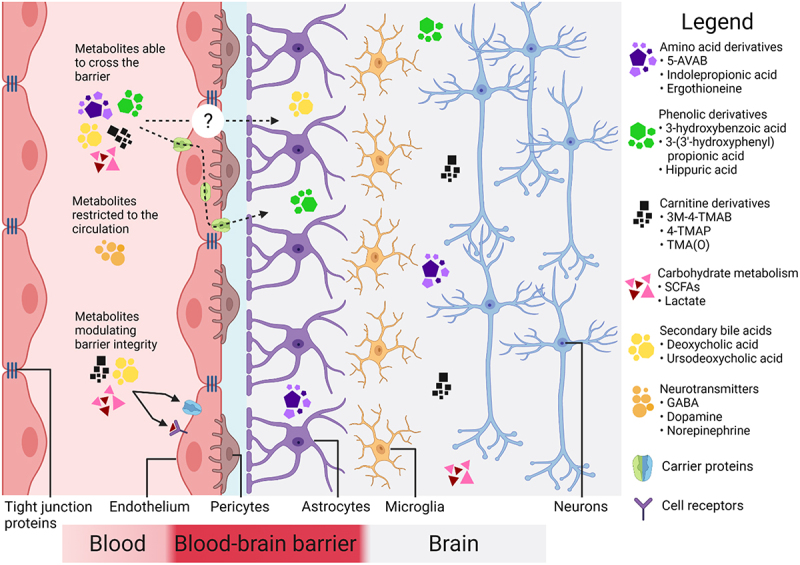
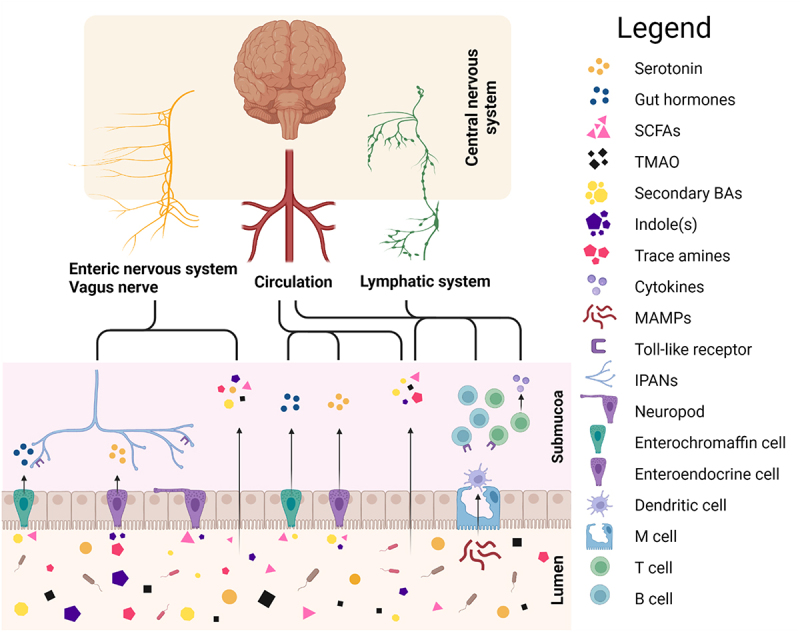
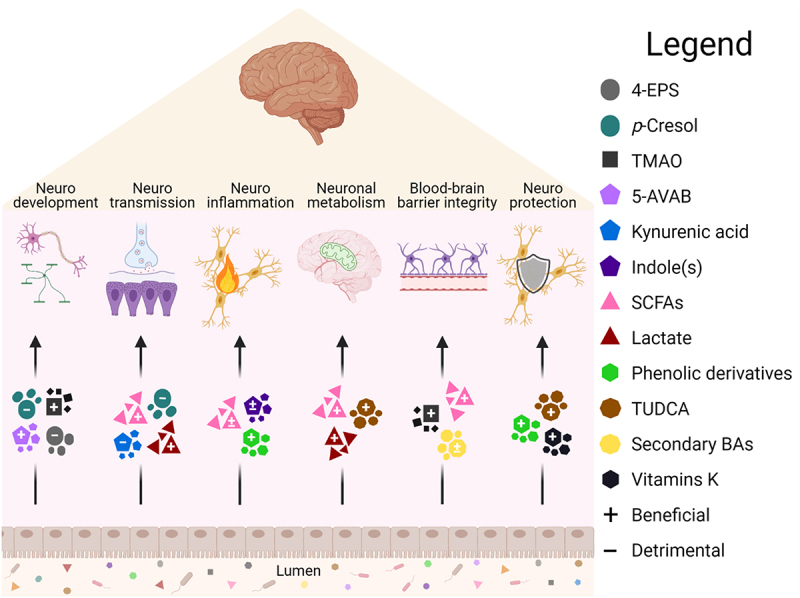
Verification
Claims the paper makes
The claims and statistics of this paper haven’t been checked yet.
Run the check — free, no account needed. It reads the open-access text and checks the sources it cites.
Claims other papers make about this one
Each is checked against this paper’s own text: does it say what the citing paper says it does?
In the citing paper
“Evidence has unveiled the bidirectional communication between the gut microbiome and the central nervous system, referred to as the “microbiota–gut–brain axis”.”
From Microbiota–gut–brain axis and its therapeutic applications in neurodegenerative diseases (2024) · cites this paper as [30]
Self-check
Percentages, sums and reported differences re-computed from the paper’s own numbers.
The self-check needs the paper’s full text.
Citations
Cites
From inflammation to sickness and depression: when the immune system subjugates the brain
Dantzer, R., O'Connor, J. C., Freund, G. G., Johnson, R. W., & Kelley, K. W. (2008) · Nature Reviews Neuroscience · doi:10.1038/nrn2297 · Cited by 7,395
Neuroinflammation in Alzheimer's disease
Heneka, M. T., Carson, M. J., Khoury, J. E., Landreth, G. E., Brosseron, F., Feinstein, D. L., Jacobs, A. H., Wyss-Coray, T., Vitorica, J., Ransohoff, R. M., et al. (2015) · The Lancet Neurology · doi:10.1016/s1474-4422(15)70016-5 · Cited by 6,226
The Microbial Metabolites, Short-Chain Fatty Acids, Regulate Colonic T reg Cell Homeostasis
Smith, P. M., Howitt, M. R., Panikov, N., Michaud, M., Gallini, C. A., Bohlooly-Y, M., Glickman, J. N., & Garrett, W. S. (2013) · Science · doi:10.1126/science.1241165 · Cited by 5,413
Cryan, J. F., O'Riordan, K. J., Cowan, C. S. M., Sandhu, K. V., Bastiaanssen, T. F. S., Boehme, M., Codagnone, M. G., Cussotto, S., Fulling, C., Golubeva, A. V., et al. (2019) · Physiological Reviews · doi:10.1152/physrev.00018.2018 · Cited by 5,286 · cited 2×
“Similar to enterochromaffin cells, colonic L cells are activated by microbial metabolites, such as SCFAs and secondary bile acids among others.(188) The L cells produce bioactive peptides such as GLP-1 and PYY both known for their local effects on gut motility and secretion, and central effects on food intake and feed…”
BackgroundMetabolites produced by commensal bacteria promote peripheral regulatory T-cell generation
Arpaia, N., Campbell, C., Fan, X., Dikiy, S., van der Veeken, J., deRoos, P., Liu, H., Cross, J. R., Pfeffer, K., Coffer, P. J., et al. (2013) · Nature · doi:10.1038/nature12726 · Cited by 4,838
Interaction between microbiota and immunity in health and disease
Zheng, D., Liwinski, T., & Elinav, E. (2020) · Cell Research · doi:10.1038/s41422-020-0332-7 · Cited by 3,947
Bravo, J. A., Forsythe, P., Chew, M. V., Escaravage, E., Savignac, H. M., Dinan, T. G., Bienenstock, J., & Cryan, J. F. (2011) · Proceedings of the National Academy of Sciences · doi:10.1073/pnas.1102999108 · Cited by 3,888
Gut microbiota regulate motor deficits and neuroinflammation in a model of Parkinson's disease
Sampson, T. R., Debelius, J. W., Thron, T., Janssen, S., Shastri, G. G., Ilhan, Z. E., Challis, C., Schretter, C. E., Rocha, S., Gradinaru, V., et al. (2016) · Cell · doi:10.1016/j.cell.2016.11.018 · Cited by 3,622
Indigenous bacteria from the gut microbiota regulate host serotonin biosynthesis
Yano, J. M., Yu, K., Donaldson, G. P., Shastri, G. G., Ann, P., Ma, L., Nagler, C. R., Ismagilov, R. F., Mazmanian, S. K., & Hsiao, E. Y. (2015) · Cell · doi:10.1016/j.cell.2015.02.047 · Cited by 3,614
Host microbiota constantly control maturation and function of microglia in the CNS
Erny, D., Hrabě de Angelis, A. L., Jaitin, D., Wieghofer, P., Staszewski, O., David, E., Keren-Shaul, H., Mahlakoiv, T., Jakobshagen, K., Buch, T., et al. (2015) · Nature Neuroscience · doi:10.1038/nn.4030 · Cited by 3,569
Cited by
Sorted by citations
Microbiota–gut–brain axis and its therapeutic applications in neurodegenerative diseases
Loh, J. S., Mak, W. Q., Tan, L. K. S., Ng, C. X., Chan, H. H., Yeow, S. H., Foo, J. B., Ong, Y. S., How, C. W., & Khaw, K. Y. (2024) · Signal Transduction and Targeted Therapy · doi:10.1038/s41392-024-01743-1 · Cited by 1,193
Microbiota–neuroepithelial signalling across the gut–brain axis
Ohara, T. E., & Hsiao, E. Y. (2025) · Nature Reviews Microbiology · doi:10.1038/s41579-024-01136-9 · Cited by 147
Zhao, Q., Chen, J., Wu, M., Yin, X., Jiang, Q., Gao, H., & Zheng, H. (2023) · Chemico-Biological Interactions · doi:10.1016/j.cbi.2023.110638 · Cited by 49
Gut-brain axis in the pathogenesis of sepsis-associated encephalopathy
Wang, X., Wen, X., Yuan, S., & Zhang, J. (2024) · Neurobiology of Disease · doi:10.1016/j.nbd.2024.106499 · Cited by 47
Jaric, I., Voelkl, B., Clerc, M., Schmid, M. W., Novak, J., Rosso, M., Rufener, R., von Kortzfleisch, V. T., Richter, S. H., Buettner, M., et al. (2022) · PLoS Biology · doi:10.1371/journal.pbio.3001837 · Cited by 32
Zhang, X., Wang, H., Kilpatrick, L. A., Dong, T. S., Gee, G. C., Labus, J. S., Osadchiy, V., Beltran-Sanchez, H., Wang, M. C., Vaughan, A., et al. (2023) · Nature Mental Health · doi:10.1038/s44220-023-00134-9 · Cited by 20
Psychobiotics in mental health: insights from human clinical trials via the gut-brain axis
Sisubalan, N., Kesika, P., Sivamaruthi, B. S., & Chaiyasut, C. (2026) · Frontiers in microbiology · doi:10.3389/fmicb.2026.1804560 · Cited by 4
“Among these interactions, the relationship between the gut and the brain is particularly prominent and is mediated through interconnected signaling pathways collectively known as the gut-brain axis (Ahmed et al., 2022).”
Metadata
- Authors
- Ahmed, H., Leyrolle, Q., Koistinen, V., Kärkkäinen, O., Layé, S., Delzenne, N., & Hanhineva, K.
- Affiliations
- University of Turku (FI)
- UCLouvain (BE)
- University of Eastern Finland (FI)
- Université de Bordeaux (FR)
- Corresponding author
- Ahmed, Hany
- ORCID
- Venue
- Gut Microbes
- Publisher
- Informa UK Limited
- Published
- 2022-07-28
- Volume
- 14
- Issue
- 1
- Pages
- 2102878-2102878
- ISSN
- 1949-0976 (ISSN-L)
- 1949-0984
- PMC
- PMC9341364
- OpenAlex
- W4288436705
- Cited by
- 462
- References
- 208
- Citations by year
- 2026: 135 · 2025: 161 · 2024: 110 · 2023: 48 · 2022: 7
- FWCI
- 26.69
- Type
- journal article
- Language
- en
- Open access
- gold
- doi.org
- Licence
- Locations
- Gut Microbes (publishedVersion, cc-by)
- PubMed Central (publishedVersion, cc-by)
- PubMed (publishedVersion)
- Oskar-Bordeaux (Universite de Bordeaux) (submittedVersion, cc-by)
- UTUPub (University of Turku) (submittedVersion)
- HAL (submittedVersion, cc-by)
- Digital Access to Libraries (Université catholique de Louvain (UCL), l'Université de Namur (UNamur) and the Université Saint-Louis (USL-B)) (submittedVersion, other-oa)
- DOAJ (DOAJ: Directory of Open Access Journals) (submittedVersion)
- Chalmers Research (Chalmers University of Technology) (submittedVersion)
- Funders
- Academy of Finland ((Grant no 321716))
- Marie Sklodowska-Curie ((Grant no 754412.)
- Région Nouvelle Aquitaine ExoMarquAge ((135059720-13062120))
- The Foundation for Medical Research
- Topics
- Life Sciences › Biochemistry, Genetics and Molecular Biology › Molecular Biology › Gut microbiota and health
- Life Sciences › Neuroscience › Biological Psychiatry › Tryptophan and brain disorders
- Health Sciences › Medicine › Gastroenterology › Gastrointestinal motility and disorders
- Keywords
- gut microbiota, gut microbiota metabolites, gut-brain axis, neurodevelopmental disorders, neurodegenerative diseases, neuropsychiatric disorders, short-chain fatty acids, trimethylamine N-oxide, bile acids, aryl hydrocarbon receptor, autism spectrum disorder, maternal immune activation, blood-brain barrier, brain-derived neurotrophic factor, germ-free mice
- MeSH terms
- Autism Spectrum Disorder, Gastrointestinal Microbiome, Brain, Fatty Acids, Volatile, Humans, Amyloid beta-Peptides
About these checks
Registry, retraction, Cites and statistics results are computed, not judged, with one exception: a printed reference that no index lists is read once by a model before it counts as a citation error. Claims are extracted by a model and kept only when their quote appears verbatim in the text; each cited source is then checked, with a model’s help, for whether it says what the claim relies on. Those verdicts can be wrong — read the claim’s quote and the cited source before relying on one.
Statistics and arithmetic are recomputed, not judged.
Confidence bands are shown only for fields calibrated on our annotated test set. None is calibrated yet, so no band is shown.
What counts as a claim ›How we measure confidence ›How we check this ›
Are you an author, or do you see a problem with this page? Request a review
